Showing posts sorted by relevance for query MODERNIST. Sort by date Show all posts

Saturday, August 27, 2022

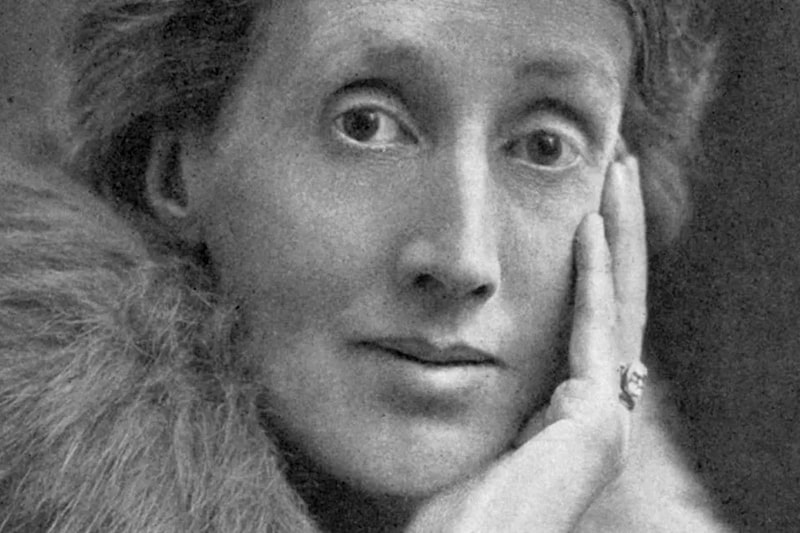
The Centre for Modernist Cultures recognises Stuart N. Clarke for decades of work on Virginia Woolf

We are very glad to announce that Stuart N. Clarke has been made an Honorary Fellow of the Centre for Modernist Cultures in recognition of his exceptional contribution to the study of Virginia Woolf. Clarke co-founded the Virginia Woolf Society of Great Britain in 1998 and served as editor of the Virginia Woolf Bulletin for 23 years before stepping down in 2022. His work as a distinguished textual editor includes volumes 5 and 6 of The Essays of Virginia Woolf (Hogarth Press, 2009 and 2011), A Room of One’s Own with David Bradshaw (Shakespeare Head Press, 2015), and Jacob’s Room for The Cambridge Edition of the Works of Virginia Woolf (Cambridge University Press, 2020).

CMC member Alexandra Harris comments:

The Virginia Woolf Bulletin is a remarkable phenomenon, closer to a full-scale journal than its title modestly implies, though it’s a rare journal that brings previously unpublished primary sources into print with each and every issue. No fewer than seventy Bulletins (cause for alternative platinum jubilee celebrations) have opened with a group of uncollected Woolf letters or other writings, meticulously researched and edited by either Stuart or his long-term collaborator Stephen Barkway. Bulletin 65, for example, arrived in September 2020 despite the lockdowns, containing the texts of 102 letters and cards from Woolf to Mary Hutchinson, familiar only to the few scholars who had read them at the Harry Ransom Centre. With his encyclopaedic knowledge and well-honed methods of literary detection, Clarke had managed to date and contextualize even the most elusive scraps.

The Bulletin was established as a ‘forum for all varieties of common readers’ and has proceeded on the understanding that such readers are likely not only to be passionate but exacting and widely-informed. The tone is set by Clarke’s style and critical approach: no gush, no first-name-terms with Virginia, precise and closely-evidenced writing with the occasional dash of irony, and always an emphasis on primary material.

Clarke himself has remained determinedly an independent scholar, sharing Woolf’s confidence in the vitality of serious reading outside the particular frameworks of university English studies, and reminding us all that professional academia is only one of the many contexts in which ground-breaking literary scholarship is pursued. At the same time, Clarke has worked in collaboration with many academics, and in particular with the late, much-missed David Bradshaw. Clarke and Bradshaw were united in their conviction that the dense weave of allusion, association, and historical reference in Woolf’s writing repays the kind of attention that had previously been accorded to the work of Joyce, Eliot, and Shakespeare but not Woolf.

Clarke’s assiduous tracing of references has been especially significant in establishing the extent and complex character of Woolf’s political engagement. In far-reaching work on Jacob’s Room he probed Woolf’s depiction of the ‘dominant culture’, its figures of authority, and the fate of individual bids for freedom. Delivering the Annual Virginia Woolf Birthday Lecture in 2019, Clarke concentrated on Woolf’s letters to the press (a full catalogue of which he compiled), particularly those concerned with the most effective forms of resistance to fascism.

As editor of the final two volumes of the six-volumes Essays, Clarke gave to readers the inestimable gift of the essays and reviews written by Woolf between 1929 and 1941, judiciously footnoted and chronologically ordered, in a format to be held in the hand and read from cover to cover, as well as to be repeatedly consulted. Many essays had not been in print since their first appearance in 1930s newspapers; some had not been published at all, and some existed in widely varying drafts (Clarke presented the different texts for comparison). Here is the long and challenging 'Phases of Fiction', the drafts of Woolf’s late history of literature, a fantasised letter to ‘A Lady in Paraguay’, and Peter the Porpoise pursuing his own untold quest around the aquarium at Brighton.

Clarke’s ample and scrupulous annotations have helped to set the standard for contemporary editions of Modernist texts. His method has long been to set out information that might be significant and let readers make up their own minds. Students, scholars, and common readers will indeed be making up their own minds for decades to come. The Modernist Studies community is much in Clarke’s debt.

Saturday, December 31, 2022

 Selfie Girls Women Woman Indonesia Asian Hijab Ramadhan Muslim

By 

By Alexander R Arifianto*


In 2022, two leading moderate Indonesian Islamic figures, Ahmad Syafii Ma’arif and Azyumardi Azra, passed away. With their departure, Indonesia’s Islamic discourse lost two moderate voices.

As chairman of Muhammadiyah — Indonesia’s second largest Islamic organisation — Ma’arif was instrumental in promoting theological reforms. Between 1998 and 2005, Ma’arif reoriented Muhammadiyah’s theological outlook from a rigid, conservative direction towards one that is progressive and compatible with Indonesia as a multicultural, religiously diverse and democratic nation.

Ma’arif’s passing marked the death of one of the last Indonesian neo-modernist Islamic thinkers. Neo-modern Islam arose alongside the movement of theological reformers who became prominent Muslim intellectuals from the 1970s to the 1990s. Neo-modernist figures such as Nurcolish Madjid, Dawam Rahardjo and Abdurrahman Wahid became founders and spokespersons of the moderate Islamic movement in Indonesia.

Azra was an Islamic thinker who promoted Islam’s compatibility with modernity and democracy while condemning violent extremism. As Syarif Hidayatullah State Islamic University president, Azra instituted a curricular reform that trained a new generation of Islamic studies scholars who shared his passion for a moderate and inclusive Indonesian Islam.

Their passing has left a gap to fill in Indonesia’s moderate Islamic movement, which is has been threatened by a conservative Islamic resurgence over the past decade. There are few moderate figures with similar levels of moral authority and influence over the Indonesian Muslim community compared to those of the neo-modernist reformers.


There are several reasons why conservative Islamists increasingly challenge moderate Islam in Indonesia. First, moderates are losing ground when competing against popular Islamist preachers to promote their ideas on social media and other outlets.

In a highly competitive market of religious ideas in post-Reformasi Indonesia, Islamist groups have been steadily growing and attracting followers and sympathisers among Indonesian Muslims — particularly among younger Indonesians. For example, the Indonesian Muslim Students Action Union (KAMMI)’s campus preaching organisation — the youth wing of the Islamist Prosperous Justice Party (PKS) — is a primary point of contact to recruit new members.

Social media platforms like Facebook, Twitter and Instagram have also promoted the rise of popular charismatic yet theologically conservative Islamic preachers. These include Abdul Somad (a traditionalist Islamic cleric), Hanan Attaki (founder of the Salafi-influenced Hijrah Youth Movement) and Felix Siauw (loosely connected with Hizbut Tahrir Indonesia (HTI) – an organisation which calls for the Indonesian state to be transformed into a global Islamic caliphate). Each command popular appeal among Muslim youth on social media outlets like Instagram.

Second, many moderate intellectuals who become staff and policy advisers to Indonesian government ministries and agencies tend to defend government policies instead of speaking out against them — unlike their neo-modernist predecessors.

These include Ulil Abshar Abdalla, an intellectual successor of Abdurrahman Wahid within Nahdlatul Ulama (NU)who became a Democratic Party legislative candidate in 2014 and 2019. And, Raja Juli Antoni, a Ma’arif protege who became an Indonesian Solidarity Party (PSI) politician and was recently appointed as a deputy minister for land and spatial planning.

Several young NU intellectuals were also recently appointed to various government positions. For instance, Zuhairi Misrawi — a former spokesperson to Indonesian President Joko ‘Jokowi’ Widodo — was appointed as Indonesia’s ambassador to Tunisia in 2021. Rumadi Ahmad — chairman of Lakpesdam (a semi-autonomous NU institution that promotes interfaith dialogue) — is now a staff member within the Executive Office of the Indonesian President.

Islamist-leaning groups and preachers dominate the breach in religious preaching (da’wa) that the departure of these intellectuals from religious activism to politics creates — particularly around preaching targeted towards Indonesia’s youth. While the government has tried to level the playing field through its ‘religious moderation’ program, which promotes semi-official moderate Islamic preaching, youth da’wa continues. Yet many da’wagroups are shifting underground due to the legal prohibition against groups such as HTI.

The appointment of moderate NU intellectuals to various government positions is adding to the perception that the organisation is closely aligning itself with Jokowi’s government. This raises concerns that NU intellectuals may not speak out against the practices of Jokowi’s government. It combats Islamists with repressive measures used in former Indonesian president Suharto’s era and by enacting legislation curtailing free expression, like the recently enacted Indonesian Criminal Code Law.

This is an unfortunate situation given that Azra, Ma’arif and other neo-modernist thinkers have a long reputation for defending freedom of expression and speaking out against unjust legislation — both during the Suharto and post-Reformasi periods.

As Indonesia’s democratic backsliding continues, it is more important than ever for moderate Islamic intellectuals who are inspired by their predecessors to boldly share their pluralist and pro-democratic vision in Indonesia’s public sphere.

*About the author: Alexander R Arifianto is a Research Fellow in the Indonesia Programme at the S Rajaratnam School of International Studies (RSIS), Nanyang Technological University, Singapore.


Source: This article was published by the East Asia Forum


East Asia Forum

East Asia Forum is a platform for analysis and research on politics, economics, business, law, security, international relations and society relevant to public policy, centred on the Asia Pacific region. It consists of an online publication and a quarterly magazine, East Asia Forum Quarterly, which aim to provide clear and original analysis from the leading minds in the region and beyond.

Sunday, December 25, 2022


SMOKERS’ CORNER: REINVENTED HISTORIES AND COMMUNITIES
Published December 25, 2022
Illustration by Abro

The day after the founder of the modern Turkish republic, Kamal Ataturk, passed away in November 1939, a leading Urdu daily in pre-Partition India, Inquilab, reported that Ataturk, who had slipped into a coma, briefly woke up to convey a message to a servant of his.

According to the report, Ataturk instructed his servant to tell the ‘millat-i-Islamiyya’ [the Islamic nation] to follow in the footsteps of the ‘Khulfa-i-Rashideen’ [the righteously guided caliphs]. After saying this, he passed away.

In 1988, the Islamic scholar Dr Israr Ahmad claimed that, according to one of Muhammad Ali Jinnah’s doctors, the founder of Pakistan during his last moments spoke about the importance of imposing Shariah laws. Both claims have been rubbished by most historians. However, as late as in May 2019, the then prime minister of Pakistan Imran Khan was circulating the second claim as a fact. All three cases can be understood as examples of ‘presentism’ and ‘invented tradition’.

Presentism, as a sociological term, refers to concocting a past that validates one’s political beliefs in the present. Presentism can also lead to invented tradition. The latter is about traditions that are posited as being old, but are actually recent inventions.


Politicians and ideologues often make use of invented traditions and presentism — concocting a past that validates one’s political beliefs in the present

Presentism and invented tradition are often used to construct national communities. Both are applied to forge a set of invented memories and traditions that a group of people are encouraged to embrace, so that they could become a community with a shared ‘history’.

Although not more than 24 hours had lapsed between Ataturk’s demise and the appearance of the aforementioned report in Inquilaab, this can still be understood as a case of presentism. At the time, India was in the midst of an evolving political battle between Muslim nationalists, Indian nationalists and Hindu nationalists. The ‘modernist’ faction of Muslim nationalism had hailed Ataturk when he abolished the Ottoman caliphate in 1924.

However, the counter-modernist faction, which had begun to advocate the creation of an ‘Islamic state’, felt uneasy about Ataturk’s secularisation project. When Ataturk was about to launch his project, he critiqued the idea of the caliphate by pointing out the presentism in it. He declared that, “the notion of a single caliph exercising religious authority over all Muslim people was only in books, not in reality.”

By books he meant theories that were attempting to justify the revival of the caliphate as if it were an ancient tradition. The fact is, just decades after Islam emerged in 7th century CE, its political system had become entirely monarchical. After the mid-7th century, the caliph was a monarch in every sense.

In the books that Ataturk was referring to, presentism and invented tradition had come together to claim that the Ottoman caliphate was a continuation of an unbroken chain of caliphs who first emerged in the first half of the 7th century. This was a concoction. Ottomans were nothing of the sort.

So Inquilaab had to go out of its way to refigure Ataturk as a man who suddenly realised his folly of secularising Turkey. Dr Israr’s similar claim regarding Jinnah came when the Ziaul Haq dictatorship had been trying to remould the founder of Pakistan as a late-blooming Islamist ideologue.

In reality, Jinnah was entirely secular in his habits. He claimed to be working towards the creation of a Muslim-majority country to safeguard the economic and political interests of India’s Muslims from the hegemonic designs of India’s upper-caste Hindus. But he detested theocracy.


Indeed, the modernist Muslim nationalism that Jinnah adopted also contained presentism. This presentism claimed that modern economic and political ideas, which the Europeans had introduced, were already embedded in Islam. This presentist notion freed 19th and 20th century Muslim reformers to adopt modernity.

This is why most counter-modernists were opposed to Jinnah. Nevertheless, their own use of presentism and invented tradition went deeper. Ironically, the counter-modernists too were a product of modernity. For example, when they began to speak of an Islamic state, they borrowed heavily from theorists who helped build the concept of the modern state.

The state as we know it today is a European construct, not more than 300 years old. And the concept of the Islamic state is an entirely 20th century concept. It emerged in the first half of the 20th century to counter the idea of the modern Muslim nation-state. The counter-modernists understood the nation-states as a Western concept and constructed the idea of the Islamic state as an alternative.

They lamented that there was no room for a nation-state in Islam nor do the faith’s scriptures allow it. Their critics retorted by pointing out that nowhere do the scriptures speak of an Islamic state as well. They called out the presentism and invented tradition that the advocates of the Islamic state were using.

The modernists insisted that the scriptures were a moral guide. But the counter-modernists posited that the scriptures not only provided moral guidance, but in them was a political ‘blueprint’ for the construction of a state navigated by pious men, who were to operate as viceregents of God. Thus was born Political Islam.

The modernists rejected this and saw it as a way through which their opponents were politicising the scriptures to grab state power. According to the historian Nicholas P. Roberts, the core of Political Islam rests upon a series of reinvented understandings of traditional Islamic concepts and symbols.

For example, words in the scriptures that are meant to forge social harmony and mindful individual behaviour in a community, are given a political meaning. These words begin to operate like political concepts through which Islamists formulate their contemporary rhetoric.

They validate their current political ideas by suggesting that these ideas were a continuation of a pristine past that had been destroyed by modernity. However, Political Islam itself is an outcome of modernity, no different or older than other modern ideologies such as socialism, nationalism, capitalism, etc. As Roberts puts it, whereas the modernist strand of Muslim nationalism tried to modernise Islam, counter-modernists Islamicise modernity.

In the 1980s, when Zia’s projection of Jinnah as an Islamic ideologue was blown to bits by historians such as Stanley Wolpert and Ayesha Jalal, out came Dr Israr’s claim that, in his dying moments, Jinnah had desired a modern-day caliphate.

This is still believed by those who are faced with the fact that Jinnah was an outright liberal, and a Muslim modernist. Zia and Israr were flexing presentism to validate the state’s shift from the modernist Muslim nationalism of its founders, to adopting a more theocratic strand of this nationalism.

When Imran Khan enthusiastically circulated Israr’s words, he was trying to validate his own image of being a contemporary architect of an ancient pious state.

Published in Dawn, EOS, December 25th, 2022

Friday, April 07, 2006

Classical Rock

During the heyday of the 70's, before Disco melted down the creativity level of music to drum beats and homogonized dance music, and before the rebellion of the three chord reaction to the dumbing down of music, the Punk DIY movement, the stellar sphere of sound was Progressive Rock.

That is rock music that was longer than two or three minute radio spots. Rock Music influenced by Classical music, and by the idea of the 'Concept Album', the idea of creating a symphonic sound out of rock and telling a story where the whole album spoke to a singular idea or theme.

The Who created Tommy a Rock Opera, and later Quadraphenia as less popular rock opera, Jethro Tull had created Thick As A Brick, Yes and Emerson Lake and Palmer integrated organ music and pre-synthesiser sounds.

ELP originated out of King Crimson and the classical music sound of Keith Emerson's earlier band the Nice, which rockified classical and symphonic music through the use of the electric organ, the percursor to the synthesizer. One of Emersons best rock classical albums is entitled the Five Bridges Suite, took several well known classical compositions and Rockified them, sped them up and underscored the basso sound using electric organ and moog synthesizer. The Bridges are tonal overlaps in classical music. Thus Rock music went from pop sound to full symphonic sound.

Tarkus, ELP's second album was a rock version of Hungarian modernist composer Bela Bartok's work without credit. Their third Album was the rock version of Russian modernist Mussgorsky's Pictures at an exhibition.

Moody Blues were one of the first bands to really work with a symphonic orchestra with their first album and hit single, Knights in White Satin.

Deep Purple would follow up with their concept album Deep Purple in Rock which again contained longer 6-9 minute songs, including the hauntingly beautiful Child in Time, recorded like the Moody Blues had, with the London Sympthonic Orchestra.

In Europe Vangelis first concept album with his band Aphrodites Child; 666 was released as an unheard of double album, live recording which was a musical concept album about the Anti-Christ, Babalon and the book of Revelations, which included famed Greek Actress Irene Papas singing the part of Babalon.

My favorite band of this period is Rennaissance, whose rock motifs are based on Russian composers. Russian Classical music by its inherent nature has been and is modernist, daring to create sound poems and aural stories, using themes to tell stories, not merely using the music to express an inner ideal.

Rennaissance picked up on this as the Folk revival was kicking off in England, and as concept albums, the creation of Progressive or Experimental rock, was begining.

I just picked up the live two CD collection of their performances which were released in the late 1990's almost twenty years after their performances were recorded. The complete collection of their work has yet to make it to CD. So look for them on vinal.

I reccomend the link above on Progressive Rock from Wikipedia, though I must say that while they show the progression from the early rock concept bands such as the Yardbirds, from whence Renaissance originated, and which gave birth to such bands as Led Zepplin, they missed one of the most influential of the Classical, Jazz, Rock crossover musicians, who really should be credited with being the father of the concept album and Progressive Rock, none other than Frank Zappa.

His only hit single Peaches in Regalia is a wholy unique and original modern classical piece of instrumental music. Zappa was influenced by the fifties modernist composer Edgard Varese, whose compostion Ameriques is a stunning combination of modern symphonic music and jazz with a continual police siren in the background, and was written in the 1920's!!

Now compare that with Leonard Bernstiens paen to America, West Side Story, and you can see the paths that modern classical/symphonic music was moving towards, where we end up in the seventies with its merger into Progressive Rock.

Varese and Zappa created tone poems, and Zappa was as egotistical an orchestra leader as ever one could find in the Classical realm. In fact his clashes with that other symphonic egotist, conductor Zubin Meta (whose 1812 Oveture with small live cannons is still the ne plus ultra version of the composition) during 200 Motels is well documented, indeed why Zappa placed Meta and the Los Angeles Philharmonic in a concentration camp setting in his movie. Nasty.

What Zappa has never been given credit for is his guitar playing. He was one of the best guitar players of his generation. And it is perhaps his classical approach to the instrument that deminished the appreciation of his abilities. Becuase he approached his guitar playing like his composing and his leading his band like a conductor, his tightly controled playing did not appear wild, arm swinging, hair flinging, style that was so popular amongst other expressive rock musicians that led to his underappreciation as a guitarist.

What Zappa got from Varese was the concept of the Idee Fixe, "
Some of Edgard Varese's later works make use of the 'Idee Fixe', a fixed theme, repeated certain times in a work. "

Through out his work a common Idee Fixe will appear repeatedly, this is a the very essence of modernist classical music, and Zappa was not only a Rock and Roll guitarist but the very essence of a modern classical composer.

By the 1980's Progressive rock was having a well deserved revival in the works of Genesis, the Quebec band Harmonium, the electronic works of Vangelis, and his team up Jon Anderson former lead singer of Yes, to create thematic concept albums like the Friends of Mr. Cairo, heralded the return of the concept album and the revival of Progressive Rock.

The Alan Parsons Project overlapped many of the concept albums coming out in the eighties, where Parsons had worked with folk musicians like Al Stewart, again there is the connection between the English Folk revival and Progressive Rock, and Pink Floyd, before coming out with his own Concept ablums with the Project.

But it was short lived revival as the ninties diminished all new sound into a wave of unoriginal remastering of 'found' sounds and the diminuation again of music to the drum beat machine staccato of Hip Hop.

Underscoring all this is the continual return to the classical roots of music, its symphonic sound, that ability to layer sound to create depth and imagery. Whether it was with the eight track revolution of the Beatles sound on Sgt. Peppers or the Rolling Stones Their Satanic Majesty's Request, both concept albums, or with the later use of synthesizer, the progressive sound in rock was its imitation of and merger with symphonic music.

As Bakunin once joked when asked if his anarchist revolution would get rid of all culture, he replied, "No we will keep Beethoven's 5th." It was the progressive and radical music of its day. An elegy to human reason. As it remains today.

Reason to Rock: Rock Music as Art Form
A Web Book by Herb Bowie


Find blog posts, photos, events and more off-site about:
, , , , , , , , , , , , , , , , , , , ,

Friday, May 21, 2021

LEFT BOLSHEVISM
The Stofflichkeit of the Universe: Alexander Bogdanov and the Soviet Avant-Garde

Prelude: Towards an Alternative Philosophical Genealogy of the Soviet Avant-Garde

Maria Chehonadskih
e-flux
Journal #88 - February 2018

One of the most discussed concepts of the Soviet avant-garde—variously characterized as “construction,” “tectonics,” “production,” or “life-building”—may seem to refer simultaneously to the formalist method in art and to a theory of social constructivism that departs from the idea of the “new Soviet man” and ends up with Stalin’s “engineers of the human soul.” The simultaneity of formalism and social constructivism normally explains the coexistence of the constructivist aesthetic program and the utilitarian politics of productivist art. As Benjamin Buchloh writes, constructivism passes from the expanded modernist aesthetics that “did not depart much further from the modernist framework of bourgeois aesthetics than the point of establishing models of epistemological and semiotic critique,” to the new industrialized forms of art.1 Optimism about technology and media leads constructivists to totalitarian Stalinism.2 Yve-Alain Bois goes so far as to argue that the total instrumentalization of art is inevitable when the critical modernist tradition is abandoned.3 In other words, the great achievements of the Soviet avant-garde conform to the standards of European modernist epistemologies, while utilitarian aesthetics and its function in the context of Stalinism signifies a break or a black hole, which the narrative of art history can only explain by turning to ethical and moral arguments against propaganda and instrumentalization. An alternative proposition would be to examine the philosophical core of the constructivist and productivist programs and rethink their epistemological foundation.

The confusion regarding the constructivists’ construction and the productivists’ production comes from a false genealogical attribution of these concepts to formalism and social constructivism. What has to be accounted for, and what is normally ignored, is the background of what I term “Empirio-Marxism.” The interest in empiricism among the pre- and postrevolutionary Marxists of the Russian Empire and the Soviet state is mainly known though Lenin’s famous Materialism and Empirio-Criticism, the book in which he accuses Bolshevik activist and philosopher Alexander Bogdanov of deviating from Marxism and of providing reactionary support for idealist philosophy.4 Indeed, Bogdanov brings together the notorious empiriokritizismus and the early Bolsheviks’ understanding of Marx to first propose the philosophy of “empiriomonism” (1900s)5 and then the universal science of organization, or “tektology” (1910s).6 Both doctrines correspond to the political idea of proletarian culture, implemented in the Proletkult (Proletarian Cultural-Enlightenment Organizations) movement after the October Revolution in 1917. Bogdanov, a principal theoretician of the movement, develops a conception of experience as a homogeneous field of collective praxis.

This is not an obvious reference point in relation to Russian avant-garde artists, since in their work there is no consistent presence of the problem of experience. There are no overt references to empiricism, Mach, or Bogdanov in the published archive of the Soviet avant-garde. It was more common to praise Lenin, and one can easily recall Dziga Vertov’s “Three Songs About Lenin” or Alexander Rodchenko’s “Worker’s Club,” with a portrait of the leader of the proletariat on a wall. Nonetheless, Empirio-Marxism was a very popular local tradition and Bogdanov had a greater intellectual authority in the art community due to his establishment of Proletkult. There are no official portraits of Bogdanov, but his philosophy in fact populates every single art-related book. This has been acknowledged only in Soviet publications, where avant-gardism is associated exclusively with Bogdanov’s ideas and political views.7 Nevertheless, it is also a very well-known fact that writer and engineer Andrei Platonov was a member of the Proletkult,8 and that the main theorist of productivist art, Boris Arvatov, worked as secretary of the Moscow Proletkult, while Rodchenko, Tretyakov, and Eisenstein, among others, collaborated with Proletkult studios.9 This fact has never led English-speaking theorists to examine closely Bogdanov’s philosophy or at least to consider Proletkult as an important intellectual and political reference. What I aim to discuss here is to what extent Bogdanov’s philosophy mediates methodologies of constructivism and productivism, and how these movements in turn radicalize and shift the philosophical and political claims of Bogdanov and the Proletkult.
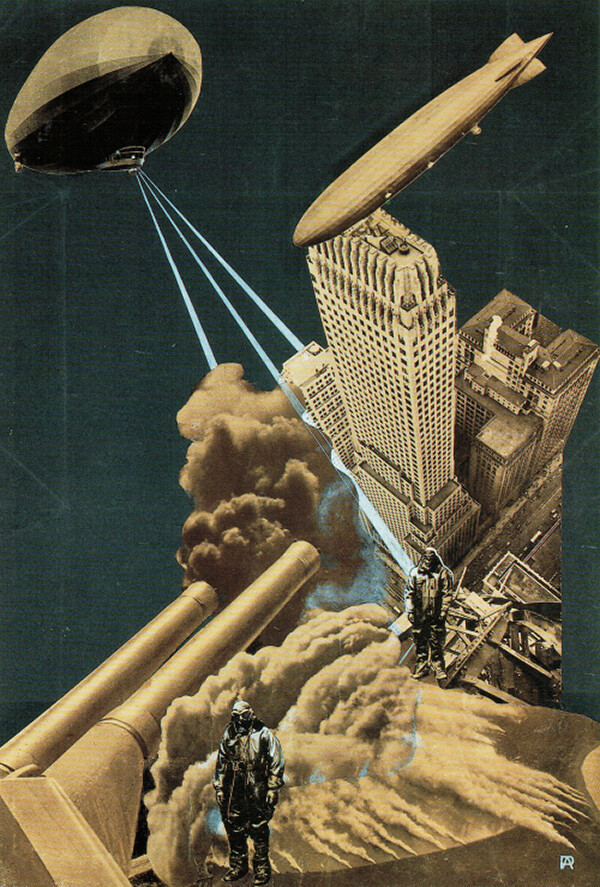
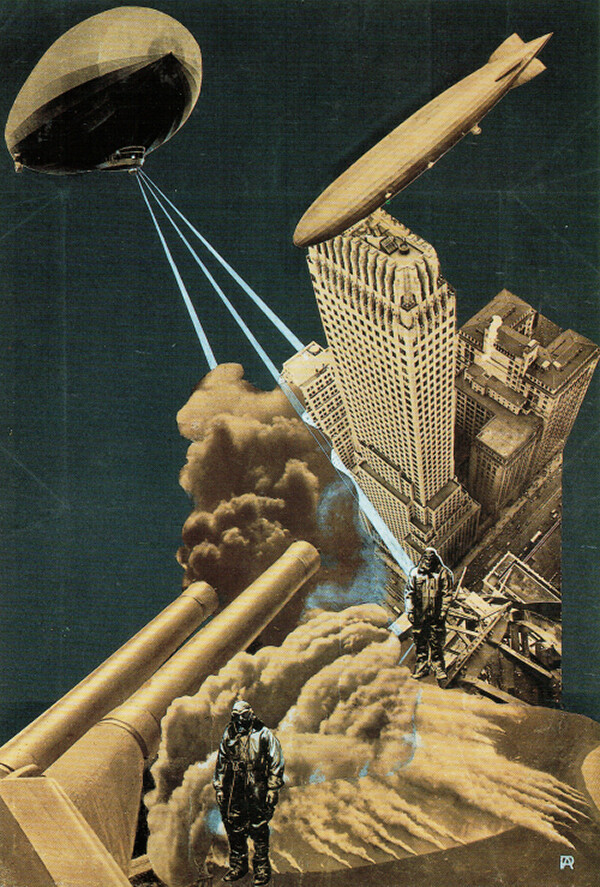
Alexander Rodchenko, War of the Future, 1930. Magazine illustration.


Bogdanov’s Ontology of Organization and the Art of World-Building


Bogdanov’s conception of organization rests on a basic empiricist assumption that experience of the outside world is given to us in the conjunctions of an object’s attributes. The decomposition of these attributes gives elementary sensations of space, time, color, form, and size. However, the elements of experience are sensations only in psychical reality, whereas the same elements may belong to physical bodies as attributes—the squareness and redness of a brick are the sensual, perceptible, physical properties of this object.10 The connection between the psychical and physical realms should be understood as a complex unity that unfolds as an exchange of sensations and properties within an environment that is itself neutral to this subject-object distinction. In other words, there is no sovereignty of a knowing subject who reflects on objects outside it, because there is no outside. This subject is already an object, a complex product of exchanges between physical and psychical elements. Ontologically, this exchange produces a series of “life-complexes” (forms of life, including social forms); and epistemologically, it constitutes a monist point of view on the otherwise heterogeneous self-organizing flow of psychical and physical concatenations: “The universe presents itself to us as an endless flow of organising activity. The ether of electrical and light waves was probably that primeval universal environment from which matter with its forces—and later on also life—crystallised.”11

Bogdanov’s empiriomonism tends to reformulate the biological and the social in terms of the organizational logic of psychophysical complexes. Taken as isolated entities, psychic and physical complexes exist in a pure state of spontaneity, or the lowest level of organization. This spontaneity preserves higher organizational forms only in analysis and in the practical composition of the elements into new series. A rock is a spontaneously formed physical combination of minerals, and fear is a spontaneously formed psychical combination of stimuli and reaction. But the fear of wild animals that leads to the construction of a house made out of rock is a product of a higher psychophysical organization.

As we can see, the psychophysical complexes are constructed first in labor activity. In the wake of the rise of labor technics, the sum of the elements grows, but their usage depends on “technical and cognitive goals.”12 The laboring subject appeals either to actions or to the attributes of objects out of necessity. Splitting and crushing, for example, led to the invention of the concept of the atom.13 Labor’s use of the elements of experience—be it a rock in construction, or ore in industry, or oil in painting, or the concept of the atom in philosophy—corresponds to use value, on the grounds that it emerges from a social need to distinguish and differentiate experience in order to develop production—domestic, industrial, scientific, or artistic. In Bogdanov, use value appears as an ontological principle of usefulness, and value as an essentially vitalist quality.14 This process of extracting, shaping, and composing the elements of experience into life-complexes, Bogdanov identifies with Marxian Verdinglichung (reification).15

This means that the object, or rather the organization of objects, is a historically produced system of relations. The ready-made object is the work in progress of laboring humanity:

The practice of this great social organism is nothing other than world-building … This world, which has been constructed and continues to be under construction … is the most grandiose and perfected that we know … Such is our picture of the world: an unbroken series of forms of organization of elements—of forms that develop in struggle and interaction without any beginning in the past, without any end in the future.16

Any kind of social practice is the labor of organization, or the labor of world-building. That is why Bogdanov’s theory of art corresponds to the same organizational ontology:

Artistic creativity, combined and often alloyed with cognition, as may be seen in many pieces of belles-lettres, poetry and painting, organizes understanding, feelings and emotions by its own methods. In art the organization of ideas and the organization of things are inseparable. For instance, an architectural construction, a statue, or a painting as they are, might be regarded as systems of “dead” elements—of stone, metal, canvases and paint; but the lively meanings of pieces of art belong to the complexes of images and emotions to which they give life in a human psyche.17

Art is one of the many forces within the logic of organization. However, only collectivized proletarian labor produces the art of total organization. The proletariat brings elements of the “lowest” life in nature and “unconscious” life in society to the noncontradictory and rational form of psychophysical unity. Bourgeois culture is based on competition and exploitation, and as a result, on the production of conflicting partial systems. To make an exit from partial irrational systems, such as capitalism, would mean to construct a new totality; some names for this new totality are “universal organization,” “classless society,” and “proletarian culture.” The highest degree of organization is a homogeneous wholeness based on unified industrial labor, solidarity, comradeship, and collectivization.18
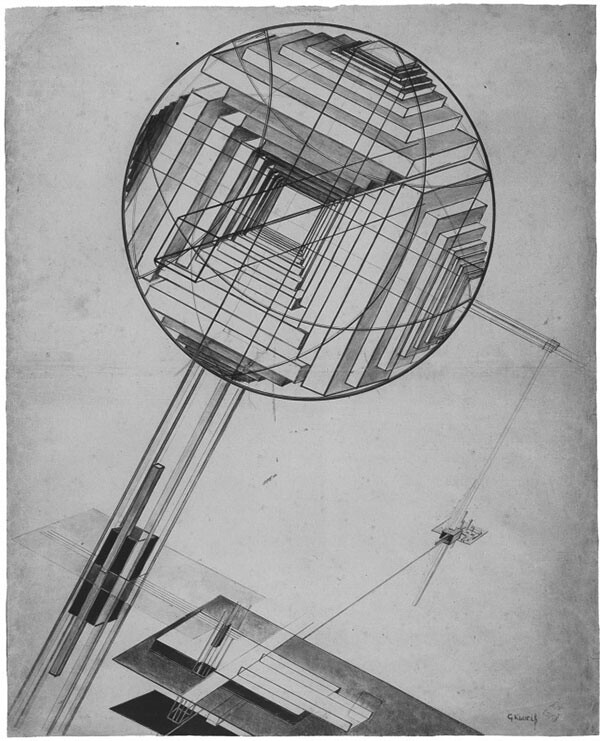
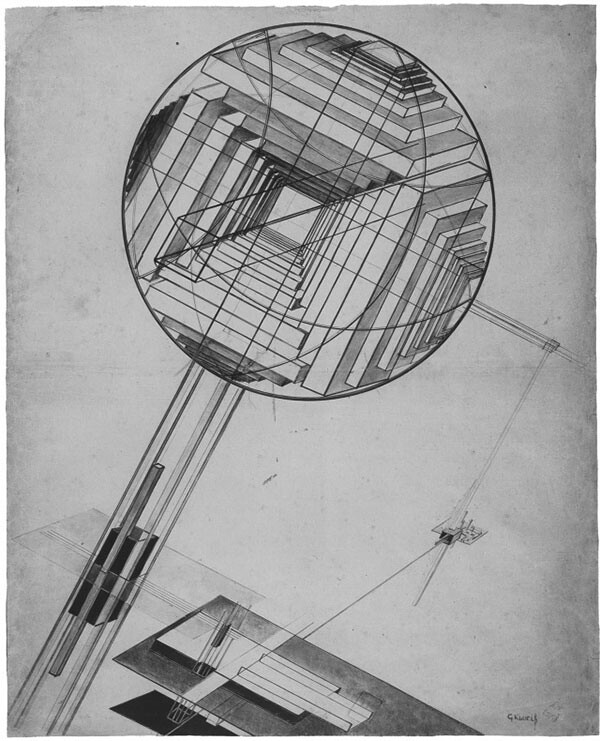
Gustav Klutsis, Construction, 1921.

World-Building Abolishes Art: Construction, Production, and Organization in the Avant-Garde


It is not hard to see how Bogdanov’s world-building is close to the productivist figures of the “life-builder” and “engineer-constructor.” Art is a labor of shaping and composing an object according to the usefulness of a color and a form, writes Osip Brik.19 In the manifesto “Constructivism,” Alexei Gan provides a three-page-long quotation from Bogdanov to support an argument about the importance of organization and production. Gan claims that material production replaces representational art. This new mode of production saves the “solid material and formal foundations of art, such as line, flatness, volume, and action,” along with the purposeful activity of “materialistically grounded” artistic labor. Constructivism is Bogdanov’s organizational science, which seeks a form of “organization and cementation for the mass labor processes, mass actions in the whole of social production.”20 This may lead to the conclusion that the three famous disciplines of constructivism—construction, facture (faktura), and tectonics—fully correspond to the principles of organization. It has even been argued that tectonics is a cipher for tektology.21 Bogdanov’s philosophy seems to be foundational, and one can read the theory of constructivism back into empiriomonism and tektology: faktura is the process of extracting and manufacturing the elements of nature, while construction is the aggregation of the complexes of elements into a purposeful organizational plan—tectonics. The organizational point of view appeals to Nikolai Chuzhak as a grandiose cosmogony of all-embracing life-building:


People who look at art from the point of view of communist monism inevitably come to the conclusion that art is only a quantitatively individual, temporary, and predominantly emotional method of life-building, and, as such, cannot remain isolated, or what is more, self-sustaining compared with other approaches to life-building.22

A similar Bogdanovian detour into the various currents of art practice, albeit more grandiose still, was that of the Proletkultist Boris Arvatov. In Art and Production, at once a presentation of research and an energetic manifesto, the history of art is shown to unfold within the terms of Bogdanov’s history of labor. According to this narrative, art has always been a part of production: for instance, crafts, frescos, and architecture served the everyday needs of premodern societies. However, under the rule of capitalism, art becomes instead an individualistic, self-organizing activity. Easel painting is one significant example of the contemplative representational function of art in bourgeois society. Arvatov seeks the new forms of a “proletarian monism” in which the productive capacity of art to shape the environment can be restored.23 The figure of the engineer-constructor expresses the unity of invention and construction in creating a new “form of being,” or communism.24 The construction of the new elements of experience—a.k.a., the labor of organization—gives art a place in production. In other words, it makes art productive.
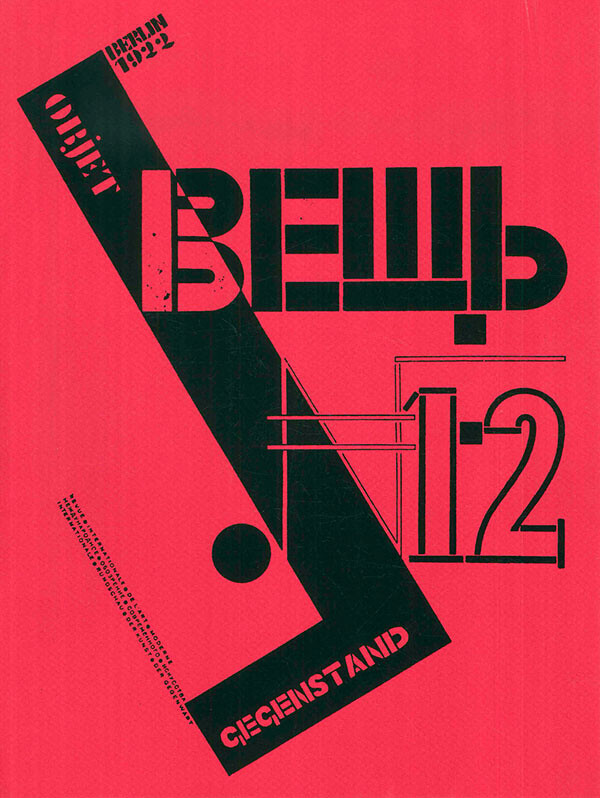
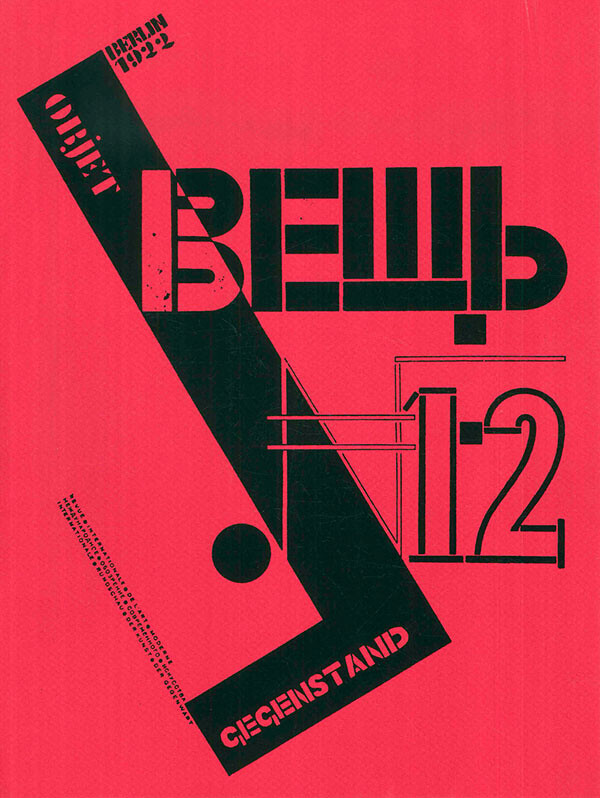
Cover of the journal Veshch/Gegenstand/Objet (1922), edited by El Lissitzky and Ilya Ehreburg.

If constructivism and productivism are oriented towards the production of new forms of being and communist world-building, the task of art, according to Bogdanov, is less radical and much more modest. Art is the education of the senses. It organizes feelings and emotions into images and forms. The “unity of form and content,” “harmony,” and “creativity” are epithets that Bogdanov uses to discuss proletarian art.25 Despite the contradiction between the enormous ambitions of the artistic avant-garde and the modest role of art in Bogdanov’s system, the theorists of constructivism and productivism tried to reinterpret Bogdanov’s organization of the senses for their own benefit. Nikolai Tarabukin understands the organization of emotions in empiricist terms, as the orientation of a subject in its natural and social environment. An artist does not copy but organizes nature on the canvas, building a landscape according to compositional laws. Painting establishes a particular “point of view” for the perceiving viewer. “The artist is the organizer of our visual orientation,” concludes Tarabukin.26 Chuzhak also accepts the emotional concept of art: “Art is an original, mainly emotional (only mainly and it only differs from science in this advantage) dialectical approach to life-building.”27 The content of the constructivist “dialectical modelling” consists of “the tangible thing” and “the idea, the thing in its model.”28

In an early Proletkultist article entitled “Proletarian Poetry” (1922), Andrei Platonov states that proletarian art has to begin with the organization of “immaterial things”—images and symbols of things; or simply put, words. He distinguishes three elements of a word: idea, image, and sound. The organization of poetry according to the triangular properties of a word is the process of gathering all wandering feelings and senses into one thought. The word-becoming of thought penetrates reality better than empty abstractions, because it makes conscious both sensibility and proletarian experience. From the organization of triangular words into thoughts, humankind will proceed to the organization of matter and world-building.29

The triangular words of Platonov recognize only proletarian experience; they materialize in words the “troubled” sound of the “gurgling of acid and alkaline grasses being digested in [the] stomachs” of the proletariat.30 Triangular words may also prove that a thought is the process of material production through “a certain pressure in the dark warmth.”31 This is the point of view of labor experience, the articulation of what is seen and what happens from the perspective of a laboring body: it speaks as it labors. Triangular words are material as much as immaterial, since they are embodied in the experience of the laboring proletariat. Platonov writes “not with words, imagining and copying real living languages, but rather with pieces of living language.”32 Similarly, Dziga Vertov writes “kino-thing[s] via filmed frames” and creates “visual thinking.”33 This art of seeing organizes the chaos of impressions into a new “class vision.”34 This does not mean that Vertov and Platonov prefer a naturalistic photographic copy of reality. Instead, they produce reality, or better yet, the universal point of view of the laboring population of the earth.
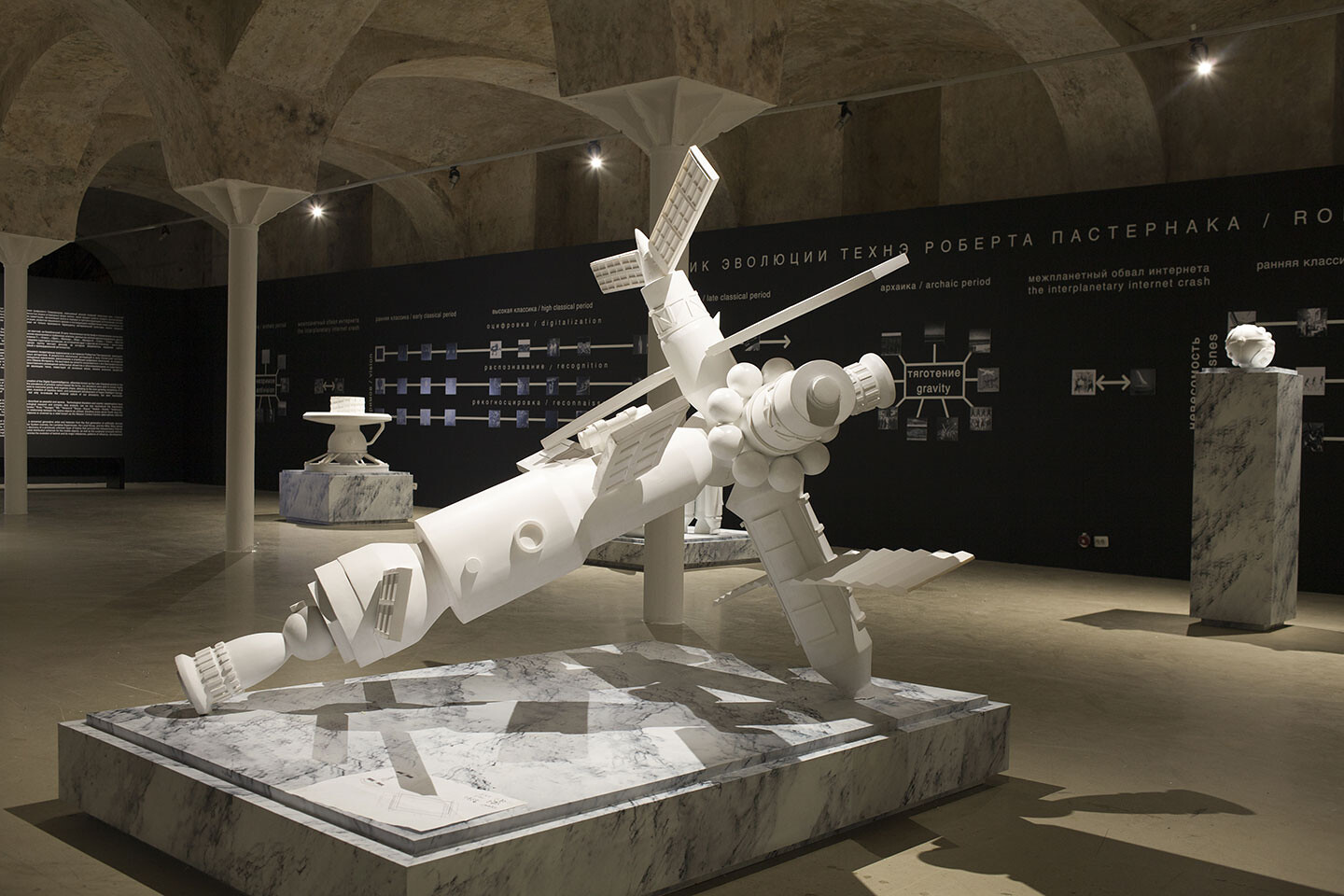
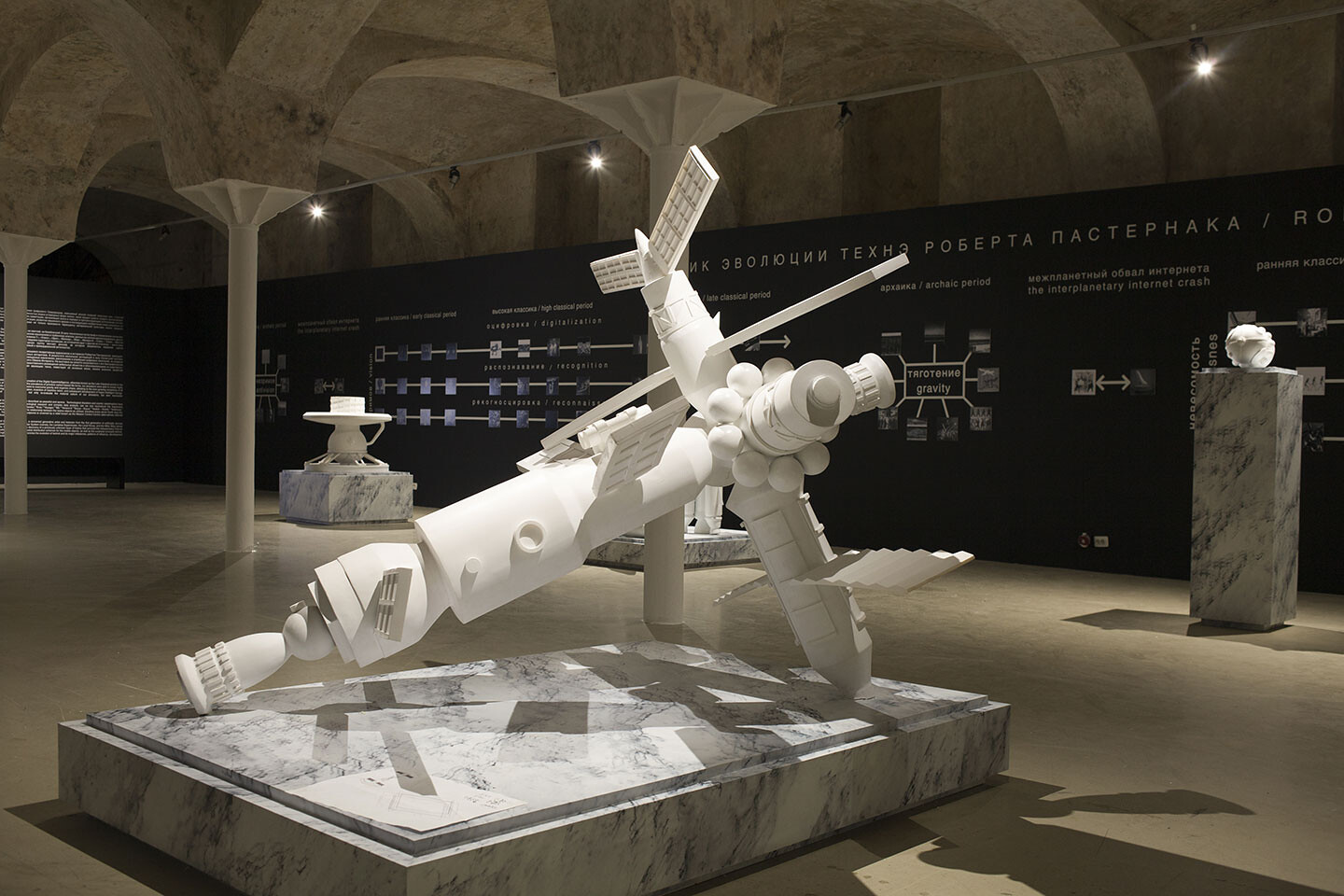
Arseny Zhilyaev, Return, 2017. Installation view.

The Stofflichkeit of the Universe: Platonov and the Thinghood of a Thing


The organization of the sensible is already the organization of matter, since the sensible is embodied proletarian experience. That is why the nature of psychophysical elements—those unities of experience—occupies Platonov as much as the materiality of words and sounds. In his science fiction story The Impossible (1921), he writes:

The Swedish physicist Arrhenius has a beautiful, amazing hypothesis concerning the origin of life on the earth. It is his guess that life is neither a local nor a terrestrial phenomenon. It has been transported to us from other planets through enormous ethereal spaces in the form of the smallest and most elementary colonies of organisms … Perhaps atoms, and atoms of atoms—electrons—are the same microorganism, but only in its limited, initial form.35


Similar reflections about atoms and electrons are repeated by the scientist Popov in Platonov’s science fiction story “Ethereal Tract.” Popov’s theory includes an understanding of living and dead matter: the center of atoms is filled with both living and dead electrons, and the dead electrons serve as food for the living ones.36 This living entity—this elemental unit of self-organizing matter—is, according to Platonov’s vocabulary, a “substance [veshchestvo] of existence.”

The Russian word veshchestvo can mean “matter,” “substance,” “thing,” “materiality,” or “stuff.” Robert Chandler, who has translated a number of Platonov’s works into English, often renders veshchestvo as “substance,” but also sometimes as “essence,” “thing,” or “object.” The root of the noun veshchestvo is veshch’, which means “thing.” Remember that Lissitzky titled his journal Veshch/Gegenstand/Objet. Maria Dmitrovskaia, a Russian researcher of Platonov, notes that the parallel usage of veshchestvo, veshch’, “matter,” and “body” corresponds to the archaic meaning in Old Medieval Russian, where veshch’ and veshchestvo sometimes were synonymous and where the understanding of a human body as veshchestvo was common. In archaic Russian, veshchestvo meant to be a material substratum of the world. It indicated things in existence and was a synonym of the word “material.” Such Platonov expressions as “metallic veshchestvo” and “fluid veshchestvo” were very common in eighteenth-century Russia.37

Veshchestvo is a reminder of veshch’; it is an elemental unit or an element of a decomposed psychophysical complex. In this sense veshchestvo is close to the English colloquial word “stuff,” or the German Stoff and Stofflichkeit. There is a scene in Platonov’s novel The Foundation Pit where the main character Voshchev collects “the objects [veshchi] of unhappiness and obscurity.”38 Thus, veshchestvo here appears as a memory of veshch’, as the remainder of its exhaustion in the past. It seems that this strange praxis of collecting the leaves, garbage, and destroyed objects of material culture exemplifies the act of recomposing and recollecting matter. In Bogdanov’s terminology, Voshchev is organizing life—the “veshchestvo of existence”—into complexes—veshchi. In Nikolai Fedorov’s terminology, he is collecting dead molecular pieces to resurrect the thinghood of a thing, the veshchnost’ veshchi, in the future. In 1931 Platonov writes:

The vulgar worldview [of materialism] anticipates that life is a combination of biological processes: “a human” properly is some sort of result of the relations and interactions of these forces—a human is relation. This is only half true. The other half is that the human is by itself veshchestvo, “materialism” included in bio-combinations. From here, and only from here—the human as by itself veshchestvo, and not only as relation—can one draw the great general conclusion that the door to the secret of nature is still open for humans. If, by contrast, a human is only “relation,” “combination,” etc., those doors are closed forever.39

For constructivism and productivism, forms of being emerge in the process of building and constructing the new. But for Platonov, the new already exists in the old, in the crumpled and poor form of veshchestvo. World-building is the resurrection of existing particles and elements, the restoration of a thing, the assembling of wandering senses, thoughts, and relations. The lowest entity—veshchestvo—corresponds to the molecular biology of self-organizing matter, but it produces the highest degree of organization: socially organized experience. Communism emerges out of the poverty of the elemental, out of the poor bodies of the proletariat. The laboring proletariat consists of those “who silently made useful veshchestvo” and those who signify not just a sociology of class relations, but also a restoration of the world in the process of communist world-building.40

Veshchestvo is a building material for the object and subject, the physical and the psychical composition of bodies, relations, and serial complexes of activities. It expresses degrees and logics of organization and structuring on the molecular, biological, and social levels. The constitutive unit of life is an element of experience in Bogdanov’s philosophy, and a veshchestvo of negative organizational spontaneity in Platonov. Taken together, the element of experience and veshchestvo introduce the principal role of the organizing force of being that shapes life-building. The Empirio-Marxist ontology of organization assumes the constructive and constitutive means of an art that not only changes, but also shapes forms of social being. Material culture as the organization of things, relations, and people replaces the concept of art.


The author thanks Danny Hayward for his help in editing this article.


Maria Chehonadskih is a philosopher and critic. She received PhD in philosophy from the Centre for Research in Modern European Philosophy, Kingston University (London) in 2017. Chehonadskih works on the problem of Soviet epistemologies across Marxist philosophy, literature and art. She wrote a number of texts on Soviet philosophy, art theory and post-Soviet politics, and contributed to Radical Philosophy, South Atlantic Quarterly, Moscow Art Magazine and Alfabeta2. Chehonadskih occasionally curates and works in collaboration with artists. Her last exhibition ‘Shadow of a Doubt’ (curated together with Ilya Budraitskis) was dedicated to the problem of conspiracy (Moscow, 2014). Lives and works in London.

© 2018 e-flux and the author
Sunday, July 11, 2021

Historic Warsaw store, seeking rebirth, hit by pandemic

By VANESSA GERA and MONIKA SCISLOWSKA

1 of 22

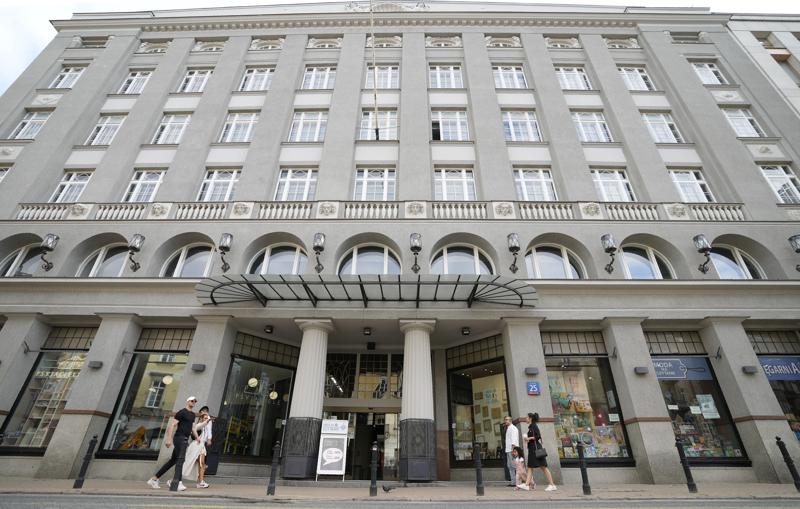
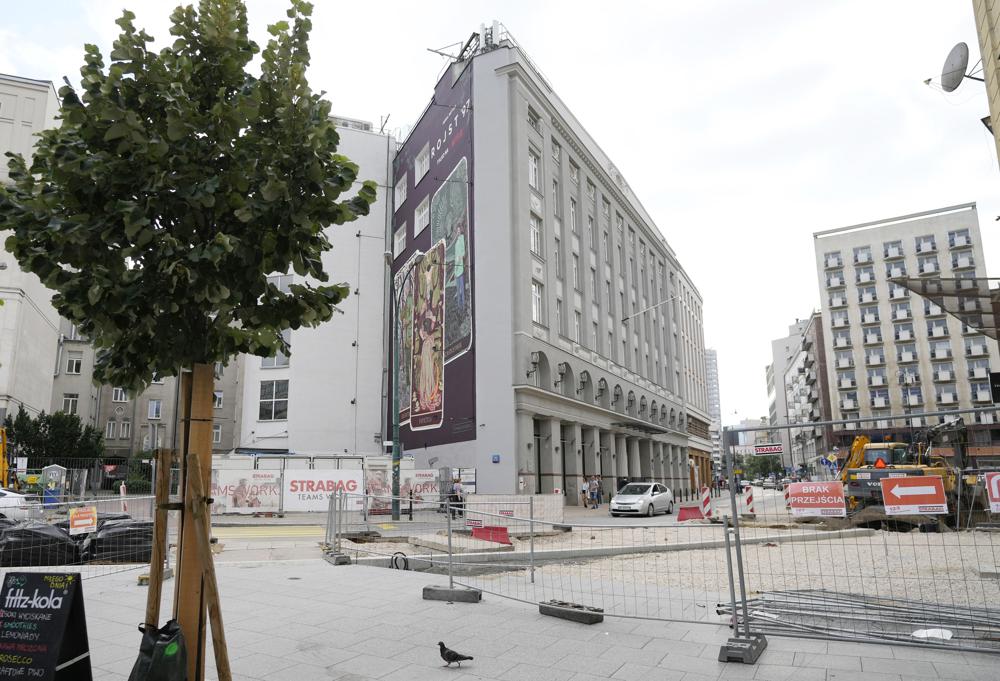
The modernist 1914 six-story building of the Jablkowski Brothers Department Store that survived World War II bombings by Nazi Germany is a historic landmark, in Warsaw, Poland, Saturday, July 10, 2021. After World War II the business was forced into bankruptcy and seized by the communist regime. The Jablkowski family regained the historic building in a long battle after communism fell, and were preparing to relaunch business when the pandemic hit and forced some changes to their plans, but did not undermine them. (AP Photo/Czarek Sokolowski)


WARSAW, Poland (AP) — The Jablkowski Brothers Department Store was once a Warsaw landmark that revolutionized shopping and brought goods to a modernizing society in the early 20th century. But unlike Harrods in London and other Western counterparts, the business was forced into bankruptcy and seized by Poland’s communist regime that took power after World War II.

When communism fell in 1989, the Jablkowski family heirs began a long legal struggle to regain their properties. They were preparing to launch when the coronavirus pandemic hit, dealing one more blow to a family business that has seen a history of hardship mirroring Poland’s adversities.

“The pandemic hit us in a moment when we were almost ready to go,” Monika Jablkowska, one of the heirs, told The Associated Press.

The pandemic has created new uncertainty because it has accelerated a trend toward online shopping, leaving questions about what kind of in-store retail experiences consumers will embrace in the coming years.

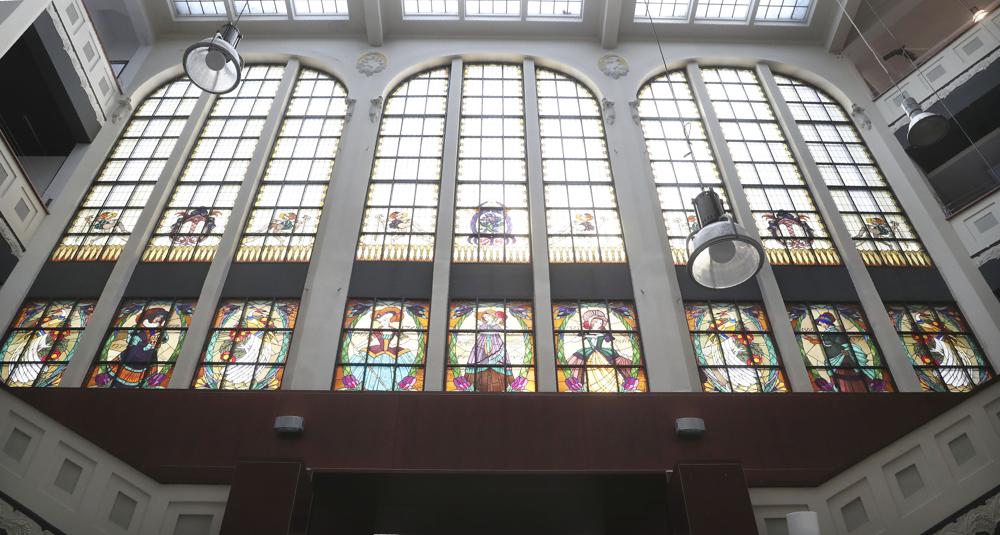
The family business started when Aniela Jablkowska began selling stationery from a chest of drawers in 1884. It expanded into the largest and most important department store across Eastern Europe. In 1914 — just as World War I began — the family opened its main building, a six-story gem of modernist architecture with soaring ceilings and stained glass windows that is now a historic landmark.


This April 20, 2021, photo shows the 1914 stained glass windows that decorate the main hall of the Jablkowski Brothers Department Store a historic landmark in Warsaw, Poland. The modernist building and the windows survived World War II, when German occupying forces destroyed most of Warsaw. Currently under renovation, the windows are to be re-installed in September. (AP Photo/Czarek Sokolowski)

Today a European Union member, Poland was at the time carved up by foreign powers, with Warsaw part of the Russian empire. In its early years, the company sold its merchandise in rubles, with a catalogue and delivery service that sent goods as far away as the Russia’s far-east city of Vladivostok.

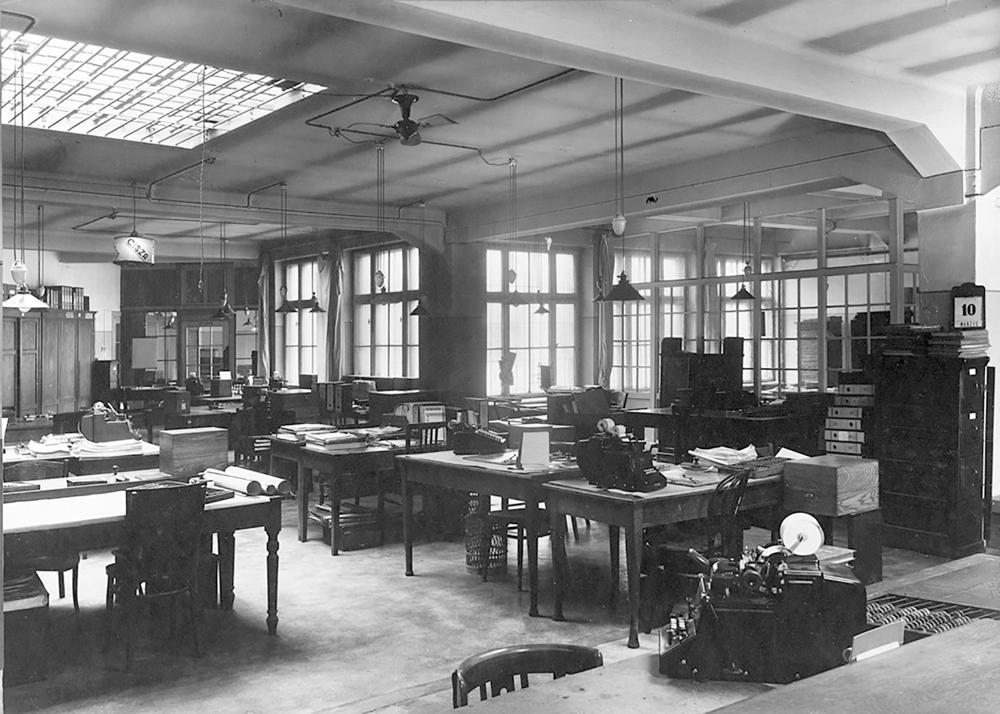
The business pulled through two world wars, hyperinflation and even the flu pandemic of 1918-20. During World War II, when German occupying forces destroyed most of Warsaw, the building was among the few to survive.

What dealt the final blow to the business, though, was Poland’s postwar communist regime, which imposed a huge tax forcing its bankruptcy, and then seized the store in 1950.

Jan Jablkowski, one of the heirs, says the family feels a “strong sense of obligation to continue” as an element of the city’s heritage, and has turned down even attractive purchase offers.

“We believe that such firms, present for many generations — just like the material substance of the city, its squares, its monuments, the street names — are all elements of the identity of this city,” said Jablkowski, a retired engineer who was formerly the head of Poland’s Institute for Automation and Measurements.

According to Cezary Lazarewicz, author of a book about the business, “Six Stories of Luxury,” the store offered a number of innovations to city shoppers -- not only all the clothes, toys and other goods for sale, but also neon advertisements, a terrace cafe, fashion shows and live piano music to stimulate shoppers.

He said the business was “revolutionary” in its introduction of catalogs, making it the Amazon of its age, and in its introduction of ready-to-wear clothing to a huge market.

“It wasn’t just a department store,” but a place that offered up a sense of magic, Lazarewicz said. “It was an exceptional place on the Warsaw map.”


After the fall of communism, the family began a legal battle to get back the building, but it took more than 20 years because they first had to reconstitute the prewar business. Even after the property was legally returned in 2004, a bookshop refused to vacate the premises, triggering more court cases until the store was finally regained in 2013.

The heirs’ initial plan was to revive the department store, but with department stores struggling to survive across the world — a trend accelerated by the pandemic — they realized that business model was no longer sustainable.

So they developed a new business plan to open it as a retail space of 4,500 square meters (48,500 square feet) with concept shops, restaurants, and spaces for cultural events. Then came the pandemic.

“The big question is how the business will look post-pandemic and whether the model will still be relevant afterwards,” Monika Jablkowska said.

Even before the pandemic, Poland has seen a huge retail upheaval, with international companies like Marks & Spencer and The Gap coming in, only to later leave the dynamic but demanding market where foreign brands compete with Polish clothing makers like Reserved. Online shopping has also taken hold, with Amazon recently entering Poland.

The fact that people buy fewer clothes now and have embraced more casual clothing creates uncertainties about what stores might want to open up in their building, Jablkowska said.


The modernist 1914 building of the Jablkowski Brothers Department Store that survived World War II bombings by Nazi Germany is a historic landmark, in Warsaw, Poland, Saturday, July 10, 2021. The family business started when Aniela Jablkowska began selling stationery from a chest of drawers in 1884. It expanded into the largest and most important department store across Eastern Europe. (AP Photo/Czarek Sokolowski)


Two business professors who have studied the Jablkowski company, Tomasz Olejniczak and Anna Pikos at the Kozminski University in Warsaw, argue it’s in a weaker position financially than counterparts elsewhere because of the way Polish industry and businesses were stripped of their capital by communist authorities.

Other department stores from Tokyo to Paris to London “are struggling, but over their continuous history they have amassed enormous wealth and resources which they can now use to reinvent or redefine themselves in the age of luxury and e-commerce,” Olejniczak and Pikos said in joint email.

“They have all the freedom they want to reinvent themselves, but they also have virtually no resources and very limited money,” the two said about the Jablkowski project.

Jablkowski says the family is taking a cautious approach now to ensure its survival. During the pandemic, managers and employees took voluntary pay cuts and the company again is earning revenue by hosting fairs and exhibitions. No key decisions will be made until the shape of the post-pandemic world comes into better focus.

“We remember the history of the past 100 or so years, and we are very sensitive about the secure functioning of the business,” Jablkowski said. “For this reason, we are being cautious.”


  • The rise & fall of department stores - Retail Gazette

    https://www.retailgazette.co.uk/blog/2019/08/department-stores-in-2019

    2019-08-13 · The most recent full-year trading update for the John Lewis Partnership – the holding company for the eponymous department store chain – saw total revenue rise by a …

    • Reviews: 3
    • Estimated Reading Time: 11 mins
  • The rise and relevance of the department store | The National

    https://www.thenationalnews.com/arts-culture/the-rise-and-relevance-of...

    The concept of the department store was born out of the Industrial ...

    • Estimated Reading Time: 7 mins
    • Woolworths: the rise and fall of the department store ...

      https://www.theguardian.com/.../nov/19/woolworths-retail-department-stores

      2008-11-19 · Woolworths: the rise and fall of the department store empire. ... In the 1970s, an average of 15 stores were closed each year to fund the renovation of more …

      • Estimated Reading Time: 4 mins

      • From Main Street to Mall: The Rise and Fall of the ...

        https://www.jstor.org/stable/j.ctt14jxw65

        Department stores had traditionally catered to women with lavish services; higher-priced, quality merchandise; and amenities at a downtown location. But purchasing power declined drastically in the face of widespread unemployment, failed banks, disastrous deflation, and an overarching loss of confidence in business leaders and the economy.