“The companies driving climate chaos cannot continue profiting from the destruction while vulnerable countries struggle.”
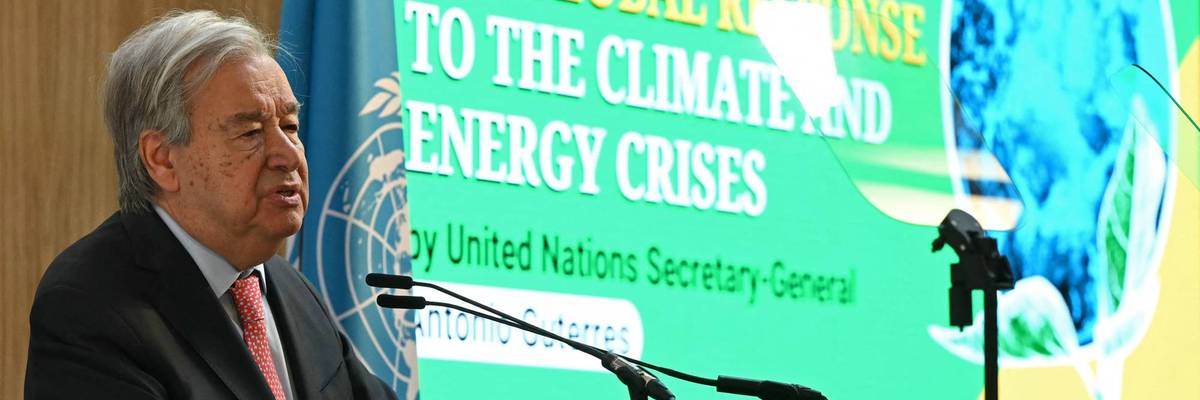
United Nations Secretary-General António Guterres delivers a speech during the Climate Innovation Forum, part of London Climate Action Week, at the Guildhall on June 23, 2026.
(Photo by Justin Tallis/AFP via Getty Images)
Jessica Corbett
Jun 24, 2026
COMMON DREAMS
As world leaders face mounting pressure to tax the windfall profits of fossil fuel giants that are wrecking the planet, United Nations António Guterres pushed for such policies in a pair of speeches at London Climate Action Week, arguing that “polluters must pay.”
Since assuming his post nearly a decade ago, the UN chief has repeatedly sounded the alarm about the fossil fuel-driven climate emergency and demanded that rich countries and companies responsible for the crisis contribute financially to adaptation and mitigation efforts, particularly in the Global South.
Just months away from the end of his term, Guterres on Tuesday highlighted the latest warnings from the World Meteorological Organization (WMO) and that “climate disasters are becoming more frequent, more destructive, and more costly.” He also flagged key tipping points—including melting ice sheets driving sea-level rise, shifts in conditions of the Amazon rainforest, and the weakening of major ocean circulation systems.
“Here in London—the city of Dickens—it is clear that our world is facing a Tale of Two Crises,” he said. “A climate crisis pushing us deeper toward higher temperatures and closer to catastrophic tipping points. And an energy crisis exposing the folly of a world hooked on hydrocarbons.”
“On the surface, these crises may seem separate. But they share the same destructive origin: fossil fuels,” he continued. “And they demand the same answer: a fast, fair transition to clean energy—and a surge in adaptation, resilience, and climate justice for those already facing climate harm.”
The UN leader stressed that “renewables are the cheapest, fastest, and most scalable source of new electricity in most of the world.”
“Since 2010, the cost of solar has plummeted by almost 90%, onshore wind by more than 70%, and battery storage by 95%,” he pointed out. “More than 90% of new renewable power added globally is already cheaper than the lowest-cost fossil fuel alternatives.”
While outlining several essential steps for ending fossil fuel dependence, Guterres issued various calls, such as urging “far greater urgency” to limit any overshoot of the Paris Agreement’s 1.5°C temperature goal for this century, and action in response to the exploding energy demands from artificial intelligence data centers.
Data centers have been met with fierce pushback from communities around the world concerned about water, land, and climate impacts. Guterres said that “by 2030, they could use more power than all but five countries—and enough water to meet the basic needs of all 1.3 billion residents of sub‑Saharan Africa for an entire year.”
He proposed the AI Environmental Transparency Initiative, “calling on every major AI company to measure and publicly disclose the full environmental impact of its systems—carbon, water, and land footprints—and to commit to power every data center with renewable energy by 2030.”
“No more hidden costs. No more shifting the burden onto those least able to bear it,” explained Guterres. “It is time to come clean. If AI is to help build a better future, it must be honest about what it costs us now.”
As data centers are sucking up massive amounts of power, he acknowledged that “families feeling the strain with higher bills, greater uncertainty, a sense that the system is not working for them—while fossil fuel giants continue to reap extraordinary profits.”
“The eight largest fossil fuel companies reported pocketing an extra $6.5 billion in the first quarter of this year alone—and that only includes one month of the Middle East crisis, as oil prices continued to climb and profits to rise,” Guterres said.
Without directly mentioning how the US-Israeli war on Iran—which Guterres has criticized—has driven up oil prices around the world, the UN leader said that “these are windfall gains born of pain—of instability, hardship and dependence. I urge governments to tax them.”
“Let me conclude where I began—with Dickens,” he said. “For the climate agenda, this is indeed the best of times and the worst of times. The worst—because climate impacts are intensifying, tipping points are looming, and the energy crisis has exposed the deep risks of dependence on fossil fuels.”
“But also the best—because the renewables revolution is well underway,” he added. “A revolution of clean power, electrification, falling costs, rising ambition—and vast opportunity.”
Following his special address on Tuesday, Guterres spoke Wednesday at the Climate & Development Financial Forum, where he emphasized that “the countries facing the greatest climate impacts are those who contributed least to causing them.”
In addition to arguing that the international community has to “recognize that climate risk is economic risk,” “global financial systems must recognize the value of resilience,” and “we need better preparation before disasters strike,” the UN chief spotlighted the necessity of closing “the finance gap” in terms of adaptation.
He called for developed countries to triple adaptation finance, replenish multilateral climate funds, and prioritize grant-based and predictable finance, and for multilateral development banks to “use their expanded lending capacity to aggressively scale up investment in resilience.”
He also reiterated his call for governments “to tax windfall profits from fossil fuel companies to help finance adaptation and climate related losses and damages,” declaring that “the companies driving climate chaos cannot continue profiting from the destruction while vulnerable countries struggle.”
As Trump Discovers Gas Price Gouging, Democrats Offer a Solution: Tax Big Oil
“Mr. President: I have a windfall excess profits bill you could support,” said one Democratic senator.
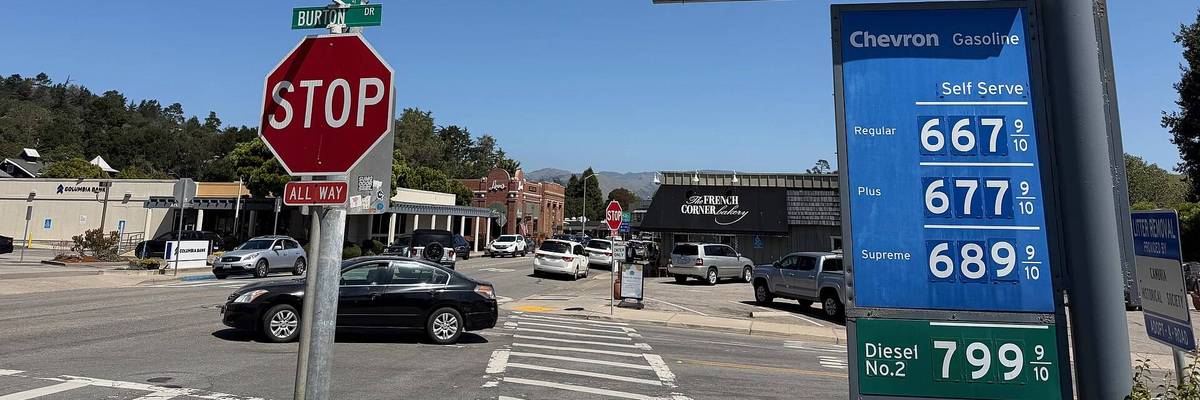
Gasoline prices starting at $6.67 per gallon and $7.99 per gallon of diesel are advertised at a Chevron station in Cambria, California on April 6, 2026 amid US President Donald Trump’s illegal war of choice on Iran.
(Photo: daveynin/flickr/cc)
Brett Wilkins
Jun 24, 2026
COMMON DREAMS
President Donald Trump said Tuesday that he has directed the US Department of Justice to investigate fossil fuel companies for not lowering gasoline prices as the cost of oil declines amid the prospect of an end to the Iran War.
“The big Oil Companies are not dropping their price at the pump commensurate with the sharply lower prices they are paying for Oil. Those prices are dropping like a rock! In other words, customers are being ‘gouged,’” Trump said on his Truth Social network.
“I have instructed the DOJ to immediately start looking into this,” he added. “Gasoline prices better start going down a lot faster than what I’m seeing!”
While benchmark West Texas Intermediate and Brent Crude oil prices have fallen to their lowest levels since Trump launched the illegal US-Israeli war of choice on Iran on February 28, the average price for a gallon of unleaded gasoline in the United States was $3.93 per gallon on Wednesday, around one-third higher than it was the day before the war started but down from a high of $4.52 a month ago, according to the American Automobile Association.
“The price of fuel is not only a national security issue, it impacts the wallet of every American,” an unnamed Trump administration official told ABC News on Wednesday following the president’s post. “We will always commit to ensuring affordability in this nation.”
Responding to Trump’s post, US Sen. Sheldon Whitehouse (D-RI) noted on social media that he has a solution for Big Oil price gouging.
In March, Whitehouse and Rep. Ro Khanna (D-Calif.) reintroduced the Big Oil Windfall Profits Tax Act “to curb profiteering by oil companies and provide Americans relief at the gas pump.”
The legislation—which only applies to large oil companies—would impose a per-barrel tax “equal to 50% of the difference between the current price per barrel of oil and the average price per barrel last year, when big oil companies were already earning large profits.”
Democrats in both chambers of Congress have also called for the prosecution of corporations that use the war as a pretext for price gouging.
Polling has shown that Americans largely support a tax on Big Oil windfall profits, which, according to The Guardian, amounted to $23 billion in the first month of the war alone—or $30 million per hour.
Trump has been a staunch supporter of fossil fuel companies. While running for reelection on a “drill, baby, drill” energy platform, he reportedly promised Big Oil executives that he would eviscerate climate regulations enacted by the Biden administration if they gave $1 billion to his campaign.
Fossil fuel interests spent nearly $450 million during the 2024 election cycle on campaign contributions, lobbying, and efforts supporting Republican causes and candidates, including Trump.
As pump prices soared and Americans suffered amid Trump’s war, the president—who promised gas under $2 a gallon and no new wars—said that “when oil prices go up, we make a lot of money.”
Last week, the Institute on Taxation and Economic Policy estimated that Americans have paid nearly $54 billion extra for gas and fuel—more than $400 per household—than they would have if the war never happened.
“Mr. President: I have a windfall excess profits bill you could support,” said one Democratic senator.
Gasoline prices starting at $6.67 per gallon and $7.99 per gallon of diesel are advertised at a Chevron station in Cambria, California on April 6, 2026 amid US President Donald Trump’s illegal war of choice on Iran.
(Photo: daveynin/flickr/cc)
Brett Wilkins
Jun 24, 2026
COMMON DREAMS
President Donald Trump said Tuesday that he has directed the US Department of Justice to investigate fossil fuel companies for not lowering gasoline prices as the cost of oil declines amid the prospect of an end to the Iran War.
“The big Oil Companies are not dropping their price at the pump commensurate with the sharply lower prices they are paying for Oil. Those prices are dropping like a rock! In other words, customers are being ‘gouged,’” Trump said on his Truth Social network.
“I have instructed the DOJ to immediately start looking into this,” he added. “Gasoline prices better start going down a lot faster than what I’m seeing!”
While benchmark West Texas Intermediate and Brent Crude oil prices have fallen to their lowest levels since Trump launched the illegal US-Israeli war of choice on Iran on February 28, the average price for a gallon of unleaded gasoline in the United States was $3.93 per gallon on Wednesday, around one-third higher than it was the day before the war started but down from a high of $4.52 a month ago, according to the American Automobile Association.
“The price of fuel is not only a national security issue, it impacts the wallet of every American,” an unnamed Trump administration official told ABC News on Wednesday following the president’s post. “We will always commit to ensuring affordability in this nation.”
Responding to Trump’s post, US Sen. Sheldon Whitehouse (D-RI) noted on social media that he has a solution for Big Oil price gouging.
In March, Whitehouse and Rep. Ro Khanna (D-Calif.) reintroduced the Big Oil Windfall Profits Tax Act “to curb profiteering by oil companies and provide Americans relief at the gas pump.”
The legislation—which only applies to large oil companies—would impose a per-barrel tax “equal to 50% of the difference between the current price per barrel of oil and the average price per barrel last year, when big oil companies were already earning large profits.”
Democrats in both chambers of Congress have also called for the prosecution of corporations that use the war as a pretext for price gouging.
Polling has shown that Americans largely support a tax on Big Oil windfall profits, which, according to The Guardian, amounted to $23 billion in the first month of the war alone—or $30 million per hour.
Trump has been a staunch supporter of fossil fuel companies. While running for reelection on a “drill, baby, drill” energy platform, he reportedly promised Big Oil executives that he would eviscerate climate regulations enacted by the Biden administration if they gave $1 billion to his campaign.
Fossil fuel interests spent nearly $450 million during the 2024 election cycle on campaign contributions, lobbying, and efforts supporting Republican causes and candidates, including Trump.
As pump prices soared and Americans suffered amid Trump’s war, the president—who promised gas under $2 a gallon and no new wars—said that “when oil prices go up, we make a lot of money.”
Last week, the Institute on Taxation and Economic Policy estimated that Americans have paid nearly $54 billion extra for gas and fuel—more than $400 per household—than they would have if the war never happened.
‘No Immunity for Big Oil’: Dem Leaders Urged to Block GOP Gift to Fossil Fuel Industry
“If we do not also protect Americans’ right to hold bad actors accountable in court, we will be handing Big Oil a get-out-of-jail-free card,” said a coalition of over 190 civil society groups.
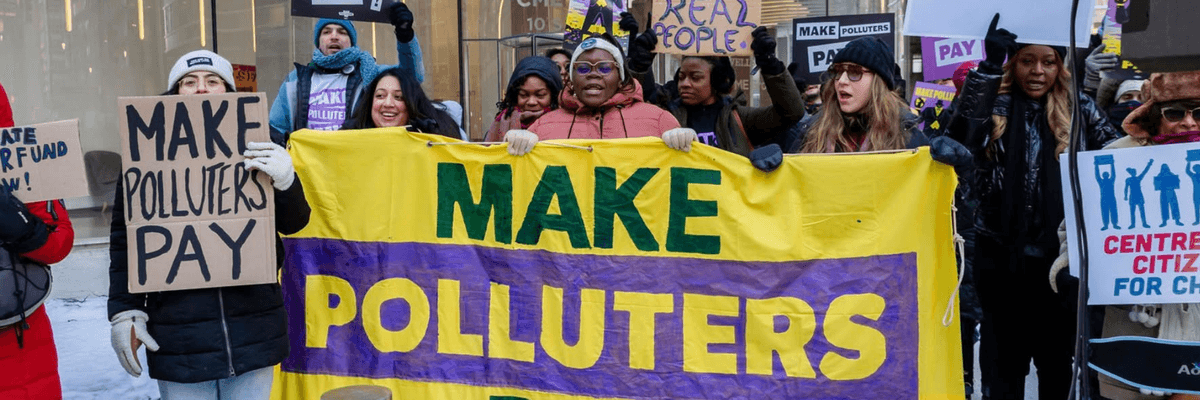
People rally outside BP’s offices in Chicago in January 2026 to demand fossil fuel polluters pay for the damages they cause.
(Photo by Vanessa Bly/Natural Resources Defense Council/Facebook)
Brett Wilkins
Jun 23, 2026
COMMON DREAMS
Nearly 200 civil society groups on Tuesday urged congressional Democrats to reject any legislation granting fossil fuel companies immunity from climate lawsuits, warning that such protections would block communities from pursuing accountability and compensation for climate-related damages.
“As communities across the country are taking Big Oil companies to court for lying to the public about the climate harms of their products, we are alarmed by reports that the fossil fuel industry is trying to secure a legal liability waiver that would block communities from attempts to hold them accountable,” the No Immunity for Big Oil coalition wrote in a letter to Senate Minority Leader Chuck Schumer (D-NY), House Minority Leader Hakeem Jeffries (D-NY), and Democratic lawmakers in both chambers.
“The American Petroleum Institute—the largest oil and gas trade association in the country and a defendant in several climate accountability lawsuits—has announced that stopping ‘abusive state climate lawsuits’ against fossil fuel companies is a top priority for the industry this year,” the letter continues.
“We’re urging you to protect our right to hold Big Oil accountable and reject any proposal that would shield fossil fuel companies from the legal and legislative efforts communities across the country are advancing to make polluters pay for the damage their climate lies and pollution [have] caused,” added the groups, which include the Sierra Club, Natural Resources Defense Council, Greenpeace USA, Union of Concerned Scientists, Center for Biological Diversity, and Amnesty International USA.
In April, Sen. Ted Cruz (R-Texas) and Rep. Harriet Hageman (R-Wyo.) introduced companion versions of the Stop Climate Shakedowns Act of 2026, which would “prohibit liability against those engaged in the mining, extraction, production, refinement, transportation, distribution, marketing, manufacture, or sale of energy for damages or injunctive or other relief from the use of their products, and for other purposes.”
Hageman’s office explained at the time that the legislation aims “to protect American energy from leftist legal crusades punishing lawful activity.”
At the state level, there has been a coordinated push by Republican-controlled legislatures to shield fossil fuel companies from climate-related lawsuits. Earlier this year, Utah became the first state to pass a law “all but shutting down communities’ ability to hold gas-emitting polluters responsible for harms caused by their bad actions,” according to law professor and critic Wes Henricksen.
Numerous Republican-controlled state legislatures are following suit, with similar legislation in various stages of advancement.
An investigation published in April by ProPublica’s Abrahm Lustgarten found that “most of these bills are part of a coordinated effort, orchestrated by a constellation of groups that share staff or have funding ties to the prominent conservative activist Leonard Leo, who is credited with placing conservative justices on the US Supreme Court.”
“These groups have drafted state legislation, planned its dissemination, and engaged a well-connected lobbying firm to get them signed into law,” Lustgarten wrote. “The effort is unfolding as courts are weighing more than 30 significant lawsuits by states, counties, and municipalities accusing fossil fuel companies of misrepresenting the risks their products posed to consumers and seeking to recoup the costs of disasters and other climate impacts like wildfire losses or coastal flooding that their products helped cause.”
“A goal of the legislation is to block these cases from going forward and prevent new ones from being filed,” he added.
Responding to an effort to establish a state program that could collect as much as $50 billion from fossil fuel companies responsible for climate-wrecking greenhouse gas emissions, New Jersey state Rep. Dawn Fantasia (R-24) asked Tuesday on social media, “Since when do we get to retroactively tax oil companies for decades of lawful, heavily-regulated activity?”
But that’s precisely what the 1998 Master Settlement Agreement did, forcing tobacco companies pay states more than $200 billion to compensate for past public health and medical costs caused by smoking-related harms. Like Big Tobacco before it, the fossil fuel industry has been accused of downplaying and obscuring evidence of climate and health harms from its products while working to stymie regulation and skirt legal and financial accountability.
Sixteen Republican state attorneys general are also pushing a liability shield for Big Oil modeled on the Protection of Lawful Commerce in Arms Act, legislation signed by former President George W. Bush that grants gun manufacturers and dealers legal immunity from civil litigation.
As the No Immunity for Big Oil letter notes:
The mounting threat of climate change is being felt first-hand by our communities as worsening floods, storms, and other extreme weather events leave destruction in their wake, saddling everyday Americans and local governments with skyrocketing costs to recover, respond, and adapt to the growing crisis. The record-breaking extreme weather events walloping our communities with increasing frequency and intensity are a result of fossil fuel pollution enabled for decades by Big Oil companies and their coordinated campaign of climate deception. Oil and gas companies have known for decades that their products posed “potentially catastrophic” risk to the climate—but instead of disclosing this knowledge, they chose to run a historic and ongoing campaign to deceive the public, protect their profits, and delay our transition to cleaner and cheaper energy.
“There are many ongoing fights to protect justice, democracy, and fundamental rights that demand your attention—and we thank you for fighting to keep our communities’ rights intact,” the letter concludes. “If we do not also protect Americans’ right to hold bad actors accountable in court, we will be handing Big Oil a get-out-of-jail-free card.”
The No Immunity for Big Oil coalition’s letter comes as 10 Democratic state governors are also calling on congressional leaders to “reject federal legislation that would grant sweeping legal protections to fossil fuel companies and limit the authority of states and local governments to enforce their own laws.”
“No industry should receive a blanket exemption from accountability under the law,” said Illinois Gov. JB Pritzker. “States have the right to protect their residents, enforce their laws, and seek justice when communities are harmed.”
“This proposal before Congress would undermine those principles and set a dangerous precedent by allowing one industry to avoid legal scrutiny,” Pritzker added, referring to the Stop Climate Shakedowns Act. “I urge Congress to reject this proposal and stand with states, taxpayers, and the rule of law—not special protections for powerful corporations.”
“If we do not also protect Americans’ right to hold bad actors accountable in court, we will be handing Big Oil a get-out-of-jail-free card,” said a coalition of over 190 civil society groups.
People rally outside BP’s offices in Chicago in January 2026 to demand fossil fuel polluters pay for the damages they cause.
(Photo by Vanessa Bly/Natural Resources Defense Council/Facebook)
Brett Wilkins
Jun 23, 2026
COMMON DREAMS
Nearly 200 civil society groups on Tuesday urged congressional Democrats to reject any legislation granting fossil fuel companies immunity from climate lawsuits, warning that such protections would block communities from pursuing accountability and compensation for climate-related damages.
“As communities across the country are taking Big Oil companies to court for lying to the public about the climate harms of their products, we are alarmed by reports that the fossil fuel industry is trying to secure a legal liability waiver that would block communities from attempts to hold them accountable,” the No Immunity for Big Oil coalition wrote in a letter to Senate Minority Leader Chuck Schumer (D-NY), House Minority Leader Hakeem Jeffries (D-NY), and Democratic lawmakers in both chambers.
“The American Petroleum Institute—the largest oil and gas trade association in the country and a defendant in several climate accountability lawsuits—has announced that stopping ‘abusive state climate lawsuits’ against fossil fuel companies is a top priority for the industry this year,” the letter continues.
“We’re urging you to protect our right to hold Big Oil accountable and reject any proposal that would shield fossil fuel companies from the legal and legislative efforts communities across the country are advancing to make polluters pay for the damage their climate lies and pollution [have] caused,” added the groups, which include the Sierra Club, Natural Resources Defense Council, Greenpeace USA, Union of Concerned Scientists, Center for Biological Diversity, and Amnesty International USA.
In April, Sen. Ted Cruz (R-Texas) and Rep. Harriet Hageman (R-Wyo.) introduced companion versions of the Stop Climate Shakedowns Act of 2026, which would “prohibit liability against those engaged in the mining, extraction, production, refinement, transportation, distribution, marketing, manufacture, or sale of energy for damages or injunctive or other relief from the use of their products, and for other purposes.”
Hageman’s office explained at the time that the legislation aims “to protect American energy from leftist legal crusades punishing lawful activity.”
At the state level, there has been a coordinated push by Republican-controlled legislatures to shield fossil fuel companies from climate-related lawsuits. Earlier this year, Utah became the first state to pass a law “all but shutting down communities’ ability to hold gas-emitting polluters responsible for harms caused by their bad actions,” according to law professor and critic Wes Henricksen.
Numerous Republican-controlled state legislatures are following suit, with similar legislation in various stages of advancement.
An investigation published in April by ProPublica’s Abrahm Lustgarten found that “most of these bills are part of a coordinated effort, orchestrated by a constellation of groups that share staff or have funding ties to the prominent conservative activist Leonard Leo, who is credited with placing conservative justices on the US Supreme Court.”
“These groups have drafted state legislation, planned its dissemination, and engaged a well-connected lobbying firm to get them signed into law,” Lustgarten wrote. “The effort is unfolding as courts are weighing more than 30 significant lawsuits by states, counties, and municipalities accusing fossil fuel companies of misrepresenting the risks their products posed to consumers and seeking to recoup the costs of disasters and other climate impacts like wildfire losses or coastal flooding that their products helped cause.”
“A goal of the legislation is to block these cases from going forward and prevent new ones from being filed,” he added.
Responding to an effort to establish a state program that could collect as much as $50 billion from fossil fuel companies responsible for climate-wrecking greenhouse gas emissions, New Jersey state Rep. Dawn Fantasia (R-24) asked Tuesday on social media, “Since when do we get to retroactively tax oil companies for decades of lawful, heavily-regulated activity?”
But that’s precisely what the 1998 Master Settlement Agreement did, forcing tobacco companies pay states more than $200 billion to compensate for past public health and medical costs caused by smoking-related harms. Like Big Tobacco before it, the fossil fuel industry has been accused of downplaying and obscuring evidence of climate and health harms from its products while working to stymie regulation and skirt legal and financial accountability.
Sixteen Republican state attorneys general are also pushing a liability shield for Big Oil modeled on the Protection of Lawful Commerce in Arms Act, legislation signed by former President George W. Bush that grants gun manufacturers and dealers legal immunity from civil litigation.
As the No Immunity for Big Oil letter notes:
The mounting threat of climate change is being felt first-hand by our communities as worsening floods, storms, and other extreme weather events leave destruction in their wake, saddling everyday Americans and local governments with skyrocketing costs to recover, respond, and adapt to the growing crisis. The record-breaking extreme weather events walloping our communities with increasing frequency and intensity are a result of fossil fuel pollution enabled for decades by Big Oil companies and their coordinated campaign of climate deception. Oil and gas companies have known for decades that their products posed “potentially catastrophic” risk to the climate—but instead of disclosing this knowledge, they chose to run a historic and ongoing campaign to deceive the public, protect their profits, and delay our transition to cleaner and cheaper energy.
“There are many ongoing fights to protect justice, democracy, and fundamental rights that demand your attention—and we thank you for fighting to keep our communities’ rights intact,” the letter concludes. “If we do not also protect Americans’ right to hold bad actors accountable in court, we will be handing Big Oil a get-out-of-jail-free card.”
The No Immunity for Big Oil coalition’s letter comes as 10 Democratic state governors are also calling on congressional leaders to “reject federal legislation that would grant sweeping legal protections to fossil fuel companies and limit the authority of states and local governments to enforce their own laws.”
“No industry should receive a blanket exemption from accountability under the law,” said Illinois Gov. JB Pritzker. “States have the right to protect their residents, enforce their laws, and seek justice when communities are harmed.”
“This proposal before Congress would undermine those principles and set a dangerous precedent by allowing one industry to avoid legal scrutiny,” Pritzker added, referring to the Stop Climate Shakedowns Act. “I urge Congress to reject this proposal and stand with states, taxpayers, and the rule of law—not special protections for powerful corporations.”

No comments:
Post a Comment