Showing posts sorted by relevance for query PROJECT 2025. Sort by date Show all posts

Sunday, June 15, 2025

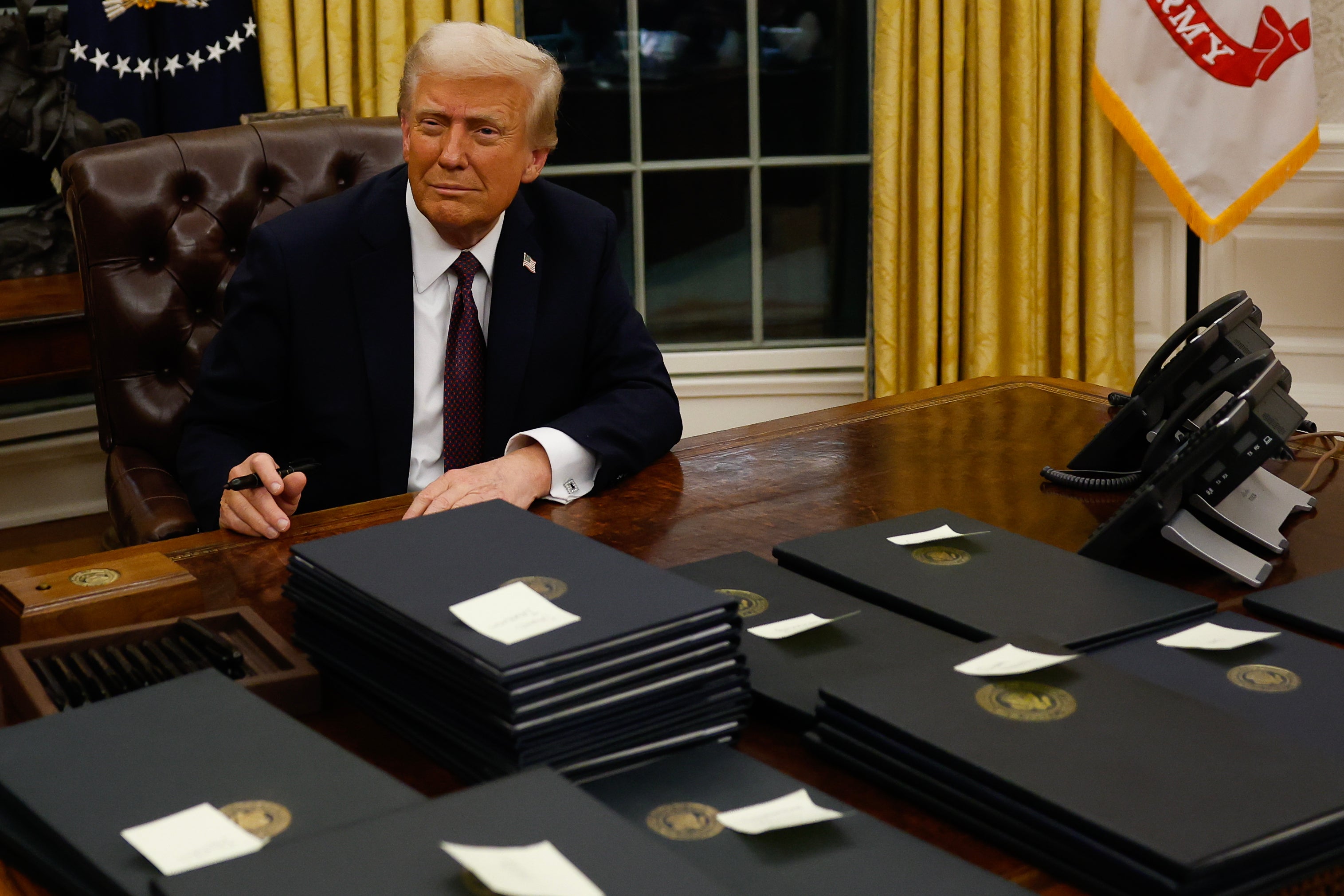
Project 2025: Five Months in, Trump’s Shock Doctrine Is Delivering

Project 2025 is hollowing out government--and it’s just getting started


Cartoon describing a few of the extremist plans in Project 2025

Project 2025 is hollowing out government — and it’s just getting started 

As we approach the fifth month of Donald Trump’s second term, you might be asking: “What’s up with Project 2025?” According to GPAHE (Global Project Against Hate and Extremism), “Data compiled by the Project 2025 Tracker reveals a presidency operating with methodical precision, adhering to the Heritage Foundation’s Project 2025 playbook. Of the 313 total objectives identified in Project 2025, 98 have been completed as of June 2025, representing a 42 percent completion rate in just five months of governance. This rapid-fire execution creates one of the most striking paradoxes of the early Trump presidency: a policy framework the candidate repeatedly disavowed during his campaign has become the most reliable predictor of his administration’s priorities.”

In short, despite the Trump administration denial that it is following the Heritage Foundation’s playbook, Project 2025 is aggressively strip mining government agencies, providing rebar for an authoritarian takeover of democracy.

Let’s review. Project 2025 is the 920-page blueprint for authoritarianism in the U.S., spearheaded by the powerful and extreme far-right Heritage Foundation. More than 100 far-right organizations were involved in crafting the document, which, according to GPAHE “is proving to be the source for Trump’s anti-democratic policies, despite his repeated disavowal of Project 2025 during his campaign.” In addition, “Dozens of members of the new administration have direct ties to the effort.”

Project 2025’s playbook turns back the clock on civil rights and deprives people of their hard-won constitutional rights, while “pushing for the erosion of environmental and education protections. It also advocates for a frightening centralization of power in the executive branch, something Trump is keen to achieve.” [Full analysis of Project 2025]

So what is up with Project 2025?  

In a June 1 interview with Russell Vought, the Office of Management and Budget director, CNN’s Dana Bash asked him about DOGE, presidential power potentially overruling Congress, and the “woke” administrative state, among other topics. Vought was smoothly responding until the conversation turned to Project 2025, when things got a little frosty.

According to GPAHE, “Bash asked him about the unmistakable convergence between Trump’s governing agenda” and Project 2025 — “a document for which Vought himself had served as a key architect and co-author — and his denial came swiftly and absolutely.”

“‘No, of course not,’ Vought declared when asked whether his current work represented an enactment of Project 2025. ‘The only people that are delusional about whether the president is the architect, the visionary, the originator of his own agenda that he was very public about throughout the campaign … are his adversaries.’”

Here are excerpts from GPAHE’s reporting on Project 2025:

The chronological record tells the story that Vought seemed determined to obscure during his CNN appearance. Within hours of his January 20 inauguration, Trump had executed 25 distinct Project 2025 recommendations, ranging from deploying active-duty military personnel to the southern border to eliminating diversity offices across federal agencies. The systematic nature of implementation becomes particularly apparent when examining agency-specific progress rates.

The personnel enacting these policies also tell the story. A report by DeSmog reveals that 70 percent of Trump’s cabinet maintains direct ties to Project 2025 organizations — more than 50 high-level officials bound to the very groups that authored or co-sponsored Project 2025, the blueprint they are now executing. Vice President JD Vance connects to five Project 2025 entities, Secretary of State Marco Rubio to four, Veterans Affairs Secretary Doug Collins to three. This represents the Heritage Foundation’s ultimate victory: the architects have become the executors.

The Commodity Futures Trading Commission has achieved 100 percent completion of its single objective: to reduce regulations on cryptocurrency. Meanwhile, all six of Project 2025’s objectives regarding USAID have been completed. The White House itself has completed 88 percent of its 13 objectives, while the Department of State has finished 75 percent of its 10 Project 2025 objectives.

Environmental policy offers the most vivid illustration of this systematic execution. Project 2025 called for eliminating “the use of the social cost of carbon” in federal decision-making — Trump’s January 20 executive orders accomplished precisely that objective. Project 2025 recommended immediate withdrawal from the Paris Climate Agreement and the UN Framework Convention on Climate Change — both withdrawals were announced within hours of the inauguration. When Project 2025 suggested abolishing the Office of Domestic Climate Policy, Trump dissolved it before the inaugural celebrations had concluded. The Environmental Protection Agency has proven exceptionally responsive to Project 2025’s policies.

In May, the agency repealed energy efficiency standards for appliances, with Trump signing four Congressional Review Act resolutions to roll back energy efficiency rules while the Energy Department simultaneously rolled back 47 efficiency regulations. Earlier, the EPA had fired 388 probationary employees and terminated grant agreements worth $20 billion.

Project 2025 has been methodically checking off the boxes of its agenda. ICE, under “border Czar” Tom Homan is cranking up its activities; private prison corporations and companies providing infrastructure for ICE are profiting handsomely; and, the Department of Homeland Security eliminated its Office for Civil Rights and Civil Liberties, while also dissolving the Office of Immigration Detention Ombudsman and the Office of the Citizenship and Immigration Services Ombudsman. Media companies and individual journalists are under attack.

GPAHE noted that when Bash When Bash “pressed Vought about pending Project 2025 recommendations — ‘eliminating the Fed, privatizing Fannie and Freddy, banning medication abortion’ — his response carried the careful ambiguity of calculated evasion. ‘What’s on the agenda is what the president has put on the agenda, most of which he ran on,’ he replied, neither confirming nor denying while maintaining the fiction of presidential originality. Vought’s Sunday CNN performance was pure political theater designed to obscure systematic policy execution of a document designed to foment authoritarianism and Christian nationalist policies.”

The Trump administration and its allies have been working at breakneck speed to implement Project 2025. The administration’s work is serving as a rallying cry for Trump’s White supremacist allies, who see the Project’s successes as a much-welcomed blueprint for authoritarianism and an attractive recruiting tool.

Bill Berkowitz is a longtime observer of the conservative movement. Read other articles by Bill.

Saturday, October 04, 2025

Media Faces Reckoning After Helping Trump Downplay Project 2025 on Campaign Trail

“A Trump denial is not a fact,” said one media critic.


The Democratic National Committee sponsors a billboard about then-Republican candidate Donald Trump and Project 2025 at 12th & Vine Streets on September 9, 2024, in Philadelphia, Pennsylvania.
(Photo by Lisa Lake/Getty Images for the Democratic National Committee)

Stephen Prager
Oct 03, 2025
COMMON DREAMS

As President Donald Trump openly embraces Project 2025, mainstream media outlets are facing criticism for their role in helping him downplay his ties to the wildly unpopular far-right governing playbook in the lead-up to his reelection last year.

After she became the Democratic nominee in July, former Vice President Kamala Harris made the Heritage Foundation’s over 900-page manifesto for “the next conservative president” central to her case against Trump during the 2024 election, often referring to it as “Trump’s Project 2025.”

She and other Democrats warned that if he retook power, he would swiftly enact many of its most extreme and unpopular proposals and dramatically expand executive power while doing it.

Among those proposals were steep cuts to social safety net programs like Medicaid and the Supplemental Nutrition Assistance Program (SNAP), the “mass deportations” of millions of immigrants, the elimination of the Department of Education, new restrictions on abortions, the gutting of climate protections, and the replacement of career civil servants with political appointees, among many others.

Democrats amplified the plan’s danger at the Democratic National Convention and in campaign ads, and Trump began to distance himself from the platform. Despite the fact that as many as 140 people who’d worked in his first administration—including Paul Dans, Heritage’s director of Project 2025—had a hand in its creation, Trump said: “I know nothing about Project 2025. I have no idea who is behind it.”

This was demonstrably untrue, even at the time. Media Matters for America dug up a clip from as far back as May 2023 of Dans stating that “President Trump’s very bought in with this,” speaking of the program.


Project 2025 was almost inconceivably unpopular. An NBC News poll from September 2024 showed that while 57% of registered voters viewed the plan negatively, just 4% viewed it positively.

But in the critical months leading up to the election, many media outlets took Trump’s denial at face value, publishing fact checks and other commentary that painted Democrats’ warnings about his connection to the plan as alarmist or misleading.


Responding to a social media post in July stating that “Trump has made his authoritarian intentions quite clear with his Project 2025 plan,” a fact check by USA Today rated the statement “false,” because, as the headline said, “Project 2025 is an effort by the Heritage Foundation, not Donald Trump.”

In September, after Harris confronted Trump about Project 2025 at the first and only debate between the two, the paper published another fact-check with the headline: “Harris repeats claim that Project 2025 is Trump’s plan. That’s still not right.”

In response to Harris’ claim during the debate that Project 2025 was “a detailed and dangerous plan... that the former president intends on implementing if he were elected,” Washington Post fact-checker Glenn Kessler, whose coverage received a fair bit of criticism during the 2024 cycle, reported in bold text that “Project 2025 is not an official campaign document.”

A CNN fact check of the Harris campaign’s social media in September remarked that one account “frequently invokes Project 2025,” before caveating that “Project 2025 is not Trump’s initiative, and he has said he disagrees with some of its proposals.”

In an October interview on CBS‘s “Face the Nation,” anchor Norah O’Donnell, Harris attempted to warn about Project 2025, before O’Donnell responded: “You know that Donald Trump has disavowed Project 2025. He says that is not his campaign plan.”


After nine months back in power, the website Project 2025 Tracker estimates that Trump has already implemented approximately 48% of the objectives outlined in the policy document.

In addition to his key campaign promises many of his second administration’s policies are highly specific to Project 2025, such as his pledge to abolish the Federal Emergency Management Agency (FEMA), his efforts to privatize the National Weather Service (NWS), his reconfiguration of Title X funding to promote pregnancy, and his elimination of the Office for Civil Rights and Civil Liberties.

Trump is no longer hiding his connection to Project 2025, having brought in many of its hiring picks and authors to staff his administration almost immediately after his victory last November.

This week, he began to boast about it openly. As his Office of Management and Budget (OMB) director, Russ Vought, one of Project 2025’s architects, began using the current government shutdown to unilaterally cut off funding to infrastructure projects in blue states and cities, Trump lauded him as “he of PROJECT 2025 Fame.”

“This was always the plan,” Harris responded on social media.


While many commentators expressed outrage that Trump blatantly lied about his connections to Project 2025, others dredged up old clips of newspapers and anchors taking him at his word.

“All those 2024 media fact checks that said, ‘Donald Trump and the Trump campaign deny any connection to Project 2025’ look pretty ridiculous right now,” said MeidasTouch editor-in-chief Ron Filipkowski. “A Trump denial is not a fact. You just used his lies to ‘debunk’ a reality that was obvious to anyone paying attention.”

Mehdi Hasan, the founder of the independent media company Zeteo, highlighted the CBS interview, saying Trump’s embrace of Project 2025 was “embarrassing not just for Norah O’Donnell but a whole host of leading American anchors and reporters who echoed Trump’s false denials.”

“Nothing showed the difference between mainstream and independent media better than the response to Trump’s obvious lie about not knowing anything about Project 2025,” said David Pepper, author of the book Saving Democracy: A User’s Manual. “Most mainstream media started fact-checking those who claimed a connection to be somehow false. Others ‘both sides’ed’ it. Far more in independent media called it out as a whopping lie.”

Sunday, December 28, 2025

Trump’s inner circle is filled with architects of Project 2025. Here are the policies they have implemented so far

About half of the policies in the ultra-conservative manifesto have been implemented by the Trump administration, writes Ariana Baio

Ariana Baio
Sunday 28 December 2025 
THE INDEPENDENT


Approximately half of the recommendations in Project 2025 have become official policies, presidential directives or overall goals of the Trump administration in the first 12 months of President Donald Trump’s second term.

The nearly 1,000-page ultra-conservative policy blueprint emerged from the Heritage Foundation think tank in 2023 and was widely seen as a possible manifesto for a second Trump turn despite denials by the candidate himself and many of those around him.

Filling the federal workforce with political appointees, phasing out the Department of Education, rolling back major Biden administration-era policies on climate change, axing diversity polices and offices, as well as ramping up immigration deportations, were some of the major policy changes that aligned with the conservative mandate.

It’s an unsurprising finding, given that major Trump administration officials are authors or contributors to Project 2025, including Office of Management and Budget director Russell Vought, border czar Tom Homan, FCC chairman Brendan Carr, CIA director John Ratcliffe, trade adviser Peter Navarro, SEC chairman Paul Atkins and many more.

Yet, the president appeared to downplay his understanding of it in June 2024 when he declared, “I know nothing about Project 2025” and “I have no idea who is behind it.”


Many of Trump’s executive orders appear to align closely with Project 2025’s recommendations (Getty Images)

Here are the areas where The Independent found Trump administration polices that reflected ideas set out in the 887 pages of Project 2025.

The federal workforce

Project 2025’s recommendations regarding the restructuring of the executive office and federal workforce have some of the most significant overlap with the Trump administration’s agenda.

The overall goal for the federal workforce, specifically within the executive branch, was to remove career civil servants and ensure that most employees are aligned with the president’s agenda while also reducing the size of the workforce by making cuts to grants and funding.


Project 2025 called for reinstating Trump’s first-term executive order, making 50,000 employees easier to dismiss by classifying them under Schedule F, designating them as at-will roles which made it easier to fire them. Trump did that on day one. Also successfully implemented was Project 2025’s call for the Office of Personnel Management to take more control over the federal workforce hiring process.


Thousands of federal employees have been forcibly removed from their positions through reductions-in-force at the hands of the Trump administration – though Project 2025 does encourage the president to be ‘wary’ of such (AFP via Getty Images)

While the Department of Government Efficiency was not part of Project 2025, its swift efforts to make sweeping cuts have helped cut down the workforce. Approximately 317,000 employees have left government jobs.


In addition, Project 2025 calls for the president to exert more authority over the executive branch by pushing for the Supreme Court to overturn a precedent that prohibits the president from firing individuals. The high court is currently considering this case.

Cuts to grants and funding

Project 2025 recommends that nearly every government department and agency conduct thorough reviews of grants and contracts to ensure no money is being allocated to projects that do not align with the president’s agenda.

Trump has fulfilled that goal, first by attempting to freeze all grants and then by taking a steadier approach to cutting back funding for polices or projects he does not agree with. Much of that impacted the U.S. Agency for International Development.

Throughout the year, the administration has cut funding to nonprofits or organizations embarking on green energy projects, as well as scrapping research projects aimed at renewable energy.

Project 2025 explicitly asks the administration to cut funding to public media such as NPR, PBS and the Corporation for Public Broadcasting – all of which the president has done.


rump and Education Secretary Linda McMahon have vowed to shut down the Department of Education and move its functions to separate departments – a suggestion from Project 2025 (REUTERS)

Education

Trump and Secretary of Education Linda McMahon have made it clear they intend to phase out the Department of Education – a suggestion Project 2025 clearly recommends.

While completely shutting down the department requires an act of Congress, Project 2025 lists ways the administration can reduce the department’s powers. The Trump administration has turned many of those suggestions into policy.

That includes getting rid of Biden’s student loan forgiveness policy, removing protections for transgender or nonbinary students, scrapping diversity initiatives, and promoting parents’ choice.

Trump also implemented Project 2025’s call for the administration to withhold or review accreditation for colleges and universities that adopt DEI policies or are not deemed to be doing enough to protect religious freedom.

Immigration

Project 2025’s policies on harsher immigration policies are synonymous with the Trump administration and, if anything, the president has taken further steps to crack down on legal and nonlegal immigration than the mandate suggests.


Cracking down on immigration has been a staple policy of the administration – both a promise from Trump’s campaign and a suggestion from Project 2025 (Getty Images)

The president has tightened restrictions on foreign-born worker visas, penalized “sanctuary” cities, directed harsher penalties against undocumented immigrants with criminal records, expanded countries with travel bans and sought to redefine birthright citizenship (though Project 2025 does not call for that.)

Project 2025 asks the president to consider utilizing the National Guard or other military personnel to assist in immigration operations along the border and to consider increasing federal law enforcement presence in “sanctuary” cities.

Trump has taken up both suggestions and also combined them to deploy the National Guard in cities conducting immigration operations.

DEI and protections for LGBTQ+

The Trump administration quickly fulfilled Project 2025’s goal of removing all mentions of diversity, equity and inclusion in department policies, but it has also taken up suggestions to punish those who participated in promoting DEI.

Trump also removed protections for transgender individuals by redefining “sex” and “gender” to no longer include nonbinary or trans people, which Project 2025 calls for.

The administration also restored a former Trump administration policy that prohibits transgender individuals from serving in the military and eliminated a Biden-era policy to protect transgender student-athletes.


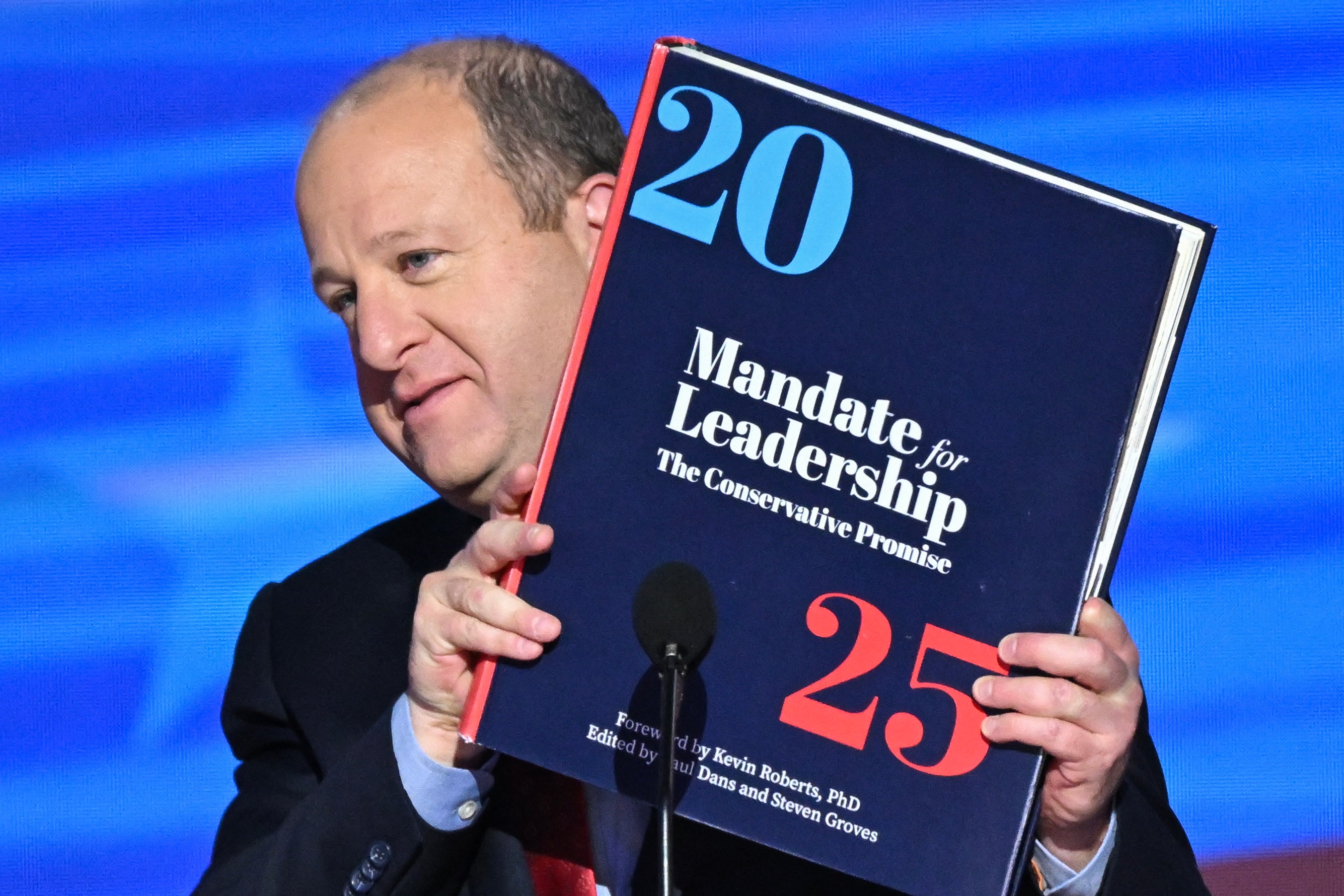
Democrats including Colorado governor Jared Polis used warnings about Project 2025 to try to sway voters away from Trump – however, the president distanced himself from the Heritage Foundation’s mandate (AFP/Getty)

The administration has taken up other specific suggestions in Project 2025, such as eliminating Medicaid funding to Planned Parenthood, modernizing nuclear facilities, and removing environmental protections to increase oil and gas drilling.

Going into 2026, the administration is likely to take up other suggestions in Project 2025 that it wasn’t able to implement swiftly – namely, implementing policies and goals that combat China.

Sunday, February 02, 2025

Trump said he hadn’t read Project 2025 – but most of his early executive actions overlap with its proposals, HE LIED

Steve Contorno and Casey Tolan, 
CNN
Fri, January 31, 2025 


President Donald Trump caught his own administration off guard last week by suggesting that the nation’s primary disaster response agency might simply “go away.”

Though Trump had routinely lambasted the Federal Emergency Management Agency throughout his third White House bid, he had stopped short of calling for its elimination. Now, an executive order bearing his signature has put that possibility in motion.

The idea, however, wasn’t new. The contours of it circulated nearly two years ago through Project 2025, a sweeping plan to overhaul the government that Trump as a candidate forcefully disavowed.

Many of Trump’s early actions appear closely aligned with Project 2025’s plans.


A CNN analysis of the 53 executive orders and actions from Trump’s first week in office found that more than two-thirds – 36 – evoke proposals outlined in “Mandate for Leadership,” Project 2025’s 922-page blueprint for the next Republican president. The overlap includes early steps taken by Trump to execute some of his most-touted pledges: cracking down on illegal immigration; dismantling diversity, equity and inclusion initiatives; and rolling back environmental restrictions on oil and gas exploration.

But the framework offered in “Mandate for Leadership” also foreshadowed some of Trump’s more provocative and less expected early actions.

It calls for “quickly and aggressively” punishing countries that refuse deported migrants – as Trump did Sunday when Colombia blocked two US military planes carrying deportees. It advises the president to “immediately revoke the security clearance” of top national security officials accused by conservatives of political bias, a move Trump executed within hours of taking office. And Trump’s directive to curb foreign aid from countries “not fully aligned” with his global aims appeases Project 2025’s concern that these programs are “disconnected from the strategy and practice of U.S. foreign policy.”

“This is exactly the work we set out to do,” Paul Dans, who oversaw Project 2025 at the conservative Heritage Foundation, told CNN in an interview Wednesday. “It’s still in the early first stages of bearing fruit, but we wanted to make sure the president was ready to hit the ground running on day one. The rapidity and the depth of what they’ve rolled out this quickly is a testament to the work done in Project 2025 and other presidential transition projects.”

The fraction of executive actions that so far do not touch on Project 2025 priorities include some of Trump’s narrower fixations, like declassifying records on the assassination of President John F. Kennedy, requiring federal workers to return to the office and demanding the flag fly at full staff during presidential inaugurations.

In a statement to CNN, the White House picked up where Trump’s campaign left off downplaying any connection between the Republican leader and the conservative playbook. The president, his spokesman Harrison Fields said, “had nothing to do with Project 2025.”

“In his first few days in office, President Trump has delivered on the promises that earned him a resounding mandate from the American people – securing the border, restoring common sense, driving down inflation, and unleashing American energy,” Fields said.

The Heritage Foundation declined to comment.

From ‘lay the groundwork’ to ‘I haven’t read it’

Think tanks and advocacy organizations from both sides of the aisle typically prepare for incoming administrations with ready-made policy proposals. But Project 2025 was significant for its breadth and coordination across the conservative movement.

The Heritage Foundation has found success influencing Republican administrations “through the back channels where a lot of Washington work happens” going back to President Ronald Reagan, said Heath Brown, a City University of New York professor who’s written multiple books on presidential transitions.

The organization once boasted that Trump during his first year as president had implemented 64 percent of the 334 policies recommended in the 2016 version of “Mandate for Leadership.” As Trump prepared for a third White House bid, he set the stage for Heritage’s seminal work to inform his next administration’s priorities once again.

“They’re going to lay the groundwork and detail plans for exactly what our movement will do,” Trump said during an April 2022 keynote address to the organization first unearthed by the Washington Post.

At least 140 former Trump administration officials and dozens of ardent allies ultimately wrote and contributed to “Mandate for Leadership.” More than 100 friendly organizations endorsed it.

But by mid-2024, with Democrats seizing on Project 2025’s more controversial proposals, Trump furiously sought to distance himself from what would become a deeply unpopular manifesto.

“I have nothing to do with Project 2025,” Trump said in the opening moments of his September debate against Vice President Kamala Harris. “That’s out there. I haven’t read it. I don’t want to read it, purposely. I’m not going to read it.”

Since his November victory, though, Trump has filled key government posts with people who helped put Project 2025 together. Both Tom Homan, who is serving as White House border czar, and Trump’s new CIA Director John Ratcliffe contributed to “Mandate for Leadership.” Brendan Carr, named chairman of the Federal Communications Commission by Trump, wrote an entire chapter for Project 2025 on the agency he now leads.

Russ Vought, chosen as director of the Office of Management and Budget, authored a section on presidential power that appeared to preview the freeze on federal spending put in place this week by Trump’s young government.


Russell Vought arrives for a Senate Homeland Security and Governmental Affairs confirmation hearing on Capitol Hill on January 15, 2025 in Washington, DC. - Andrew Harnik/Getty Images

The president, Vought wrote for Project 2025, “should use every possible tool to propose and impose fiscal discipline on the federal government. Anything short of that would constitute abject failure.”

Dans, who stepped down from his position in July amid intensifying criticism of Project 2025 from Trump, said the first week of Trump’s new term has been “gratifying” to watch. He called the Democratic Party’s “obsession” with Project 2025 – the subject of tens of millions of dollars in negative ads during the presidential race – an “epic electoral fail.”

Democrats, though, continue to attack Trump over his ties to the conservative blueprint. Since the election, the Democratic National Committee has sent more than 50 press releases that included the term “Project 2025.”
Beyond political alignment

Some of the synergy between Trump’s early movements and Project 2025 reflect the expected harmony of a new Republican administration and a supportive right-wing group. Indeed, a considerable share of the manifesto’s voluminous policy plans are anchored in two consistent themes: unravel Joe Biden’s presidency wherever possible and return to the policies of Trump’s first term.

In Trump’s first executive order after taking office, he revoked 67 of Biden’s executive orders – including at least 15 singled out in “Mandate for Leadership.”

Meanwhile, reinstating his first-term border policies – such as blocking federal grants to cities that don’t comply with immigration enforcement – satisfied some of Project 2025’s own immigration prescriptions.

But Trump also moved to restrict temporary protected status for those fleeing humanitarian emergencies, paused disbursements to non-profits assisting undocumented immigrants and mobilized the military to assist in border enforcement – all policies pushed by Project 2025.

“This is not a continuation of the first Trump administration. It is substantially more aggressive, and he’s doing a lot of the things we complained he didn’t do in the first term,” said Ken Cuccinelli, the acting deputy secretary for the Department of Homeland Security under Trump who authored the Project 2025 section on his former agency.

The “general aggressiveness is certainly consistent” with what Cuccinelli wrote in Project 2025, he added, pointing especially to the deployment of the military and Trump’s use of Department of Justice officers to assist in deportation.

As for FEMA, Cuccinelli in “Mandate for Leadership” urged the new administration to “shift the majority of preparedness and response costs to states and localities.” The language is recognizable in the proposal Trump floated recently while touring North Carolina flood damage: “We’re going to recommend that FEMA go away and we pay directly, we pay a percentage, to the state, and the state should fix it.”

In his ensuing executive order, Trump launched a commission to review changes to FEMA, including whether the agency should be reformed to function only as a “support agency” to the states.

Michael Coen, a former FEMA chief of staff during the Obama and Biden administrations, said that while he had seen the Project 2025 proposal for the agency, it surprised him to hear Trump vocalize it.

“I never imagined it would be something that he would openly talk about,” Coen said. “It does seem like there are people in the president’s ear that are pushing what is in Project 2025 as far as their plan for FEMA.”

President Donald Trump speaks while visiting a neighborhood affected by Hurricane Helene in Swannanoa, North Carolina, on January 24. - Mandel Ngan/AFP/Getty Images

Cuccinelli acknowledged he also hadn’t expected Trump to embrace his proposal on FEMA. In his first term, Trump relished his power awarding emergency relief to disaster-stricken areas.

“President Trump does love to show up and write checks, but I give him a lot of credit,” Cuccinelli said. “He clearly recognizes that FEMA as a concept is failing.”

Coen expects Republican governors and local officials will push back against this worldview.

“States across the country have come to rely on the federal government,” Coen said. “It’s hard to budget for if you’re going to get a 500-year rain event that’s going to wash away a town, and wash away your critical infrastructure.”
Promises made, Project 2025 kept

Trump previewed many of his opening movements as president more than a year ago in a series of policy proposals published on a campaign website called “Agenda47,” such as ending subsidies for electric vehicles, limiting refugee programs and restoring a first-term directive allowing him to remove federal workers deemed insufficiently loyal. Those ideas were separately backed by Project 2025’s authors.

Trump’s campaign website made clear he intended to reopen Alaska to drilling – which he did on his first day as president. Project 2025 endorsed not only the move, but also the urgency.

“Alaska is a special case and deserves immediate action,” one section said.

Some of Project 2025’s other priorities have been achieved indirectly through Trump’s actions. For example, a pending plan by the Biden administration for a ground and surface water limit on toxic PFAS, or perfluoroalkyl and polyfluoroalkyl substances, was withdrawn under Trump’s day one freeze on new regulations.

A section on the Environmental Protection Agency in “Mandate for Leadership” encouraged the new president to “revisit the designation of PFAS chemicals as ‘hazardous substances.’”

Groups that had pushed for the Biden administration to crack down on PFAS – known as “forever chemicals” because they don’t degrade in the environment – were well aware of the target placed on those regulations by Project 2025, said Melanie Benesh, vice president of governmental affairs at the Environmental Working Group.

There was some reason for optimism, Benesh acknowledged, when Lee Zeldin, Trump’s EPA administrator, touted his past work tackling PFAS during his confirmation hearing. But that hope dissipated when Trump’s executive order effectively stalled Biden’s planned crackdown.

“It calls into question the incoming administrator’s commitment to taking on PFAS,” Benesh told CNN.

EPA spokeswoman Molly Vaseliou said it was “common transition procedure” to hold pending regulations when a new administration comes in.

“President Trump advanced conservation and environmental stewardship while promoting economic growth for families across the country in his first term and will continue to do so this term,” Vaseliou said.
Beyond Trump’s first week

As the administration moves forward, the extent to which Trump’s actions run parallel to Project 2025 will remain a central question. Some of Trump’s early executive orders appear to lay the groundwork for future actions advocated by Project 2025.

For example, Trump’s national energy emergency calls for a review of regulations protecting endangered and marine wildlife that may be “obstacles to domestic energy infrastructure.” Project 2025 suggests the new administration move immediately to lift protections on grizzly bears and gray wolves and work with Congress on an overhaul of the Endangered Species Act.

An immigrant is detained by US Immigrations and Customs Homeland Security Investigations agents at a Home Depot parking lot in Tucson, Arizona, on January 26. - Rebecca Noble/Reuters

Elsewhere, Trump has taken steps that seem to go beyond what Project 2025 has proposed. Nowhere in the dozens of pages dedicated to a forceful crackdown on immigration do “Mandate for Leadership” authors suggest declaring the US is under invasion and designating Mexican drug cartels as terrorist groups, as Trump did in his executive orders. Similarly, Trump exceeded Project 2025’s calls to restart federal executions with an executive order expanding the potential crimes that could trigger the death penalty.

Still, not all of Project 2025’s plans are necessarily included in the public manifesto. The project’s website acknowledged it intended to deliver the Trump transition a “playbook of actions” for the administration’s first 180 days. Neither Heritage nor the Trump White House would say if that exchange took place. And in a hidden-camera video of Vought released last year, he said his group was drafting hundreds of potential orders, regulations and memos for Trump.

“With immigration in particular, executive orders aren’t necessarily the thing that makes policy change,” said Dara Lind, a senior fellow at the American Immigration Council, an advocacy group for immigrants. “What’s been notable from the first nine days or so is not just that they had the executive orders ready to go on day one,” but other technical regulations and declarations on hand as well.

“That kind of timeline indicates a certain amount of preparation before getting into office,” she said.

Dans noted Project 2025 also engaged in a nationwide search for Trump loyalists to fill federal agencies with people who would execute his agenda.

“It all comes down to implementation,” Dans said, “And Project 2025 was ultimately about putting in place the people who would come in from outside the swamp and make changes.”

On at least one issue, Trump is already spurning Project 2025: the future of TikTok. Trump in an executive order paused a ban on the Chinese social media app, which Project 2025 described as a national security imperative.

Trump also recently said he was “very unlikely” to limit abortion pill access. Project 2025 not only pushes for the administration to reverse federal approval of the abortion pill mifepristone, it also proposes excluding the morning-after pill and men’s contraceptives from coverage mandated under the Affordable Care Act.

Trump has, though, moved to restrict federal funding for abortions both domestically and abroad, a stance that also appears in Project 2025’s policy framework. And his nominee to lead the Department of Health and Human Services, Robert F. Kennedy Jr., told a Senate hearing Wednesday that Trump asked him to “study the safety” of mifepristone.

CNN’s review of Trump’s executive actions covered the first week of his new term, from his swearing in until noon on Monday. In the days since, he has remained active, restricting certain treatments for transgender minors, keeping transgender adults out of the military and reinstating servicemembers who were discharged for refusing COVID vaccinations.

Each of those moves had support in Project 2025.

Editor’s Note: This story has been corrected to reflect the type of water affected by a withdrawal of new regulations on PFAS.

CNN.com

Wednesday, August 28, 2024

Project 2025 would lower taxes for the rich and hike them for everyone else: analysis

Edward Carver, Common Dreams
August 28, 2024 


The Center for American Progress on Tuesday released an analysis of the tax plans in Project 2025, a right-wing manifesto whose authors have close ties to Republican presidential nominee Donald Trump, showing that conservatives aim to lower taxes on corporations and the rich while raising them on working- and middle-class Americans.

The liberal research and advocacy group, which published the analysis as part of a series of in-depth articles on Project 2025, found that the right-wing plan would raise income taxes for the median family of four by about $3,000, cut taxes by at least $1.5 million for a household earning more than $10 million per year, on average, and cut the corporate tax rate to 18% from 21%, an already historically low rate instituted by Republicans in 2017.

The analysis, authored by Brendan Duke, a senior director of economic policy at CAP, shows that, of households with a married couple and two children, only those earning more than $170,000 per year would see a tax break under the Project 2025 plan.

"This analysis lays bare how the extreme, conservative Project 2025 plan is more of the same from conservative leaders—delivering handouts to the wealthy and corporations on the backs of working people," Kobie Christian, a spokesperson at Unrig Our Economy, an advocacy group, said in a statement.

The Project 2025 plan would consolidate seven tax brackets into just two—15% and 30%—on the grounds that it would "simplify" the tax code. However, CAP says that the existing number of tax brackets don't create any additional complexity and are easily dealt with by tax-filing software. Moreover, 70% of tax filers only deal with the two lowest tax brackets—10% and 12%—"so they effectively are already in a two-bracket system," Duke wrote.

CAP's findings about the impact of Project 2025's tax proposals on median earners are in keeping with those of the Democrats on the U.S. congressional Joint Economic Committee, who released a similar analysis earlier this month.

CAP included projections of the impact that Project 2025 would have on median income earners in each state and in the District of Columbia. Only in D.C., a high-earning area, were median earners projected to pay lower taxes under the right-wing plan; in all 50 states, their taxes went up.

It's unclear how popular the Project 2025 tax plans would be. Polling from Navigator Research, a progressive polling firm, in February showed that the vast majority of Americans favor increasing taxes on the rich and large corporations.

In addition to the immediate tax plans laid out above, Project 2025 also puts forth a long-term plan to replace all income taxes with a value-added tax—a flat, regressive proposal endorsed by some U.S. House Republicans. In addition to the injustice of such a plan, it may also be impractical. CAP found that it would require a value-added tax—similar to a sales tax—on everything, even essential items such as groceries and healthcare, of at least 45%, if it were to replace lost government revenues, and warned that this would cause inflation.

Project 2025 policy agenda is a 920-page manifesto written by right-wing groups including the Heritage Foundation. The plan has drawn intense media attention in recent months and has proven unpopular with the American public, leading Trump, who was president from 2017 to 2021, to repeatedly try to distance himself from it. However, 140 of his former administration officials helped create the manifesto.

Stephen Moore, a Heritage Foundation fellow and an outside economic adviser to Trump, helped write Project 2025 tax plan, according to Duke. Moore drew scrutiny this week for questioning the need for the child tax credit.


Project 2025 Provides a GOP Blueprint for Destroying America’s Labor Unions and the Rights of America’s Workers
August 28, 2024
Source: Originally published by Z. Feel free to share widely.

The approach of Labor Day provides an appropriate time to reflect upon how Donald Trump and his MAGA Republicans, if restored to power, will deal with the American labor movement.

Much of the evidence on this score is available in Project 2025, a 922-page public policy agenda, produced by the Heritage Foundation, for the first 180 days of a new Republican administration. Ever since 1981, this exceptionally wealthy, conservative, and powerful Washington think tank has been churning out blueprints for incoming Republican administrations. In fact, the Heritage Foundation performed the same service for the first Trump administration, bragging after only a year that the Trump White House had implemented nearly two-thirds of its proposals.

The Project 2025 policy agenda is far-ranging and includes many of the nostrums advanced by rightwing Republicans, including abolishing the U.S. Department of Education, slashing taxes for the wealthiest Americans and corporations, building a wall on the U.S.-Mexico border, further restricting abortion, increasing oil and gas production, maintaining a “biblically based” definition of marriage and family, and ending diversity, equity, and inclusion programs.

But few of the project’s recommendations are as extreme as those dealing with America’s unions and the workers they represent.

For example, Project 2025 calls for banning public employee unions―unions representing teachers, librarians, firefighters, postal workers, police, clerks, trash collectors, and other public sector workers. As 32.5 percent of public sector employees belong to unions, they constitute the most highly unionized portion of the American workforce. Thus, the abolition of their unions would eliminate nearly half the union membership in the United States.

Nor would the rest of the nation’s union members, composed of private sector workers (only 6 percent of whom belong to unions), fare much better under this Heritage Foundation scheme. Most notably, Project 2025 advocates empowering the states to ban labor unions. Even partway through existing contracts, unions could be terminated. Furthermore, it would become illegal for employers to voluntarily recognize unions, while businesses would be allowed to create their own sham company unions.

Stripped of their access to union representation and the benefits unions bring, American workers would face still further losses of long-standing rights. Project 2025 calls for allowing the states to ignore the federal minimum wage and overtime pay laws, as well as for eliminating child labor rules that protect children from working in mines, meatpacking plants, and other hazardous workplaces. In these and other ways, Project 2025 promotes a return to the distant past, before the advent of legislation to prevent the abuse and exploitation of American workers.

Moreover, to safeguard the implementation of the Heritage Foundation’s rightwing agenda, Project 2025 champions firing as many as 50,000 federal government workers and replacing them with Trump loyalists.

Not surprisingly, once the extremist proposals in Project 2025 began to attract negative publicity, Donald Trump scrambled to distance himself from it. “I know nothing about Project 2025,” the Republican presidential candidate declared. “I have no idea who is behind it.”

Nevertheless, the connections between Trump and Project 2025 were hard to disguise. A CNN investigation revealed that at least 140 people who worked in the Trump administration helped write or had a hand in the Heritage Foundation game plan, including six of Trump’s former Cabinet secretaries. In fact, the person overseeing the entire project, Paul Gans, had served as a top official in the Trump White House.

Embarrassed by the growing controversy over Project 2025, key participants scurried for cover. Gans suddenly retired from the project in July, announcing that, given the election season, he would “direct all my efforts to winning bigly.”

Upon Gans’s departure, Kevin Roberts, the director of the Heritage Foundation and a leading Trump ally, took command of Project 2025. But Roberts, too, facing unpleasant public scrutiny and Democratic Party criticism, sought to downplay Project 2025’s connection to Trump and the Republican Party. This included postponing, until after the election, the publication of his forthcoming book, which contained a revealing foreword by J.D. Vance. In the foreword, the GOP vice-presidential candidate observed that “the Heritage Foundation isn’t some random outpost on Capitol Hill; it is and has been the most influential engine of ideas for Republicans from Ronald Reagan to Donald Trump.”

Only two years before, Trump himself emphasized his staunch and continued partnership with the Heritage Foundation. Attending a foundation event, he remarked: “This is a great group, and they’re going to lay the groundwork and detailed plans for exactly what our movement will do and what your movement will do when the American people give us a colossal mandate to save America, and that’s coming.”

In addition, if anyone had any doubts about what Trump and his MAGA Republicans would do in the future about workers’ rights, they had only to look at the labor record of the first Trump administration. That record included sabotaging America’s labor unions, presiding over massive plant closures and job losses, blocking workers’ wage gains, and undermining the health and safety of American workers.

Consequently, the nation’s labor movement saw Trump’s past record and agenda for the future for what they were. In a statement issued on July 18, 2024, Liz Shuler, president of the national AFL-CIO, declared: “In his first term as president, Donald Trump was a disaster for workers and our unions.” Moreover, “the Trump Project 2025 Agenda lays out his plan to turbocharge his anti-worker policies, eliminate or control unions, and eviscerate labor laws and workers’ contracts.” Consequently, “a second Trump term would put everything we’ve fought for―good jobs, fair wages, health care, retirement security, worker security―on the chopping block.”

Indeed, Project 2025 provides a powerful reminder to the labor movement and its supporters of how important it is to defeat the election of Trump and his MAGA Republicans this November.


ZNetwork is funded solely through the generosity of its readers.


Lawrence S. WittnerWebsite

Lawrence ("Larry") Wittner was born and raised in Brooklyn, NY, and attended Columbia College, the University of Wisconsin, and Columbia University, where he received his Ph.D. in history in 1967. Thereafter, he taught history at Hampton Institute, at Vassar College, at Japanese universities (under the Fulbright program), and at SUNY/Albany. In 2010, he retired as professor of history emeritus. A writer on peace and foreign policy issues, he is the author or editor of twelve books and hundreds of published articles and book reviews and a former president of the Peace History Society. Since 1961, he has been active in the peace, racial equality, and labor movements, and currently serves as a national board member of Peace Action (America's largest grassroots peace organization) and as executive secretary of the Albany County Central Federation of Labor, AFL-CIO. On occasion, he helps to fan the flames of discontent by performing vocally and on the banjo with the Solidarity Singers. His latest book is Working for Peace and Justice: Memoirs of an Activist Intellectual (University of Tennessee Press). More information about him can be found at his website: http://lawrenceswittner.com

Wednesday, July 24, 2024

U.S. public rapidly sours on Project 2025 as awareness grows
Julia Conley,
 Common Dreams
July 24, 2024 7

Donald Trump (Mandel Ngan/AFP via Getty Images)

New polling out on Tuesday suggests that Republican presidential nominee Donald Trump's best hope for Project 2025, the far-right policy agenda that at least 140 of his former administration officials helped craft, was that most Americans would remain unfamiliar with it.

Over the past month, though, a growing number of voters have learned more about the 900-page plan spearheaded by the right-wing Heritage Foundation—and public opinion of the agenda has plummeted as it's become more widely known.

Progressive polling firm Navigator Research found in a survey conducted between July 11-14 that 54% of Americans were familiar with Project 2025, which calls for the weakening and eradication of federal agencies and the consolidation of power with the president, the elimination of job protections of thousands of federal employees, and the withdrawal of mifepristone—a pill used in a majority of abortions in the U.S.—from the market.


That's an increase of 25 percentage points from Navigator's poll on Project 2025 just one month ago, said the firm.

Just 11% of people polled viewed the agenda favorably, while 43% had unfavorable views—a 24-point increase since June.

Project 2025 appears to especially be galvanizing Democratic voters, 71% of whom said they were aware of the document. Nearly two-thirds of Democrats said they had unfavorable views of Project 2025, and 62% said their opinion was "very unfavorable."

Nearly two-thirds of independent voters said they still didn't know enough about the project to have an opinion, but 28% of independent respondents said they had an unfavorable view of the agenda.

Overall, said Navigator, "the recent upsurge in conversations and news coverage about the plan" since June has resulted in a greater number of Americans having negative views of Project 2025.

Following President Joe Biden's announcement on Sunday that he was ending his campaign for reelection and instead endorsing Vice President Kamala Harris, the vice president took direct aim at Project 2025 in her speech officially announcing her intention to seek the Democratic Party's nomination.

"I will do everything in my power to unite the Democratic Party—and unite our nation—to defeat Donald Trump and his extreme Project 2025 agenda," said Harris.

The vice president linked Trump to Project 2025 despite his attempts to distance himself from the agenda. As Common Dreams reported earlier this month, another poll by Navigator Research showed that 63% of Americans believed Project 2025 described Trump's vision and plans even as he claimed he "knew nothing" about the agenda and didn't know who was behind it.

Former Trump administration officials Russ Vought, who led the Office of Management and Budget, and John McEntee, who served as the White House personnel director, are among the co-authors of Project 2025.

The poll released on Tuesday found that 45% of respondents said Project 2025 describes Trump's agenda, while only 16% said it does not describe his plans for the country.

Along with the focus Biden, Harris, and other Democratic politicians have increasingly placed on Project 2025 in recent weeks, the movement against the plan has gotten a boost from the BET Awards on June 30, when host Taraji P. Henson urged viewers to vote in the election and warned the audience about the Republican agenda.

"Pay attention, it's not a secret, look it up," the actress said. "They are attacking our most vulnerable citizens. The Project 2025 plan is not a game. Look it up!"

Stephen Colbert also explained the agenda on "The Late Show" earlier this month.

Eric Michael Garcia of The Independent shared on social media Tuesday that Project 2025 has "genuinely permeated the culture," judging from people who have mentioned it to him, unprovoked, during his reporting.


Journalist David Roberts said Democratic politicians "have been discovering somewhat to their surprise that Project 2025 is 'sticky.'"

"Make this election about it. Make it famous," he advised. "One of the biggest and most persistent problems in recent U.S. politics is that the right's agenda is so malign that most disengaged voters just flat don't believe it. Describing it sounds like partisan attack. Well, they wrote it down. All of it. Make it famous!"

Thursday, August 01, 2024

Project 2025 Isn’t Just Anti-Abortion. It Attacks Surrogacy, IVF, Contraception.

The right’s 922-page policy agenda for a Trump presidency offers an extremist plan for rolling back reproductive rights.
July 28, 2024
Source: TruthOut


From left to right: Cody Carnley of Crenshaw County, Alabama; Carrie McNair of Mobile; Veronica Wehby-Upchurch of Birmingham and Lindsey Shaw of Birmingham hold signs at a rally in aupport of legislation to protect in vitro fertilization on Feb. 28, 2024 in Montgomery, Alabama. (Brian Lyman/Alabama Reflector)

Early childhood educator Sammi Gerken, a married mother of a 3-year-old, became a surrogate in late 2022 and calls the experience “rewarding on all fronts.” “I was proud and happy to give a couple who had struggled with infertility for 11 years what they’d dreamed of — a baby — something that would have been impossible without me,” she told Truthout.

Even as a child, Gerken says that she was fascinated by birth, pregnancy and motherhood. “I used to watch YouTube videos, which is where I learned about in vitro fertilization, surrogacy and infertility. Watching people struggle to achieve a healthy pregnancy pulled at my heart. I couldn’t imagine longing for a baby and not being able to have one. After a successful pregnancy with my daughter in early 2021, I felt it was time to explore becoming a surrogate.”

And, although Gerken said that she had to go through numerous medical procedures, including hormone injections, to sustain the pregnancy, she is “beyond glad” she did it.

She is also thrilled that she and the receiving family continue to be in touch. Throughout the pregnancy, Gerken said that they exchanged daily texts and frequently met over Zoom. Then, after the baby was born, she pumped breast milk for four months. “It was a beautiful way to stay connected,” she said. “Although we no longer text as often, I’ll see them in August for the baby’s first birthday. We all want to have a lifetime relationship. Our hearts will forever be connected.”

As Gerken speaks, it’s obvious that she is passionate about the efficacy of surrogacy. This is why Project 2025, a 922-page right-wing wish list and game plan that is explicit about its intent to impose a nationwide ban on abortion and limit access to contraceptives, IVF and surrogacy, enrages her. “Why should outsiders decide how people grow their families?” she asks. “Surrogacy is love. It’s a valid way to build a family.”

The right-wing, of course, disagrees — even as the Republican National Committee’s official platform strategically steers clear of a direct attack on reproductive autonomy. But Project 2025 is far more explicit, and its authors are hell-bent on creating what Kevin Roberts, president of the Heritage Foundation, the organizational mastermind behind Project 2025, calls “the second American revolution.”

For Heritage and the more than 100 organizations that endorse the plan, that revolution involves the creation of a policy agenda for the first 180 days of a GOP presidency and lays “the groundwork for a White House more friendly to the right.” The plan also includes the creation of a personnel database of conservative movers and shakers, something that Paul Dans, director of the 2025 Presidential Transition Project at Heritage and Trump’s former director of the Office of Personnel Management, likens to a LinkedIn or Facebook for the right. Should this roster include people new to government, he says, a Presidential Administration Academy has been established to train potential staffers for every federal agency. A series of free, online, asynchronous classes covers everything from how to get a security clearance, to “the dangers of the administrative state,” to how federal budget processes and procurements work. This, of course, is to ensure that a well-trained workforce is ready to jump in on day one to serve the MAGA cause.

What’s more, Project 2025 provides an agency-by-agency playbook that explains what each government department will advocate for and do.

In an interview with The Washington Stand, the daily news site of the Christian nationalist Family Research CouncilDans stressed that,


We want new folks to come in and serve, essentially, but to do that they need to know how this game is played and the rules of the road. That’s what we are hoping to do. We’re going to identify talent and then we’re going to teach you essentially what our core group of beliefs is…. We need to have an entire army of conservatives coming to Washington.… In the past, the transition effort has really been the second thought for the candidate.

But not this year.

“We want every potential applicant to curate his or her own page and upload their resume, list their social media, take some background diagnostic tests,” and make themselves known, Dans told The Washington Stand.

Unsurprisingly, anti-abortion credentials and a commitment to eroding access to reproductive health care are feathers in the cap of job applicants.
Project 2025 Threatens Reproductive Care

According to Media Matters for America, a media literacy and watchdog organization, the Project 2025 plan, officially called the “Mandate for Leadership: The Conservative Promise,” aims to remove the word “abortion” from all federal laws and regulations; roll back the Food and Drug Administration’s approval of medication abortion; use the Comstock Act, a Victorian-era law that was passed in 1873, to ban the mailing of abortion pills and stop clinics from receiving shipments of supplies and equipment; and limit access to birth control, in vitro fertilization and surrogacy. Moreover, Project 2025 seeks to end research using fetal tissue and stop the sale of nonprescription emergency contraception, including the popular over-the-counter pill Ella, which it erroneously claims is an abortifacient.

The Media Mattersreport, “Inside Project 2025’s Attacks on Reproductive Rights,” further states that Project 2025 hopes to elevate draconian state policies, like a Louisiana law that makes “carrying abortion medication without a prescription” a crime, into federal law.

Additionally, Media Matters zeroes in on Project 2025’s promotion of fallacies, among them that taking a daily birth control pill causes infertility; that IVF is unregulated; and that frozen embryos are children. Media Matters also points out that “at least 17 partner organizations of Project 2025 have published and publicly presented anti-surrogacy arguments,” including the idea that surrogacy is “morally wrong.”

“From the moment of conception,” Project 2025 states “every human being possesses inherent dignity and worth and our humanity does not depend on our age, stage of development, race or abilities.”

This statement is a particularly bitter pill to swallow for Stetson Law School professor Robyn M. Powell, a nationally recognized expert on disability law and its intersection with reproductive justice. “The anti-abortion movement has used disabled people as pawns for years, and the idea that legal abortion encourages eugenics — policies that dictate who is fit and who is unfit to have children — is absurd,” Powell told Truthout. “People with disabilities are disproportionately impacted by anti-abortion policies that tell us what we can and can’t do with our bodies.”

In addition, she says that despite lip service about the value of every human life, those who oppose abortion do little to nothing to support or improve the lives of those living with disabilities. “As disabled people, we understand that attacks on the rights of the poor, the LGBTQIA+ community and women are attacks on us since we are part of multiple marginalized communities,” she said.

In addition, Powell sees Project 2025’s emphasis on deregulation as another potent area of attack, since eliminating federal agencies such as the Department of Education and the Occupational Safety and Health Administration — long-standing goals of the Heritage Foundation as well as many others on the right, and explicitly advocated in Project 2025 — would cause irreparable harm to the disabled.

“Project 2025 impacts everything,” Powell told Truthout. “It is infuriating.”

Andrew Beck, senior staff attorney at the ACLU’s Reproductive Freedom Project, agrees that the project has deep tentacles, but is keeping his eyes on Project 2025’s implications for abortion access. “Despite Trump’s efforts to obfuscate the issue, abortion is on the ballot this year,” Beck told Truthout. He calls Project 2025 “a 900-page nightmare,” and says that some of the document’s most egregious provisions are buried deep within it.

“The Comstock Act is never mentioned by name,” Beck noted. (Instead, the document references “long-standing federal laws that prohibit the mailing and interstate carriage of abortion drugs.”)

“For many decades, the Comstock Act was assumed to have no application whatsoever for abortion care,” Beck said. “But in the last few years, a drumbeat has been heard and echoed by Project 2025 to use Comstock, a law that is already on the books, as a back door to a nationwide abortion ban. This statute makes it a crime to mail or ship ‘any article or thing designed, adapted, or intended for producing abortion.’ If they use Comstock, they do not need Congress to pass an abortion ban.” Project 2025, he continues, is also “gunning for medication abortion. This has been a target of anti-abortion politicians for a long time, but now that two-thirds of all U.S. people who have abortions use pills, this goal has been heightened.”

Beck further notes other potential incursions that could impact reproductive health, including the desired weakening of the Health Insurance Portability and Accountability Act (HIPAA), passed in 1996 to keep medical information from being shared without the patient’s permission, and an end to the over-the-counter sale of emergency contraceptives.

“The ACLU is doing all it can to raise the alarm about Project 2025 to elevate public concern about a second Trump administration,” Beck said. “We’re also working with members of Congress to address the threat the Comstock Act poses.”
Repealing Comstock

That effort got a boost from Tina Smith (D-Minnesota), who introduced the Stop Comstock Act into the Senate in June. The bill has 18 co-sponsors: A companion bill was introduced in the House by Representatives Becca Balint (D-Vermont), Cori Bush (D-Missouri), Bonnie Watson Coleman (D-New Jersey), Veronica Escobar (D-Texas) and Mary Gay Scanlon (D-Pennsylvania).

Reproductive justice activists and care providers know that getting the Stop Comstock Act passed is important — albeit a long shot in a GOP-controlled House of Representatives — but they also know that much more is needed to keep Project 2025’s policies at bay.

“Abortion is a vehicle to access our full humanity,” Merle Hoffman, president and CEO of Choices Women’s Medical Center in New York City, told Truthout. As a care provider since 1971, when New York State first legalized abortion, Hoffman says, “We need a unified movement to fight a defensive battle.” She explains that one way to do this is to train and mentor the next generation of physicians, midwives, nurse practitioners, physician’s assistants and social workers — something that Choices has made part of its mission.

“The people behind Project 2025 are serious and they believe wholeheartedly in what they’re advocating,” she said. “Heritage has worked on this agenda for decades and the pro-choice movement has underestimated them and treated their aspirations as ridiculous and unachievable. At the same time, the Democrats have certainly not been knights on white horses. They’ve allowed abortion to be referred to as something that should be safe, legal and rare rather than a normal part of reproductive health care. They’ve allowed the Hyde Amendment to cut off Medicaid funding for abortion. They have never been our saviors … neither they nor the courts will save us.”

She and others are working tirelessly to fight back and she is cheered that the newly formed Abortion Access Now coalition has unveiled a 10-year plan to win back abortion access and move beyond what Roe v. Wade provided. The $100 million initiative will bring nine groups together. Among them are the ACLU, the Center for Reproductive RightsIn Our Own Voice: National Black Women’s Reproductive Justice Agendathe National Latina Institute for Reproductive Justicethe National Asian Pacific American Women’s ForumPlanned Parenthood and Reproductive Freedom for All. These groups pledge to work together to build “a future where abortion, and all sexual and reproductive healthcare, is not only legal but also accessible, affordable and free from stigma or fear.” The Hill reports that the 10-year plan includes “lobbying efforts, grassroots organizing and public education initiatives” to “build a long-term federal strategy to codify the right to abortion.”

Despite this formation, Hoffman concedes that the magnitude of the attacks on reproductive freedom can feel overwhelming but says we can’t let fear and demoralization keep us from organizing and educating people about the threats we’re facing. “It’s all of our responsibility to fight for abortion and reproductive justice without borders,” she says.

With Project 2025 and Agenda 47, the USA’s Coups Come Home to Roost

The authoritarian, dystopian settings that the U.S. created in so many places across the world are being reconceived by ultra-conservative forces affiliated with Trump for the purpose of introducing them here.


By CJ Polychroniou
July 28, 2024

Since the rise of the United States into a global power, U.S. policymakers have been keen on halting the spread of popular government abroad by undermining democratic institutions; overthrowing or assassinating elected leaders; and installing brutal, vicious military dictatorships. Indeed, the fact of the matter is that the United States has invaded more countries, organized more coups, and installed more military dictatorships than any other imperialist power in the course of history. During the Cold War alone, Washington staged dozens of invasions, orchestrated or sponsored numerous coups that installed subservient governments, and engaged in total in over 70 attempts at regime change.

U.S. involvement in foreign coups was so widespread that a common joke was that there has never been a coup d’état in the United States because there is no U.S. Embassy there. Of course, the joke was before the political era of former U.S. President Donald J. Trump and thus has lost some of its sting. Because what happened at the U.S. Capitol on January 6, 2021 was a coup attempt incited by the rhetoric of an outgoing president as part of his effort to overturn the results of the 2020 presidential election. Moreover, Trump has warned voters of a “bloodbath” for the country if he is not elected in November 2024.

The roosters have come home to roost. The U.S. is sleepwalking toward democratic collapse and into a Trump proto-fascist dictatorship. If Donald Trump gets elected in November, “the gloves are off… its four years of scorched earth,” as Republican National Committee boss Lara Trump proudly announced to an audience a few months ago. Never mind people like John Bolton who tried to make the argument that Trump did not attempt a coup on January 6 because he is not competent enough to have done so. Those who entertain such thoughts seem to imply that it takes brilliance to destroy democracy. Yet, a reactionary revolt against democracy (or what’s left of it in the U.S.) has been underway since Trump gained control of the GOP. Trump encouraged violence during his 2016 campaign and levied harsh attacks against his opponents. Upon assuming office as president, he exhibited blunt authoritarian tendencies and levied attacks against the press. And when he lost a free and fair election in 2020, he tried to block a peaceful transfer of power.


There should be little doubt in any concerned citizen’s mind that the reactionary forces in this country, led by one of the most authentic con artists in political history, are as close as they have ever been to dismantling U.S. democracy.

But even if Trump isn’t capable enough to draw up a plan on his own for the dismantling of our democracy from within, there are plenty of extreme right-wingers able and willing to show him how it can be done. Indeed, the authoritarian, dystopian settings that the U.S. created in so many places across the world from the end of the Second World War to the present—through Washington’s support of oppressive political regimes that committed massive violations of human rights against their own citizens and forced them to live under constant threat—are being reconceived by ultra-conservative forces affiliated with Trump for the purpose of introducing them here inside the United States. This is precisely the aim of Project 2025, a Heritage Foundation plan to reshape the United States in a manner consistent with the ideology and vision of neoliberal proto-fascism.

Project 2025 is not Trump’s plan, but a plan for Trump. It’s also fair to point out that Trump has publicly denied knowing anything about the dystopian Project 2025. Yet, many of the people who worked in high-level positions during his presidency served as authors of the project. In fact, CNN reported finding some 240 people “with ties to both Project 2025 and to Trump.” It is thus ludicrous for Trump to claim ignorance of this extreme far-right agenda and having “no idea who is behind it.” Also, Paul Dans, director of the 2025 Presidential Transition Project at The Heritage Foundation and who had previously served in the Trump administration as the chief of staff at the Office of Personnel Management, said on a radio show during the Republican primary race last year that “Trump’s very brought in with this.” Last week, the same person suddenly claimed that the idea that Trump is attached to Project 2025 is a “hoax.”

More important, while Trump and his campaign staff have pointed out that Agenda 47 is their official policy platform for the 2024 presidential election, Project 2025 and Agenda 47 have a lot of overlap in terms of ideas and policy plans. They both contain plans for the reshaping of U.S. government and civil society that can only be described as “fascist.” They both assert that the mission they serve is to rescue the country from the influence of the radical left.

Project 2025 envisions the end of the administrative state by placing the entire federal bureaucracy under direct presidential control. In other words, the plan is for Trump to rule as a Unitary Executive, long considered a pathway for autocracy. Likewise, Trump’s plan in Agenda 47 is to dismantle what it calls the “deep state” by firing thousands of civil servants and replacing them with party hacks (though in Agenda 47 they are called “patriots who love America”). In doing so, Trump claims, federal bureaucrats and politician will be “held accountable to the American people.” Not to the president, mind you, who will now have complete control of the federal bureaucracy, but to the American people. Of course, not a single word is mentioned in Agenda 47 about how the “people” even enter the power equation of holding bureaucrats and politicians accountable to the popular will. But authoritarian leaders and wannabe dictators have always been masters of propaganda who engineer techniques of mass manipulation through the politics of illusion. And no propaganda tool is more effective in the authoritarian playbook than the one that justifies the dismantling of checks and balances as “corrupt obstacles to the popular will.”

State control over public education and teachers has always been an integral component of fascist ideology and strategy. In the neoliberal proto-fascist mentality that guides the thinking of the architects of Project 2025, the contention made however is that federal intervention in education should be severely limited and that, ultimately, the federal Department of Education should be eliminated. This is because their reactionary vision for the future of the United States would not object to the conversion of public schools into religious zones and calls for the rejection of “gender ideology” and the banning of “critical race theory.” Thus, it is of paramount importance that complete authority over primary and secondary education, including funding, transfers to the state and local level. Likewise, Project 2025 also endorses universal school choice and allowing families to access public funds to pay for private school tuition. Moreover, Project 2025 wants to ban any public education employee or institution from using a pronoun in addressing a student that does not “match a person’s biological sex” without the written permission of a student’s parents or guardians.

The call for the banning of “critical race theory” is utterly revealing of the ideological underpinnings of the architects of Project 2025. They want to see “critical race theory” forced out of classrooms because, they argue, its emphasis on the racist history of the United States “disrupts the values that hold communities together.” It’s rather shameful though that they omitted mentioning slavery as one of the values that should “hold communities together.”

As for higher education, which comes under severe attack by the reactionary minds behind Project 2025 for being “hostile to free expression” and “American exceptionalism,” student loans and grants should be placed into the hands of the private sector. They also call on the next president to downplay the value of a bachelor’s degree by removing it as a requirement for any federal job unless it is specifically demanded.

Agenda 47 is an even more extreme version of Project 2025 on the issue of education and comes much closer to authentic fascism. Trump’s proposals for K-12 schools call for, among other things, ending federal funding to any school teaching “critical race theory,” certifying only teachers who embrace “patriotic values,” firing Department of Education employees deemed radical zealots and Marxists, pushing prayer in public schools, and abolishing teacher tenure.

Trump’s Agenda 47 and Project 2025 also share the same extremist views on immigration and climate change. Project 2025 wants to demolish the entire U.S. immigration system while Trump wants to engage in draconian measures against undocumented immigrants, which includes a pledge to deport millions of undocumented immigrants living in the United States.

Regarding climate change, Project 2025 is all about a project that backs a fossil fuel agenda and wants to go so far as to eliminate the National Oceanic and Atmospheric Administration because it’s “one of the main drivers of the climate change alarm industry.” Trump’s stance on energy and climate as expressed in Agenda 47 is in full alignment with Project 2025 and can be summarized by three words: “DRILL, BABY, DRILL.”

Finally, both the Heritage Foundation’s Project 2025 and Trump’s Agenda 47 (along with his already established record on the matter) make abundantly clear that serving the interests of a plutocracy is of equal importance to them as destroying the environment and turning back the clock on social and cultural progress through the implementation of extreme authoritarian measures. Among other major changes to the tax system, Project 2025 calls for reducing the corporate tax to 18% and cementing the tax on capital gains and dividends at 15%. A second Trump presidency would most certainly also see another round of tax cuts targeted at the very rich.

In sum, there should be little doubt in any concerned citizen’s mind that the reactionary forces in this country, led by one of the most authentic con artists in political history, are as close as they have ever been to dismantling U.S. democracy and replacing it in turn with a dystopian setting guided by the very same vision, values, and even tactics that have been the hallmark of U.S. imperialist efforts to install and support neo-fascist regimes around the globe.

ZNetwork is funded solely through the generosity of its readers.Donate


CJ Polychroniou

C.J. Polychroniou is a political scientist/political economist, author, and journalist who has taught and worked in numerous universities and research centers in Europe and the United States. Currently, his main research interests are in U.S. politics and the political economy of the United States, European economic integration, globalization, climate change and environmental economics, and the deconstruction of neoliberalism’s politico-economic project. He has published scores of books and over one thousand articles which have appeared in a variety of journals, magazines, newspapers and popular news websites. His latest books are Optimism Over Despair: Noam Chomsky On Capitalism, Empire, and Social Change (2017); Climate Crisis and the Global Green New Deal: The Political Economy of Saving the Planet (with Noam Chomsky and Robert Pollin as primary authors, 2020); The Precipice: Neoliberalism, the Pandemic, and the Urgent Need for Radical Change (an anthology of interviews with Noam Chomsky, 2021); and Economics and the Left: Interviews with Progressive Economists (2021).