Russia’s War Against Ukraine: Diplomatic Talks And U.S. Policy – Analysis

August 10, 2026
By Andrew S. Bowen and Cory Welt
Key Takeaways:
The Trump Administration continues security assistance to Ukraine at reduced levels, largely through NATO-funded procurement of U.S. equipment, while maintaining most sanctions on Russia (with temporary oil-related relief earlier in 2026) and exploring limited defense-industrial cooperation.
Congress is weighing continued support, potential new sanctions legislation, and the costs and benefits of further U.S. mediation, including implications for NATO relations and long-term European security guarantees for Ukraine.
The Russian Federation (Russia) launched a full-scale invasion of Ukraine in February 2022. More than four years later, Russia and Ukraine remain engaged in Europe’s largest war since World War II. With estimates of up to 2 million or more killed or wounded, and with Russia controlling about 20% of Ukraine’s territory, neither side appears poised to achieve a decisive military victory. In 2026, Ukrainian forces have limited—and in some cases reversed—Russian gains and markedly expanded a campaign of long-range attacks against Russian oil facilities and logistics infrastructure.
The second Trump Administration has engaged in efforts to facilitate an end to the Russia-Ukraine war. Formal negotiations were last held in February 2026; whether negotiations will resume—and, if so, when—is uncertain. Members of Congress may evaluate the prospects for, and potential costs and benefits of, continued U.S. mediation between Russia and Ukraine, including implications for U.S. strategic interests.
Aspects of Negotiations
Building on discussions in 2025, Russian, Ukrainian, and U.S. officials met for the first time in a trilateral format in Abu Dhabi, United Arab Emirates, in January 2026. Two rounds of U.S.-mediated talks followed, but formal peace talks have not resumed since U.S.-Israeli military operations against Iran began in late February 2026.
In an August 2025 meeting with President Trump in Anchorage, AK, Russian President Vladimir Putin reportedly proposed a ceasefire along the line of contact in two of Ukraine’s southern regions, if Ukraine transferred populated areas of its eastern Donetsk region to Russia. This proposal appeared to be included as an element of subsequent talks, but Ukrainian authorities rejected it, maintaining (among other reasons) that the transfer of this heavily fortified “fortress belt” would greatly diminish Ukraine’s ability to defend itself from further Russian aggression.
In May 2026 remarks to the press, Secretary of State Marco Rubio said Russia-Ukraine talks had not been “fruitful” and the Trump Administration was “not interested in getting involved in an endless cycle of meetings that lead to nothing.” In July 2026, Secretary Rubio referred to the “failed” efforts that began in Anchorage but said “if the opportunity presents itself and the conditions are right,” the United States was “prepared to offer some [new ideas] in the right setting and forum.”
In June 2026, Ukrainian President Volodymyr Zelensky proposed meeting with President Putin in a neutral country to kickstart negotiations and called for “a full ceasefire for the duration of the negotiations.” President Putin reportedly rejected the proposal and suggested Russia would continue fighting until it achieved its stated goals.
Security Cooperation. The Trump Administration has announced new security assistance for Ukraine, at levels lower than from FY2022 to FY2024, while continuing to provide certain previously committed assistance. In 2025, the United States and NATO allies launched the Prioritized Ukraine Requirements List (PURL) initiative, whereby NATO allies fund procurement of U.S. defense articles for Ukraine. As of July 2026, NATO allies and partners had contributed more than $6 billion in PURL-related assistance. Some NATO and European officials reportedly have expressed concern that U.S. military operations against Iran could lead to procurement shortages and delays that may affect assistance to Ukraine. Ukrainian officials state they are running low on air defense munitions to intercept Russian ballistic and hypersonic missiles.
Ukraine has concluded some, and is seeking more, joint production and defense agreements and has removed barriers to exporting surplus defense production. Some reports indicate U.S. and Ukrainian officials are exploring ways to improve defense industry cooperation. In July 2026, President Trump indicated the United States was considering options to allow Ukraine to coproduce Patriot missiles but subsequently noted this would be a “big step” and “we have to be very careful.”
Ukrainian officials have sought guarantees against further Russian aggression, including through the deployment of Western peacekeeping forces and closer integration with NATO and the European Union. President Trump and other Administration officials have expressed the view that NATO membership for Ukraine is unrealistic while indicating support for the provision of some kind of European-led security guarantees, potentially with U.S. involvement.
U.S. Sanctions Against Russia. The Trump Administration generally has maintained previously established U.S. sanctions on Russia. The U.S. Department of the Treasury listed some new entities for sanctions, most notably two of Russia’s largest oil companies, Rosneft and Lukoil, and several subsidiaries. After the start of U.S.-Israeli military operations against Iran, the Treasury Department, to help stabilize oil markets, issued a series of general licenses temporarily relaxing sanctions on certain Russian oil exports. The last of these licenses expired on June 17, 2026, and was not renewed.
Prisoners, Detainees, and Forcibly Transferred Populations. Talks have addressed the exchange of prisoners of war, the remains of deceased persons, and the release of Ukrainian civilian detainees and forcibly transferred populations, including children.
Potential Considerations for Congress
Members of Congress may assess the costs and benefits of potential outcomes of U.S.-mediated negotiations and the likelihood of a sustainable ceasefire or peace agreement. Members may evaluate the potential impact of negotiations on other U.S. policy interests, including relations with NATO allies.
The Trump Administration and Congress may assess whether and on what terms to provide continued support to Ukraine alongside U.S. allies. For FY2026 and FY2027, Congress authorized $400 million annually in security assistance for Ukraine (P.L. 119-60, §1243); for FY2026, Congress appropriated $400 million in European capacity building, to include Ukraine (P.L. 119-75, Division A). On June 4, 2026, the House of Representatives passed the Ukraine Support Act (H.R. 2913), by a vote of 226-195, following a discharge process on a special rule that provided for the bill’s consideration.
On August 7, 2026, the Senate passed (by a vote of 86-11) a revised version of a sanctions bill first introduced in 2025, now titled the Lindsey O. Graham Sanctioning Russia and Iran Act of 2026 (S.Amdt. 6711 to H.R. 5334). This bill would reinforce existing sanctions authorities, authorize tariffs against Russia and third countries that import certain Russian products, and expand congressional oversight of most Russia sanctions imposed since 2022.
About the authors:
Cory Welt, Specialist in Russian and European Affairs
Source: This article was published by the Congressional Research Service (CRS).

About CRS
The Congressional Research Service (CRS) works exclusively for the United States Congress, providing policy and legal analysis to committees and Members of both the House and Senate, regardless of party affiliation. As a legislative branch agency within the Library of Congress, CRS has been a valued and respected resource on Capitol Hill for nearly a century.
View all posts by CRS →
By Magnus Lund Nielsen
Key Takeaways:
- Poland’s government has rejected as “absurd” and populist an opposition PiS proposal to deport military-age Ukrainian men who are not legally employed, noting that more than 90% of them already work and that many others are wounded soldiers or carers.
- PiS has pledged to create deportation centres and a central register of foreigners if it returns to power, framing the policy as enabling these men to “fight for their homeland.”
- The party is simultaneously dealing with internal splits, including former Prime Minister Mateusz Morawiecki’s departure to form a new movement, amid declining poll numbers.
(EurActiv) — Poland’s government has dismissed as unworkable an opposition proposal to deport military-age Ukrainian men who are not legally employed, describing it as an attempt to win over far-right voters.
“These plans are pure absurdity and populism,” an interior ministry spokesperson said on Saturday.
Deputy Interior Minister Maciej Duszczyk said on Friday that more than 90% of military-age Ukrainian men living in Poland were employed. Those outside the labour market include wounded Ukrainian soldiers receiving rehabilitation and parents caring for disabled children, he said.
On Thursday, Poland’s right-wing Law and Justice party (PiS) pledged to deport Ukrainian men of military age who are not legally employed if it returns to government after next year’s parliamentary election.
One of PiS’ first major decisions would be to deport Ukrainian men aged 25-60 who lack legal employment in Poland, deputy leader and MEP Tobiasz Bocheński announced at a party conference on Thursday.
“They will have the opportunity to fight for their homeland,” Bocheński said, according to local news media, Polsat News.
PiS is proposing dedicated deportation centres and a central register of foreign nationals, under which failure to meet administrative obligations could initiate deportation proceedings. The proposal would also cover Ukrainians working in the informal economy.
Separately, the EU plans to deny temporary protection to newly arriving military-age Ukrainian men (who are barred from leaving Ukraine under Ukrainian law), while extending the scheme for other Ukrainians until March 2028.
A party divided
PiS – part of the European Conservatives and Reformists (ECR) group in the European Parliament, which also includes Giorgia Meloni’s Brothers of Italy – has been shaken by internal divisions in recent months.
In late July, Mateusz Morawiecki, former Polish prime minster during the last PiS-government, splitfrom the party to create his own movement, Rozwój Plus.
Tensions escalated after the PiS leadership named a eurosceptic candidate for prime minister in next year’s election.
“Of course, we have to confront Brussels’ bureaucratic excesses and absurdities, but Poland’s membership of the European Union brings many benefits,” he said.
Recent polling puts Rozwój Plus at around 8% support in a parliamentary election. PiS is polling at 18%, down from 35% at the 2023 parliamentary election.

August 10, 2026
By Paul Goble
Many assume that Moscow Patriarch Kirill’s regular statements of support for Putin’s war in Ukraine set t
he weather for Orthodox priests and laiety in the Russain Federation, Nikolay Mitrokhin says; but that is not the case: Indeed, “only about 15 percent” of Orthodox priests there actively support the expanded Russian invasion.
Kirill’s delarations, the scholar at the University of Bremen says, are not so much directed at the priests and believers to get them to accept his position – in Orthodoxy, even a patriarch doesn’t have that right – as a sign to the Kremlin that the Patriarchate as such is loyal to Putin (vot-tak.tv/94741767/rpc-voyna).
Mitrokhin notes that “Patriarch Kirill is often perceived by analogy with the Pope or Ayatollah Khomeini – as a figure whose words automatically encourage believers to act. However, in Orthodoxy in general and in the ROC in particular, there is no direct connection between the rhetoric of the top leadership and the behavior of ordinary laity.”
Kirill’s words, he points out, “are addressed primarily to the state power, as a demonstration of loyalty. Their practice influence ends at the church pulpit where the speech was made and the real administrative powers of the patriarch are limited to the boundaries of the Moscow diocese alone,” where Kirill is bishop.
Most priests avoid talking about the war to avoid sparking conflicts within their parishes, and the Patriarchate does not encourage them to travel to Ukraine or to serve in the ranks of the Russian army. It decided on that course when priests who did early in the expanded war began to die, forcing the Patriarchate to take a public position it preferred not do so, Mitrokhin says.
Few Russian parishes are enthusiastic about the war or actively involved in getting people to serve there either from their own faithful or more generally, although many more are quite prepared to collect money and goods for humanitarian assistance, something they see as a Christian duty but not an indication of support for Putin’s political goals.
Russia could use nuclear weapons as “last option” in face of expanding Ukraine war, warns Turkish foreign minister
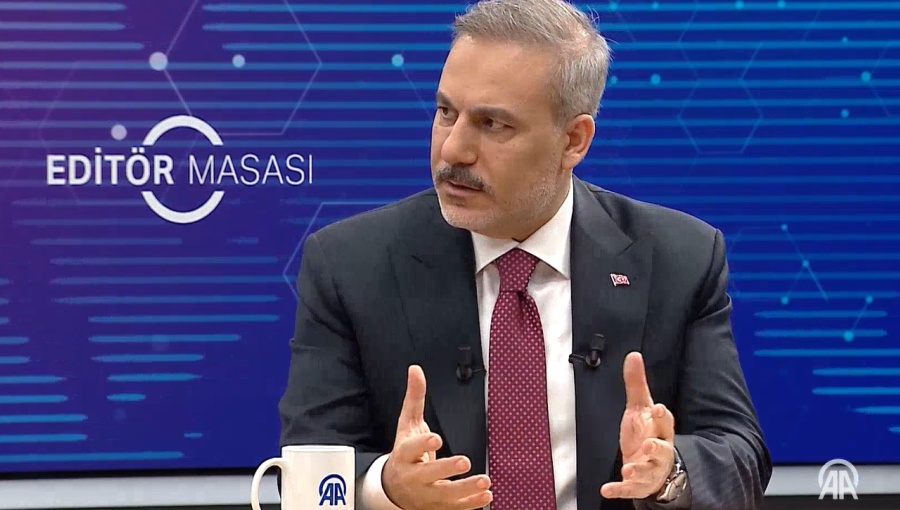
Turkey’s foreign minister has warned that an “expanding war of destruction” could cause Russia to use nuclear weapons as “the last option available to it”.
Hakan Fidan said that during a recent visit to Moscow, the Turkish delegation was close to raising the issue in talks with their counterparts because the “public is now demanding such a thing.”
“We also told the Westerners of this [concern over nuclear use], and the Westerners know it,” Fidan added in an August 8 appearance on the Anadolu Editor’s Desk programme of Turkish official news service Anadolu Agency.
Warning that “everything that it was said could not happen [in the Russo-Ukrainian conflict] is happening”, Fidan observed that the war, which ignited in February 2022, had spread beyond the battlefield and was now having severe impacts inside Russia. It was, he said, expanding geographically and becoming more extensive in terms of targets and methods, and the international community must step in to stop the fighting.
“But where no one makes concessions, the war continues with growing violence until it creates its own area for concessions. Unfortunately, this is what we are witnessing,” he said.
Call for Black Sea attacks "moratorium"
During the discussion on the show, Fidan called for a “moratorium” on attacks by Russia and Ukraine in the Black Sea following a series of strikes on civilian ships there. “The conflict has spread across the whole Black Sea,” he said. “To begin with, they targeted the ports and the military ships. Now, they are attacking all commercial shipping without distinction,” he added, noting vessels belonging to Turkey or flying the Turkish flag were among those targeted.
Fidan added that it seemed the two sides in the war seem to be waiting until they have completely exhausted each other before embracing the mentality of “now let’s sit around a table and make peace”, and with another reference to Russia’s nuclear arsenal, he cautioned: “When this destruction, this attrition on the front, turns into attrition behind the front, the issue is no longer about whether you win or lose a war or a battle on a front; it becomes an issue of whether you exist as a nation. Then you use whatever last means you have at your disposal.”
Fidan also referred to how some parties believe ending the conflict under current conditions would cost them more than allowing it to continue. This, he said, was among the reasons they remain unwilling to bring the war to an end.
In June, Reuters reported that prominent Russian nationalist figures had publicly urged President Vladimir Putin to abandon diplomacy with the US and consider more drastic military measures, including the possible use of tactical nuclear weapons. Their calls came after a series of successful Ukrainian long-range strikes inside Russia.
Though a Nato member, Turkey, as a Black Sea neighbour of both Ukraine and Russia, attempts to largely steer a path of neutrality in the conflict, with President Recep Tayyip Erdogan periodically offering to revive his previous role as an active mediator hosting peace talks attended by Kyiv and Moscow. However, Turkey does sometimes go ahead with notable arms sales to Ukraine and this weekend caused some surprise by agreeing a weapons deal that will see 70 M39 ATACMS tactical ballistic missiles, 12 M270 multiple-launch rocket systems and tens of thousands of cluster munitions from Turkish stockpiles sold to the Ukrainians.
At the end of June, IntelliNews published a comment piece, headlined "Steadily but surely, Erdogan has broken with Putin."


No comments:
Post a Comment