Monday, January 06, 2020

How climate change has intensified the deadly fires in Australia

The unprecedented conditions that have led to the devastating wildfires in Australia stem from a typical weather pattern that has been intensified by climate change. And the fire danger is expected to get worse in the future, CBS News meteorologist and climate specialist Jeff Berardelli said on "CBS This Morning" Friday.

More than 200 fires have burned roughly 12 million acres, forcing more than 100,000 residents and tourists to flee in one of the largest evacuations in Australia's history. At least 19 people have died. Navy ships helped evacuate hundreds of people from beaches along the country's southeastern coast.

With extreme heat and strong winds in the forecast, the country could see some of the worst fire weather of the season Saturday, Berardelli said.

"We're in a three-year drought in Australia," Berardelli said, adding that 2019 has been the hottest and driest year on record.

Just a couple of weeks ago, Australia hit 107 degrees for the average temperature, breaking a past record by 3 degrees. "As a meteorologist, that is remarkable, almost seems like it's not possible, but it happened," Berardelli said.

The drought is due in part to a typical weather pattern called the Indian Ocean Dipole.

"It's kind of like El Nino and La Nina. It goes back and forth over the course of years," Berardelli said. CBS NEWS
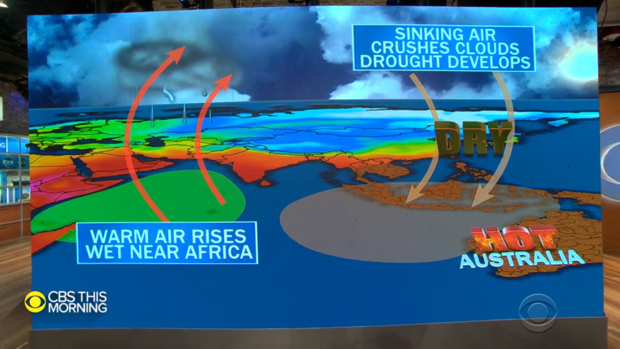
But this year, there has been a record Indian Ocean Dipole with warm water in the western part of the Indian Ocean and cooler-than-normal water in the eastern part, Berardelli said.

"So we end up with rising air over the western part of the ocean right near Africa. That causes rain. But sinking air, dry air in the eastern part of the Indian Ocean — that causes Indonesia and Australia to dry out," he said.

That extreme pattern has been made worse by warming temperatures, according to a study published in the journal Nature. The number of extreme heat days in Australia has increased from nearly zero in 1910 and 1920 to an average of about 15 per year now, and the average temperature of the country has increased by 3 degrees Fahrenheit over 100 years, Berardelli said. CBS NEWS
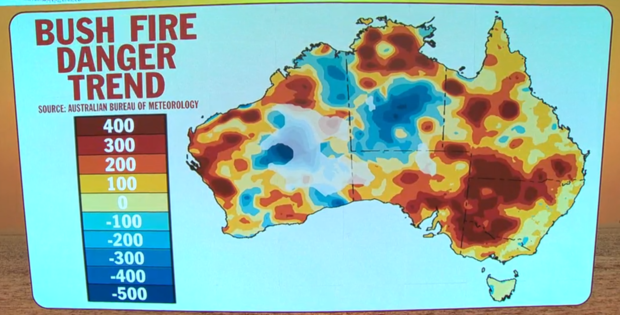
That increased heat dries out the soil and bush, increasing the fire danger, which has soared over the past 40 years, especially in the southeast portion of Australia.

"So this is a situation where climate change is kind of the background," Berardelli said. "When you have a natural pattern that's causing extreme fire danger, climate change spikes it, it enhances it, it turns extreme fire danger into catastrophic fire danger."

Berardelli added that the fire risk is expected to get worse in places like Australia.

"Places that get a lot of rain will get more rain, places that are dry like Australia will continue to get drier and drier. It will get worse there," he said. "In the United States, in places like California, not every year is a bad fire year, but when it's dry for a couple of years in a row, it will progressively get worse, and this will become kind of a new norm, but only worse."
© 2020 CBS Interactive Inc. All Rights Reserved.
FAA checking potentially "catastrophic" issue with 737 Max wiring


BY KRIS VAN CLEAVE

JANUARY 6, 2020 / 11:39 AM / CBS NEWS

The Federal Aviation Administration is looking at a potentially "catastrophic" issue with wiring that helps control the tail of the 737 Max, CBS News has confirmed. The safety review was first reported by the New York Times and confirmed by Boeing officials.


It grew out of an FAA request to Boeing for an internal audit to confirm the company had accurately assessed the dangers of key systems in light of new assumptions about pilot response times to emergency situations.

Boeing is reviewing whether two bundles of "critical wiring" are too close together and could cause a short circuit.


If a short goes unnoticed by pilots who then do nothing to respond to the situation, it could put the plane in a catastrophic nose dive. But multiple sources tell CBS News Transportation Correspondent Kris Van Cleave that is a hypothetical at best, since Boeing hasn't determined whether that scenario could actually occur in flight.

If necessary, Boeing would have to separate or better insulate those bundles on the roughly 800 737 Max aircraft it has built. A Boeing official tells Van Cleave that the work, if needed, could be done during the process of returning the grounded planes to flight. A fix would take an hour or two per plane, according to sources.

Boeing hasn't determined whether it needs to look at the approximately 6,800 737NGs (previous generation 737s) currently in service, as well.


Boeing informed the FAA of the issue in December and possible wiring changes were discussed in an internal conference call last week.

From Boeing's standpoint, such an issue isn't unusual or "a major issue" and isn't unique to Boeing or the 737, but it could delay the Max's return to service.
Americans who know of 737 Max troubles say they don't want to fly on plane
FAA finds new potential risk in Boeing 737 Max planes

The engine supplier for the 737 Max, CFM International, has also alerted the FAA to a potential weakness with one of the engine's rotors that has a remote possibility of a failure. The agency may require additional engine inspections. CFM is a joint venture between General Electric and the French aerospace company Safran.

Boeing is also looking at a manufacturing issue with some engine covers that involves possible damage to a coating that insulates the engine cowlings from lighting strikes.


Meanwhile, the FAA confirms it's still reviewing the findings from a round of simulator testing by a cross section of 737 pilots from American, Southwest, United and Aeromexico airlines. They successfully landed the plane and responded to scenarios presented but about half didn't use the prescribed emergency procedures to handle the problems.


The next round of FAA flight testing is expected later this month.

Those findings could push the FAA to recommend additional simulator training but it's premature to speculate on that.

First published on January 6, 2020 / 11:39 AM

© 2020 CBS Interactive Inc. All Rights Reserved.

Kris Van Cleave


Kris Van Cleave is the transportation correspondent for CBS News.


Joel Sartore on saving endangered species – and ourselves

By National Geographic photographer Joel Sartore:

So, why should you care that so many of Earth's species are going to run out of time, and relatively soon?

Because what happens to them … will eventually happen to us.

A female, critically-endangered Northern 
white-cheeked gibbon with her year-old baby 
(Nomascus leucogenys) at the Gibbon 
Conservation Center. 
 JOEL SARTORE/NATIONAL GEOGRAPHIC

My Photo Ark project has made me intimately familiar with the nearly departed. In creating a photographic record of animals before they disappear, I've had a front-row seat to nearly 10,000 mammals, birds, amphibians, fish, reptiles and invertebrates, including the world's most vulnerable.

Most you've never heard of. There's the tarsier and the torpedo barb, the bonneted bat and the bearded pig, the wildcat and the woolly monkey.

Notice how many are looking us in the eye, as if they're counting on us to save them. Some actually look worried. We should be, too.

Though we forget it sometimes, we humans are animals ourselves. Yep, we're 100 percent primate, just like them, and we depend on the natural world in which we evolved.

We must have intact rainforests to produce dependable amounts of rain to grow our crops. We need healthy seas to generate much of the food we eat and the oxygen we breathe. And we need pollinating insects as well to bring us fruits and vegetables.

We need pollinating insects if we wish to eat fruits and vegetables. 
 JOEL SARTORE/NATIONAL GEOGRAPHIC

The solution is simple but not easy: We must preserve and restore vast tracts of wild lands and oceans now, to stabilize the planet's life support systems.

As someone who has looked so many others in the eye, this is very personal. If we fail, which of these would we choose to lose?

The bonobo or the kakapo? The Barbary lion or the lion-tailed macaque? The four-striped lizard or the polka-dot poison frog?

Each are living works of art, honed by the ages, intelligent in their own way. Whether it's the San Francisco garter snake or the San Joaquin kit fox, each is deserving of a basic right to exist.


"Kit Kat," a San Joaquin kit fox, Vulpes macrotis mutica, 
at the Big Bear Alpine Zoo in Big Bear Lake, CA. 
This species is on the federal Endangered Species List. JOEL SARTORE

The good news is there's no need to get depressed. Indeed, we live in a Golden Age for conservation. Thanks to the web, we can let the whole world know about the biggest threats to co-existence, in real time. And where there's a need, humans love to fill it.

You must get off the bench now, though. Step up and find a problem you can solve in your town, then actually do something about it.

Perhaps you can get your friends to grow flowers for butterflies and native bees in yards, public parks and along roadways. Native plants at your office building is a fine idea as well, as is insulating your home, eating less meat, and reducing, reusing and recycling everything you buy.


A baby aye-aye (Daubentonia madagascariensis) named Tonks, 
16 days old, at the Denver Zoo. JOEL SARTORE/NATIONAL GEOGRAPHIC

All of this gives me great hope – for the Pacific hagfish, the noble crayfish and the glass catfish. The Atlantic sturgeon and the Pacific seahorse. The aye-aye and the Iberian lynx. The little spotted kiwi, and the giant armadillo.

By doing the best you can, diligently and for the rest of your life, your very existence will have improved the world.

Imagine that!


See also:
The Photo Ark: Preserving species before they disappear ("Sunday Morning," 11/15/15)


For more info:
joelsartore.com | The Photo Ark project
Follow @JoelSartore on Twitter and Facebook
"The Photo Ark Vanishing: The World's Most Vulnerable Animals" by Joel Sartore (National Geographic), in hardcover, available via Amazon


Story produced by Amy Wall.
© 2020 CBS Interactive Inc. All Rights Reserved.

Scientists Race to Document Puerto Rico’s Coastal Heritage
By Dánica Coto • Published December 2, 2019

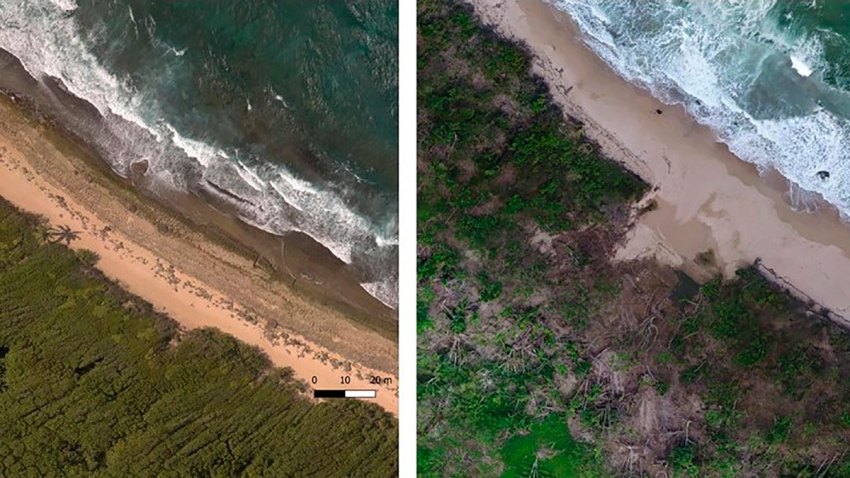
APIn this photo combo provided by Eric Lo, shows the shoreline in Manati, on Aug. 2017, left, before hurricane Maria and on Nov. 2017, after the Hurricane Maria, in Puerto Rico. A group of U.S.-based scientists are rushing to document indigenous sites along Puerto Rico’s coastline that date back a couple thousand years before rising sea levels linked to climate…


A group of U.S.-based scientists is rushing to document indigenous sites along Puerto Rico's coast dating back a couple of thousand years before rising sea levels linked to climate change destroy a large chunk of the island's heritage that is still being discovered.

Scientists hope to use the 3D images they've taken so far to also help identify which historic sites are most vulnerable to hurricanes, erosion and other dangers before it's too late to save the island's patrimony.

"It's literally being washed away," said Falko Kuester, director of the Cultural Heritage Engineering Initiative at the University of California, San Diego, which is involved in the project. "A big part of what we're working on is to make the invisible visible and make sure it stays in our memory."

Also involved in the project are UCSD's Scripps Institution of Oceanography and Para la Naturaleza, a nonprofit environmental group based in Puerto Rico.

The first site scientists targeted was a large swath along the U.S. territory's north coast that includes a ceremonial center used by the Taino Indians roughly 2,000 years ago, said Isabel Rivera Collazo, an environmental archaeologist at UCSD who is overseeing the project that began in August 2017.

Scientists discovered what appears to be a large settlement just east of the ceremonial site thanks to drones and technology including 3D images, she said. They were also able to determine the shape of the ceremonial site, she added.

Armed with that information, scientists used excavations to determine that one of six plazas previously discovered appears to have been used for ceremonial dances and the veneration of ancestors.

"The inside of the plaza was intensively trampled," Rivera said.

The Tainos populated various Caribbean islands but were eventually wiped out after the arrival of Christopher Columbus and European settlers.

"Up to today, there is still a lot we don't know about indigenous culture along our coasts," Rivera said. "It's not in our history books."

"The entire coast is blanketed with archaeological sites," she said. "We want to recover that information before it disappears."

Puerto Rico's Department of Natural Resources has said the sea level around the island is rising by more than 3 millimeters — a little over a tenth of an inch — per year. But climate change has more immediately dramatic effects as well, destroying habitats, eroding coastlines and causing more powerful storm surges when hurricanes hit.

Some scientists say that warmer temperatures increase the frequency and intensity of storms. Puerto Rico is exposed to storms every year for six months during the Atlantic hurricane season, and the scientists noted that the storm surge from Hurricane Maria washed away part of the region they're studying.

"It's literally in the eye of the storm quite regularly," Kuester said of the island.

Eric Lo, an engineer with the UCSD's cultural heritage initiative, flew to Puerto Rico in August 2017 to launch the project a month before Maria hit the island as a Category 4 hurricane. Lo was surprised at what he saw upon his return to the U.S. territory months later.

"Pieces of land where I had stood and flown the drone didn't exist anymore," he said. "They were underwater."

Scientists are now trying to determine the extent of coastal erosion in that region and the hurricane's impact on the archaeological site they are studying.

Three-dimensional models based on drone images are being used to measure distances, areas, volumes and explore fine details: "You start asking these details that historically you couldn't," Kuester said.

The engineering initiative that he oversees has helped explore other historic sites elsewhere, including an underwater cave with prehistoric fossils and a baptistery in Florence, Italy.


---30---


Can a minimalist mindset help save the planet?

Less is more, according to a growing movement of minimalists. They say a clean space can clear the head, but could it also draw a link between personal and planetary well-being?

If everybody lived in the same way as the average German, we would need almost three planet Earths. If we lived like Americans, it would be almost five. That's according to calculations by the Global Footprint Network.

But what if people chose a different lifestyle — a less consumerist one filled with less stuff?

Read more: Our consumption choices are driving biodiversity loss

Minimalist blogger and podcaster Elisa Stangl doesn't have a couch or even a bed at home. She, her husband and their 2-year-old daughter sleep on Japanese tatami mats in their small flat in southern Germany. "We don't own a lot," she told DW.

Stangl adopted her minimalist lifestyle while still a student, for financial rather than environmental reasons. Travelling the world compounded her sense that she was better off living with less.

"I just learned that don't need anything other than the things I have in my backpack," she said. "So I figured, why should I need more when I'm at home?"

Now, Stangl says her main motivation is living mindfully. Having less stuff means she and her family can focus on what's important to them. They need less money, and therefore have more time for hobbies like hiking and exploring nature.


Stangl and her family plan to move out of their apartment and into a converted van so they can spend more time traveling

But Stangl also believes a minimalist lifestyle goes hand in hand with environmental responsibility.

"Living a mindful life doesn't only concern the individual," she said. "If you get to know how to live mindfully, then you know that you have to respect nature, because you live with nature and it gives you something, and you have to give something back."

Minimal lifestyles for personal rewards

Beyond the decluttering craze sparked by Japanese tidying expert Marie Kondo, there's a growing interest in getting rid of stuff, with the idea that equates living more minimally with living more meaningfully.

Browsing the countless minimalist blogs, vlogs and podcasts, most overlook eco-impacts in favor of focusing on the personal benefits of having fewer belongings.

That's reflected in an ongoing study into minimalist lifestyles by Duke University in the US.

"Typically, people adopt minimalism in the interest of their own psychological wellbeing — to reduce stress and cultivate mental clarity, for example," the study's lead researcher Aimee Chabot told DW.

"But as their practice evolves, their motivations for pursuing minimalism often expand to include more outwardly focused sources of motivation, such as environmental or ethical concerns."

Chabot and her team have so far surveyed more than 800 people, most of them in the US.

"Only about 10% of survey respondents said that reducing their environmental impact was their primary motivation for practicing minimalism, though about 70% said they did consider environmental impacts to be one of their reasons for doing so," she said.

Unsustainable consumption

Even as an unintended consequence, living with less is certainly good for the planet.

A 2015 study found that more than 60% of global greenhouse gas emissions are due to household consumption. That's mainly down to transport and food, but also the other products people buy which generate carbon emissions in production.

Read more: World marks earliest 'Earth Overshoot Day'

Household consumption is of course higher in wealthier countries. As economies around the world develop, consumption is growing. The more people that have money to spend, the more stuff they buy.

But it doesn't necessarily make them happy. As studies show, higher income and bigger spending power boosts well-being only up to a certain point.

And as the minimalism trend suggests, more and more people are becoming disillusioned with the materialistic societies they live in.

Happiness is low emission

In her 2014 book Happier People Healthier Planet, academic Teresa Belton argues that the factors driving human well-being actually have very little environmental impact.

"What generates and sustains well-being are all sorts of what I call 'non-material assets,'" she told DW. "Good relationships, contact with the natural world. Being creative, having a sense of belonging and community and purpose and meaning, being actively engaged in life and things like that, which don't involve any material consumption — or very little."


Spending time in natural green spaces has been found to improve health and well-being

Belton interviewed more than 100 people in the UK who had chosen to live lower-consumption lives. Unlike the Duke University researchers in the US, she found environmental concerns were the most common motivation.

Shift in mindset

"If we as individuals and societies made our priority our well-being, by focusing on the things that really do underpin well-being, rather than on profit-making and the material consumption that goes into profit making, then the world would be a very much better place in all respects," Belton said.

With their focus on conscious, value-driven lives, even minimalists who aren't primarily interested in their carbon footprint would no doubt agree. And those of us whose lives are full of clutter and consciences heavy on emissions might do well to see living with less as a relief, not a sacrifice.

Beyond the individual level, governments are yet to be convinced to focus on human rather than financial and material growth. But leveraging the link between human and planetary well-being could be key to shifting our economies away from consumption and tackling the climate crisis.

DW RECOMMENDS


World marks earliest 'Earth Overshoot Day'

By the end of Monday, humanity's allotment of natural resources for 2019 will be all used up, according to a report. Over the past 20 years, Earth Overshoot Day has moved up three months to July 29. (29.07.2019)


Can carbon trading cut EU emissions to net zero?

In an effort to cut carbon emissions, the EU established a cap-and-trade system 15 years ago. So far, it hasn’t had much impact. So how does it work, and how can it be made more effective? (03.12.2019)


Environmental psychology: How do you feel about that coffee to go?

DW's Hannah Fuchs likes to think she's pretty responsible about her environmental impact. But the guilt induced by a take-out coffee got her asking why even the most eco-conscious of us slip up. (21.02.2019)


'Lowering our personal carbon footprint is a question of credibility'

Activist Cara Augustenborg says individual action to cut greenhouse gases is essential, but it won't be enough without political engagement and system change. (06.03.2018)


'Our consumption choices are driving biodiversity loss'

Humankind is decimating plant and animal species, with alarming consequences for the planet. From the UN biodiversity conference in Egypt, Cristiana Pasca explains why preserving biodiversity is key to our survival. (28.11.2018)


Bangladesh: Protest over student rape — activists demand justice

Over 1,000 people gathered in Dhaka to demand justice for rape victims in Bangladesh. On Sunday night a student was raped and violently assaulted near the university campus.


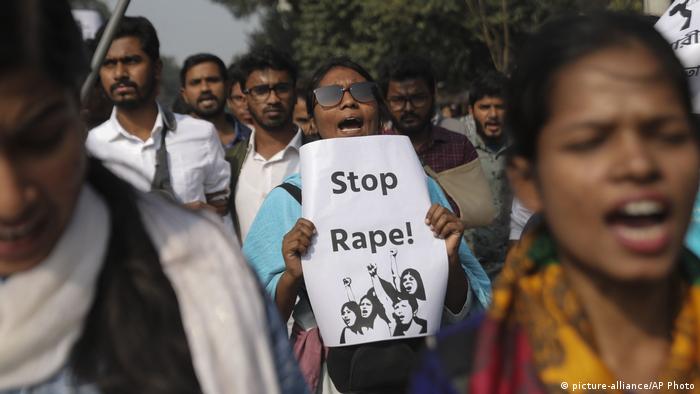
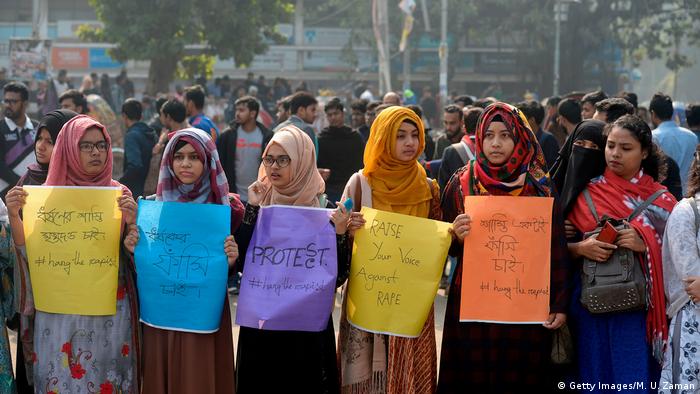
More than 1,000 students and activists gathered in Bangladesh's main public university on Monday following the violent rape of a second-year student on Sunday night.

Protesters in Dhaka called for the arrest of whoever was responsible for the rape and for greater female safety in general.

"No more rape, we want justice!" protesters chanted. "We want a higher punishment," they said, linking hands as they marched through the campus of Bangladesh's main university.

Read more: Bangladesh shocked by rise in sex crimes, child rape

The student was walking home from a friend's house on Sunday night when she was grabbed from behind, gagged and taken to a place where she was attacked and raped, a forensic expert said on Monday.

She was rescued and taken to hospital at around midnight on Sunday.


Protesters on the Dhaka university campus

Kazi Sahan Haque, the police chief at Kurmitola Police Station, said authorities recorded a case filed by the victim's father and were investigating.

Rape and violence against women have been described as frequent occurrences in Bangladesh. Non-governmental human rights watchdog Ain O Salish Kendra reported that at least 1,351 women were raped in Bangladesh between January and November 2019.

At least 66 of the women were murdered after the rape, the organization said. The condition of Sunday's victim is unknown.


DW RECOMMENDS


Bangladeshi soldiers accused of raping 12-year-old Rohingya refugee girl

Bangladeshi troops have allegedly raped an underage Rohingya girl at the Cox's Bazar refugee camp. The authorities deny rape allegations, but the girl's family told DW they were being threatened by security forces. (04.10.2019)


Bangladesh shocked by rise in sex crimes, child rape

Multiple incidents of ghastly sexual violence in recent months have raised serious concerns over the safety of women and children in Bangladesh. Experts blame "a culture of impunity" for the spike in sex crimes. (10.07.2019)


Bangladesh sentences 16 to death for burning teen girl alive

Nusrat Jahan had reported the principal of a religious school for attempted rape, but was then burnt alive for not withdrawing the complaint. Her death sparked public outrage and mass demonstrations. (24.10.2019)

Students protest across India after attack at top Delhi university

Opposition links violence to Narendra Modi’s BJP party and tensions over citizenship law
 Masked mob storms top Delhi university, injuring staff and students – video

Students have protested in cities across India after a masked mob stormed a high-profile university in Delhi and attacked students and teachers with weapons including sledgehammers, iron rods and bricks, injuring more than 30.
Opposition parties and injured students blamed Sunday night’s violence on a student organisation linked to the prime minister Narendra Modi’s Hindu nationalist Bharatiya Janata party (BJP), which has increasingly targeted the institution.
The attack at the Jawaharlal Nehru University (JNU), long seen as a bastion of leftwing politics, comes as students lead a nationwide campaign against a citizenship law introduced last month by Modi that is seen as targeting Muslims.
Videos that emerged after the assault showed people in masks roaming inside the corridors of the university and beating students who were protesting against a fee rise.
Students at the Sabarmati hostel, which bore the brunt of the violence, described on Monday how they had locked themselves into their rooms when they heard glass being smashed or ran outside and hid in bushes until the attackers dispersed.
“Even after it was over, I had the most fearful night of my life, lying awake listening to every footstep in the corridor,” said Arjit Sharma, 23, a student of ancient history at JNU. One attacker told him: “We’ll come back for you.”
The violent clashes have further polarised an already poisonous atmosphere that’s prevailed for three weeks over the citizenship law. Although the JNU clashes were not about the law, which has triggered massive nationwide protests, they have added to the growing sense of unrest.
The Sabarmati hostel at the Jawaharlal Nehru University campus in New Delhi, India, after the attack.
Pinterest
 The Sabarmati hostel at the Jawaharlal Nehru University campus in New Delhi, India, after the attack. Photograph: Harish Tyagi/EPA
Scores of students left JNU on Monday, ignoring a plea by the university’s proctor to stay. One of those preparing to leave, Gayatri Basumatary, 23, said: “My parents are frantic. What happened is beyond any limit. They want me to get away from this madness.”
Those students who have remained are being extra vigilant. Satarupa Lahiri, who was in the hostel washroom when she heard screams and window panes being smashed, said: “It feels like a battle zone. We are walking around only in groups of 10 or 12 for safety.
“I am staying. Some students live a long way away and can’t afford the fare home so we have to show solidarity by staying on. We have to stick together. After all, it’s our campus. We can’t let these thugs take it away from us,” she said.
Opposition parties have accused the BJP of tacitly encouraging rightwing gangs to enter campuses and attack students. The main opposition Congress party called the attack on JNU “state-sponsored terrorism”. The BJP in turn has accused the opposition of encouraging anarchy and rioting.
“The fascists in control of our nation are afraid of the voices of our brave students. Today’s violence in JNU is a reflection of that fear,” tweeted Rahul Gandhi, a leading Congress politician.
The Akhil Bharatiya Vidyarthi Parishad, the student wing of the BJP, denied accusations that it was behind the attack, which it blamed instead on rival leftist unions.
Authorities faced criticism for failing to rein in the violence on a campus viewed as a centre of resistance to Modi’s policies, including the abolition last year of special status for Muslim-majority Kashmir.
Amit Thorat, who teaches economics at JNU, said he called the police a little after 7pm on Sunday but they didn’t come until an hour later. Nearly a dozen students Reuters spoke to said police watched as the mob rampaged inside the campus.
Surya Prakash, 25, a research scholar at the university’s Sanskrit school, said he had been brutally beaten in his dorm room despite telling them he was blind. They broke the door and windows of the room, barged inside and hit his head with a rod, said Prakash.
One floor up from Prakash, above the dorm wardens’ residence, students said two Kashmiri Muslim students living in adjacent rooms were targeted. While the attackers used a fire extinguisher to ram open a door, one student climbed over his balcony into the next-door room while another jumped on to the ground below, sustaining an injury, according to Mukesh Kumar, a research scholar who lives across the hall.
An ambulance carrying injured people off campus was attacked by a group of men with sticks while police stood by, bystanders said.
Critics accuse Modi of pushing a Hindu-first agenda that undermines India’s foundations as a secular democracy. The citizenship law lays out a path for Indian nationality for minorities from six religious groups in neighbouring countries but excludes Muslims.
The government condemned the violence. “Horrifying images from JNU the place I know and remember was one for fierce debates and opinions but never violence. I unequivocally condemn the events of today,” said the finance minister, Nirmala Sitharaman, a member of the prime minister’s party, on Twitter.
Associated Press and Reuters contributed to this report
Fresh student protests hit India over university attack

Monday's protests follow a violent attack by masked assailants on students at a university in New Delhi. Some have blamed the clashes on a student group linked to Prime Minister Narendra Modi's Bharatiya Janata Party.


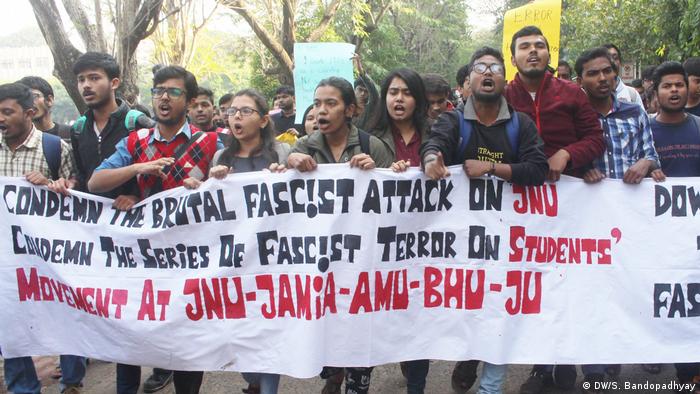
Fresh student protests are taking place across India following violent clashes at a prestigious university in New Delhi which left more than 30 people injured.

Late Sunday, masked assailants beat students and teachers with rods and bricks at the capital's Jawaharlal Nehru University (JNU) in an assault that opposition lawmakers say is linked to the government.

Police in India criticized for brutal response to protests

Videos of the attack showed people in masks assaulting students who were protesting against a fee hike. Assailants also vandalized dormitories and university halls. Scores of riot police on Monday patrolled JNU. Police have begun a probe and say that they have found some of the assailants, but so far, no arrests have been made.

Students at universities across the country continued to protest Sunday's assault on demonstrators. Nimisha Jaiswal was at the JNU for DW, describing a heavy police presence and tense atmosphere, but also a calm day.

Students also challenged police for failing to step in on Sunday, with police saying they were waiting on authorization to act and to organize a large enough force to manage the crowd. Students countered that the police response had been far swifter during protests last month at the university.

Read more: Indian state shuts down internet ahead of protests


Jadavpur University students protest aginst the JNU attacks, on Monday in Kolkata.

In response to the attacks, more than 1,000 people held a vigil in Mumbai, and demonstrations took place in major cities across India, including Bangalore, Kolkata and Hyderabad.

Read more: India citizenship bill ignites mass protest over migration fears

Uncertainty over the assault

New Delhi Police Commissioner Amulya Patnaik told the Associated Press that Sunday's incident was a clash between rival student groups. However, opposition parties have pinned the blame on Akhil Bharatiya Vidyarthi Parishad, a right-wing Hindu nationalist student organization connected with Prime Minister Narendra Modi's Bharatiya Janata Party (BJP).

Sitaram Yechury, general secretary of the Communist Party of India, said the attack was a "collusion" between the JNU administration and "goons" of the Modi-linked party.

German told to leave India over protests

Modi's BJP, however, denounced the attacks in a tweet. "This is a desperate attempt by forces of anarchy, who are determined to use students as cannon fodder, [to] create unrest to shore up their shrinking political footprint. Universities should remain places of learning and education," the party said.

Many students and organizers at JNU have protested Modi's policies in recent years. Protests against the fee hike, which students said would make education too expensive, kicked off in November.


2019: A YEAR OF PROTESTS, EVERYWHERE!
Hong Kong's stability jolted

Protests erupted across Hong Kong in June over the introduction of a bill to allow the extradition of fugitives to mainland China. The bill was withdrawn in September, but months later, protesters are still demanding full democracy for the territory and an inquiry into police violence. The rallies have regularly turned ugly and security forces have been accused of being too heavy-handed.


Indian state shuts down internet ahead of protests

Authorities in India's most-populous state have been bracing for protests after Friday prayers. At least 16 people have been killed in the state, most of them shot dead. (27.12.2019)


India citizenship bill ignites mass protest over migration fears

In northeast India, protests have broken out over a bill that would grant citizenship to migrants from religious minority groups. Opponents say that the bill would endanger the region's "cultural identity." (10.01.2019)


Protesters killed as India's Modi meets lawmakers over citizenship bill

India's Prime Minister called a meeting with ministers to assess the ongoing protests over a controversial citizenship bill. So far at least 23 people have died, with the violent protests showing no sign of stopping. (21.12.2019)


German student asked to leave India after joining student protests

A German student will leave India after receiving "oral directions" from immigration authorities. He had participated in protests against legislation to expand citizenship for non-Muslim immigrants in India. (24.12.2019)


India's Modi says new citizenship law is not against Muslims

Scores of people have been killed as a result of violent protests against a citizenship amendment law, which critics say discriminates against Muslims. Indian PM Narendra Modi says the opposition is distorting the facts. (22.12.2019)


2019: A year of protests, everywhere!

Millions have mobilized globally this year over a lack of democracy, ethnic discrimination, corruption and climate change. From China to Chile, Sudan to Sweden, people have hit the streets demanding change. (23.12.2019)
EGYPT PULSE

New oil, gas field in Egypt promises more discoveries

ARTICLE SUMMARY
Egypt’s successive governments have largely ignored drilling of oil and gas in the Western Desert given the high cost of such an operation, although the area is rich.


Ahmed Youness January 2, 2020

REUTERS/Amr Abdallah Dalsh
A car crosses the Western Desert and the Bahariya Oasis

 in Siwa, Egypt, May 15, 2015.


CAIRO — Egypt announced Dec. 19 the discovery of a new oil and gas field in the Abu Senan area in the Western Desert. The Egyptian Ministry of Petroleum and Mineral Resources said in an official statement that the new oil and gas field was discovered after excavation work by Borg El-Arab Petroleum Company, a government-affiliated company.

The statement indicated that the new field’s production is expected to reach an average of 7,000 barrels of crude oil per day, as well as 10 million cubic meters of gas. It added, “New discoveries in the Western Desert are proof that this region is still characterized by its high oil and gas possibilities, especially in the deep layers, in light of modern technologies contributing to achieving several promising discoveries in the area.”

On Dec. 12, Russia Today quoted Adel al-Bahnasawy, a journalist specializing in energy affairs, as saying that the new oil and gas field discovered in the Western Desert was a huge field compared to previous discoveries in the same area, stressing that this discovery will open the door to the possibilities of finding new oil fields in the Western Desert.

Bahnasawy told Al-Monitor over the phone that several discoveries have been made in the Western Desert, and that government officials believe the area is rich in undiscovered oil and gas fields.
ALSO READ


CULTURAL HERITAGECan Karnak sphinxes survive on Tahrir Square?


He said that in October 2008 oil and gas wells in the Western Desert were discovered; at that time, a major petroleum discovery in the West Kalabsha concession area was announced, with a daily production capacity of 5,000 barrels in the US Apache concession area for oil and gas exploration.

Bahnasawy added that Apache Corporation CEO John Christmann said Oct. 17 during a meeting with Prime Minister Mustafa Madbouly that his company envisions a promising future for the Egyptian oil sector in light of the great developments over the past years. He added that the company plans to increase activities in Egypt.

In addition, Bahnasawy noted that David Chi, regional vice president and general manager of Apache Egypt, said in a press statement that there are large potential oil and gas discoveries in Egypt, especially in the Mediterranean and Western Desert.

Bahnasawy added that these recent discoveries attracted the attention of officials toward the Western Desert, which prompted the government to reassess the area and explore the presence of oil and gas fields.

Hamdi Abdel Aziz, spokesman for the Ministry of Petroleum and Mineral Resources, told Al-Monitor, “The new petroleum discovery in the Western Desert is great proof that this area is very promising in terms of oil and gas discoveries, and that the government should take care of it and support it in the coming period, which the ministry is already planning to do.”

He explained that these discoveries were the culmination of the development plans of the Egyptian government — represented by the Ministry of Petroleum and Mineral Resources — with Minister Tarek El-Molla signing three agreements for oil and gas exploration in the Western Desert on Aug. 26, 2017.

Abdel Aziz said that these agreements were signed between the Egyptian General Petroleum Corporation on the one hand, and Apache Corporation and the American Merlon Petroleum Company on the other, with investments of about $79 million and plans to drill 17 new exploration wells to search for oil and gas.

He noted that the Ministry of Petroleum is working to promote these successes to attract more foreign investors and motivate international companies to expand their activities in this area, as well as to conduct more research and exploration operations.

Abdel Aziz stressed that the Egyptian government is currently working on assessing gas and oil reserves in the Western Desert. The average oil production in the area has increased from 150,000-165,000 barrels per day in 2000 to 240,000 barrels per day currently.

Abdel Khalek Farouk, economic expert and head of the Nile Center for Economic and Strategic Studies, told Al-Monitor over the phone that this new discovery is a major event, especially since it is located in a very important area that officials had not been paying attention to for many years.

Farouk explained that successive governments in Egypt never bothered to focus on exploring for gas and oil in the Western Desert, in particular due to the large financial cost of such an endeavor, as well as the need for advanced technology to explore large quantities of oil and gas and to enable companies to know the expected economic return from drilling operations.

He pointed out that there are several other factors that have hindered the state from exploring gas and oil in the Western Desert, the most prominent of which is that the area is scattered with mines from World War I and World War II, which makes the excavation process difficult and increases its cost as mines must be removed in some areas first before the drilling process can begin.

Farouk denounced Egypt's import of gas from Israel — under an agreement signed between the two countries in 2018 — despite the recent large discoveries, especially the Zohr and Nour fields in the Mediterranean, and the recent discoveries in the Western Desert.
Found in:OIL AND GAS


Ahmed Youness is an Egyptian writer and journalist covering foreign and regional affairs. He writes for a variety of regional media outlets, including Al-Hayat, Aawsat and Raseef22.
NEXT FOR YOU


Read more: https://www.al-monitor.com/pulse/originals/2019/12/egypt-oil-gas-field-discovery-western-desert.html#ixzz6AGkevc6y

MERRY UKE CHRISTMAS


SEE  https://plawiuk.blogspot.com/search?q=UKRAINIAN+CHRISTMAS

SEE  https://plawiuk.blogspot.com/search?q=ORTHODOX