It’s possible that I shall make an ass of myself. But in that case one can always get out of it with a little dialectic. I have, of course, so worded my proposition as to be right either way (K.Marx, Letter to F.Engels on the Indian Mutiny)
Saturday, August 08, 2026
NTSB: Houston Pilot's Cell Phone Call Contributed to Fatal Collision
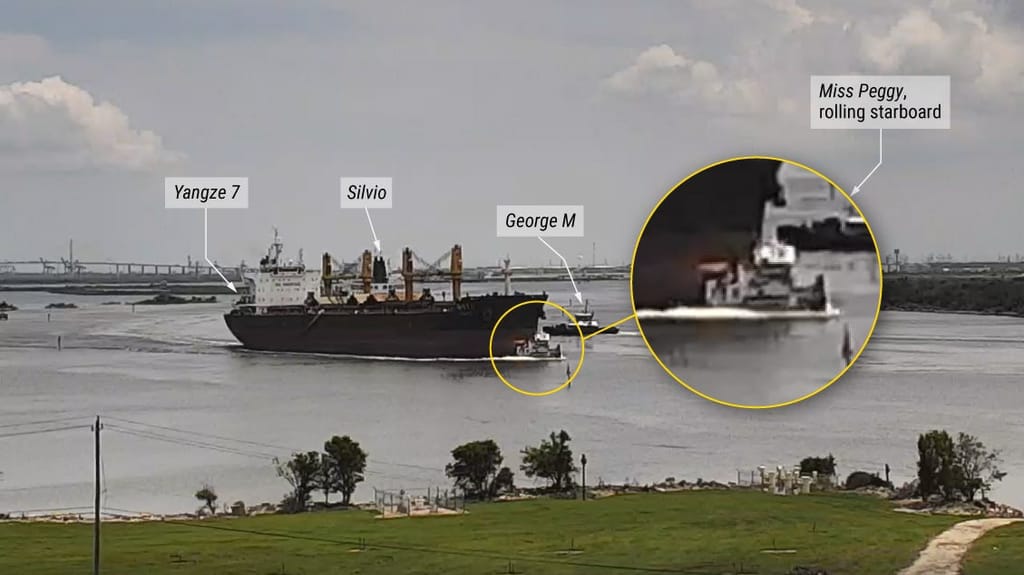
The National Transportation Safety Board has released its report on the collision of the Chinese bulker Yangze 7 and the towboat Miss Peggy, which capsized the smaller vessel and killed one of its crewmembers. The casualty's root cause was a comprehensive failure to maintain proper lookout by both vessels' bridge teams, NTSB found, exacerbated by the Yangze 7 pilot's "nonoperational cell phone use." The safety agency called out a pattern of "normalization" of personal cell phone use by pilots on the Houston Ship Channel, normalized and allowed by the local association.
At about 1000 hours on July 19. 2024, the bulker Yangze 7 got under way from the Galveston offshore anchorage, bound for the Kinder Morgan coal terminal on the Houston Ship Channel. She was in ballast and drawing about 23 feet. The pilot boarded at the Galveston Bay entrance channel for the inbound transit. For the five-hour transit for a vessel of this size, the pilotage fee would come to (very roughly) $15,000 at 2026 tariff rates, roughly equivalent to several thousand dollars per hour.
The pilot set up on the bridge with his PPU at a forward station, and was joined by the master, the watch officer and a helmsman. The bosun was stationed on the bow.
Sometime after noon, the officer of the watch observed "the Houston pilot watching a video not related to operations on his cell phone." At 1322 hours, the ship's VDR recording captured the pilot taking a phone conversation with a second Houston pilot who (at the time) had the conn of the laden tanker Petrel, outbound in the channel. Petrel was already past and clear Yangze 7, having passed her half an hour previously.
At 1332, still talking to the pilot on the Petrel and using a Bluetooth earpiece, the pilot continued to issue rudder commands in between snippets of conversation. The VDR picked up clear audio details of his call from 1335 onwards, "and the subject was not related to operations," NTSB found. The call continued on as the vessel progressed up the channel and neared her destination.
At 1349, Yangze 7 approached the inbound towboat Miss Peggy from astern. The pilot - still on the phone - ordered half ahead, then full ahead. He paused briefly to make a VHF call to a third pilot and to check in with Houston VTS, then returned to the phone call. The watch officer told investigators that he was growing very concerned that the pilot would issue a wrong helm or propulsion order while having a conversation that was "not about the vessel, not about safety, not about navigation."
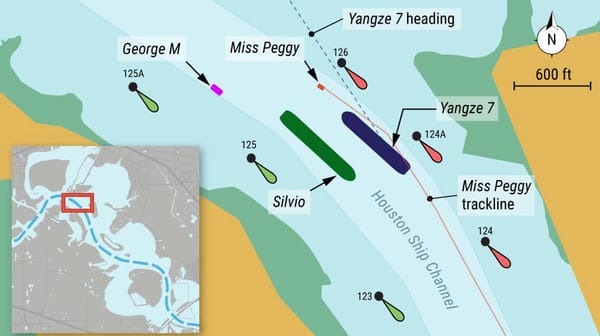
By 1358, Miss Peggy was less than four ship lengths away and the two vessels were closing quickly. The pilot ordered rudder commands to bring the ship to the center of the channel, lining up to overtake Miss Peggy on the towboat's port side. The LPG carrier Silvio was outbound on the other side of the channel and also closing fast, lined up for a port to port passing.
Miss Peggy's skipper was not aware of the bulker's approach, but an off-duty deckhand stepped out onto the upper deck and spotted Yangze 7, and he realized that a collision was imminent. Meanwhile, the bosun on the bow of Yangze 7 - who had been watching Silvio, like the rest of the crew - noticed Miss Peggy at about the same time, and called in "one tugboat very near . . . about 20-30 meters" just before 1403.
At 1403, the pilot on Yangze 7 ordered starboard 20 degrees rudder and then back to midship in order to clear Silvio. 30 seconds later, the crew of a nearby harbor tug called Yangze 7 to warn the crew to "watch out for that tow right in front of you." The pilot ordered starboard 10 and 15 degrees rudder - towards Miss Peggy - and the helmsman executed the orders.
At about 1403:35, Yangze 7's bulbous bow hit the stern of Miss Peggy, which rapidly turned and rolled over on its starboard side. It happened so quickly that the towboat's master did not have time to sound the general alarm before water began flooding the pilothouse. One deckhand did not manage to escape the galley as the tug rolled onto its side; he did not survive. Two other sustained injuries, including one who needed intensive care treatment.
The George M - the good Samaritan tug that had tried to warn Yangze 7 - responded first to the scene of the casualty, and it used a rescue cradle to save the four survivors from Miss Peggy.
"Because the pilot on the Yangze 7 failed to maintain a proper lookout by all available means, his situation awareness while directing the movement of the bulk carrier in the Houston Ship Channel was degraded, resulting in him not detecting the Miss Peggy," said the NTSB.
NTSB also faulted the crew of the Yangze 7 for failing to maintain situational awareness and communicate their safety concerns to the pilot, as required by best-practice bridge resource management standards; the captain of Miss Peggy for failing to use all available means to detect the oncoming threat; and the pilot's association for not prohibiting personal cell phone use on watch. The agency did not fault the pilot conning Petrel, who had allegedly been on the other side of the "nonoperational" call while navigating a tanker.
Since the casualty, the Houston Pilots have added a rule that pilots should only use theuir personal phones to make calls related to “vessel safety, essential communications with other pilots, pilot transfers, Coast Guard, national security, law enforcement, or other professional purposes." The rule requires avoiding nonoperational uses of phones.
While the Coast Guard has issued repeated recommendations against cell phone use on watch, and many companies have policies prohibiting it, there is no federal regulation covering the practice.
South Korea Names First Boxship for Arctic Route to Europe
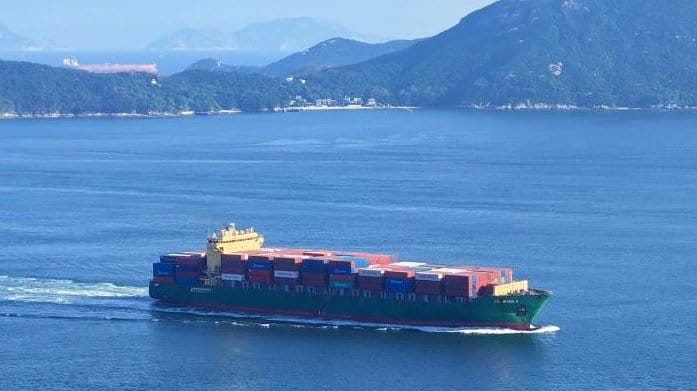
PanStar acquired the HMM Mombasa for its demonstration voyage along Russia's NSR to Europe (Peter Chang photo courtesy of VesselFinder)
South Korea continues to push forward with preparations for its first demonstration voyage of a containership through the Arctic, traveling on Russia’s Northern Sea Route. News that it has named the ship for the trip expected to depart next month comes as Russia’s Rosatom reported it has issued the permits for 2026 and says it will be the first year of regular commercial cargo service on the NSR.
Rosatom reports that China’s Sea Legend Shipping has received the necessary permits to launch a weekly commercial service along the NSR to Europe. Last year, the company ran a record-setting 20-day transit to Europe and now looks to launch its scheduled commercial service.
South Korea’s government is actively supporting the trial voyage planned for its NSR service. It identified the project more than a year ago. It cites a key advantage that it will be following international laws and environmental restrictions for its operations along the NSR.
The Aju Press in South Korea reports the government is not providing any financial support for the trial voyage, but the Ministry of Oceans is backing the project. The Korea Shipowners’ Association reported it is offering a financial incentive to successfully complete the voyage. Aju reports that a prize of a little more than $2 million will be paid for successfully completing the voyage, and a further prize of just over $700,000 will also be awarded if the round-trip carries at least 2,000 TEUs.
The Busan-based PanStar Line was the only Korean carrier to bid for the demonstration voyage and was selected in May for the demonstration. The government reportedly liked the idea that PanStar would conduct the voyage, noting the company, while a mid-size carrier, has experience developing new routes. It currently operates a regional service between Korea, Japan, and China. The government is said to envision opportunities by marketing its Arctic service to consolidate cargo from the three countries.
While HMM did not bid, it is indirectly assisting the effort. PanStar acquired the HMM Mombasa containership on July 31 and took delivery of the vessel on August 2. While it is a smaller vessel, HMM had just acquired the ship in December 2025, but agreed to sell it for use on the demonstration voyage.
PanStar is renaming the 45,500 dwt containership, which was built in 2011, as the PanStar Acro. It is slightly smaller than the targeted 3,000 TEU capacity – carries 2,700 TEU – but is said to be in good condition for the voyage. The Korean media is reporting that HMM was unloading the vessel and that it would be moved to Busan for modification to prepare it for the Arctic voyage. The government required the carrier to receive an ice certificate, and PanStar told the Korean media it expects to gain the certificate by mid-August from the Korean Register. Unconfirmed reports said the line has received its permit from Rosatom for the voyage, although Korea was not mentioned in Rosatom’s comments today about the NSR.
Marketing for the voyage has already begun with a dedicated site. Reports are that PanStar is targeting at least 1,300 TEU and focusing on automobile parts, synthetic resins, steel products, food, cosmetics, used vehicles, and liquid cargo for the voyage. It said it has received interest from Japanese exporters, and with the vessel now identified, it was expecting an increase in interest.
PanStar is reported to be recruiting a crew of 20 for the voyage, which has a target date of sailing on August 22. At least one of the officers will have Arctic navigation experience. Government officials said the actual departure date would be confirmed based on weather and conditions on the route and could be delayed until September. The transit is expected to take 20 days to reach Rotterdam and then will proceed to Hamburg and Gdansk on the return leg. The round trip is forecast to take 45 days. The company said it is a demonstration to gather information and that it plans to use the data to finalize plans for the commercial service.
South Korean officials highlight the rapid growth of shipping on the NSR and echo the Russian messages of the advantages of distance versus shipping through the Suez Canal. It cites data that shows a 40 percent increase since 2013 in vessels operating in Arctic Polar Code waters. It notes that just over 100 full transits took place on the NSR in 2025, carrying about 3.2 million tons of cargo.
The challenge remains not only the Chinese competition, but also opposition by environmentalists, and a promise by many leading consumer brands not to use the NSR. Companies including Nike, H&M, Gap, Ralph Lauren, and Puma have all signed the Arctic Corporate Shipping Pledge, which was launched in 2019, saying it would protect the Arctic. Major carriers, including MSC Mediterranean Shipping, CMA CGM, and Hapag-Lloyd, have each vowed not to ship on the NSR.
US Container Imports Are Expected to Decline Monthly After an Early Peak
US container import volumes have peaked say the NRF and will decline finishing the year flat with 2024 and 2025 (Port of Long Beach)
U.S. container import levels remain high, but according to the National Retail Federation, they have peaked early and are starting to decline steadily month-over-month. The trade group for retailers believes importers adjusted the timing of their volumes to beat the latest round of tariffs and that 2026 overall will end the year with volumes flat compared to the last two years.
The group’s Global Port Taker shows that volumes peaked much earlier than in past years. In its first forecast for the full year, the NRF says total container imports are expected to be 25.5 million TEU. That compares with 25.4 million TEU in 2025 and 25.5 million TEU in 2024.
“We had an early peak season this year as retailers brought in merchandise ahead of tariff changes in late July and responded to other uncertainties in the supply chain like the ongoing disruption brought by the conflict in Iran,” said Jonathan Gold, the NRF Vice President for Supply Chain and Customs Policy.
Gold highlights that one tariff policy ended, but that another began with the new program affecting 99 percent of U.S. imports. Donald Trump has indicated that he still firmly believes in the tariff policy and will continue to implement it despite broad opposition and negative rulings in the courts.
“While ports have remained busy this summer and spread out the peak season, this year’s busiest month appears to have arrived in May,” highlighted the NRF. It explains that the peak shipping season historically came in late summer or fall, but was moved up ahead of the uncertainty of the July expiration of the Section 122 tariffs.
As such, the group estimates that June volumes were at 2.23 million in TEU, 2.21 million in July, and will come in at 2.22 million TEU in August.
It predicts a steady decline each month for the rest year. While it expects volumes could be up as much as 3 percent year-over-year for September and October, it sees the monthly volumes declining to 2.16 million TEU and then 2.13 million TEU. November is forecast at 2.03 million TEU and a slight end of year uptick to 2.06 million TEU for December.
The group points out that despite expectations that consumers might become more cautious due to increases in the cost of living, spending levels have so far remained resilient. It says this is despite high gasoline costs and persistent geopolitical uncertainty.
Judge Orders US Defense Department to Resume Review of Wind Energy Projects
Judge found that Defense is not following the Congressionally-mandated process for reviews (file photo)
For the second time during the current Trump administration, a federal court judge has found the administration is violating U.S. administrative law in its efforts to stop the wind energy sector. On Thursday, August 6, Judge Karin Immergut of the U.S. District Court for the District of Oregon issued a preliminary injunction and instructed the Pentagon to resume its reviews of wind energy project applications.
Earlier in the week, after a hearing, the judge had said she was inclined to issue the order to restart the reviews. Lawyers for the Defense Department reportedly said the reviews were proceeding, but when she asked for a specific example, they did not name a single project. While the decision largely impacts onshore wind energy projects, it is the second time this year that a judge has said the administration cannot arbitrarily suspend the review of wind energy projects.
Shortly after returning to the White House in January 2025, Donald Trump signed an executive order directing a review of the entire process for permitting wind energy projects. He refers to them as “wind mills” and insists they are not economically sound projects, as well as objecting to them as “ugly.”
The administration has systematically taken steps to stop the development of wind energy projects, and now is buying back leases after having failed in the courts. The executive order directing the review was rejected by the courts, which said it was a violation of administrative regulations. The Trump administration also issued stop-work orders on the under-construction offshore projects, citing national security concerns. Five separate courts issued preliminary injunctions letting the projects continue work.
In May 2026, a coalition of environmental groups and others filed suit in Oregon challenging the Department of Defense’s reported suspension of all reviews. Judge Immergut found for these groups and on Thursday, August 6, issued a preliminary injunction ordering the Defense Department to resume the reviews. It was further ordered that it must supply updates every 30 days on the progress.
The suit highlighted a 2011 act of Congress that stipulates the review process for energy projects contained in the Ike Skelton National Defense Authorization Act. The Federal Aviation Administration and the Department of Defense are given oversight to review the proposed construction of a structure over 200 feet above ground level, which includes utility-scale wind turbines. They have 75 days under the law to conduct a preliminary review and render an opinion. If a risk is identified, they must start mitigation discussions, and those can continue for an additional 90 days.
According to the court, before August 2025, DoD evaluated wind energy project applications in accordance with the statutes and regulations and adhered to a predictable timeline for its review. It then slowed the process, eventually canceling scheduled mitigation discussions, and by May 2026, the court found the incremental slowdown had reached a standstill. DoD issued interim guidance to reassess its internal review process for energy projects that it said were “causing impactful Doppler interference.”
Defense officials claimed the pause was required because the growing use of drones in overseas conflicts had revealed new threats. They asked the court to dismiss the complaint, saying it was outweighed by national security concerns.
The judge told the Justice Department lawyers that if DoD wanted to alter the statutory requirements, it could go to Congress and ask for the change. However, the court found that DoD was not following the Congressionally mandated requirements and ordered it to resume the reviews following the prescribed requirements.
Another judge earlier this year issued a similar ruling after the administration broadly stopped reviews, saying the process for permitting was being accessed. In that case, as in this case, the judge found the federal administrative regulations did not give the administration the ability to have an open-ended review. They said applicants were entitled under the law to timely reviews.
Reports said the DoD delay was impacting more than 155 onshore wind projects that have filed for permits.
Trump Administration to Pay RWE $1.22B in Fifth Deal to End Offshore Wind
RWE said there was no path forward in the U.S. to develop offshore wind energy but it would continue internationally (RWE)
Germany’s energy giant RWE and the Trump administration have reached a settlement agreement that calls for the Department of the Interior to pay RWE $1.22 billion to relinquish three U.S. offshore wind leases and instead invest in LNG energy projects. It is the fifth deal the Department of the Interior has made with wind energy developers, committing to reimburse more than $3.9 billion, although states are suing to stop the deals.
The buyback policy is the latest effort by the Trump administration in its efforts to stop offshore wind energy and other renewable energy projects in favor of fossil fuel development. The administration has lost court cases where it attempted to suspend work on under-construction offshore wind energy projects, and just this week, a federal judge in Oregon said she was inclined to order the Pentagon to resume reviewing applications for offshore wind projects. The Trump administration imposed a moratorium on reviewing all wind energy projects, which has already been overturned by a court, while the Pentagon has made claims about “national security” issues and interference from wind turbines.
“Americans deserve an energy system built on common sense, not one dependent on costly subsidies or technologies that can't meet our country’s current demand,” said Interior Secretary Doug Burgum after RWE announced today’s agreement. “We welcome RWE’s agreement and voluntary investment in projects that strengthen our nation's energy security.”
RWE held three offshore leases in the United States, including one in the New York Bight, which had set a record for the largest offshore wind auction when the Biden administration offered six leases. RWE, through a joint venture Bight Wind, bid $1.1 billion in 2022 for a lease area that could support approximately 3 GW of capacity. In October 2023, RWE’s Community Offshore Wind, a joint venture with National Grid Ventures, was provisionally awarded a 1.3-gigawatt (GW) offtake contract as part of New York’s third solicitation for offshore wind.
The other two lease areas included a project off the northern coast of California called Canopy Offshore Wind, for which it paid $157.7 million in 2023. It proposed a 1.6-gigawatt commercial-scale floating offshore wind project off the coast of Humboldt County. The company in 2023 also paid $5.6 million for the Lake Charles Lease Area, 44 miles off Louisiana, which it said could potentially generate 1.24 GW.
“After careful consideration, it was determined there is no path forward to permit these projects in the U.S. for the foreseeable future,” said RWE. “The settlement resolves RWE U.S. Offshore’s legal claims and provides $1.22 billion in settlement funds. The company determined that this resolution best serves the interests of its stakeholders and allows it to direct resources toward energy projects that can be advanced with certainty.”
RWE said it, however, remains focused on growing its offshore wind energy portfolio globally. It already has 18 offshore wind farms in operation with four more under construction. It noted that it has additional projects in development and recently secured 6.9 GW of capacity in the UK’s most recent offshore wind auction.
The company said it had invested more than $1 billion in the development and planning for the U.S. projects. The agreement will resolve RWE’s claims against the U.S. government. In exchange, it has agreed to a financial investment of $900 million to acquire a 16 percent stake in the Louisiana LNG project, signed a $300 million turbine reservation agreement, and announced plans to invest approximately $19.6 billion in the U.S. over the next six years. The company said it will grow its U.S. generating capacity from approximately 13 GW across 27 states to 22 GW by 2031. It said it has a pipeline of 15 natural gas peaking projects in the U.S.
The Environmental Defense Fund issued a statement calling today’s deals the “Trump administration’s latest wasteful buyout.” Katelyn Roedner Sutter, California Senior Director at Environmental Defense Fund, said, "Paying companies to shut down massive sources of clean, reliable power while our state's electricity needs keep growing is a recipe for higher costs. Californians did not sign up for these wasteful payouts that mean higher bills, more pollution, and less jobs.”
The administration had previously struck deals with TotalEnergies, Duke Energy, and Ocean Winds (a joint venture between EDP Renewables and ENGINE) to pay a total of approximately $2.7 billion to buy back leases on both coasts. The Environmental Defense Fund highlights that the administration is buying back three of the five awarded leases on the California coast, which is in addition to another large project in the New York Bight and one planned for the coast of North Carolina.
Congressional members have questioned where the money is coming from to pay for the agreements and criticized the strategy. Seven states, including New York and Massachusetts, formed a coalition and sued to block the approximately $1 billion deal with TotalEnergies. California has also filed notice of its intent to sue over the two previous deals to buy back leases off its coast.
The states are arguing that they have invested in developing these projects and that they are critical to meeting their energy needs. In the case of California, it further highlighted that the investments are being redirected to other areas of the country and do not address the West Coast’s energy needs.
Denmark Completes Successful Offshore Wind Farm Tender Using New Approach
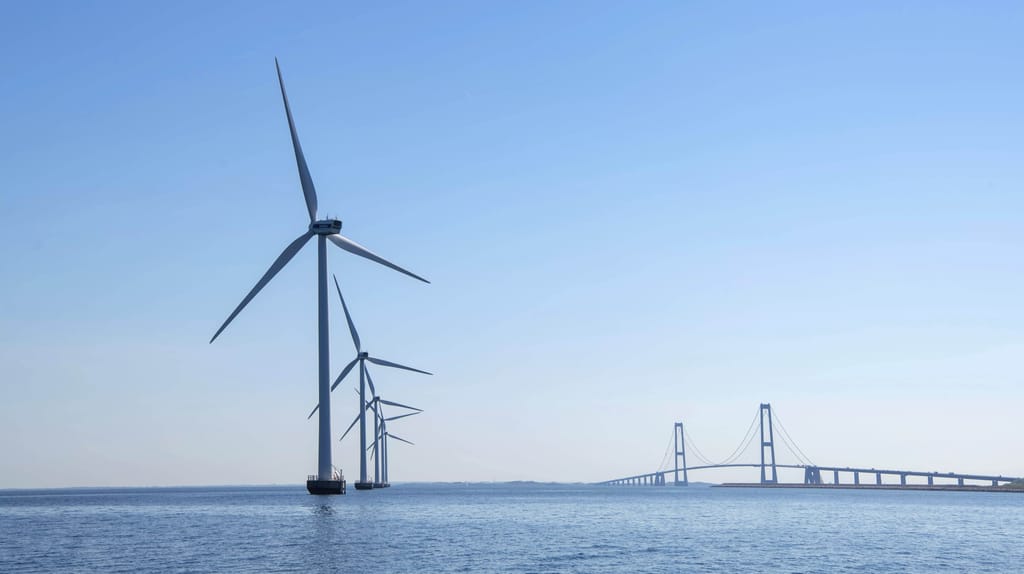
Denmark completed it first tenders in two years after reworking its approach
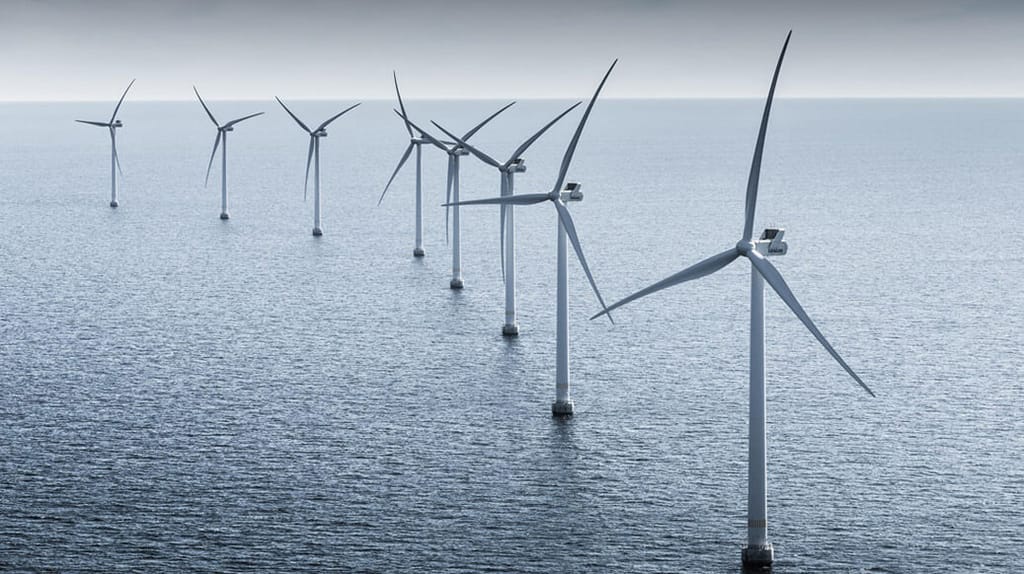
The Danish Energy Agency awarded two new contracts for offshore wind farms to Vattenfall, marking a critical success after it reworked its contracts. It is the first time in two years that Denmark has successfully completed tenders after winning government approval for a revised approach to encourage greater industry participation.
The last tender, which was launched in 2024 for six areas, failed to attract bids. The Danish Energy Agency was forced to cancel the tender, as it reported that, as the deadline approached for the first three sites, it had not received bids. It launched a political debate that resulted in two agreements in 2025 and the adoption of the Contract for Difference (CfD) approach, where the state guaranteed a fixed price for the electricity. If the price falls below the contract, the government will provide a subsidy, and if it exceeds the price, the operator reimburses Denmark.
The approach has worked successfully in the UK, and more countries were encouraged to adopt it to address the challenges in the offshore wind energy sector. When the Danes relaunched the tender in November 2025, they said the CfD, along with other changes, provided greater flexibility for developers and reduced the risks to increase the likelihood of bids.
"The Danish Energy Agency has conducted an extensive market dialogue and tender process on the construction of two new offshore wind farms in the North Sea and Kattegat. It is very pleasing that we have now reached an important milestone with a positive result, where we can announce the winners of the tenders," says Deputy Director General of the Danish Energy Agency, Stig Uffe Pedersen.
The agency reported on August 4 that it had received two bids for Hesselo, an 800 MW site in the Kattegat. Nordsøen Midt, a site in the North Sea that can support 1 GW, received five bids. The government is offering 20-year leases from completion and requiring the projects to be completed by the end of 2032.
Hesselo will be located approximately 19 miles from the coast. Nordsøen Midt will be located approximately 12.5 miles offshore.
Vattenfall was selected as the winner for both projects. For Nordsøen Midt, it bid 504 kroner per MWh ($77.75), and for Hesselo it bid 542 kroner ($83.60). These were the lowest of the bids for each location. In addition, the bids required sustainability and social responsibility components, including a requirement to recycle turbine blades. Hesselo must also establish a so-called nature-inclusive design
Vattenfall said the projects would strengthen its offshore portfolio. The company currently operates five offshore wind farms in Denmark, generating around 6.5 TWh of electricity annually. It reports that the grid connections have been reserved for the two new projects, saying the consent will be granted for 30 years with an option to extend it by a further 10 years.
Denmark has a long history with wind energy, and it was the first country to host an offshore wind farm, which was commissioned in 1991. Currently, it has a total installed capacity of 2.7 GW of offshore wind power, with one additional wind farm under construction to add another 1 GW in 2027. As part of this current tender, it also offered a third site, Nordsøen Syd, which will have a capacity for a minimum of 1 GW, and it has a bid deadline of October 2028.
Wreck of 19th-Century Schooner Gets Protection on US National Register
rendering of the wreck which is well preserved on the floor of the lake (Wisconsin Historical Society)
The shipwreck of a 19th-century schooner that gained fame transporting cargo in the Great Lakes is set to be accorded more protection after it was listed on the National Register of Historic Places. The FJ King shipwreck sits intact in Lake Michigan near Liberty Grove, in Door County, where it was discovered in June last year.
Constructed by Master Shipbuilder George R. Rogers in 1867 in Toledo, Ohio, FJ King was a workhorse wooden schooner that transported cargo in the Great Lakes for two decades. Historical accounts indicate the ship was originally designed for the coal and grain trade between Lake Michigan and the lower lakes. However, it was later adapted for use in the lumber and iron ore trades.
Unlike other cargo vessels, FJ King was a representative of a unique class of sailing vessels called canal schooners or canallers. This is because she was specifically designed to transit the Welland Canal locks, a canal that bypasses Niagara Falls. Owing to her design, the ship was able to carry a maximum amount of cargo through the locks with only inches to spare. While running her trade in the Great Lakes, the schooner experienced several groundings and collisions that required repair.
Her fate, however, came on September 15, 1886, just a year after she was re-rigged as a three-masted schooner. On the fateful day, FJ King was sailing with a cargo of iron ore collected at Escanaba, Michigan, bound for Chicago. In a heavy gale, the ship’s hull sprang a leak that caused heavy flooding, which the crew could not control.
Desperate efforts by the captain to turn the ship around were unsuccessful, forcing the crew to abandon ship and be rescued by a passing schooner, La Petite. The FJ King went down by its bow, with the masts breaking the surface of the water. Although salvage attempts were made to recover the ship, it was ultimately abandoned.
Last year, a project by the Wisconsin Historical Society and the Wisconsin Underwater Archaeology Association led to the discovery of the schooner. Today, the vessel sits upright at the bottom of the sea with the hull intact, with damage sustained during her sinking being evident at the bow.
While in March the FJ King was added to the Wisconsin State Register of Historic Places, the listing on the National Register now affords the wreck more protection. The listing means that divers are not allowed to disturb the wreck by removing, defacing, displacing, or destroying artifacts or the structure of the shipwreck.
First Multipurpose Cargo Vessel Installs Wind-Assisted Propulsion
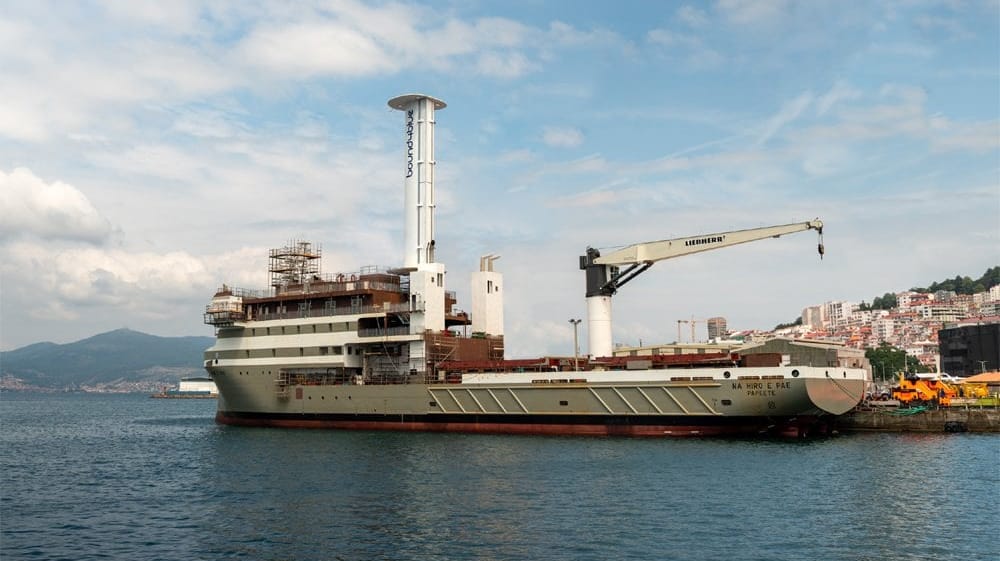
First installation of wind-assisted propulsion n a multipurpose cargo vessel
The global shipping industry is witnessing a significant increase in the number of cargo ships deploying wind-assisted propulsion as part of efforts to cut down on energy consumption and emissions. The industry is now pushing the boundaries as the first multipurpose cargo vessel was fitted with wind-assisted propulsion.
Spanish wind propulsion company bound4blue announced that it has completed the installation of its eSail suction sail on the Na Hiro E Pae, a newbuild multipurpose vessel that will provide vital transport links between Tahiti and the remote Austral Islands. The 292-foot (89-meter) vessel was fitted with a 22-meter (72-foot) tall sail, becoming the first known multipurpose vessel worldwide to adopt a wind propulsion system.
Owned by Greek shipping company Société de Navigation des Australes SNA Tuha’a Pae, the vessel will offer services transporting passengers, food supplies, and general cargo between Tahiti and the South Pacific archipelago. Apart from a capacity of 200 passengers, the vessel is capable of transporting 1,500 tonnes of supplies. The ship is also outfitted with engines capable of running on biofuel or e-fuel as soon as it becomes commercially available in the region.
Bound4blue is highlighting that the installation of the eSail was a complex task that was carried out at its Astilleros Armon Vigo yard in Spain. The suction sail works by harnessing wind power to propel the vessel, employing an autonomous vertical sail with suction technology, dragging air over a thick aerodynamic profile.
The process generates seven times the propulsive force of a standard rigid sail of the same size, resulting in exceptional propulsive efficiency and greatly reducing the load on main engines, thus saving on fuel and significantly cutting emissions. In the case of Na Hiro E Pae, the system is expected to reduce energy consumption by 10 percent.
“Multipurpose vessels have traditionally been seen as a challenging segment for wind power due to the required flexibility of operations and related integration demands. This project demonstrates how systems suppliers, naval architects, shipowners, and other key stakeholders can solve such issues, collaborating closely to empower progress,” said José Miguel Bermúdez, bound4blue CEO.
The new ship forms part of efforts to modernize maritime transport links serving the Austral Islands and will provide services alongside the Tuhaa Pae IV, which was introduced on the route in 2012 and has been transporting essential products such as gasoline, gas, as well as passengers. Spreading across five inhabited islands, the Austral Islands in French Polynesia have a total population of approximately 7,000 people.
For bound4blue, which has been in operation for only 12 years, the installation of the system on Na Hiro E Pae is the latest in a series of high-profile deployments. So far, the eSail system has been installed on 12 vessels, with a further six vessels in its orderbook, representing more than 50 eSails in total.
The Trump administration has rapidly engaged post-Assad Syria and Iraq, removing Syria from the U.S. State Sponsors of Terrorism list and pursuing deeper economic and energy ties with both governments.
A central, low-profile element of the strategy is the planned revival of the historic Kirkuk–Baniyas oil pipeline, which would give Iraqi exports a Mediterranean outlet that bypasses the Strait of Hormuz.
These moves position Syria as a potential regional energy transit hub and commercial partner, though residual Turkish and Russian influence, as well as Israeli caution, remain significant complications.
On July 8, on the sidelines of the NATO summit in Ankara, US President Donald Trump had a face-to-face meeting with Syrian President Ahmed al-Sharaa.
According to the official Syrian read-out and US reporting, they discussed strengthening US-Syrian relations, Syria’s economic recovery, and foreign investment. Following their meeting Trump announced he was removing Syria from the US list of State Sponsors of Terrorism, a designation Syria had borne since 1979.
Reuters reported that Trump handed Sharaa a personal letter during the meeting. The key passages were: “I promised to remove all barriers stopping you from rebuilding your country, and very soon, you will finally be able to do so,” and “We have US companies ready to invest in Syria and help make your country greater and more prosperous than ever before.”
Speaking to the media after their meeting, Trump praised Sharaa in unusually strong terms. He’s: “doing an unbelievable job in unifying Syria….Syria was a mess…now it’s just come together….He’s done a fantastic job.” All the indications are that Trump has decided to adopt post-Assad Syria as a working partner in developing a reinvigorated Middle East.
One week later, Trump was entertaining Iraq’s prime minister, Ali al-Zaidi,at the White House.
Once again the meeting was notable for its tone. Trump repeatedly praised Zaidi and spoke of their “tremendous chemistry.” He made it clear that he regarded Iraq’s new prime minister also as a partner with whom Washington could build a stronger long-term relationship.
The discussion covered expanding economic relations between the two countries, while both sides endorsed a series of memoranda of understanding (MoU) involving US participation in Iraq’s oil and gas sector. Zaidi reiterated his government’s intention of bringing all armed groups, including Iran-backed militias, under state control, while confirming that the remaining US forces in Iraq are expected to complete their withdrawal by September 30, 2026.
What was not specifically referred to by either party – and not mentioned either following Trump’s discussion with Sharaa – was the US-Syria-Iraq plan to revive the historic 500-mile pipeline from the oilfields of Kirkuk in northern Iraq to the town of Baniyas, on Syria’s Mediterranean coast – a determined effort to reduce Iran’s control of the Strait of Hormuz.
Tom Barrack, Trump’s ambassador to Turkey and envoy to Syria and Iraq, had been working on the details of the agreement before Zaidi’s visit.
The pipeline was completed in 1952 by Iraq’s Petroleum Company with a capacity of around 300,000 barrels per day. Baghdad shut the pipeline in the 1980s after Syria sided with Iran during the Iran-Iraq war.
The pipeline will almost certainly have to be wholly replaced – a project calculated to last up to three years.
A glance at the map shows that reviving the pipeline would give Iraq a strategic alternative to exporting oil through the Strait of Hormuz. Unlike Gulf exports, shipments through the Kirkuk-Baniyas pipeline would avoid the Persian Gulf altogether. It would spare tankers the need to negotiate the strategic Hormuz chokepoint on both their outbound and return voyages. Oil reaching Syria’s Mediterranean coast via the pipeline could be shipped directly to European markets.
Routing Iraqi oil this way could cut a tanker’s voyage to European refineries by roughly 3,000 nautical miles and more than a week at sea, saving hundreds of thousands of dollars in normal shipping costs while avoiding the war-risk insurance and disruption associated with the Strait of Hormuz.
Although it has clearly been agreed between the parties to keep the resurrection of the historic pipeline low-key, Reuters and other media outlets indicate that the project has advanced well beyond the conceptual stage. It is claimed that the US is officially backing restoration of the 891 km (about 550 mile) long pipeline, and that the US expects American firms to take part in rebuilding the line. Chevron has been widely mentioned as a potential participant, although the company has declined to comment publicly.
Other pipeline projects with outlets on Syria’s Mediterranean coast are also under consideration, and could link major energy producers in the Gulf, including Saudi Arabia and Qatar, directly to Syria’s ports. Indeed, with Syria shorn of its sanctions and established as a fully-fledged partner, it has the potential to become a major energy transit hub. It has about 2.5 billion barrels of proven oil reserves, but some geological estimates suggest its undiscovered onshore and offshore petroleum resources could ultimately exceed 20 billion barrels.
In February 2026, Chevron signed a memorandum of understanding with Syria’s state-owned petroleum company and Qatar’s Power International Holding to develop the country’s first offshore oil and gas field. Days later, Saudi and American energy companies formed a consortium to explore four or five oil and gas blocks and rebuild energy infrastructure in north-east Syria.
Finding gas is, of course, only the beginning. Syria would ultimately need to sell it. Trump’s decision to remove Syria from the US list of State Sponsors of Terrorism signals that Washington now regards Sharaa’s government as a legitimate partner. That political endorsement encourages investors who might otherwise have stayed away, and it makes it much easier to construct pipelines, use Mediterranean export terminals, attract investment and conclude long-term gas sales contracts with foreign buyers.
Were Israel to follow Trump’s lead in considering Syria’s potential as a commercial partner, several hazards would need to be overcome. One is the strong influence that Turkey, no friend of Israel, exercises on Sharaa.
Then there is the fact that Russia has retained a significant military and commercial presence in Syria. President Vladimir Putin has preserved his strategic foothold on the eastern Mediterranean, having negotiated continued access to Russia’s naval facility at Tartus and its Khmeimim air base near Latakia. At the same time, according to reliable media reports, a Russian commercial logistics hub is expected to become operational at Tartus very soon, handling Russian cargo and providing a maritime link between the Syrian coast and Russia’s Black Sea port of Novorossiysk.
Trump seems determined to enfold both Syria’s Sharaa and Iraq’s al-Zaidi into a close commercial and economic embrace. In Israel, however, both are viewed rather more cautiously. Trust cannot simply be bestowed; it will have to be earned.
About Neville Teller Neville Teller's latest book is ""Trump and the Holy Land: 2016-2020". He has written about the Middle East for more than 30 years, has published five books on the subject, and blogs at"A Mid-East Journal". Born in London and a graduate of Oxford University, he is also a long-time dramatist, writer and abridger for BBC radio and for the UK audiobook industry. He was made an MBE in the Queen's Birthday Honours, 2006 "for services to broadcasting and to drama." View all posts by Neville Teller →
London robotaxis granted minicab licences
07.08.2026,
Photo: Julia Kilian/dpa/dpa-tmn
By Neil Lancefield, Press Association Transport Correspondent
A fleet of self-driving cars to be used by Uber in London have been granted minicab licences.
Technology company Wayve said Transport for London (TfL) has awarded private hire vehicle (PHV) licences to a number of its autonomous pure electric Ford Mustang Mach-E vehicles.
Uber said some of the 100,000 people who signed up to express their interest in experiencing robotaxis will be offered rides in the vehicles “later this summer”, ahead of a full public launch.
A human driver will initially sit behind the wheel ready to take control during journeys, while the technology is demonstrated to be safe.
Wayve vice president for global affairs and assurance, Sarah Gates, said: “This licence is an important step towards giving Londoners the chance to experience autonomous driving technology.
“The responsible deployment of these vehicles will bring us safer, cleaner and quieter streets, and we’re proud to continue working alongside regulators, communities and the public as we take the next steps towards making autonomous rides a reality in the capital.”
Uber global head of autonomous mobility operations Annie Duvnjak said: “This licence is a key milestone in bringing autonomous rides to London on Uber.
“Our interest list has seen an incredible response from Londoners who are excited to experience Wayve’s British-built autonomous driving technology.”
A TfL spokesperson said safety is its “top priority” and any new vehicle licensed to carry passengers in London must align with its target of eliminating all deaths and serious injuries on London’s roads by 2041.
Wayve’s modifications to the Mustang Mach-E – such as its six cameras – were assessed by experts and found “they do not compromise passenger safety”, he added.
A qualified driver must be present and remain responsible for the car under the terms of a PHV licence.
Uber and Wayve will be required to obtain separate approval from the Driver and Vehicle Standards Agency if they want to operate the cars without a driver.
Wayve was founded in 2017 by two University of Cambridge PhD students.
London will be the first city in the world to use its technology for commercial journeys.
Wayve is also working with car manufacturers such as Nissan and Stellantis to deploy its systems in private vehicles.