Wednesday, August 26, 2026

Settler attacks threaten the West Bank’s final Christian village
(RNS) — As settler violence escalates in Taybeh, a Catholic priest and a papal charity are working to give Palestinian Christians security, jobs and community support to remain in the Holy Land.
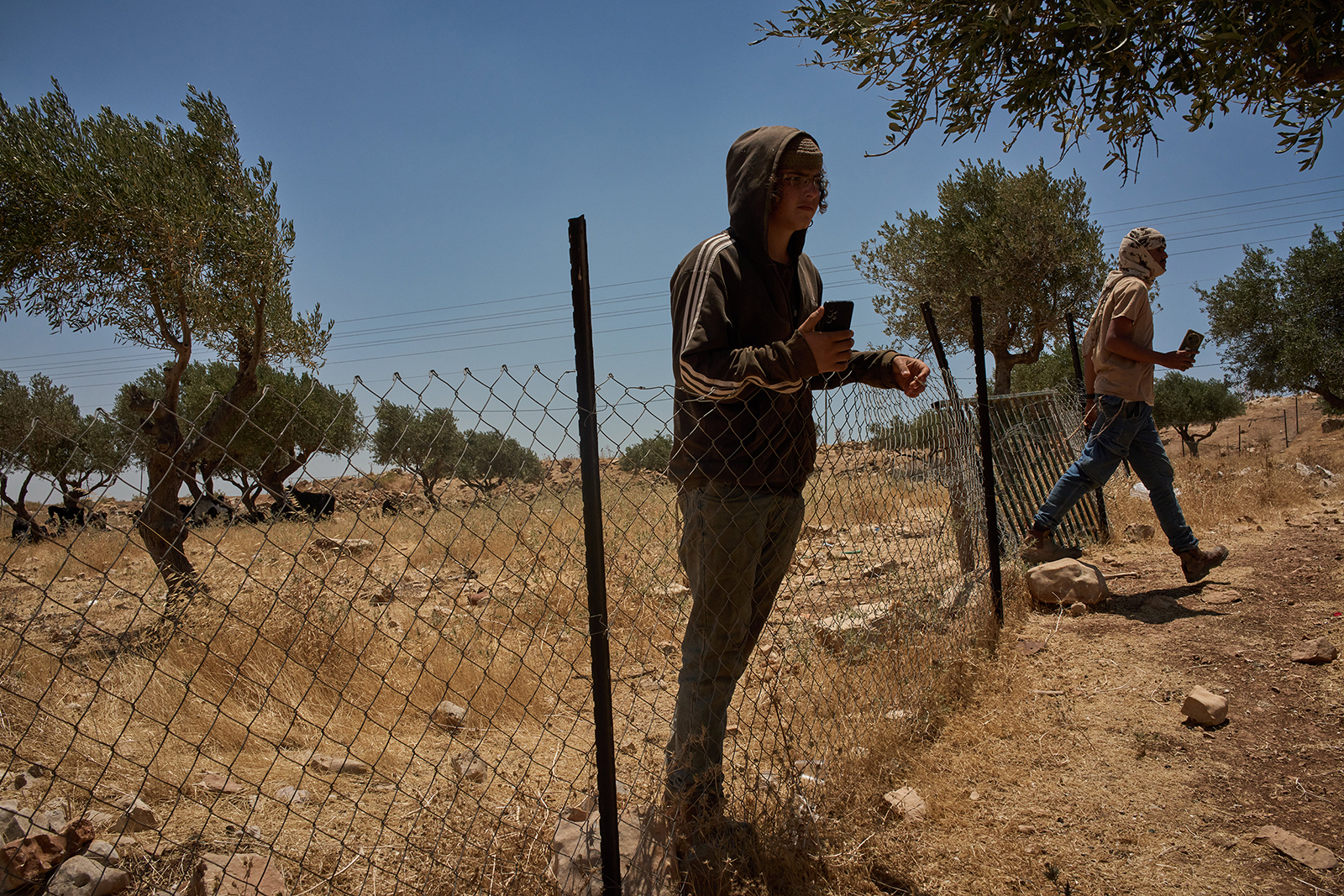
An Israeli settler steps into the courtyard of a home as another stands next to the fence, trespassing on Palestinian property on the outskirts of the West Bank town of Taybeh, Thursday, June 25, 2026. (AP Photo/Leo Correa)

(RNS) — In early August, Joseph Hazboun visited a newly built home among the fields near Taybeh, considered the last Christian village in the West Bank. Its owner, a local Palestinian Christian, claimed he could not access his property safely because of intimidation by Israeli settlers.

As Hazboun inspected fencing that was reportedly cut to allow settlers’ sheep onto the land, a settler approached him driving a tractor at full speed, he said, an attempt to intimidate and chase him and his group away.

“I witnessed firsthand how this settler terrorizes the local community,” Hazboun said, adding that the man carried a gun concealed beneath his shirt. The intervention of two Israeli peace activists prevented the confrontation from escalating.

Hazboun is the regional director for Palestine and Israel for the Catholic Near East Welfare Association, a papal agency that supports Eastern churches and vulnerable communities and reports to the Vatican. A CNEWA delegation visited Taybeh and nearby properties on Aug. 5, investigating what the organization described as the “systematic intimidation” of Palestinian families by Israeli settlers.

CNEWA documented portions of Hazboun’s encounter in photographs and a video published on its YouTube channel and described the delegation’s findings in an Aug. 7 situation report.

“Standing on that contested hillside, the human cost of the West Bank’s expanding outposts became starkly evident — leaving families stranded away from the very homes they built, caught in a cycle of displacement and daily intimidation,” Hazboun wrote in the report.
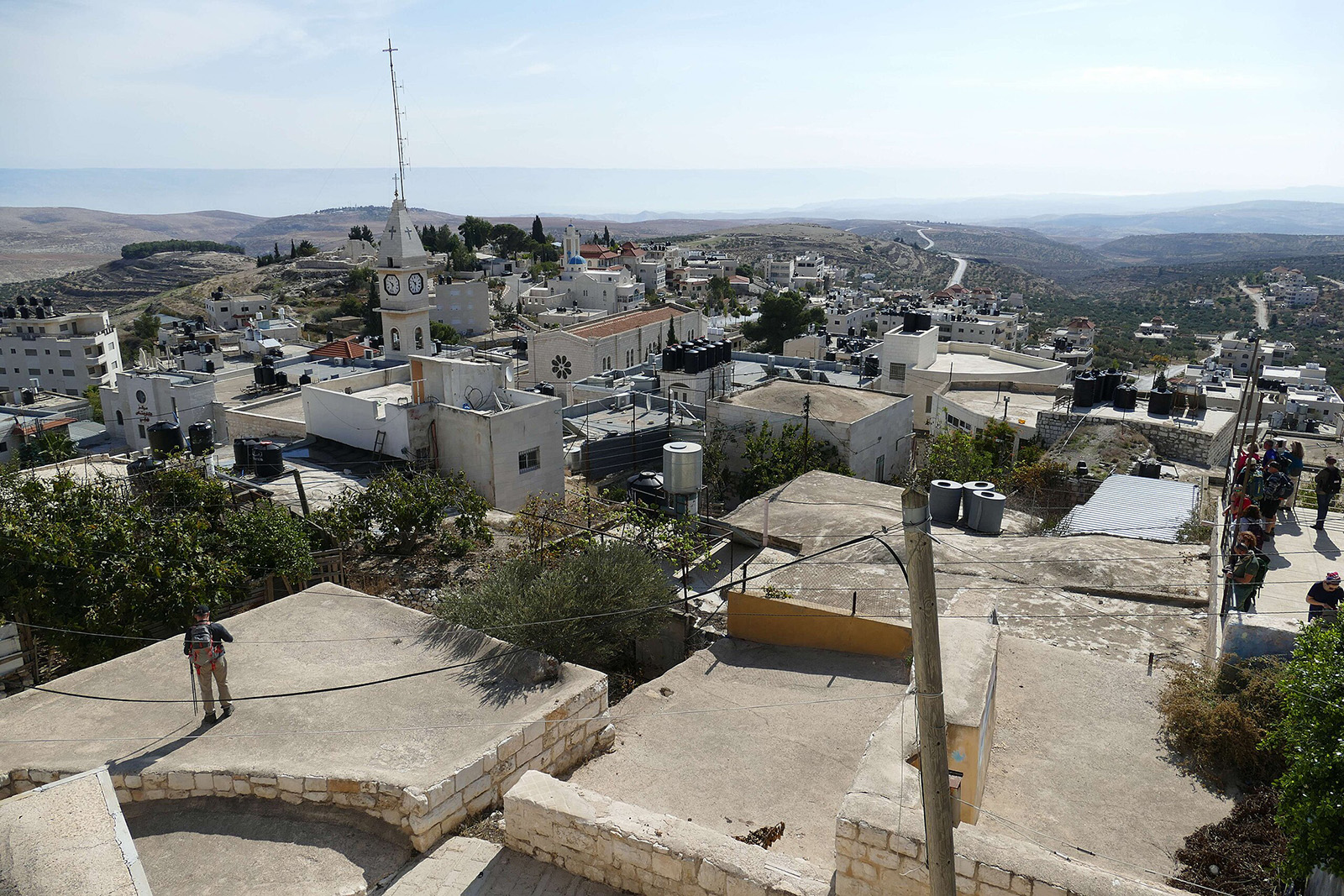
Overlooking Taybeh in the West Bank in 2018. (Photo by Bukvoed/Wikimedia/Creative Commons)

The confrontation was one episode in a growing struggle over land in the West Bank, a Palestinian territory captured by Israel in 1967 that remains under its occupation. Settler violence has escalated in recent weeks, drawing widespread condemnation and causing Israel’s military to declare Taybeh closed to non-residents to attempt to prevent attacks.

“This is the worst, the worst crisis that we have witnessed even since 1967,” said Hazboun, who has over 30 years of experience at CNEWA and has lived in the Holy Land his entire life.

Settlers have received support from some far-right leaders in Israel’s government, such as National Security Minister Itamar Ben-Gvir and Finance Minister Bezalel Smotrich, Hazboun said. 

Unlike Israel’s large, government-authorized settlements, herding outposts may begin with little more than a tent, a trailer and a flock — a tactic settlers are using to expand. Some will enter private Palestinian properties with their sheep, with some incidents including arson and large, coordinated raids.

“A settler could go anywhere in the West Bank and set up a tent,” Hazboun said. “Then, after a couple of months, it will turn into barracks or a container. Then, after a few months or a couple of years, it will turn into homes and then a settlement.”

Like elsewhere in the West Bank, in Taybeh — the majority-Christian Palestinian village identified as the biblical town of Ephraim, where Jesus took refuge — tensions escalated this summer.
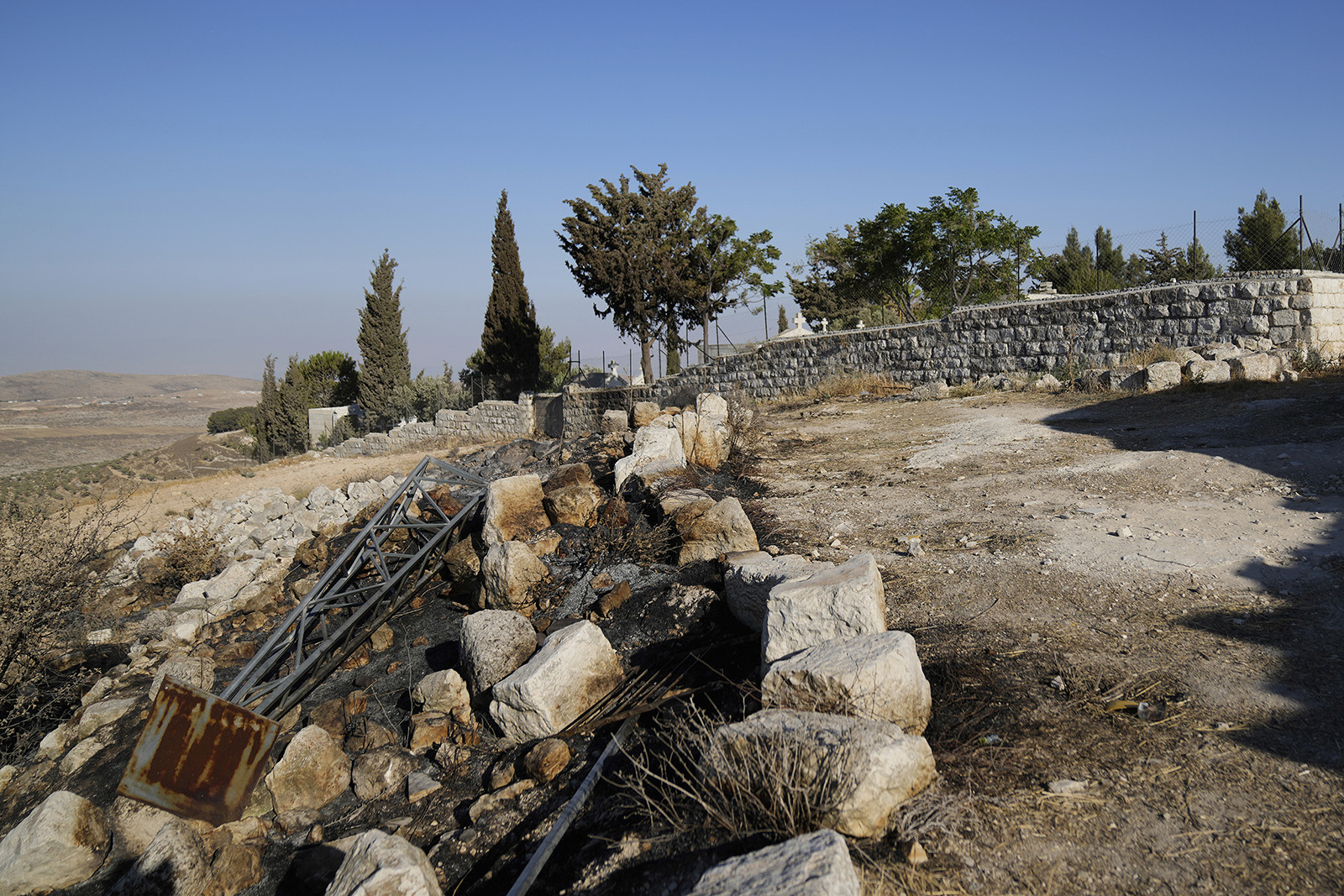
Char marks, which Palestinians say are from an attack by Israeli settlers, are visible in the cemetery near the St. George Greek Orthodox Church in the West Bank village of Taybeh, July 14, 2025. (AP Photo/Nasser Nasser)

“Taybeh has experienced fires, incursions, attacks on private property, the intimidation of families and obstruction of emergency services,” said Father Bashar Fawadleh, the Latin parish priest of Christ the Redeemer in Taybeh. He said that in June, settlers obstructed Palestinian firefighters from responding to a large blaze near the town.

Bashar described a situation where “insecurity has become a daily reality.” He said that in recent weeks, settlers have cut fences, bathed in private water cisterns and stolen a beehive. Palestinian workers have been impeded from reaching their workplaces, and on Aug. 18, he said, two settlers on horseback terrorized a Palestinian family by approaching the wall of their home.

“For a family, seeing strangers come up to its garden or the wall of its home is not merely an inconvenience — it is a message of intimidation,” Bashar said.

Despite Taybeh’s Christian identity, Bashar underscored that the settler attacks are not motivated by religion. “We are Christians, but we are also Palestinians,” he said. “Settlers entering Palestinian land generally do not first ask whether its owner is Catholic, Orthodox or Muslim.”

The incursions continued after the Israeli military’s closure of the village two weeks ago, Bashar said. “A decision has value only if it is enforced,” he said. 
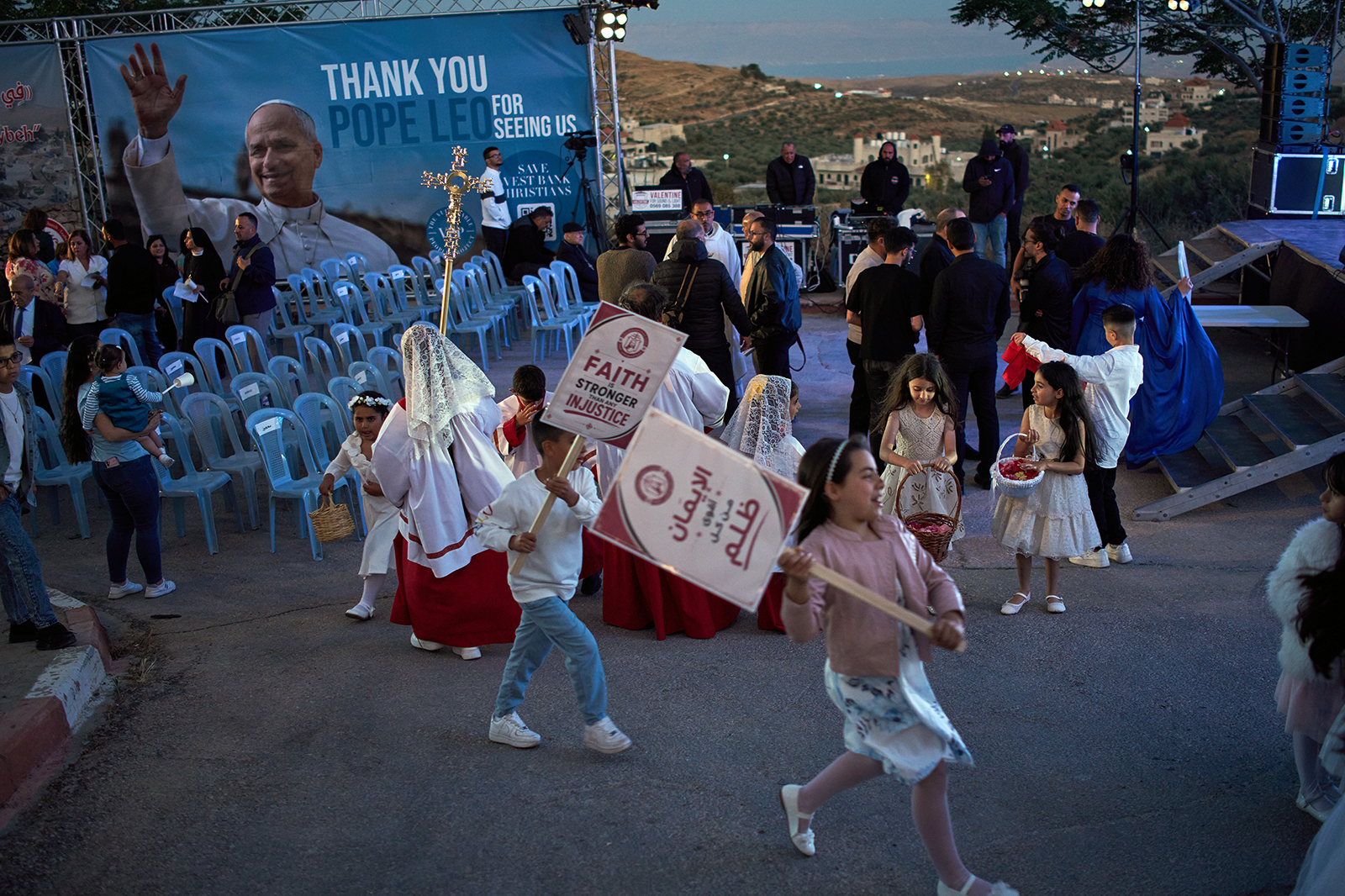
A Palestinian altar girl carries a cross after taking part in a procession during celebrations honoring the Virgin Mary in the West Bank town of Taybeh, Friday, May 29, 2026. (AP Photo/Leo Correa)

The priest asked that the restrictions be applied only to those who act illegally to intimidate residents, not farmers, visitors or others who want to support the community.

Bashar said he attempts to guide his flock spiritually through feelings of rage, desperation or the desire to leave.

“Today, perhaps the gravest problem is invisible,” he said. “Residents are beginning to lose the basic sense that they are safe in their own homes.”

The situation in the West Bank also drew the attention of Pope Leo XIV, who made an appeal in his Angelus address on Aug. 16 “for an end to the ongoing violence against the Palestinian civilian population.” Bashar said the pope has continued contact with the only Catholic parish in Gaza, the Holy Family Church, which continues to celebrate Mass and provide shelter as Israeli attacks continue, despite a tenuous ceasefire between Israel and Hamas since October 2025.

The Latin Patriarch of Jerusalem, Cardinal Pierbattista Pizzaballa, visited Taybeh on the feast of Mary’s Assumption into heaven on Aug. 15 — “at a time when many people felt vulnerable and exhausted,” Bashar said. He said the visit reminded the small Christian community that they are not alone.

In his homily at the Christ the Redeemer church, Pizzaballa urged the faithful to “not be afraid” and to remain a Christian voice despite the “very complex situation” in the Holy Land.

“We will continue to do everything in our power to preserve the Church’s presence here, at every level, throughout the Holy Land,” Pizzaballa said.

For Bashar, the message was clear. “We will relinquish neither our presence nor our right to live on this land,” he said.

Palestinian Christians represent only an estimated 1% of the population of the West Bank and Gaza, according to a 2017 Palestinian Authority census. In Gaza, the number of Christians has declined sharply since 1997 to approximately 1,000 before the war, and church leaders say that number is roughly halved today. Taybeh counted an estimated 1,700 residents recently, Bashar said, but the figure is now around 1,200.

Christian charities like CNEWA are attempting to sustain the population by providing food security, part-time employment, maternal and infant care and educational services tailored especially for young women. The organization aims to help fund a regional football field and a track-and-field space to allow youth in the Taybeh area to have a space to play and grow together.

Hazboun emphasized the importance of “investing in Christian-Muslim relations on a grassroots level,” allowing children to grow and play together to overcome conflict.


But road closures, military blockades, poverty and unemployment continue to threaten the Palestinian population, including Christians. And charities struggle to fund aid in the West Bank as tensions unfold in other parts of the world, including Gaza, Lebanon and Ukraine.

“I do believe that we are very privileged to be Palestinian Christians — we are Christians from the land of Jesus Christ,” said Xavier Abu Eid, a political scientist and a Palestinian Christian.

A former adviser to the Palestine Liberation Organization, Abu Eid said he was almost killed two years ago after an ambush by Israeli settlers as he drove with his pastor from Jericho to Ramallah, not far from Taybeh.

“I think some people are focusing on people that are leaving the country,” he said. “And many Palestinians are leaving, not just Christians.

“But it’s important to support and focus on those who are struggling to stay in Palestine,” he added.


13 US citizens denied entry to Israel for weeklong trip to learn about Palestinian Christians
(RNS) — Amid escalating violence in the West Bank, an interfaith group, led by a retired Emory University theology professor, was turned back at Israel's border.
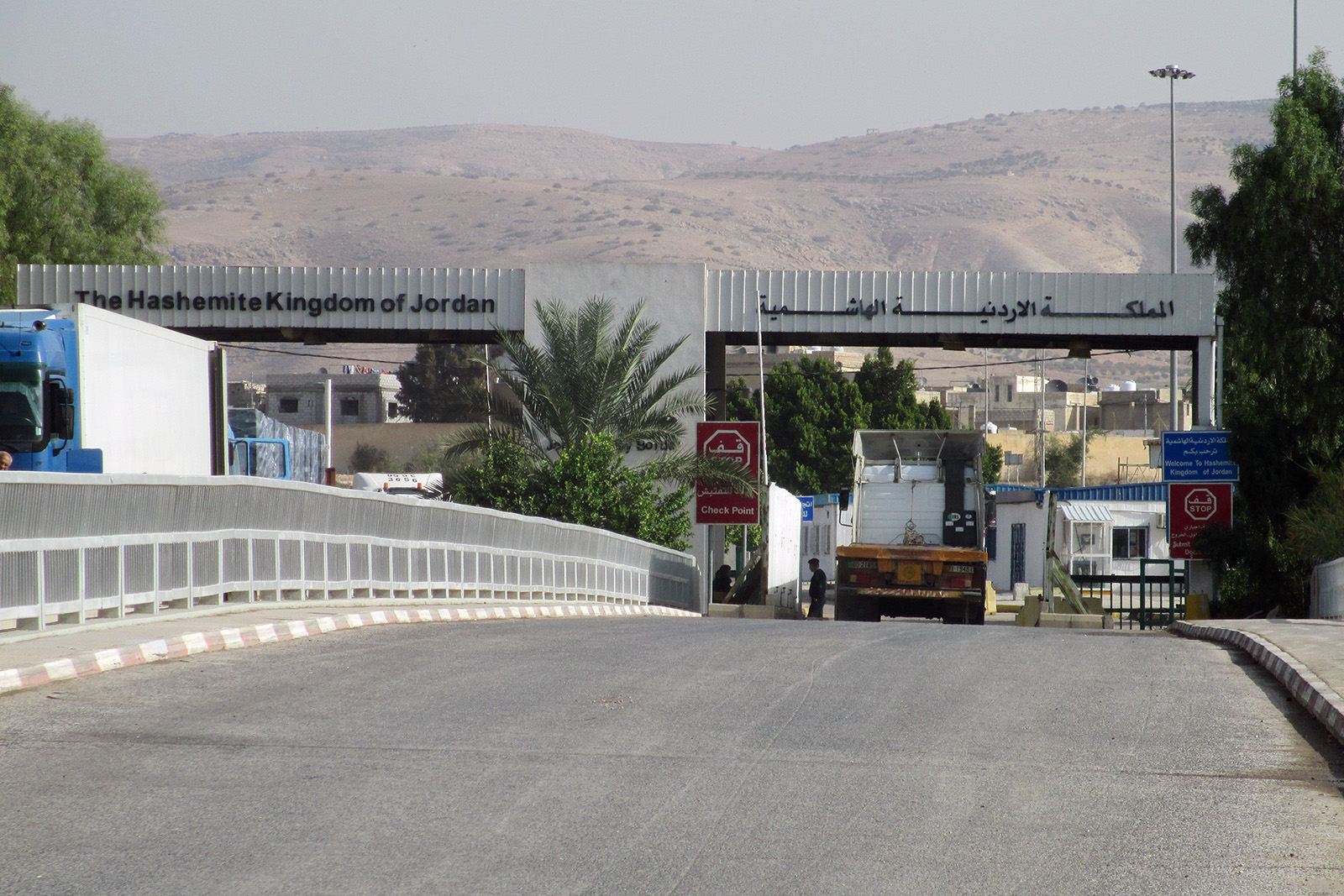
The Sheikh Hussein Crossing, or Jordan River Crossing, between Jordan and Israel. (Photo by Avishai Teicher/Wikimedia/Creative Commons)

(RNS) — A group of 13 United States citizens who traveled to Israel to take part in a weeklong trip with a Christian organization dedicated to Palestinian liberation theology were denied entry at the border last week.

The interfaith group, led by retired Emory University theology professor L. Edward Phillips and his wife, the Rev. Sara Webb Phillips, an ordained United Methodist minister, were set to tour Jerusalem and West Bank sites with the Sabeel Ecumenical Liberation Theology Center, a 40-year-old nonprofit organization registered in Israel.

They traveled from the U.S. to Jordan and had planned to enter Israel via the Sheikh Hussein Crossing when they were interrogated by Israeli border agents. Nine were initially granted visas and allowed into Israel, while four were denied. Then in a turnabout, Israeli border authorities boarded a bus where the nine were waiting and seized and cancelled their visas.

“I always wanted to be first at something,” said L. Edward Phillips, 71, who taught historical theology and worship at Emory’s Candler School of Theology in Atlanta, speaking by phone from Jordan. “Now I’m the first person to lead a Christian delegation into the West Bank to be categorically denied entry.”
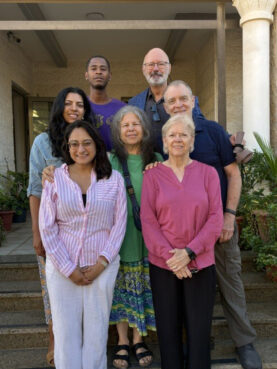
Seven of the 13 members of the delegation to Israel gathered for a photo prior to crossing the border and being denied entry to Israel last week. L Edward Phillips and his wife, Sara Webb Phillips, right, second and third row, are ordained United Methodists from Atlanta. (Photo courtesy of Edward Phillips)

Israel’s Border Control Administration, part of the Ministry of Interior, did not respond to RNS’s emailed requests for comment.

Sabeel’s director, Omar Haramy, said that although Israel has denied entry to a handful of individuals over the years, it has never denied an entire delegation.

“This is something you don’t expect in a country that labels itself as a liberal democracy,” Haramy said. “This is how you’d expect somebody going into Iran or Iraq or North Korea. You don’t expect a group of interfaith people, Jews, Christians, Muslims, Hindus, with a clean record, many of them professors, graduates of top-notch universities, to get treated like this.”

Sabeel, which has welcomed thousands of visitors to Israel and the West Bank over the years, is appealing the denial of two in the group. Jonathan Kuttab, a lawyer and the executive director of Friends of Sabeel North America, an affiliate organization, said Israel does not allow groups to appeal.

Two reasons were citied for each of the denials: public safety and immigration considerations, specifically that some members of the group might overstay their visas, Kuttab said.

Kuttab also protested the Israeli decision to the U.S. Embassy and Ambassador to Israel Mike Huckabee. The State Department did not respond immediately to RNS’s request for comment.

In the past couple years, the Israeli government has arrested and swiftly deported dozens of international activists, including U.S. Jews who traveled to Israel as volunteers with nonprofits to help Palestinians in the West Bank.

Both Muslims and Christians in the West Bank have suffered escalating violence at the hands of Israeli settlers and/or the Israeli army. A United Nations report from late July estimated 2,000 such attacks will occur by the end of 2026 — an all-time high.


RELATED: These US Jews wanted to show solidarity with Palestinians. Israel deported them.


Israel has not routinely denied access for tourists on short stays.

But that may be changing.

Sara Webb Phillips, among the last four delegation members denied visas, said she was hectored and intimidated by border agents, accused of being an activist and asked to write down every organization she is a part of. She listed the Red Cross, Habitat for Humanity and the Atlanta Community Food Bank. Sabeel is not a membership organization.

“They were bullying me, and finally (the border agent) says, ‘We know about your work. We know you are with Sabeel,’ and she said, ‘You know they’re a terrorist organization,’ and I said, ‘No. They’re an organization that’s working peacefully for Palestinian rights,'” Phillips said.

Friends of Sabeel North America, or FOSNA, has called for an investigation into the incident and posted a petition to its website.

The eight-day trip was supposed to include stops in Jerusalem, Bethlehem and Hebron, and meetings with Palestinian Christians in those cities, many of whom have endured Israel’s brutal occupation. The itinerary also included a trip to Yad Vashem, Israel’s Holocaust museum.

L. Edward Phillips said the purpose of the trip, like several others he has participated in over the years, was to learn about Palestinian Christians’ lives and to tell others about what they saw. 

“This is a come see what’s happening, learn about the situation, and go back and tell the stories trip,” he said. “We tell the stories of the people we’ve encountered, the histories of the places we’ve seen, the strength of the people locally that are putting up with amazing odds and the tradition of ‘sumud,’ or perseverance.”


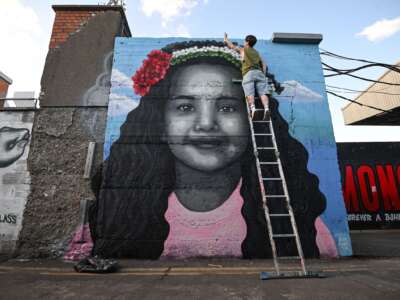
Hind Rajab’s Family Says Israel’s Investigation Into Hind’s Death Just a PR Ploy

“Even now, all I hear is her crying, ‘I’m scared,’ and her plea: ‘Come here, Mama, take me,’” Hind’s mother said.
August 21, 2026

The grandmother of Hind Rajab holds a mobile phone displaying a picture of Hind on August 20, 2026.Omar AL-QATTAA / AFP via Getty Images

Hind Rajab’s mother has dismissed the Israeli military’s announcement this week that it is opening a supposed criminal investigation into the killing of her 5-year-old daughter, saying that it is nothing more than a PR move meant to distract from Israel’s ongoing genocide in Gaza.

“Why did the investigation and the acknowledgment of the shooting at Hind’s car and at the paramedics come only after more than two years?” Wesam Hamada, Hind’s mother, told the Associated Press on Friday. “It’s an attempt to distract from what’s happening in Gaza and improve the [Israeli] army’s image to the world. That’s it.”

On Wednesday, Israel’s military acknowledged that its soldiers played a role in the horrific series of events in January 2024, in which Hind, her 15-year-old cousin, and five members of their family were killed.

The military admitted to the slaughter of her adult family members, but did not take responsibility for the killing of Hind or her cousin Layan Hamada specifically, despite numerous independent investigations finding that they were shot by Israeli soldiers in a tank. Israeli soldiers have been found to be targeting children in Gaza, often with gunshots to the head, countless other times since Hind’s killing.

“I don’t trust the Israeli authorities, I don’t trust their government, and I don’t trust any justice system they have,” Hind’s mother said in an interview with NBC. “I don’t want an investigation used to whitewash anyone’s image.”


After Years of Denial, Israel Finally Admits to Role in Killing of Hind Rajab
Israel has maintained a PR campaign for years, supported by the US, denying its soldiers’ role in the brutal killing. By Sharon Zhang , Truthout  August 19, 2026


Hind’s grandmother, who is also named Hind Rajab, similarly dismissed the investigation. “For us this is not an admission but rather an attempt by the Israeli army to justify to the world how it committed the crime and how they executed Hind,” she told AFP. “The army is trying to justify its position to the world, claiming that what happened was a mistake and that the soldiers who committed it will be prosecuted.”

An Israeli tank sprayed the car carrying Hind and her family members with hundreds of bullets, despite having a clear line of sight to the children inside, an investigation by Forensic Architecture found.

After her family was killed, Hind remained trapped in the car with their bodies for hours, a tank looming nearby, as Palestinian Red Crescent workers waited for the Israeli military to give clearance for them to rescue her. In those hours, she spoke with rescuers and her mother on the phone. Recordings from the Palestinian Red Crescent documented the terrifying last hours of the little girl’s life before she was gunned down.

“I’m so scared, please come. Please call someone to come and take me,” Hind said to emergency dispatchers.

Rajab noted that Israel only acknowledged Hind’s killing because her harrowing phone call to rescuers became so widely known, pointing out that there are many other similarly horrific killings that Israel will never follow up on.

Hind’s family still mourns her death.

“She died with the most heartbreaking sound I’ve ever heard,” Hamada told NBC. “Even now, all I hear is her crying, ‘I’m scared,’ and her plea: ‘Come here, Mama, take me.’”

Hamada has demanded an independent investigation that will actually lead to answers. “I want to know who killed my daughter, who killed my family members, and who killed the paramedics who went to rescue her. Who gave the orders? Who fired the shots?”

 Islam Beyond Phobia

Hind Rajab, the 5-year-old killed in Gaza, should have been enough

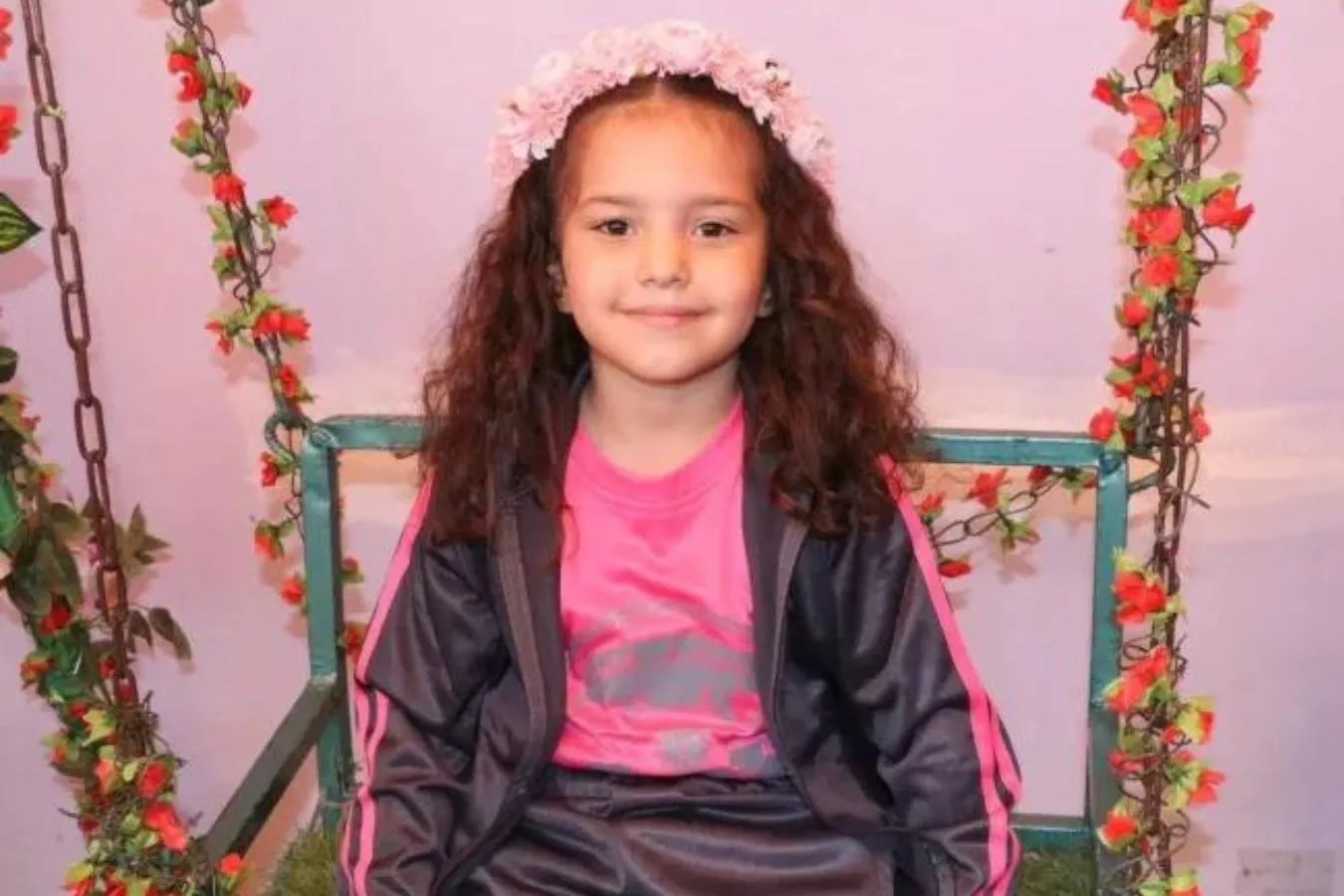
(RNS) — Hind Rajab was killed while pleading for help in a car with her six dead relatives. On Wednesday (Aug. 19), the Israeli military acknowledged for the first time its firing on the car. 
Hind Rajab. (Photo courtesy of Palestine Red Crescent Society)

(RNS) — One child. Five years old. Trapped inside a car in Gaza City surrounded by the bodies of her dead relatives, pleading into a telephone for someone to come save her.

“Come take me. Please, will you come?”

The world heard Hind Rajab’s voice. We heard her fear. We knew rescuers were trying to reach her. The Palestine Red Crescent Society dispatched two paramedics after coordinating their passage to reach her.

They never reached Hind.

Twelve days later, Hind was found dead in the bullet-riddled car alongside six members of her family. The two paramedics were found dead in their destroyed ambulance roughly 50 meters away. A subsequent forensic investigation, conducted in collaboration with Al Jazeera, mapped 335 bullet holes in the family’s vehicle and concluded that the damage to the ambulance was consistent with Israeli munitions and that Israeli military vehicles were nearby.

On Wednesday (Aug. 19), more than two and a half years after she was killed, the Israeli military acknowledged that its troops had fired on the car and announced a criminal investigation into the family and medical workers’ deaths. The announcement comes after the military initially denied that its forces were even present near the vehicles or within firing range. The Hind Rajab Foundation, which has pursued the case internationally, dismissed the investigation as an attempt to create the appearance of accountability after years of impunity.

But there is a question before the question of whether this investigation will produce justice. That is: Why did we need thousands more dead children before Hind’s death was treated as something worthy of accountability?

Hind should have been enough because one child should always be enough.


The Quran teaches that “whoever unjustly takes a single life, it is as though he has killed all of humanity, and whoever saves one life, it is as though he has saved all of humanity.”

I have reflected on that verse countless times during these years of mass death. God does not allow us to hide the individual inside the statistic.

One life contains a world. One child contains a world. One terrified little girl waiting for an ambulance should contain enough humanity to stop armies, move governments and awaken consciences.

Instead, Hind became one name among thousands. Her story was later dramatized into the award-winning film “The Voice of Hind Rajab,” which moved audiences to tears with the audio of Hind pleading for rescue. The film received a lengthy standing ovation at its Venice Film Festival premiere and won the festival’s Grand Jury Prize.

The emotional response was overwhelming — but it also raised a harder question: If we needed a film to feel what was already happening in real time, what does that say about what we ignored? And if we had to make a film for every Palestinian child, or stand and pray a funeral (janaza) prayer for every one of them, would the world still be able to function, still be able to look away?

UNICEF reported that as of Feb. 3 of this year, at least 21,289 Palestinian children had been killed in Gaza since October 2023. Even after what the world called a ceasefire, Palestinian children continued to die. This month, UNICEF reported at least 300 children were killed during the 300 days following the ceasefire announcement in October 2025.

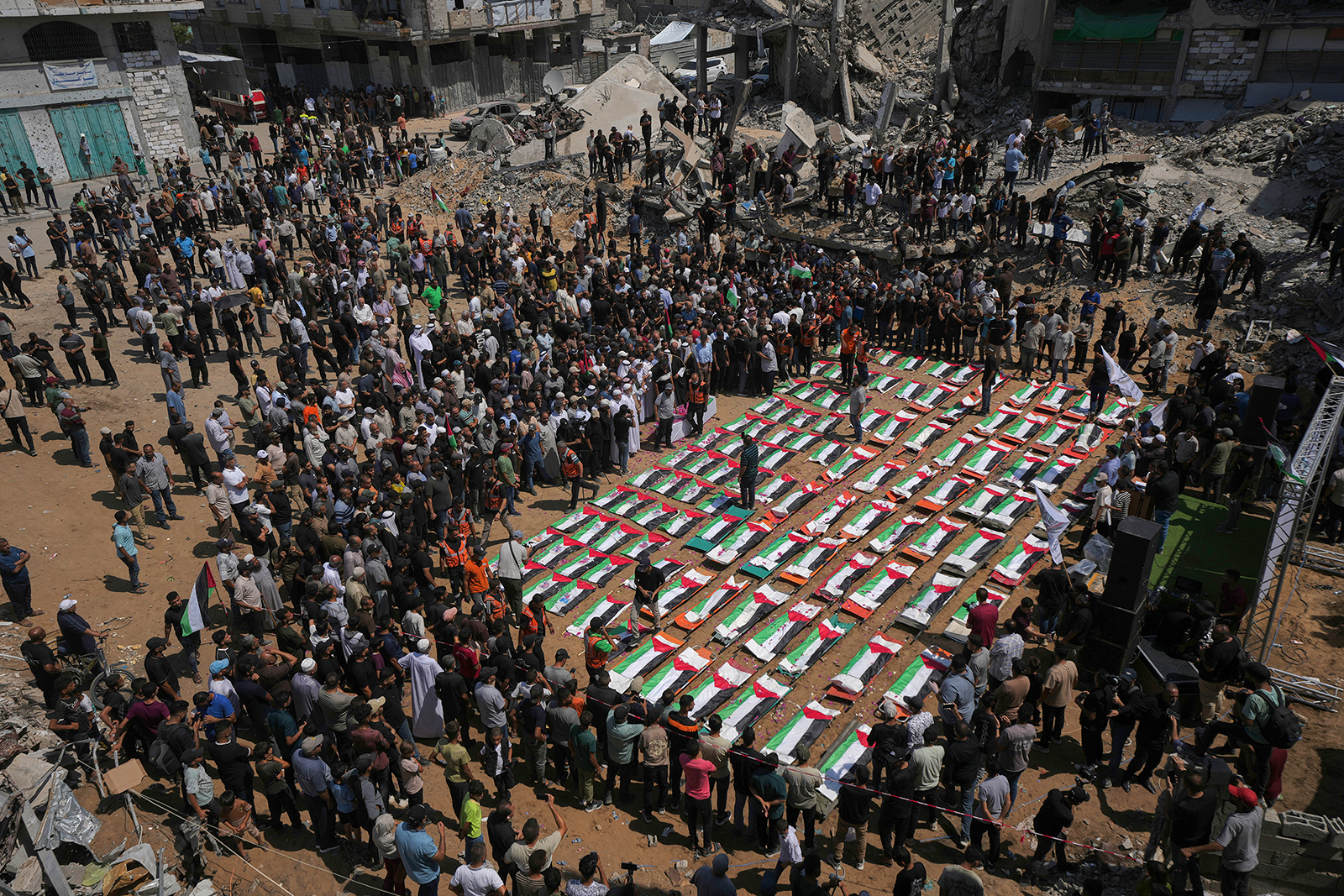
Bodies of members of the Hassayna and Abu Sharia families, killed in an Israeli strike in 2023 and recently recovered from the rubble, are draped in Palestinian flags during their funeral in Gaza City, Tuesday, Aug. 4, 2026. (AP Photo/Jehad Alshrafi)

One child a day, even after a ceasefire was announced.

What does it say about us that Hind was not enough?

There is another Quranic passage I cannot stop thinking about when I think of Hind.

In describing the Day of Judgment, God paints a haunting scene: “And when the girl-child that was buried alive is asked for what sin she was killed.”

The verse is striking because God does not ask the murderer first. He asks the murdered child. The girl whose life society decided was disposable is brought forward before all of creation. The crime that people normalized on Earth becomes an indictment before God.

For what crime was she killed?

I imagine Hind being asked that question.

What was your crime, Hind?

Was it being Palestinian? Was it being born in Gaza? Was it sitting in a car? Was it surviving the bullets that killed the people around you? Was it asking someone to come get you?

There is no military justification that can make that question disappear. No internal investigation can bury it. No press release can answer it. Criminals can’t investigate themselves or issue statements to make it better.

One day, Hind herself gets to put her criminals on trial before God. But will we also be on trial for indifference? 

Hind Rajab should have been enough.


And accountability has certainly not been enough. It is not merely whether a soldier is disciplined or a government publishes an investigation. Accountability means believing that no victim disappears simply because the powerful have moved on.

The Quran’s insistence on the value of a single life is especially necessary in an age of mass death because numbers can become their own form of anesthesia.

Twenty thousand children. Two hundred journalists. Thousands of amputees.

Eventually, the human mind protects itself by turning people into arithmetic.

But Hind was not arithmetic.

She had a voice. We heard it. She was afraid. We heard that too. She waited for adults to save her. And we know how the story ended.

The question now is not merely whether the Israeli military can credibly investigate itself. Human rights organizations and journalists will rightly scrutinize that process. Israel’s record gives ample reason for skepticism. The more important question for the rest of us is why the killing of one little girl was not enough to force a moral reckoning in the first place.

If Hind had been enough, perhaps thousands of children would be alive.

The Quran does not say whoever kills thousands has killed humanity. It says whoever kills one. It also says whoever saves one life, it’s as if they’ve saved all of humanity. So perhaps that’s what we can now hold onto.

Saving another child from Hind’s fate should be enough to keep acting.

Because God knows something about us that we repeatedly forget: Once we permit ourselves to explain away the destruction of one innocent life, we have already crossed the moral boundary that makes the next one easier to explain away.

And when the girl who waited in that car is finally asked, “For what crime were you killed?” the rest of us should fear the questions that will be asked of those who heard her voice and still allowed thousands of children to follow her.


As a Palestinian From Gaza, I Can Study Abroad in Safety, But Never Visit Home

Our ability to study in safety is tied to a feeling of being emotionally trapped, for we are unable to return home.
August 22, 2026

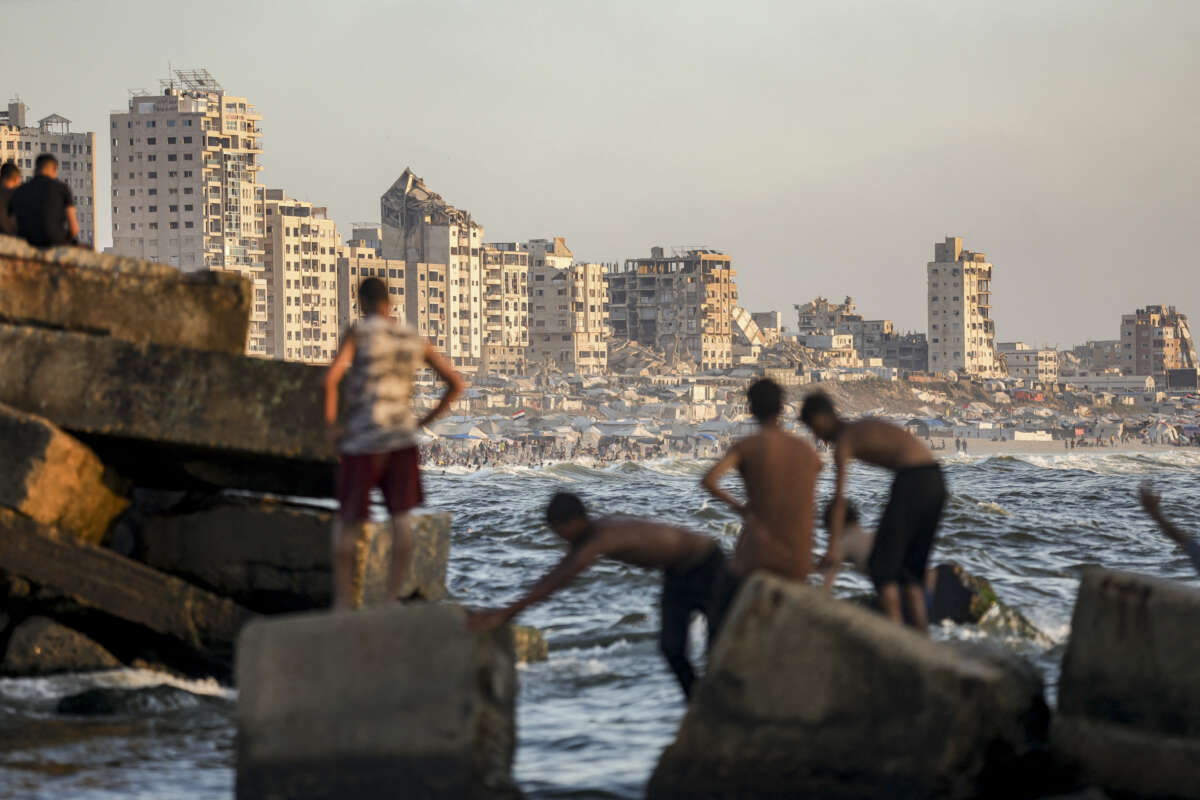
Palestinian youths stand and swim along a rocky breakwater on the Mediterranean coast in Gaza City, on July 4, 2026.Ahmed Younis / Middle East Images / AFP via Getty Images

Since Israel’s war began in Gaza, Palestinian university students have seen their education and futures upended. All universities have been damaged or destroyed, campuses have closed, and around 88,000 students have been deprived of access to higher education, according to Palestinian officials. Friends of Palestinian Universities has reported that nearly 1,400 university students have also been killed.

For some students, obtaining a scholarship abroad is no longer a privilege to have; it is a necessity to reclaim a future interrupted by war. Many European countries and universities have opened their doors for those students, with scholarships and programs offering a chance for survival. Many Palestinians have managed to leave Gaza, but this comes with another kind of suffering: They can study in safety abroad, yet cannot return home to their families.

I paid that price when I left home.

I was evacuated from Gaza to Italy in December 2025 after the war destroyed my university and all of my city. I was fortunate to receive a scholarship that allowed me to continue my bachelor’s degree in Italy. I am safe here, and I have a place to rebuild my future. However, my family is still in Gaza.

This is my first summer away from my homeland. I live in an apartment with international students. In the past weeks, I watched them pack their stuff and book tickets to go home. I watched them leaving in excitement to see their families and friends after an exhausting academic year. But I had to stay behind.


For Gaza’s Students, International Scholarships Offer Both Hope and Heartbreak
This academic year, for the first time, Italy extended university scholarships to more than 180 students from Gaza.  By Sara Awad , Truthout February 14, 2026


I was afraid to experience that moment, and I wasn’t ready to see my own pain reflected so visibly in front of me.

Leaving Gaza never looked like taking a plane from one country to another. It was more complex, more complicated. Palestinian students do not simply buy a ticket and travel to their destination. They walk into authority proceedings that feel impossible to schedule in a short while. Gaza’s borders are totally controlled by Israel and there is no way to leave Gaza as before through the Rafah border, as Israel has imposed a total blockade on the borders.

Special humanitarian corridors have to be created by the host country, students face visa issues and travel restrictions, and agreements between the governments and Israeli authorities determine whether they can leave from Gaza. Every step has to align before the scholars can leave. And they leave with nothing but phones and identification documents.

These elaborate processes offered a way out but with no promise for a way back in. Freedom was given to us to leave, but something seems hollow about an idea of freedom that means one cannot return home.


Voices From Abroad


Many Palestinian students have been given a chance to continue their path elsewhere in Europe and beyond. Some made it to Ireland, others to France, as well as Spain and other countries. Those students each experience new lifestyles, new language, faces, and unfamiliar surroundings. But we all have the same painful reality of separation from our own family.

I spoke with three students who are living through the same contradictions as I am, but in a very different place and environment. I wanted to understand how this pain weighs on each of us.

Their pain is different but we all share the same trauma of war.

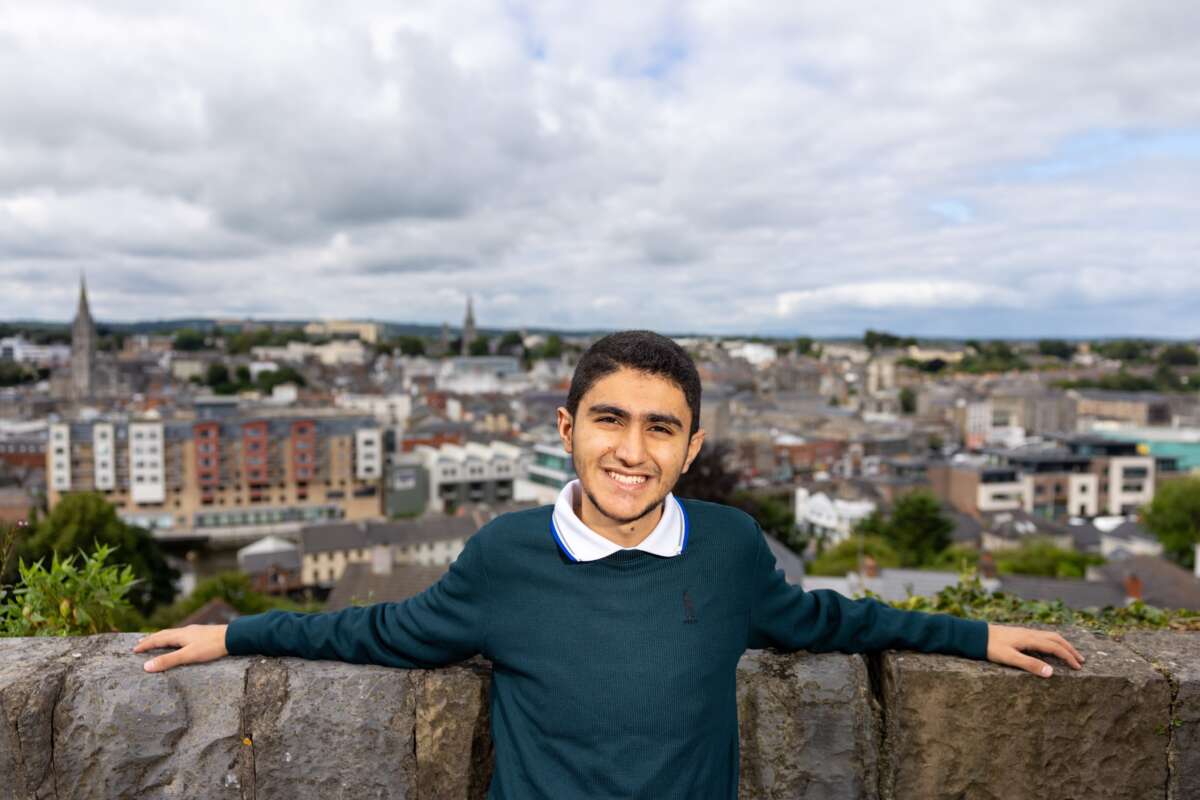
In Ireland, Abubaker Abed, 24, is a journalist and football reporter and commentator from Dair Al Balah, Gaza Strip. He left behind the life he had built in Gaza, along with the places, people and memories he was deeply attached to, in order to save whatever remained of his future.

“It hurts me that I haven’t seen my family for a year and a half. I feel so much pain,” Abed told me

.
Abubaker Abed is a Palestinian student from Gaza now in Ireland after surviving Gaza’s war in 2025.Sara Awad

He does not dream of returning to Gaza for only a holiday or a brief visit. He dreams of going home for good — to sit with his family in their own home, to live beside them without a screen or a border between them, and to feel safe together.

Abed’s suffering is not limited to the summer holiday. He is constantly reminded of his painful circumstances when he sees the freedom of movement enjoyed by other students. “I feel jealous when a colleague mentions a gathering of his family while I cannot even see mine,” he mentioned.

Abed wishes that all Palestinian students from Gaza might one day experience the full freedom of going back home whenever they need or wish. “We came from a traumatized state; we want our families alongside us,” he said.

Meanwhile, Ola Saed, who won a scholarship to pursue a master’s degree in international communication at Sciences Po Toulouse in France, describes how difficult it is to spend the summer doing nothing but working simply to keep herself busy.

“I feel very bad when the student accommodation is empty and quiet. I feel like I’ve lost the meaning of home,” Saed told me. “I did not leave — I was uprooted from my land.”

But there is another reality that many students face: They left with a scholarship, but the scholarship does not last forever. At some point, the funding, the university program, and the accommodation will end. One student facing this reality is Saja Hijaze, 23, a business and management student at the University of Jaén in Spain. She left Gaza through a six-month program that ended last month.

“All my colleagues packed their bags to go home. I stayed behind, facing a new and uncertain future,” Hijaze said through tears.


“I don’t have the desire to visit cities in Spain. I want to go to Gaza so much, even if all I find there is rubble.”

She longs to return to Gaza, to reconnect with the people she loves and regain a sense of home, safety, and familiarity. “I don’t have the desire to visit cities in Spain. I want to go to Gaza so much, even if all I find there is rubble,” Hijaze said.

The experience of separation from Gaza has taken a mental and emotional toll on all of us. Seeking professional support, including therapy, is one of the few things we can do to help ourselves navigate the weight of separation, loss, and uncertainty.

I spoke with Dr. Nouhaila Faida, a Moroccan-Italian psychologist who volunteers to support students from Gaza now studying and living alone in Europe. She described the ways prolonged separation from family, uncertainty about the future, and the experience of rebuilding a life far from home can affect students.

“Summer, which should be a time of rest, can instead deepen their isolation. Our first task is to give them an anchor — a safe space where they can be heard, their pain validated and their sense of connection rebuilt,” Faida said.

According to Tomaso Montanari, rector of the University for Foreigners of Siena in Italy and a supporter of Palestinian students from Gaza, “In Italy, even summer might be harder for Palestinian students.”

Montanari pointed out that the universities in Italy are not designed as residential communities. “In Italy, unlike in the United States or other countries, universities are not built around the college model: they generally do not have common spaces or permanent student residences,” Tomaso said.

These summer months feel particularly harsh for us. We are constantly reminded that we cannot enjoy them like how others do. Even visiting another city can feel offensive when our families are living through such a horrific situation back home.

Palestinian students from Gaza like me did not leave because we wanted a new home or a new country; we only wanted to have a future. But having a future should not come with the price of permanent separation from the people who are the meaning of life.

We were evacuated as students, but we did not leave Gaza as ordinary travelers, for we cannot return home.

Cardinal Brislin joins African clergy in calling Israel’s actions in Gaza genocide

VATICAN CITY (RNS) — Drawing on Africa’s experience of apartheid, genocide and war, Cardinal Stephen Brislin and nine other Catholic clergy say Israel’s actions in Gaza constitute genocide — and argue silence is no longer an option.
Bodies of members of the Hassayna and Abu Sharia families, killed in an Israeli strike in 2023 and recently recovered from the rubble, are draped in Palestinian flags during their funeral in Gaza City, Tuesday, Aug. 4, 2026. (AP Photo/Jehad Alshrafi)

VATICAN CITY (RNS) – Ten Catholic clergy from Africa, including Cardinal Stephen Brislin of South Africa, issued a statement Friday (Aug. 21) describing the Israeli government’s actions in Gaza as genocide, drawing on their continent’s experience of war and apartheid.

“We believe that the policies and actions of the Government of Israel in Gaza constitute genocide,” the statement read, citing arguments by international legal scholars and genocide experts. “Having learned to recognise dehumanisation in our own history, we cannot refuse to recognise it in another people.”

The statement was issued by Priests Against Genocide, a network of Catholic priests, bishops and cardinals advocating for Palestinian rights. The organization was founded in 2025 and says it represents over 2,500 members across 67 countries.

On Sunday, Pope Leo made an appeal for peace and called for a two-state solution that would respect the national integrity of Israel and Palestine. But the pontiff has stopped short of declaring Israeli actions in Gaza a genocide.

Brislin, among the signatories of the statement, is the Archbishop of Johannesburg in South Africa and was appointed last year by Pope Leo as a member of the Vatican department overseeing clergy. The pope also gave Breslin a prominent advisory role in the June consistory, a summit of cardinals.

Cardinal Stephen Brislin. (Photo courtesy of Archdiocese of Johannesburg)

South Africa — which enforced racial segregation and white minority rule, called apartheid, between 1948 and 1994 — has a long history of Palestinian advocacy. Nelson Mandela, the anti-apartheid leader who became the country’s first Black president, declared in 1997 that “our freedom is incomplete without the freedom of the Palestinians.”

In December 2023, South Africa brought a case before the International Court of Justice accusing Israel of violating the Genocide Convention in its war in Gaza. South Africa argued that Israel’s conduct unfolded “against a background of apartheid” and an “institutionalized regime of discriminatory laws, policies and practices” toward Palestinians. The case is still pending with the ICJ.

In their statement, the African clergy said they “cannot condemn apartheid in our history and refuse to recognise these patterns inflicted upon Palestinians.”

The statement, directly addressed to the government of Israel, also rejected “antisemitism and Islamophobia alike” and condemned the “grave crimes” committed by Hamas on Oct 7, 2023, that resulted in the death of about 1,200 people in Israel and the abduction of some 250 hostages.

“Their crimes do not diminish Israel’s obligations under international law, nor justify genocide or collective punishment. We will not answer one dehumanisation with another,” the statement added.

Israel has not issued a response to the clergy’s statement but has denied past genocide allegations, stating that its war is against Hamas and not Palestinians.

Israel launched its military offensive in Gaza after the Oct 7. attack. Since then, more than 73,000 Palestinians have been killed in Gaza, according to the territory’s Health Ministry, including at least 21,000 children. A ceasefire took effect on October of last year, but Israeli strikes and gunfire have continued, killing more than 1,200 Palestinians since the agreement. Tensions have also intensified in the occupied West Bank as attacks by Israeli settlers against Palestinians have increased.

Friday’s statement called for Israel to put an immediate end to “genocidal policies” and forced displacement and to cooperate with international judicial systems. The signatories also asked that Israel suspend weapons and technologies that risk violating international law. And they called on Christian groups to scrutinize their investments for ties to human rights violations. Finally, they demanded humanitarian, medical and trauma-healing support for those who were harmed in the conflict and called for the creation of a dignified and safe future for Palestinians and Israelis alike. 


The African clergy stated that their “continent knows war,” not only in its past, but also through the ongoing conflicts in Sudan and South Sudan, the Democratic Republic of Congo, the Sahel and northern Mozambique. They issued the same demands for peace and justice to African governments.

“A particularly horrifying feature of this genocide is that, for the overwhelming majority of Gaza’s population, there has been no reliable route to safe refuge — only repeated displacement within a closed territory, from one unsafe place to another,” the statement read. “To order people to flee when there is no safe place to flee to is not protection.”

The document drew from the sacred African tradition of Ubuntu, which emphasizes interconnectedness and shared responsibility, as well as sacred Scripture and Vatican pronouncements to make its case.

“Our answer cannot be silence. Our answer cannot be hatred. Our answer must be truth, justice, mercy — and a true peace which is never merely the absence of fighting,” the statement read.

Shaken Baby Syndrome Has Been Largely Debunked. Courts Are Still Catching Up.


Katie Smith, whose murder conviction was based on what’s increasingly seen as junk science, is fighting for her freedom.
Truthout/TheAppeal
August 22, 2026

mstroz via Getty Images

By the time Mason Tucker Smith was 2 years old, his mother, Mary Katherine Smith, had taken him to the doctor dozens of times.

Tucker had frequent ear infections, high fevers, and episodes of vomiting. On at least six occasions, he had seizures, but the doctors repeatedly reassured his mother, who goes by Katie, that these were benign “breath-holding spells” that would resolve on their own.

On the day of his collapse, July 30, 2014, Tucker had another seizure while Katie’s housemate, Jeremy Kitchens, was watching him in their bedroom and Katie was making dinner, according to her statement to the police.

As she approached the bedroom door, she heard a “thud.” Katie entered the room and Kitchens told her that Tucker was having another “episode.” Katie told police that she found Tucker unconscious on the ground. Believing that this was another breath-holding episode, she picked him up and put him on the bed. She left him in Kitchens’s care while she drove her daughter to meet a friend. While she was gone, Tucker vomited.

She returned to the house about 20 minutes later and checked Tucker’s oxygen level. When it began to drop, she called 911 and attempted to resuscitate him.

At the hospital, a physician concluded Tucker had been shaken. He was declared dead on August 2 and Katie was charged with his murder.

Two years later, Katie went to trial in Richmond County, Georgia, and was found guilty. The judge sentenced her to life in prison.

Shaken baby syndrome (SBS), also known as abusive head trauma (AHT), has been largely debunked, with one New Jersey judge calling it “akin to ‘junk science.’” While some courts have started to take a more critical look at SBS/AHT cases, prosecutions have continued and many people are still fighting their convictions.

The so-called triad of symptoms associated with SBS/AHT — bleeding around the eyes, bleeding between the skull and brain, and brain swelling — can be caused by strokes, short-distance falls, seizures, and disease, among other things.

Katie’s attorneys with the Southern Center for Human Rights say their investigation has revealed that she was convicted of a crime that never occurred.

Experts retained by her legal team — a neurologist and a forensic pathologist — have concluded that Tucker died of undiagnosed epilepsy, which was caused by an undetected arteriovenous malformation (AVM) in his brain. AVM is a life-threatening condition that typically develops in utero, in which a person has abnormally tangled blood vessels that disrupt blood flow, deprive tissue of oxygen, and face risk of rupture.

Forty-four people have been exonerated in SBS/AHT cases, according to the National Registry of Exonerations.

Katie’s attorneys have filed a motion for a new trial and, on August 24, they will present their new evidence before the Superior Court of Richmond County. The Augusta District Attorney’s Office is opposing Katie’s petition. The office did not respond to emails or calls seeking comment.

“Tucker’s death was a tragedy, not a crime,” Katie’s lawyers wrote in their motion. “Tucker was sick from birth, and was living with an undiagnosed and untreated deadly brain condition.”
Tucker’s Medical Records

Truthout reviewed Tucker’s medical records, which total about 278 pages. They reveal that Katie took him to the pediatrician more than 25 times, in addition to visits to specialists and the emergency room.

The physicians reassured Katie that Tucker was a healthy child. They told her that when he became upset he held his breath until he passed out, but that this was nothing to be concerned about.

Tucker’s first witnessed seizure occurred at daycare when he was five months old. Katie picked him up from daycare and took him to the pediatrician.

“Patient was reported to have had eyes roll back and lose consciousness while eating baby food in a highchair (sort of slumped),” the doctor wrote.

The pediatrician sent him to the hospital for an overnight observation. During the observation, Tucker “ate and slept well,” according to the medical records. Katie told the doctor that Tucker’s father, who had died shortly after Tucker’s death, and nephew each had experienced one seizure. The report does not recommend any further evaluation.

After his second seizure, which also occurred at daycare, his pediatrician referred him for an electroencephalogram (EEG), which measures electrical activity in the brain. The EEG report states that it was normal.

In her affidavit to the court, defense expert Heather Ravvin McKee, a neurologist who specializes in epilepsy, says research shows that “a single routine EEG only has an approximately 29-55 percent chance” of showing abnormal brain waves.

Despite the results of the EEG, Tucker should have been treated for epilepsy after the second seizure at the latest, she wrote.

Tucker had another seizure a few months later in March of 2013. Then, on July 20, 2013, when Tucker was 15 months old, he experienced a seizure that lasted between 15 and 20 minutes. He was still seizing when he and Katie arrived at the hospital, according to his medical records.

Notes from the hospital state that he “was bedridden” because he “could not rise from the bed without assistance, could not ambulate, and could not sit in a chair or wheelchair without support restraints.” Yet, he was discharged the next day. Katie was instructed to make a follow-up appointment with Tucker’s pediatrician.

Less than two weeks later, Katie took Tucker to see a pediatric neurologist. His report is riddled with errors. He wrote that Tucker was born full-term (he was premature) and that he had never been hospitalized, although he had been admitted to the neurologist’s own institution just 11 days earlier.

He diagnosed Tucker with breath-holding episodes and told Katie that Tucker would grow out of them. “I do not think these are seizures or epilepsy,” he wrote in his report.

On July 23, 2014, a week before Tucker’s final collapse, Katie and Tucker returned to the pediatrician. Tucker had been vomiting, was nauseous, and was experiencing headaches. The doctor told Katie to keep him hydrated. However, this may have been a sign that something more serious was at play. Vomiting can occur as part of a seizure, following a seizure, or can be a sign of increased pressure in the brain, according to neurologist McKee, the defense expert.
The Prosecution’s Case

Misogyny and junk science collided at Katie’s trial. Katie was a single parent working as a hospice nurse. Her husband, Tucker’s father, died by suicide when Tucker was just two months old. After his death, Katie and her children moved in with Kitchens, a friend from high school.

At trial, prosecutors portrayed Katie as an uncaring mother who neglected Tucker’s medical needs and prioritized her friendship with Kitchens over her children. Katie did not take the stand.

Vilifying mothers is a common prosecutorial tactic in cases where women are accused of crimes that likely never occurred, according to Valena Beety, author of Pink Crime: Fighting Against the Criminalization of Motherhood, Pregnancy, and Queer Identity.

“The woman is wrongly convicted based on that confluence of [false] forensic evidence and gender bias,” Beety recently told The Appeal.

Katie and Tucker Smith on August 12, 2012.Provided by the Southern Center for Human Rights

Kitchens testified for the prosecution and relayed essentially the same account that Katie had provided to the police. The prosecutor asked Kitchens if he had not killed Tucker, who did? Kitchens replied, “I guess Katie did … She was the only other one there.” On cross-examination, the defense accused Kitchens of killing Tucker.

Emergency personnel testified that Katie was “unnaturally calm” when they arrived.

“We’ve had kids locked in cars on cool days and the parents were much more emotional about the situation than that day,” a sergeant with the fire department told the jury.

Prosecutors and police often make assumptions about how a person should respond to a crisis. Among wrongful convictions, there are numerous examples of law enforcement presuming that too much or too little emotion was indicative of an innocent person’s guilt.

Katie’s attorney, Mark Loudon-Brown, noted in a phone interview with Truthout that Katie was a nurse who is trained to remain calm in crises.

The centerpiece of the prosecution’s case was the testimony of two medical experts who told the jury that Tucker had been shaken.

Mary Lynn Sheram, the hospital physician who first diagnosed Tucker with SBS/AHT, testified that Tucker’s symptoms are “shown in the literature to be 100 percent as non-accidental trauma.” The bleeding around his eyes “makes it a hallmark for abusive head injury.”

Nearly identical statements have been made in numerous SBS/AHT cases that have resulted in exonerations.

Timothy Gonzalez was convicted in an SBS case in 2016, the same year as Katie’s conviction, and was exonerated earlier this year. At his trial, a child abuse pediatrician testified that there was no “accidental explanation” and no “medical explanation” for his daughter’s injuries. In 2022, the court tossed out his conviction. At his retrial earlier this year, his attorneys presented evidence that Gonzalez’s daughter had suffered from a respiratory infection that led to encephalitis, an inflammation of the brain, which then developed into sepsis. On March 11, the jury acquitted Gonzalez of all charges.

The second medical expert for the prosecution in Katie’s case was Lora Darrisaw, the director of pediatric forensic pathology at the Georgia Bureau of Investigation.

“[W]e have no plausible accidental event that would account for the findings that I had,” she told the jury.

Several years before Katie’s trial, Darrisaw was the star witness in the murder trial of two Georgia parents, Ashley and Albert Debelbot, who were accused of killing their three-day-old newborn. She ruled the death a homicide by blunt force trauma. In 2021, the parents were exonerated after their attorneys uncovered evidence that their baby had been born with abnormalities in the brain which led to her death.
Openings for Exoneration

The medical community’s understanding of SBS/AHT has changed significantly in the years since Tucker’s death. Since 2014, 27 people convicted in SBS/AHT cases have been exonerated, according to the National Registry of Exonerations.

Last year, in a first-of-its-kind decision, the New Jersey Supreme Court banned testimony on SBS from the state’s courtrooms. In July, in another Georgia case, Gwinnett County Superior Court Judge Kimberly A. Gallant granted Danyel Smith’s request for a new trial, noting SBS/AHT is no longer treated as a “presumptive diagnosis,” and that “current medical and scientific standards” require providers to consider “alternative, non-abusive causes before concluding abuse.” (Danyel is also represented by the Southern Center for Human Rights. He and Katie are not related.)

“Today, the diagnostic approach is different,” Katie’s attorney, Loudon-Brown, told Truthout. “You might keep the idea of non-accidental trauma in your head, but you would have to go further. You would have to look at what’s going on with Tucker.”


This article is licensed under Creative Commons (CC BY-NC-ND 4.0), and you are free to share and republish under the terms of the license.

Elizabeth Weill-Greenberg
Elizabeth Weill-Greenberg is an independent journalist and founder of The Carceral Report. Follow her on Bluesky @elizabethweill.bsky.social and Instagram @elizabethweillgreenberg.
Trump deals deathblow to 100-year-old manufacturer


U.S. President Donald Trump gestures as he speaks to the media before boarding Air Force One at Joint Base Andrews in Maryland, U.S., en route to Myrtle Beach, South Carolina, August 21, 2026. REUTERS/Evan Vucci
August 25, 2026 
ALTERNET

A Connecticut manufacturing company that has operated for more than a century is finally closing its doors after being sent over the edge by President Donald Trump’s economic policies.

Its longtime owner cites “soaring business expenses and tariffs as key reasons for the decision,” reports NBC Connecticut.

“Leed-Himmel Industries, a custom aluminum manufacturing company based in Hamden, has been winding down operations after decades of serving customers,” NBC CT reports. “The closure did not come as a surprise to owner Howard Goldfarb.”

When NBC Connecticut visited the plant in 2024, Goldfarb was already warning reporters that rising expenses were biting an expanding hunk out of his business and putting pressure on it.

"It could get to the point where I just say, 'It's not worth doing anymore. All we're doing is working to pay the electrical bill,'" he told NBC Connecticut at the time.

Two years later, that prediction became reality, with Goldfarb declaring that costs had climbed too high as he walked through a largely empty factory floor.

"If our costs were where they were, say, eight years ago, I wouldn't have shut it down," Goldfarb told reporters.

Goldfarb’s factory was not only a stable source of jobs but also a considerable spring of revenue. The business paid about $160,000 annually in local property taxes. But Goldfarb said health insurance for workers kept rising, as did insurance for buildings, vehicles, and workers' compensation. The company's power bill topped $500,000 despite reduced operations.

But Goldfarb said the final blow came from the White House.

"Tariffs was the final nail in the coffin, if you will," he said, adding that tariffs increased the cost of aluminum and other materials while forcing him to tie up more cash in inventory purchases before customers paid their invoices.

The Supreme Court has already rejected Trump’s tariffs, calling them illegal because they lacked congressional authorization. But the president has continued to levy them despite not receiving legislative approval.

“President Trump’s repeated attempts to impose tariffs have become an encapsulation of his second term,” wrote the Times Editorial Board. “They have hurt the American economy and his own popularity. They also range from legally dubious to blatantly illegal.”

Goldfarb had almost managed to salvage some jobs by selling the company to a European buyer, but he said the buyer backed out after Trump unilaterally declared war on Iran. He said he is still trying to find a buyer for the Hamden facility and hopes it will remain a manufacturing site rather than being converted to storage space.