March on Washington renews focus on voting rights after Supreme Court gutting
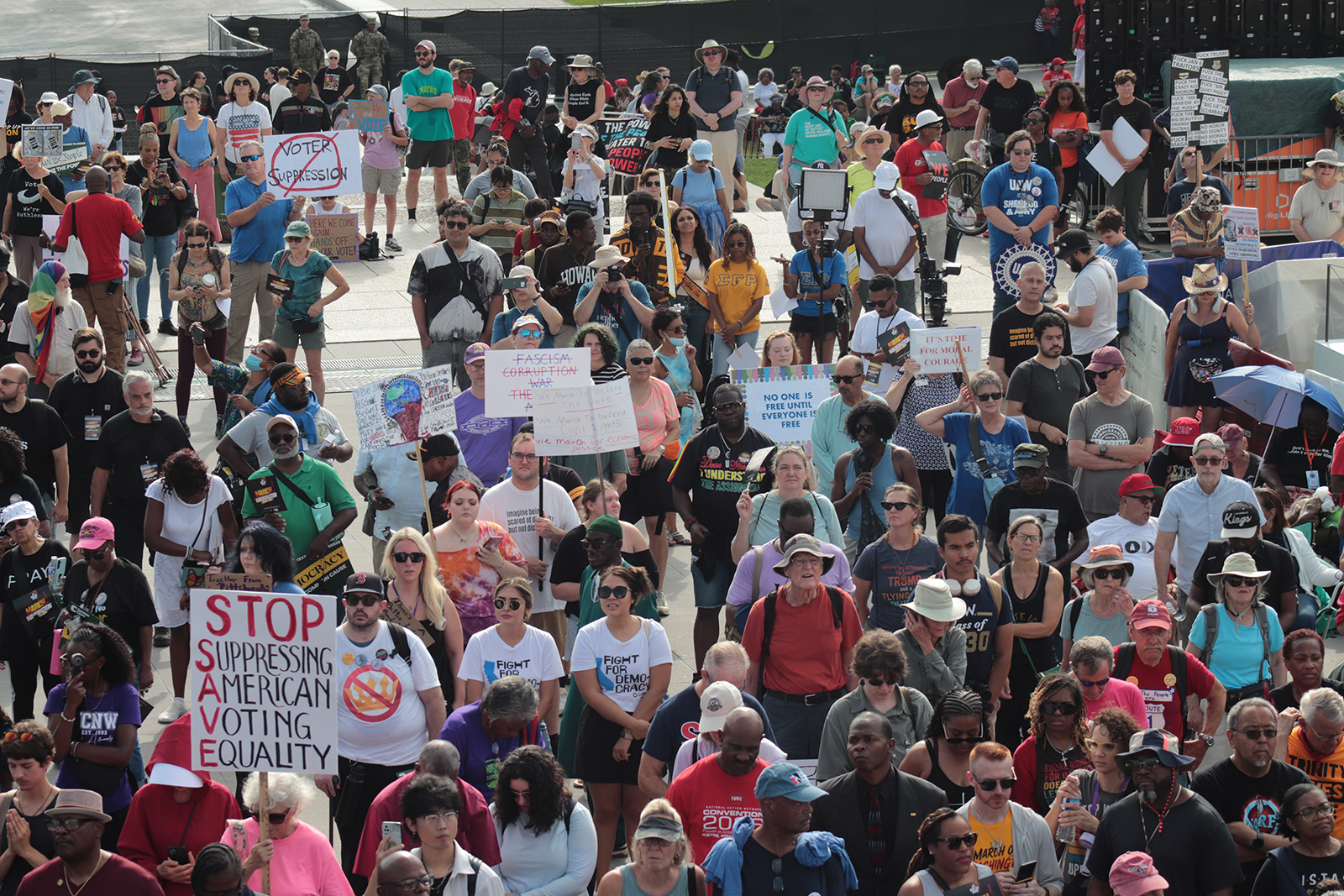
WASHINGTON (RNS) — Thousands of people gathered before the Lincoln Memorial on the 63rd anniversary of the March on Washington for a program Friday (Aug. 28) bookended by prayers and focused on voting rights.
The son of the Rev. Martin Luther King Jr., who that day more than six decades before delivered his “I Have a Dream” speech, decried the state of voting rights in America, referring to the Supreme Court’s gutting of the landmark 1965 Voting Rights Act earlier this year.
“The fact that we still have to fight to maintain and renew voting rights in this country is beyond abysmal and a truly national disgrace,” Martin Luther King III said Friday. “If some don’t change their ways, it won’t be long before we all experience the discomfort of the divine judgment that God has promised.”
The Rev. Al Sharpton, president of the National Action Network civil rights organization, said it was time to organize for voting rights on a new level.
“We must turn this country upside down with those elected officials that are taking, for us, the right to vote,” he said, drawing cheers. “The Callais decision by the Supreme Court shot a bullet in the heart of voting rights, but they don’t understand we’re not going back. We will not let them turn back the hands of time.”
Sharpton’s network and the younger King’s Drum Major Institute, two organizations focused on social justice, were joined at the event by leaders of religious, political, labor and student organizations who took the stage in Lincoln’s shadow over the course of several hours.

The Rev. Al Sharpton, from left, director Spike Lee and other activists walk from the Lincoln Memorial to the Martin Luther King Jr. Memorial during the March on Washington, Friday, Aug. 28, 2026, in Washington. (RNS photo/Adelle M. Banks)
Rabbi Jonah Dov Pesner, the director of the Religious Action Center of Reform Judaism, blew a shofar, a traditional Jewish instrument made from a ram’s horn, before making his remarks.
RELATED: Black clergy strategize, preach and urge election turnout after Voting Rights Act gutting
Just as the shofar blast was used thousands of years ago as ancient Hebrew people worked to escape Egyptian slavery, Pesner said it is time to “wake up” to achieve “a robust, multiracial, inclusive democracy in which every voice is heard because every vote is counted.”
Rallying the audience, as some stood in the hot sun beside a covered Reflecting Pool while others crowded in shadier spots near trees farther away, he asked: “Some people want some people not to vote. Are we going to stand for that?”
“No!” came the response.

Rabbi Jonah Dov Pesner blows a shofar at the March on Washington, near the Lincoln Memorial, Friday, Aug. 28, 2026, in Washington. (RNS photo/Adelle M. Banks)
Some in the crowd, which was sometimes quiet and sometimes boisterous, seemed ready to take home the lessons of the day to share with others. Pastor Gregory Ross of Philadelphia’s Thankful Baptist Church was taking notes.
“I’ve never missed a vote since the age of 18,” he said, expressing his hope that his congregation and community will take the upcoming election more seriously when he shares what he heard at the march. “I believe if you promote positive information, it will create positive actions.”

Martin Luther King III speaks during the March on Washington, near the Lincoln Memorial, Friday, Aug. 28, 2026, in Washington. (RNS photo/Adelle M. Banks)
Early in the program, a multi-faith set of prayers were uttered by Christian and Muslim speakers before dozens of speeches that often focused on voting and the upcoming midterm election, but also addressed other issues, including support for affordable healthcare and for diversity, equity and inclusion.
Before marching to the Martin Luther King Jr. Memorial with leaders like actor and director Spike Lee and Congress of National Black Churches Chairman the Rev. W. Franklyn Richardson, the crowd heard from several politicians. These included Congressional Black Caucus Chair Yvette Clarke, D-New York, Vermont Independent Senator Bernie Sanders and Rep. Alexandria Ocasio-Cortez, D-New York. Other speakers included Yusef Jackson, the son of the late Rev. Jesse Jackson who succeeded his father as the head of the Rainbow Push Coalition.
After the speeches, a chanting, drumming crowd marched from the Lincoln Memorial to the King Memorial.

Activists walk from the Lincoln Memorial to the Martin Luther King Jr. Memorial during the March on Washington, Friday, Aug. 28, 2026, in Washington. (RNS photo/Adelle M. Banks)
Before they stepped off, Bishop Leah Daughtry, national presiding prelate of The House of the Lord Churches, gave a closing prayer, acknowledging portions of the Voting Rights Act being cut.
“Our votes have been challenged. Our rights have been trodden. Our humanity has been questioned,” prayed Daughtry, who has twiced served as the CEO of the Democratic National Committee. “But Lord, you did not raise up a movement to depend on nine votes in a marble building. You raised up a people. And so, we do not send these marchers out in mourning. We send them out in commission to serve the least, the last and the lost.”
Defending the Vote
Sen. Bernie Sanders delivered the following remarks at the National Action Network’s March on Washington: Defend the Vote rally in Washington, D.C., on August 28, 2026.
Let me thank Rev. Sharpton and the National Action Network for organizing this event for allowing me to say a few words to you today, and let me thank all of you for being here.
63 years ago, a quarter of a million Americans descended upon this very location for what is now recognized as one of the most significant events in the modern history of our country: the March on Washington for Jobs and Freedom. As a young college student at that time, I had the fortune to get on a bus from the University of Chicago to attend that event – and experience a day that I have never forgotten and which has had a lasting impact upon my life.
And when we think back upon that extraordinary day, it is important that we remember not only Dr. King’s unforgettable “I Have a Dream” speech, but we also remember the context in which that speech took place.
We must never forget the extraordinary courage of the people who marched, who organized, who went to jail, who faced dogs and fire hoses, who risked their lives and, in far too many cases, gave their lives to secure a more just and equitable America. Because of that movement, segregation was dismantled. The Civil Rights Act was passed. The Voting Rights Act was passed. The Fair Housing Act was passed. Millions of Americans gained rights and freedoms that had been denied to them solely because of the color of their skin.
That dream of a more just and more equitable society has never been under greater threat than it is right now.
Today, we have a President who, along with the Supreme Court members he appointed, is carrying out the most significant assault on voting rights since segregation – targeting virtually every aspect of the electoral system. He is seeking to purge voter rolls and obtain sensitive voter data, restrict mail-in and early voting, redraw congressional districts for partisan advantage and deploy federal agents around polling places. He has undermined faith in American elections by falsely claiming that he won the 2020 election and goes around the country claiming that hundreds of thousands of undocumented immigrants vote in our elections – which is nonsense.
Bottom line: Trump is an authoritarian who is deliberately trying to destroy faith in American democracy, create confusion, sow mistrust in our elections and make it harder for Americans to vote.
But Dr. King’s dream is under threat in other ways too.
Dr. King understood that political freedom and economic freedom are inseparable. That is why the March on Washington was not simply a march for voting rights – as enormously important as that was. It was the March on Washington for Jobs and Freedom.
As Dr. King, a strong ally of the trade union movement, famously asked, “What good is having the right to sit at a lunch counter if you can’t afford to buy a hamburger?”
And let us never forget: Dr. King was assassinated in 1968 while he was in Memphis, Tennessee, standing with exploited sanitation workers who were attempting to organize a union.
Let’s be clear: it is not only voting rights that are under assault today. That part of Dr. King’s dream – the dream of genuine economic freedom – is also under unprecedented attack.
Today, while we have more income and wealth inequality than at any point in American history, 60% of our people live paycheck to paycheck, struggling to afford groceries, health care, education and other basic necessities of life.
In the midst of a major housing crisis, some of the 800,000 Americans who are homeless are sleeping out on the streets a few blocks from where we are right now.
And while this economic crisis impacts people of all races, creeds, and people in every corner of our country, it continues to disproportionately affect the Black community.
Black Americans continue to face higher rates of poverty, shorter life expectancy, lower rates of homeownership, greater exposure to environmental hazards and enormous disparities in access to capital and economic opportunity.
Trump’s devastating cuts to health care, education, Head Start and other programs have only made a bad situation worse.
My friends: 63 years ago, Dr. King stood at this location and inspired all Americans – people of every color, every religion, every background – to stand together in the struggle for racial and economic justice. And as you well know, the message he delivered in 1963 is as true today as it was back then.
Yes. Black and White, Latino and Asian – people of all races, religions and backgrounds, must come together now in the fight for justice.
We must never accept an economy in which so few have so much, while so many have so little – where one man now owns more wealth than the bottom 50% of American households.
Billionaires must pay their fair share of taxes.
We must never accept a corrupt campaign finance system which allows wealthy campaign contributors to undermine our democracy and buy elections. We need to get super PACs out of the political process and move to public funding of elections.
We must never accept a system in which millions of workers continue to earn starvation wages and are denied the right to join unions. We must raise the minimum wage to a living wage – at least $20 an hour – and pass the PRO Act, making it easier for workers to join unions.
We must never accept a healthcare system designed to make huge profits for the insurance companies and pharmaceutical industry. Healthcare is a human right.
We must never accept a situation in which a handful of big tech oligarchs push their AI agenda down the throats of the American people, threatening millions of jobs, our privacy rights, the mental wellbeing of our children and the very future of humanity.
AI and robotics must work for all of us — not just the few.
We must never accept a situation in which a handful of fossil fuel executives are putting the very future of the planet at stake for their own short-term profits. We must create millions of good-paying union jobs by transforming our energy system away from fossil fuels and towards energy efficiency and sustainable energy.
The people in Washington in 1963 understood.
Real change does not come from the top down.
It comes from the bottom up.
It comes when ordinary people organize.
It comes when Black and white Americans stand together.
When Latino, Asian American, Native American and immigrant communities stand together.
The March on Washington and the movement behind it changed the course of American history.
And now it is our turn.
Let us go forward together.
Thank you.

No comments:
Post a Comment