Wednesday, August 26, 2026


Utah mountain ranges may store a billion tons of hidden ice


University of Utah geoscientists create 3D map of a hidden ‘rock glacier’ in the Wasatch Mountains, one of more than 800 in Utah


University of Utah

rock glacier 

image: 

This cirque under Utah's Mount Timpanogos contains a hidden 'rock glacier' holding enough water to fill 600 Olympic swimming pools, according to University of Utah researchers.

view more 

Credit: Bronson Cvijanovich, University of Utah


Unlike conventional glaciers, rock glaciers appear as piles of rock that obscure large masses of unaccounted for ice. Rock glaciers are common in the Wasatch and Uinta ranges, even appearing on the Colorado Plateau in the La Sal Mountains near Moab.

Now University of Utah geologists are bringing one of Utah’s largest rock glaciers, located under the towering, iconic summit of Mount Timpanogos near Salt Lake City and Provo, into sharp focus. Two new studies document how Timpanogos Rock Glacier formed and how much ice it contains. By measuring minute differences in gravitational pull between rock and ice the team created a novel technique to image the 3D ice body within a large rock glacier.

Timpanogos Rock Glacier stores enough frozen water to fill 600 Olympic swimming pools or 1.5 million cubic meters. That is also equivalent to the volume of the largest pyramid at Giza in Egypt, according to Bronson Cvijanovich, a former graduate student in the Department of Geology & Geophysics.

“Timpanogos Rock Glacier is surprisingly ice rich. It is 83% ice and 17% loose rock, said Cvijanovich, the lead author of one of two studies overseen by geophysics professor Michael Thorne and glaciology professor Leif Anderson.

The ice hiding under our feet

“There's a lot of ice that's hidden in Utah’s mountains,” Anderson said. “When we are high in the mountains and walking across loose rocks or rubble, you don't realize there could be 120 feet of ice buried beneath your feet.”

Cvijanovich led field campaigns to Timpanogos Rock Glacier hauling sensitive instruments, including a state-of-the-art gravimeter, to the ice buried above Emerald Lake in the fall of 2024. Over the course of six forays, Cvijanovich took gravity readings at 232 spots, separated by 25 meters (~80 feet) in a grid atop the rock glacier.

The gravimeter measures density differences between rock and ice, enabling scientists to calculate the 3D shape of the buried ice body. “There is a large contrast in mass density between the rock that makes up Mount Timpanogos and the much lower density ice that is in rock glacier adjacent to it,” Thorne said. “When we measure the gravitational acceleration over the rock glacier, we see a larger decrease in that gravitational acceleration as we make measurements over areas with thicker ice.”

Once the gravity observations were collected, they still needed to be corrected for differences in gravity due to the position of the sun and the moon, the location’s terrain, latitude, and elevation. After these corrections, the research really broke new ground. The team developed a novel method for imaging the internal ice of the rock glacier in 3D using Bayesian statistics. “We spent months of computation time doing the imaging with our new techniques,” Thorne said.Rock glaciers footprints can be outlined with satellite imagery, but the 3D shape, depth, and ice they obscure is harder to reveal. For such measurements, scientists need instruments that can “see” what is hidden under the rocky rubble, like the way a CT scanner can image bone and tissues inside the human body.

Estimating the water contents of the world’s rock glaciers

Rock glaciers exist below steep-walled mountain valleys or cirques that frequently shed rocks. “In the Wasatch, the mountains themselves are eroding and burying the snow, and that's why the rock glaciers exist,” Anderson noted. The researchers wrote a new mathematical model that shows how rock glaciers gain mass: rockfalls bury persistent snow in the upper parts of rock glaciers..

The second study shows that Utah’s rock glaciers are not remnants from the Ice Age (which reached its peak 21,000 to 18,000 years ago), but rather water stores that formed over the thousands of years after the Ice Age glaciers melted away.   

Timpanogos Rock Glacier is one of 836 rock glaciers documented in Utah using satellite imagery. These researchers used their findings on Timpanogos rock glacier to identify a relationship that provides a scale between a rock glacier’s surface area and the volume of ice beneath. Using this new relationship, they estimate that the world’s 50,000 known rock glaciers hold 48 gigatons of water. Equal to 1 billion metric tons, a gigaton is the equivalent of a cubic kilometer of water, enough to fill 400,000 Olympic swimming pools. Utah’s rock glaciers may hold a 1 gigaton, or 815,000 acre-feet of water, the researchers estimated.

#####

This research, titled “The internal ice content of Timpanogos Rock Glacier, Utah, USA from 3-D Bayesian inversion of gravity data,” was published Aug. 26 in the Journal of Geophysical Research. The earlier paper, titled

Mass Addition to Timpanogos Rock Glacier: Debris‐ Covered Snow and the Importance of Interannual Variability in Headwall Erosion and Climate,” appeared in Geophysical Research Letters on April 2, 2026, with Isaiah Davies, an undergraduate at Stanford University and visiting summer researcher at the University of Utah in 2023, as lead author.

Funding came from the U.S. Geological Survey, National Science Foundation, University of Utah’s Wilkes Center for Climate Science & Policy, the U’s Office of Undergraduate Research, and the Summer Program for Undergraduate Research.


The hidden chemistry behind glow-in-the-dark art


Researchers study how eye-catching phosphorescent and fluorescent pigments age — with hopes of finding ways to preserve the colors for art, fashion, and safety applications


American Chemical Society

The hidden chemistry behind glow-in-the-dark art 

image: 

A swath of spandex fabric with DayGlo pink graffiti designed by Stephen Sprouse, 1984-1985.

view more 

Credit: Indianapolis Museum of Art at Newfields, Gift of Joanne Sprouse, in memory of her son Stephen Sprouse, 2020.42.


CHICAGO, Aug. 25, 2026 — Some of the world’s brightest colors don’t just reflect light, they create it. Scientists and museum conservators are now uncovering why these luminous pigments fade and how to preserve them for future generations. The findings could help protect artwork while informing the development of longer-lasting phosphorescent materials for a variety of applications, from fashion runways to airport runways.

The researchers will present their results at the fall meeting of the American Chemical Society (ACS) during the “Chemistry Behind Art and Art Conservation” symposium in McCormick Place. ACS Fall 2026 is being held August 23-27.

“Artists have always been attracted to bright, emissive colors. They allow you to do exciting things that you just can’t do with a regular pigment on the artist palette.” — Gregory Smith

Most paints and dyes are seen because they bounce visible light back to our eyes. Fluorescent and glow-in-the-dark pigments are different: They absorb light and give it back as a vivid glow. This produces the attention-grabbing visual effects found in pop art, fashion, traffic signage, and the glowing stars that many people stick to their bedroom ceilings as children.

Over time, however, these bright materials break down. And as the colors become duller, the artwork loses some of the oomph that was initially intended. “For artists, the effect isn’t simply cosmetic, because they intentionally use these colors for their visual impact,” says photochemist Sarah Schmidtke Sobeck, Professor of Chemistry and Dean for Faculty Development at The College of Wooster.

“Artists have always been attracted to bright, emissive colors,” says Gregory Smith, Senior Conservation Scientist at the Indianapolis Museum of Art at Newfields. “They allow you to do exciting things that you just can’t do with a regular pigment on the artist palette.”

And because fluorescent and phosphorescent materials attract attention and improve visibility, they’re also important parts of safety signs and markings. By understanding how these materials break down over time, Sobeck and Smith want to help manufacturers develop products that stay brighter longer, such as luminescent paint for airplane runways.

The duo has spent years studying daylight fluorescent and phosphorescent pigments through a collaboration that began 10 years ago when they met at a cultural heritage science conference in Maine. Their work initially centered on testing the emission of light from samples in the Indianapolis Museum of Art at Newfield’s Stephen Sprouse collection, which features fashion with bold fluorescent colors and attention-grabbing designs.

For Sobeck’s presentation at ACS Fall 2026, she will share new findings from her studies of glow-in-the-dark phosphorescent pigments. For this research, Sobeck and colleagues first identified what the materials are made of. Then, the researchers examined the pigments’ photophysics — how they absorb, store, and emit light — and how the processes change as the materials age.

The team found that many phosphorescent materials contain inorganic compounds and mineral-based pigments and differ significantly from the organic dyes commonly used in fluorescent colorants.

New studies on a white pigment powder called lithopone will add another dimension to the ACS presentation. Eleanor Fleming, an undergraduate chemistry major in Sobeck’s lab, will use photography to track how long phosphorescent materials containing lithopone continue to glow after being charged by visible light.

One of the most surprising initial findings is that prolonged exposure to high levels of humidity can play an equally important — and sometimes greater — role than prolonged exposure to ambient light in breaking down phosphorescent pigments. This information will “inform improved storage and exhibition conditions for artworks containing this pigment,” says Sobeck.

Earlier studies of fluorescent pigments from the Sobeck lab revealed that the compounds responsible for enhancing brightness, called optical brighteners, degrade faster than the pigmentary dyes themselves. As a result, colors appear to darken even when the pigment molecules remain intact. Wooster alumna Georgia Hopps-Weber, a double major in chemistry and art history, helped uncover these unexpected results.

These results also highlight why conserving modern artworks can be challenging. Conservators restoring fluorescent artworks must match colors under both visible and UV light, while the pigments themselves continue to change over time, making long-term restoration difficult.

The researchers also see their innovative collaboration as an opportunity to share with their students how chemistry combines with nearly any discipline.

“I’ve been able to establish a lot of different opportunities for students who are pursuing double majors in art history and chemistry, or chemistry students who are really interested in seeing how they can apply their studies to different real-world scenarios,” says Sobeck. “It shows how chemistry and art can come together to answer important questions.”

The research was funded by the Indianapolis Museum of Art at Newfields and the Hamburger Endowment for Collaborative Projects and Program Development at The College of Wooster. The DayGlo Color Corporation provided sets of pigments for analysis.

###

The American Chemical Society (ACS) is one of the world's largest scientific organizations and a global leader in advancing scientific knowledge. Founded in 1876, ACS' mission is to advance scientific knowledge, empower a global community, and champion scientific integrity. Guided by its vision of a world built on science, ACS brings together people, ideas, and resources to drive discovery and innovation, support the professional growth of scientists and students, and advance scientific discussion. Through its trusted publications, scientific meetings, community networks, education and career resources, and scientific information solutions, ACS helps scientists, educators, and students make a lasting impact on their communities and the world at large. Together, these efforts support ACS' commitment to improve all lives through the transforming power of chemistry.

Registered journalists can subscribe to the ACS journalist news portal on EurekAlert! to access embargoed and public science press releases. For media inquiries, contact newsroom@acs.org.

Note to journalists: Please report that this research was presented at a meeting of the American Chemical Society. ACS does not conduct research.


Title
Glow in the light & dark: Investigations of the photochemistry of emissive pigments used in art

Abstract
Modern materials present unique challenges for art conservators due to limited studies of their properties and long-term stability. Synthetic chemistry has introduced a range of new dyes and pigments—originally developed for commercial and industrial applications—that have since found popularity in art. Daylight fluorescent materials, such as products manufactured by the Day-Glo Corporation, and glow-in-the-dark “phosphorescent” pigments begin to appear more prominently in art in the mid-20th century, though earlier pigments exhibit related emissive properties. This talk highlights ongoing studies into the chemical composition, spectral properties, and stability of these emissive artists’ materials. Our research focuses on how the unique photochemistry of these pigments influences viewer experience and informs considerations for museum exhibition and storage. Special attention is given to its relevance within the museum’s Stephen Sprouse Collection.


The hidden chemistry behind glow-in-the-dark art 

A pantsuit adorned with phosphorescent paillettes appears white in normal, visible light but glows green in the dark.

Credit

Indianapolis Museum of Art at Newfields, Fashion Arts Society Acquisition Fund, 2013.310A-D.2.


The hidden chemistry behind glow-in-the-dark art 

The darkening on the bottom half of these fluorescent tape strips shows that the optical brightener in the tape degraded faster than the pigmentary color when exposed to light. The top half of the strips was shielded from light exposure.

Credit

Sarah Sobeck / The College of Wooster


The hidden chemistry behind glow-in-the-dark art 

Attention-grabbing DayGlo orange shirt and pants with Stephen Sprouse’s trademark graffiti pattern.

Credit

Indianapolis Museum of Art at Newfields, Fashion Arts Society Acquisition Fund, Joanne Sprouse Acquisition Fund, purchased with funds provided by Penny Rosenthal, 2021.187.


The hidden chemistry behind glow-in-the-dark art 

A close-up of a fluorescent mural at Newfields showing bright red DayGlo paint in an area formerly protected from light by the green vinyl lettering.

Credit

Amanda Holden / Indianapolis Museum of Art at Newfields


A swath of fabric with a bright orange Saturn covered in black graffiti designed by Stephen Sprouse, 1984-1985.

Credit

Indianapolis Museum of Art at Newfields, Gift of Joanne Sprouse, in memory of her son Stephen Sprouse, 2020.58.

The hidden chemistry behind glow-in-the-dark art 

By understanding how fluorescent and phosphorescent pigments break down over time, Sarah Sobeck wants to help manufacturers develop paints that stay brighter longer.

Credit

Matt Dilyard / The College of Wooster


Germany’s Die Linke takes a stand

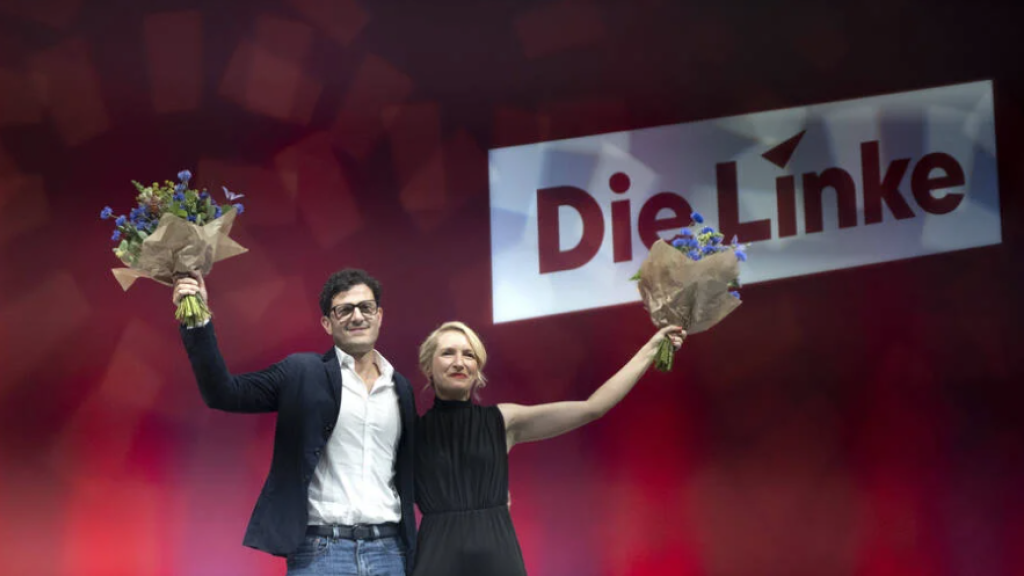
Die Linke co-chairs Luigi Pantisano and Ines Schwerdtner during the Potsdam party conference, 20 June 2026

First published at Rosa-Luxemburg-Stiftung.

Economic, demographic, environmental, democratic, geopolitical — the multitudinous crises besetting Germany only seem to deepen by the month. The situation may be dire, but the resurgence of Die Linke over the past 18 months has established a much needed counterweight to the incessant right-wing drift of German politics. In August 2026, Die Linke overtook the Social Democratic Party of Germany (SPD) in national pollingfor the first time in the party’s history, crossing the 12 percent threshold. And among younger people in particular, democratic socialism is an increasingly appealing alternative to the mainstream consensus of austerity, militarization and xenophobia — one which has pushed the catastrophic possibility of the far-right party Alternative for Germany (AfD) attaining power frighteningly close to reality.

The party’s annual conference, held in June in Potsdam outside of Berlin, saw the party more energized and unified than at any time since the 2000s. A mass of new delegates (more than half attending a party conference for the first time) revealed the changes undergone by the party’s base, which recently doubled its membership to 126,000: there were more women, young people, and those with a family history of migration, more West Germans, and more wearing the Palestinian keffiyeh.

From 3% to frontrunner

Seemingly fated for oblivion ahead of a federal election in February 2025, the party was polling at 3 percent and harried by the left-conservative Sahra Wagenknecht Alliance (BSW), which split from it a year before. But Die Linke rallied during the campaign under the dual leadership of Ines Schwerdtner and Jan van Aken (who announced he was stepping aside due to health concerns in Potsdam), taking several direct mandates through mass door-knocking campaigns and proving itself a major force on social media. The party beat expectations and won 8,8 percent of the vote.

This year's conference saw the party consolidate its newfound momentum, sharpen its social, economic and foreign policy positions, and debate how to advance itself as a workers' party.

Die Linke could lead a state government for the first time in Berlin, where it is in the lead ahead of elections in September. But the urgency of Germany's crisis allows no time for celebration. In the eastern states of Saxony-Anhalt and Mecklenburg-Vorpommern, which also go to the polls next month, only the margins of AfD’s certain victories are open to contest. In her conference speech, Schwerdtner spoke somberly about the challenges ahead: not only the party’s lasting struggle to establish itself as a worker’s party worthy of the name, but a simultaneous fight against the reactionary center and the fascist right.

"We must realize that the best we can achieve in September is to buy ourselves time,” she said. “Time to ensure that the fascists, while out of power, never even come close to it again. Time to build counter-power. Time to become anchored in society.”

Fighting austerity

In July, the governing coalition of the Christian Democratic Union (CDU) and SPD announced a “Programme for Revival and Employment,” an attempt to revitalize Germany’s dysfunctional economy by rolling back pension entitlements, working conditions and healthcare access.

Schwerdtner has called the measures the greatest assault on the welfare state since Gerhard Schröder’s Agenda 2010 reforms of the early 2000s, which led to Die Linke’s formation. The party has called for nationwide protests against the cuts, attempting to unite unions and social movements under the “Enough is Enough” campaign. The results have been modest so far, but the consequences have only begun to take effect: Citing a predicted shortfall in revenue from the reforms, hospital chain Vivantes walked back an agreement with union Ver.di, leading to a two-month strike in Berlin, seriously affecting patient care.

To address the cost of living pressure on workers, the party wants a higher minimum wage, cheaper public transport, a nationwide rent freeze and VAT exemptions on essential goods. As a matter of solidarity and credibility, Potsdam conference delegates voted to cap the salaries of Bundestag and European Parliament representatives at slightly above the average national wage. The leadership pushed this measure through against considerable resistance from within the parliamentary party.

Germans might be facing austerity, but for guns the government’s chequebook is open. The government has doubled down on its frenzied remilitarization, allocating 110 billion Euros in next year’s budget to defense spending, which is predicted to account for one-third of all government expenditure by 2030. A lucky few of the tens of thousands of industrial workers facing redundancy may find themselves manufacturing rocket parts for the Israeli Defence Forces or drones to chase Russian soldiers between trenches in Donestsk. Dismal numbers of volunteers to fill the ranks of Germany’s armed forces mean conscription will likely be reintroduced.

Die Linke’s “practical antimilitarism” links barbarisms at home and abroad, proposing that peace and diplomacy be given the highest priority, imperialist military interventions be resisted, and international justice pursued with allies from the Global South. Domestically, it is already assisting young men to register as conscientious objectors, and organising opposition against the transformation of industry toward arms manufacturing. The party has proposed a 20 billion Euro fund for climate investments, backed by stronger worker protections, which could revive the economy, reduce inequality and help Germany reach its climate targets — which the present government has all but abandoned.

Saxony-Anhalt: Holding the line against the AfD

The increased antagonism between Die Linke and the CDU is of critical importance in Saxony-Anhalt, where they are the only parties certain to make it into parliament behind the AfD, which is chasing an outright majority with 43% in polls. How many, if any, of the other four parties will clear the 5% entry hurdle will decide what form an anti-AfD alliance might take. Fragile minority coalitions in the neighbouring states of Saxony and Thuringia have kept the AfD at bay so far, but have not required close cooperation between the two parties. According to a leaked internal Die Linke paper mapping out potential post-election scenarios, refusing collaboration with CDU altogether would likely result in the AfD electing a leader in the third round, which only requires a simple majority to break a deadlock.

Whether Die Linke should prioritise protest or governance (with all the compromises it requires) has been a fundamental strategic question since its founding, but the stakes today are higher than ever before.Should the AfD take control of the state’s interior ministry, right-wing extremists could direct its police and intelligence apparatuses against political opponents and minority groups. The local party’s attacks on “un-German” culture, particularly the Bauhaus in Dessau, leave no doubts as to its affinity to the völkisch ideology of the Nazis, who pressured the art school into closing in 1932 when they took control of the local government.

A gaffe by newly-elected co-chair, Luigi Pantisano, only worsened tensions between Die Linke and the CDU. Just days after publicly supporting cooperation with the conservatives in Saxony-Anhalt, he told the party conference that there was “absolutely no difference” between the fascist politics of the CDU and the AfD. A retraction a few days later was rejected by the CDU’s chairman, and Merz reaffirmed once again his party’s refusal to work with Die Linke. Eva von Angern, Die Linke’s lead candidate in Saxony-Anhalt, was particularly irritated by Pantisano: in other states, the party might have the luxury of choosing more suitable coalition partners; she does not.

Die Linke will refuse to support any AfD-like policies advanced by the CDU, or any that undermine social and economic rights. But nevertheless, the so-called firewall (Brandmauer) between the mainstream and far right might soon be a relic of a previous era. Both the BSW and liberals (FDP) now reject it, and the CDU, which is already cozying up to the far-right in the European Parliament in Brussels, cannot be relied upon to maintain the firewall for much longer. Parliamentary arrangements alone plainly will not contain this development. Support for the AfD is now deeply embedded in the social worlds of tens of millions of Germans. Whether Die Linke’s anti-fascist organizing in schools, workplaces, and unions will manage to put up meaningful, long-term resistance to German society’s drift to the right remains to be seen.

A socialist mayor for Berlin?

In Berlin, the situation could hardly be more different. Polling in first place under lead candidate Elif Eralp, who is running a Zohran-Mamdani inspired campaign to “make Berlin affordable,” Die Linke has its first chance to implement municipal socialism in the German capital. Alongside the reintroduction of a 9 euro travel ticket and the opening of public canteens, the party has vowed to finally implement the 2021 referendum demanding the expropriation corporate landlords, which passed with 59% of votes cast. The move would take hundreds of thousands of apartments into public ownership. Over the past decade, rents have risen faster in Berlin than almost any major European city.

The revival of the expropriation campaign, which the incumbent CDU-SPD Berlin government had simply refused to even consider, has drawn immediate hostility from the right and center. In early July, the federal government announced plans to legally prohibit German states from expropriating private landlords –– which Die Linke has has criticised as unconstitutional. The primary target, already identified by Eralp, will be Vonovia, a DAX-listed real estate giant which owns 138,000 apartments in the capital, many of which were once state-owned until mass privatisation in the 2000s.

More quietly, Die Linke have also proposed cutting funding and powers to police –– a welcome change from the CDU’s proclivities to use fences, security cameras and police batons to address drug use, petty crime and peaceful pro-Palestine marches. Despite a low crime rate, Berlin has significantly more police officers per resident than New York.

A return to the Red-Red-Green coalition of Greens, Die Linke and SPD is, however, far from certain. The SPD’s lead candidate has absolutely ruled out expropriation or cuts to the police’s budget. In interviews, party head Ines Schwertner has insisted upon implementing the referendum. The strategic value of this position is self-evident: Only by achieving a reversal of neoliberal privatisation — which the political mainstream has claimed is impossible — will a socialist agenda gain nationwide credibility.

However late in the day, the party has also begun to take a clear stance on what has been its most divisive issue: Palestine. Much of the first day of the party conference was taken up with discussions around Gaza — with delegates ultimately voting both to describe Israel’s war there as a genocide, and recognize Israel’s continued right to exist. As incongruous as these positions may seem, they mark a significant shift for the party, whose equivocation around Gaza has severely damaged its reputation among the international left. Though opinions do not break cleanly along generational lines, the influx of young pro-Palestine members — its youth branch recently described Israel as fundamentally racist and colonialist — has undoubtedly offset the pro-Israel sympathies of many older members. 

Still, positions in line with other European socialist parties, whether principled anti-Zionism or the economic and cultural boycott of Israel, remain unthinkable for Die Linke — and would isolate it from potential coalition partners. How to engage with other parties will be a central question after the elections in September, when the influx of new members and Die Linke's principled stand against fascism and austerity may pay off.

Ruairí Casey is a freelance journalist based in Berlin.