Sunday, August 30, 2026


March on Washington renews focus on voting rights after Supreme Court gutting

WASHINGTON (RNS) — 'The fact that we still have to fight to maintain and renew voting rights in this country is beyond abysmal and a truly national disgrace,' Martin Luther King III said Friday.
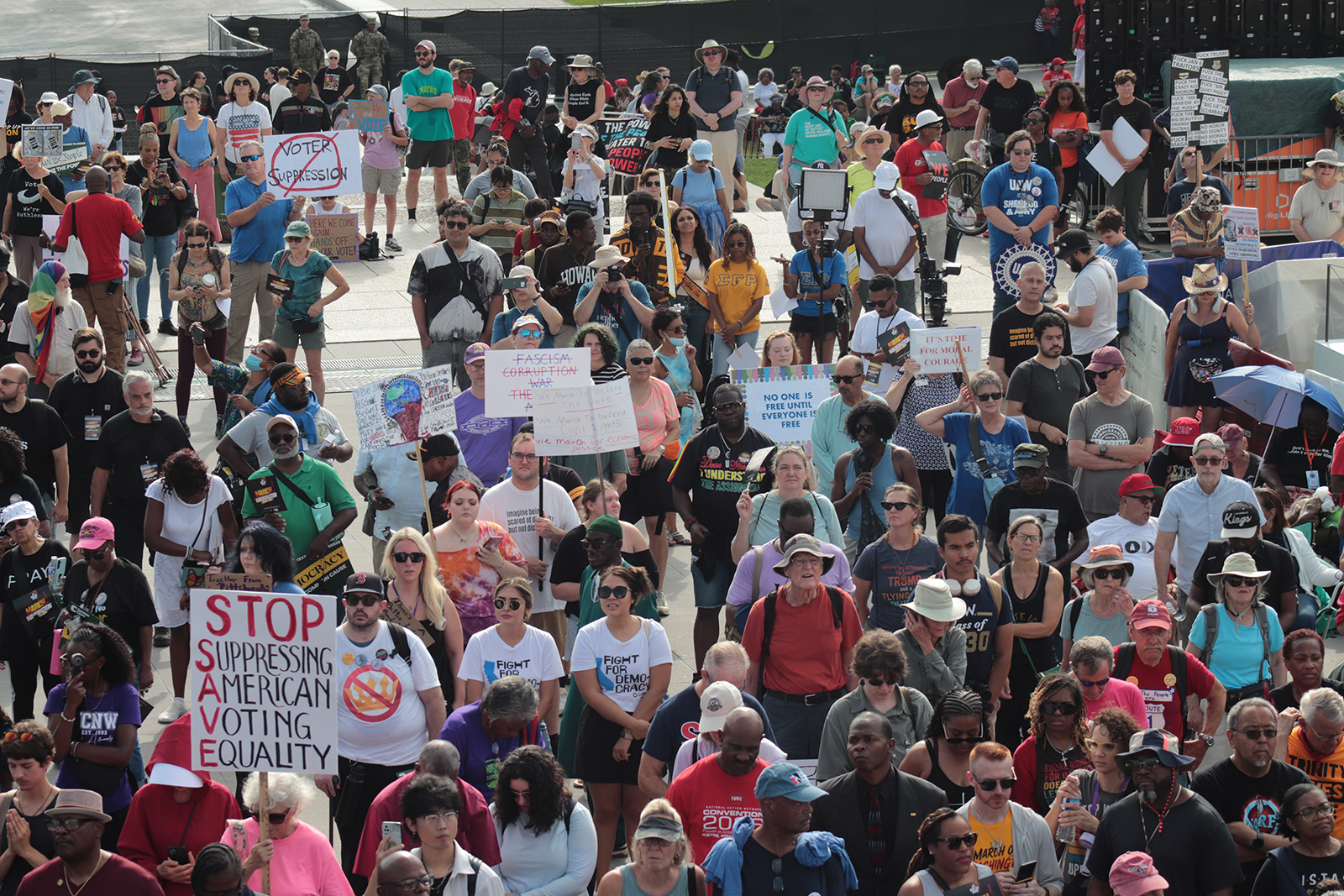
Demonstrators listen to speakers during the March on Washington, near the Lincoln Memorial, Friday, Aug. 28, 2026, in Washington. (RNS photo/Adelle M. Banks)

WASHINGTON (RNS) — Thousands of people gathered before the Lincoln Memorial on the 63rd anniversary of the March on Washington for a program Friday (Aug. 28) bookended by prayers and focused on voting rights.

The son of the Rev. Martin Luther King Jr., who that day more than six decades before delivered his “I Have a Dream” speech, decried the state of voting rights in America, referring to the Supreme Court’s gutting of the landmark 1965 Voting Rights Act earlier this year. 

“The fact that we still have to fight to maintain and renew voting rights in this country is beyond abysmal and a truly national disgrace,” Martin Luther King III said Friday. “If some don’t change their ways, it won’t be long before we all experience the discomfort of the divine judgment that God has promised.”

The Rev. Al Sharpton, president of the National Action Network civil rights organization, said it was time to organize for voting rights on a new level.

“We must turn this country upside down with those elected officials that are taking, for us, the right to vote,” he said, drawing cheers. “The Callais decision by the Supreme Court shot a bullet in the heart of voting rights, but they don’t understand we’re not going back. We will not let them turn back the hands of time.”

Sharpton’s network and the younger King’s Drum Major Institute, two organizations focused on social justice, were joined at the event by leaders of religious, political, labor and student organizations who took the stage in Lincoln’s shadow over the course of several hours.

The Rev. Al Sharpton, from left, director Spike Lee and other activists walk from the Lincoln Memorial to the Martin Luther King Jr. Memorial during the March on Washington, Friday, Aug. 28, 2026, in Washington. (RNS photo/Adelle M. Banks)

Rabbi Jonah Dov Pesner, the director of the Religious Action Center of Reform Judaism, blew a shofar, a traditional Jewish instrument made from a ram’s horn, before making his remarks.


RELATED: Black clergy strategize, preach and urge election turnout after Voting Rights Act gutting


Just as the shofar blast was used thousands of years ago as ancient Hebrew people worked to escape Egyptian slavery, Pesner said it is time to “wake up” to achieve “a robust, multiracial, inclusive democracy in which every voice is heard because every vote is counted.”

Rallying the audience, as some stood in the hot sun beside a covered Reflecting Pool while others crowded in shadier spots near trees farther away, he asked: “Some people want some people not to vote. Are we going to stand for that?”

“No!” came the response.

Rabbi Jonah Dov Pesner blows a shofar at the March on Washington, near the Lincoln Memorial, Friday, Aug. 28, 2026, in Washington. (RNS photo/Adelle M. Banks)

Some in the crowd, which was sometimes quiet and sometimes boisterous, seemed ready to take home the lessons of the day to share with others. Pastor Gregory Ross of Philadelphia’s Thankful Baptist Church was taking notes.

“I’ve never missed a vote since the age of 18,” he said, expressing his hope that his congregation and community will take the upcoming election more seriously when he shares what he heard at the march. “I believe if you promote positive information, it will create positive actions.”

Martin Luther King III speaks during the March on Washington, near the Lincoln Memorial, Friday, Aug. 28, 2026, in Washington. (RNS photo/Adelle M. Banks)

Early in the program, a multi-faith set of prayers were uttered by Christian and Muslim speakers before dozens of speeches that often focused on voting and the upcoming midterm election, but also addressed other issues, including support for affordable healthcare and for diversity, equity and inclusion.

Before marching to the Martin Luther King Jr. Memorial with leaders like actor and director Spike Lee and Congress of National Black Churches Chairman the Rev. W. Franklyn Richardson, the crowd heard from several politicians. These included Congressional Black Caucus Chair Yvette Clarke, D-New York, Vermont Independent Senator Bernie Sanders and Rep. Alexandria Ocasio-Cortez, D-New York. Other speakers included Yusef Jackson, the son of the late Rev. Jesse Jackson who succeeded his father as the head of the Rainbow Push Coalition.

After the speeches, a chanting, drumming crowd marched from the Lincoln Memorial to the King Memorial.

Activists walk from the Lincoln Memorial to the Martin Luther King Jr. Memorial during the March on Washington, Friday, Aug. 28, 2026, in Washington. (RNS photo/Adelle M. Banks)

Before they stepped off, Bishop Leah Daughtry, national presiding prelate of The House of the Lord Churches, gave a closing prayer, acknowledging portions of the Voting Rights Act being cut.

“Our votes have been challenged. Our rights have been trodden. Our humanity has been questioned,” prayed Daughtry, who has twiced served as the CEO of the Democratic National Committee. “But Lord, you did not raise up a movement to depend on nine votes in a marble building. You raised up a people. And so, we do not send these marchers out in mourning. We send them out in commission to serve the least, the last and the lost.”

Defending the Vote


 August 28, 2026

Sen. Bernie Sanders delivered the following remarks at the National Action Network’s March on Washington: Defend the Vote rally in Washington, D.C., on August 28, 2026.

Let me thank Rev. Sharpton and the National Action Network for organizing this event for allowing me to say a few words to you today, and let me thank all of you for being here.

63 years ago, a quarter of a million Americans descended upon this very location for what is now recognized as one of the most significant events in the modern history of our country: the March on Washington for Jobs and Freedom. As a young college student at that time, I had the fortune to get on a bus from the University of Chicago to attend that event – and experience a day that I have never forgotten and which has had a lasting impact upon my life.

And when we think back upon that extraordinary day, it is important that we remember not only Dr. King’s unforgettable “I Have a Dream” speech, but we also remember the context in which that speech took place.

We must never forget the extraordinary courage of the people who marched, who organized, who went to jail, who faced dogs and fire hoses, who risked their lives and, in far too many cases, gave their lives to secure a more just and equitable America. Because of that movement, segregation was dismantled. The Civil Rights Act was passed. The Voting Rights Act was passed. The Fair Housing Act was passed. Millions of Americans gained rights and freedoms that had been denied to them solely because of the color of their skin.

That dream of a more just and more equitable society has never been under greater threat than it is right now.

Today, we have a President who, along with the Supreme Court members he appointed, is carrying out the most significant assault on voting rights since segregation – targeting virtually every aspect of the electoral system. He is seeking to purge voter rolls and obtain sensitive voter data, restrict mail-in and early voting, redraw congressional districts for partisan advantage and deploy federal agents around polling places. He has undermined faith in American elections by falsely claiming that he won the 2020 election and goes around the country claiming that hundreds of thousands of undocumented immigrants vote in our elections – which is nonsense.

Bottom line: Trump is an authoritarian who is deliberately trying to destroy faith in American democracy, create confusion, sow mistrust in our elections and make it harder for Americans to vote.

But Dr. King’s dream is under threat in other ways too.

Dr. King understood that political freedom and economic freedom are inseparable. That is why the March on Washington was not simply a march for voting rights – as enormously important as that was. It was the March on Washington for Jobs and Freedom.

As Dr. King, a strong ally of the trade union movement, famously asked, “What good is having the right to sit at a lunch counter if you can’t afford to buy a hamburger?”

And let us never forget: Dr. King was assassinated in 1968 while he was in Memphis, Tennessee, standing with exploited sanitation workers who were attempting to organize a union.

Let’s be clear: it is not only voting rights that are under assault today. That part of Dr. King’s dream – the dream of genuine economic freedom – is also under unprecedented attack.

Today, while we have more income and wealth inequality than at any point in American history, 60% of our people live paycheck to paycheck, struggling to afford groceries, health care, education and other basic necessities of life.

In the midst of a major housing crisis, some of the 800,000 Americans who are homeless are sleeping out on the streets a few blocks from where we are right now.

And while this economic crisis impacts people of all races, creeds, and people in every corner of our country, it continues to disproportionately affect the Black community.

Black Americans continue to face higher rates of poverty, shorter life expectancy, lower rates of homeownership, greater exposure to environmental hazards and enormous disparities in access to capital and economic opportunity.

Trump’s devastating cuts to health care, education, Head Start and other programs have only made a bad situation worse.

My friends: 63 years ago, Dr. King stood at this location and inspired all Americans – people of every color, every religion, every background – to stand together in the struggle for racial and economic justice. And as you well know, the message he delivered in 1963 is as true today as it was back then.

Yes. Black and White, Latino and Asian – people of all races, religions and backgrounds, must come together now in the fight for justice.

We must never accept an economy in which so few have so much, while so many have so little – where one man now owns more wealth than the bottom 50% of American households.

Billionaires must pay their fair share of taxes.

We must never accept a corrupt campaign finance system which allows wealthy campaign contributors to undermine our democracy and buy elections. We need to get super PACs out of the political process and move to public funding of elections.

We must never accept a system in which millions of workers continue to earn starvation wages and are denied the right to join unions. We must raise the minimum wage to a living wage – at least $20 an hour – and pass the PRO Act, making it easier for workers to join unions.

We must never accept a healthcare system designed to make huge profits for the insurance companies and pharmaceutical industry. Healthcare is a human right.

We must never accept a situation in which a handful of big tech oligarchs push their AI agenda down the throats of the American people, threatening millions of jobs, our privacy rights, the mental wellbeing of our children and the very future of humanity.

AI and robotics must work for all of us — not just the few.

We must never accept a situation in which a handful of fossil fuel executives are putting the very future of the planet at stake for their own short-term profits. We must create millions of good-paying union jobs by transforming our energy system away from fossil fuels and towards energy efficiency and sustainable energy.

The people in Washington in 1963 understood.

Real change does not come from the top down.

It comes from the bottom up.

It comes when ordinary people organize.

It comes when Black and white Americans stand together.

When Latino, Asian American, Native American and immigrant communities stand together.

The March on Washington and the movement behind it changed the course of American history.

And now it is our turn.

Let us go forward together.

Thank you.

Bernie Sanders is a US Senator, and the ranking member of the Senate budget committee. He represents the state of Vermont, and is the longest-serving independent in the history of Congress.


CIA and Vatican visits converge in Moscow amid rising tensions over Ukraine

VATICAN CITY (RNS) — As the CIA director quietly carried warnings to Moscow, Pope Leo’s foreign minister arrived offering dialogue and humanitarian cooperation — two contrasting missions that one Vatican expert likened to a 'good cop, bad cop operation.'
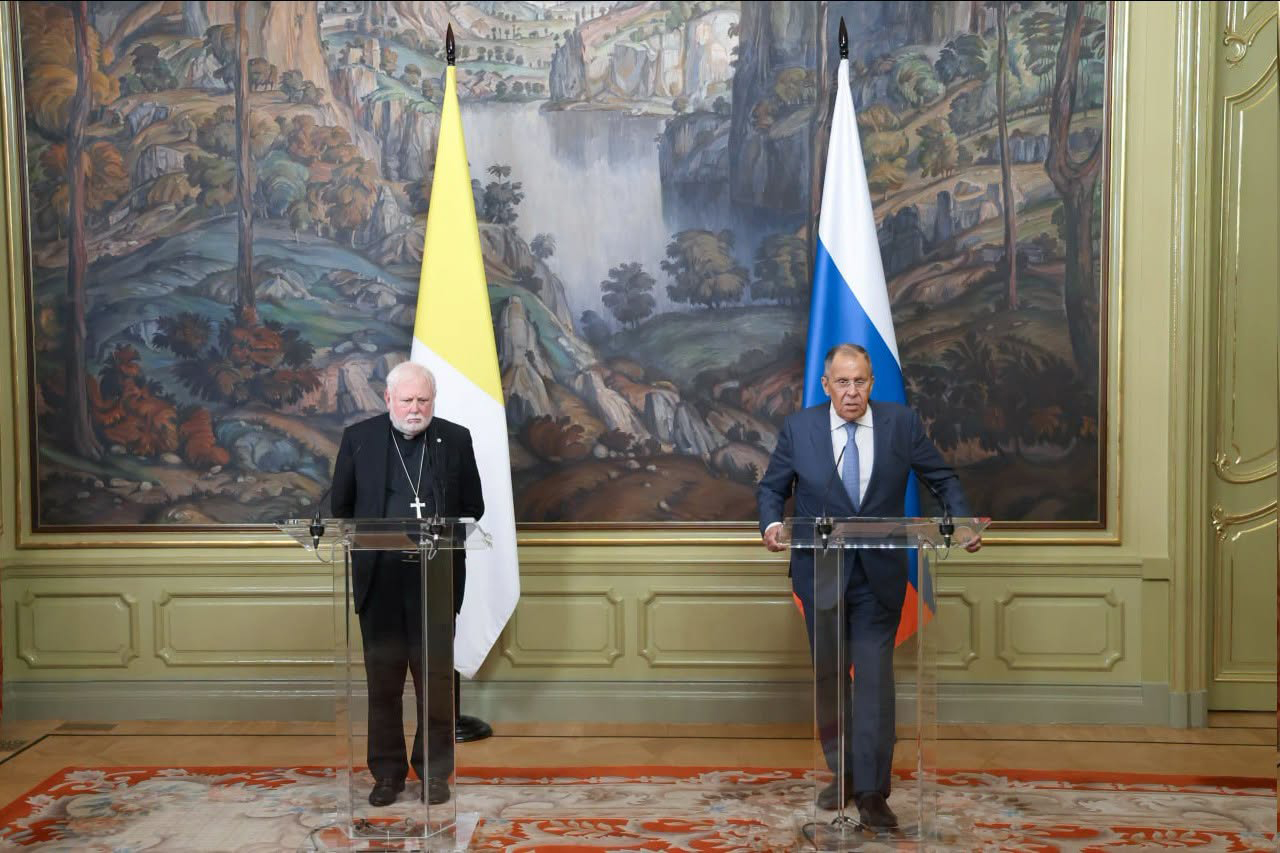
Russian Foreign Minister Sergey Lavrov, right, at a joint news conference following talks with Archbishop Paul Gallagher, Holy See Secretary for Relations with States and International Organisations, Aug. 25, 2026, in Moscow. (Photo by Russian Foreign Ministry)

VATICAN CITY (RNS) — The CIA director made an unannounced visit to Moscow on Tuesday (Aug. 25) as the Vatican’s foreign minister led a five-day mission to the Russian capital, in disparate attempts to influence an end to the war in Ukraine.

Multiple reports said CIA Director John Ratcliffe privately delivered a warning to the Kremlin to avoid an escalation to the conflict, although accounts differed over the principal purpose of his visit. Meanwhile, Archbishop Paul Gallagher, who leads the Vatican’s diplomacy with states, publicly offered Russian officials dialogue and humanitarian assistance.

“In a simplistic way, it looked like a good cop, bad cop operation,” said Victor Gaetan, author of “God’s Diplomats: Pope Francis, Vatican Diplomacy and America’s Armageddon.”

Gallagher’s visit marked an important moment for Vatican diplomacy under Pope Leo XIV, who has expressed more conspicuous sympathy for Ukraine than his predecessor, Pope Francis, while preserving the Holy See’s traditional insistence on dialogue with both sides. And the simultaneous presence of Ratcliffe raised questions about whether the first U.S. pope’s peace diplomacy might intersect with Washington’s strategic pressure on Moscow.

Gaetan noted that Washington and the Holy See have cooperated secretly before, most prominently in the negotiations that led to the 2014 restoration of diplomatic relations between the United States and Cuba.

Neither the government nor the Vatican has indicated the Moscow visits were coordinated. But their convergence presented Russia with two complementary messages from the West.

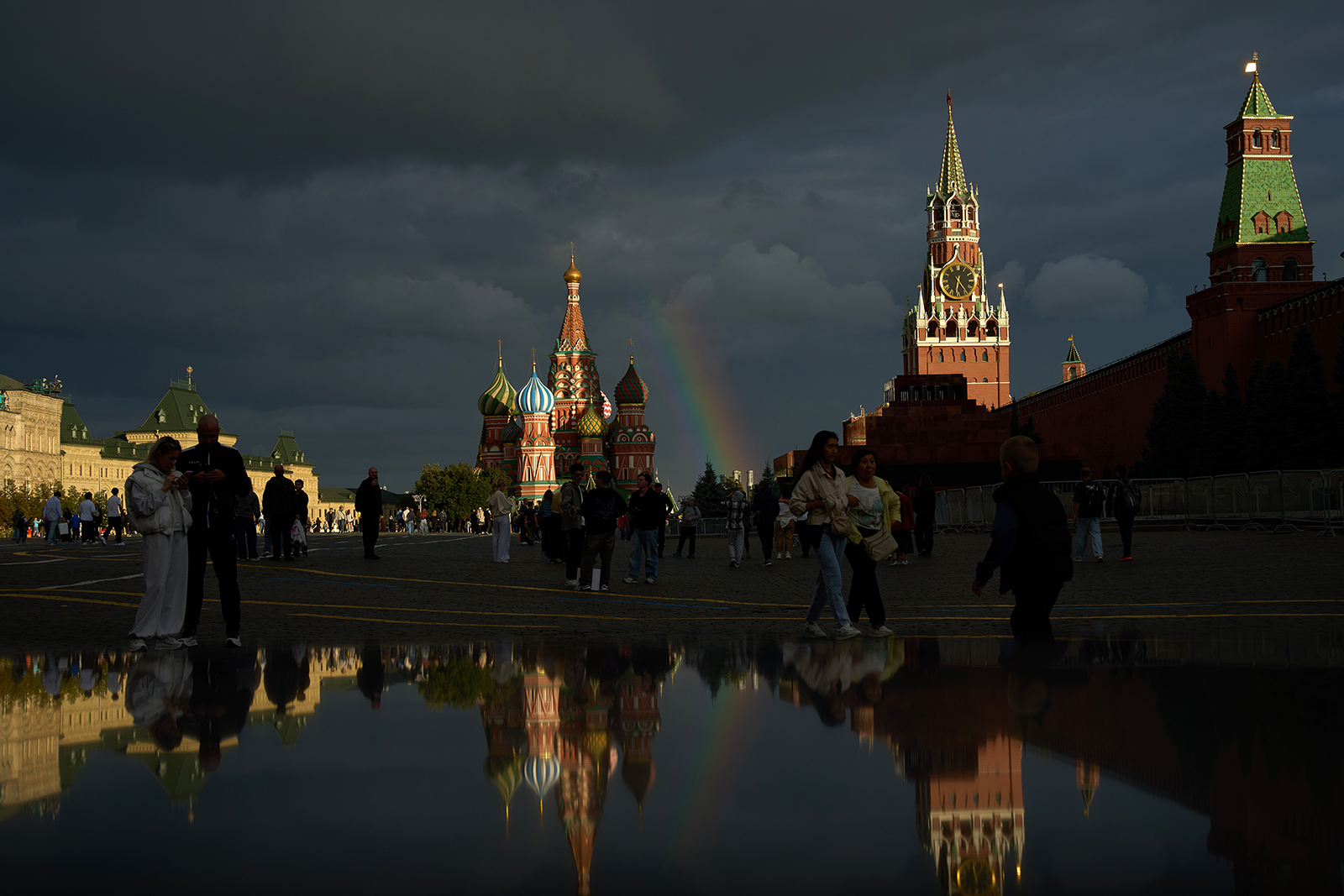
People enjoy a view of a rainbow, backdropped by St. Basil’s Cathedral, center, and the Spasskaya Tower, right, in Red Square during the golden hour in Moscow, Russia, on Monday, Aug. 24, 2026. (AP Photo/Alexander Zemlianichenko)

Ratcliffe’s Tuesday visit, which lasted roughly eight hours, was his first trip to Russia as CIA director. A practicing Catholic who earned his law degree from the University of Notre Dame, Ratcliffe reportedly met Sergei Naryshkin, the head of Russia’s Foreign Intelligence Service, and carried several messages to Moscow. The New York Times reported that he gave Russia a “bleak assessment” of its war prospects, while The Wall Street Journal and Politico reported he warned against attacking NATO members, in particular, the Baltic states.

Meanwhile, Gallagher’s five-day trip to Moscow mixed diplomacy with spirituality and included meetings with his Russian counterpart, Sergey Lavrov, the Orthodox church in Russia and the local Catholic community.

“The position of the Holy See remains clear: the conflict cannot be resolved by military means,” the archbishop said in a joint press conference with Lavrov after their meeting.

Gallagher pointed to the challenges of promoting dialogue the longer the conflict continues. The war in Ukraine has been ongoing for four-and-a-half years, and combined casualties may have reached 2 million, according to the Center for Strategic and International Studies.

“Let us be clear, this war must end,” Gallagher said, urging leaders to “look beyond the conflict.”

He also underlined that the Holy See and Russia discussed peaceful avenues and that the church offered to continue its humanitarian efforts, especially in caring for children impacted by the war.

The Holy See will “continue to provide strong spiritual, diplomatic and humanitarian support by contributing ⁠to ​and offering a space for dialogue,” he added.

Lavrov recognized that Vatican-Russian relations “continue to be characterized by trust, friendship and pragmatism” and thanked the Holy See for its “balanced position” on the Ukrainian crisis. But the Russian minister for foreign affairs also leaned on what he considers the “root causes” of the conflict, pointing to Ukrainian attacks against Russian civilians, including children, and Ukrainian efforts to curtail the influence of the Russian language and the Moscow-linked Ukrainian Orthodox Church.

Ukraine has stated that it’s not attempting to suppress the Russian Church but prevent it from being used as a Russian tool for influence, while it argues that the Russian language has been only restricted in official contexts.

“The joint press conference with Mr. Lavrov demonstrated that the Holy See diplomacy matters, especially in a context of war,” Gaetan said.

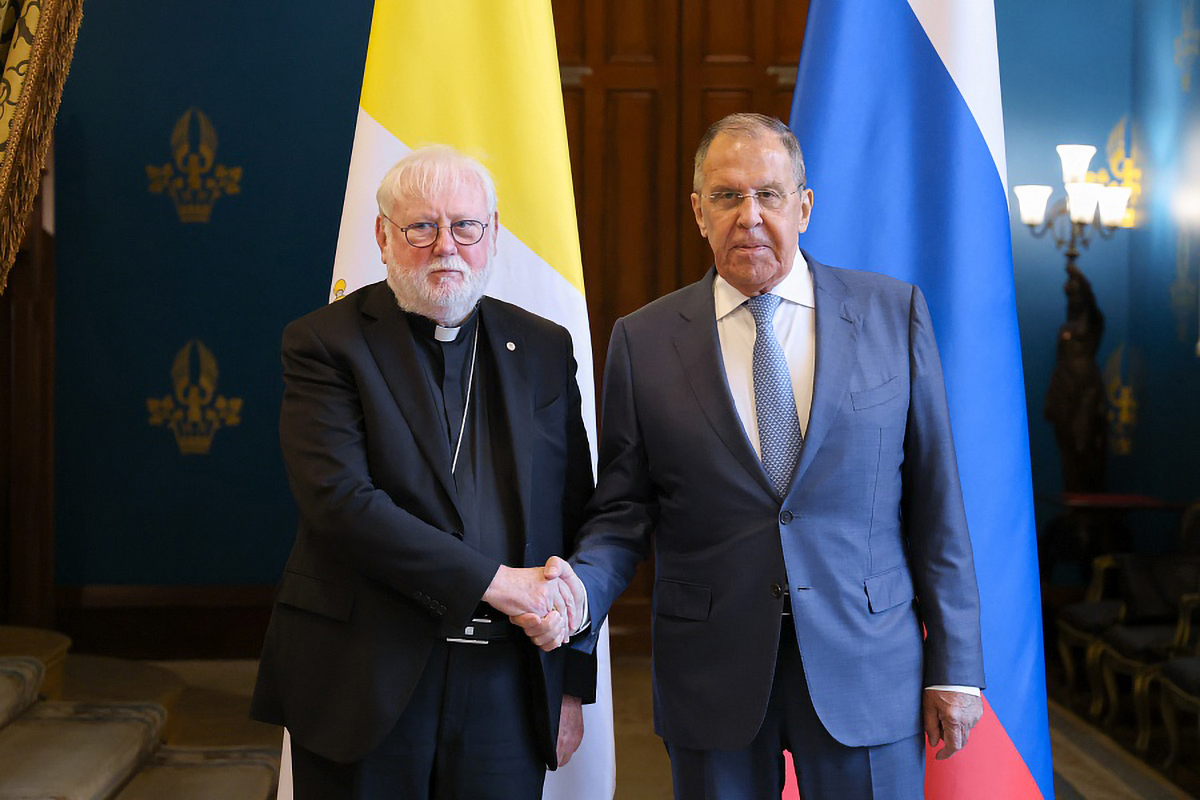
Russian Foreign Minister Sergey Lavrov, right, with Archbishop Paul Gallagher, Aug. 25, 2026, in Moscow. (Photo by Russian Foreign Ministry)

Gallagher’s most discreet engagement came in closed-door talks with Yuri Ushakov, Russian President Vladimir Putin’s senior foreign policy adviser and a central figure in Moscow’s negotiations over Ukraine. Neither the Vatican nor the Kremlin disclosed details of the meeting.

On Tuesday, Gallagher also met with Metropolitan Anthony of Volokolamsk, who leads the Moscow Patriarchate’s relations with other churches.

The meeting addressed “pressing issues concerning the situation in the world,” according to a statement by the church’s department for external church relations, and presented Gallagher with information about the “persecution of the Ukrainian Orthodox Church by the Ukrainian state authorities.”

While the Holy See has historically maintained a neutral stance in conflicts to provide a platform for dialogue and peace, “Leo does appear to be more preoccupied with the Ukrainian tragedy,” Gaetan said. He suggested Leo’s American Catholic formation during the Cold War may help explain why his public posture toward Russia differs from that of his predecessor. Francis, by contrast, approached the conflict from a Latin American perspective generally more suspicious of Western geopolitical narratives.

Despite this week’s effort by the Vatican to approach a dialogue with Russia, it maintained a strong posture in defense of the Ukrainian people.

Gallagher’s arrival in Moscow occurred on the anniversary of Ukraine’s 1991 Declaration of Independence from the Soviet Union. That same day, Leo addressed Portuguese military and security personnel at the Vatican and affirmed that their “noble mission” is that of “defending the sovereignty of your homeland and the rule of law.” Although the pope did not mention Ukraine in that passage, the language resonated with a conflict rooted in Russia’s violation of Ukrainian sovereignty and sits in stark contrast with Francis’ suggestion in 2022 that the “barking of NATO at Russia’s door” may have led to the invasion.

Pope Leo also appealed for peace in “martyred Ukraine” in his first Sunday address as pontiff in May 2025, and he held his first meeting with Ukrainian President Volodymyr Zelenskyy after his inaugural Mass. That same month, Italian Prime Minister Giorgia Meloni stated that Leo attempted to mediate a peace between the warring nations, but Lavrov shut down the idea of a Catholic country hosting peace talks between two Orthodox nations. Leo met Zelenskyy again in his summer residence at Castel Gandolfo in July and December of last year.

Speaking to journalist Elise Harris of Crux, Leo recognized the Holy See’s “great efforts” to maintain a neutral position on the Ukraine-Russia war, “as difficult as it might be.”

The first and only phone call between Leo and Putin took place in June of last year.

With the possibility of hosting peace talks seemingly off the table, Pope Leo seems to have shifted tactics, opting for traditional Vatican diplomacy with an emphasis on humanitarian efforts. Last July, he sent Cardinal Matteo Zuppi, the head of the Italian bishops’ conference and a skilled diplomat, to Ukraine, quickly followed by a visit by Gallagher.

On July 4, Leo also had an unprecedented informal dinner with the U.S. ambassador to the Holy See, Brian Burch. This week, Burch met with President Donald Trump, Vice President JD Vance and Secretary of State Marco Rubio to discuss how the U.S. “can partner with the Holy See to promote global peace and religious freedom,” according to a post by the U.S. Embassy to the Holy See on X.

Burch presented baseballs signed by Leo “as a gesture of friendship.”

CIA chief’s secret Moscow trip exposed as insiders leak details: report

Alexander Willis
August 29, 2026 
RAW STORY


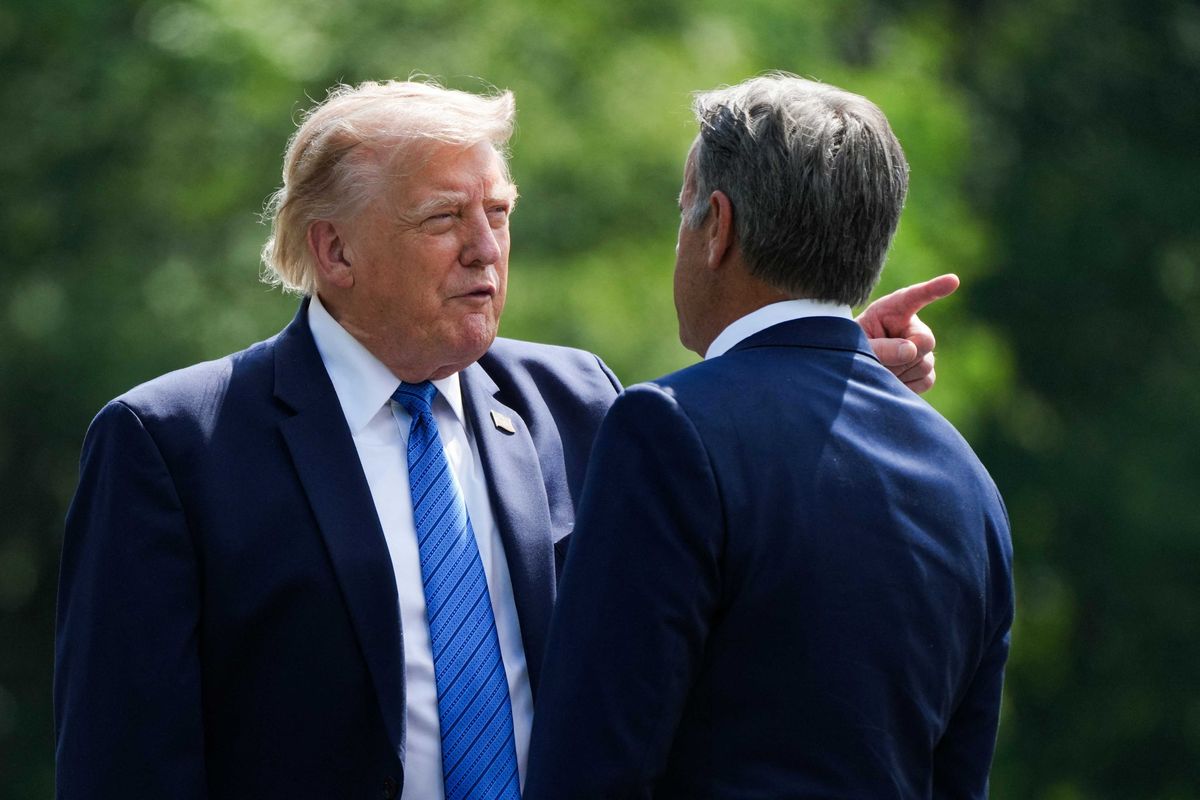
U.S. President Donald Trump and John Ratcliffe, Director of the Central Intelligence Agency (CIA), speak as they depart after a Cabinet meeting at Camp David in Thurmont, Maryland, U.S., July 31, 2026. REUTERS/Nathan Howard/Pool

CIA Director John Ratcliffe raised eyebrows this week after secretly jetting off to Moscow, Russia, and while the Kremlin denied that any meetings between Russian officials and Ratcliffe took place, two insiders on Saturday revealed at least one apparent reason for the mysterious trip.

Two sources briefed on the matter told Axios Saturday that while in Moscow, Ratcliffe proposed a “trilateral meeting” between President Donald Trump, Russian President Vladimir Putin and Ukrainian President Volodymyr Zelenskyy in just the latest effort to end the Russo-Ukraine war. Since the beginning of his second term, Trump has struggled to bring about an end to the conflict despite his repeated efforts.

“Ratcliffe's visit was partly aimed at determining whether Russia's heads of intelligence services could help convince Putin to move toward resuming U.S.-mediated negotiations with Ukraine, the sources said,” Axios’ Barak Ravid wrote in the outlet’s report.

“On Friday, U.S. officials briefed Zelensky on Ratcliffe's talks in Moscow and the proposal for a trilateral summit.”

Ratcliffe’s trip was so secretive that even top White House aides were “in the dark” about the expedition. The trip reportedly sent European officials “scrambling for information,” according to the Wall Street Journal.

According to reports, Ratcliffe took a secretive route to Moscow aboard an unmarked U.S. C-17 military cargo plane flying out of Latvia. Trump, when asked about the trip by reporters, downplayed the mission as being “semi-routine.”

“This was the first time Ratcliffe got personally involved in the diplomatic push to broker a breakthrough between Russia and Ukraine,” Axios’ report reads.

“Ratcliffe met with his Russian counterparts: SVR foreign intelligence chief Sergey Naryshkin and FSB director Alexander Bortnikov. Trump told Axios that Ratcliffe's visit was ‘standard business’ and not intended to warn Russia against attacking NATO territory.”

Trump personally deployed his top spy to Russia behind his aides' backs: report

Bennito L. Kelty
August 27, 2026
RAW STORY


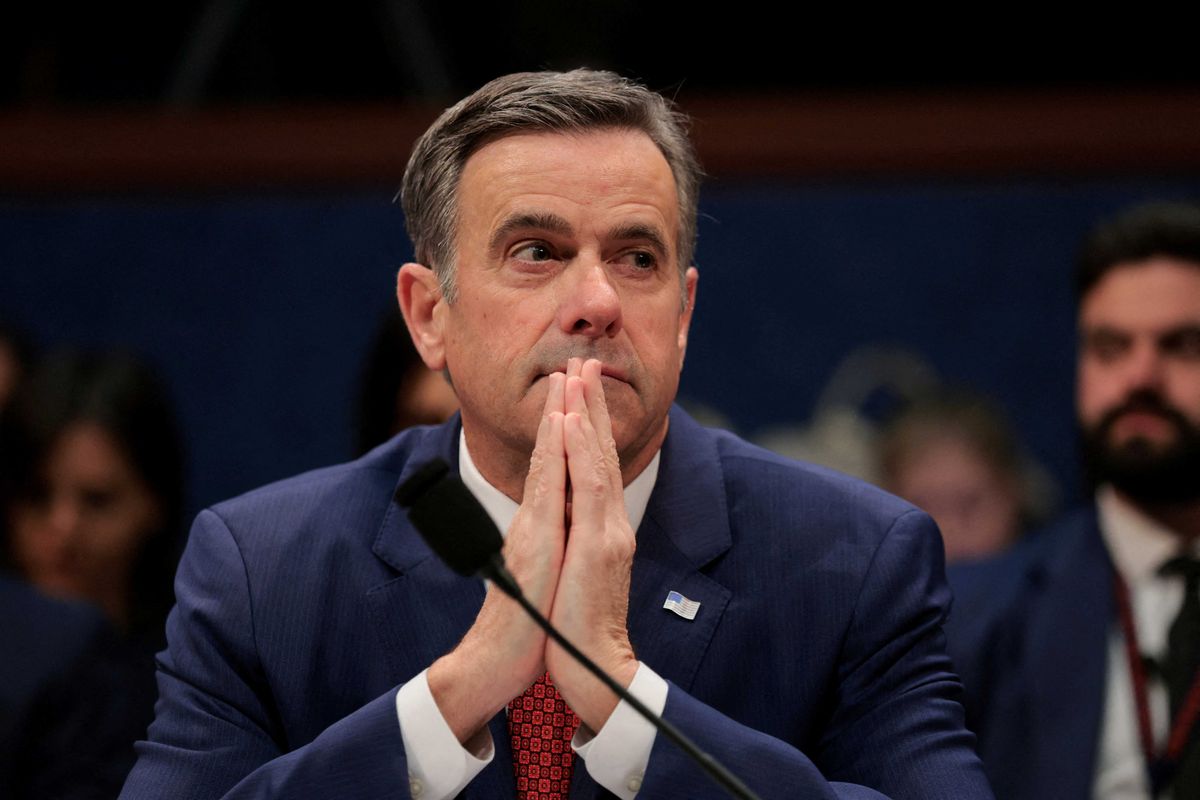
FILE PHOTO: Central Intelligence Agency (CIA) Director John Ratcliffe attends a U.S. House Intelligence Committee hearing on worldwide threats, on Capitol Hill in Washington, D.C., U.S., March 19, 2026. REUTERS/Kylie Cooper/File Photo

CIA Director John Ratcliffe's secret trip to Russia came at the personal direction of President Donald Trump while senior White House aides were kept in the dark.

According to a Thursday report by the Wall Street Journal, the covert diplomatic mission to Moscow was tightly held as Trump dispatched his top spy to carry a message to top Kremlin figures. Trump's move bypassed aides and military brass who would ordinarily be looped in beforehand, The Journal noted.

The choice to send Ratcliffe as an envoy also marked a shift, The Journal pointed out. Earlier rounds of talks were led by other Trump confidants but failed to halt the fighting in Ukraine. Trump then turned to Ratcliffe, according to anonymous U.S. officials who talked to The Journal.

Ratcliffe reportedly also took a secretive route into Russia as he flew into Moscow aboard an unmarked U.S. C-17 military cargo plane out of Latvia, according to The Journal. European officials told The Journal that the move sent them scrambling to figure out what had happened once word got out about Ratcliffe's mission.

Two European officials told The Journal that they were briefed on the meeting. Ratcliffe used the sit-down to stress Washington's continued backing of NATO's mutual-defense pledge and to warn Russia off any strike on alliance members, they told The Journal and later reporting revealed.

Trump brushed off worries about Russian aggression when reporters asked him about Ratcliffe's mission on Thursday, The Journal noted. Putin "won't attack NATO territory," Trump told reporters.

He also downplayed Ratcliffe's trip when he told conservative radio host Glenn Beck in an interview that the mission was "semi-routine," The Journal noted.

Officials along NATO's eastern edge struck a similarly calm tone, according to The Journal. Latvian Prime Minister Andris Kulbergs addressed the matter in a video posted to social media, The Journal reported.

"There is currently no reason for concern," Kulbergs said. "Latvia's level of military threat hasn't changed. The risk of direct military invasion threats to Latvia is currently low."

Former senior U.S. intelligence official J.C. Lintzenich, now at the German Marshall Fund, struck a graver tone when talking to The Journal, however.

"Putin has a tolerance for extraordinary risk and is even potentially willing to escalate to compel de-escalation," Lintzenich said. "But he is unlikely to roll the dice on actions that could threaten the Russian state."