Tuesday, December 21, 2021

Nuclear power advocates keep pushing, but Gov. Newsom won’t act to ‘save’ Diablo Canyon


The San Luis Obispo Tribune Editorial Board
Mon, December 20, 2021, 6:30 AM·5 min read

A couple of weeks ago, U.S. Energy Secretary Jennifer Granholm suggested California consider extending the life of Diablo Canyon nuclear power plant.

In an interview with Reuters, she also “hinted she would be willing to give her persuasion skills a try with officials in California,” the news agency wrote.

But in a visit to Sacramento Friday, she walked back those statements. “California has made a decision on Diablo Canyon and they’re moving in a decision to close it down. I totally respect that,” she said.


Good thing, because the president has no authority over a power plant in California.

More to the point, Gov. Gavin Newsom has no intention of intervening to keep the PG&E plant, located in the Central Coast community of Avila Beach, open past 2025, when its Nuclear Regulatory License expires.

“California has the technology to achieve California’s clean energy goals without compromising our energy needs. The pathway is through diverse renewable energy sources, expanded energy storage, and grid climate resiliency,” Newsom spokesperson Erin Mellon wrote in an email to The Tribune. “Our retail energy providers are already in the process of procuring new energy projects to replace the energy produced by Diablo Canyon.”

That all but slams the door on what many saw as the most logical way to keep Diablo open — an emergency order from the governor or the president.

But that almost certainly won’t be enough to discourage the campaign to keep California’s last nuclear power plant operating for at least another five or 10 years.

It’s a cause that has been gaining traction lately, especially since the publication of a Stanford-MIT study that supported keeping the plant operating past 2025, to give the state more time to ramp up offshore wind, solar power and battery storage facilities.

Several editorial boards — including The Washington Post — have come out in favor of Diablo’s continued operation.

More activists are joining a loosely knit coalition that includes scientists, climate change activists, public officials, celebrities and energy sector workers.

And negative public opinion about nuclear power appears to be shifting. In a 2021 national poll by Bisconti Research 76% of 1,000 respondents supported nuclear power.
‘No plausible scenario’

There is no denying that huge obstacles stand in the way of continued operation.

In addition to relicensing, there’s the likelihood that the plant will require an expensive new cooling system and seismic upgrades; strong opposition from activists who say a nuclear power plant never should have been built in an area riddled with earthquake faults; and here’s the kicker — no one has stepped up and expressed a willingness to operate the plant past 2025.

Yet some, like Diablo Canyon employee Heather Hoff, still hold out hope that PG&E will change its mind.

“We have a largely new board of directors,” said Hoff, a co-founder of the activist group Mothers for Nuclear. “I think they are largely pro nuclear and support clean energy.”

Plus, Hoff says the current CEO of PG&E, Patti Poppe, is more sympathetic to their cause than the executives in charge when the closure agreement was reached.

Yet PG&E’s PR team is sticking to its statement: The company is moving forward with the “retirement” of the power plant.

Even if the company were willing to reverse course, it’s too late for a last-minute rescue, according to legal expert Alex Karlin, a retired Nuclear Regulatory Commission judge who has served on the Diablo Canyon Decommissioning Panel.

“There is no plausible scenario whereby (the) NRC or the state could order that the Diablo Canyon nuclear power plant continue to operate after 2025. It would violate criminal law for Diablo to operate without the necessary federal and state licenses. Those licenses expire in 2025. There is no realistic way that the NRC licenses can be renewed by 2025,” he wrote in an email.
Not a ‘finger in the dike’

Given the severity of the climate crisis, it’s easy to see why keeping Diablo Canyon open would appear to be a logical, albeit temporary, fix.

But Diablo Canyon cannot be the finger in the dike. And truth be told, there was no little Dutch boy who saved a town from flooding, just as no single power plant is going to “save” California.

The fact is, we’re paying the price for haphazard energy policies and foot-dragging by public officials.

If they had done their job, we would have no need to be looking to extend the life of Diablo Canyon.

We would already have wind turbines off the coast of California.

Rooftop solar would be the norm.

And coal-fired power plants would be gone.

Instead, we’re still years — maybe even decades — away from that.

Rather than ruminate about Diablo, we should hold public officials and utility companies accountable for putting us in this situation in the first place and demanding that we stay on track to meet clean energy goals.

To that end, we need to hear more from the California Energy Commission about where we stand on the transition to 100% clean energy.

Ideally, we would have an easy-to-decipher, concise, up-to-date dashboard that shows where we’re at now; which projects are in the pipeline; and where we’ll be when those projects come online.

If we can keep track of our progress against COVID, we should be able to do the same in our fight against the far greater threat of climate change.

Being stuck in this endless loop of debate over Diablo Canyon accomplishes little — especially if there’s no conceivable way the plant can remain open.

Instead of fighting the inevitable closure of the plant, it’s time to rally for offshore wind, protest new fees for rooftop solar, become more aggressive about conserving energy.

It’s time to finally look beyond Diablo Canyon.
Thailand sends refugees back to Myanmar as clashes continue

THAILAND A MILITARY DICTATORSHIP IS PALS
WITH BURMA DICTATORS


2 / 5
Thailand send hundreds of refugees back to Myanmar despite the continued fighting

Sun, December 19, 2021

MAE SOT, Thailand (Reuters) - Thailand has sent over 600 Myanmar refugees who fled fighting between the military and ethnic rebels back across the border, according to a senior Thai official who said on Sunday clashes were continuing.

Some of the refugees who reached northwest Thailand's Tak province told Reuters before they went back over the frontier on Sunday morning that they had volunteered to return. On Sunday afternoon, Reuters reporters on the Thai side of the frontier were hearing continuous gunfire.

Provincial Governor Somchai Kitcharoenrungroj had told Reuters in the afternoon: "More people are willing to go back as they are worried about their property there."


Human Rights Watch's deputy Asia director, Phil Robertson, urged Thailand not to rush refugees back to Myanmar.

"Everyone knows the Myanmar's military deliberately targets civilians with deadly force when it goes into the field, so it's no exaggeration to say these refugees are literally fleeing for their lives," Robertson said.

A spokesman for Myanmar's military junta did not answer his phone on Sunday. The army denies targeting civilians.

The Aid Alliance Committee, a Thai-based Myanmar migrants group, said about 1,000 displaced people were camping along the Myanmar border at various points waiting to cross into Thailand.

On Sunday morning, Reuters reporters had seen dozens of refugees who had been sheltering at a local Thai school being put into three trucks to be sent back across the frontier.

"I fled from Mae Htaw Talay. There was artillery falling into my neighbourhood," a refugee who asked not to be named said while standing in a truck about to leave for the border. "I walked across the water to this (Thailand) side."

Kitcharoenrungroj, the Tak province governor, said that 623 refugees had been sent back and 2,094 remained on the Thai side, adding that all would be returned if they were willing.

Myanmar has been in turmoil since the military ousted a civilian government led by Nobel laureate Aung San Suu Kyi on Feb. 1, triggering protests and sporadic clashes in the countryside between anti-junta militia and the army.

Fresh fighting broke out last week between the Karen National Union (KNU), Myanmar's oldest rebel force, and the military, forcing thousands from Myanmar's Karen state to flee.

Some crossed the narrow river between Myanmar and Thailand in boats while others waded through chest-high waters while holding children.

(Editing by Kay Johnson and Mark Heinrich)

Human Rights Watch calls on Japan to suspend military exchange with Myanmar


FILE PHOTO: People gather to denounce the Myanmar military coup, in Taipei

Sun, December 19, 2021, 

TOKYO (Reuters) - Human Rights Watch (HRW) urged Japan on Monday to halt a military study-abroad program in which cadets from Myanmar receive combat training.

Since the February coup in Myanmar, Japan has cut new aid and called on the Myanmar military to halt violence, but human rights groups have been asking for stronger actions such as economic sanctions.

Japan has sought to balance its support for Myanmar democracy with its efforts to counter China's influence there, officials and analysts have said.


The two countries have an academic exchange program, under which eight cadets then deputy defence minister from the Myanmar military are studying at Japan's National Defense Academy.

In March, the deputy defence minister told Reuters that any move to cut the partnership with Myanmar's military could result in China winning more clout.

"It's mind boggling that Japan is providing military training to Myanmar cadets at the same time as its armed forces are committing crimes against humanity against Myanmar’s people," HRW said in a statement.

The exchange programme for cadets from foreign countries provides the same courses that Japanese cadets take, according to the academy's website. The academy includes a broad range of military training from combat arms to basic command and operation.

Japan's defense ministry, which runs the National Defense Academy, had no immediate comment on HRW's statement.

Revelations about economic ties to Myanmar's military may put more pressure on Tokyo and Japanese companies to drop them, according to human rights groups.

Myanmar's military overthrew the elected government of Nobel laureate Aung San Suu Kyi, claiming election fraud, and this month sentenced her to four years in prison.

More than 1,300 protesters have been killed by troops, independent observers say.

Australia has suspended its defence cooperation programme with Myanmar in non-combat areas such as English-language training and New Zealand has stopped all high-level military contact with Myanmar.

(Reporting by Ju-min Park; Editing by Gerry Doyle)


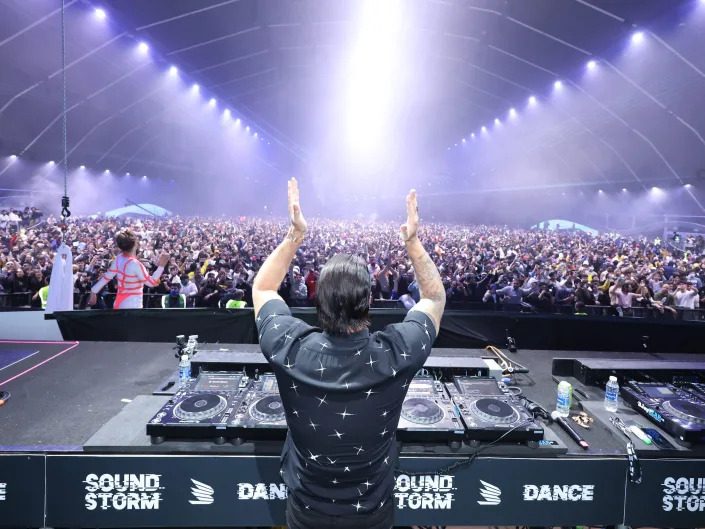
A massive rave took place in a Saudi desert. It was just like any other festival, bar the electronic music pausing for the Islamic call to prayer, say reports

Cedric Gervais performs on stage during MDLBEAST SOUNDSTORM 2021 on December 18, 2021 in Riyadh, Saudi Arabia.
Cedric Gervais performs on stage during MDLBEAST SOUNDSTORM 2021 on December 18, 2021 in Riyadh, Saudi Arabia.Tim P. Whitby/Getty Images for MDLBEAST SOUNDSTORM
  • A four-day electronic music festival took place in the socially conservative kingdom of Saudi Arabia.

  • Martin Garrix, David Guetta, and Tiësto were among the internationally famous DJs to perform.

  • Bloomberg reported that women wore "skintight pants," and the smell of marijuana wafted up from the crowd.

A four-day music festival took place in a desert in Saudi Arabia this weekend, and a Bloomberg report says it looked remarkably similar to its' Western equivalents.

MDLBEAST Soundstorm 2021 kicked off on December 16 on the outskirts of Riyadh, the socially conservative nation's capital, and it featured internationally famous DJs like Martin Garrix, David Guetta, and Tiësto.

MDLBEAST in Saudi Arabia
A general view during MDLBEAST SOUNDSTORM 2021 on December 18, 2021 in Riyadh, Saudi Arabia.Neville Hopwood/Getty Images for MDLBEAST SOUNDSTORM

The festival organizers say that 200,000 people attended on the second day alone, making it one of the best-attended music events in the world, the Saudi Gazette reported.

"Women and men danced with abandon" as electronic music blared, Bloomberg said, only for the rave to be temporarily put on pause for 15 minutes while participants responded to the Islamic call to prayer.

Bloomberg reported that the women at MDLBEAST Soundstorm 2021 wore everything from "skintight pants" to "full-length robes and face veils."

A general view during MDLBEAST SOUNDSTORM 2021 on December 18, 2021 in Riyadh, Saudi Arabia.
A general view during MDLBEAST SOUNDSTORM 2021 on December 18, 2021 in Riyadh, Saudi Arabia.Neville Hopwood/Getty Images for MDLBEAST SOUNDSTORM

Saudi women are required to dress modestly, per The Week, meaning that tight-fitting clothing is generally prohibited. Traditionally, women were expected to wear the abaya — a loose overgarment — in public, but Crown Prince Mohammed bin Salman relaxed this dress code requirement in 2018.

According to Bloomberg, other sights to behold were a sign of "pushing boundaries" as the kingdom transforms. Previously, religious police once punished restaurants for playing music — a far cry from this weekend's reported activities.

"Inebriated men stumbled through crowds perfumed with the distinct scent of marijuana," said Bloomberg, "alongside a limited but notable display of local queer culture."

MDLBEAST SOUNDSTORM 2021 on December 18, 2021 in Riyadh, Saudi Arabia.
A view of people partying at MDLBEAST SOUNDSTORM 2021 on December 18, 2021 in Riyadh, Saudi Arabia.Darren Arthur/Getty Images for MDLBEAST SOUNDSTORM

Cannabis, alcohol, and homosexuality are forbidden in Saudi Arabia, but Bloomberg described a "carnival-like" atmosphere where these rules were apparently snubbed.

Critics have accused the festival organizers of "culture-washing." Resident Advisor journalist Joe Siltanen said it was an attempt to distract from the "authoritarian regime."

MDLBEAST Soundstorm 2021 was just one event in a roster of activities this month, spearheaded by the crown prince, to create the optics of a softer and more secular image of the kingdom. Recently, Saudi Arabia hosted a Formula One race and two art biennials.

An oil-themed amusement park is also being opened as part of Saudi Vision 2030, as Insider previously reported, which is a strategic framework to diversify the nation's dependence on oil and move towards entertainment and tourism.

EU plans to finish green investment rules for gas and nuclear next year

Mon, December 20, 2021
By Kate Abnett

BRUSSELS, Dec 20 (Reuters) - The European Commission plans to finish next year its long-awaited rules on whether to label gas and nuclear energy as climate-friendly investments under EU green finance rules, its environment policy chief said on Monday.

The European Union's executive Commission is considering whether to include nuclear and natural gas in its "sustainable finance taxonomy", a rulebook that will restrict which activities can be labelled as climate-friendly investments.

"We are going to have most likely a discussion tomorrow in college, which then will lead... to approval next year," EU environment commissioner Virginijus Sinkevicius told a news conference on Monday, referring to the Commission's weekly "college" meeting.

Before the Commission publishes its proposal for the rules, it must share them with member states and its group of expert advisers from finance, industry and civil society groups.

The Commission is expected to start the consultation process before the end of the year, which would mean the proposal itself would not be published until January 2022.

"We will kick start the process when it comes to the proposal on taxonomy before the end of the year," a European Commission spokesman told a regular briefing on Monday.

The Commission had planned to adopt the climate section of its taxonomy this year, but has struggled to overcome rifts among EU member states, who disagree on whether gas and nuclear help or harm attempts to avert disastrous climate change.

Once published, a majority of EU countries or European Parliament could block the proposed rules.

Brussels' decision on gas and nuclear has faced intense lobbying from EU countries, who are split. Some countries say gas investments are needed to help them quit more-polluting coal and others warn labelling a fossil fuel as green would undermine the credibility of the rules and the EU's leadership in tackling climate change.

Nuclear energy is similarly divisive. France, the Czech Republic and Poland are among those saying the fuel's low CO2 emissions make it vital in the transition to green energy. Germany, Luxembourg and Austria are among those opposed, citing concerns around radioactive waste.

The EU taxonomy will not ban investments in activities not labelled "green". But by limiting the green label to those activities deemed truly climate-friendly, the EU aims to steer cash into low carbon projects and stop companies or investors from making unsubstantiated environmental claims. (Reporting by Kate Abnett; Editing by David Gregorio)
CALIFORNIA
After four months and thousands of slain sequoia, KNP Complex Fire reaches full containment


Joshua Yeager, 
Visalia Times-Delta | Tulare Advance Register
Mon, December 20, 2021, 3:42 PM·3 min read

After four months, the KNP Complex Fire — which destroyed thousands of giant sequoia and caused extensive damage within Sequoia and Kings Canyon national parks — has reached full containment, fire managers announced Friday.

A series of heavy winter storms ultimately defeated the fire that continued to smolder in remote areas of the parks for months after thousands of firefighters launched a months-long effort to defend Sequoia — and its iconic, namesake trees — from the raging fire.

"While the fire has not grown in recent weeks, it has continued to show activity in remote areas. Significant precipitation events across the Sierra Nevada have prompted fire managers to declare the fire fully contained at this time," park officials said in a statement.

Previous coverage:

KNP Complex reaches Giant Forest, explodes to 17K acres

'Worry for the town' is real in Three Rivers as KNP Complex Fire grows in sequoias

The KNP Complex began as two separate fires on Sept. 9 — both sparked by a massive lightning storm that exploded across California — before merging into the KNP Complex and threatening several mountain communities, including Three Rivers and Silver City.

The fire's dramatic growth was fueled by millions of dead and desiccated trees, victims of an ongoing drought and bark-beetle infestation plaguing the southern Sierra.

At the fire's peak, firefighting crews from around the country rallied to defend General Sherman, the Earth's largest tree by volume, from encroaching flames. Photos of the tree wrapped in fire-resistant wrap circulated around the globe as fire crews talked up the beneficial effects of prescribed burning, crediting the Giant Forest's survival to decades of planned and highly controlled burns carried out by the National Park Service.


Snow rests on a wildfire-scorched sequoia tree, Tuesday, Oct. 26, 2021, in Sequoia Crest, Calif. Archangel Ancient Tree Archive is planting sequoia seedlings in the area. The effort led by the Archangel Ancient Tree Archive, a nonprofit trying to preserve the genetics of the biggest old-growth trees, is one of many extraordinary measures being taken to save giant sequoias that were once considered nearly fire-proof and are in jeopardy of being wiped out by more intense wildfires. (AP Photo/Noah Berger)More

Despite firefighters' best efforts, the fire killed between 3% to 5% of the world's mature sequoia population. That's on top of the devastation wrought by the SQF Complex that charred the same region just one year prior, killing an additional tenth of the world's sequoias, which are endemic to the western slopes of California's Sierra range.

In total, the two fires — along with the Windy Fire that burned to the south of the KNP in the Sequoia National Forest — destroyed up to a fifth of all of the world's sequoia trees, a catastrophic loss that forest managers are still reckoning with.

More:

Up to 19% of the Earth's sequoias have been destroyed by wildfires


Shocking study finds 10% of world's giant sequoias killed by Castle Fire


Windy Fire incinerates giant sequoias as firefighters scramble to save big trees

“I am going to tell you that it does not ever get easy, looking at a monarch giant sequoia that has died. That is one of the hardest things I’ve ever had to look at in my 30-year career with the forest service,” said Teresa Bensen, Sequoia National Forest supervisor, last month. “It is not a good thing for the environment.”

The KNP Complex burned 88,307 acres across the parks and forest. Fire managers breathed a sigh of relief with the announcement of its full containment.


State Assembly Member Richard Bloom, (D-Santa Monica), left, California Gov. Gavin Newsom listen to Superintendent of Sequoia and Kings Canyon National Parks Clay Jordan on Thursday, September 23, 2021 talk about the protective structure wrap used to protect the welcome sign and giant sequoia trees from the KNP Complex Firein Sequoia National Park. Newsom signed a $15 billion climate package into law on site that will help bolster the state's response to climate change.

“We hope that total containment on the KNP Complex is a comfort not only to local communities but to people everywhere who care about the parks,” said Leif Mathiesen, Assistant Fire Management Officer for Sequoia and Kings Canyon national parks.

“While the onset of winter weather was the push we needed to reach full containment, it’s thanks to the incredible work of literally thousands of firefighting personnel that we were able to protect and save what we did. We’re very grateful to a lot of people,” he continued.

While the fire is contained, it is not yet considered "out" and will likely continue to burn in areas through the winter. Errant trees burning from last year's SQF Complex were discovered as late as April of this year.

More:

Giant sequoia still burning in Sequoia National Park after last summer's Castle Fire

Sequoia National Park reopens with limited big tree access

The fire, which burned heavily at the doorstep of Sequoia's Tulare County headquarters, caused severe damage to some of the park's roads and infrastructure. Access to the Giant Forest reopened to the public this month but is limited to the weekends, for now, weather permitting.

The road to the big trees closed this weekend due to the storm that is putting an end to the fire season but may complicate tourist and travelers' plans. For regularly updated information on what areas and services are accessible, visit go.nps.gov/sekiconditions.

Joshua Yeager is a reporter with the Visalia Times-Delta and a Report for America corps member. He covers Tulare County news deserts with a focus on the environment and local governments.
Follow him on Twitter @VTD_Joshy
This article originally appeared on Visalia Times-Delta: KNP Complex Fire reaches full containment

Robotics essential to the oil and gas industry, as technological advancements increase the tasks they can undertake, according to GlobalData

Robot renting — also known as the robot as a service (RaaS) — is expected to revolutionize the way oil & gas (O&G) companies approach robotics, according to GlobalData. The leading data and analytics company notes that industry leaders such as BP, Equinor, ExxonMobil, and Shell are increasingly testing autonomous robots in their facilities, with these systems often supported by other technology such as AI. However, the costs can be off putting. Technology companies such as Fugro that offer RaaS allow O&G players to avoid the cost of inventory and obtain robotic services when required.

Ravindra Puranik, Oil & Gas Analyst at GlobalData, comments: “A number of technology vendors are trying to adopt RaaS in addition to selling robotics equipment. This market has considerable potential for growth within O&G as it can save players the considerable costs associated with purchasing robotics systems.”

The O&G industry is actively collaborating with robotics hardware and software technology vendors to implement RaaS.

Filipe Oliveira, Thematic Analyst at GlobalData, comments: “RaaS is possible because of developments within cloud computing in the last decade. Cloud technology has changed the way we work, how we access entertainment, and is now changing robotics. Cloud-connected robots are smarter — learning from each other’s experience, instead of just their own — and can be monitored, managed and maintained remotely. Within the O&G industry, tech specialists such as Fugro, currently have an incumbency edge due to their industry know-how.”

GlobalData’s latest report, ‘Robotics in Oil and Gas (2021) – Thematic Research’ reveals that robots have been an essential part of a dynamic oil and gas industry for several decades and continue to undertake an evolving and diverse role in the industry. With a growing list of functionalities tailored to O&G robots operate as terrestrial crawlers, quadrupeds, aerial drones, autonomous underwater vehicles (AUVs), and remotely operated vehicles (ROVs). Other digital technologies such as AI, cloud computing, and the Internet of Things (IoT) are also continuously improving the performance of robots for O&G applications.

Puranik continues: “Robotics will have applications throughout all workstreams within O&G. For upstream operations, uses include automated drilling or conducting seismic surveys; for midstream, they can be used for inspection and maintenance, as well as for design, construction and remote monitoring; while downstream applications include automated refuelling and material handling. Robotics offer high reliability and efficiency, while also improving overall operational safety. Various terrestrial, airborne and submerged robots are already playing critical roles in several high-stake O&G projects across the value chain.”

Companies are increasingly moving towards autonomous robots that are supported by AI technology. AI-backed robotics provide diverse functionality for a wide range of oil and gas use cases.

Puranik adds: “AI is expected to develop further, enhanced with computer vision — the ability of computers to derive meaningful data from images — and context-aware computing capabilities.”
Source: GlobalData


Robots Are Taking Over Oil Rigs
Editor OilPrice.com
Mon, December 20, 2021

After years in the making, a new fully automated drilling rig recently made its debut in Permian Basin. While this has long been a pipedream, restrictions faced by many oil and gas companies during the pandemic forced several to stop operations and call rig workers home. This spurred a plethora of tech companies to establish partnerships with oil giants to help automate systems and digitalize operations so that projects could run with or without human workers, through innovations like robot rigs.

In October, Houston company Nabors Industries achieved drilling to a depth of almost 20,000 feet with its automated rig, with no help from a crew on the floor to run operations manually. The company is expected two dig three wells in the area as part of its test phase. The Nabors Pace-R801 is the world’s first fully automated land rig, taking five years of engineering to achieve. It supports ExxonMobil operations in the region, providing unmanned vessels to drill wells that would previously have required whole teams on board.

The rig uses digital technologies and Canrig robotics to man the platform, providing vital components such as a robotic arm that runs the drill. The company also says that its SmartDRILL and SmartSLIDE automation software helps to reduce drilling times by up to four days, thereby reducing carbon emissions in projects.

Travis Purvis, Senior Vice President of global drilling for Nabors, stated “This is the direction that the industry is heading and should head,” Further, “This robotic technology really is game-changing. Over the next five to 10 years, it’s going to be really exciting to see the innovation that happens around that.”

The transition to human-free rigs emerged last year in the ‘ghost rig’ concept when systems were run remotely by rig workers that were prohibited from physically accessing the platforms during Covid. Although discussions around automated rigs have been going on for years. Norway’s Equinor switched to a ghost rig approach in 2020, with crews operating the platform remotely, followed shortly after by BP and other oil majors.

Other robotic mechanisms have been used across the oil and gas industry for years, including robotic dogs that support the monitoring of oil platforms, as well as onshore drones that check for pipeline leaks.

However, this latest innovation worries workers in the oil and gas industry that were already hit hard during the pandemic. Around 400,000 jobs were cut from the sector during Covid, half of which were in the U.S. The main worry for oil and gas workers at present is the impending transition away from fossil fuels to renewable alternatives. But the digitalization of systems and the addition of robotics could spell earlier job losses than previously anticipated.

Yet, others praise the innovation, noting that oil rigs are traditionally extremely dangerous places for workers to operate, no matter the level of safety standards implemented. Accidents take place regularly due to the complex nature of the work, digging holes deep into the earth’s surface to extract crude. This could be an important move towards improving the social aspect of ESG, as Big Oil faces increasing pressure to better operations. Although, a reduction in drilling time also spells a decrease in the emissions being released, which will also support the environmental part.

Many highlight the long history of oil rig disasters such as the Piper Alpha pipeline ruptures, which caused the rig to set alight at the cost of 167 human lives. Just this year, we saw a fire outbreak at a Mexican oil rig cause the death of five workers. And while the world focuses on putting an end to oil extraction for environmental reasons, it is important to note the social implications, as oil operations are set to continue so long as the availability of renewable alternatives is limited.

Jason Gahr, ExxonMobil operations manager on the project explained, “ExxonMobil’s collaboration with Nabors in deploying this automated rig in Midland demonstrates the ability to optimize drilling using the combined power of robotics, automation, computing, and data”. In addition, “This is a great example of enhancing the safety, efficiency, and environmental performance of our operations through innovative technologies.”

And Nabors is insistent that automation doesn’t necessarily mean job losses, as workers will be kept on to supervise operations and carry out essential tasks. It will simply prevent workers from having to be present in the most dangerous ‘red zone’ of the rig. However, as the new technology is adopted by other firms around the globe, we will see what it means in practice for oil workers, many of whom are still working remotely due to new restrictions.

The innovation of robot rigs is clearly ground-breaking, taking years of careful planning, investment, and engineering. However, only time will tell what this means for the oil industry and its workers, as digitalization and the automation of operations picks up pace across the board.

By Felicity Bradstock for Oilprice.com


Oil driller sees the industry's future in electric rigs, carbon offsets


A rig hand works on an electric drilling rig for oil producer Civitas Resources, at the Denver suburbs, in Broomfield


Sun, December 19, 2021
By Liz Hampton

BROOMFIELD, Colorado (Reuters) - In a Denver suburb, an oil drilling rig plumbs the earth near a wealthy enclave framed by snow-capped mountains. The site is quieter, cleaner and less visible than similar oil and gas operations. It might just be the future of drilling in the United States.

Oil firm Civitas Resources designed the operation to run largely on the city's electric grid, eliminating daily runs by more than a dozen diesel fuel trucks. The electric rig has none of the soot or sulfur smell of diesel exhaust and is muffled enough that rig hands can converse without yelling.

As investors and lawmakers push the oil industry to lower its carbon emissions, this drill site and others run by Civitas offer one model for drillers looking to migrate to low- or no-carbon emissions operations.

An extra incentive for Civitas is that it must be mindful of neighbors of its drilling sites in relatively affluent suburban areas, where it also has easier access to the power grid. It is unclear whether drillers in more remote areas will be able to adopt the same technology as easily.

Civitas, Colorado's largest oil and gas producer, says it is the state's first "carbon neutral" producer. To get there, it has eliminated some diesel-powered pumps, makes modifications to drilling and hydraulic fracturing equipment and its production sites. It also buys carbon credits to offset remaining emissions.

'NO DUST, NO TRAFFIC'

A few miles away, another Civitas pad with 18 wells is hidden behind an earthen berm, largely invisible to the surrounding community. It has dozens of air-monitoring sensors to detect greenhouse gas emissions. Its pneumatic controls have been adapted to avoid methane leaks. It is Civitas' first facility to do away with oil and waste water storage tanks.

"Everything is piped directly off location. There is no dust, no truck traffic necessary to produce the hydrocarbons,” said Matt Owens, Civitas' chief operating officer.

Colorado, among the top oil producers among U.S. states, also has some of the toughest state emissions regulations. It has told energy firms they must cut methane emissions from drilling by 2030 to less than half of 2005 levels. More drillers also face stricter mandates as President Joe Biden's administration enacts tougher federal methane rules.

"Electrifying drilling, upgrading pneumatics and going tankless are certainly steps in the right direction," said Deborah Gordon, a senior principal in the Rocky Mountain Institute's climate intelligence group.

Colorado's tougher regulatory environment has partially evolved from the industry's proximity to homes and businesses. For Civitas, that suburban life means strong local electric power supplies.

"All the power lines that have been built out for urban expansion, we're able to tap into those," said Brian Cain, Civitas' chief sustainability officer during a tour of a drilling site. He estimates switching from diesel to line power reduces emissions by 20% to 25%. "The landscape is a lot different than west Texas," where operators do not have easy access to the adequate electric power, he said.

Some environmentalists have said lowering greenhouse gas emissions from oil drilling is not enough, and instead advocate for moving society away from fossil fuel usage https://www.reuters.com/business/environment/radical-change-needed-reach-net-zero-emissions-iea-2021-05-18 altogether. This year, the International Energy Agency said investors should halt funding to new oil, gas and coal supply projects if the world wants to achieve net zero emissions by mid-century.

POWER GRID WORRIES


While electrification offers a quick way to cut emissions from production, there are other hurdles. Civitas shifts work schedules to avoid overtaxing the grid during peak heating or cooling times, said Cain.

In Texas, however, top oilfields "tend not to be urban environments" with ample electricity, said Don Whaley, president of Texas retail power provider OhmConnect Energy.

The second-largest Texas producer, Pioneer Natural Resources, aims to electrify drilling, hydraulic fracturing and compression at pump stations within eight to 10 years, its chief executive vowed last week. The company has already begun switching out compression at pumping stations to move oil and gas for electric, said Chief Executive Scott Sheffield.

Pioneer is working with Texas transmission operator Oncor to boost capacity near the oilfield. It and other shale oil firms will likely cover some of the cost of upgrading power lines and substations to more quickly reduce diesel fuel use, Sheffield said.

Hydraulic fracturing, the pumping of water, sand and chemicals into well bores to release trapped oil and gas, is undergoing its own conversion. So-called electric fracks, powered by fossil fuels coming from nearby wells, are just emerging.

Top U.S. fracking provider Halliburton Co this year said it successfully deployed a grid-powered fracturing operation, which sharply reduced its carbon footprint, according to a company report.

"When you move to electric fracks, that's the white whale for us," said Cain, which he estimates could reduce emissions from completions by 20% to 30%. "That is a huge benefit for us in terms of total greenhouse gas."

(Reporting by Liz Hampton in Broomfield, Colorado; Editing by David Gregorio)
Amazon reportedly paused plans to reinstate a ban on warehouse workers having phones after 6 died in a tornado
Shona Ghosh
Sun, December 19, 2021

An employee handles packages at the Amazon's Bretigny-sur-Orge warehouse in France.
THOMAS SAMSON/AFP via Getty Images

Amazon won't reinstate a ban on workers having phones in its warehouses, Bloomberg reported.

The company had permitted phones during the pandemic, but planned to reinstate the ban next month.

It's pausing that after at least six Amazon warehouse workers died in a tornado this month.

Amazon is reportedly rethinking plans to reinstate a ban on its warehouse workers having smartphones at work, after at least six of its workers died in a tornado this month.

Some warehouse workers received messages that the ban wouldn't come in "until further notice," Bloomberg reported Saturday and confirmed with a spokesperson. Insider has contacted Amazon for comment.

Amazon's warehouse workers have previously recounted to Insider that they must put phones, wallets, and other personal items in lockers before going to work.

Insider's Isobel Asher Hamilton reported in March 2020 that Amazon started allowing workers to access their phones on the warehouse floor during the pandemic, in case of emergencies.

But, according to Bloomberg, plans to renew the ban in January changed after the death of six Amazon workers at a facility in Edwardsville, Illinois whose roof and wall collapsed in a tornado on December 11.


Construction crews work at the site of a roof collapse at an Amazon distribution center in Edwardsville, Illinois, US December 11, 2021.Reuters/Lawrence Bryant

Federal regulators are investigating the incident, and Insider obtained a 911 call transcript that uncovered chaos at the scene, with workers told to shelter in bathrooms rather than the warehouse's designated tornado shelter.

Amazon has been criticized for its handling of the incident, with reports stating workers were denied permission to leave as the tornado approached.

The company has defended itself. Its retail boss Dave Clark wrote in an internal memo, seen by Insider, that "fast action saved lives."

And in a previous statement, a spokesperson said the firm followed federal tornado safety guidelines by acting as quickly as it could to get employees to shelter inside the building.
Oust Trump coup planners, enablers and provocateurs from public office. They betrayed us.

Jill Lawrence, USA TODAY
Mon, December 20, 2021

The price of admission in a democracy is accepting that your side has lost. That’s especially true when you are an elected official. And that’s why elected leaders at every level – from county election boards and state legislatures to state officials, Congress, former President Donald Trump and all who enabled him – must be held accountable for threatening U.S. democracy and leaving it on a knife edge. They need to be expelled and forced out and prosecuted for putting America at risk.

These Trump acolytes fueled corrosive Stop the Steal lies about non-existent vote fraud and organized, supported and attended Stop the Steal rallies. Some plotted in legislatures, courts and Congress to nullify the 2020 presidential election by ignoring, contesting or simply throwing out legitimate votes. Some were on the Capitol grounds during the bloody Jan. 6 attack that left five people dead. At least one was part of the mob.

We don’t know all the details yet of who did what and when they did it, but we will.

March to the Capitol, 'fight like hell'

The House Jan. 6 committee knows it was Ohio Rep. Jim Jordan who forwarded a text to Trump chief of staff Mark Meadows on Jan. 5, the day before Vice President Mike Pence presided over the ceremonial electoral vote count in Congress, saying that Pence should “call out all electoral votes that he believes are unconstitutional as no electoral votes at all.”

The committee will know, if it doesn't already, who told Meadows that Trump’s allies “tried everything we could in our objection to the six states” on Jan. 6. “I am sorry nothing worked” – and which lawmakers helped plan the Jan. 6 "Stop the Steal" rally where Trump lied that he'd been robbed, told his followers to march to the Capitol, advised them to be peaceful and patriotic, then exhorted them to "fight like hell" because "if you don't fight like hell, you're not going to have a country anymore." And the committee will determine if anyone in Congress aided or abetted the mob that then stormed the Capitol.

President Donald Trump urges supporters to march to the Capitol at a rally on Jan. 6, 2021, in Washington, D.C.

The Democratic Legislative Campaign Committee (DLCC) identified 21 Republican state legislators who took part in the events of Jan. 6 and several hundred who called to "stop the steal" or overthrow the 2020 election. One Virginia legislator was censured after expressing support for the Capitol mob and three others were booted off a committee apiece after urging Pence to block Joe Biden's victory in Virginia.

But according to the DLCC, the only legislator forced out so far was Delegate Derrick Evans of West Virginia, who was arrested after livestreaming himself breaking into the Capitol yelling "Move, move!" and "We're in!" He resigned before his colleagues could vote on expelling him. And at least three election-denying legislators who were on the Capitol grounds Jan. 6 are running for higher office or exploring a race.
Confederate loyalties sank 14 senators

For the U.S. House and Senate, congressional history suggests a path if Democrats have the evidence, the will and the stomach to act. Expulsion is the most severe penalty available, and its main trigger has been betraying the United States.

Fifteen senators have been expelled, one in 1797 for plotting to give U.S. territories to Great Britain and, more than 60 years later, 14 because of “support for Confederate rebellion.” The House has only expelled five members – two for corruption and three for “disloyalty to the Union; fighting for the Confederacy.”

Paul Hodgkins of Tampa is pictured on the floor of the U.S. Senate on Jan. 6, 2021, at the U.S. Capitol in Washington, D.C.

Support for a rebellion and disloyalty to the nation were hallmarks of the Jan. 6 insurrection. As U.S. District Judge Randolph Moss put it in July when he sentenced defendant Paul Hodgkins, a Tampa, Florida crane operator who carried a Trump flag into the building: “He was staking a claim on the floor of the United States Senate, not with the American flag, but with a flag declaring his loyalty to a single individual over a nation.”

Hodgkins pleaded guilty to corruptly obstructing an official proceeding, a felony that carries a maximum 20-year sentence. The government has filed the same charge against hundreds of Jan. 6 rioters, and a Trump-appointed judge recently ruled it is an appropriate charge in those cases.

It is also a potential charge against elected officials, including Trump. Rep. Liz Cheney, vice-chair of the House Jan. 6 committee, used the statutory language this month in describing a fundamental question in the panel's investigation: whether Trump, “through action or inaction, corruptly sought to obstruct or impede Congress's official proceeding to count electoral votes.”

Rep. Liz Cheney, vice chair of the committee investigating Jan. 6, at a meeting Dec. 13, 2021, in Washington, D.C.

That’s one of several avenues suggested by law professors Laurence Tribe, Barbara McQuade and Joyce White Vance in a Justice Department roadmap to investigating Trump and Jan. 6. Some of the potential charges are specific to Trump, the executive branch or his tight inner circle. But others could be used to charge anyone, from rioters to government officials at any level.

In addition to the statute Cheney cited, there is conspiracy to defraud the United States by impairing or obstructing a government function like an election. That's looking increasingly plausible because “it sounds like members of Congress may have been part of this type of conspiracy,” McQuade told me. A third possibility is the federal voter fraud law that makes it a crime to deprive or defraud voters of a fair election. That could involve “anybody trying to get states to throw out elections,” said McQuade, a former prosecutor, including Trump telling the Georgia secretary of state to “find” him enough votes to win.
Ousting voter choices is a big deal

Elected officials bear the most responsibility when democracy goes off the rails like this, but they also have the strongest shields against paying a price. They were elected fair and square, and it’s no small thing to countermand the voters’ will by throwing them out of office. You could even argue that by doing so, congressional and/or legal authorities would be reversing a legitimate election result, just like Trump was trying to do.

But, as Tribe, McQuade and Vance put it, “attempted coups cannot be ignored.” We are in a different world after the first non-peaceful transfer of power in U.S. history. “January 6th was without precedent,” Cheney said this month. “Our Constitution, the structure of our institutions and the rule of law, which are at the heart of what makes America great, are at stake.”

Republicans across the country are passing "election sabotage" laws that will help them tailor results to their liking if new restrictions on voting don’t get the job done. This absolutism about winning is dangerous on every level. It’s already proven to be life-and-death dangerous, and not just on Jan. 6.

Just last week Mark Aguirre, a former Houston police captain, was indicted for aggravated assault with a deadly weapon after holding the driver of an A/C repair truck at gunpoint in October 2020. A conservative group had paid Aguirre more than $266,000 to investigate vote fraud and he was sure the truck held 750,000 fake ballots signed by Hispanic children. He was wrong and "we are lucky no one was killed,” Harris County District Attorney Kim Ogg said.

Angst is rising among those of us impatient to see investigations and punishment that match this moment, when U.S. democracy is teetering on the edge of failure. State authorities as well as President Biden, House Speaker Nancy Pelosi, Senate Majority Leader Chuck Schumer and – most essentially – Attorney General Merrick Garland must make examples of public officials who created chaos and brought America to the brink, all so Trump could stay president for life, or until he got bored. They aren't fit to lead or serve in any capacity.

Jill Lawrence is a columnist for USA TODAY and author of "The Art of the Political Deal: How Congress Beat the Odds and Broke Through Gridlock." Follow her on Twitter: @JillDLawrence

You can read diverse opinions from our Board of Contributors and other writers on the Opinion front page, on Twitter @usatodayopinion and in our daily Opinion newsletter. To respond to a column, submit a comment to letters@usatoday.com.

This article originally appeared on USA TODAY: Punish Trump and those in Congress who betrayed voters and America
Op-Ed: What it means to live in a society where the fringe becomes the center


John L. Jackson Jr.
Mon, December 20, 2021

Rep. Marjorie Taylor Greene (R-Ga.) wears a "Trump Won" face mask as she arrives on the floor of the House to take her oath of office on Jan. 3. She has expressed support for the conspiracy theories, such as QAnon. (Associated Press)

We live in an increasingly fringeless world. Though we are used to imagining social life as easily cordoned off into centers and margins, cores and peripheries, it might be helpful for us to let go of this timeworn and erroneous assumption. Instead, our new reality on the verge of 2022 requires knowing and accepting that we live in an age without fringes, without margins, without a clear-cut partitioning of our world into center stages and rafters — for better or worse.

This notion of fringelessness captures many of our contemporary cultural experiences and the ways in which we make sense of cultural differences. I remember when we used to label things "subcultures," but the term feels quaint and even offensive these days. When was the last time you heard anyone describe some practice as subcultural? That's because we no longer have subcultures.

In fact, we have grown to reject the very idea that certain people's cultural actions and beliefs should be deemed "sub" in any way. In part, that is an arguably healthy outgrowth of our attempts at humbling hubristic tendencies toward ethnocentrism. We like to think that if the folks we love and care about do or believe something, it must be good, right, superior — and certainly better than some other group's strange behaviors or ideas.

Fringelessness isn't the total lack of recognizable standards and trusted expectations. It is a kind of organized counter-logic to classic claims about what is "normal" or "natural." We are living during a time of concerted pushback against forces that would seek to determine what counts as normative. Just because most people do or believe something, the argument goes, shouldn't mean that they can simply impose their notions on others, no matter how small the number of "others" there might be on a given issue.

Much of the current version of our "culture wars" is predicated on the fact that not only do people believe different things, but we have less and less power to determine how much the erstwhile fringes can affect the most established and hallowed sectors of society.

Of course, technology and social media drive a good deal of this. No matter how obscure the belief, we are only ever a few computer keystrokes away from accessing like-minded believers all over the planet, giving us not only the ability to mobilize around even cockamamie ideas but also the impression that maybe those ideas aren't so marginal or cockamamie after all.

With enough commitment, you can even force the most mainstream of institutions, from government to big business, including media outlets, to contend with your claims, no matter how disconnected from evidence or detrimental to our collective good. This is the version of fringlessness that manifests with, say, an obstinate faith in the claim that we have an illegitimate president residing in the White House because of a rigged election. That same fringelessness is what helps weaponize populism, transforming it from a march in Washington to a would-be government siege.

But it is also the engine driving so-called cancel culture and the ways in which a few thousand people on Twitter can either effectively topple a public figure or completely hamstring them and their agents into total damage-control mode.

This fringeless sensibility emerges from a quintessentially ego-centric perspective. When the entire world rotates around you, then the center is wherever you are located.

In and of itself, fringelessness doesn't necessarily benefit the political right or the political left. If anything, many commentators will tell us that the "fringe" of both political parties continues to have an outsized impact on our overall political environment. Rep. Marjorie Taylor Greene of Georgia, a well-known QAnon proponent, has proudly declared: “We are not the fringe; we are the base of the party." This raises the question of whether movements such as QAnon are simply receiving inappropriate amounts of media attention or are forming a new social standard. Either way, this is one example of why it is becoming more and more misleading to call such positions fringe at all.

We live in a moment when the fringe is as big a factor in our political calculations as anything else. It drives debates about abortion as well as how we talk about racism in public school classrooms.

There may be little we can really do about this state of affairs other than monitor the extent to which we are each susceptible to an inaccurate sense of how our ideas stack up against external evidence. If nothing else, we need to recognize that the fringes are determining the central contours of social possibility for all of us.

John L. Jackson Jr., is dean of the Annenberg School for Communication at the University of Pennsylvania and co-director of the award-winning documentary "Making Sweet Tea," about the lives of Black gay men in the South.

This story originally appeared in Los Angeles Times.