Empires of Flow Control
In September 1507 the Portuguese conquistador Afonso de Albuquerque sailed his small fleet to a point off the coast of Hormuz Island, in the narrow bottleneck that provides access to the Persian Gulf. Negotiations between the Portuguese and the independent Kingdom of Hormuz broke down quickly, and the small tributary state of Persia sent hundreds of oar vessels and dhows to attack the intruders. In the ensuing naval battle, Albuquerque’s advantage in heavy artillery enabled his fleet to sink most of the opposing ships. When the white flag was flown over Hormuz, its teenaged king, Seyf Ad-Din, promised the Portuguese a large tribute and permitted them to construct a fort on his island. For the Hormuzians, submission to the military protection of a distant maritime power was the price to pay for continued prosperity. For Portugal, Hormuz was the latest node in the global empire of maritime transit that it was establishing from the Strait of Gibraltar to Malacca.
Five hundred years later, maritime trade continues to be the lifeblood of our world economy, and the Straits of Hormuz and Malacca remain two of its central valves. Forty-five percent of all seaborne oil trade and around a third of all global maritime trade passes through these two straits; ships sailing out of the Persian Gulf alone carry one fifth of the global oil and gas, a third of the worldwide supply of fertilizers, large amounts of petrochemicals, and essential shipments of helium, sulphur, and aluminum. Since the end of February Iran has responded to the US–Israeli war by using its drone and missile arsenal to close this passageway of vital importance to the global economy. Trump has, since mid-April, imposed his own blockade on the Islamic Republic, a tense situation in which the besiegers are besieged.
Iran’s influence over the Strait of Hormuz has highlighted what was already becoming an inescapable fact: the US is not the only state to wield economic leverage over others. For decades the centrality of the US dollar granted American policymakers a unique form of sanctions power. But as Washington resorts to economic pressure more regularly and with fewer constraints, other countries have developed not just evasion routes but economic counter-weapons of their own. To stem Trump’s global tariff offensive, last year China deployed a system of export controls on refined rare earth minerals, forcing Trump into a commercial truce.
Many political commentators today describe these sites of leverage—American financial sanctions, Chinese rare earths, and Iranian straits interdiction—as “chokepoints.” It is an evocative term, suggesting that power is the ability to strangulate others into submission. But the more useful concept to grasp how economic pressure functions in the Hormuz War is that of flow control: the ability to manipulate crucial points of transit to determine who gets to receive how much of what, when they receive it, and under what conditions. The point of such manipulation is usually not to choke off or block traffic, but to regulate it and profit from it. For passage through the Strait of Hormuz, Iran was as of early April demanding a toll payment of about $1 per barrel of oil—an effective fee of 1 to 2 percent of most cargo values at prevailing prices.
Flow control mechanisms exploit not so much total deprivation but rather careful management of access. This is precisely why they work better than brute-force blockades: in the long run, economic weapons are most effective not when they exert maximum pressure—a course that often produces evasion, substitution, or defiance—but when they balance coercion with the continued encouragement of exchange through a critical valve. Sanctions, blockades, and export controls rely on interdependence and flow rate in the way that fires require heat and oxygen: without it, they fizzle out.
The Hormuz conflict has been compared to the Suez Crisis of 1956, on the assumption that the outcome will be pivotal to the US’s status as the most powerful country in the West, but in material terms the nascent system of flow control in the strait will affect the populous, fast-growing economies of South, Southeast, and East Asia most severely. These trading states are particularly exposed to the erratic consequences of US primacy, yet they are also distinctly incentivized to protect globalization from any interference. Now they are starting to think through how to organize their exchange in a world market shorn of US preparedness to defend it. Given the importance of Gulf energy imports to their economies, several large Asian states, including India, Pakistan, Bangladesh, Malaysia, the Philippines, Vietnam, and China, have already made arrangements about transit with Iran. For them the urgency of securing access to energy outweighs the risks. Other countries, such as Singapore, have refused to bargain over freedom of navigation, insisting that openness is a nonnegotiable condition of maritime trade through international waterways.
How strong a post-American network of global trade could become, and what its internal balance of power would be, remains uncertain. But its rise should not be a surprise; there are, after all, deep historical traditions of economic exchange across the Eurasian continent and its oceanic and maritime approaches. It was precisely in Hormuz, on the cusp of modernity, that advanced methods of flow control as well as the modern doctrine of freedom of the seas arose, as Europeans attempted to break into the commercial circuits of the Indian Ocean. And it is there, today, that these ideas stand to be remade, as both the United States and Iran impose new fees, charge protection rents from their allies, and attempt to sell access to the wealth of other nations.
*
Flow control existed well before Albuquerque’s foray into the Strait of Hormuz. From the 1430s onward, Denmark had demanded tolls to transit through one of the straits connecting the Baltic to the North Sea. Ships plying the lucrative Baltic trade in grain, furs, flax, herring, wool, and pitch were required to call at the Danish fortress of Kronborg in Helsingør, a location immortalized by Hamlet. After their conquest of Constantinople in 1453, the Ottomans likewise exploited their hold on the Turkish Straits, which connected the Black Sea and the Mediterranean. To this end they elbowed out the Venetians and the Genoese, who had long dominated the Black Sea trade in slaves and grain, and limited passage to their own merchants and a select group of approved foreign traders.
Denmark and the Ottomans benefited from the good fortune of geography. Portugal was a poor agrarian country with a craggy coastline, harsh soil, and few natural resources. Driven by messianic fervor and mercantilist greed, the Portuguese spent a century clawing their way eastward. Starting with their seizure of Ceuta on the North African coast in 1415 and the capture of Malacca in present-day Malaysia in 1511, conquistadores cobbled together a multi-oceanic polity that was more geographically far-flung than any previously constructed, eclipsing the Phoenicians, Athenians, Carthaginians, Venetians, and Genoese.
Portugal’s empire of flow control hinged on points of ingress and egress along the sea route to the Indies: Cape Verde, Guinea-Bissau, São Tomé, Socotra and Hormuz, Diu, Goa, Malacca, and later Macao. From these points, it could guard access to maritime straits, gulfs, bays, and river estuaries, and beyond them to rich hinterlands. In some places the Portuguese attacked local states, as Albuquerque did the Hormuzians and later the Sultanate of Malacca. But as they moved east and came up against the strength of China and rival Japanese states, the Portuguese had to tread more carefully; they could secure commercial access only by paying taxes to the Ming emperor and respecting local customs.

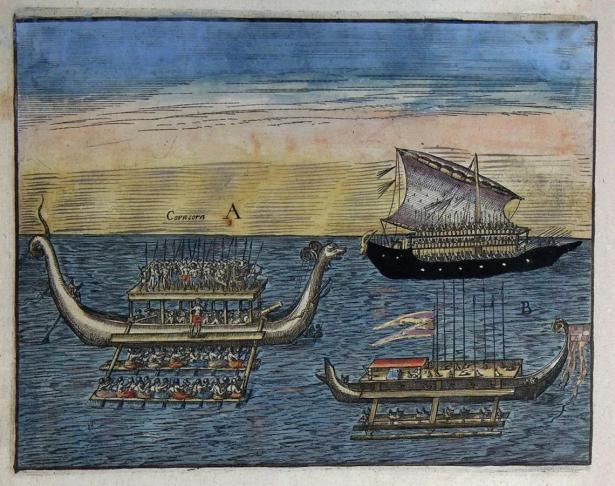
A plate from a volume of India Orientalis, circa 1598–1613 Wikimedia Commons
The main object of Portuguese flow control was the merchandise that had long moved freely across the Indian Ocean. The Persian, Gujarati, Vijayanagara, Bengali, Acehnese, and Omani merchants in these waters found themselves forced to pay transit fees to Portuguese customs administrators. Not unlike the US Treasury in its use of sanctions waivers today, Portugal arrogated to itself the right to determine how other nations could and could not trade with one another, issuing special licenses called cartazes permitting Indian Ocean transit. The major difference was that the Portuguese customs houses at Hormuz, Diu, Goa, and Malacca also served to generate income. As the historian Sanjay Subrahmanyam has described it, the cartaz system was initially “a means to channel Asian trade through Portuguese revenue-systems, and helped swell the customs-duties taken at these ports,” but over time it “also emerged as a politico-diplomatic instrument, which could be offered to Asian rulers in exchange for reciprocal privileges and concessions.” Portugal’s maritime dominance underpinned its flow control, and this in turn conferred commercial power in the Indian Ocean and beyond.
Hormuz was one the most valuable customs houses around the Indian Ocean. The English merchant and explorer Ralph Fitch observed in 1583 that the island was
the driest island in the world; for there is nothing growing in it but only salt; for their water, wood, and victuals and all things necessary come out of Persia, which is about 12 miles from thence…. In this town are merchants of all nations, and many Moors and Gentiles. Here is very great trade of all sorts of spices, drugs, silks, cloth of silk, fine tapestry of Persia, great store of pearls, which come from the isle of Bahrein, and are the best pearls of all others and many horses of Persia, which serve all India. They have a Moor to their King which is chosen and governed by the Portugals.
This Western domination of the Indian Ocean was deeply resented by Muslim merchants, who longed to restore the relative freedom of trade they had enjoyed prior to Albuquerque’s arrival. In the 1550s Ottoman fleets began to raid Portuguese ports in the region, and in 1566 a fleet of galleons bearing pepper from the Sultanate of Aceh on Sumatra used the protection of armed Ottoman galleys to bypass the cartaz system and reach the Red Sea. The emergence of an Islamic free-seas alliance marked the beginning of the end of Portugal’s selective closure of the Indian Ocean. Ever larger numbers of Islamic traders found ways to circumvent the European controls.
Persia’s regional power was restored by emperor Abbas, the fifth shah of the Safavid dynasty. Abbas sent diplomatic envoys to the Russian tsar and the kings of Poland and Spain to help him fight the Ottomans. But it was his alliance with England that allowed him to take to the offensive against the Portuguese, whom he evicted from Bahrain in 1602 and expelled from the port of Comorão in 1615 (renamed Bandar Abbas—“Port Abbas”—as a result). Finally, in 1622, four English warships helped Persia to retake Hormuz.
*
By this time other European merchants and imperial adventurers had begun to follow the Portuguese into Asia, seeking to break into the lucrative intra-Asian trade. The Dutch were the most aggressive of these maritime powers. In 1603 a vessel from their East India Company seized the treasure-laden Portuguese carrack Santa Catarina in the Singapore Strait.
This episode sparked a legal case that would produce the modern notion of freedom of the seas. Troubled by the violence with which the confiscation had occurred, the Dutch East India Company’s Mennonite shareholders sued the board in court. To defend itself, the company hired Hugo Grotius, a brilliant young humanist and budding lawyer. Grotius’s defense of the state-sponsored piracy of Portuguese goods rested on the argument that the sea and its fruits were the common property of mankind, and could never be “closed” by any one state. Grotius held it as legitimate to attack any nation that tried to maintain such an unjust “closed sea” (mare clausum) in violation of what he called mare liberum.
Three centuries later, Grotius came to be considered the father of international law; at the time, however, he was simply trying to justify Dutch commercial warfare against another European power. But issues of trade and navigation in peace and war were certainly at the center of the law of nations. From the seventeenth to the nineteenth century, the principle of mare liberum frequently clashed with the desire of powerful states to control all maritime traffic. In most wars the neutral countries would invoke freedom of the seas to protect their trade, while the belligerents would insist on their right to blockade all ships bound for enemy harbors, port cities, and coastlines. (No naval power was a more adamant blockader than Britain, which seized more than 35,000 enemy ships across fourteen wars fought between 1652 and 1815.)
Even if countries at war could be convinced to loosen their blockades to the benefit of international commerce, there remained the problem of critical waterways with two shores controlled by a single power. The Ottomans were forced to allow Russian ships through the Turkish Straits after they were defeated by Catherine the Great in the Russo–Turkish War of 1768–1774. But the sultan preserved his power to charge these vessels fees for transit permits (İzn-i sefînei); the same right of paid passage was later granted to vessels from Austria, Britain, and France before the treaty that ended the Russo–Turkish War of 1828–1829 opened the Black Sea to all vessels.
Of the countries in a position to engage in maritime gatekeeping, none clung to its old privilege longer than Denmark. In the seventeenth and eighteenth centuries, the Sound Dues funded as much as two thirds of the Danish budget, allowing the small kingdom to become a heavily armed absolutist state that could hold its own against much larger neighbors, such as Sweden. The Sound Dues came to an end in 1857 thanks to the United States, the Atlantic nautical power most committed to free navigation and neutral rights. American diplomats and jurists argued that the Sound Dues could not apply to their country because it had not yet existed when they were instituted; the United States would not pay tolls to which it had not consented. “The [Danish] tribute,” wrote one of them in 1837, “is oppressive in its operation, disgraceful in its character, and pleading no justice for its imposition but the power to enforce it at the early era in which it took its origin.” In exchange for a lump sum payment, the Danes abolished the Sound Dues; the US contribution was $393,011.
The second half of the nineteenth century was a golden age of international law. A new technique developed to stabilize great power rivalry was the regulation of international waterways through treaties. After its opening in 1869 the Suez Canal became a major new trade route between Asia and Europe, and by 1888 it was officially declared a neutral waterway in war and peace alike for all major powers.
The campaign to govern waterways by treaty ran up against imperialist designs, especially in the Western Hemisphere: when the Panama Canal was opened in 1914, it was accessible to international shipping but remained under the direct management of the United States government, which had acquired the land on either side as its sovereign territory, the Panama Canal Zone. Nonetheless, international treaties for maritime bottlenecks persisted in the interwar years. When the Ottoman Empire collapsed in 1922, the League of Nations took over management of the Turkish Straits, but this arrangement was temporary, as Turkey rapidly reasserted its sovereignty under Mustafa Kemal Ataturk. In 1936 an international convention restored Turkish sovereignty over the straits in exchange for their free and uninterrupted use by civilian and military vessels from all nations, subject to certain numerical and weight restrictions. This agreement has held up for ninety years and counting, a respectable duration compared to the shorter shelf life of some other elements of the rules-based international order.

A plate from a volume of India Orientalis, circa 1598–1613 Wikimedia Commons
Even in this era of relatively open seas, however, liberal maritime powers did not shy away from the use of coercion. In the nineteenth century Victorian Britain pioneered the protection of global sea lanes as a justification for its preeminence, even though the Royal Navy often restricted trade in the course of wars and diplomatic disputes. It also engaged in gunboat diplomacy against weaker states such as Greece and Argentina by imposing blockades without declaring war—so-called “pacific blockades.” As the saying went, when Britannia ruled the waves, it waived the rules.
*
The emergence of the United States as a global hegemon after World War II disrupted this state of affairs. The US has espoused the doctrine of freedom of navigation for most of its history, and since the 1940s the US Navy has backed up this commitment everywhere with unique credibility by conducting occasional “freedom of navigation” operations to check what it considers the excessive maritime claims of other countries. During the cold war, Washington undertook such cruises in the Taiwan Strait to contain Maoist China and, in the 1980s, in the Mediterranean to curb the power of Muammar Gaddafi’s Libya. Washington’s Asian and European allies have huddled under the umbrella opened by these displays of American naval power; their assumption has been that US administrations are prepared and able to protect the shipping routes vital to sustaining their economies and societies.
That belief has not always been borne out. The United States has been an inconsistent defender of free seas, and in the Western Hemisphere especially it has long claimed a wide latitude to intervene. A notable case occurred during the Cuban Missile Crisis in 1962, when Kennedy erected a US naval cordon around Cuba to prevent Soviet ships from reinforcing Moscow’s military presence on the island, but avoided calling this a blockade for fear that the Soviets would see it as an act of war. He instead used the euphemistic term “quarantine” to describe what was in effect the same policy. In 1982 the United States helped to draft the most important international legal treaty regulating maritime conduct, the United Nations Convention on the Law of the Sea (UNCLOS). But the Reagan administration wanted to retain its rights to claim parts of the ocean floor for deep-sea mining and never ratified the treaty, which would have required it to pay royalties for exploiting a part of the global commons.
The Trump administration has abandoned an already waning US interest in international law. Since December 2025 the US Navy has maintained a naval blockade against Venezuela to subjugate the government in Caracas. Following the abduction of Nicolás Maduro in January, this campaign has involved the seizure of Russian and Panamanian ships and has given Washington virtually complete flow control over the Venezuelan economy. It has also raised the economic pressure on Cuba, which has been put under an effective US naval and coast guard blockade since late January. Although a Russian tanker was recently allowed to discharge its fuel in Havana, Mexican and Colombian energy trade with Cuba has all but ground to a halt.
There is a striking regional discrepancy here: whereas the US is attacking freedom of the seas in the Caribbean, it claims to support it in the Arabian Sea. The issue for the US is not merely that this rhetoric exposes its hypocrisy but also that its actions jeopardize its role as a provider of maritime security. By blithely launching the Hormuz War and belittling its consequences for the majority of the world’s population that depends on maritime supply chains, the US has shown that it offers many fewer benefits to its allies than advertised.
The comparison with British power in the nineteenth century is instructive. Victorian Britain derived its authority from a unilateral commitment to free trade that lasted from the 1840s to the 1930s, maintained in the face of widespread protectionism by other states, including the United States, France, and Germany. Yet while cabinets in London kept their economy open, they did not have to uphold a worldwide system of alliances and security arrangements premised on untrammeled maritime access. As long as he keeps exercising command over the US global power structure, Trump—despite his disinterest in globalism—very much does.
At the same time, it is clear that Trump’s America has begun to shirk the provision of the global public goods that in the 1940s made the United States such a relatively attractive hegemon for a troubled, hostile, unsafe world. Instead of reciprocal free trade, a one-sided US tariff barrier now regulates access to the American market for all countries, including close allies. And in the place of reliable political backing, these allies have faced American interference in their domestic politics and even threats of military annexation, as Denmark has over Greenland. Together these reinforcing trends have led to the serious decay of the commercial, logistical, and diplomatic foundations of US hegemony.
The Persian Gulf Strait Authority, created by Iran in early May to run a tollbooth at Hormuz, does not, in other words, exist in isolation. It has to be understood in the wider setting of the ongoing onslaught against unfettered globalization—a backlash emanating in large part from advanced economies in the capitalist West, and preceding Trump’s latest depredations. Since 2016 both the Trump and Biden administrations have wielded tariffs and sanctions, ramping up export controls against China, while the retaliatory Chinese rare earths restrictions have added further uncertainty. Even the European Union, usually a stalwart free-trader, recently imposed tariffs on Chinese cars as its market is flooded with imports.
Some of these restraints on free exchange may well be warranted for domestic political reasons. Certain sectors cannot be abandoned to private-sector offshoring, and industrial policy has been an important catalyst of development across economic history. What is deleterious to global stability is the pell-mell, haphazard way in which these instruments are being used. Rich economies are justifying economic coercion with alarmist rhetoric and blanket invocations of national security, offering no sense of what guardrails, if any, they might respect. Under these conditions, international trust and constructive global governance are nearly impossible.
Iran’s Persian Gulf Strait Authority would institute a unilateral tax on a global public good. But in material terms its cost would be quite marginal compared to that of the growing bundle of sanctions, export controls, import duties, and other burdens that Western states have heaped on commercial transactions. It is hard to argue that a 1 or 2 percent Iranian tariff on energy exports is intolerable when the United States levies, on average, an 11 percent tariff on all its trading partners, with rates rising to 25 or even 50 percent on specific goods such as steel, aluminum, and cars. Over the course of 2025 this tollbooth for entry to the US market brought in $287 billion in federal revenues—a substantial economic rent paid to the world’s consumer of last resort.
*
Despite the West’s deep history of mercantilism, this reversal from the more recent, liberal form of globalization is disorienting. Political and economic openness are no longer as neatly aligned as they once seemed in the Western imagination. There are still many free societies that are also open in their economic posture: Japan, South Korea, Australia, New Zealand, Brazil, and South Africa, among others. Yet on both sides of the Atlantic, democracies such as the United States, Canada, Mexico, and the member states of the European Union are bolting down their economies against foreign threats. At the same time, a broad and multifarious group of authoritarian states and postliberal democracies across Eurasia—including Turkey, the Gulf monarchies, Iran, India, Pakistan, the Central Asian republics, Russia, Indonesia, Vietnam, and China—are forging new networks of exchange outside the reach of Western economic pressure. As Western democracies deepen their protectionist turn and postliberal Eurasian states create their own variety of globalism, they will exert countervailing pressures on the large group of Latin American, African, and Asian states caught in the middle.
The principle of free seas was always loftier than the imperial realities it justified, but we should be wary of equating the past origins of a practice to its present value. Mare liberum is a principle to which any international order worth its name should aspire. It offers real benefits to smaller and weaker states, to migrants and the countries that are sustained by them, and to those who need to move to survive—in other words, to most of the world’s population.
The problem is that open seas have always been maintained by some great preponderance of military power. Such singular might is inherently unstable, liable to be abused, and generates challengers. On top of this, the dominant power needs to be durably committed to policing the oceans and critical waterways. In both these domains, ability and will, the Hormuz War has been especially corrosive to US hegemony. For one thing, there is no obvious and easy military way to reopen the strait short of a massive amphibious assault against Iran and a permanent occupation of the country. Drone and missile technology have given a whole new tier of states and non-state actors the ability to impose lasting damage on global trade. The US blockade, which has now entered its second month, seems unlikely to succeed in its goal of forcing the capitulation of a regime that has withstood many years of sanctions and prior collapses in oil exports. Well-worn methods of evasion and substitution will likely cushion the damage for a considerable time.
Yet even if a straightforward military method to regain Hormuz were at hand, a deeper trend finds its expression in Trump’s insouciance about global trade: the United States has ceased to be a great trading state, as it still was in the nineteenth and twentieth centuries. In the centuries of European mercantilism, states expanded their navies because of the perceived need to protect their own merchant marine. The spread of liberalism reduced this nationalist anxiety about defense, as one dominant country henceforth provided security for all seaborne traders. But over time the domestic foundations of the commitment withered away, with the decay of American industry leaving its naval power without much of its material raison d’être. There are only 188 US-flagged merchant vessels of more than 1,000 gross registered tons in size; by contrast, China operates roughly 5,500 cargo vessels in that category and has a fleet of some 57,000 industrial fishing vessels roaming the world’s seas. As the French historian Arnaud Orain has pointed out, the United States is the first empire in history that is a dominant naval power but has ceased to be a maritime power of any significance.
In the long autumn of US hegemony, global interdependence will certainly survive. But there will no longer be a unified Western political community in charge of its direction. This should not come as a surprise, nor need it be a cause for dread. Eurasian commerce along the Silk Roads was a cosmopolitan and unifying force across culturally and politically diverse states for many centuries before the arrival of modern liberalism. The unusual preeminence of Western power that marked the nineteenth and twentieth century helped obscure the fact that, throughout recorded history, Eurasia has been the most consistently dominant region in globalization.
When we speak of economic globalization today, what we are talking about is pan-Eurasian exchange. In 2025 roughly 87 percent of global container trade entered or left Asian ports and waters. Taken together, Europe and Asia are home to 81 percent of all trade-driven employment in the world and account for three quarters of global maritime trade. The real question is not whether this world will be connected or siloed but what admixture of laissez-faire and interventionism its participants will adopt, and how they will balance the benefits of open access against the temptation to control its flows.