Thursday, July 09, 2026


NATO's new €70bn Ukraine pledge repackages aid already promised

Nato's new €70bn Ukraine pledge repackages aid already promised
Alliance headline figure for 2026 largely bundles existing bilateral commitments and an EU loan, with the US absent from the funding / bne IntelliNewsFacebook
By Ben Aris in Berlin July 9, 2026

Nato pledged to provide Ukraine with €70bn ($80bn) in military equipment, assistance and training this year during the Ankara Nato summit on July 8, with a commitment to match that sum in 2027 — but little of the money is new.

The pledge was set out in a joint declaration issued at the close of the alliance's summit, adopted by consensus by all 32 member states.

"For 2026, Allies pledge €70bn in military equipment, assistance and training for Ukraine and affirm their sovereign commitments to sustaining at least equivalent levels in 2027," the statement read.

The first tranche of the EU’s €90bn loan for Ukraine of €3.2bn was received earlier this month and $15bn in international financial assistance in June. That has boosted its international reserves to a comfortable $51.3bn, solidifying Kyiv’s finances for the rest of this year. Since the start of the war the EU has sent a total of €215bn in budget and military support to Ukraine.

"A significant part of these funds is aimed at replenishing reserves, which made it possible to resume their growth," the NBU reported.

But behind the headline number, little of the €70bn package is new. Most of it consists of commitments already made rather than fresh cash. Of the total, €30bn is part of the €90bn loan agreed in December that was already earmarked for Ukrainian defence spending. The remaining €40bn is to be met through bilateral support from other allies, and largely reflects pledges first made at Nato's 2024 summit in Washington, according to Reuters and other reports.

That means almost none of the announced €70bn is new money. Current EU and bilateral commitments fall short of the mark, leaving Ukraine’s funding in 2027 and beyond in doubt.

Recycling previously made pledges matters because the two-year total of roughly €140bn is not expected to be covered in full by existing programmes. The €50bn shortfall from estimated needs for the next two year Ukrainian budget was two thirds covered by December’s €90bn loan but it was always intended to raise the missing money from the other non-European members of the G7. Those countries have yet to commit to making more funding available for Ukraine.

The joint statement did add some clarity to exactly which country has committed to how much. The US has sent no money to Ukraine since US President Donald Trump took over and will not participate in this latest funding pledge either. That has left Europe, Canada and Japan to shoulder the lion’s share of the burden. The declaration's denomination of aid priced in euros rather than dollars was read in Ankara as a deliberate signal that Washington remains out of the game, despite Trump’s promise to grant Ukraine a license to make Patriot missiles.

The statement  said that European allies and Canada, "now finance the vast majority of security assistance to Ukraine through bilateral and multilateral means." Support must be "equitable, predictable, and sustainable in the long-term."

What new money there is, is increasingly channelled into hardware and, above all, air defence — the overriding theme of this year’s Nato summit. Ukrainian President Volodymyr Zelenskiy spent all his time in Turkey shuttling between nearly 20 bilateral meetings, trying to scrounge up more interceptor ammo to counter Russia’s relentless missile and drone attacks.

During the two-day event, Russian missile strikes on Kyiv killed at least three people and wounded 14, underscoring Zelenskiy's case for more interceptors. As IntelliNews reported, while Ukraine has mounted a spectacular and effective long-range drone campaign against Russia’s oil refineries that has caused a country-wide fuel crisis, in the drones vs missiles arms race, Russia has the overwhelming advantage. As Ukraine runs desperately low on interceptor missiles, Ukraine’s skies are once again open to Russian missile attacks. On the last day of the summit, Russia launched 29 missiles against Ukraine and all of them got through to hit their targets, according to local reports.

Appearing alongside Zelenskiy, in addition to announcing the Patriot licence Trump said the mega drones-for-weapons deal suggested by Zelenskiy last year will go ahead. The Ukrainian president said he has already secured fresh agreements with Estonia, the Netherlands and Denmark, with further drone deals expected with Germany, Norway, Finland and Canada. He also thanked South Korean President Lee Jae Myung for a $100mn support package and hailed Italy for "always [helping] in a principled way to protect life." Additional US weapons are expected to reach Ukraine indirectly, bought by European states under the Prioritised Ukraine Requirements List (PURL) scheme.

One of the main take outs from the Ankara summit is that increasingly Ukraine is being seen by the White House as a contributor to transatlantic security rather than merely a recipient of it. The 32 Nato leaders repeated they "stand united in our unwavering support for Ukraine in defending its freedom, sovereignty, and territorial integrity," in the statement. It retained wording from previous years describing Russia as a "long-term" threat to Euro-Atlantic security, more than four years after its full-scale invasion.

Europe boosts spending, but fiscal space tightening 

In addition to funding for Ukraine, much of the discussion in the Turkish capital was also given over to the allies' own defence spending. At last year’s Nato summit in the Hague the European Nato members promised to increase their defence spending from under 2% to 5% of GDP by 2035, although most of them will struggle to hit that target.

European allies and Canada have increased their core defence investment by more than $139bn in 2025, with some members expected to hit the goal well ahead of schedule. Poland and the Baltic states are already spending just under 5% of GDP and all the other members have now crossed the Welsh summit threshold of 2% of GDP. The alliance also announced "more than $50bn in new procurements," pledging to expand collective manufacturing capacity, with planned investment spanning integrated air and missile defence, deep-precision strike, uncrewed systems and a shared transatlantic military cloud. Rutte said Europe would be able to manufacture 4mn shells in 2026, after it failed to meet a pledge to make one million shells for Ukraine in 2023.

The summit ran alongside allied disputes over defence spending and the fallout from the recent conflict between the US and Iran — tensions. 

An increasingly dysfunctional European economy is finding it harder and harder to find enough funds for Ukraine. Dutch Prime Minister Rob Jetten said this week that the Netherlands had run out of money for Ukraine. As IntelliNews reported, as Russia continues to fund its war effort with cash earned from oil exports, and increasingly Europe is finding it support with debt, European governments are starting to run out of fiscal space as the cost of borrowing inextricably rises.

Finnish Defence Minister Antti Hakkanen also told the Kyiv Independent that Finland was reaching the limits of what it could provide from its military stockpiles after more than four years of supporting Ukraine.

"Of course, I think that there's two pillars: what can you give from stocks or from industry, and how much can you give financial aid," Hakkanen said on the sidelines of the summit. "We already also have challenges to give from stocks anymore."

At the same time, after Trump’s withdrawal of support last year, Europe has struggled to offset the end of US military funding and year-on-year weapons deliveries to Ukraine fell for the first time last year, since the war started.

The meeting’s key quote came not from Trump, but from US Secretary of State Marco Rubio, who suggested that Washington is counting on Ukraine negotiating with Russia from a position of strength, rather than relying on plans stemming from the Trump-Putin Alaska summit last August, which has defined the negotiations until now.

"We are currently engaged in a dialogue that takes into account Ukraine's capability to strike deep inside Russia, aren't we?" he said. "I think that is precisely the dynamic that has changed the picture of the war in recent months. Russia is finding it difficult to defend even its own airspace. But we hope this will create an opportunity for negotiations to end this war."

Based on signals given by Bankova and reports of ongoing backchannel talks between the US and Russia, analysts speculate a formal attempt to restart ceasefire talks may be launched in August.


Western funding for Ukraine

Facility

Size

Period

What it is / pays for

Ukraine Support Loan newest

€90bn

2026–27

New EU loan agreed April 2026. Split €60bn military / €30bn budget. Repaid only if Russia pays reparations. €7bn out so far.

Ukraine Facility

€50bn

2024–27

EU recovery, reconstruction & reform fund, tied to conditions. €42bn mobilised; €24bn paid into the budget.

G7 ERA loans

$50bn

2024–onward

Extraordinary Revenue Acceleration — loans repaid from interest on frozen Russian assets, not the assets themselves. $35bn delivered; EU share €18.1bn now fully disbursed.

NATO Ankara pledge

€70bn/yr

2026 (+2027)

Military equipment, training & assistance. Mostly repackages existing bilateral aid + the EU loan. US not contributing; 31 allies carry it.

Reparations loan stalled

up to €210bn

proposed

The Commission plans to tap the frozen Russian assets themselves. Blocked by Belgium over legal risk; unresolved.

IMF Extended Fund Facility

$8bn

2026–29

New IMF programme underpinning macro-financial stability, unlocked once the EU loan secured Ukraine's financing path.

Reconstruction need gap

€197bn

post-war

Estimated cost to rebuild Ukraine. The EU has budgeted only €89bn — leaving a €108bn hole, separate from war-fighting needs (bne IntelliNews).

Sources: European Council/Commission, G7, IMF, NATO Ankara declaration. Figures rounded and current to mid-2026; disbursed amounts change month to month. The frozen-asset facilities (ERA, reparations loan) rely on €193bn of Russian assets immobilised at Euroclear in Belgium.


Trump offers Ukraine Patriot production licence in major policy about-face

Trump offers Ukraine Patriot production licence in major policy about-face
US President Trump has done an about face on Ukraine and offered Zelenskiy significant support in his war with Russia, including the right to make desperately needed Patriot missiles. / bne IntelliNewsFacebook
By Ben Aris in Berlin July 8, 2026

After being distracted by the Iran war and cutting off Ukraine’s financial and military aid, US President Donald Trump is back in the Ukraine peace game. In a major policy U-turn, the Trump administration has promised to give Kyiv a licence to make its own desperately needed Patriot missile weapons to fend off Russia’s relentless missile attacks that are destroying the country, Trump said during a press conference at the Ankara Nato summit on July 8.

Trump also did an about face on a mooted drone deal. Ukrainian President Volodymyr Zelenskiy offered Washington a $50bn mega drones-for-weapons deal last year but was rebuffed by Trump who dismissively said “We don’t need any help” at the time. However, after being pounded by Iran’s drones in the first month of the Gulf war it seems that the White House has woken up to Kyiv’s prowess at drone warfare. Now Trump says he wants to buy Ukrainian-made drones, signalling a clear shift in his administration's approach as the US becomes actively involved again in trying to revive peace negotiations with Russia that collapsed in March.

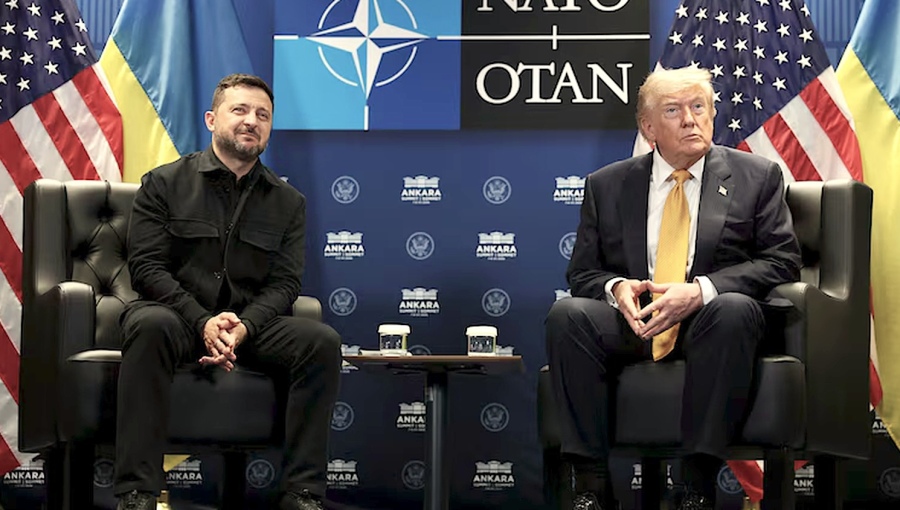
Trump made the twin announcements sitting alongside Zelenskiy at the Nato summit, in what has been described as their “warmest” meeting to date and stands in stark contrast to Trump's confrontational Oval Office meeting with the president of Ukraine last February, when he famously told the Ukrainian leader that he had "no cards". This time round, Trump repeatedly praised Ukraine's technological innovation, described its drone industry as "an amazing ability" and suggested Kyiv had become a defence-industrial “partner” rather than simply an impoverished cousin looking for handouts.

Patriot production

The headline announcement came when Trump confirmed that the US was considering allowing Ukraine to manufacture Patriot interceptors itself, addressing one of Kyiv's most pressing military problems as Russian missile and drone attacks intensify.

Much has been made of Ukraine’s rapid development of drones, but in the drones vs missiles arms race, Russia still has the overwhelming advantage. Ukraine has repeatedly warned that supplies of Patriot interceptor missiles are critically constrained, while US production capacity remains constrained and after the Iran war the backlog in orders has stretched into years. With winter looming, it is widely assumed that Russian President Vladimir Putin will again use his advantage in missile production to try and freeze Ukraine into submission by repeating last winter’s missile attacks on what remains of Ukraine’s power sector. Pre-war Ukraine had just under 60GW of generating capacity. Now it has 10GW left and some regions have already been forced to introduce rolling blackouts during this summer’s heatwave. Kyiv’s skies are open again forcing thousands of residents to shelter in the metro system each night.

"We're going to give a licence to you to make Patriots," Trump said. "Make them yourself."

Trump said Washington would work with the manufacturer to transfer production know-how, adding that Ukrainian engineers possessed the expertise to master the complex system quickly.

"Most countries couldn't do that," Trump said. "This is a very ingenious group."

Calling Patriot "the best" air-defence system in the world, Trump stressed that he preferred defensive weapons to offensive ones but acknowledged the US itself had limited stocks.

"We have Patriots, but we don't have that many. We need them for ourselves too," he said.

If implemented, licensed production would represent one of the most significant transfers of advanced US military technology to Ukraine since Russia's full-scale invasion.

From weapons aid to industrial partnership

Trump also confirmed that Washington wants to purchase Ukrainian drones in another major volte-face. He embraced an idea Zelenskiy floated last year when he proposed a large-scale drones-for-weapons industrial partnership that the White House showed little interest in pursuing.

"We would buy their drones," Trump said. "They have an ability to make a lot of them... It's an amazing ability. In a war situation, they make them in basements. They make them wherever the hell you have a little shelter."

The remarks reflected growing recognition in Washington that Ukraine has become one of the world's leading innovators in low-cost military drone production after more than four years of war in the asymmetrical war that has now become the norm since Russia invaded Ukraine.

Rather than simply supplying weapons to Ukraine, in contrast to the Biden administration, the Trump administration has launched a new direction where it is willing to exchange technology with Kyiv, licensing advanced American air-defence systems while seeking to acquire Ukrainian expertise in mass-produced unmanned systems. This is a significant promotion for Kyiv in its foreign relations standing with the White House.

Putin wants peace

Underlying his changes is an apparent change in attitude by the Trump administration in its assessment of Ukraine’s chances of defeating Russia. Following Trump’s tête-à-tête with Putin at the Alaska summit last August, Trump aggressively promoted Putin’s demands culminating in his “final offer” proposal at a London summit. Trump demanded Zelenskiy accept most of Putin’s demands, which Zelenskiy refused in his counteroffer that started with a call for an unconditional ceasefire before talks could begin. Eventually negotiations started in Riyadh last February, brokered by the US, but went nowhere. That process culminated in the Moscow meeting on December 3 where a 27-point peace plan (27PPP) was thrashed out that Putin said was “almost acceptable.” In parallel, it emerged that Trump had brokered the so-called Dmitriev package of business deals with Russia worth a reported $12 trillion – around five-times more valuable than the entire Russian economy.

Trump seems to have abandoned this mercantile approach to the Ukraine war entirely and is now offering real long-term support to Bankova to keep it in the war as Putin comes under increasing pressure thanks to Ukraine's more aggressive drone attacks on Russian oil refineries. Trump also struck a markedly more optimistic tone on diplomacy than in previous months, insisting that both Vladimir Putin and Zelenskiy now wanted to end the conflict. He spoke to both presidents by phone on the eve of the Nato summit.

"I think he wants to make a deal," Trump said of the Russian president. "I know when people want to make a deal... I think he wants to make a deal."

Asked why he believed Putin was serious, Trump replied simply: "Because I talk to him."

He also acknowledged that Moscow was under increasing strain.

"There's a lot of pressure on President Putin to get it done," Trump said. "I don't think he likes what's going on."

As IntelliNews reported, tensions in the Kremlin are rising between the Kremlin’s doves and the hawks, who both want the conflict to end as the economy comes under increasing pressure, but can’t agree on how to end it: the doves want to declare victory now and stop; the hawks want to call a general mobilisation in the autumn, flood Ukraine with soldiers and rapidly capture the rest of the Donbas.

Trump nevertheless cautioned that wars often become most dangerous immediately before negotiations begin.

"Sometimes you have two kids in a park and they don't like each other and they start fighting," he said. "Sometimes you have to let them fight."

He estimated that around 25,000 Russian soldiers died last month and 35,000 the month before, "more Russians", describing the conflict as "brutal".

Reality on the battlefield

Trump's optimism came against a complex military backdrop. In the run up to the Nato summit, Ukraine’s backers have been guilty of threat escalation, suggesting that Russia is getting ready to attack Poland and the Baltics. At the same time they hype the slowdown of Russia’s advances and have talked of the conflict reaching a “turning point”.

The reality on the battlefield paints a different picture. Russian forces appear close to consolidating control over Kostiantynivka, one of the three key towns in Ukraine's Donbas "fortress belt" and an important step towards Putin’s stated war goal of capturing the remainder of the Donetsk region. Ukrainian troops are reported still to hold isolated positions inside the city, but several analysts believe Russia has effectively established control over most of the urban area while preparing to push towards Druzhkivka, Sloviansk and Kramatorsk – the last holdouts in the fortress belt.

Journalist and military analyst Leonid Ragozin argues that the apparent capture of Kostiantynivka demonstrates that Russia continues to make "slow but steady" territorial gains despite Ukraine's increasingly successful long-range strike campaign against Russian refineries and logistics. Mark Galeotti, the CEO of Mayak Intelligence, argues that this is why Putin remains on the fence between the doves and the hawks as the military situation could still swing either way.

Most tellingly, former Ukrainian commander-in-chief Valerii Zaluzhnyi cautioned against drawing simplistic conclusions from either side's battlefield successes and not to assume that Russia has lost the war.

"Modern warfare no longer rewards tactical victories in the way it once did," he wrote this week in an op-ed for the Telegraph. The war, he argued, had become one of "mutual denial rather than decisive victory", with success increasingly determined by industrial production, logistics, drone warfare and societal resilience rather than movements of the front line.

Zaluzhnyi has bucked the trend and undermined Bankova’s rhetoric before when he gave a controversial interview to the western press saying that the war had reached a stalemate after the AFU’s failed summer offensive in 2023. Those comments brought down a storm of protest and denials from Bankova and led to a personal clash between the president and the highly popular general. Zelenskiy later sacked Zaluzhnyi, who is now his main political rival and likely to defeat Zelenskiy in mooted elections this autumn. As it turned out, Zaluzhnyi was right about the war being stalemated.

Instead of being close to a Russian collapse, Trump seems to think that the war is in another stalemate. Questioned about Ukraine's increasingly effective strikes deep inside Russia, Trump acknowledged that "Russians are finding it more difficult to defend their own airspace", while Secretary of State Marco Rubio argued that the campaign had "changed the dynamics" of the conflict and could help create conditions for negotiations. European leaders are almost universally spinning Ukraine’s position as being one of strength and calling for an “increase in pressure” on Russia to bring Putin to the negotiating table and offer better terms.

Zelenskiy arrived in Ankara visibly a lot more confident than he had been for much of the last four years and argued that Ukraine had seized the technological initiative.

"We are trying to move this war to the sky from the battlefield," he said. "We found another way... to cut their logistics for their army," he said of the highly successful campaign to use Ukraine’s new medium-range drones to attack Russia’s supply lines behind the frontlines.

Security guarantees

The Trump administration seems to have abandoned the 27PPP as a formula to end the conflict and is going back to basics if ceasefire talks resume this summer. The biggest obstacle to any settlement remains coming up with a real security deal. Trump acknowledged that Ukraine would require assurances that Russia would not simply resume the war after any ceasefire is struck.

"We're going to work on some kind of a security package," he said. "I think if we make a deal, Russia is going to be very happy... I don't see it happening again."

In keeping with America’s new National Security Strategy (NSS) introduced in December, Europe, he suggested, would play the principal role, with the US supporting whatever arrangement emerged.

Zelenskiy has consistently argued that credible Western security guarantees are essential if Kyiv is to contemplate any territorial compromise in negotiations with Moscow. Zelenskiy can’t give up any Donbas territory – a key sticking point in the talks with Moscow – unless he can be sure Russia won’t simply reinvade a few years later. That means one of Nato membership, joining the EU and cover from the European’s Article 42/7 collective security guarantee, or at the very least, strong bilateral security deals with the US and leading EU nations. None of these have been forthcoming so a US offer to provide a real deal would be a breakthrough.

Asked whether peace talks could take place in Moscow, Trump said Putin had suggested the Russian capital as a venue.

"I said you're not going to meet in Moscow," Trump recalled.

Zelenskiy has already rejected a Moscow meeting on December 3, countering with a suggestion that Putin comes to Kyiv for talks. During the press conference with Trump he played down the idea of a Moscow meeting again with a wry comment: "It's difficult. There are a lot of Ukrainian drones there. It's dangerous."

Whether Trump's renewed optimism proves justified remains uncertain. But his remarks suggested a White House that increasingly sees the war not simply as a contest of territory, but as one of industrial capacity, technological innovation and endurance—an assessment that increasingly resembles Kyiv's own view of how the conflict is evolving.

More funding for Ukraine

The Ankara summit also delivered a second important win for Kyiv. Nato Secretary General Mark Rutte said allies had pledged €70bn ($80bn) in military assistance for Ukraine in 2026, with a commitment to maintain at least equivalent support in 2027.

The pledge is not an EU budget line but a commitment by individual Nato members, many of which are already struggling to reconcile support for Ukraine with rising domestic defence bills and weak public finances. Its significance is therefore political as much as military: after months of doubts over whether Europe could sustain the war effort, allies have again promised to keep Ukraine funded.

The new package comes on top of the €90bn EU loan agreed in December and covers an expected shortfall this year due to higher than expected military spending.

Even so, the burden is becoming harder to carry in an increasingly dysfunctional European economy. Several governments are warning that they are running out of fiscal space, while calls for higher Nato defence spending are competing with the cost of supporting Kyiv. For example, on the same day as the press conference, the government of the Netherlands announced it has run out of money to support Ukraine. At the same time the EU has just cut its long-term 2028-2034 funding for Ukraine in its next Multiannual Financial Framework (MFF) budget plan due to the growing lack of cash.

For Ukraine, however, the commitment would help cover part of this year’s expected military financing gap and strengthen Zelenskiy’s position as he argues that Russia can still be forced into serious negotiations.

US To Let Ukraine Build Own Patriot Missiles, Trump Says


Patriot missiles. Photo Credit: NATO

July 9, 2026 
EurActiv
By Kjeld Neubert


Key Takeaways

Trump Approves Ukraine Producing Patriot Missiles — The US will grant a license allowing Ukraine to manufacture its own Patriot air defense systems to address critical shortages.

Response to Ukraine’s Urgent Needs — Zelenskyy has long requested more Patriots to counter Russian ballistic missile attacks, as allied stockpiles are depleted and production cannot keep up with demand.

Practical Next Steps — A US team is expected to travel to Ukraine to help transfer the technology, with Trump expressing confidence that manufacturers Raytheon and Lockheed Martin will support the move.


(EurActiv) — US President Donald Trump said on Wednesday that Washington will allow Ukraine to build their own Patriot missiles for its air defence.

Over the last year, Ukraine’s President Volodymyr Zelenskyy has been asking his allies for more of these missiles as they are crucial to defend against Russia’s air attacks.


“A little birdie told me this, about the fact that we’ll give them the right to make Patriots,” Trump said during a joint press event with Zelenskyy at the NATO summit in Ankara. “We are going to give a license to you to make Patriots.”

“This way, you can’t complain that we’re not giving them enough,” Trump added.

The US and allies’ stockpiles of such interceptors were rapidly shrinking when the US and Iran launched their operation against Iran. American stocks depleted fast during the first six weeks of the conflict as Iran attacked neighbours and Western bases throughout the Middle East.

“Today’s wars have shown that current Patriot production is not enough to meet the growing demand for protection against ballistic missiles,” Zelenskyy said on Tuesday, stressing that Ukraine is very much self-reliant in its current defence against Russia, except for anti-ballistic missile systems.

In the joint presser with his Ukrainian counterpart, Trump admitted that he has not informed the companies that produce these missiles – US weapon manufacturers Raytheon and Lockheed Martin – yet.

“But that’ll work out alright,” he said. “I am sure they will be thrilled.”

The US president projected that a team will soon travel to Ukraine in order to show the country’s industry how to build the Patriot missiles themselves.

Kyiv has received multiple Patriot batteries from the US and European allies but arsenals are wearing thin and ammunition donations are becoming rarer at a time when Russia is increasing its attacks with ballistic missiles.

Some international orders of the system have also been pushed back, with Switzerland now considering buying a European alternative instead.


About EurActiv
EurActiv publishes free, independent policy news and facilitates open policy debates in 12 languages.
View all posts by EurActiv →

NATO’s Ankara Summit: The Rearmament Drive And The Critical Minerals Impasse – OpEd

NATO Commits to Major Rearmament — At the 2026 Ankara Summit, the Alliance is pushing forward with the goal of raising defense spending to 5% of GDP by 2035, backed by new procurement contracts and industrial efforts.

Critical Minerals Are the New Bottleneck — China dominates 60–90% of the supply or refining of most of NATO’s 12 critical raw materials needed for defense (lithium, cobalt, rare earths, etc.), creating a major strategic vulnerability.

New Initiative Launched for Supply Security — NATO announced a “High-Visibility Project” involving 12 allies (plus partners like Australia and Japan) to secure procurement, stockpiling, and management of these minerals, aiming to reduce dependence on Beijing.


Ankara’s long-neglected avenues were overnight transformed into smooth asphalt roads for diplomatic guests. Unsightly views along potential protocol routes were concealed behind large canvases. For two days, city residents were left suffocated by overwhelming security measures. Media channels once again chose to focus on the window-dressing: for days, the public agenda was occupied by which park would be closed for the morning jog of French President Emmanuel Macron, who never took off his sunglasses throughout the summit. Headlines were dominated by photographs of Donald Trump presenting an intimate front with President ErdoÄŸan, while experiencing visible friction with Spanish Prime Minister Pedro Sánchez and Italian Prime Minister Giorgia Meloni.

Yet, behind the political theater projected onto screens lay the highly austere agenda of the 36th NATO Summit, held on July 7–8, 2026. Attended fully at the level of heads of state and government from 32 member countries—with Australia, Japan, South Korea, New Zealand, Ukraine, and the European Union also at the table—the summit represented a critical threshold for the Western bloc’s military power projection.

From The Hague to Ankara: The 5% Pledge and Rearmament Momentum

The core axis of the meetings in Ankara was anchored in the radical decision made at the North Atlantic Council in The Hague in June 2025: Alliance members pledged to raise their defense expenditures to 5% of their GDP by 2035. Driven further by the pressure of the Trump administration, the Ankara Summit turned into a platform where operational steps for this massive rearmament drive were taken, military-industrial capacities were showcased, and billion-dollar defense procurement contracts were signed.

However, this aggressive budget expansion and rearmament momentum simultaneously harbor a deep structural vulnerability. In today’s world, having massive defense budgets yields no meaning if your adversaries on the field control your industry’s supply chains. Indeed, NATO’s push to augment its defense capacity is hitting a critical raw materials bottleneck carefully managed and increasingly restricted by Beijing. To expand its defense capabilities, the Western military-industrial complex is currently more dependent on China than ever before in history.

A Predictable Crisis: The 12 Critical Minerals

On the other hand, this structural dependence is by no means a sudden surprise for the Alliance. In June 2024, NATO Defense Ministers approved the “Critical Supply Chain Security Roadmap for the Defense Sector,” mandating that allies build strategic raw material stockpiles, enhance recycling capabilities, and investigate alternative material substitutions. Subsequently, on December 11, 2024, NATO published an official list of 12 critical raw materials, including aluminum, cobalt, graphite, lithium, and rare earth elements. These minerals constitute the fundamental inputs for the Western bloc’s defense industry, spanning from ammunition production to missile navigation systems, aerospace fuselages, and advanced radar technologies.

However, China holds a crushing market share ranging from 60% to 90% in either the mining production or refining processes of at least 10 of these 12 critical minerals defined as vital by NATO; in some, it enjoys an absolute monopoly. Furthermore, Beijing’s share increases year by year, consequently heightening the risk for NATO.

Beijing has proven repeatedly in recent years that it can use this monopoly over critical minerals not merely as a commercial advantage, but directly as a coercive foreign policy instrument. Through export restrictions, China possesses the leverage to slow down or entirely paralyze NATO’s rearmament drive.

The Ankara Initiative: A New Project for Critical Mineral Security


Recognizing that supply security equates directly to military sovereignty, NATO Secretary General Mark Rutte announced during the Ankara Summit the launch of a new “High-Visibility Project” focusing on critical raw materials for defense. Bringing together 12 allies—including Belgium, Canada, Denmark, Finland, Greece, Italy, Luxembourg, the Netherlands, Norway, Spain, Sweden, and Türkiye—this initiative will focus on the procurement, stockpiling, transportation, and management of critical raw materials required for the defense industry.


While the absence of certain “Eastern Flank” members with notable mineral reserves, such as Poland, Romania or Czechia, is an eye-catching omission, the presence of the “Asia-Pacific Four” (Australia, Japan, South Korea, New Zealand) and critical mineral-rich Ukraine in Ankara reflects the West’s resolve to forge an alliance aimed at breaking the Chinese monopoly.

In conclusion, in this new era where global power competition is evolving from conventional deterrence into an industrial and technological war of attrition, military power can no longer be measured solely by the size of allocated financial budgets. Unless the security of critical mineral supply chains is guaranteed, NATO’s multi-billion-dollar rearmament drive will remain a vision built on sand. Consequently, critical mineral supply security will inevitably be one of the top priorities of every subsequent NATO summit.


About Dr. Nejat Tamzok
Dr. Nejat Tamzok received his bachelor's and master's degrees in Mining Engineering from the Middle East Technical University, and his doctorate degree in Political Science and Public Administration from the Ankara University. He also graduated from the Anadolu University Department of History. He has worked at the Turkish Coal Enterprises since 1985, where he has held the positions of Planning Director and Strategic Planning Coordinator. He has participated in the construction of numerous engineering projects throughout his career. He also served as the Editor-in-Chief of the Scientific Mining Journal, a peer-reviewed publication of the Chamber of Mining Engineers of Turkey, from 2016 to 2023. Dr. Tamzok is a member of the Chamber of Mining Engineers of Turkey, the Turkish National Committee of the World Mining Congress, the Turkish National Committee of the World Energy Council, and the Middle East Technical University Alumni Association.
View all posts by Dr. Nejat Tamzok →


What is GlobalEye, the Swedish aircraft set to become NATO’s new ‘eyes in the sky’?

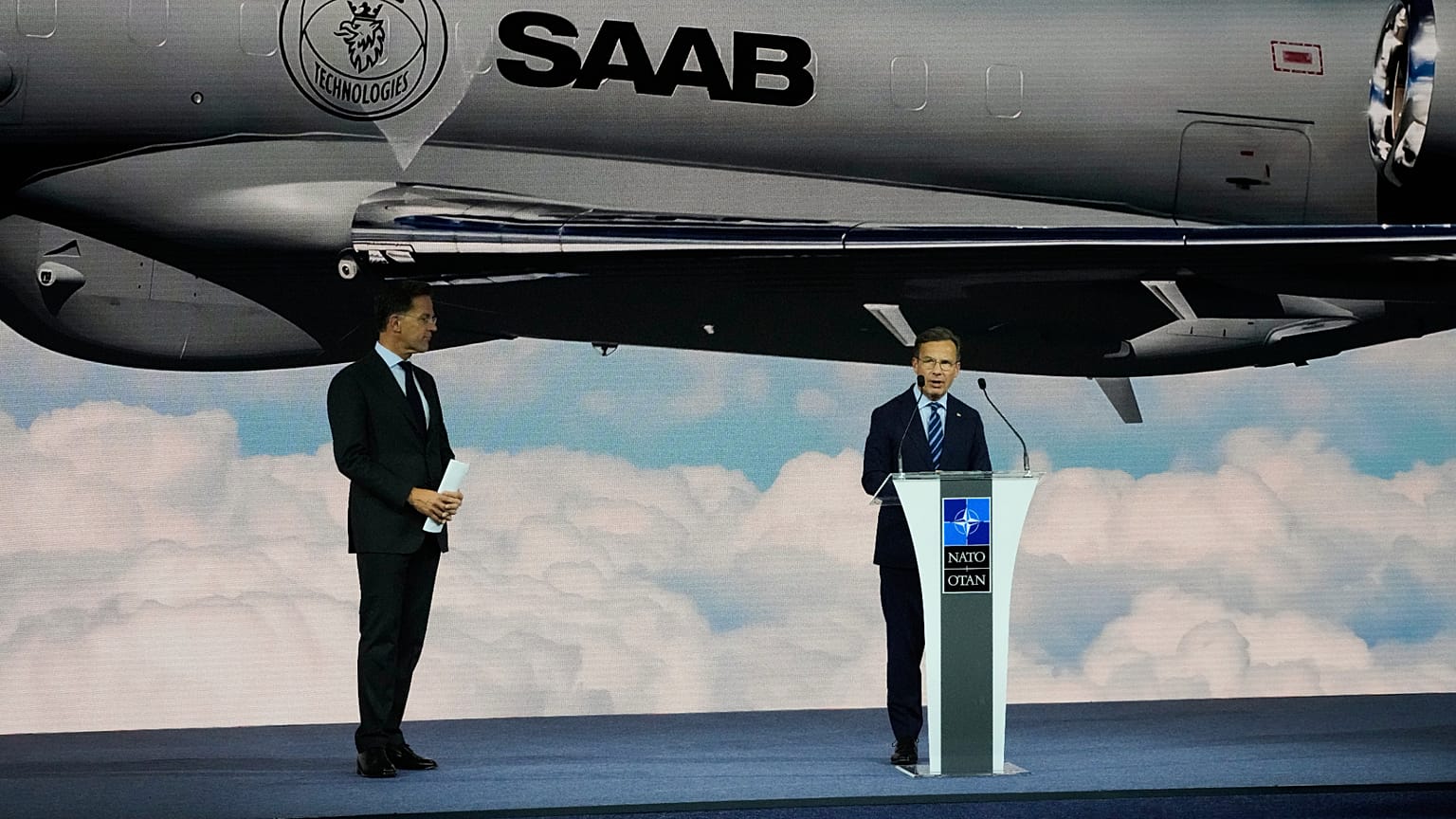
NATO Secretary General Mark Rutte, listens, as Sweden's Prime Minister Ulf Kristersson speaks at the opening of the NATO Defense Industry Forum.
Copyright AP Photo

By Roselyne Min
Published on

As NATO members discuss future defence capabilities in Ankara, Swedish defence company Saab announced its GlobalEye aircraft will become the alliance’s new “eyes in the sky”.

Swedish-made aircraft are set to replace NATO’s ageing US-built surveillance fleet.

At the NATO Summit Defence Industry Forum in Ankara, NATO and the Swedish government announced that the military alliance had chosen GlobalEye, an Airborne Early Warning and Control (AEW&C) system made by Swedish defence company Saab, as the replacement for NATO’s current Boeing E-3A aircraft.

NATO plans to open negotiations with Saab to purchase up to 10 GlobalEye aircraft, according to an announcement by the Swedish government.

What is the Early Warning & Control System?

An Early Warning & Control (AEW&C) system is a modified aircraft fitted with long-range radar, sensors and command-and-control systems.

Flying at high altitude, it can detect aircraft, ships, missiles and other threats at long distances, including low-flying targets that ground-based radars may miss. It can also help direct friendly forces during military operations.

“In a serious security situation, the ability to detect threats early and control operations in the air, at sea and on the ground is becoming increasingly important,” PÃ¥l Jonson, the Swedish minister of defence, said at the summit.

“GlobalEye provides precisely the kind of advanced situational awareness that modern defences need to combat everything from drones, missiles and other types of threats,” he added.

NATO calls its airborne early warning and control capabilities its “eyes in the sky”.

Unlike most military assets in the alliance, NATO’s current airborne early warning fleet is operated by NATO itself rather than by a single member state.

The military alliance currently operates 14 Boeing E-3A aircraft, which have been in service since 1982.

The selection marks NATO's second attempt to replace the ageing fleet: the alliance initially chose Boeing's E-7A Wedgetail in 2023, but that plan collapsed in 2025 after the US Air Force dropped the aircraft from its budget in favour of space-based surveillance.

Specs of the new reconnaissance aircraft

Saab says its GlobalEye is “the only AEW&C solution on the market that can provide long-range air, sea and land surveillance in real time, from a single platform.”

The advanced reconnaissance aeroplane uses a combination of long-range active and passive sensors. It is built on the Global 6500 aircraft family from Canadian business jet maker Bombardier.

The Swedish company says GlobalEye can detect, identify and track objects at distances of more than 550 kilometres, while its radar is designed to reach even farther in some conditions.

It can remain airborne for more than 11 hours and “combines excellent flight performance with low maintenance costs,” according to an announcement by the Swedish government.

For comparison, NATO says one Boeing E-3A can track aircraft and ships at distances over 400 km and fly up to 10 hours.

A single current NATO surveillance aeroplane can monitor an area roughly the size of Poland. Three coordinated aircraft can continuously scan the entirety of Central Europe.

Saab has not yet disclosed an equivalent area-coverage figure for GlobalEye.

The planned purchase is being backed by 11 NATO countries: Belgium, Canada, Denmark, Germany, Latvia, Lithuania, Luxembourg, the Netherlands, Norway, Romania and Sweden.

No contract has been signed yet. Saab says it will now proceed to formal negotiations with the NATO Support and Procurement Agency to secure a deal.

Saab’s CEO Micael Johansson told Swedish newspaper Dagens Nyheter that the company could begin deliveries in 2030 if an agreement is reached soon.


UK to lead European initiative to fund next

generation of long-range missiles


The United Kingdom, France, Germany and other European countries will spend more than $50 billion over the next 10 years to develop long-range precision weapons in a boost to NATO's defence capabilities, the UK government announced on Wednesday.


Issued on: 09/07/2026 - RFI

Prime Minister Keir Starmer and other British officials in front of a Royal Navy F-35B Lightning fighter jet on the flight deck of the aircraft carrier HMS Prince of Wales, on 24 April 2025. AFP - RICHARD POHLE

Outgoing UK Prime Minister Keir Starmer was set to unveil details of the programme at the NATO summit in Ankara.

Backed by a dozen European partners, the UK-led initiative "is expected to announce that allies will spend $50 billion over the next 10 years to develop deep precision strike capabilities to bolster defence and deterrence across the alliance", Downing Street said in a statement.

The investment will deliver "the most advanced weapons NATO will have at its disposal in the future – with the ability to strike targets no less than 300km away and in some cases beyond 2000km, with pinpoint accuracy", it added.

Such missiles have proved crucial in the Ukraine war, allowing Ukrainian forces to hit targets far from the front line.

The partners, who are also expected to include Baltic nations, will work on several different missiles with a view to avoiding duplication.

The weapons will be developed without the involvement of the United States.

Europe’s defence dilemma: autonomy or dependence?

US President Donald Trump stands next to British Prime Minister Keir Starmer as NATO leaders gather for a group photo at a summit in Ankara, Turkey, on 8 July 2026. © Jonathan Ernst / Reuters


Closer European cooperation


Starmer on Wednesday urged leaders to "show the unity and the strength of NATO" against a background of the Ukraine conflict and the US war with Iran.

"We must continue to work together as allies to develop the capability of the future to bolster security and protect growth at home," he said in a statement.

The NATO leaders' summit comes at a fraught time for the 77-year-old transatlantic alliance, with US President Donald Trump lashing out at allies as Washington steps back from Europe.

The second day of the tense meeting in the Turkish capital saw Trump pose for the traditional group photo of 32 NATO leaders, before taking part in a working session and holding a highly anticipated meeting with Ukrainian President Volodymyr Zelensky.

The summit is expected to see European allies make plans to take a bigger role in NATO, including by upping defence spending.

(with newswires)


China’s Pacific Missile Test Sends Message To U.S. Allies – Analysis


Submarines from China's Navy. Photo Credit: Mehr News Agency


July 9, 2026 
RFA
By Taejun Kang

Key Takeaways

China Flexed Its Growing Military Reach — The test of a submarine-launched ballistic missile into the Pacific was intended to demonstrate Beijing’s advancing hypersonic and nuclear capabilities, sending a signal to regional countries including Australia and other Pacific states.

Strategic Timing and Message — The launch occurred shortly after Australia and Fiji signed a mutual defense treaty and amid major U.S.-led military exercises, interpreted by analysts as a deliberate political warning against efforts to counter Chinese influence in the Pacific.

It Risks Backfiring — While showcasing China’s ability to threaten deep into the Central Pacific (including routes relevant to Taiwan contingencies), the test has drawn sharp criticism from multiple countries and may push Pacific nations closer to the US and Australia.


China’s test of a submarine-launched ballistic missile into the Pacific this week was aimed at signaling its growing military reach to U.S. allies across the region, analysts told Radio Free Asia, as Beijing sought to frame the launch as a routine exercise.

China’s state-run Xinhua news agency reported Monday that a Chinese navy submarine launched a missile carrying a dummy warhead toward international waters in the Pacific at 12:01 p.m. local time, describing it as a “routine arrangement” in annual military training and not directed at any specific country or target.


Analysts said the timing and trajectory suggested Beijing was using the test to send a broad political and military message across the Asia-Pacific.

“China’s latest ICBM test serves several purposes,” William Yang, a Northeast Asia analyst at the Belgium-based International Crisis Group, told RFA. “It demonstrates the progress in China’s advanced missile capabilities, sends a signal to regional countries, including Australia and other Pacific states, about Beijing’s ability to respond resolutely to what it views as a challenge to its interests, and allows the People’s Liberation Army to maintain regular military drills across the Asia Pacific region.”

Though Yang referred to it as an ICBM, or intercontinental ballistic missile, Xinhua did not specifically use those words. The U.S. State Department called it an “intercontinental-range ballistic missile,” in a statement where it criticized the launch at a time when “the United States is working harder than ever to prevent nuclear proliferation,” and “China is doing the opposite.”

The launch also drew criticism from Japan, Australia, New Zealand and Taiwan, with several governments saying they had received only short notice.


The test touched a nerve across the region because it came against the backdrop of intensifying strategic competition in the Pacific, where China, the United States and its allies have been vying for influence over sea lanes, security ties with Pacific Island countries, and military access to the region.

For China, the Pacific islands have become an increasingly important diplomatic and strategic arena as Beijing seeks to expand its presence beyond East Asia. For Australia, New Zealand and the United States, the region has become a frontline in efforts to prevent China from translating economic influence into a deeper security foothold.

Australia-Fiji treaty

The missile landed in the South Pacific Nuclear Free Zone only hours after Australia and Fiji signed a mutual defense treaty.

Yang said the timing was “also a political signal to Canberra and other U.S. allies that China will not be deterred by their efforts to undercut China’s interests in deepening its influence in the Pacific region.”

The defense pact, known as the Ocean of Peace, commits Australia and Fiji to assist each other if attacked. It was signed as Canberra has sought to rebuild security ties and trust in the Pacific after years of concern among island governments over climate change, development needs and outside interference.

China has meanwhile deepened engagement with several Pacific island states through policing, aid and infrastructure agreements, raising alarm in Washington and allied capitals over the possibility of a more permanent Chinese security role in the region.

The launch occurred during “a crowded window of allied activity” that included not only the treaty signing – but also on the heels of RIMPAC, Valiant Shield, and Resolute Dragon – U.S.-led bilateral or multilateral military exercises focusing on the broader Pacific region, Aadil Brar, a Taipei-based independent analyst and former visiting scholar at National Chengchi University, told RFA.

Message sent

Though the Chinese navy said that the launch was directed at no particular country or target, Brar said the distance and direction was deliberate.

“That trajectory alone shows the real aim was less about any single target and more about proving China can range deep into the Central Pacific, threading through waters used by the Philippines, Guam-based U.S. forces, and Pacific island states, all at once,” he said.

The route described by Brar, from the Chinese coast across the Philippine Sea and south of Guam before landing near the Marshall Islands and Nauru, would have taken the missile through a corridor that matters strategically to both Washington and Beijing. It passes through waters used by U.S. forces based in Guam, near routes that could be critical for moving reinforcements in a regional conflict, including one involving Taiwan.

Brar said Taiwan was not directly overflown this time, but the test still carried implications for the island because it demonstrated China’s ability “to hold reinforcement routes at risk well beyond the first island chain,” the arc of islands running from Japan through Taiwan and the Philippines to Borneo, forming a key maritime boundary around China’s near seas.

Such abilities would complicate any U.S. intervention in a hypothetical Taiwan Strait crisis, he said.

Taiwan, which China claims as its own territory, has long warned that Beijing is stepping up military pressure on the democratically governed island through war games, air and naval patrols, and missile development. Chinese officials have not ruled out the use of force to bring Taiwan under Beijing’s control.

Still, Yang said he did not think the launch was directly related to Taiwan in this case, arguing that Beijing’s “target audience is the wider region rather than the Taiwanese government,” given its timing alongside the Australia-Fiji agreement and the missile’s launch and impact areas.

The test launch might not have been the best strategy for China, Gregory Brown, director of the Alliance Futures Initiative, a Washington-based think tank, told RFA.

“I don’t know that the intention from the Chinese is actually to threaten the Pacific Islands or Australia. It certainly got everybody’s attention,” said Brown. “It’s probably an own goal for China to have done this now, because now there’s reason to say this is the sort of thing and sort of behavior why Fiji would want to sign a treaty with Australia or maybe get closer to the United States.”

China last publicly conducted an intercontinental ballistic missile test in 2024, in a launch that underscored the country’s growing strategic capabilities and prompted renewed scrutiny of the pace and opacity of its nuclear modernization.


About RFA
Radio Free Asia’s mission is to provide accurate and timely news and information to Asian countries whose governments prohibit access to a free press. Content used with the permission of Radio Free Asia, 2025 M St. NW, Suite 300, Washington DC 20036.
View all posts by RFA →


Submarine missile test puts China's Pacific ambitions on display

A Chinese submarine test-fired a "strategic" missile carrying a dummy warhead into the Pacific Ocean on Monday, Beijing said, prompting immediate condemnation across the region.


Issued on: 08/07/2026 - RFI

Screenshot of the WeChat channel of China's Defence Ministry showing the launch of an ICBM that would land in the Pacific, 25 September 2024. © Screengrab WeChat via agencies


By: Jan van der Made

“It’s the first known submarine-based missile test since 1982,” according to Professor Michael Dillon, a China specialist affiliated with the Lau China Institute at London’s King’s College, and "the first ever from a nuclear-powered submarine."

According to Dillon, Beijing wants to demonstrate that "the Chinese Navy is here and it is in a position to fire missiles."

China’s state-controlled People’s Daily called the launch a “routine arrangement of the annual training of the PLA Navy."

But Australia’s PM Anthony Albanese, on a visit to the Solomon Islands called it a "provocative act by China which does destabilise the region,” during a joint press conference with the Solomon’s PM Mathew Wale, who remarked that he launched a “strong protest" with the Chinese ambassador.

The US State Department expressed concern. According to the Japan Times, Tokyo had “strongly urged” China to refrain from the test prior to the launch, and on Wednesday, Tuvalu Prime Minister Feleti Teo on condemned the test near its waters.

Clive Hamilton, the Australia-based author of Hidden Hand, a book that describes China’s growing influence around the world, points out that the missile launch comes immediately after Australia signed a mutual defence pact with Fiji.

"China is afraid that its push to gain more influence in and over Pacific nations is facing serious pushback,” he told RFI.

“This missile test has the appearance of a deliberate rebuke to Pacific Island states and Australia for undertaking more systematic military and economic cooperation,” he says.

A spokesperson for China's Minstry of National Defense (MND) announcing the launch of a ICBM into the Pacific, 25 September 2024. © Screenshot Chinese Ministry of National Defense website

The missile tests also shows the “urgent need for Australia to build its military capability” in the Pacific, according to Hamilton, and "far from intimidating Pacific island states out of military cooperation with Australia, it may well force them to become closer to Australia and by implication also New Zealand and the United States."

According to defconlevel.com, an organisation consisting of intelligence analysts and nuclear specialists, China currently disposes of some 600 nuclear war heads, and 6 Jin type 094 nuclear submarines, capable of launching strategic missiles.
'Drive the US out'

The Chinese missile test coincides with the “Joint Sea-2026” naval exercises that performed with Russia, that will continue through July 13.

The naval exercise are aimed at "complicating United States maritime superiority” in the Pacific theatre, according to defence watchdog Defence Security Asia, while intensifies "Indo-Pacific military competition surrounding Taiwan” with countries like Australia, Japan and the Philippines.

According to Hamilton, the “Joint Sea-2026” drills "reflect China's broader attempts, in its alliances with Russia and Iran and North Korea to project a more formidable and more threatening military capability.” and part of a "longer term strategy to drive the US out of the Western Pacific.”

In this photo released by Xinhua News Agency, Chinese naval frigate Binzhou takes part in a joint naval drills with Russian warships in the East China Sea on Dec. 27, 2022. AP - Xu Wei

However, Dillon points out that the relationship between China and Russia remains “complex,” and in spite of China’s covert support for Russia’s war in Ukraine, there has been “a lot of tension” between the two countries - including not fully resolved historical territorial claims and Russia’s concern about a growing influx of Chinese in eastern Siberia.

"China is wanting to demonstrate that it is ahead (of Russia) in missile terms,” according to Dillon.

Security pact


France, because of its territories New Caledonia and French Polynesia, is also a pacific power that worries about China’s growing military activities in the region; officially New Caledonia’s ocean territory borders that of the Solomon Islands, that currently enjoys a security pact with China.

China expands military might as far as French borders with Solomon Islands pact

But even for the Solomon Islands, the ICBM test was a step too far: “China's a good friend of Solomon Islands - but this is not something a friend does,” according to its PM Mathew Wale.

“We don't want to see any more countries, China, America, testing ICBMs in the Pacific Islands region. That's the bottom line,” he said.

While Australia is looking to improve ties with the island nation, Hamilton also stresses that ties with France can be improved. “It could be "beneficial if Australia decided to spend a substantial sum buying some armaments from France.”

Former admiral urges Australia to renege on Aukus deal and buy French subs

In 2021, Canberra joined the AUKUS military alliance with the US and the UK and cancelled a billion Euro submarine deal with Paris, leaving relations with France today “still fairly cool” in spite of a new government. Under the AUKUS deal, the US will sell nuclear submarines to Australia.

Buying French arms could "help repair the relationship” with Canberra, says Hamilton, which would be advantageous in the face of China’s growing military might in the region.