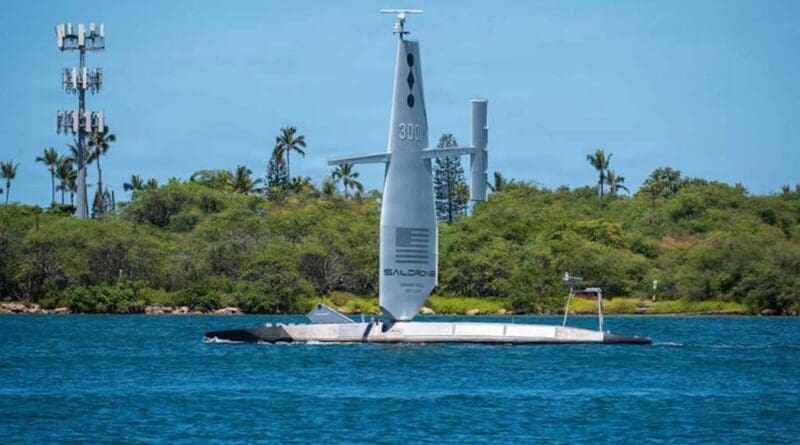
A Saildrone Surveyor uncrewed surface vessel deploys during RIMPAC 2026. PETTY OFFICER 2ND CLASS LORDIN KELLY/U.S. NAVY
July 26, 2026
By Indo-Pacific Defense Forum
Key Takeaways:
Major Multilateral Exercise with Focus on Innovation: RIMPAC 2026, involving 35 Allies and Partners, more than 25,000 personnel, ~40 surface ships, five submarines, and over 140 aircraft, emphasizes experimentation with unmanned systems, cyber capabilities, and emerging technologies alongside traditional maritime training.
Uncrewed Vessels as Force Multipliers: Participants tested uncrewed surface and undersea vessels for intelligence, surveillance, reconnaissance, and contested-area operations, enabling greater stealth, lethality, and efficiency while supporting interoperability among partner forces.
Advanced Manufacturing for Contested Logistics: Demonstrations included uncrewed vessels delivering 3D printers to ships at sea, allowing on-demand production of critical components and drones closer to the operational edge to improve readiness and reduce reliance on distant supply chains.
The 30th iteration of Exercise Rim of the Pacific (RIMPAC), hosted biennially in and around the Hawaiian Islands by the United States Navy’s Pacific Fleet (PACFLT), provides an opportunity to evaluate innovations such as uncrewed maritime vessels and 3D printers under realistic conditions.
Experimentation is a major part of the five-week multilateral exercise, which runs through July 2026. “RIMPAC includes new technologies such as unmanned systems and other advanced capabilities. However, the purpose remains the same: Countries gather together to enhance their capabilities and cooperate with each other,” Japan Maritime Self-Defense Force Rear Adm. Takuo Kobayashi told The Wall Street Journal newspaper.
Defense personnel from 35 Allies and Partners joined the world’s largest series of maritime-oriented drills and educational exchanges to train and collectively confront potential contingencies from conflict to humanitarian response. Along with more than 25,000 personnel, RIMPAC featured about 40 surface ships, five submarines and more than 140 aircraft.
“When a crisis hits, you have to know that the person to your left and your right has the same level of competency and understanding of the operational environment,” U.S. Marine Corps Maj. Gen. Valerie Jackson told Defense One magazine.
Defense operations are evolving, and exercise leaders noted that along with traditional challenges there is an increasing prevalence of cyberattacks, manipulated information, economic coercion and other gray-zone tactics that fall short of outright warfare.
RIMPAC 2026 includes an advanced manufacturing demonstration that combines the expertise of military, government, academic and commercial partners. It allows researchers and developers to move technologies from laboratory testing to real-world applications, with an emphasis on enhanced readiness. The exercise “provides the scale and complexity needed to evaluate whether distributed manufacturing can function under realistic operational conditions,” the U.S. Navy stated.
For example, PACFLT’s Submarine Force deployed uncrewed undersea vessels for intelligence, surveillance and reconnaissance. The submersibles simulated operating in contested areas by detecting, tracking and holding off adversary forces. The autonomous assets are force multipliers, enabling crewed vessels to operate with greater stealth, lethality and efficiency.
“Alongside our normal operations with surface ships and submarines, we have an experimentation portion of RIMPAC, which has about 30 to 35 experiments that utilize unmanned systems,” said Vice Adm. Jeffrey Jablon, PACFLT deputy commander.
Allied and partner forces are developing and deploying uncrewed vessels to ensure interoperability and deter aggression. Japan and the Republic of Korea deployed uncrewed surface and underwater vessels at previous RIMPAC iterations, and the Australian Defence Force’s ADV Guidance, a submarine support vessel, is participating in 2026.
“RIMPAC provides an ideal environment for experimentation,” Chilean Navy Commodore Andres Howard told The Wall Street Journal. Chile has participated in the exercise since 1996. “Nations bring new technologies, including unmanned systems, cyber capabilities and other emerging technologies, to evaluate how they operate alongside allied and partner forces. The exercise provides valuable operational lessons before those capabilities are fully fielded.”
The U.S. Navy is testing surface vessels that can deliver vital equipment to ships at sea. At RIMPAC, the transported gear includes 3D printers that enable forces to produce critical components at sea. One manufacturer displayed a 3D printer that can be paradropped and quickly set up, Defense One reported.
U.S. defense leaders are “focused on contested logistics and demonstrating advanced manufacturing capabilities to produce repair parts and drones closer to where they’re needed,” said U.S. Navy Rear Adm. Michael Mattis. “It enables replacement parts to be built at the operational edge, reducing wait times and increasing readiness.”
About Indo-Pacific Defense Forum
Indo-Pacific Defense Forum is sponsored by the United States Indo-Pacific Command (USINDOPACOM) and publishes daily online articles, daily social media updates and a quarterly magazine to provide timely updates on the Indo-Pacific security environment.
View all posts by Indo-Pacific Defense Forum →
The 30th iteration of Exercise Rim of the Pacific (RIMPAC), hosted biennially in and around the Hawaiian Islands by the United States Navy’s Pacific Fleet (PACFLT), provides an opportunity to evaluate innovations such as uncrewed maritime vessels and 3D printers under realistic conditions.
Experimentation is a major part of the five-week multilateral exercise, which runs through July 2026. “RIMPAC includes new technologies such as unmanned systems and other advanced capabilities. However, the purpose remains the same: Countries gather together to enhance their capabilities and cooperate with each other,” Japan Maritime Self-Defense Force Rear Adm. Takuo Kobayashi told The Wall Street Journal newspaper.
Defense personnel from 35 Allies and Partners joined the world’s largest series of maritime-oriented drills and educational exchanges to train and collectively confront potential contingencies from conflict to humanitarian response. Along with more than 25,000 personnel, RIMPAC featured about 40 surface ships, five submarines and more than 140 aircraft.
“When a crisis hits, you have to know that the person to your left and your right has the same level of competency and understanding of the operational environment,” U.S. Marine Corps Maj. Gen. Valerie Jackson told Defense One magazine.
Defense operations are evolving, and exercise leaders noted that along with traditional challenges there is an increasing prevalence of cyberattacks, manipulated information, economic coercion and other gray-zone tactics that fall short of outright warfare.
RIMPAC 2026 includes an advanced manufacturing demonstration that combines the expertise of military, government, academic and commercial partners. It allows researchers and developers to move technologies from laboratory testing to real-world applications, with an emphasis on enhanced readiness. The exercise “provides the scale and complexity needed to evaluate whether distributed manufacturing can function under realistic operational conditions,” the U.S. Navy stated.
For example, PACFLT’s Submarine Force deployed uncrewed undersea vessels for intelligence, surveillance and reconnaissance. The submersibles simulated operating in contested areas by detecting, tracking and holding off adversary forces. The autonomous assets are force multipliers, enabling crewed vessels to operate with greater stealth, lethality and efficiency.
“Alongside our normal operations with surface ships and submarines, we have an experimentation portion of RIMPAC, which has about 30 to 35 experiments that utilize unmanned systems,” said Vice Adm. Jeffrey Jablon, PACFLT deputy commander.
Allied and partner forces are developing and deploying uncrewed vessels to ensure interoperability and deter aggression. Japan and the Republic of Korea deployed uncrewed surface and underwater vessels at previous RIMPAC iterations, and the Australian Defence Force’s ADV Guidance, a submarine support vessel, is participating in 2026.
“RIMPAC provides an ideal environment for experimentation,” Chilean Navy Commodore Andres Howard told The Wall Street Journal. Chile has participated in the exercise since 1996. “Nations bring new technologies, including unmanned systems, cyber capabilities and other emerging technologies, to evaluate how they operate alongside allied and partner forces. The exercise provides valuable operational lessons before those capabilities are fully fielded.”
The U.S. Navy is testing surface vessels that can deliver vital equipment to ships at sea. At RIMPAC, the transported gear includes 3D printers that enable forces to produce critical components at sea. One manufacturer displayed a 3D printer that can be paradropped and quickly set up, Defense One reported.
U.S. defense leaders are “focused on contested logistics and demonstrating advanced manufacturing capabilities to produce repair parts and drones closer to where they’re needed,” said U.S. Navy Rear Adm. Michael Mattis. “It enables replacement parts to be built at the operational edge, reducing wait times and increasing readiness.”
About Indo-Pacific Defense Forum
Indo-Pacific Defense Forum is sponsored by the United States Indo-Pacific Command (USINDOPACOM) and publishes daily online articles, daily social media updates and a quarterly magazine to provide timely updates on the Indo-Pacific security environment.
View all posts by Indo-Pacific Defense Forum →

No comments:
Post a Comment