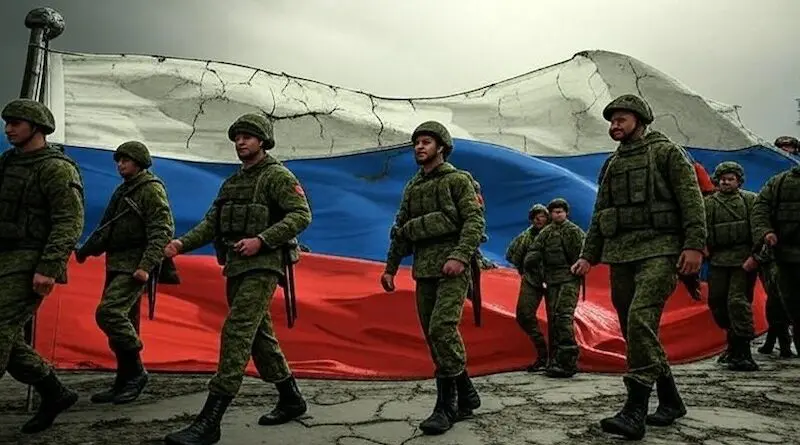
Image: Grok
July 30, 2026
By Dr. Taras Kuzio
Key Takeaways:
Despite successive Western sanctions packages, Russia’s military-industrial complex has expanded since 2022 by exploiting major sanctions gaps, leaving many defense-linked companies, chemicals, and dual-use technologies outside existing restrictions.
Russia continues acquiring critical military components through intermediary states, parallel imports, and weak export controls, while thousands of companies—particularly in the People’s Republic of China and Hong Kong—facilitate sanctions evasion and sustain Russian weapons production.
Ukrainian intelligence has documented extensive Western-made components in Russian missiles, drones, aircraft, and air defense systems, demonstrating that U.S., European, and Asian technologies remain integral to Russia’s precision-strike capabilities despite sanctions.
The West is still imposing new sanctions on Russia due to its war against Ukraine. On July 23, the European Union adopted its 21st sanctions package against Russia, and on July 28 the U.S. Senate advanced sanctions legislation targeting Russia’s energy sector (Council of the European Union, July 23; Kyiv Post, July 29). Western sanctions, however, have not successfully completely inhibited Russia’s military-industrial complex. The paradox of Russia’s military-industrial complex is that, as the Stockholm International Peace Research Institute found, it grew after the imposition of Western sanctions and the decline in arms exports following the 2022 full-scale invasion of Ukraine (Stockholm International Peace Research Institute, 2026). This is because Western sanctions are allowing Russia to continue to build weapons systems that are being used against Ukraine.
U.S. Secretary of State Marco Rubio said at the 2025 Group of Seven (G7) meeting, “There’s not a lot left to sanction from our part.” At least half of the Russian companies that supply the military-industrial complex, however, remain unsanctioned (Euromaidan Press, February 9). Rosatom, Russia’s state nuclear corporation, includes 21 companies—e.g., Innovation Hub, Mayak Production Association—that are not sanctioned and have links to the military-industrial complex (Dixi Group, March 4).
The West faces two main difficulties when imposing sanctions against Russia’s military-industrial complex. According to Andrey Zayakin at The Insider, it is “not always clear which goods are being imported specifically for military use.” Additionally, “when one company is sanctioned, a substitute soon appears in its place, and while new Western restrictions are being introduced, the Russian military-industrial complex has time to adapt” (The Insider, February 18). Russia acquires technology through intermediary countries, parallel imports, secondary markets and weak end-user controls (Ukraine Business News, April 9). Western sanctions have slowed down but not ended the supply of Western goods to Russia’s military-industrial complex.
There are no sanctions on chemicals used to produce mechanical lubricants and military-grade tires. Western and Chinese companies provide motor oil additives and lubricants (Kyiv Independent, February 16). Raw glycerine is not sanctioned and continues to be exported to Russia despite its use for the manufacture of propellants and explosives. Russian petro-chemical manufacturers supply the military-industrial complex (Dekleptocracy Project, April 30).
Machine-building equipment from 15 Taiwanese, 13 German, 8 Czech, 6 Swiss, 3 Japanese, and 1 U.S. company was exported to Russia despite its dual-use for the military-industrial complex (Kyiv Independent, June 19). Russia’s leading tank maker, Uralvagonzavod, uses Western machines that require parts and software updates. Ukraine’s military intelligence (HUR) documented 300 Western companies exporting machinery to Russia that is essential to its military-industrial complex (Kyiv Post, March 26, 2025).
Many Western companies continued to supply Russia’s military-industrial complex through corrupt middlemen and via intermediary countries such as Türkiye, Georgia, Armenia, Kyrgyzstan, and Kazakhstan—countries not sanctioned. The People’s Republic of China (PRC) directly, and through Hong Kong, continues to be a major supplier to Russia’s military-industrial complex (Freedom Hong Kong, February 2026).
In February, Ukrainian President Volodymyr Zelenskyy signed two decrees sanctioning 24 individuals and 27 companies supplying Russia’s military-industrial complex, including those circumventing Western and Ukrainian sanctions from countries such as the United Arab Emirates, Kyrgyzstan, and Georgia (President of Ukraine, February 7 [1],[2]).
The HUR documented 6,000 companies violating sanctions by trading with sanctioned Russian military-industrial complex companies, of whom 4,000 were Chinese (including those from Hong Kong) and the remainder from Türkiye, the Gulf states, the Middle East, and India (The Insider, March 11). A Dutch national registered the Redwing Metal company in Türkiye to re-export components and machinery from the European Union to Russia (Organized Crime and Corruption Reporting Project, June 19). A Polish–Ukrainian investigation found the Polish company Famot Pleszew had exported machinery to Russia (United24 Media, January 25, 2025; FrontStory, March 13). Fifty Western components are used in Russian shipbuilding and by the ship repair companies Kronstadt Marine Plant, Sevmash, and the Baltic Shipyard (Euromaidan Press, March 18).
Russia’s military-industrial complex is assisted by two well-established sanctions evaders—Iran and North Korea. Western components are found in Iranian Shahed drones, which are used to build Russian Geran drones. Iranian drones used to attack Cyprus and the Gulf states during the U.S.–Israeli conflict with Iran used Western components (United24 Media, March 5).
The number of Western components used by Russia’s military-industrial complex is very high, and Western governments are failing to close the channels used to export them to Russia. The HUR maintains an extensive database of components from 33 countries used by the Russian military-industrial complex. As of April, the HUR’s database included 1,635 components used in 218 Russian military-industrial complex plants (HUR, accessed July 29).
After analyzing debris from nearly 500 Russian drones and 50 missiles launched in an October 2025 attack on Ukraine, the HUR found they contained tens of thousands of Western components, which included 1,500 in the Iskander cruise missiles, 405 in the Kalibr cruise missiles, and 192 in the Kinzhal ballistic missiles (President of Ukraine, October 6, 2025). In another analysis of a Russian attack in May, the missiles Russia fired were built this year using 100 components from the United States (Texas Instruments, AMD), Germany (Harting Technical Group), and the Netherlands (Nexperia) (Kyiv Post, May 15). The largest share of components comes from the United States, the PRC, Switzerland, Germany, Japan, and Taiwan. Fewer components are from Czechia, Sweden, and Australia.
The Kyiv Independent, posing as a Russian defense company in 2025, ordered U.S. chips to prove how easy it was to buy them—and, if they had wished, export them to Russia (Kyiv Independent, January 24,March 10, 2025). An investigation by BILD magazine found Russian postal workers in Germany were sending components to Russia (BILD, January 25; United24 Media, January 26). Russia has built military communications systems using radio bridges, antennas and networking equipment from the U.S. company Ubiquiti (The Insider, February 20).
A third of the Russian military-industrial complex companies (e.g., Krasny Oktiabr, National Institute for Aviation Technologies, Yashz Avia) that build SU-57 planes used to launch the devastating KH-59 glide bombs at Ukraine are not sanctioned (Euromaidan Press, April 20). Russian glide bombs include components from the United States (Altera Corporation, Analog Devices, CTS, Texas Instruments, Linear Technology, MaxLinear, Sipex, American Semiconductor, Products Integrated), Ireland (Antena manufacturing, Taoglas), Switzerland (Ublox, TE Connectivity, Axicom STMicroelectronics), Japan (Din-Tek Semiconductor, Okuma Corporation), Taiwan (Akira Seiki), South Korea (Samsung Machine Engineering), and the PRC (Kyiv Independent, November 17, 2025). Components from the German company Guhring LLC are found in the SU-30 Russian fighter jet and S-400 air defense system (The Insider, July 3). The Pantsir S1 air defense system uses 52 Western components (Kyiv Post, May 12; Militarnyy, July 5).
The two main needs of Russia’s war machine are components for missiles and drones that are launched nightly at Ukraine. The Kh-101, 3M-14, KN-23/24, Iskander 9M728, and Kinzhal KH47M2 cruise and ballistic missiles, which have been launched against Ukraine, include components from the U.S. companies mentioned above, as well as AMD, Anderson Electronics, Intel-USA, Motorola, Vicor Corporation, and Microchip Technology, alongside Dutch, Swiss, German, Swedish, Japanese, Taiwanese, and South Korean parts. Eighty to ninety percent of the guidance systems in Russian cruise missiles are Western.
Components from 16 U.S., Swiss, Chinese, and East Asian companies are found in the KH-101 cruise missile—64.3 percent of the components in the KH-101 cruise missile are U.S., 17.9 percent German, 7.1 percent Swiss, 7 percent Dutch, and 3.6 percent Taiwanese. A ballistic missile fired at Kyiv in April 2025 used 116 mainly U.S. components (Kyiv Independent, October 6, 2025). Seven hundred ninety-nine shipments of XP Power microchips were exported from the United Kingdom to Russia via Hong Kong and are used in its KN-23/24 ballistic missiles (The Telegraph, February 16).
Russia’s Lancet and Zala reconnaissance drones use many Chinese components as well as components from 12 U.S. companies (Kyiv Independent, November 21, 2024). Besides the U.S. companies listed above, these also include components built by Nvidia, National Semiconductor, Micron Technology, Xilinx, Qorvo, Bel Fuse and Semtech Corporation.
Russia’s Molniya-2R reconnaissance drone includes Chinese and U.K. (Raspberry Pi5 Microcomputers) components (Euromaidan Press, December 22, 2025). Russia’s Kniaz Veshchiy Oleg reconnaissance drone depends on foreign parts, including 33 U.S., five Swiss, Taiwanese, Dutch, and Chinese components (Euromaidan Press; United 24 Media, April 13).
Russia’s Orion, a plagiarism of the U.S. Reaper drone, is built by 43 Russian companies, a third of whom are not sanctioned. Orion uses components from many U.S. companies listed earlier (Kyiv Independent, November 5, 2025)
The HUR documented U.S., Swiss, Japanese, Taiwanese, Dutch, Irish, and Chinese components in the Shahed 107 Iranian drone rebuilt by Russia as Geran-1 (Kyiv Independent, November 25, 2025). Russia’s Geran-2 drone uses the rotary encoder sensor built by the Austrian company AMS-Osram. The Geran-2 uses a clock buffer built by the Indian company Aura Semiconductor. Russia’s Geran-3 drone (using Iranian Shahed 238 specifications) includes 45 Western components (Euromaidan Press, September 16, 2025). Half of these are from U.S. companies (including Infineon Technology, Sipex Corporation, Adesto Technology, Alpha and Omega, and other U.S. companies listed earlier), with the remainder from Switzerland (seven companies, including U-Blox and STMicroelectronics), Germany (including Infineon Technology and Bosch), the PRC (six companies), United Kingdom (Raspberry Pi, Futura Technical Services), and Japan (Rubycon Corporation) (The Telegraph, February 18).
With turbojet propulsion and triple the speed of the Geran-1, 2, 3, and 4 drones at 300 and 400 miles per hour, Russia’s most advanced Geran-5 drone is a major technological upgrade. Geran-5 bridges the gap between low-cost loitering munitions and high-speed cruise missiles to bypass Ukrainian air defenses. Geran-5 includes components from six U.S. companies (in addition to the U.S. companies listed earlier, Monolithic Power Systems and CTS Corporation), and the German company Infineon (Kyiv Independent, January 22).
Historically, sanctions have never been 100 percent effective. Nevertheless, Western governments could take a greater number of steps to tighten sanctions on chemicals, components, and machinery exported to Russia for use by its military-industrial complex. Russia’s military equipment is being used today against Ukraine, but with North Atlantic Treaty Organization (NATO) intelligence and military leadership predicting Russia could be ready to launch an attack on NATO’s territory between 2027 and 2030, its weapons, which use a high number of Western components, would then be used against the West.
This article was published by The Jamestown Foundation

About Dr. Taras Kuzio
Taras Kuzio is a professor of political science at the National University of Kyiv Mohyla Academy. He is co-author of The Four Roots of Russia’s War Against Ukraine (Cambridge University Press, 2026); co-editor of Russia and Modern Fascism: New Perspectives on the Kremlin’s War Against Ukraine (Columbia University Press, 2025); Crimea: Where Russia’s War Started and Where Ukraine Will Win (Jamestown Foundation, 2024), and Russian Nationalism and the Russian-Ukrainian War (Routledge, 2022). He can be found on X/Twitter @TarasKuzio
View all posts by Dr. Taras Kuzio →
A Crown Jewel In Peril: Russia’s Arctic Aggression Masks Nuclear Vulnerability – Analysis
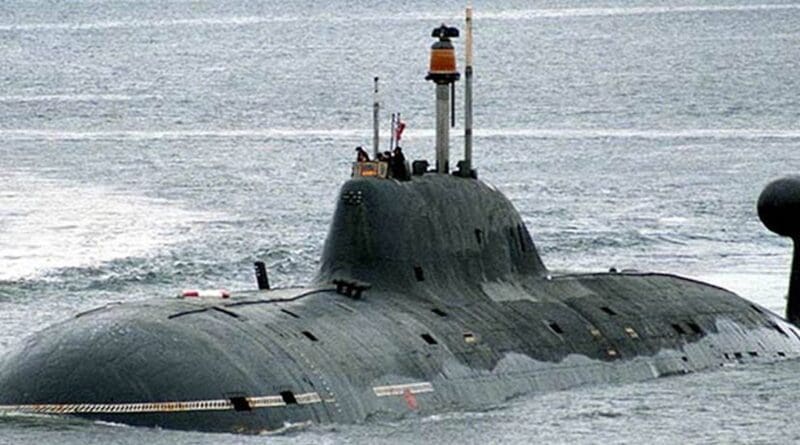
File photo of Russian Submarine Vepr by Ilya Kurganov. Source: Wikipedia Commons.
July 30, 2026
Published by the Foreign Policy Research Institute
By Carl Parkin
Key Takeaways:
Melting ice is increasing the vulnerability of Russia’s nuclear submarine fleet. Two-thirds of Russia’s sea-based nuclear forces are based on the Kola Peninsula; longer transit times to protective ice and the ice’s retreat toward allied waters erode a key Cold War-era defensive layer.
NATO has an opportunity to exploit this vulnerability but must proceed cautiously. The Alliance is boosting Arctic presence through Arctic Sentry, new ASW assets, and icebreakers. Aggressive tracking of Russian SSBNs could deter gray-zone activity, yet risks provoking overreaction or use-it-or-lose-it pressures.
(FPRI) — Russia sees opportunity in the Arctic. For centuries, ever-present sea ice has made the region hostile to trade or military exploitation. But as the ice melts, that reality is changing. Russia plans to capitalize on the economic benefit of arctic trade, is increasing its military presence in the region, and is leveraging its dominance to conduct disruptive gray zone activity against US allies. But the retreat of arctic ice may not work entirely in Russia’s favor. As the ice melts, Russian nuclear weapons are becoming more vulnerable. Allies must thread the needle between appropriately exploiting this vulnerability, and avoiding Russian overreaction.
Russia’s Arctic Interests
A significant portion of Russia’s Arctic power projection is based on its dominance of regional trade. Russia is expanding the Northern Sea Route (NSR), a long-established shipping route between Russia and Asia, into a broader trade network known as the Trans-Arctic Transport Corridor. Russia maintains tight control over the area by requiring that international vessels obtain both Russian permission and icebreaker escort from its fleet to transit the route.
This behavior is part of a broader pattern of Russian lawfare in the region, leveraging contested legal claims to restrict allied freedom of movement in the Arctic. After Russia passed a law in late 2022 regulating the navigation of warships in the NSR, allied-aligned analysts have debated whether to conduct a freedom of navigation operation there, However, the risks have ultimately outweighed the benefits and Russia maintains de facto dominance over the route.
This dominance is reinforced by a strengthening military posture. Russia has revitalized its Arctic military forces for over a decade by rebuilding Soviet-era bases and modernizing air defense capabilities. In its 2023 foreign policy concept, Russia listed the Arctic as a priority region, second only to its near abroad in Eastern Europe. However, Russia’s foreign policy and military expansion seems to increasingly serve its trade decisions, rather than the other way around. Cargo volumes in the NSR have fallen over the past two years, reaching a new low of 37 million metric tons last year and bucking Putin’s 2018 ambitions of traffic reaching 80 million by 2024. The NSR’s relative economic weakness indicates the true purpose of Russian regional dominance: power projection.
Russia’s lawfare and military expansion facilitates military control, which in turn shields Russia’s gray zone warfare activities. Russia’s “shadow fleet” of vessels, sailing under flags of convenience, has been increasingly implicated in the destruction of undersea infrastructure, as well as its broader sanction-evasionefforts. Russia’s control over the surrounding waters facilitates these activities, allowing the shadow fleet to move with impunity across increasingly broad swathes of Arctic waters.
A Crown Jewel in Peril
While the Arctic is presently a region of Russian strength, it also houses one of Russia’s most precious, and historically most vulnerable, assets: its nuclear-armed ballistic missile submarines, or SSBNs. According to US intelligence estimates, two-thirds of Russia’s sea-based nuclear forces are based on the Kola Peninsula – the region of Russian near-Arctic territory closest to the Norwegian border. The peninsula is highly militarized, and sits at the core of Russia’s Arctic power projection. It is home to the headquarters of Russia’s Northern Fleet at Severomorsk and a submarine base at Gadzhyievo, which hosts both Cold War Delta-IV and modern Borei-class ballistic missile submarines.
Russia’s crown jewel of nuclear deterrence did not come to reside in its freezing home by happenstance. During the earliest days of the Cold War, the Soviets had not yet developed intercontinental-range missiles to mount on their submarines. To carry out a nuclear strike against the United States—or to patrol in a region from which they could do so—their SSBNs had to navigate close to the US’s Atlantic and Pacific coastlines. But these locations close to US coastlines were within range of a large network of US passive acoustic sonar sensors called SONOS, which could detect and track Soviet submarines, thereby minimizing the submarines’ value as a deterrent force.
Soviet espionage eventually identified this vulnerability, and the USSR quickly moved to better secure their naval nuclear deterrent. Instead of transiting subs through risky, distant waters, they developed longer-range sea-launched missiles capable of hitting the United States from the Barents Sea and nearby Arctic waters closer to home. To further secure these local submarine patrol areas, the Soviets constructed “bastions,”or zones of layered defenses where SSBNs could safely reside, surrounded by networks of sensors, mines, escorting attack submarines, and other naval assets.
But the layered bastion defense was not the only thing protecting Soviet submarines. The surrounding Arctic ice served, in effect, as a security blanket for vulnerable SSBNs.
SSBNs are pursued by mixed forces of planes, helicopters, and ships, equipped with various sensors designed to detect submarines in their underwater hiding places. Additionally, submarines can be followed, or “tailed,” by other submarines. All of these methods of submarine detection are further complicated by the presence of surface sea ice. Large ships struggle to navigate zones with heavy sea ice and the sensor arrays they tow for submarine detection can be disrupted by unpredictable ice floes. Some anti-submarine planes and helicopters can detect submarines through the ice by identifying the magnetic field disruption caused by their hulls, but their munitions are unable to punch through thick “pack ice,” especially when traveling at the low altitudes required for submarine tracking. Finally, the sound wave detection methods used to tail submarines underwater are made unreliable as they pass into the sonically active marginal ice zone, where ice breakup causes significant acoustic anomalies.
Altogether, the under-ice environment is much safer for submarines than the open ocean, especially when actively evading an opposing anti-submarine warfare (ASW) force. The decline in Arctic ice could remove one of the layers of protection Russia relies on to secure its SSBN fleet, reintroducing an early Cold War vulnerability in a modern context.
Measuring the Danger
Geospatial analysis reveals just how bad this challenge is for Russia. The following figure shows how long Russian submarines would need to traverse to safer under-ice waters, assuming that they could travel in a straight line at maximum speed, a scenario which is unlikely in practice.

Graphic courtesy of Carl Parkin based on data from the National Snow and Ice Data Center (NSIDC)
The figure demonstrates that these transit times are growing longer across all seasons, especially in late summer, when record lows of around 20 hours from the 1980s are blown out of the water by 35+ hour transit times in recent years. Additionally, the upper curve of the graph observed during summer months is stretching horizontally. This indicates that the length of “ice summers,” when traversal times are at their highest, is getting longer, meaning there are more days each year where Russian submarines are further from the protection of ice.
But traversal time isn’t the only variable that should concern Russia—the following figure shows that as the ice melts, it is receding further into the waters of its adversaries. While the 1980s saw sea ice regularly reaching through the gap between the archipelagoes of Svalbard (demilitarized, and controlled by Norway) and Franz-Joseph Land (Russian-owned), the ice is now hiding itself behind Svalbard and moving closer to the coast of allied-controlled Greenland, where US bases create far more dangerous waters for a Russian SSBN.

Graphic courtesy of Carl Parkin based on data from the National Snow and Ice Data Center (NSIDC)
Allied Opportunities
These estimates deserve a caveat: other variables may improve submarine survivability in the Arctic region. A recent study found that changing water temperatures in the Arctic are affecting how sound propagates, perhaps providing a hider’s advantage to SSBNs. The Arctic soundscape is also changing as a whole, with ice breakup and increasing commercial activity creating more ambient noise in the region, which helps mask the sounds of nuclear submarines.
Nevertheless, the changing extent of Arctic sea ice will affect the vulnerability of Russian SSBNs in the future, and alter the overall dynamics of naval warfare in the Arctic. In the mid-1980s, in response to the Soviet bastion strategy, the Allies implemented a new Maritime Strategy designed to be implemented in the event of war. The centerpiece of this plan was a naval surge into the Barents Sea, enabling an aggressive campaign to hunt down Soviet SSBNs. This strategy was criticized at the time for its feasibility in the Arctic’s harsh, icy conditions. As the environment changes, it may become more feasible.
NATO is already rising to meet the Russian threat in the Arctic, in part due to pressure from the Trump administration. In December 2025, NATO reorganized its Joint Forces Command, Norfolk, to include Denmark, Sweden, and Finland, “reinforc[ing its] posture in the High North” and creating a new “strategic bridge between North America and Europe” according to US Air Force General Alexus G. Grynkewich, Supreme Allied Commander Europe. In February of 2026, the Alliance launched the Arctic Sentry vigilance activity, after US President Donald Trump and NATO Secretary-General Mark Rutte agreed that “NATO should collectively take more responsibility for the defense of the region.” Arctic Sentry will intensify NATO’s force presence in the Arctic: the United Kingdom will double its troops in the Norwegian arctic to two-thousand over the next three years, and Sweden will lead a new four-thousand strong land force based in Finland. The operation will also involve integrated sensing and the construction of new infrastructure in NATO’s Arctic nations.
The Alliance is also pursuing high profile anti-submarine warfare modernization and expansion efforts. Germany has ordered eight P-8 Poseidon aircraft, massive derivatives of the Boeing 737 equipped with sensors designed to track submarines, and Norway has purchased at least five British Type 26 frigates, another anti-sub platform. To traverse through the ice that still remains in the contested Arctic, the US has signed a pact with Canada and Finland to construct a new fleet of allied icebreaker ships to challenge Russia’s long-held icebreaker dominance.
Altogether, NATO seems well-poised to exploit the emerging vulnerability of Russian submarines in the coming years. It has reason to do so: Russia’s submarine-based harassment is increasing. The UK Ministry of Defense recorded a 30 percent increase in Russian submarines entering British waters in the past two years, and the UK deployed forces in April to deter a covert Russian operation to sabotage its undersea cables. Russian subs may be less likely to engage in escalatory, gray zone activity if they are more aggressively tracked, tailed, and held at risk. While shifting from chasing off attack submarines to chasing down SSBNs may seem like a radical escalation, it is not without precedent given the extreme vulnerability of the Russian submarine force prior to its transition to bastion basing, and the explicit plan to destroy SSBNs laid out in the Maritime Strategy.
While Russia increased the rate and scope of its naval exercises across territorial and allied-aligned waters indiscriminately up until 2022, it now seems to have refocused to a more defensive, preparatory posture in the Barents Sea. This shift could indicate that Russia has recognized the emerging vulnerability to its submarine bastions, and is looking to secure its SSBN force regardless of the state of the Arctic ice. In doing so, Russia has revealed a soft spot. NATO has the opportunity to probe this vulnerability in an attempt to curtail Russian gray-zone activity.
However, regardless of its Cold War precedent, NATO should be cautious when employing this strategy. The Alliance must be explicit that its tracking and tailing of SSBNs is a reaction to Russian submarines’ gray zone activity, intended to re-establish a red line rather than conduct a counterforce first strike. Military innovations that threaten the efficacy of Russia’s nuclear forces have shaken Russia in the past, provoking it to resurrectand complete escalatory Cold War-era weapons proposals, such as the nuclear-powered cruise missile. Inciting further overreactions should be avoided by the Alliance if possible. Furthermore, in a worst case scenario, tracking SSBNs could lead to use-it-or-lose-it pressures in an emerging conflict. NATO should consider the balance of risks and benefits in its approach when attempting to deter future Russian aggression.
Source: This article was published by FPRI
About Published by the Foreign Policy Research Institute
Founded in 1955, FPRI is a 501(c)(3) non-profit organization devoted to bringing the insights of scholarship to bear on the development of policies that advance U.S. national interests and seeks to add perspective to events by fitting them into the larger historical and cultural context of international politics.
View all posts by Published by the Foreign Policy Research Institute →
File photo of Russian Submarine Vepr by Ilya Kurganov. Source: Wikipedia Commons.
July 30, 2026
Published by the Foreign Policy Research Institute
By Carl Parkin
Key Takeaways:
Russia is expanding Arctic control for trade and military power projection. It is developing the Northern Sea Route into a Trans-Arctic Transport Corridor, requiring Russian permission and icebreaker escorts, while rebuilding bases and prioritizing the region in its foreign policy.
Melting ice is increasing the vulnerability of Russia’s nuclear submarine fleet. Two-thirds of Russia’s sea-based nuclear forces are based on the Kola Peninsula; longer transit times to protective ice and the ice’s retreat toward allied waters erode a key Cold War-era defensive layer.
NATO has an opportunity to exploit this vulnerability but must proceed cautiously. The Alliance is boosting Arctic presence through Arctic Sentry, new ASW assets, and icebreakers. Aggressive tracking of Russian SSBNs could deter gray-zone activity, yet risks provoking overreaction or use-it-or-lose-it pressures.
(FPRI) — Russia sees opportunity in the Arctic. For centuries, ever-present sea ice has made the region hostile to trade or military exploitation. But as the ice melts, that reality is changing. Russia plans to capitalize on the economic benefit of arctic trade, is increasing its military presence in the region, and is leveraging its dominance to conduct disruptive gray zone activity against US allies. But the retreat of arctic ice may not work entirely in Russia’s favor. As the ice melts, Russian nuclear weapons are becoming more vulnerable. Allies must thread the needle between appropriately exploiting this vulnerability, and avoiding Russian overreaction.
Russia’s Arctic Interests
A significant portion of Russia’s Arctic power projection is based on its dominance of regional trade. Russia is expanding the Northern Sea Route (NSR), a long-established shipping route between Russia and Asia, into a broader trade network known as the Trans-Arctic Transport Corridor. Russia maintains tight control over the area by requiring that international vessels obtain both Russian permission and icebreaker escort from its fleet to transit the route.
This behavior is part of a broader pattern of Russian lawfare in the region, leveraging contested legal claims to restrict allied freedom of movement in the Arctic. After Russia passed a law in late 2022 regulating the navigation of warships in the NSR, allied-aligned analysts have debated whether to conduct a freedom of navigation operation there, However, the risks have ultimately outweighed the benefits and Russia maintains de facto dominance over the route.
This dominance is reinforced by a strengthening military posture. Russia has revitalized its Arctic military forces for over a decade by rebuilding Soviet-era bases and modernizing air defense capabilities. In its 2023 foreign policy concept, Russia listed the Arctic as a priority region, second only to its near abroad in Eastern Europe. However, Russia’s foreign policy and military expansion seems to increasingly serve its trade decisions, rather than the other way around. Cargo volumes in the NSR have fallen over the past two years, reaching a new low of 37 million metric tons last year and bucking Putin’s 2018 ambitions of traffic reaching 80 million by 2024. The NSR’s relative economic weakness indicates the true purpose of Russian regional dominance: power projection.
Russia’s lawfare and military expansion facilitates military control, which in turn shields Russia’s gray zone warfare activities. Russia’s “shadow fleet” of vessels, sailing under flags of convenience, has been increasingly implicated in the destruction of undersea infrastructure, as well as its broader sanction-evasionefforts. Russia’s control over the surrounding waters facilitates these activities, allowing the shadow fleet to move with impunity across increasingly broad swathes of Arctic waters.
A Crown Jewel in Peril
While the Arctic is presently a region of Russian strength, it also houses one of Russia’s most precious, and historically most vulnerable, assets: its nuclear-armed ballistic missile submarines, or SSBNs. According to US intelligence estimates, two-thirds of Russia’s sea-based nuclear forces are based on the Kola Peninsula – the region of Russian near-Arctic territory closest to the Norwegian border. The peninsula is highly militarized, and sits at the core of Russia’s Arctic power projection. It is home to the headquarters of Russia’s Northern Fleet at Severomorsk and a submarine base at Gadzhyievo, which hosts both Cold War Delta-IV and modern Borei-class ballistic missile submarines.
Russia’s crown jewel of nuclear deterrence did not come to reside in its freezing home by happenstance. During the earliest days of the Cold War, the Soviets had not yet developed intercontinental-range missiles to mount on their submarines. To carry out a nuclear strike against the United States—or to patrol in a region from which they could do so—their SSBNs had to navigate close to the US’s Atlantic and Pacific coastlines. But these locations close to US coastlines were within range of a large network of US passive acoustic sonar sensors called SONOS, which could detect and track Soviet submarines, thereby minimizing the submarines’ value as a deterrent force.
Soviet espionage eventually identified this vulnerability, and the USSR quickly moved to better secure their naval nuclear deterrent. Instead of transiting subs through risky, distant waters, they developed longer-range sea-launched missiles capable of hitting the United States from the Barents Sea and nearby Arctic waters closer to home. To further secure these local submarine patrol areas, the Soviets constructed “bastions,”or zones of layered defenses where SSBNs could safely reside, surrounded by networks of sensors, mines, escorting attack submarines, and other naval assets.
But the layered bastion defense was not the only thing protecting Soviet submarines. The surrounding Arctic ice served, in effect, as a security blanket for vulnerable SSBNs.
SSBNs are pursued by mixed forces of planes, helicopters, and ships, equipped with various sensors designed to detect submarines in their underwater hiding places. Additionally, submarines can be followed, or “tailed,” by other submarines. All of these methods of submarine detection are further complicated by the presence of surface sea ice. Large ships struggle to navigate zones with heavy sea ice and the sensor arrays they tow for submarine detection can be disrupted by unpredictable ice floes. Some anti-submarine planes and helicopters can detect submarines through the ice by identifying the magnetic field disruption caused by their hulls, but their munitions are unable to punch through thick “pack ice,” especially when traveling at the low altitudes required for submarine tracking. Finally, the sound wave detection methods used to tail submarines underwater are made unreliable as they pass into the sonically active marginal ice zone, where ice breakup causes significant acoustic anomalies.
Altogether, the under-ice environment is much safer for submarines than the open ocean, especially when actively evading an opposing anti-submarine warfare (ASW) force. The decline in Arctic ice could remove one of the layers of protection Russia relies on to secure its SSBN fleet, reintroducing an early Cold War vulnerability in a modern context.
Measuring the Danger
Geospatial analysis reveals just how bad this challenge is for Russia. The following figure shows how long Russian submarines would need to traverse to safer under-ice waters, assuming that they could travel in a straight line at maximum speed, a scenario which is unlikely in practice.
Graphic courtesy of Carl Parkin based on data from the National Snow and Ice Data Center (NSIDC)
The figure demonstrates that these transit times are growing longer across all seasons, especially in late summer, when record lows of around 20 hours from the 1980s are blown out of the water by 35+ hour transit times in recent years. Additionally, the upper curve of the graph observed during summer months is stretching horizontally. This indicates that the length of “ice summers,” when traversal times are at their highest, is getting longer, meaning there are more days each year where Russian submarines are further from the protection of ice.
But traversal time isn’t the only variable that should concern Russia—the following figure shows that as the ice melts, it is receding further into the waters of its adversaries. While the 1980s saw sea ice regularly reaching through the gap between the archipelagoes of Svalbard (demilitarized, and controlled by Norway) and Franz-Joseph Land (Russian-owned), the ice is now hiding itself behind Svalbard and moving closer to the coast of allied-controlled Greenland, where US bases create far more dangerous waters for a Russian SSBN.
Graphic courtesy of Carl Parkin based on data from the National Snow and Ice Data Center (NSIDC)
Allied Opportunities
These estimates deserve a caveat: other variables may improve submarine survivability in the Arctic region. A recent study found that changing water temperatures in the Arctic are affecting how sound propagates, perhaps providing a hider’s advantage to SSBNs. The Arctic soundscape is also changing as a whole, with ice breakup and increasing commercial activity creating more ambient noise in the region, which helps mask the sounds of nuclear submarines.
Nevertheless, the changing extent of Arctic sea ice will affect the vulnerability of Russian SSBNs in the future, and alter the overall dynamics of naval warfare in the Arctic. In the mid-1980s, in response to the Soviet bastion strategy, the Allies implemented a new Maritime Strategy designed to be implemented in the event of war. The centerpiece of this plan was a naval surge into the Barents Sea, enabling an aggressive campaign to hunt down Soviet SSBNs. This strategy was criticized at the time for its feasibility in the Arctic’s harsh, icy conditions. As the environment changes, it may become more feasible.
NATO is already rising to meet the Russian threat in the Arctic, in part due to pressure from the Trump administration. In December 2025, NATO reorganized its Joint Forces Command, Norfolk, to include Denmark, Sweden, and Finland, “reinforc[ing its] posture in the High North” and creating a new “strategic bridge between North America and Europe” according to US Air Force General Alexus G. Grynkewich, Supreme Allied Commander Europe. In February of 2026, the Alliance launched the Arctic Sentry vigilance activity, after US President Donald Trump and NATO Secretary-General Mark Rutte agreed that “NATO should collectively take more responsibility for the defense of the region.” Arctic Sentry will intensify NATO’s force presence in the Arctic: the United Kingdom will double its troops in the Norwegian arctic to two-thousand over the next three years, and Sweden will lead a new four-thousand strong land force based in Finland. The operation will also involve integrated sensing and the construction of new infrastructure in NATO’s Arctic nations.
The Alliance is also pursuing high profile anti-submarine warfare modernization and expansion efforts. Germany has ordered eight P-8 Poseidon aircraft, massive derivatives of the Boeing 737 equipped with sensors designed to track submarines, and Norway has purchased at least five British Type 26 frigates, another anti-sub platform. To traverse through the ice that still remains in the contested Arctic, the US has signed a pact with Canada and Finland to construct a new fleet of allied icebreaker ships to challenge Russia’s long-held icebreaker dominance.
Altogether, NATO seems well-poised to exploit the emerging vulnerability of Russian submarines in the coming years. It has reason to do so: Russia’s submarine-based harassment is increasing. The UK Ministry of Defense recorded a 30 percent increase in Russian submarines entering British waters in the past two years, and the UK deployed forces in April to deter a covert Russian operation to sabotage its undersea cables. Russian subs may be less likely to engage in escalatory, gray zone activity if they are more aggressively tracked, tailed, and held at risk. While shifting from chasing off attack submarines to chasing down SSBNs may seem like a radical escalation, it is not without precedent given the extreme vulnerability of the Russian submarine force prior to its transition to bastion basing, and the explicit plan to destroy SSBNs laid out in the Maritime Strategy.
While Russia increased the rate and scope of its naval exercises across territorial and allied-aligned waters indiscriminately up until 2022, it now seems to have refocused to a more defensive, preparatory posture in the Barents Sea. This shift could indicate that Russia has recognized the emerging vulnerability to its submarine bastions, and is looking to secure its SSBN force regardless of the state of the Arctic ice. In doing so, Russia has revealed a soft spot. NATO has the opportunity to probe this vulnerability in an attempt to curtail Russian gray-zone activity.
However, regardless of its Cold War precedent, NATO should be cautious when employing this strategy. The Alliance must be explicit that its tracking and tailing of SSBNs is a reaction to Russian submarines’ gray zone activity, intended to re-establish a red line rather than conduct a counterforce first strike. Military innovations that threaten the efficacy of Russia’s nuclear forces have shaken Russia in the past, provoking it to resurrectand complete escalatory Cold War-era weapons proposals, such as the nuclear-powered cruise missile. Inciting further overreactions should be avoided by the Alliance if possible. Furthermore, in a worst case scenario, tracking SSBNs could lead to use-it-or-lose-it pressures in an emerging conflict. NATO should consider the balance of risks and benefits in its approach when attempting to deter future Russian aggression.
About the author: Carl Parkin researches nuclear risk and the history of US defense policy. He is currently a research fellow with the University of Chicago Existential Risk Lab.
Source: This article was published by FPRI
About Published by the Foreign Policy Research Institute
Founded in 1955, FPRI is a 501(c)(3) non-profit organization devoted to bringing the insights of scholarship to bear on the development of policies that advance U.S. national interests and seeks to add perspective to events by fitting them into the larger historical and cultural context of international politics.
View all posts by Published by the Foreign Policy Research Institute →

No comments:
Post a Comment