The Odyssey Is Facing a Boycott for Filming in Occupied Western Sahara
The film’s producers have provided legitimacy to the illegal occupation by accepting subsidies from the Moroccan state.
By Daniel Falcone ,
Published
July 29, 2026
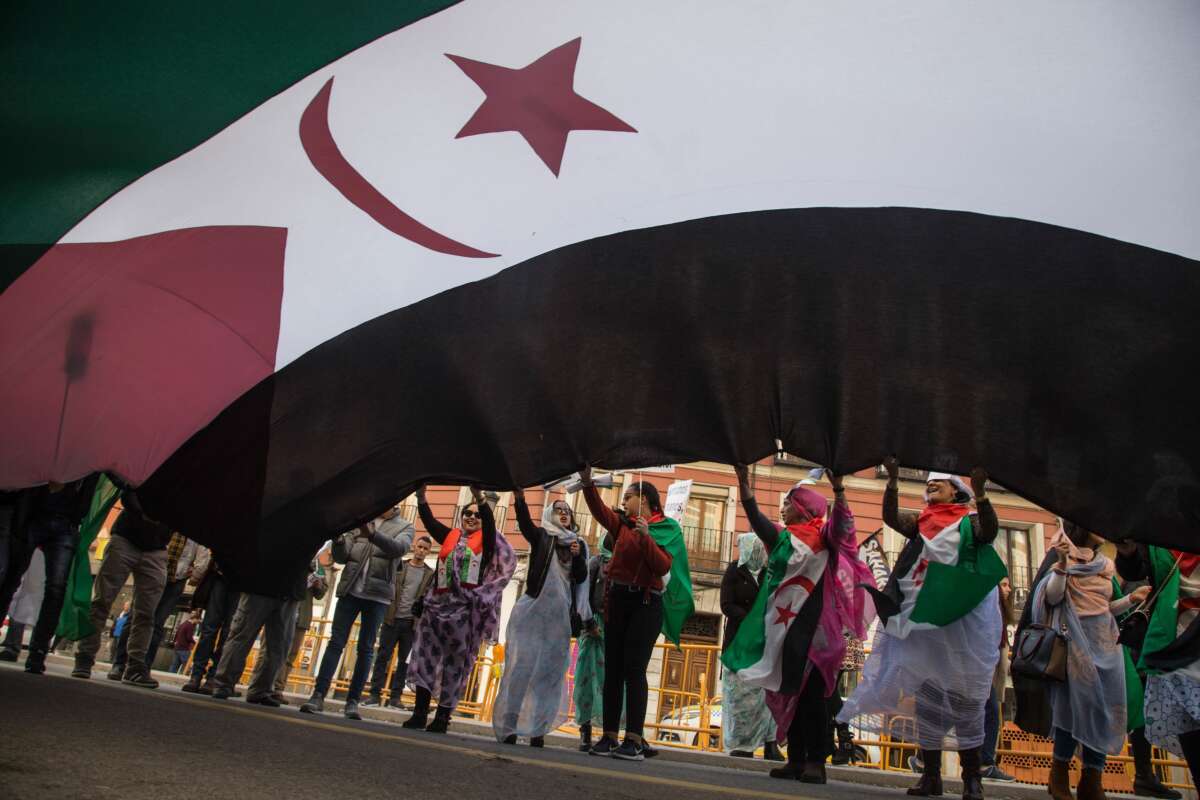
Saharawi women in exile wave a huge flag of Western Sahara during a demonstration calling for the end of the Moroccan occupation and the independence of Western Sahara, in Madrid, Spain, on November 17, 2018.
Lito Lizana / SOPA Images / LightRocket via Getty Images
Truthout is an indispensable resource for activists, movement leaders and workers everywhere. Please make this work possible with a quick donation.
Western Sahara is a sparsely populated country roughly the size of Colorado, located in northwestern Africa, just south of Morocco. It’s inhabited by a traditionally nomadic people known as Sahrawis, who have a distinct history, culture, and dialect. The land is currently under the occupation of Moroccan forces who moved into Western Sahara in 1975 in violation of a landmark decision by the International Court of Justice and a series of United Nations Security Council resolutions which have called for the withdrawal of foreign forces and the recognition of the right of the people of Western Sahara for self-determination.
Efforts to enforce these resolutions, however, have been blocked by France and the United States. In 1991, the United Nations ordered a ceasefire to be monitored by the peacekeeping force known as MINURSO (the United Nations Mission for the Referendum in Western Sahara), but Morocco prevented the scheduled referendum on self-determination from taking place. Despite the efforts of intergovernmental organizations and civil society, Morocco has continued to ignore human rights concerns expressed by UN agencies, Amnesty International, Human Rights Watch, and others. Further, Morocco’s Western government supporters have helped facilitate the monarchy’s lack of cooperation and adherence to global governance.
Christopher Nolan’s most recent film The Odyssey was partially filmed in Western Sahara and his production team took nearly a week shooting scenes by the coastal city of Dakhla. The choice to film in a territory under foreign belligerent occupation has led to calls for a boycott from human rights groups, arguing that the film gives legitimacy to the Moroccan government’s ongoing violations of international law and mistreatment of the Indigenous Sahrawi population. In this interview, political scientist and Truthout contributor Stephen Zunes provides more insight into the issue with the geopolitics of film in the region.
Daniel Falcone: Christopher Nolan’s The Odyssey reportedly filmed scenes in Moroccan-controlled Western Sahara. Can you describe the criticism coming from Sahrawi writers and activists? What responsibilities do artists/filmmakers have in territories that are occupied?
Stephen Zunes: In accepting generous subsidies from the Moroccan regime, the film’s producers have provided legitimacy to the illegal occupation. It would be the equivalent of filming in Israeli- or Russian-occupied territories in collaboration with those governments. The producers of The Odyssey are siding with the Trump administration in undermining international law and helping the repressive Moroccan monarchy tighten its grip on the territory. Freedom House, Human Rights Watch, and other human rights groups have ranked Moroccan-occupied Western Sahara as among the most politically repressed nations in the world. Since any protest within the occupied territory is not tolerated, it is imperative that global civil society mobilize against this injustice.
Morocco wants to turn the Dakhla region, where some segments of the movie were filmed, into a major tourist destination and film set. Already, airlines like RyanAir and Transavia as well as major booking agencies like Expedia, Trivago, and Booking.com are listing the Dakhla area as being in “Morocco.” Just recently, Donald Trump has praised the planned construction of a major coastal highway connecting Morocco with Dakhla, which he says will be named after him as a result of his support for the monarchy.
And this normalization of Morocco’s illegal occupation makes it all the easier for the likes of Putin and Netanyahu to consolidate their illegal occupations as well.
Mohamed Sleiman Labat wrote that the use of Western Sahara as a film set helps to erase a brutal journey. Can you think of any comparable previous cultural productions that failed to challenge systems?
Human rights groups have ranked Moroccan-occupied Western Sahara as among the most politically repressed nations in the world. Since any protest within the occupied territory is not tolerated, it is imperative that global civil society mobilize against this injustice.
As part of an effort to normalize the white South African’s grand apartheid scheme, the supposedly independent tribal homeland of Bophuthatswana hosted a luxury gambling and entertainment complex known as Sun City. A number of prominent entertainers — including Frank Sinatra, The Beach Boys, Linda Ronstadt, Cher, Liza Minnelli, Paul Anka, Rod Stewart, Elton John, Olivia Newton-John, Kenny Rogers, and Queen — ignored calls for a boycott. In reaction, Steven Van Zandt organized a group of leading musicians that became known as Artists United Against Apartheid which produced an album, concert, and documentary that raised over $1 million to support anti-apartheid activism.
Overall, though, it’s been rare for artists to so flagrantly give legitimacy to such a clear injustice. They are better known to give support for movements for justice.
In addition to the struggle for a free South Africa, cultural workers have used their celebrity to mobilize opposition to the Vietnam War, U.S. intervention in Central America, and increasingly Israel’s wars and occupations and advance these causes in the popular imagination. It is very unfortunate that Nolan, using his star-studded cast — a number of whom have supported progressive causes in the past — to effectively legitimize such a brutal military occupation.
You’ve written a lot on Western Sahara and international humanitarian law. How do the politics of the film relate to your work?
Calls for an international boycott of The Odyssey are growing in reaction to Nolan’s decision to shoot key segments of the film in that occupied nation. Western Sahara has a functioning government administering liberated zones and refugee camps serving roughly 40 percent of the nation’s population; is a full member state of the African Union; and has been recognized by scores of countries around the world. Meanwhile, three-quarters of the country, including the coastal areas where the filming took place, is under a repressive military occupation by the Kingdom of Morocco. The United States and Israel are the world’s only two nations to formally recognize Western Sahara as part of Morocco, which the monarchy illegally annexed following its 1975 invasion of its southern neighbor.
The United States and Israel are the world’s only two nations to formally recognize Western Sahara as part of Morocco.
The closing credits of The Odyssey claim that — in addition to segments filmed in Greece, Italy, Scotland, and Iceland — it was filmed in Morocco. Some scenes were indeed within Morocco, but the pristine beach of “Ogygia” and related segments were filmed in the occupied territory. No international organization recognizes Western Sahara as part of Morocco, but the film producers have sided with Trump, Netanyahu, and the Moroccan monarchy by essentially claiming that it is.
There are reasonable debates about whether or not a film should be shot in certain countries under authoritarian rule or pursuing other controversial policies. However, the inappropriateness of filming in territories under a foreign belligerent occupation with close collaboration with occupying authorities and without the input of the people or the recognized government of the territory should be a no-brainer.
To what extent does art remain inseparable from politics?
Decisions by artists and their producers can have significant political impact. It is harder to challenge bad decisions by politicians, such as Trump’s recognition of Morocco’s illegal annexation, if artists are seen to be supporting them. And because the general public is often more attuned to works of art (such as a major film adaptation of a classic tale) than foreign policy debates (such as those of the status of an occupied nation in northwest Africa), decisions by these artists and producers can either advance or harm movements for justice.In Europe, where the issue of Western Sahara is far more prominent than in the United States, cultural workers have been in the forefront of anti-occupation activism. These have included such prominent actors as Javier Bardem and Penelope Cruz, both Academy Award winners. Bardem and others have published an open letter critical of Nolan’s decision. Each year, the Western Sahara International Film Festival (FiSahara) takes place in the refugee camps in neighboring Algeria, bringing film screenings, roundtables, workshops, concerts, and other cultural events, attracting prominent actors, directors, producers, and musicians. Such efforts have done a lot to raise awareness of the plight of the people of Western Sahara, particularly in Spain, the former colonial power.
Can this controversy help bring attention to the Sahrawi people? What makes this issue more difficult than films related to the politics of South Africa or Palestine?
Unlike previous struggles in South Africa, Central America, and Vietnam, or today in Israel/Palestine, Western Sahara is not that well-known. Since the U.S. recognition of Morocco’s illegal annexation during Trump’s first term, U.S. government maps and various media have shown Western Sahara as part of Morocco with no recognition of its legal status as a non-self-governing territory under a foreign belligerent occupation. It is quite possible that many of the actors and crew of The Odyssey were unaware of what they were doing.
Since Western Sahara is in the news so rarely, perhaps all the attention being given to The Odyssey might provide a rare opening for those who do care about international law and human rights to push the call for a boycott. While a boycott will probably do little to dent the profits from what is already becoming a blockbuster film, it can call attention to the plight of those suffering under occupation and the complicity of the U.S. government — and Hollywood — in attempting to legitimize the criminal expansion of territory by military force.
This article is licensed under Creative Commons (CC BY-NC-ND 4.0), and you are free to share and republish under the terms of the license.
Truthout is an indispensable resource for activists, movement leaders and workers everywhere. Please make this work possible with a quick donation.
Western Sahara is a sparsely populated country roughly the size of Colorado, located in northwestern Africa, just south of Morocco. It’s inhabited by a traditionally nomadic people known as Sahrawis, who have a distinct history, culture, and dialect. The land is currently under the occupation of Moroccan forces who moved into Western Sahara in 1975 in violation of a landmark decision by the International Court of Justice and a series of United Nations Security Council resolutions which have called for the withdrawal of foreign forces and the recognition of the right of the people of Western Sahara for self-determination.
Efforts to enforce these resolutions, however, have been blocked by France and the United States. In 1991, the United Nations ordered a ceasefire to be monitored by the peacekeeping force known as MINURSO (the United Nations Mission for the Referendum in Western Sahara), but Morocco prevented the scheduled referendum on self-determination from taking place. Despite the efforts of intergovernmental organizations and civil society, Morocco has continued to ignore human rights concerns expressed by UN agencies, Amnesty International, Human Rights Watch, and others. Further, Morocco’s Western government supporters have helped facilitate the monarchy’s lack of cooperation and adherence to global governance.
Christopher Nolan’s most recent film The Odyssey was partially filmed in Western Sahara and his production team took nearly a week shooting scenes by the coastal city of Dakhla. The choice to film in a territory under foreign belligerent occupation has led to calls for a boycott from human rights groups, arguing that the film gives legitimacy to the Moroccan government’s ongoing violations of international law and mistreatment of the Indigenous Sahrawi population. In this interview, political scientist and Truthout contributor Stephen Zunes provides more insight into the issue with the geopolitics of film in the region.
Daniel Falcone: Christopher Nolan’s The Odyssey reportedly filmed scenes in Moroccan-controlled Western Sahara. Can you describe the criticism coming from Sahrawi writers and activists? What responsibilities do artists/filmmakers have in territories that are occupied?
Stephen Zunes: In accepting generous subsidies from the Moroccan regime, the film’s producers have provided legitimacy to the illegal occupation. It would be the equivalent of filming in Israeli- or Russian-occupied territories in collaboration with those governments. The producers of The Odyssey are siding with the Trump administration in undermining international law and helping the repressive Moroccan monarchy tighten its grip on the territory. Freedom House, Human Rights Watch, and other human rights groups have ranked Moroccan-occupied Western Sahara as among the most politically repressed nations in the world. Since any protest within the occupied territory is not tolerated, it is imperative that global civil society mobilize against this injustice.
Morocco wants to turn the Dakhla region, where some segments of the movie were filmed, into a major tourist destination and film set. Already, airlines like RyanAir and Transavia as well as major booking agencies like Expedia, Trivago, and Booking.com are listing the Dakhla area as being in “Morocco.” Just recently, Donald Trump has praised the planned construction of a major coastal highway connecting Morocco with Dakhla, which he says will be named after him as a result of his support for the monarchy.
And this normalization of Morocco’s illegal occupation makes it all the easier for the likes of Putin and Netanyahu to consolidate their illegal occupations as well.
Mohamed Sleiman Labat wrote that the use of Western Sahara as a film set helps to erase a brutal journey. Can you think of any comparable previous cultural productions that failed to challenge systems?
Human rights groups have ranked Moroccan-occupied Western Sahara as among the most politically repressed nations in the world. Since any protest within the occupied territory is not tolerated, it is imperative that global civil society mobilize against this injustice.
As part of an effort to normalize the white South African’s grand apartheid scheme, the supposedly independent tribal homeland of Bophuthatswana hosted a luxury gambling and entertainment complex known as Sun City. A number of prominent entertainers — including Frank Sinatra, The Beach Boys, Linda Ronstadt, Cher, Liza Minnelli, Paul Anka, Rod Stewart, Elton John, Olivia Newton-John, Kenny Rogers, and Queen — ignored calls for a boycott. In reaction, Steven Van Zandt organized a group of leading musicians that became known as Artists United Against Apartheid which produced an album, concert, and documentary that raised over $1 million to support anti-apartheid activism.
Overall, though, it’s been rare for artists to so flagrantly give legitimacy to such a clear injustice. They are better known to give support for movements for justice.
In addition to the struggle for a free South Africa, cultural workers have used their celebrity to mobilize opposition to the Vietnam War, U.S. intervention in Central America, and increasingly Israel’s wars and occupations and advance these causes in the popular imagination. It is very unfortunate that Nolan, using his star-studded cast — a number of whom have supported progressive causes in the past — to effectively legitimize such a brutal military occupation.
You’ve written a lot on Western Sahara and international humanitarian law. How do the politics of the film relate to your work?
Calls for an international boycott of The Odyssey are growing in reaction to Nolan’s decision to shoot key segments of the film in that occupied nation. Western Sahara has a functioning government administering liberated zones and refugee camps serving roughly 40 percent of the nation’s population; is a full member state of the African Union; and has been recognized by scores of countries around the world. Meanwhile, three-quarters of the country, including the coastal areas where the filming took place, is under a repressive military occupation by the Kingdom of Morocco. The United States and Israel are the world’s only two nations to formally recognize Western Sahara as part of Morocco, which the monarchy illegally annexed following its 1975 invasion of its southern neighbor.
The United States and Israel are the world’s only two nations to formally recognize Western Sahara as part of Morocco.
The closing credits of The Odyssey claim that — in addition to segments filmed in Greece, Italy, Scotland, and Iceland — it was filmed in Morocco. Some scenes were indeed within Morocco, but the pristine beach of “Ogygia” and related segments were filmed in the occupied territory. No international organization recognizes Western Sahara as part of Morocco, but the film producers have sided with Trump, Netanyahu, and the Moroccan monarchy by essentially claiming that it is.
There are reasonable debates about whether or not a film should be shot in certain countries under authoritarian rule or pursuing other controversial policies. However, the inappropriateness of filming in territories under a foreign belligerent occupation with close collaboration with occupying authorities and without the input of the people or the recognized government of the territory should be a no-brainer.
To what extent does art remain inseparable from politics?
Decisions by artists and their producers can have significant political impact. It is harder to challenge bad decisions by politicians, such as Trump’s recognition of Morocco’s illegal annexation, if artists are seen to be supporting them. And because the general public is often more attuned to works of art (such as a major film adaptation of a classic tale) than foreign policy debates (such as those of the status of an occupied nation in northwest Africa), decisions by these artists and producers can either advance or harm movements for justice.In Europe, where the issue of Western Sahara is far more prominent than in the United States, cultural workers have been in the forefront of anti-occupation activism. These have included such prominent actors as Javier Bardem and Penelope Cruz, both Academy Award winners. Bardem and others have published an open letter critical of Nolan’s decision. Each year, the Western Sahara International Film Festival (FiSahara) takes place in the refugee camps in neighboring Algeria, bringing film screenings, roundtables, workshops, concerts, and other cultural events, attracting prominent actors, directors, producers, and musicians. Such efforts have done a lot to raise awareness of the plight of the people of Western Sahara, particularly in Spain, the former colonial power.
Can this controversy help bring attention to the Sahrawi people? What makes this issue more difficult than films related to the politics of South Africa or Palestine?
Unlike previous struggles in South Africa, Central America, and Vietnam, or today in Israel/Palestine, Western Sahara is not that well-known. Since the U.S. recognition of Morocco’s illegal annexation during Trump’s first term, U.S. government maps and various media have shown Western Sahara as part of Morocco with no recognition of its legal status as a non-self-governing territory under a foreign belligerent occupation. It is quite possible that many of the actors and crew of The Odyssey were unaware of what they were doing.
Since Western Sahara is in the news so rarely, perhaps all the attention being given to The Odyssey might provide a rare opening for those who do care about international law and human rights to push the call for a boycott. While a boycott will probably do little to dent the profits from what is already becoming a blockbuster film, it can call attention to the plight of those suffering under occupation and the complicity of the U.S. government — and Hollywood — in attempting to legitimize the criminal expansion of territory by military force.
This article is licensed under Creative Commons (CC BY-NC-ND 4.0), and you are free to share and republish under the terms of the license.
Daniel Falcone
Daniel Falcone is a historian specializing in the revolutions of 1848 and the political refugees who sought asylum in New York City. His academic work focuses on Giuseppe Garibaldi’s influence on New York’s local history and the politics of memory in the nineteenth and twentieth centuries. Aside from his research, he is a teacher and journalist whose work has appeared in The Journal of Contemporary Iraq & the Arab World, The Nation, Jacobin and CounterPunch. His writing and interviews intersect history with modern-day geopolitical issues.

No comments:
Post a Comment