What will help prevent future outbreaks is restoring and expanding regulatory agencies tracking infectious outbreaks, and breaking up food monopolies while sustaining and strengthening small farms.

Lettuce is shown in a bowl.
(Photo by Petr on Unsplash)
Sonali Kolhatkar
Jul 29, 2026
OtherWords
The recent, record-breaking outbreak of Cyclospora infections linked to lettuce consumption has left Americans wondering what food is safe to eat.
What brands of lettuce are safe and which aren’t are important questions. But even more important might be why such outbreaks happen in the first place—and how our government has made them increasingly likely.
Nobody wants explosive diarrhea—and yet the way our federal government has left us unprotected is enough to make one sick.
The chief culprit in the cyclosporiasis debacle is our centralized, monopoly-based food system. The outbreak has been linked to Taylor Fresh Foods, which supplies many restaurants. Many brands of bagged lettuce and salad are also Taylor products—whether consumers realize it or not.
Last year the administration weakened the nation’s already thin food safety monitoring service, FoodNet, by making it optional to track numerous types of infections—including cyclosporiasis.
In fact, according to Farm Action, “Just four companies—Taylor Fresh Foods, Cultrale-Safra, Itochu, and Bonduelle—control 54% of the US fresh-cut salad market.” Similarly, only a handful of corporations control meat, dairy, grains, and beverages. Another handful controls food distribution.
This means that the industry practices giving rise to contaminated foods happen on a very large scale—and those foods are then distributed all over the country. That a single outbreak in one company can potentially impact the entire nation is a grave weakness in the food system.
Monopolies like Taylor Farms use the profits they generate from dominating our food supplies to lobby the federal government for weaker oversight. According to Wired, the company has contributed millions of dollars to conservative political committees, including a super PAC called MAGA Inc.
It has also spent hundreds of thousands of dollars to directly lobby against food safety regulations. News even emerged recently of representatives from Taylor Farms calling the White House to try to delay a recall of their lettuce.
The Trump administration has been more than happy to comply with Big Food’s wishes to reap billions in profits with little oversight.
Last year the administration weakened the nation’s already thin food safety monitoring service, FoodNet, by making it optional to track numerous types of infections—including cyclosporiasis. “We’re really gutting one of the cornerstones of food safety,” epidemiologist Elaine Scallan Walter warned The New York Times last September.
Mega monopolies aren’t just bad for our gut. They also contribute to higher prices and reduced access to fresh foods.
Their sheer size gives them what Civil Eats called “enormous power to make decisions about what food is produced how, where, and by whom, and who gets to eat it.” Big Food companies have repeatedly been found guilty of illegal price fixing. They routinely package the same foods under different labels to give the impression of diversity and competition.
Small farms are one important solution. Their supply chains are localized, making it easier to track and stop infections before they spread on a national scale. Independent farmers are selling out of lettuce at farmers markets as people seek out clean greens.
Yet instead of promoting and aiding small farmers—as he promised to do when running for president in 2024—President Donald Trump has cut back support for training new farmers, who might be competitors to companies like Taylor Farms.
His administration also cut a program that matched small producers with food banks—feeding hungry people while financially stabilizing independent farmers—along with a disaster aid program for minority farmers. The funding losses have left small farmers reeling.
What will help prevent future outbreaks is restoring and expanding regulatory agencies tracking infectious outbreaks. And breaking up food monopolies while sustaining and strengthening small farms.
The question is: Will the federal government have the guts to do what it takes to protect the American people’s guts?
The recent, record-breaking outbreak of Cyclospora infections linked to lettuce consumption has left Americans wondering what food is safe to eat.
What brands of lettuce are safe and which aren’t are important questions. But even more important might be why such outbreaks happen in the first place—and how our government has made them increasingly likely.
Nobody wants explosive diarrhea—and yet the way our federal government has left us unprotected is enough to make one sick.
The chief culprit in the cyclosporiasis debacle is our centralized, monopoly-based food system. The outbreak has been linked to Taylor Fresh Foods, which supplies many restaurants. Many brands of bagged lettuce and salad are also Taylor products—whether consumers realize it or not.
Last year the administration weakened the nation’s already thin food safety monitoring service, FoodNet, by making it optional to track numerous types of infections—including cyclosporiasis.
In fact, according to Farm Action, “Just four companies—Taylor Fresh Foods, Cultrale-Safra, Itochu, and Bonduelle—control 54% of the US fresh-cut salad market.” Similarly, only a handful of corporations control meat, dairy, grains, and beverages. Another handful controls food distribution.
This means that the industry practices giving rise to contaminated foods happen on a very large scale—and those foods are then distributed all over the country. That a single outbreak in one company can potentially impact the entire nation is a grave weakness in the food system.
Monopolies like Taylor Farms use the profits they generate from dominating our food supplies to lobby the federal government for weaker oversight. According to Wired, the company has contributed millions of dollars to conservative political committees, including a super PAC called MAGA Inc.
It has also spent hundreds of thousands of dollars to directly lobby against food safety regulations. News even emerged recently of representatives from Taylor Farms calling the White House to try to delay a recall of their lettuce.
The Trump administration has been more than happy to comply with Big Food’s wishes to reap billions in profits with little oversight.
Last year the administration weakened the nation’s already thin food safety monitoring service, FoodNet, by making it optional to track numerous types of infections—including cyclosporiasis. “We’re really gutting one of the cornerstones of food safety,” epidemiologist Elaine Scallan Walter warned The New York Times last September.
Mega monopolies aren’t just bad for our gut. They also contribute to higher prices and reduced access to fresh foods.
Their sheer size gives them what Civil Eats called “enormous power to make decisions about what food is produced how, where, and by whom, and who gets to eat it.” Big Food companies have repeatedly been found guilty of illegal price fixing. They routinely package the same foods under different labels to give the impression of diversity and competition.
Small farms are one important solution. Their supply chains are localized, making it easier to track and stop infections before they spread on a national scale. Independent farmers are selling out of lettuce at farmers markets as people seek out clean greens.
Yet instead of promoting and aiding small farmers—as he promised to do when running for president in 2024—President Donald Trump has cut back support for training new farmers, who might be competitors to companies like Taylor Farms.
His administration also cut a program that matched small producers with food banks—feeding hungry people while financially stabilizing independent farmers—along with a disaster aid program for minority farmers. The funding losses have left small farmers reeling.
What will help prevent future outbreaks is restoring and expanding regulatory agencies tracking infectious outbreaks. And breaking up food monopolies while sustaining and strengthening small farms.
The question is: Will the federal government have the guts to do what it takes to protect the American people’s guts?
Disease Researchers Blame DOGE Cuts for Spiraling Cyclospora Outbreak
Public health agencies are struggling to mount an effective response with less resources and fewer staff.
By Sasha Abramsky ,
Public health agencies are struggling to mount an effective response with less resources and fewer staff.
By Sasha Abramsky ,
July 29, 2026
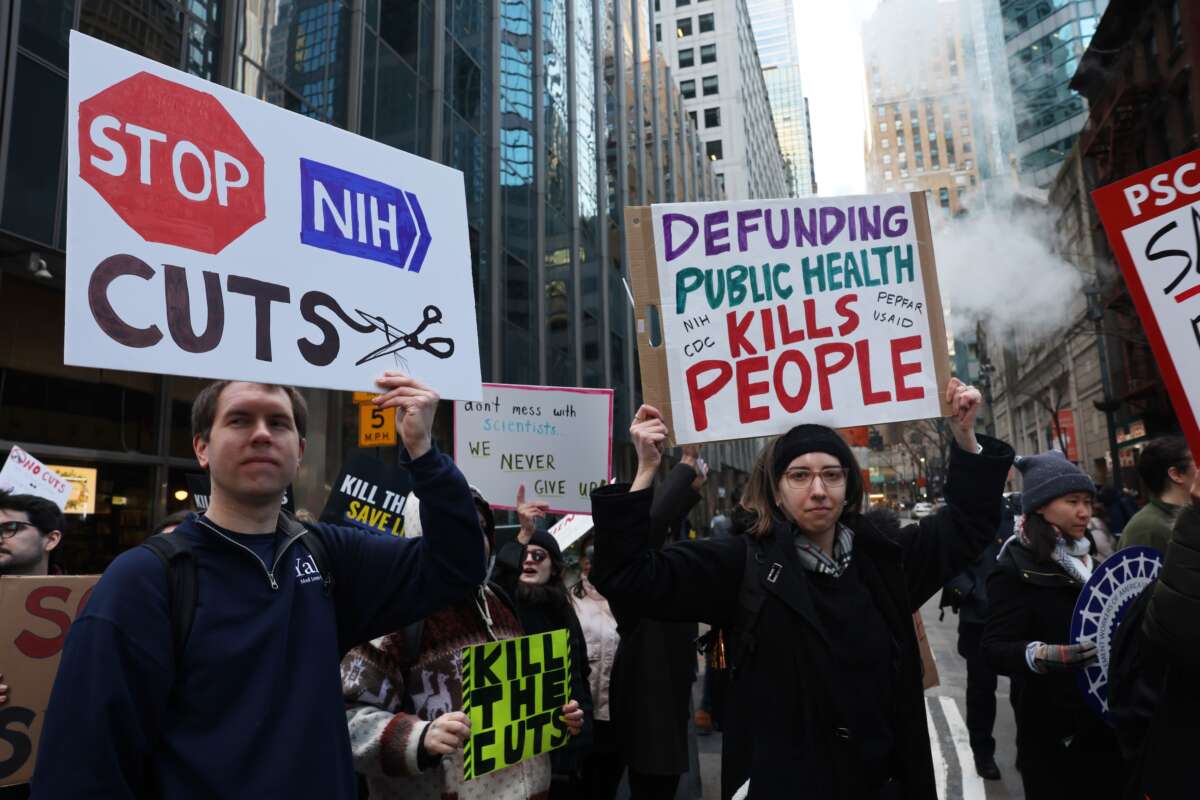
Protesters rally to demand an end to DOGE’s and the Trump administration’s cuts to funding for science, research, education, and other areas, on April 8, 2025, in New York City.Spencer Platt / Getty Images
As the diarrhea-causing cyclospora parasite continues to spread through the U.S., now having sickened an estimated 11,500 Americans in at least nine states since May, it is becoming increasingly clear that the situation has been massively worsened by the actions of the “Department of Government Efficiency” (DOGE) over the past 18 months.
CNN reported last week that cuts to the Centers for Disease Control and Prevention (CDC) have created a “perfect storm” in which the outbreak could go from a minor inconvenience to a national public health crisis within a matter of weeks. DOGE cut eight of the 11 jobs at the CDC lab specializing in cyclospora. Meanwhile, the rapid dismantling of the U.S. Agency for International Development (USAID), which shared facilities and personnel with the State Department and CDC, also led to the loss of many of the experts and labs dealing with exotic diseases stateside, such as cyclospora. Take down USAID — an act that DOGE marketed as being about snuffing out supposedly bloated foreign aid programs — and there’s a guaranteed impact on the CDC and on the health of Americans stateside.
Add in additional cuts to a range of CDC offices, and the result is a disaster in the making.
Dan Jernigan, former director of the CDC’s National Center for Emerging and Zoonotic Infectious Diseases, told Truthout that the CDC’s Division of Parasitic Diseases and Malaria lost much of its funding, as did the CDC’s office for neglected tropical diseases. While those offices didn’t directly fund cyclospora research, many of their scientists had specialty knowledge of parasites such as the one that causes cyclospora — and could be called on to share that knowledge during an outbreak.
DOGE cut eight of the 11 jobs at the CDC lab specializing in cyclospora.
The Division of Parasitic Diseases and Malaria has “taken a hit because of DOGE[’s] USAID cuts and the hiring freeze [for the CDC],” notes Jernigan. “Because of that, there were fewer people to respond to the cyclospora outbreak when it was first detected.”
Taken as a whole, the result of the assault on USAID and on the CDC is that under-resourced, under-staffed labs are struggling to test all the samples that need to be tested for cyclospora to stop the spread of the parasite and to work out its origins — for while the largest outbreak has been traced to iceberg lettuce from a facility in central Mexico run by produce giant Taylor Farms, multiple cyclospora investigations are also underway for other outbreaks spread by as-yet-unidentified sources.

Musk Says He Got “Carried Away” With DOGE Cuts, Which Are Set to Kill Millions
Research last year found that, by 2030, DOGE cuts could kill 14 million, including 4.5 million children under 5. By Sharon Zhang , Truthout July 27, 2026
Jernigan, who resigned last year after the Trump administration fired the CDC director, estimates that 73 scientists at the CDC were being funded by USAID dollars before DOGE’s cuts. Today, only 38 of those scientists remain at the agency. Labs that could monitor cyclospora aren’t fully functional; many contractors have lost their government contracts; and so-called Title 42 hires — scientists hired on renewable short-term contracts — have had their appointments lapse.
Seventy-three scientists at the CDC were being funded by USAID dollars before DOGE’s cuts. Today, only 38 of those scientists remain at the agency.
The result is chaos. Put simply, the U.S. government’s top public health agencies are struggling to mount an effective response in the face of emerging biological threats. Indeed, in many instances, the government has simply abandoned the field.
Under Robert F. Kennedy Jr.’s leadership, the CDC’s FoodNet partnership with the Food and Drug Administration, U.S. Department of Agriculture, and 10 state health departments no longer mandates the tracking of cyclospora, focusing only on salmonella and E. coli outbreaks. This makes it harder both to identify an outbreak in its early stages and to track its development and push for successful interventions.
In 2025, the federal government slashed $11 billion in funds for state and local public health systems. Not surprisingly, even big states such as California are struggling mightily to plug these funding holes — a situation made worse by explicitly political efforts by the Trump administration to withhold medical and research dollars from blue states as punishment for not toeing the line on immigration and other policies.
A year ago, as I was writing on the DOGE purges for my book American Carnage, one of the fired federal workers whom I spoke with told me that he and his colleagues kept coming back to a single phrase: “Fuck around and find out.” If you cut federal government services to the bone, he explained, eventually the consequences will be extreme. We are seeing that now in the realm of public health: Since Donald Trump got back into power and unleashed DOGE on the federal workforce, the dismantling of public health infrastructure has led to the U.S.’s worst measles outbreak in decades; escalating numbers of whooping cough cases among children; the reemergence, after 60 years in which it had been eliminated, of screwworm within the country’s cattle herds; and now, a cyclospora outbreak that has sent thousands to hospital and that shows no sign of ending anytime soon.
If you cut federal government services to the bone eventually the consequences will be extreme. We are seeing that now in the realm of public health.
Overseas, as I reported for Truthout earlier this year, the CDC monitoring systems that could have detected, early on, the ongoing Ebola outbreak, were largely shuttered — leading to an uncontained outbreak that now impacts many countries in central Africa.
Polio, which since the early 1990s has been almost entirely eliminated globally, is also making a comeback, albeit still of a limited nature, in countries no longer assisted by USAID medical expertise and vaccine distribution. Many of these countries are also receiving less funding from the U.K., which historically has been a huge funder of polio vaccination campaigns but is scaling back its foreign aid commitments in the face of relentless pressure from the Trump administration to divert funds to military spending.
Taken as a whole, these cascading public health crises point to a system that is being bent to the breaking point. On top of that, the Trump administration’s revision of rules for federal grants and increased scrutiny of projects funded by the National Institutes of Health makes it extraordinarily hard for universities and research teams to staff their laboratories. Without a steady stream of grants, “we essentially have to turn the lights off,” Sarah Ewald, associate professor of immunology, microbiology, and cancer biology at the University of Virginia, explained to Truthout. “There’ve just been massive delays in terms of funding for basic research.” As a result, it has become harder for clinicians and researchers to work out the “frequency of disease incidences and whether they’re reaching outbreak levels.”
Making a bad situation worse, disease outbreaks are taking place in the months after the Trump administration succeeded in convincing the GOP majority in Congress not to vote to extend Affordable Care Act (ACA) credits, leading to more than 2.6 million people losing their ACA health insurance coverage. In consequence, cyclospora victims who have lost insurance now may need to fall back on visits to the emergency room for treatment.
By any measure, all of this is an extraordinarily expensive and ineffective way for the world’s richest nation to deal with a foodborne disease outbreak. Trump and RFK Jr. promised to “make America healthy again.” They are, it is now clear, falling woefully short in realizing this promise.
As the diarrhea-causing cyclospora parasite continues to spread through the U.S., now having sickened an estimated 11,500 Americans in at least nine states since May, it is becoming increasingly clear that the situation has been massively worsened by the actions of the “Department of Government Efficiency” (DOGE) over the past 18 months.
CNN reported last week that cuts to the Centers for Disease Control and Prevention (CDC) have created a “perfect storm” in which the outbreak could go from a minor inconvenience to a national public health crisis within a matter of weeks. DOGE cut eight of the 11 jobs at the CDC lab specializing in cyclospora. Meanwhile, the rapid dismantling of the U.S. Agency for International Development (USAID), which shared facilities and personnel with the State Department and CDC, also led to the loss of many of the experts and labs dealing with exotic diseases stateside, such as cyclospora. Take down USAID — an act that DOGE marketed as being about snuffing out supposedly bloated foreign aid programs — and there’s a guaranteed impact on the CDC and on the health of Americans stateside.
Add in additional cuts to a range of CDC offices, and the result is a disaster in the making.
Dan Jernigan, former director of the CDC’s National Center for Emerging and Zoonotic Infectious Diseases, told Truthout that the CDC’s Division of Parasitic Diseases and Malaria lost much of its funding, as did the CDC’s office for neglected tropical diseases. While those offices didn’t directly fund cyclospora research, many of their scientists had specialty knowledge of parasites such as the one that causes cyclospora — and could be called on to share that knowledge during an outbreak.
DOGE cut eight of the 11 jobs at the CDC lab specializing in cyclospora.
The Division of Parasitic Diseases and Malaria has “taken a hit because of DOGE[’s] USAID cuts and the hiring freeze [for the CDC],” notes Jernigan. “Because of that, there were fewer people to respond to the cyclospora outbreak when it was first detected.”
Taken as a whole, the result of the assault on USAID and on the CDC is that under-resourced, under-staffed labs are struggling to test all the samples that need to be tested for cyclospora to stop the spread of the parasite and to work out its origins — for while the largest outbreak has been traced to iceberg lettuce from a facility in central Mexico run by produce giant Taylor Farms, multiple cyclospora investigations are also underway for other outbreaks spread by as-yet-unidentified sources.
Musk Says He Got “Carried Away” With DOGE Cuts, Which Are Set to Kill Millions
Research last year found that, by 2030, DOGE cuts could kill 14 million, including 4.5 million children under 5. By Sharon Zhang , Truthout July 27, 2026
Jernigan, who resigned last year after the Trump administration fired the CDC director, estimates that 73 scientists at the CDC were being funded by USAID dollars before DOGE’s cuts. Today, only 38 of those scientists remain at the agency. Labs that could monitor cyclospora aren’t fully functional; many contractors have lost their government contracts; and so-called Title 42 hires — scientists hired on renewable short-term contracts — have had their appointments lapse.
Seventy-three scientists at the CDC were being funded by USAID dollars before DOGE’s cuts. Today, only 38 of those scientists remain at the agency.
The result is chaos. Put simply, the U.S. government’s top public health agencies are struggling to mount an effective response in the face of emerging biological threats. Indeed, in many instances, the government has simply abandoned the field.
Under Robert F. Kennedy Jr.’s leadership, the CDC’s FoodNet partnership with the Food and Drug Administration, U.S. Department of Agriculture, and 10 state health departments no longer mandates the tracking of cyclospora, focusing only on salmonella and E. coli outbreaks. This makes it harder both to identify an outbreak in its early stages and to track its development and push for successful interventions.
In 2025, the federal government slashed $11 billion in funds for state and local public health systems. Not surprisingly, even big states such as California are struggling mightily to plug these funding holes — a situation made worse by explicitly political efforts by the Trump administration to withhold medical and research dollars from blue states as punishment for not toeing the line on immigration and other policies.
A year ago, as I was writing on the DOGE purges for my book American Carnage, one of the fired federal workers whom I spoke with told me that he and his colleagues kept coming back to a single phrase: “Fuck around and find out.” If you cut federal government services to the bone, he explained, eventually the consequences will be extreme. We are seeing that now in the realm of public health: Since Donald Trump got back into power and unleashed DOGE on the federal workforce, the dismantling of public health infrastructure has led to the U.S.’s worst measles outbreak in decades; escalating numbers of whooping cough cases among children; the reemergence, after 60 years in which it had been eliminated, of screwworm within the country’s cattle herds; and now, a cyclospora outbreak that has sent thousands to hospital and that shows no sign of ending anytime soon.
If you cut federal government services to the bone eventually the consequences will be extreme. We are seeing that now in the realm of public health.
Overseas, as I reported for Truthout earlier this year, the CDC monitoring systems that could have detected, early on, the ongoing Ebola outbreak, were largely shuttered — leading to an uncontained outbreak that now impacts many countries in central Africa.
Polio, which since the early 1990s has been almost entirely eliminated globally, is also making a comeback, albeit still of a limited nature, in countries no longer assisted by USAID medical expertise and vaccine distribution. Many of these countries are also receiving less funding from the U.K., which historically has been a huge funder of polio vaccination campaigns but is scaling back its foreign aid commitments in the face of relentless pressure from the Trump administration to divert funds to military spending.
Taken as a whole, these cascading public health crises point to a system that is being bent to the breaking point. On top of that, the Trump administration’s revision of rules for federal grants and increased scrutiny of projects funded by the National Institutes of Health makes it extraordinarily hard for universities and research teams to staff their laboratories. Without a steady stream of grants, “we essentially have to turn the lights off,” Sarah Ewald, associate professor of immunology, microbiology, and cancer biology at the University of Virginia, explained to Truthout. “There’ve just been massive delays in terms of funding for basic research.” As a result, it has become harder for clinicians and researchers to work out the “frequency of disease incidences and whether they’re reaching outbreak levels.”
Making a bad situation worse, disease outbreaks are taking place in the months after the Trump administration succeeded in convincing the GOP majority in Congress not to vote to extend Affordable Care Act (ACA) credits, leading to more than 2.6 million people losing their ACA health insurance coverage. In consequence, cyclospora victims who have lost insurance now may need to fall back on visits to the emergency room for treatment.
By any measure, all of this is an extraordinarily expensive and ineffective way for the world’s richest nation to deal with a foodborne disease outbreak. Trump and RFK Jr. promised to “make America healthy again.” They are, it is now clear, falling woefully short in realizing this promise.

No comments:
Post a Comment