Thursday, August 20, 2026


‘Speckles of hope’: What we learned from cycling the length of the drought-hit Danube

Anna and Callum cycled the Danube from source to sea.
Anna and Callum cycled the Danube from source to sea. Conservation Amplified


By Angela Symons
Published on

This couple cycled 3,000km along the Danube. Here's what drought looks like from the riverbank.

Cycling the Danube from source to sea, Anna and Callum were mid-trip when the river suddenly hit the headlines.

On 3 August, as drought worsened, authorities were forced to use a controlled explosion to redirect water towards Romania’s only nuclear power plant, which supplies 20 per cent of the country’s electricity and relies on the river for cooling.

“To me, it was that moment of, this is becoming real now: we are actively interfering in the river ecosystem to ensure that human electricity and power needs are being met,” recalls Anna Wentsch, the German-born co-founder of New Zealand charity Conservation Amplified.

While the measure was extraordinary, it still wasn’t enough: the plant was forced to shut down its final reactor on 13 August after it failed to maintain sufficient cooling water.

Together with her partner Callum Armstrong, Anna recently completed a 3,000-kilometre journey through 10 countries to find out how communities and nature are responding to drought on the EU’s longest river.

Danube drought impacts more than energy

Successive heatwaves and a severe lack of rainfall have driven Danube water levels to record lows this summer, with impacts not only on energy security but food, drinking water, transport and wildlife.

Romania isn’t the only country facing a drought-induced energy crisis. On 15 August, Hungarian authorities sank two barges in the Danube ​to raise the water level and prevent a shutdown of its only nuclear power plant.

Even more basic human needs have been hit, with farmers’ harvests devastated by dry soils. Hungarian winegrowers have already reported a 30 per cent drop in grape harvests.

Parched vegetation has also sparked wildfires – Anna and Callum witnessed one along their route in Serbia.

“It was hot, dry and windy,” recalls Callum. “Just seeing how dry the ground was – just a spark’s needed for it to go up in flames.”

For people who live in the area, these conditions are now just part of daily life. Knocking on a door to alert the nearby town, Callum and Anna were invited in by friendly locals who told them, “This is just normal, all the locals have called it in, people won’t respond until it actually gets to a really bad state.”

More than 580,000 hectares have now burned across the EU this year, according to the European Forest Fire Information System.
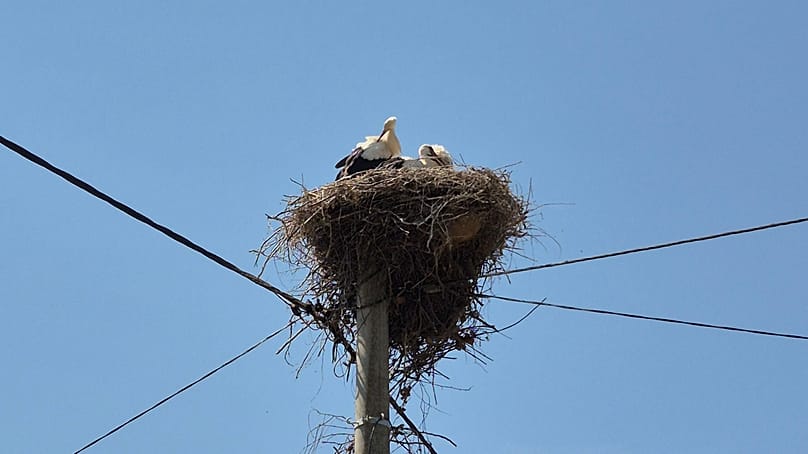
Storks nesting along the Danube in Croatia. Conservation Amplified

Panting birds and grounded boats: Life along the drought-hit Danube

At Germany’s Danube Gorge, Anna and Callum were confronted with another consequence of low water levels when their booked ferry was unable to run.

“We had to catch one of those small wooden boats because they were the only ones that were still able to operate,” says Anna.

While passenger ferries have run aground, freight traffic has also been brought to a standstill, with operators rerouting to avoid the dried-up waterway and grain harvests piled up at terminals – creating further food insecurity.

It’s not unique to the Danube: Germany has temporarily relaxed truck-driving restrictions to ease pressure on supply chains disrupted by record-low water levels on the Rhine.

But, for Anna, the impact on animals hit her hardest.

“We’ve seen a lot of wildlife, in particular birds, panting during the day. We’re obviously cycling in the heat, and we’re struggling. But then seeing them struggle is even worse,” she tells me by video call.

“We can take ourselves out of that environment and go into the shade, but for a stork, for example, that nests on an open platform, they don't have that ability.”

Extreme weather has hit a vast ecosystem already under strain: human infrastructure like power plants and dams has fragmented habitats, reducing biodiversity and disconnecting wetlands and floodplains that once acted as natural buffers against drought.

Witnessing this first hand has made one thing clear, according to Anna and Callum: protecting humans and protecting nature are inextricable.

Boats on the river in Serbia. Conservation Amplified

‘Speckles of hope’ along the drought-hit Danube

But for all the reasons to be worried, “There are these speckles of hope everywhere of things that are already happening, and we’re seeing results,” says Anna.

An eight-kilometre fish bypass helping biodiversity to return to a stretch between Germany’s Neuburg and Ingolstadt made a particular impression on Callum. It’s part of a conservation project that reconnects floodplains and restores ecosystem functions lost due to dam construction.

While this covers just a tiny fraction of the 2,857-km river, countries are also working together to restore the natural corridor.

Anna points to the 930,000-hectare Mura-Drava-Danube Biosphere Reserve as an inspiring example of cross-border collaboration.

Five countries – Austria, Croatia, Hungary, Serbia and Slovenia – are working together to protect the expansive river landscape, from enforcing a no-dam policy to preserve free-flowing water, to replanting native forests to restore biodiversity.

The protected landscape provides migratory pathways and feeding zones for otters, beavers and more than 250,000 waterbirds. It is also an important nesting site for white-tailed eagles, with around 150 pairs now calling the area home.

For Anna and Callum, these projects are more than wildlife success stories. They show how restoring the river’s natural functions can also strengthen the systems people depend on – from water and agriculture to energy and local economies.

Anna Wentsch and Callum Armstrong are co-founders of charity Conservation Amplified. Conservation Amplified

Nature isn’t just a victim – it’s part of the infrastructure

Among the many learnings Callum and Anna will take back home, one stands out: nature needs to be considered before infrastructure is built, rather than retrofitted into systems that have already been designed around human needs.

“Think about nature and the consequences for you before you put infrastructure in place,” says Anna. “It’s way easier to find a healthy balance.”

That balance isn’t about putting people and nature on opposite sides of the equation. The river supplies water, energy, food and transport, while healthy wetlands, floodplains and forests help sustain the ecosystems and water that communities rely on.

“Conservation is more than just protecting wildlife,” says Callum. “It’s securing our future, securing our economy, because there’s all these unpriced benefits that come from the stability that’s there.”

For Conservation Amplified, the New Zealand charity they co-founded, the journey has also been an experiment in finding new ways to engage people with environmental issues.

“Always look overseas to what other people are doing or what your neighbour is doing,” says Callum. “We can learn so much from each other.”

And after 3,000 kilometres of following the Danube from its source to the Black Sea, Anna says there is one message she wants people to take away.

“A river is a lifeline. It’s fresh water. It’s so important to treasure these places and not take them for granted.”

 

Picasso print stolen in broad daylight from Milwaukee gallery found eight years later

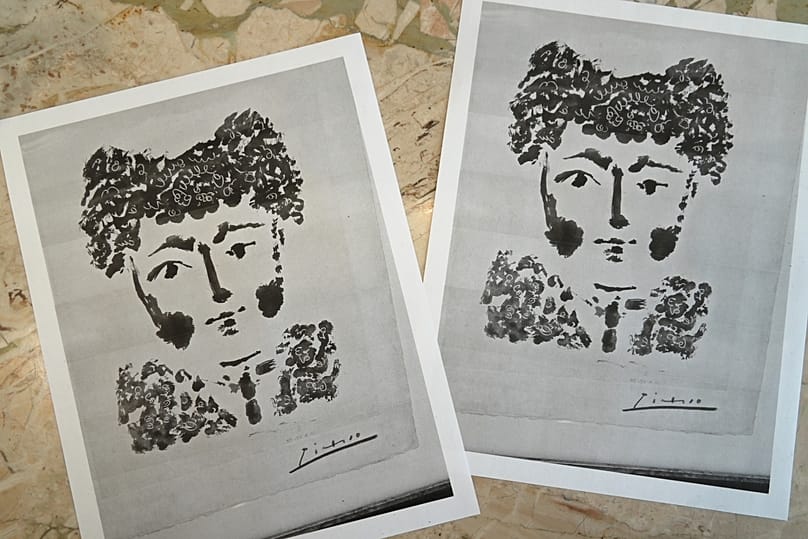
Printouts of a photo of the Pablo Picasso etching, "Torero" are displayed on a table in DeLind Fine Art Appraisals in Milwaukee on 15 August 2026. Credit: AP Photo
By Theo Farrant
Published on

A local landlord discovered the stolen artwork while clearing out a vacant apartment and took it to police after an antique dealer recognised it.

In 2018, a Picasso print was stolen in broad daylight from a Milwaukee art gallery, leaving art dealer Bill DeLind convinced that the valuable work was gone for good.

The rare “Torero" print, one of only 30 known to have been signed by Picasso, was valued at upwards of $50,000 (€43,000) at the time. It had been commissioned for sale through DeLind’s gallery.

Eight years later, DeLind received an unexpected call from Milwaukee police asking him to come and identify an artwork that had been recovered. A local landlord, Tim Dertz, had found the framed print while clearing out a vacant apartment belonging to a tenant who had left his belongings after being evicted.

"When they called me, I was in disbelief," DeLind said. “I was at a loss for words. It was an overwhelming moment for me.”

“It was indeed mine,” he added. “It came back full circle.”

The landlord told local television station WISN that the artwork was hanging in an unusual spot: "It was kind of in a weird spot hanging on a wall." He added: "It looked like it had been there for a long, long time because it had tons of dust across the top of it."

After showing it to a friend who worked as an antique dealer, he was told it appeared to be the Picasso that had been reported stolen. It was subsequently handed over to police, who contacted DeLind.

"When it disappeared, it was such a sort of a personal insult. This just made me feel so bad,” DeLind said. "So it was just the opposite when it came back. It's like, there are good people in the world."

Art dealer Bill DeLind points to where a Pablo Picasso sketch was hanging when it stolen from his shop DeLind Fine Art Appraisals in 2018. Credit: AP Photo

DeLind said his former business partner, who died in February, was distraught over the theft in 2018 and called police every year on the anniversary of the crime asking that they publicise it again in the hope the Picasso could be found.

"He would have been over the moon about this," DeLind said. "It was special to him."

The artwork now remains in possession of Milwaukee police while the client who had commissioned it for sale with his art gallery works it out with his insurance company, DeLind said.


New York museum shows ancient 'Odyssey' fragment amid film's success

20.08.2026,  DPA

Photo: ---/Metropolitan Museum of Art/dpa

New York's Metropolitan Museum of Art is exhibiting the earliest written fragment of the Greek epic poem "The Odyssey" amid the popularity of the film on show in much of the world.

People have loved Homer’s poem through the millennia thanks to its "timeless themes of bravery, loyalty, perseverance, and cunning," the museum says.

"From vase painters in ancient Greece and Rome to contemporary filmmakers like Christopher Nolan, artists have continually retold 'The Odyssey' across mediums."

"Countless paintings, ceramics, and statues relate to Odysseus’s ten-year journey home to Ithaka, where he ruled as king alongside his wife, Penelope," the Met notes, offering visitors a series of objects from its collection that bring the epic to life.

The papyrus fragment on display dates from around 285 to 250 BC, and is considered the earliest written fragment of "The Odyssey" to be discovered.

"This fragment is beautifully inscribed using a combination of charcoal and water via a stylus on papyrus—one of the most popular materials for writing in antiquity—and contains three lines that do not exist in today’s standard text," the museum says.

"While the story of 'The Odyssey' has been presented in many ways over centuries, one crucial yet often-overlooked aspect is that it was originally recited by bards in oral performances," the Met notes. "As such, there were many different versions of the epic poem."

"Like the Greek warrior, this object reminds us that the telling of 'The Odyssey' itself has taken its own distinct journey through history."

The book fragment, measuring just under 20 centimetres, was excavated in 1902 at the necropolis of el-Hibe in Egypt and came into the possession of the museum – founded in 1870 – in 1909 as a gift from the Egypt Exploration Fund.

The most significant collection of Homeric texts in the Hellenistic world was housed in the Library of Alexandria in Egypt, the first comprehensive public library ever, the New York museum says.

Record-breaking adaptation on screen

Alongside "The Iliad," another epic dating back to Ancient Greece, "The Odyssey" ranks among the oldest and most significant texts in world literature.

The two epics attributed to Homer date back to the eighth century BC and tell of the Late Bronze Age – a period stretching back centuries further – using material passed down mainly through oral tradition.

Today, the film adaptation "The Odyssey" is breaking records in terms of viewers as people crowd to cinemas to watch Homer’s epic on the silver screen.

US actor Matt Damon plays the Greek hero Odysseus in the new film by Christopher Nolan. It describes his years-long journey home after the Trojan War, a time marked by battles, storms and mythical monsters.


Alarming study reveals that almost 40 per cent of music released globally in July 2026 used AI

Alarming study reveals that almost 40 per cent of music released globally in July 2026 used AI
Copyright AP Photo - Canva

By David Mouriquand
Published on

The use of AI in music creation continues to be a divisive topic and recent figures confirm that the onslaught of AI-generated tracks is not slowing down. Worse, certain artists are becoming more open about using the controversial technology.

Just stop your crying, it's a sign of the times...

What do you know about it, Harry Styles? Some signs are worth crying over.

Here’s one that is sure to provoke some sobbing: As AI-generated music continues to flood streaming platforms, a new study has revealed that almost 40 per cent of new music released globally in July 2026 used AI in its creation.

That alarming figure comes from a new survey by SubmitHub, an online platform that allows users to submit music to playlists and blogs. They analysed over a million pieces of music and using their own AI detector, SH Labs, found that 23.2 per cent of them were fully AI-generated.

In addition to that, 15.3 per cent were found to have used elements of AI-generated audio that had been "modified or processed" by humans. That totals to a whopping 38.5 per cent of all music released last month to have been made with the involvement of AI.

SubmitHub was launched SH Labs earlier this summer in order to highlight a “growing disclosure problem” with artificial intelligence in music. Their AI detection tool is being used by Bandcamp and Traxsource to uncover the use of AI in music, as well as GEMA, the performance rights organisation which recently won a landmark court case against AI music generator platform Suno.

In a statement, SubmitHub’s founder Jason Grishkoff said: "I think the path forward for AI music is disclosure. People should be able to decide for themselves whether they want to engage with AI-generated music.”

He added: “Our job is to give them enough information to make that choice."

These recent figures follow fresh stats from Deezer, who reported that AI tracks accounted for more than half of all new daily uploads in June. They also follow a 2025 study that found that 97 per cent of people “can’t tell the difference between real and AI music”.

Certain organisations are starting to finally wake up to the concerns of real artists and music lovers expressing concerns over the AI slop dished out on streaming platforms.

For instance, Bandcamp banned all AI-created music at the start of 2026, stating that they “reserve the right to remove any music on suspicion of being AI-generated", while streaming giant Spotify recently announced that it will begin adding an “AI Persona” badge to some artist profiles, helping listeners identify when an artist’s music may have been generated using artificial intelligence. That initiative starts in September.

While artists from Kate Bush to Queen’s Brian May have spoken out on the existential crisis AI represents to creatives, stating that “the unlicensed use of creative works for training generative AI is a major, unjust threat to the livelihoods of the people behind those works”, there are some creatives who have taken a more decomplexed approach to the use of the controversial technology.

Empire Of The Sun’s Luke Steele recently admitted that he uses AI to make music; Boy George said he used AI to help write his dire pro-Israel reggae track ‘We Will Dance Again’ (something which eventually led it to be removed from Bandcamp for violating its AI rules); and one recent artist who has provoked the ire of his peers is American rapper Tyga.

The latter admitted he used AI as a “tool” on his new (and critically panned) album, ‘$tarface’. Tyga used AI to generate the retro synths on his album, framing it the “tool” as being “no different than when Auto-Tune came out.”

Regardless, the album has been savaged by critics, with Pitchfork giving it the lowest possible rating of 0/10, describing ‘$tarface’ as “smug and complacent and depressing” and that “its very existence has made the world a worse place.”

Artists have called out Tyga – including Doja Cat, who spoke for many music lovers when she called him a “penis for making an AI album”.

A literal and figurative tool for some; a complete scam for others.

In a further sign that certain content creators are becoming more comfortable / shameless in embracing AI slop, American record prodcuer and rapper Timbaland has launched an “A-Pop” venture called Stage Zero and signed its first act, TaTa, which he describes as “a living, learning, autonomous music artist built with AI.”


These examples and recent figures, on top of the harrowing “music” by AI creations Tilly Norwood, Velvet Sundown and Breaking Rust - who compete with real artists for listening time as well as royalties - show that one thing is clear. We’re not out of the artificial woods yet.

CHINA

Unitree's viral dancing, rollerblading robots make a 600% stock market debut

WHERE IS TESLA'S BOT?!
A robot plays table tennis at a Unitree booth during the World Robot Conference in Beijing, Wednesday, Aug. 19, 2026.
Copyright AP Photo/Andy Wong

By Indrabati Lahiri
Published on

Unitree, known for its dancing and backflipping robots, saw shares surge as much as 629% on its Shanghai stock market debut.

Unitree, the world's biggest humanoid robot maker, has kicked off its public listing with a bang, with shares soaring more than 600% during its trading debut.

The Chinese company accrued immense worldwide popularity through viral videos of its robots acting as backup dancers for pop stars, alongside performing martial arts and extreme athletic feats. They can also rollerblade, play table tennis, and do backflips and vaults.

Shares surged from an initial public offering (IPO) price of around 150.8 yuan (€19.3) to as high as 1,100 yuan (€140.6) on Wednesday, a jump of more than 600%, although they settled at almost 500% later in the day.

Chinese retail investors formed the bulk of this extraordinary demand, with shares allocated to non-professional investors seeing demand exceed supply by thousands of times over.

Wang Xingxing, the founder of Unitree and its current CEO, still owns around a fifth of the business.

Unitree is exceptionally well-positioned to capture the rising interest in the robotics market, largely thanks to affordable hardware, such as its robot dogs and budget humanoids, which are available at a fraction of the price of their US counterparts.

This is largely down to robust local supply chains in Hangzhou, which keep manufacturing costs relatively low.

Riding on the back of spectacular demos and strong marketing, Unitree has also positioned itself as a high-volume company, ahead of several major US and European competitors. This has helped it turn a profit far earlier than most other early-stage robotics startups.

China also sees robotics as a key national priority in the effort to offset a shrinking workforce.

Robotics go global

With the global robotics industry seeing considerable advancements in recent years, investors are constantly searching for the next big winner. This is especially true given robotics' central role in advancing artificial intelligence through physical AI.

This allows AI to use robots for real-world learning and trial and error in tasks such as walking and gripping objects. It also develops better perception and reaction skills while creating rich new data loops for feedback and training material for smarter models.

The global market for humanoid robots is likely to reach $38 billion (€32.7bn) by 2035, according to Goldman Sachs.

At present, companies such as China's Unitree and UBTECH Robotics are among the few listed humanoid robot companies, while others such as Tesla, Xiaomi and Hyundai Motor have humanoid robot divisions of their own.

However, a few more Chinese humanoid robotics companies, such as Leju Robotics and Deep Robotics, are also making plans to go public soon.

Despite these advancements, some countries, including the US, still prefer to take a more conservative stance when it comes to importing or relying on foreign-made humanoid and quadruped robots, citing national security concerns.

Unitree has already been included on a list of Chinese military companies by the US Pentagon, which called it a "contributor to the Chinese defence industrial base," despite the company maintaining that its robots are for civilian purposes.


Fans launch petition calling for Infantino resignation and FIFA reform

20.08.2026, DPA

Photo: Sven Hoppe/dpa

Fans’ groups worldwide have launched a petition calling for the resignation of Gianni Infantino as FIFA president and for wholesale reform of the organization.

Infantino is under pressure after being forced to abandon plans to seek private investment in a company to run FIFA tournaments, including the men’s and women’s World Cups.

Three continental confederations accused Infantino of “deception” in an open letter last week over the manner in which the plan was devised and presented, with European football’s governing body UEFA still intent on boycotting FIFA events having “lost confidence” in Infantino’s leadership.

The Swiss does still retain support, notably in Africa and South America, but now fans’ organizations have called on him to step down, with a petition being launched on the change.org website.

“The shameful attempt by one individual – the FIFA president himself – to sell off the World Cup to private investors exposed a betrayal football will never forget,” a statement on behalf of the fan organizations said.

“Infantino’s plan was stitched together in secret. Negotiated behind closed doors. Hidden from FIFA’s own members and from the millions of people whose passion makes football what it is.”

Individual fans are being encouraged to sign the petition, which already has support across all six FIFA confederations spanning continental and national fan groups.

The private investor plan is seen by the fan organizations as the final straw, on top of FIFA’s involvement in discussions around the European Super League and its ticket pricing policy at this June and July's men’s World Cup

“A president who repeatedly betrays football and makes a mockery of our game has lost the right to lead it,” the statement continued.

“For the credibility of FIFA – and for the future of the game – he must resign.”

The petition also calls for reform of FIFA itself, including the formal involvement of supporters and other key football stakeholders in decisions that shape the future of the game.

Ronan Evain, the executive director of Football Supporters Europe (FSE) which is a signatory to the petition, told the Press Association: “The departure of Gianni Infantino is a first and a must, but that can only have a positive impact if it’s followed by some reform of the office and of governance.

“If a man can concentrate so many powers then the governance of FIFA is not fit for purpose.

“(FIFA) needs to start from scratch. All the reforms from 2016 have been erased or made irrelevant by Infantino. I think we need to be as open-minded as possible on the future of football governance and there are other models outside of football, outside of sport, that need to be looked into – the idea of rotating presidencies seems interesting.”

FIFA has been approached for comment.


Severe storms, two tornadoes cause widespread damage in Germany

20.08.2026

Photo: Boris Roessler/dpa

By Daniel Mollitor and Malin Wunderlich, dpa

Severe storms, including two confirmed tornadoes, caused widespread damage across parts of Germany overnight, leaving at least one person dead and others injured, with dozens of buildings damaged, authorities said on Thursday.

More severe storms could be on the way, particularly in the southern states of Baden-Württemberg and Bavaria, the German Weather Service (DWD) warned.

In Waldorf in the western state of Rhineland-Palatinate, a 58-year-old woman was killed by a falling tree and a 47-year-old woman was seriously injured, police said.

The two women had been out walking together when the storm approached and sought shelter in a covered seating area. A nearby tree was uprooted by the storm and crashed onto the shelter, hitting both women.

The 58-year-old died at the scene, while the 47-year-old was taken to hospital.

Elsewhere in Rhineland-Palatinate, the storm tore walls from houses and felled trees, while falling facade elements and flying debris caused further damage.

Tornado in Brandenburg - tree lodged in kitchen ceiling

A tornado struck in Fürstenwalde/Spree in Brandenburg, the state that surrounds Berlin, the DWD confirmed. 

Several videos posted on social media also showed the tornado.

Police in Potsdam said the storm caused damage in the area, including trees falling onto cars. No injuries had been reported.

Several trees were uprooted and at least one building lost its roof. One photo showed a tree trunk protruding through the ceiling of a residential building's kitchen.

Another tornado damages around 60 homes

A second tornado struck the area around Wetzlar in the central state of Hesse on Wednesday evening, the DWD confirmed. The weather service said it was still assessing the tornado's strength.

Around 60 homes were damaged in Wetzlar, according to the fire brigade. Damage ranged from missing roof tiles to entire roofs being torn off, with some roof sections blown as far as 100 metres.

In nearby Laubach, a falling tree damaged a gas tank at a residential building. The surrounding area was evacuated within a radius of 200 metres after gas began leaking.

There were also numerous weather-related emergency callouts overnight in the states of Thuringia and Bavaria. Damage ranged from missing roof tiles to entire roofs being torn from buildings, leaving some homes uninhabitable.

Germany charges four men over €20m tax evasion in cum-ex scandal

20.08.2026, DPA

Photo: Andreas Arnold/dpa Pool/dpa

Germany has brought charges against four former employees of Commerzbank on suspicion of serious tax evasion linked to the cum-ex fraud scandal. 

The Frankfurt Public Prosecutor's Office said on Thursday the four men - two British nationals aged 66 and 59, a 61-year-old German and a 60-year-old US citizen - are responsible for tax losses amounting to more than €20 million ($23.4 million).

Cum-ex, which peaked between 2006 and 2011, was a complex share-trading scheme around dividend dates in which financial actors claimed refunds or credits for dividend tax that had not actually been paid, causing major losses for tax authorities.

Germany was particularly badly hit, with the country estimated to have suffered tax losses running into the tens of billions of euros.

The latest case concerns share transactions in 2008. The four bankers are alleged to have developed, authorized and implemented the cum-ex transactions "in conscious and deliberate collusion." Two were working in Frankfurt at the time of the offences, whilst the other two were in London.

Commerzbank declined to comment on the substance of the case. "We do not comment on proceedings against third parties," a spokesman said in response to an enquiry. "Commerzbank is not itself a party to the proceedings."

Various public prosecutor's offices in Germany have been investigating the cum-ex scandal for years. Twelve defendants have already been convicted by courts in Frankfurt and Wiesbaden.

The Frankfurt-based authority is still investigating Cum-Ex in 10 "extensive sets of proceedings" against a total of 39 accused individuals.