Wednesday, August 26, 2026

'No Room for Bhagwat': Interfaith group blasts Hindutva leader's upcoming MSG speech
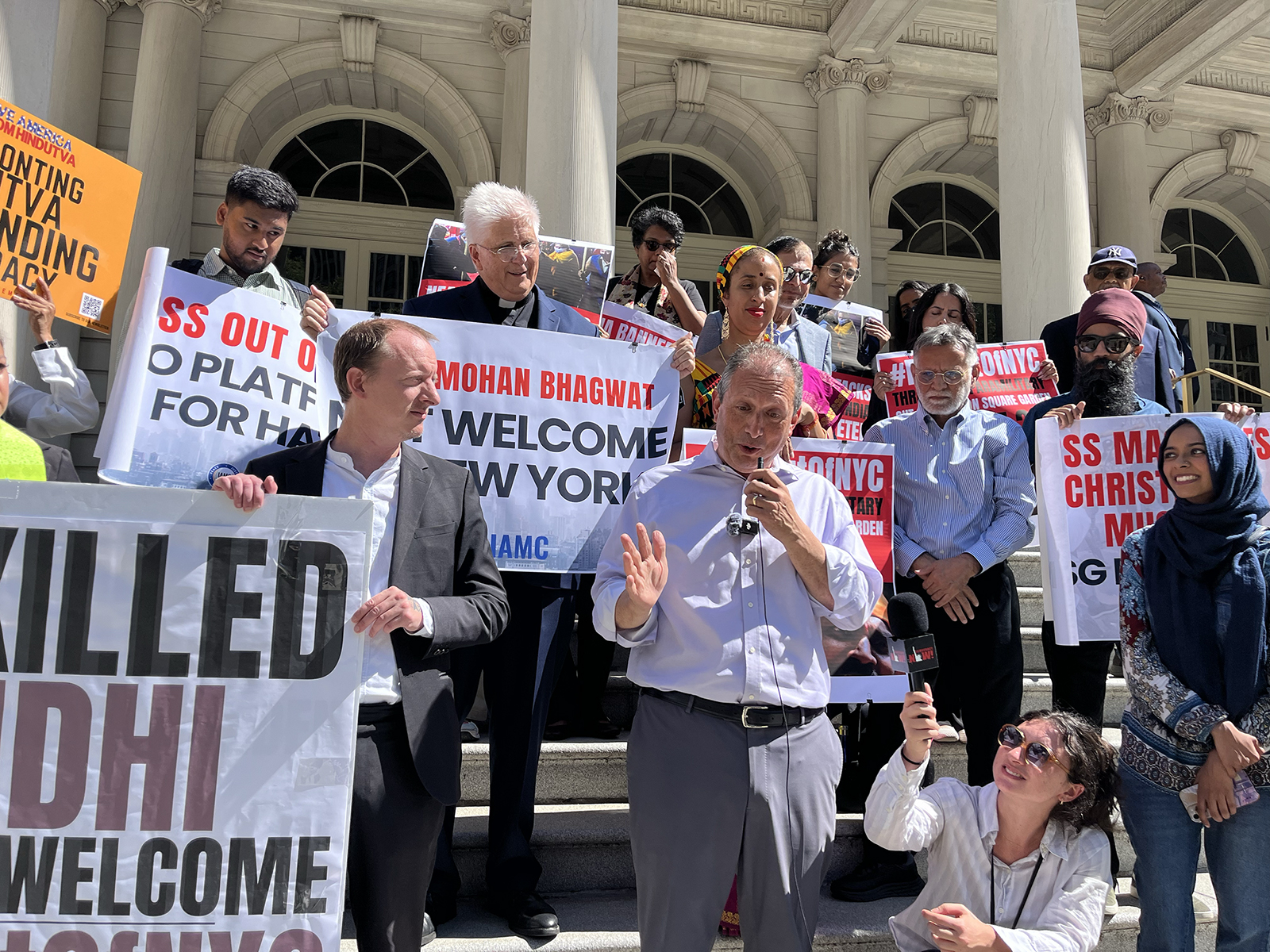
(RNS) — 'There is no room for Mohan Bhagwat and RSS hatred in our city,' said Brad Lander, Democratic nominee for Congress, of Bhagwat’s speaking engagement at Madison Square Garden.
Brad Lander, center, speaks during a demonstration against Mohan Bhagwat at City Hall on Tuesday, Aug. 25, 2026, in New York City. (RNS photo/Fiona André)


NEW YORK (RNS) — A coalition of faith leaders and religious advocates gathered at New York’s City Hall on Tuesday (Aug. 25) to denounce the upcoming visit of Mohan Bhagwat, leader of the Hindu nationalist paramilitary organization Rashtriya Swayamsevak Sangh (RSS) based in India.

Brad Lander, a New York Democratic Party nominee for Congress and former New York City comptroller, denounced what he described as an exclusionary and discriminatory ideology. 

“There is no room for Mohan Bhagwat and RSS hatred in our city,” he said, adding the organization “fomented violence and promoted hatred against Muslims, against Sikhs, against Dalits, against Christians.”

The press conference, organized by the progressive advocacy organization Hindus for Human Rights, included speakers from the Indian American Muslim Council, the Interfaith Center of New York, Riverside Church and the New York State Council of Churches.

Bhagwat, chief of the RSS since 2009, is expected to address 5,000 Hindu Americans at Madison Square Garden on Saturday (Aug. 29). His visit has prompted outcry in the U.S., including from the U.S. Commission on International Religious Freedom. Meanwhile, some Hindu American organizations have accused Bhagwat’s critics of leveraging opposition to Hindu nationalism, also called Hindutva, to spew anti-Hindu hate.
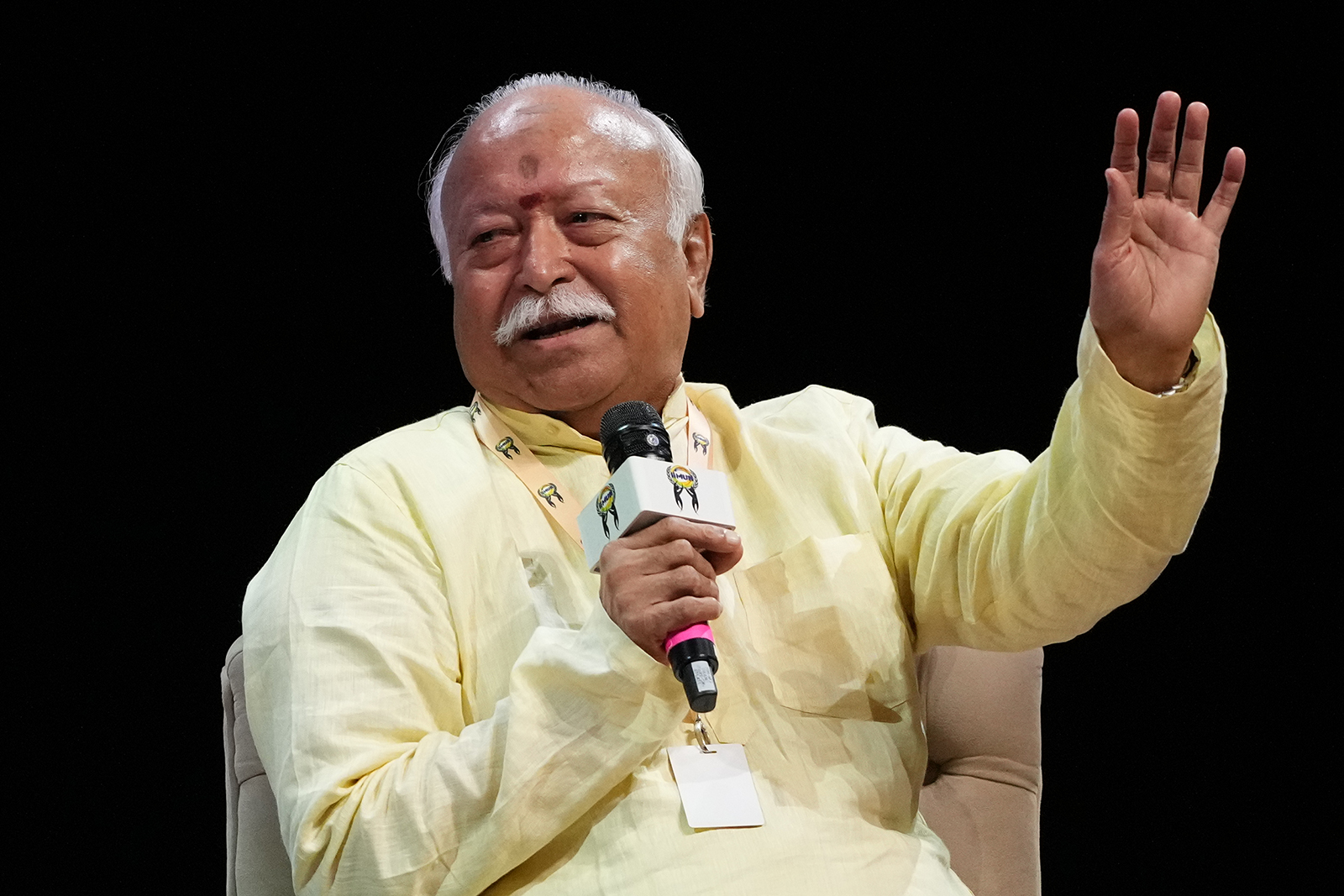
Rashtriya Swayamsevak Sangh (RSS) chief Mohan Bhagwat addresses students during an India International Movement to Unite Nations (IIMUN) event in Mumbai, India, Thursday, Aug. 6, 2026. (AP Photo/Rafiq Maqbool)

Founded in 1925 during British colonial rule, the RSS promotes a vision of India as a Hindu-first nation and describes itself as a cultural and social movement dedicated to strengthening Hindu society. The ideology also emerged as a response to the continent’s long history of Muslim conquests, which the RSS has presented as a period of Hindu subjugation. Its members formed India’s current ruling party, the Bharatiya Janata Party (BJP), and the organization has survived multiple bans to now serve as an ideological mentor and launching pad for several high-ranking politicians in the party, including Prime Minister Narendra Modi. 

Human rights groups have accused the RSS and BJP of orchestrating decades of violence against minorities in India, a claim the RSS has repeatedly denied, though their philosophy paints Muslim and Christian Indians as foreigners. Since Modi’s election in 2014, human rights organizations and watchdog groups have documented a sharp rise in state-sanctioned discrimination, hate speech and vigilante-led violence targeting religious minorities and critics in India. 


Bhagwat rarely addresses American Hindus and hasn’t visited the country since 2018, when he attended the World Hindu Congress in Chicago.

The “Universal Oneness Celebration,” which will mark the RSS centenary, promises to emulate Sanskrit principles of unity and family. The rally is supported by 135 Hindu American organizations and is expected to draw temple representatives, yoga organizations and cultural groups. Bhagwat is then expected to attend two more private events in New York before heading to Canada.

American Hindus for Dialogue, which organized the event, addressed the outcry sparked by Bhagwat’s visit in a press release

The RSS “has also played a prominent and, at times, debated role in India’s modern history, making Dr. Bhagwat a figure of considerable interest to observers, supporters and critics alike. His New York remarks will offer a direct opportunity to hear his perspective on the unity theme anchoring this year’s program,” the organization wrote. 
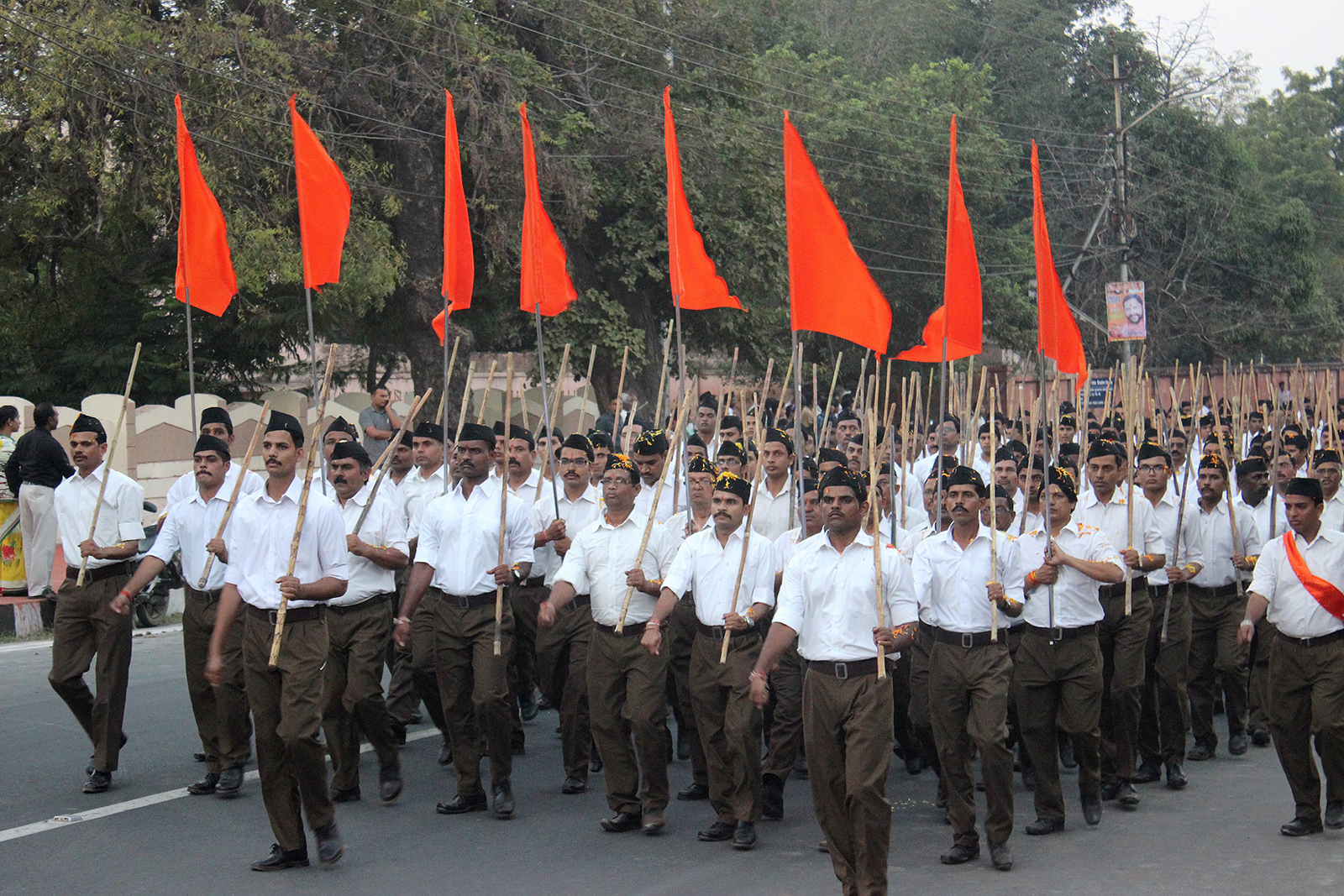
Members of the Hindu nationalist Rashtriya Swayamsevak Sangh (RSS) during an event in Bhopal, India, in 2016. The RSS, parent organization of the ruling Bharatiya Janata Party, combines Hindu religious education with self-defense exercises. (Photo by Suyash Dwivedi/Wikipedia/Creative Commons)

Asif Mahmood, vice chair of the U.S. Commission on International Religious Freedom (USCIRF) who was born in Pakistan, condemned Bhagwat’s U.S. visit in a statement posted on the organization’s X account.

“India’s PM Modi is a member of the Rashtriya Swayamsevak Sangh (RSS), an Indian umbrella organization whose sub-groups have perpetrated attacks on religious minorities, incl. Christians & Muslims,” he wrote in the post.

His colleague, Commissioner Gene Mills, also decried Bhagwat’s visit and urged American leaders not to receive him. His statement linked to the commission’s recent report, which found RSS members responsible for and tolerant of religious freedom violations. The report cited violent acts committed by Hindu nationalist mobs against Christians and Muslims. For example, in June, a Hindu nationalist mob attacked 20 Christian families in the state of Odisha after they refused to convert to Hinduism. The attacks, which did not prompt police intervention, left eight people injured and hospitalized.

“RSS leaders, even when affiliated with the Indian gov’t, should not be honored with high-level meetings or diplomatic courtesies. Instead, the USG (U.S. government) should focus on imposing sanctions on RSS members found responsible for FoRB (freedom of religion and belief) violations,” wrote Mills in an X post. 

In its annual report, USCIRF recommended that the U.S. freeze the assets of RSS members and bar them from entering the country “for their responsibility and tolerance of severe violations of religious freedom.” It also urged the government to designate India a “country of particular concern” for engaging in and tolerating religious freedom violations.

USCIRF has repeatedly rung the alarm about India’s turn to Hindu nationalism. In November 2025, it raised concerns that Modi’s BJP was enforcing policies aligned with Hindutva ideology, which have led to “disenfranchising members of India’s religious minority communities.” In recent years, BJP-majority states, such as Gujarat and Haryana, have introduced or strengthened laws criminalizing conversions to other faiths with prison sentences.

In response, the U.S.-based Hindu Policy Research and Advocacy Collective (HinduPACT) condemned USCIRF’s opposition to Bhagwat’s visit.

“USCIRF has disgraced its mandate. When its chair speaks about India and the RSS, he sounds less like the head of a pluralistic American commission and more like an advocate for a hardened anti-Hindu narrative,” wrote HinduPACT founder Ajay Shah. “Mohan Bhagwat leads one of the world’s most consequential Hindu organizations. He should not be met with slander scripted by … groups that have made a habit of treating Hindu self-assertion as extremism.”


At the press conference, Lander, who is Jewish, said he felt compelled to stand in solidarity with Hindu organizers denouncing Hindutva’s weaponization of Hinduism and compared it to his denouncement of the devastation caused by Israel’s war in Gaza after the Oct. 7 Hamas attacks.  

Similar weaponization happened around the world, he said, adding, “We see it in settler violence in the West Bank, and in genocide in Gaza, and we see it in what Hindutva is doing.”
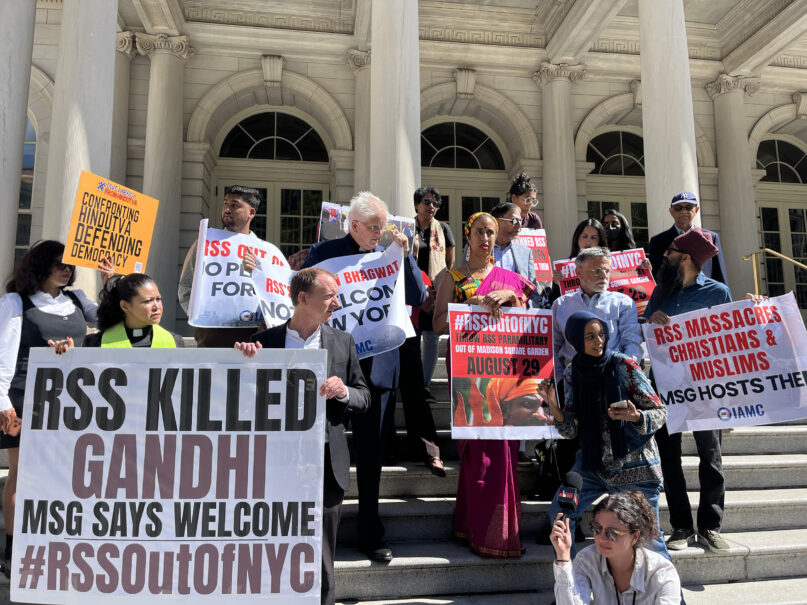
A group with participants from an array of religions protests an upcoming visit of Mohan Bhagwat at City Hall on Tuesday, Aug. 25, 2026, in New York City. (RNS photo/Fiona André)

Danielle Williams, an organizer with the Interfaith Center of New York, denounced Madison Square Garden for hosting the event, saying it wasn’t “the first time that Madison Square Garden has hosted fascists, hate and supremacy,” alluding to the pro-Nazi rally held in the arena in 1939. Modi also spoke at the venue in 2014. 

Williams likened the anti-Hindutva advocacy to criticism of Christian nationalism in the U.S. 

“These movements are not the same; they come from different religions, histories, and political contexts,” she said. “But we know that the danger of any ideology that says one religious identity should oppress others — that is not religious freedom.”

Amin Zama, associate director of the Indian American Muslim Council, called on the State Department to deny Bhagwat’s visa to prevent his visit. “We are here to say clearly that New York must not become a stage for normalizing fascist and exclusionary politics,” he said. 

The founder of the Sikh Council NY, Japneet Singh, called on Mayor Zohran Mamdani, who was born in Uganda to Indian parents, to condemn Bhagwat’s visit as firmly as he denounced that of Israeli Prime Minister Benjamin Netanyahu. In late July, the mayor called Netanyahu a “war criminal” and acknowledged that he couldn’t enforce an arrest warrant issued by the International Criminal Court against him for crimes against humanity committed in the Israel-Hamas war.  

“If you believed Modi’s record demanded that you speak out, then how can New York remain silent when the ideological organization that helped shape the political worldview behind Modi is bringing its leader to our city,” Singh said. 

During his campaign, Mamdani criticized Modi and said he wouldn’t appear at a press conference next to him. Mamdani pointed to the 2002 massacre of Muslims in the Indian state of Gujarat, when Modi served as the state’s chief minister, and noted his father’s family were Gujarati Muslims. 

Saturday’s event will also coincide with the Hindu festival of Raksha Bandhan, which falls on Friday (Aug. 28) and celebrates the loving bond between brothers and sisters. 


Pope Leo hat giveaway turns White Sox game into the church of baseball

CHICAGO (RNS) — After three terrible years, the White Sox are in the midst of a revival — with good young players and perhaps a little divine intervention. The team's best-known fan is Pope Leo XIV.
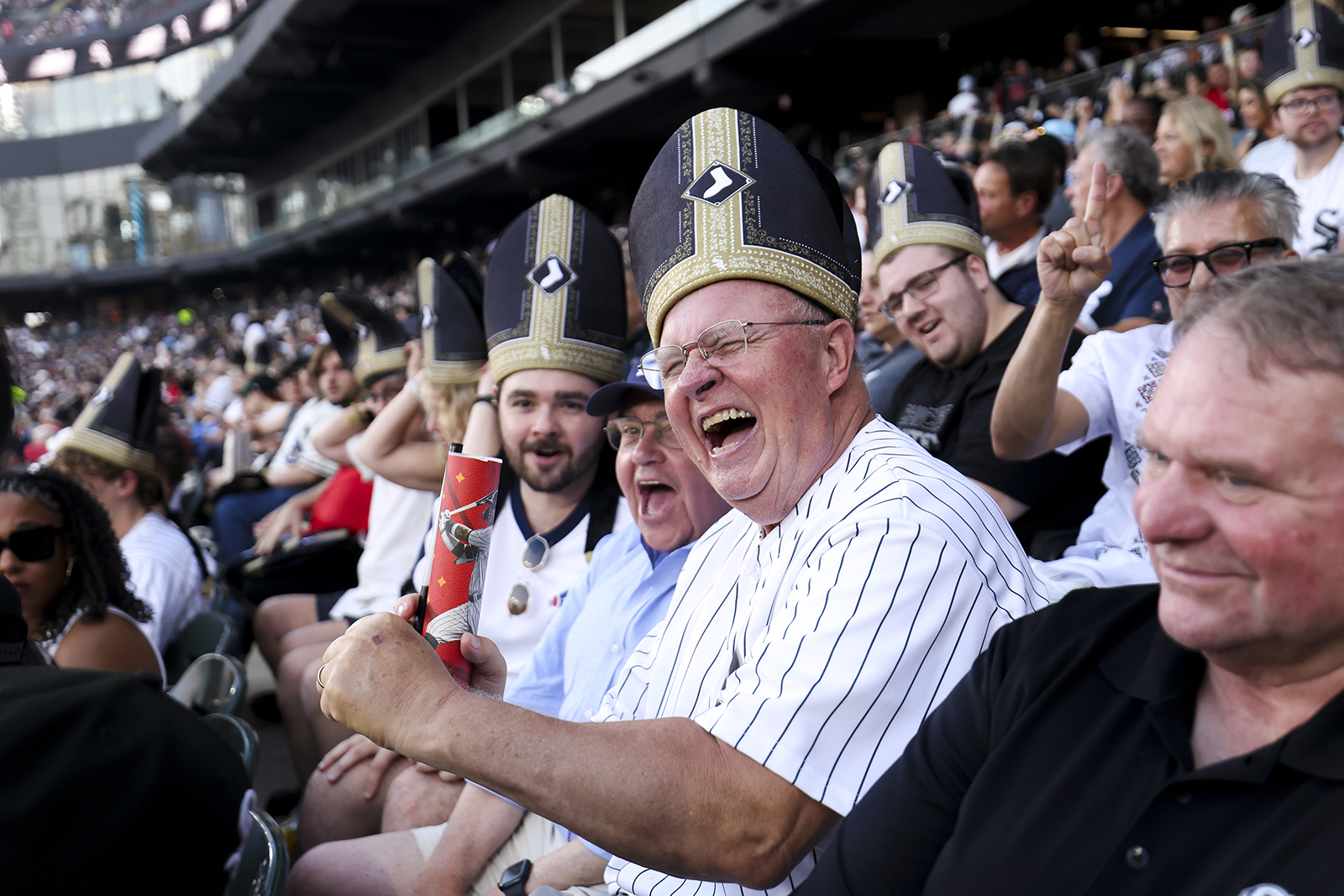
White Sox fans cheer while wearing Pope hats during "Pope Night," Tuesday, Aug. 11, 2026, in Chicago. (Photo courtesy of the Chicago White Sox)

CHICAGO (RNS) — On a hot August night on the South Side of Chicago, Rate Field, home of the White Sox, turned into a church of baseball, filled to capacity with true believers who sang, passed the peace, cheered on a celebrity nun and, of course, wore their pope hats.

Those hats, emblazoned with the Sox logo, were given to every fan who entered the park on Tuesday (Aug. 11). It was, according to team officials, the biggest promotional giveaway in White Sox history, with more than 40,000 pope hats given away. The night was a testimony to the resurgent White Sox, who appear to be playoff-bound after three years of losing 100 games a season, as well as to the appeal of Pope Leo XIV, a longtime fan of the team and Chicago native.

“It doesn’t matter your religion or your denomination,” said Brooks Boyer, chief revenue and marketing officer for the White Sox. “Everyone respects the pope. For us, it’s obviously fun that he is a White Sox fan.”

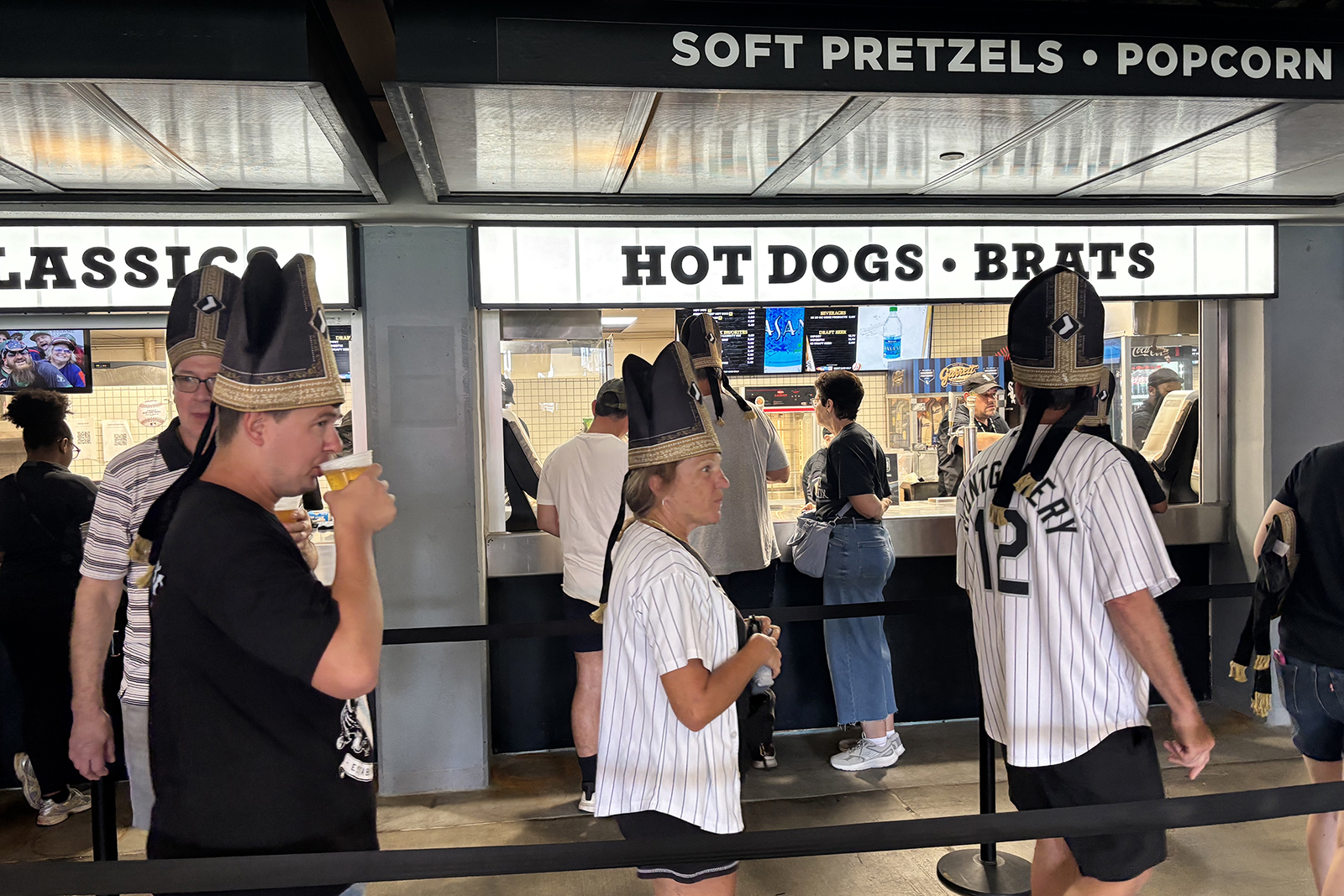
As soon as the gate opened, the park was flooded with fans, young and old, some with jerseys with the pope’s name on the back, many already wearing their pope hats. They stood in line for hot dogs or beers, where some greeted Sister Mary Jo Sobieck of the Dominican Sisters of Springfield, Illinois, who was grabbing a hot dog before throwing out the first pitch.

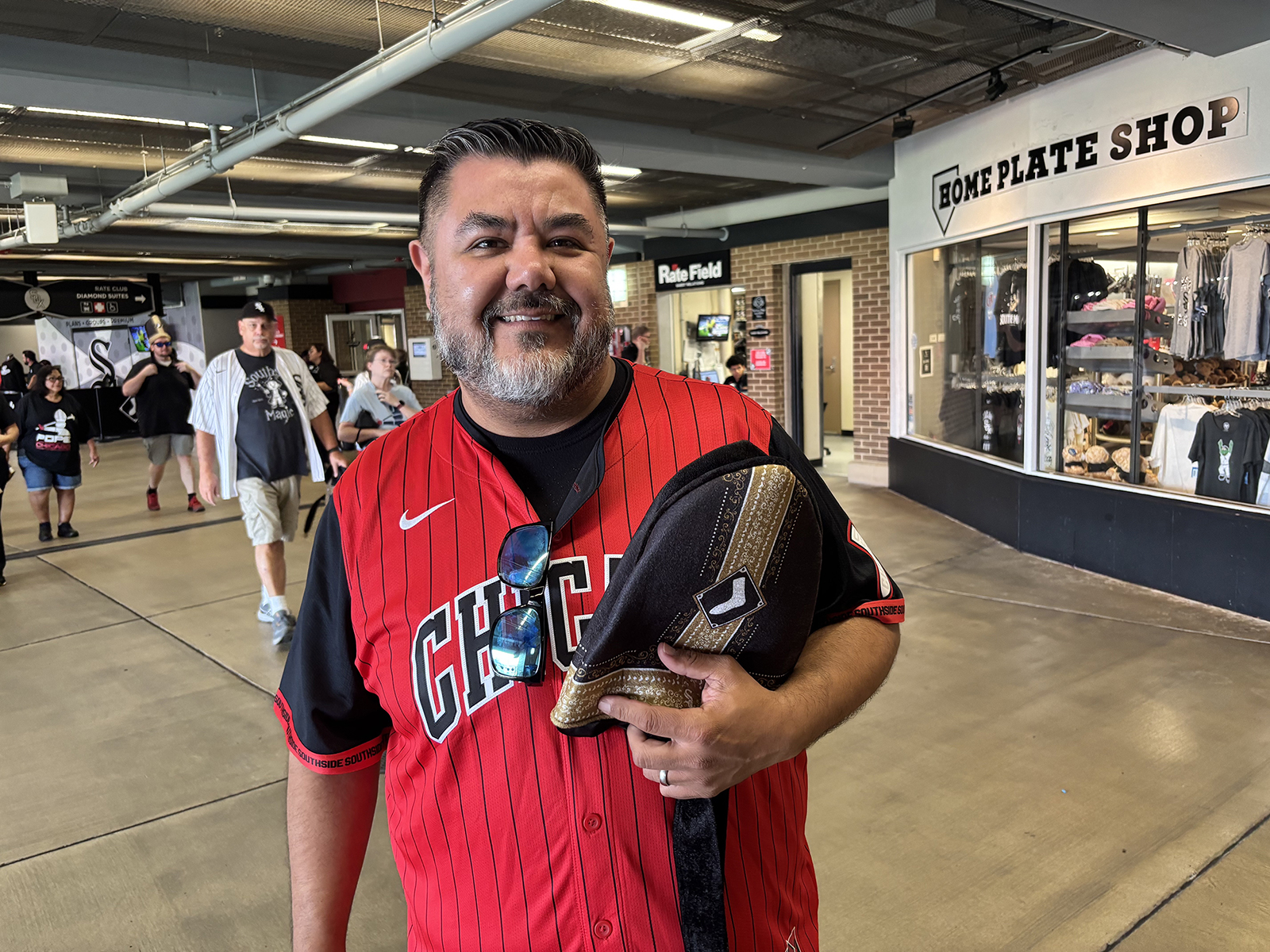
Jaime Garcia and his wife were decked out in Sox garb and their new pope hats. Garcia, who is from the Back of the Yards neighborhood on Chicago’s southwest side, grew up both Catholic and a Sox fan. He got off work early to get to the game.

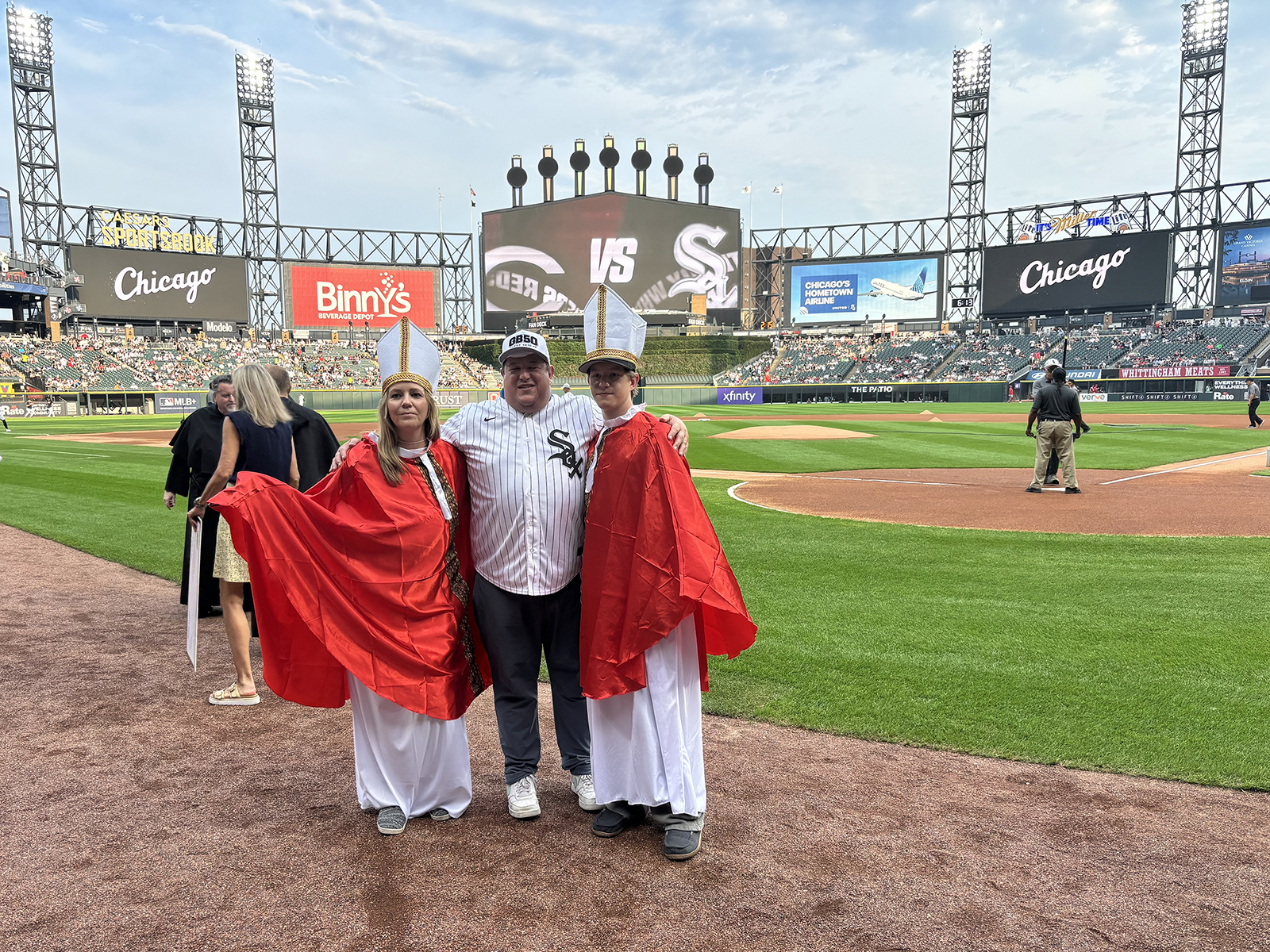
Jaime Garcia attends the White Sox’s “Pope Night,” Tuesday, Aug. 11, 2026, in Chicago. (RNS photo/Bob Smietana)

“Got to get the hat,” he said. “Got to represent.”

He said that, as a fellow Southsider, the pope is someone he can relate to. Pope Leo, born Robert Prevost and raised in nearby Dolton, loves the Sox and came from a working-class family, just like many of his fans, Garcia said.

“That’s what the Southside is,” he said. “Hardworking families. He’s got them roots.”

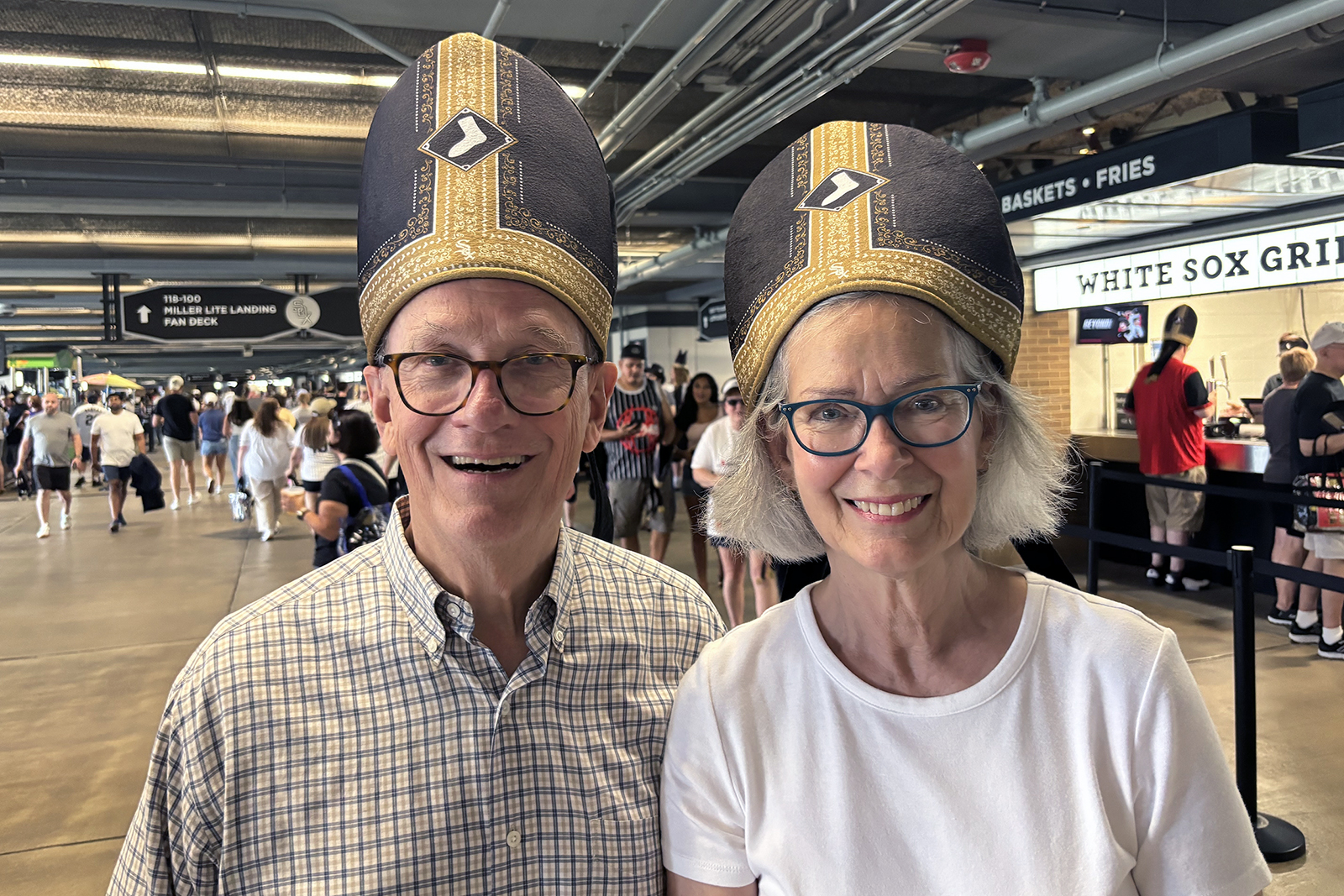
Dick and Marty Murphy attend the White Sox’s “Pope Night,” Tuesday, Aug. 11, 2026, in Chicago. (RNS photo/Bob Smietana)

Dick and Marty Murphy, a Catholic couple from Northbrook, Illinois, made the trek from the city’s northern suburbs. He has been a fan of the Sox since boyhood, while she married into Sox fanhood. He has been to a few games this year, but it had been a while for her. On Tuesday, they were there because of the pope, who Marty described as a really kind man.

“It was all Pope Leo,” Marty said. “And the hat.”

Her husband agreed. “It’s very unique,” he said, pointing to his miter-shaped hat emblazoned with a Sox logo. “I wanted to be one of 40,000 people walking around Chicago with this thing on their head.”

Along with the pope hat giveaway, the night featured a fifth-inning passing of the peace, during which fans greeted one another, modeled after a ritual from a Catholic Mass. A group of Catholic school kids, whose mock conclave last year made national headlines, greeted players as they took the field. Legendary organist Nancy Faust provided the soundtrack, with songs like Billy Joel’s “Keeping the Faith,” Bon Jovi’s “Livin’ on a Prayer,” and, of course, Journey’s “Don’t Stop Believin.’”

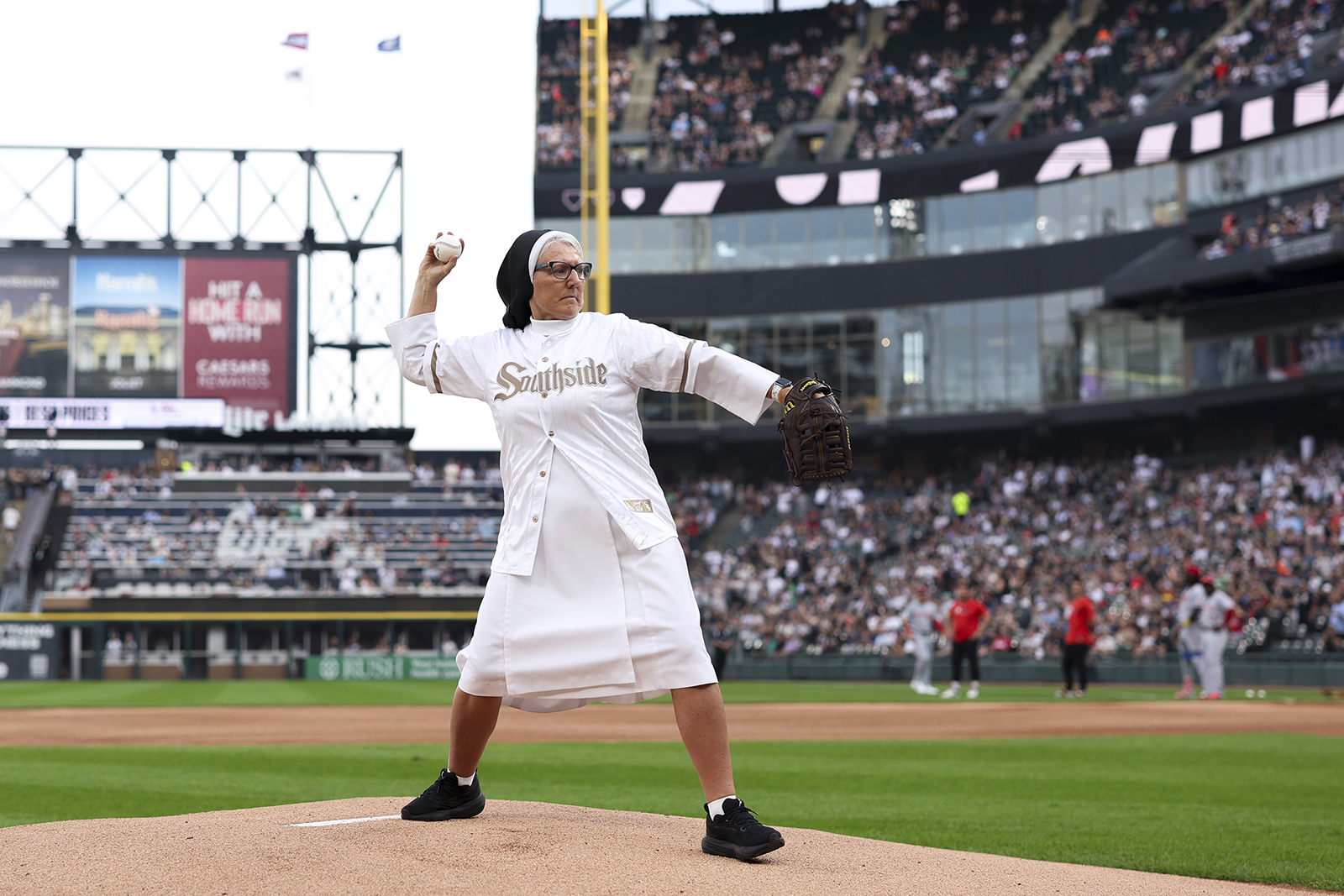
Sister Mary Jo Sobieckm of the Dominican Sisters of Springfield, Illinois, throws out the first pitch during the White Sox’s “Pope Night,” Tuesday, Aug. 11, 2026, in Chicago. (Photo courtesy of the Chicago White Sox)

Sister Sobieck delighted fans by bouncing a baseball on her bicep before firing the ball home for the opening pitch. Before her star turn, she posed for selfies and chatted with fans. She said that she loved that so many people had turned out for the pope hat night. It was a sign that the pope can bring people together.

A few people asked her whether the pope giveaway hat, modeled after the pope’s miter, was irreverent.

“Not at all,” she said. “It’s just good fun. You know, baseball unites. The church unites. You put two good things together, and it’s perfect.”

Even some of the players are fans of the pope.

Drew Romo, a catcher who joined the White Sox in the off-season, wasn’t with the team when Leo was elected pope last year.

“Then when I went to the White Sox, that’s when I was like, it’s so cool — I’m going to the pope’s team,” he told RNS during an interview in the Sox dugout before the game. “The pope’s going to be cheering me on.”

Romo, who is Catholic, had a viral moment earlier this season. A teammate was wearing a microphone for a local broadcast when Romo called out for Pope Leo to “say a quick prayer” that Jacob Gonzalez, then a shortstop for the Sox, would hit a home run.

Not long after, Gonzalez did just that.

White Sox Manager Will Venable said before the game that he was excited that the stands would be filled with pope fans. He hoped they brought a little luck along.

“Any time we get to celebrate the pope and his fandom of the White Sox, that is something that we’ll lean into,” he said during a pregame scrum with reporters. “Hopefully, that creates some good favor for us tonight.”

Romo, who is active with Catholic Athletes for Christ, said that his faith keeps him grounded. While he is devoted to the game, it’s not all there is to life, he noted. And even the best players fail most of the time at the plate, where getting a hit three out of every 10 times can make you a star.

“Baseball is a game of failure,” he said. “I think for us baseball players, remembering that Jesus is at the center and remembering that our faith is, first and foremost, not baseball, that’s very helpful.”

The idea for a pope-related giveaway emerged in May 2025, when Leo was elected. Mike Downey, the team’s director of marketing, said he was at lunch when he first heard the news that then-Cardinal Prevost, an American cleric from Chicago, was elected pope. At first, the Cubs claimed Pope Leo, only to later learn that not only was Leo a lifelong White Sox fan, but that he’d been in the stands during the team’s run to a World Series championship in 2005.

White Sox fans take photos on the field before a game Tuesday, Aug. 11, 2026, in Chicago. (RNS photo/Bob Smietana)

For the Sox, it was a kind of miracle. 

“Our heads started spinning here — how do we celebrate this?” Downey said. “How do we honor this — it’s such a cool historic thing that’s now descended upon 35th and Shields.”

The team started by putting up a plaque on the seat where the pope sat during the World Series, added a pope-themed mural and hosted a Mass last year in Leo’s honor, organized by the Archdiocese of Chicago.

A bobblehead — a staple of major giveaways — didn’t seem quite right. Instead, they were inspired by a photo of Leo in his papal robes and wearing a White Sox cap at the Vatican.

“If the pope’s wearing our hat,” Downey said, “what if our fans wore a pope hat?”

And that’s how the team’s “divine promotion” came to life, as they referred to it. The Tuesday night game between the White Sox and the Cincinnati Reds sold out.

“It’s going to be very fun, a very cool night,” he said ahead of the game — “a big Southside Catholic celebration.”

White Sox fans wearing Pope hats line up for concessions, Tuesday, Aug. 11, 2026, in Chicago. (RNS photo/Bob Smietana)

Father Tom McCarthy, a member of the same Midwest Augustinian order as Pope Leo, was grateful to the White Sox for giving fans a chance to celebrate their faith and the Sox. “I think it just gets people thinking about God, about our faith, about the church, about religion,” he said, standing on the field before the game. “And I think it’s awesome.”

The pope hat giveaway comes as the White Sox are experiencing a revival. The Sox have already won more games than last year, and the team’s record stood at 61-56 entering Tuesday, after taking two of three games from the Cleveland Guardians, their division rival. The team already passed last year’s attendance, with more than 40 games to go.

Boyer said he’s glad for the pope’s support.

“I’ve been asked that question quite a bit, ‘Is there any sort of divine intervention going on with this team this year?’” he said. “And I just said, we accept. We accept any divine intervention.”

The game itself tested the faith of fans at times. The White Sox took an early lead, thanks to a leadoff home run from center fielder Brenton Doyle and four no-hit innings from starting pitcher Sean Burke. The Reds tied the game on an RBI single by Reds catcher Tyler Stephenson. They then took the lead on a sacrifice fly in the bottom of the 10th, quieting the crowd.

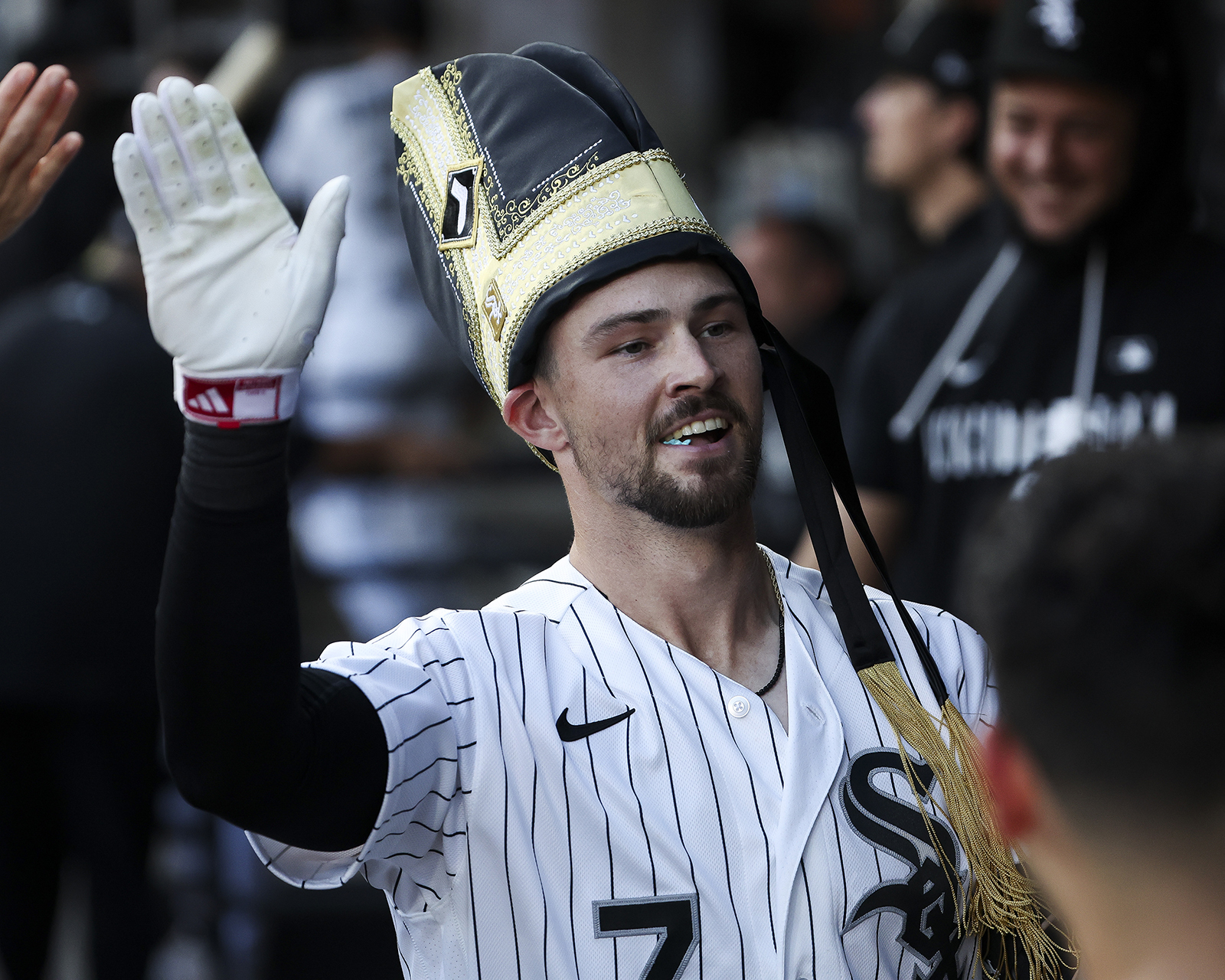
Brenton Doyle dons a Pope hat in the dugout after hitting a home run during the White Sox’s “Pope Night,” Tuesday, Aug. 11, 2026, in Chicago. (Photo courtesy of the Chicago White Sox)

In the end, even the pope could not save the Sox, at least on this night. The game ended 5-4 on a pop-up, with the tying run still on base and Cincinnati closer Emilio Pagán on the mound.

But the 40,000 fans will keep the faith. And the team will be back at it Wednesday.

 One Eye Squinted

The church has a Cambridge problem

(RNS) — Christians can criticize affirmative action and DEI hires all they want, but the continued employment of disqualified pastors in the pulpit is the church’s own form of an employment program.
(Image by Mohamed Hassan/Pixabay/Creative Commons)

(RNS) — Fake testimony. Inflated credentials. Fabricated personal history. Embellished resume. Incompetent scholarship. Blatant, repeated and rampant plagiarism.

I’m not talking about Cambridge University and the recent tragedy involving Jason Arday, a professor who was accused of all these things, subsequently resigned and was found dead just a few days later, presumably by suicide.

No, I’m not talking about Cambridge. I’m talking about the church and Christian leaders.

The problems I list above are far more common and overlooked or excused than they should be among those who claim the Christian faith.

To be sure, charlatans and cheaters are everywhere. But Christians would do well to examine how the church attracts and fails to prevent these forms of fraudulent behavior, especially among leaders. Christians can criticize affirmative action and DEI hires all they want (and they do), but the continued employment of disqualified pastors in the pulpit — whether disqualified by sexual abuse, cover up of abuse, plagiarism or not upholding the character requirements of 1 Timothy 3:1-7 and Titus 1:5-9 — is the church’s own form of an employment program.

This is partly why “fallen pastors so rarely walk away.” Church institutions have their own boxes to check when it comes to hiring (as they should), but having some boxes checked should not cancel out the other boxes that list the most essential qualifications. As I’ve written before, the church is not a sugar daddy.

Many forms of dishonesty have made church headlines in recent years, and these forms range in severity and impact. Yet each form occurs within a culture, and that culture likewise exhibits degrees of tolerance or intolerance for such dishonesty. A culture that overlooks the little things is a culture that more easily overlooks the big things.


Perhaps the most seemingly harmless form of deceit in Christian ministries and institutions is the insistence by some on using the title of “Doctor” when a doctoral degree is honorary rather than earned. For example, I worked at an evangelical university for years before I learned that the university’s founder and president — whom everyone referred to as “Doctor” — had only earned an undergraduate degree from a Bible college. But long-held rules of etiquette and academic standards say that honorary doctorates do not confer the privilege of being addressed by the title of “Doctor” beyond use by the institution conferring the honor. (The same rules say that people like me with an earned Ph.D. are not to be referred to as “Doctor” outside an academic or professional setting.)

On the surface, this may seem like merely an etiquette question and not an ethical or moral one. But when you stop to ask why someone would want to appear to have more credentials than they do, moral and ethical questions come up fast. An institution that puffs up the credentials of its president is less likely to closely examine the credentials of a celebrity hire — or to hold that celebrity sufficiently to account when discrepancies in his life story emerge that cannot be explained away.

One of the earliest red flags around the once-beloved apologist Ravi Zacharias was his faked academic credentials. Later, more serious revelations of serial sexual misconduct emerged, more proof that institutional accountability must happen early and often.

But the modern American church has a celebrity problem, a topic RNS podcast host Katelyn Beaty addresses compellingly in her 2022 book “Celebrities for Jesus: How Personas, Platforms, and Profits Are Hurting the Church.”

Celebrity status covers a multitude of sins. Pastors of national renown, in presidential positions or in high-profile churches plagiarize, sometimes repeatedly, with near immunity. But Christians of all people should recognize and respect the connection between authorship and authority. One becomes an authority not through originality alone but through the study of reliable, trustworthy sources. Showing that one has done such study increases one’s authority rather than diminishing it. But celebrity status blinds us to false authorities and those who would tickle our ears by telling us the stories we want to hear, whether about themselves or ourselves.


This lack of robustness leads inevitably to an inferiority complex, one that seems to be growing among Christians now that we live in a time when to be a Christian will almost certainly bring skepticism or disdain from the rest of the world (as if the Bible hadn’t told us it would), a context one writer calls a “negative world.”

One way of being shielded from that sense of inferiority is to create one’s own schools, seminaries, publishers and businesses that mirror what the secular world does but keeps it all “in house,” thereby eliminating, or at least mitigating, the competition. Of course, there are very good reasons for building these institutions. However, what may begin as a desire for purity and biblical fidelity can end up constructing an echo chamber, an intellectual and cultural ghetto, a closed system in which those inside are cut off not only from what is bad in the world but also from what is good. (As someone who has lived and worked most of my adult life in such institutions, I know of what I speak.)

This echo chamber effect is exactly what many critics point to as the problem that is the undoing of higher education.

A recent study from Yale University warns that the ideological echo chamber that has been cultivated in institutions of higher education over the past few decades is bringing about their own “irrelevance” as colleges and universities become increasingly “disconnected from mainstream American life.”

Inasmuch as this has been increasingly evident in academia, it also can be true of the church and its institutions. 

But it’s not merely irrelevance at stake. It’s integrity. It’s our testimony to the world and each other of whether or not we really believe what we say we believe.

Is a school trip to a mosque preaching or teaching? California school district gets hit with lawsuit.

PALO ALTO, Calif. (RNS) — A group of parents of various faiths sued Palo Alto Unified School District over a 2025 school trip to a mosque, claiming students were gifted Qurans and female students were encouraged to wear hijabs.
(Photo by Jose Alonso/Unsplash/Creative Commons)

PALO ALTO, Calif. (RNS) — Last fall, a group of students at Palo Alto High School took a field trip to a local mosque, meeting the mosque’s imam and a Muslim civil rights lawyer. The students observed Dhuhr prayers, listened to students recite passages from the Quran and were given Qurans as gifts, while female students also were encouraged to wear hijabs, according to a civil rights lawsuit filed by some parents and students.

The lawsuit, filed in federal court by Jewish, Hindu and Zoroastrian parents and students, claims Palo Alto Unified School District violated students’ First Amendment rights and state laws requiring religious neutrality by elevating one religion and disfavoring or stigmatizing “students and families who do not share the promoted religious perspective.” The lawsuit is raising questions about where the line is drawn between education about religion and religious indoctrination.

The fall 2025 trip was part of the high school’s Social Justice Pathway curriculum, a three-year track beginning in students’ sophomore year. A recruitment video highlights field trips to the San Francisco Museum of Modern Art and the former immigration station on Angel Island, and it includes photographs of students during a prior trip to the mosque. The plaintiffs, who include several Jewish parents and students, one Hindu parent and one Zoroastrian parent, belong to a group called Community Members for Religious Neutrality in Public Schools – San Francisco Bay Area.

“The flavor of this trip was that this particular faith is particularly worthy for this particular purpose (social justice),” David Rosenberg-Wohl, the plaintiffs’ lawyer, said in an interview. “When you favor one faith, you denigrate the others.”

The plaintiffs also contend that Zahra Billoo, the executive director of the Bay Area office of the Council on American-Islamic Relations, spoke to students unchallenged, even though she had previously made “publicly documented hostile and discriminatory statements regarding Jews and sharply ideological political views.” In 2021, she referred to the Anti-Defamation League, chapters of Hillel International, The Jewish Federations of North America and “Zionist synagogues” as “enemies” for supposedly stoking Islamophobia, according to news reports.

The plaintiffs are asking the court to bar the school district from religious activities without parental consent and to institute new policies on photographing students and vetting speakers. The lawsuit claims students were photographed wearing religious attire without parental consent, and the mosque later posted the photos online. Rosenberg-Wohl said some of the photos were removed after the lawsuit was filed.

Both the mosque and some Palo Alto students disputed some of the claims in the lawsuit — including that all students were given Qurans as gifts and that the school program, by only visiting a mosque, was giving preferential treatment to Islam. The mosque’s communications director, Mongi Dhaouadi, said staff simply left the books on a table at the back of the hall for anyone who wanted to take one home. 

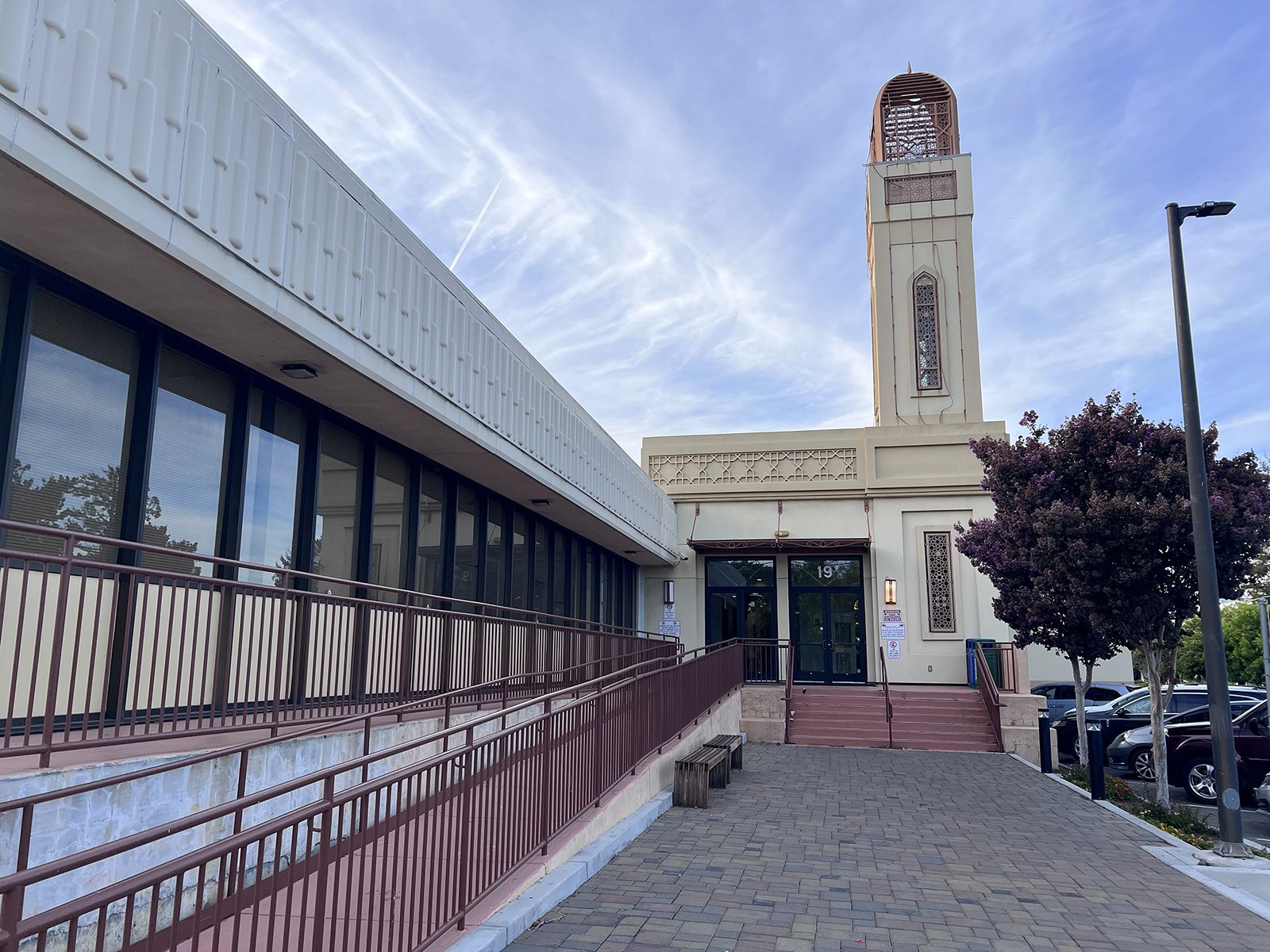
The exterior of the Muslim Community Association (MCA) in Santa Clara, Calif. (Photo by Andrew Esensten)

The school district didn’t respond to requests for comment. Local NBC affiliate KRON4 said the superintendent noted that district policy requires instruction about religion to be “academic, not devotional.”

Ari Y. Kelman, a Stanford professor of education and Jewish studies, said the lawsuit highlights the challenges public high schools face in teaching about religion in an experiential way. “It’s one thing to say these are the Five Pillars of Islam, or these are the books of the Torah — you can answer those kinds of questions on a multiple-choice test,” he said. “But if you want to help students get inside of the material, that kind of approach can be mistaken for proselytizing, even if it is not.” In college, a standard assignment in a religion course is to visit a house of worship for a faith that is not your own, according to Kelman. “But there are developmental differences between 18-year-olds and 15- or 16-year-olds that their teachers should be conscious of,” he said.

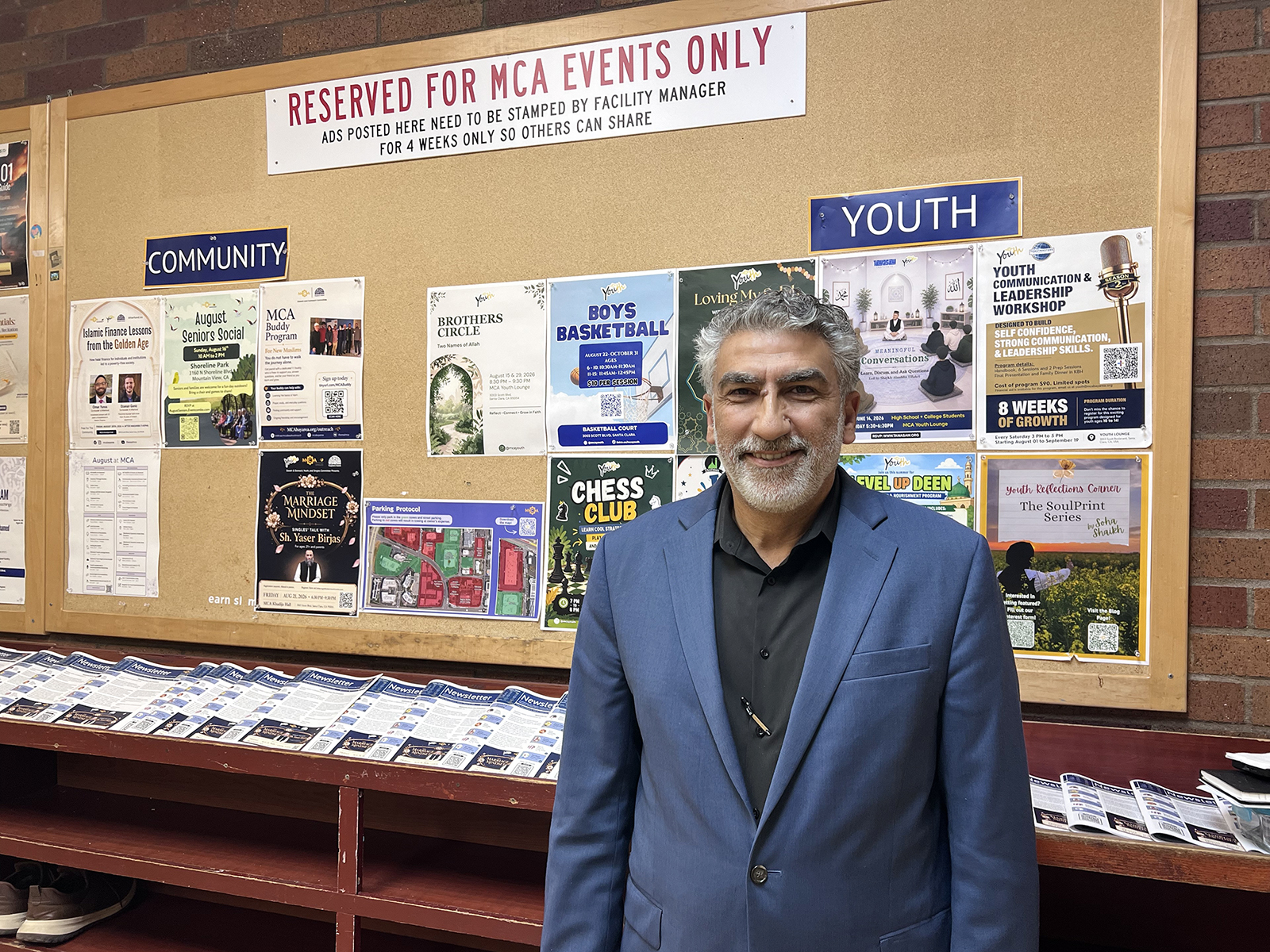
The mosque that hosted the students, the Muslim Community Association (MCA), is located in the city of Santa Clara in Silicon Valley. Founded in 1981, it is one of the largest Islamic centers in the U.S., with more than 3,000 people attending Jumah prayers on Fridays, according to its website. The religious director, Imam Fuad Mohamed, was born in Ethiopia, and community members hail from 50 different countries.

The center, which is not being sued, released a statement this week reaffirming its commitment to hosting groups like the one from Palo Alto High School. “Visitors to MCA have the opportunity to learn about our faith, ask questions, and observe our community as it practices its traditions,” it read in part. “Learning about a religion is not the same as being asked to practice it.”

Dhaouadi, the mosque’s communication and outreach director, gave RNS a tour of the center on Thursday. In the lobby, an exhibit on famous Muslim converts included photos and biographies of Malcolm X, Muhammad Ali, British broadcaster Lauren Booth and social media personality Sneako, among others. Dhaouadi, who was born in Tunisia, pointed out the men’s and women’s prayer halls, classrooms for students enrolled in a pre-K through twelfth-grade Islamic school, a Zakah (charity) office, a bookstore and an outdoor field, where dozens of children were doing soccer drills.

Over tea in the center’s halal cafe, he disputed the idea that the students were coerced to take home Qurans or put on hijabs. “Some did and some didn’t,” he said. “It was completely up to them. Same thing with the hijabs. There was no coercion.”

Mongi Dhaouadi, the communication and outreach director at Muslim Community Association (MCA) in Santa Clara, Calif. (Photo by Andrew Esensten)

Juni Thurston, a 17-year-old senior, is not involved with the lawsuit and missed the mosque visit due to illness, but in an email, she pushed back against the idea that the Social Justice Pathway program gave preferential treatment to one religion. She said classmates studied seven religions: Judaism, Christianity, Islam, Hinduism, Buddhism, Baha’i and Taoism. “While the Santa Clara Muslim Community Association was the only religious site visited, other religions received specialized attention in other ways,” she said in an email, noting that students read “Night” by Elie Wiesel and other texts to gain a deeper understanding of Judaism.

Students who visited the mosque last fall had to have permission slips signed by their parents, according to Thurston, who is the editor-in-chief of the school newspaper. In an opinion piece published last week, she wrote that a female student told her women were encouraged to cover their hair only if they wished to enter the prayer hall. That student chose to cover her hair with her hoodie rather than with a hijab. Thurston also wrote that another student told her that speakers did not promote Islam over other faiths.

When asked to comment on the students’ accounts, Rosenberg-Wohl said, “I’m sure there are a number of students who came out liking what happened. What they think about it is irrelevant. What the Constitution says about it is relevant.”

Thurston, however, did write that she was “disappointed” that the mosque invited Billoo to speak. She defended her teachers against accusations of being complicit in religious indoctrination.

“The idea that they would be working to indoctrinate students into Islam, or any religion, is an idea extremely foreign to me as a student who has had them as my teachers for the past two years,” she wrote.

Billoo addressed another cohort of students at the mosque in the fall of 2022. In a statement, Billoo said, “We are concerned that this lawsuit risks turning ordinary engagement with Islam and Muslims into something suspicious and could have a chilling effect on educators who want their students to learn about the diverse communities around them.”