Is a school trip to a mosque preaching or teaching? California school district gets hit with lawsuit.

PALO ALTO, Calif. (RNS) — Last fall, a group of students at Palo Alto High School took a field trip to a local mosque, meeting the mosque’s imam and a Muslim civil rights lawyer. The students observed Dhuhr prayers, listened to students recite passages from the Quran and were given Qurans as gifts, while female students also were encouraged to wear hijabs, according to a civil rights lawsuit filed by some parents and students.
The lawsuit, filed in federal court by Jewish, Hindu and Zoroastrian parents and students, claims Palo Alto Unified School District violated students’ First Amendment rights and state laws requiring religious neutrality by elevating one religion and disfavoring or stigmatizing “students and families who do not share the promoted religious perspective.” The lawsuit is raising questions about where the line is drawn between education about religion and religious indoctrination.
The fall 2025 trip was part of the high school’s Social Justice Pathway curriculum, a three-year track beginning in students’ sophomore year. A recruitment video highlights field trips to the San Francisco Museum of Modern Art and the former immigration station on Angel Island, and it includes photographs of students during a prior trip to the mosque. The plaintiffs, who include several Jewish parents and students, one Hindu parent and one Zoroastrian parent, belong to a group called Community Members for Religious Neutrality in Public Schools – San Francisco Bay Area.
“The flavor of this trip was that this particular faith is particularly worthy for this particular purpose (social justice),” David Rosenberg-Wohl, the plaintiffs’ lawyer, said in an interview. “When you favor one faith, you denigrate the others.”
The plaintiffs also contend that Zahra Billoo, the executive director of the Bay Area office of the Council on American-Islamic Relations, spoke to students unchallenged, even though she had previously made “publicly documented hostile and discriminatory statements regarding Jews and sharply ideological political views.” In 2021, she referred to the Anti-Defamation League, chapters of Hillel International, The Jewish Federations of North America and “Zionist synagogues” as “enemies” for supposedly stoking Islamophobia, according to news reports.
The plaintiffs are asking the court to bar the school district from religious activities without parental consent and to institute new policies on photographing students and vetting speakers. The lawsuit claims students were photographed wearing religious attire without parental consent, and the mosque later posted the photos online. Rosenberg-Wohl said some of the photos were removed after the lawsuit was filed.
Both the mosque and some Palo Alto students disputed some of the claims in the lawsuit — including that all students were given Qurans as gifts and that the school program, by only visiting a mosque, was giving preferential treatment to Islam. The mosque’s communications director, Mongi Dhaouadi, said staff simply left the books on a table at the back of the hall for anyone who wanted to take one home.
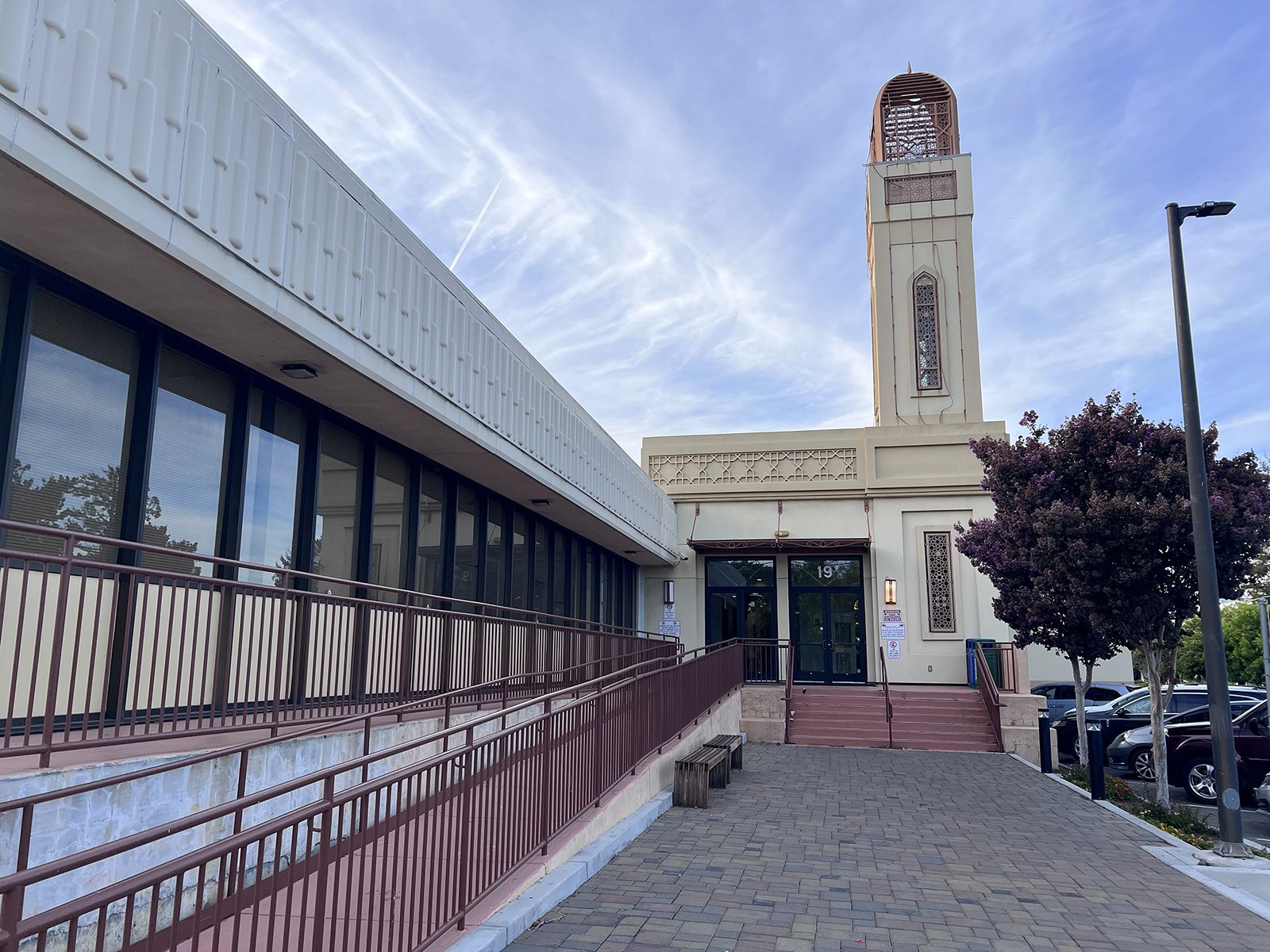
The exterior of the Muslim Community Association (MCA) in Santa Clara, Calif. (Photo by Andrew Esensten)
The school district didn’t respond to requests for comment. Local NBC affiliate KRON4 said the superintendent noted that district policy requires instruction about religion to be “academic, not devotional.”
Ari Y. Kelman, a Stanford professor of education and Jewish studies, said the lawsuit highlights the challenges public high schools face in teaching about religion in an experiential way. “It’s one thing to say these are the Five Pillars of Islam, or these are the books of the Torah — you can answer those kinds of questions on a multiple-choice test,” he said. “But if you want to help students get inside of the material, that kind of approach can be mistaken for proselytizing, even if it is not.” In college, a standard assignment in a religion course is to visit a house of worship for a faith that is not your own, according to Kelman. “But there are developmental differences between 18-year-olds and 15- or 16-year-olds that their teachers should be conscious of,” he said.
The mosque that hosted the students, the Muslim Community Association (MCA), is located in the city of Santa Clara in Silicon Valley. Founded in 1981, it is one of the largest Islamic centers in the U.S., with more than 3,000 people attending Jumah prayers on Fridays, according to its website. The religious director, Imam Fuad Mohamed, was born in Ethiopia, and community members hail from 50 different countries.
The center, which is not being sued, released a statement this week reaffirming its commitment to hosting groups like the one from Palo Alto High School. “Visitors to MCA have the opportunity to learn about our faith, ask questions, and observe our community as it practices its traditions,” it read in part. “Learning about a religion is not the same as being asked to practice it.”
Dhaouadi, the mosque’s communication and outreach director, gave RNS a tour of the center on Thursday. In the lobby, an exhibit on famous Muslim converts included photos and biographies of Malcolm X, Muhammad Ali, British broadcaster Lauren Booth and social media personality Sneako, among others. Dhaouadi, who was born in Tunisia, pointed out the men’s and women’s prayer halls, classrooms for students enrolled in a pre-K through twelfth-grade Islamic school, a Zakah (charity) office, a bookstore and an outdoor field, where dozens of children were doing soccer drills.
Over tea in the center’s halal cafe, he disputed the idea that the students were coerced to take home Qurans or put on hijabs. “Some did and some didn’t,” he said. “It was completely up to them. Same thing with the hijabs. There was no coercion.”
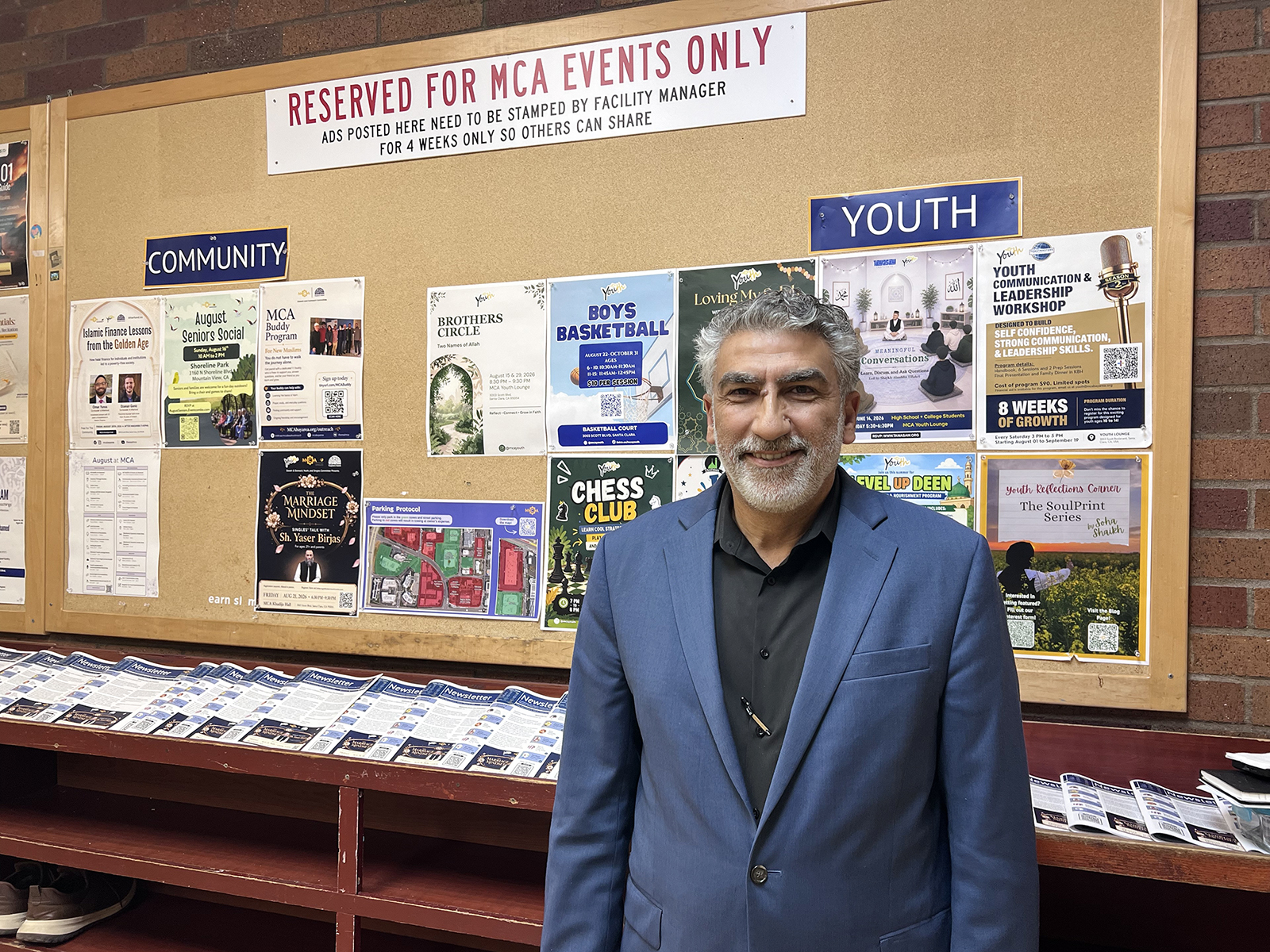
Mongi Dhaouadi, the communication and outreach director at Muslim Community Association (MCA) in Santa Clara, Calif. (Photo by Andrew Esensten)
Juni Thurston, a 17-year-old senior, is not involved with the lawsuit and missed the mosque visit due to illness, but in an email, she pushed back against the idea that the Social Justice Pathway program gave preferential treatment to one religion. She said classmates studied seven religions: Judaism, Christianity, Islam, Hinduism, Buddhism, Baha’i and Taoism. “While the Santa Clara Muslim Community Association was the only religious site visited, other religions received specialized attention in other ways,” she said in an email, noting that students read “Night” by Elie Wiesel and other texts to gain a deeper understanding of Judaism.
Students who visited the mosque last fall had to have permission slips signed by their parents, according to Thurston, who is the editor-in-chief of the school newspaper. In an opinion piece published last week, she wrote that a female student told her women were encouraged to cover their hair only if they wished to enter the prayer hall. That student chose to cover her hair with her hoodie rather than with a hijab. Thurston also wrote that another student told her that speakers did not promote Islam over other faiths.
When asked to comment on the students’ accounts, Rosenberg-Wohl said, “I’m sure there are a number of students who came out liking what happened. What they think about it is irrelevant. What the Constitution says about it is relevant.”
Thurston, however, did write that she was “disappointed” that the mosque invited Billoo to speak. She defended her teachers against accusations of being complicit in religious indoctrination.
“The idea that they would be working to indoctrinate students into Islam, or any religion, is an idea extremely foreign to me as a student who has had them as my teachers for the past two years,” she wrote.
Billoo addressed another cohort of students at the mosque in the fall of 2022. In a statement, Billoo said, “We are concerned that this lawsuit risks turning ordinary engagement with Islam and Muslims into something suspicious and could have a chilling effect on educators who want their students to learn about the diverse communities around them.”

No comments:
Post a Comment