Saturday, August 29, 2026


Canada’s West Coast Ports Drive Trade Growth Beyond the U.S.
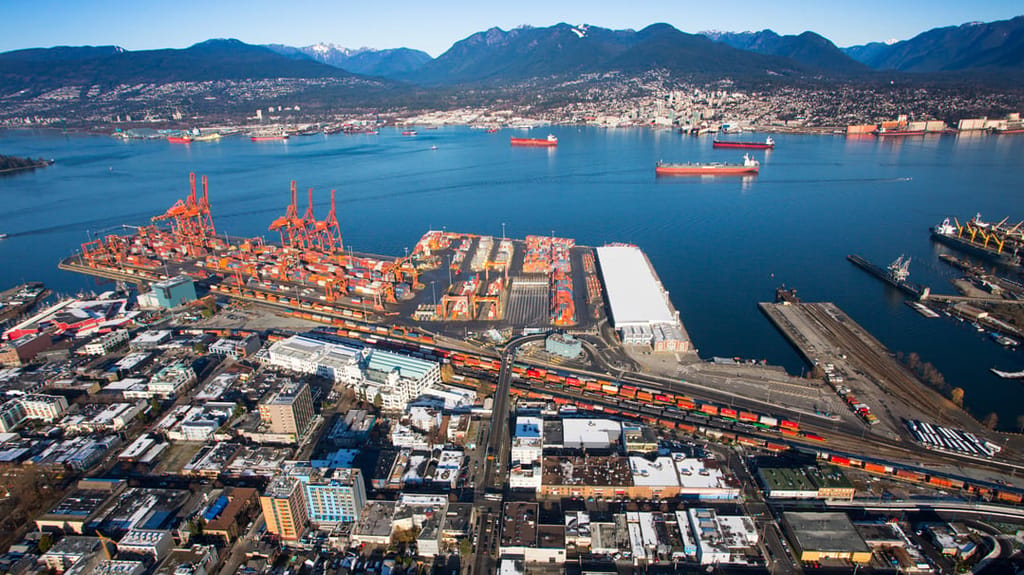
Vancouver, Canada
Port of Vancouver has 29 deep-water terminals and plays a key role in Canadian trade (Port of Vancouver file photo)

Published Aug 26, 2026 6:44 PM by The Maritime Executive


As it finds itself locked in a deepening trade war with the United States, Canada is successfully building its international trade. A newly released study sponsored by Canada’s West Coast ports shows that they are playing a critical role in growing foreign trade as the Canadian government highlights that it is investing in the country’s seaports.

The Economic Impact of West Coast Ports study, released today, August 26, highlights that British Columbia’s maritime gateways at the ports of Vancouver, Prince Rupert, and Nanaimo (sponsors of the study along with two trade associations) serve as the backbone of Canada’s international trade. The three ports handled more than 200 million metric tonnes of cargo in 2025 worth C$409 billion (US$295 billion), of which C$270 billion was Canada’s trade with overseas trading partners, or nearly half of Canada’s trade with markets outside North America.

The ports highlight that they are moving record volumes of what Canadians make, mine, harvest, and grow to global customers in more than 170 overseas markets. They handle a diverse mix of cargo, supporting the movement of everything from bulk exports of Canadian energy, forestry products, potash, grain, and critical minerals to two-way container trade and imports of Asian-made vehicles, manufacturing parts and household necessities.

Not included in the study, but also a key contributor was the opening of Canada’s LNG export terminal. It is the only North American Pacific Coast LNG terminal and is expected to make strong inroads into Asian markets. It is being followed by others and offers the advantage of shorter distance and eliminates the need to transit the Panama Canal.

“West Coast ports like Vancouver have an outsized role to play as Canada looks to double exports to non-U.S. markets over the next 10 years in support of a thriving national economy,” said Peter Xotta, President and CEO, Vancouver Fraser Port Authority.

The Port of Vancouver, with its 29 major deep-water terminals, is active in five key sectors: auto, bulk, breakbulk, container, and cruise. To the north, the Port of Prince Rupert handles raw materials as well as containers, and the Port of Nanaimo, located 30 nautical miles from the Port of Vancouver, is emerging on the Pacific coast. It supports containers, auto, bulk, breakbulk, cruise, and logistics services.

Canada's new government highlights that it is “laser-focused on building a stronger, more independent, more resilient Canadian economy.” Speaking on Monday, August 24, Prime Minister Mark Carney highlighted the government’s commitment to the ports. In the east, he pointed to the expansion of the Port of Montréal at Contrecoeur with a new container terminal and at the Port of Québec to move more Canadian products to global markets.

Port of Vancouver officials highlight their planned Roberts Bank Terminal 2 to expand container capacity as well as the new federal Port of Vancouver Gateway strategy that is currently being developed. Similarly, the Port of Prince Rupert points to C$3 billion (US$2.2 billion) in ports underway that will expand capacity and support diversification.

The West Coast ports are highlighting their economic contribution to Canada and the role they are playing in expanding Canadian trade globally. The full report is posted online.
 

Trillion-Dollar Port: Houston's Petroleum Trade Supports Millions of Jobs

Port Houston
Courtesy Port Houston

Published Aug 26, 2026 8:18 PM by The Maritime Executive


Plenty of ports contribute billions of dollars in economic value to their respective regions, but only a few reach above that mark. Port Houston's latest economic impact assessment suggests that it supports nearly $1 trillion in economic activity - roughly three percent of U.S. gross domestic product. 

The study is an update performed by Martin Associates on behalf of Port Houston, and builds on previous work in 2022. By 2025, economic activity supported by Port Houston rose by about $100 billion, reflecting substantial growth in business along the Houston Ship Channel. 

The study also found that the port's economic activity supports 3.5 million jobs nationwide, one out of every 50 jobs in the country,d including 1.9 million jobs in Texas alone (up 22 percent since 2022). The vast majority of these positions depend to varying extents on trade through the port, but are not directly linked to its daily operations. A much smaller number, about 92,000 positions, are directly employed with the port, its terminal operator partners or various contractors. Those local waterfront posts are well-paid, according to the study's authors, and bring home $8.5 billion a year in wages (about $92,000 per person on average). 

The national economic impact is driven in large part by the port's massive petroleum and chemical trade. Port Houston's terminals handle nearly 300 million tons of cargo every year, the overwhelming majority in the form of liquid bulk.   

"The Houston Ship Channel is one of the country's most important economic corridors, and these findings demonstrate its impact far beyond our region," said Charlie Jenkins, CEO of Port Houston. "Manufacturers, energy producers, businesses, and consumers across the country depend on this critical gateway to move products."


Klaipeda Port Largest-Ever Expansion Project Moves Into Construction Phase
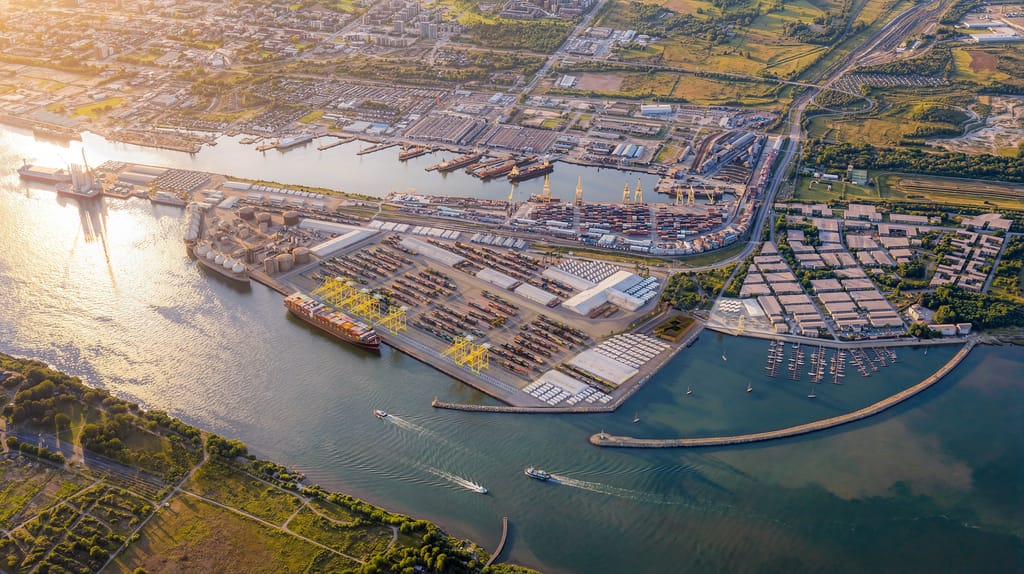
Port of Klaipeda
Port of Klaipeda

Published Aug 28, 2026 8:06 AM by The Maritime Executive


[By: Port of Klaipeda]

The Port of Klaipeda is moving into a new phase of the largest expansion project in its history, with the first works now getting underway. Site preparation has started in the southern part of the port, where a major new port area will be developed in the coming years.

“We are now very close to the start of the southern port expansion. After a long period of planning and preparation, work on site is beginning. Once the site is ready, construction of the southern breakwaters will start this autumn, marking the first stage of the largest expansion project in the history of the Port of Klaipeda. This project shows that we are steadily moving forward with our plans to build a stronger port for Lithuania. It will make the country more attractive to investors, strengthen our competitiveness in international markets and support military mobility needs that are important not only for Lithuania, but for the wider region,” says Algis Latakas, CEO of the Klaipeda Port Authority.

The southern breakwaters will be built by Tilsta, which won the tender launched earlier this year. The contract signed with the Klaipeda Port Authority is worth EUR 24.5 million excluding VAT. Construction is expected to begin this autumn.

The new breakwaters will also serve an important environmental purpose by helping to limit the flow of salt water into the Curonian Lagoon.

The southern port expansion will create new space and significantly increase the Port of Klaipeda’s capacity for port operations and cargo handling. Nearly EUR 600 million – the largest share of the Port’s investment programme for 2026–2029 – is planned for the project.

Together with investment expected from future investors, the total value of the development will exceed EUR 1 billion, making it one of the largest investment projects currently being developed in Lithuania.

The products and services herein described in this press release are not endorsed by The Maritime Executive.


Ningbo-Zhoushan Tops Singapore as World’s Second Busiest Container Port
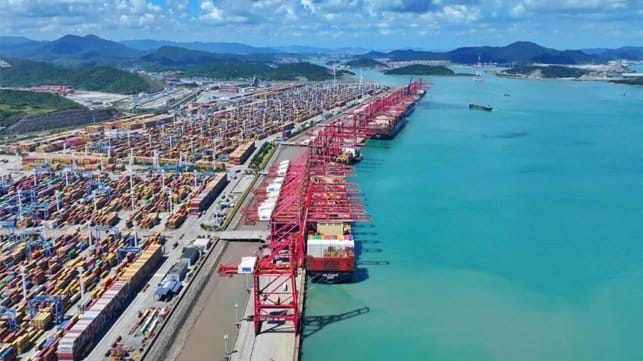
Ningbo China container port
Ningbo-Zhoushan edged out Singapore to take second place in a ranking of the highest volume container ports (Ningbo-Zhoushan)

Published Aug 26, 2026 5:35 PM by The Maritime Executive


China’s ports are continuing to support the expansion of the country’s exports despite the Trump administration’s efforts at tariffs. China now has six of the top 10 ports by volume, according to Alphaliner’s latest rankings, and in a surprise move, the Ningbo-Zhoushan port complex edged out Singapore for the position of the world’s second busiest port.

Officials at the Zhejiang Provincial Seaport Group and Ningbo-Zhoushan Port Group highlighted that they had fully implemented their plans to strengthen work style and efficiency. The port complex has continued its rapid growth. It finished 2025 only about 800,000 TEU behind Singapore, and with the continued growth, it has now edged out Singapore and slipped into second position on Alphaliner’s Top-30 chart for global port throughput.

Ningbo-Zhoushan is growing at nearly twice the rate of Singapore, with the chart showing 8.8 percent growth for throughput in the first half of the year versus 4.7 percent for Singapore. Both ports showed slowing growth rates versus 2025, but still Ningbo-Zhoushan ended up ahead by 158,310 TEU.

The expectation is that the two ports will continue in a neck-and-neck race for the remainder of the year. However, China’s growth rates continue above those of most other countries.

Shanghai remains firmly atop the list at more than 28.7 million TEU, according to Alphaliner’s data. Last year, Shanghai broke the 55 million TEU mark for the first time, with officials pointing to the efficiency from the increasing levels of automation in the port. In July, recovering from the impact of a typhoon, Shanghai reported it smashed the record for a single-day volume, moving nearly 204,000 TEU.

China’s Shenzhen, Qingdao, Guangzhou, and Tianjin were also among the 10 busiest container ports in the first half of 2026. Tianjin also showed strong growth, helping it to edge out Busan by nearly 400,000 TEU over the six months to move up one spot, claiming number 7 on Alphaliner’s table.

Analyzing the changes, Alphaliner says the half-year data “shows the widespread impact of geopolitical trends on the global container market, as carriers adjusted their networks in reaction to the Middle East conflict and shippers responded to the US tariff policy.”

It highlights the most significant drops were in the Middle East, where the war and the closing of the Strait of Hormuz dramatically impacted the fortunes of Dubai’s Jebel Ali port and Abu Dhabi’s Khalifa Seaport. Jebel Ali’s volumes, they report, plummeted over 90 percent to just 374,000 TEU for the second quarter and 3.14 million TEU for the six months, which was down 23 percent. 

As a result, Jebel Ali fell out of the top 30 ranking to 32nd place. Similarly, Khalifa Seaport fell from its previous position of 32nd out of the top 50 reports by Alphaliner. They note exact numbers have not been published, but they believe based on wider group results that Jebel Ali’s volumes fell at least 50 percent.

Most of the other global ports retained the order in the ranking or moved up or down one notch. Combined, the Port of Los Angeles and Long Beach came in again at number 9, handling just under 10 million TEU in the first half of the year. They are the only U.S. port to be in the top 10, with the Port of New York and New Jersey a distant second, falling one notch to 22 on the chart. It handled 4.4 million TEU, which was relatively stable compared to 2025.


CMA CGM and Saudi Arabia to Invest $434M to Expand Jeddah Islamic Port
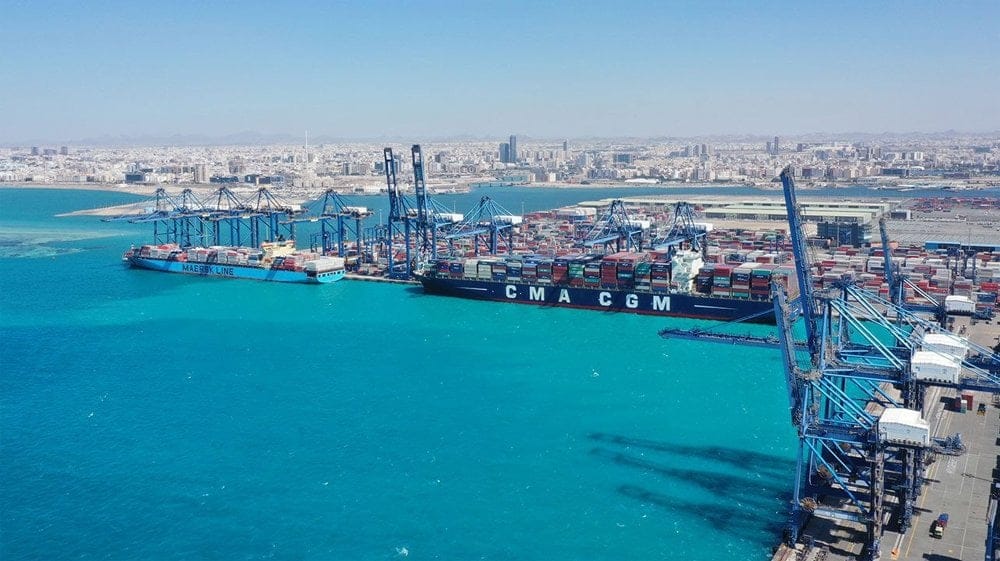
Saudi Arabia container terminal
CMA CGM will invest in the expansion of the container terminal capabilities at Saudi Arabia's Jeddah Islamic Port (RSGT)

Published Aug 25, 2026 7:52 PM by The Maritime Executive


An agreement was signed in Paris during a French-Saudi Investment Roundtable that calls for CMA CGM and Red Sea Gateway Terminal (RSGT), Saudi Arabia's terminal operator, to expand the Red Sea Jeddah Islamic Port. Working in collaboration with the Saudi Ports Authority (Mawani), the companies will be marking one of the largest foreign direct investments in Saudi Arabia's maritime sector.

The project will bring approximately $434 million in investment into Jeddah Islamic Port and create a new state-of-the-art container terminal as part of RSGT’s existing concession. It will add up to approximately 2.6 million TEUs of annual handling capacity at the port, which currently has a capacity of 6.2 million TEUs. It will include new deep-water berths designed to accommodate the world's largest container vessels supported by advanced terminal technologies and 10 new ship-to-shore cranes.

RSGT calls the Jeddah operation its flagship terminal, noting that it is the largest and most advanced container terminal on the Red Sea. It accounts for nearly 40 percent of Saudi Arabia’s container throughput. 

The companies highlighted that the development project will enhance productivity, efficiency, and service reliability for customers across the Kingdom and the wider region. They said the enhanced marine infrastructure will strengthen Jeddah Islamic Port's ability to efficiently serve larger vessels and major international shipping services, supporting greater trade volumes, stronger global connectivity, and more efficient access to international markets for Saudi imports and exports. The development also further reinforces the successful partnership between the Kingdom, represented by the Saudi Ports Authority (Mawani), RSGT, and CMA CGM Group.

The project will provide critical future capacity to accommodate the Kingdom's growing trade requirements while strengthening the port's position on major global shipping routes. The addition of deep-water berths will enable the terminal to efficiently accommodate larger, next-generation container vessels, helping attract and retain major shipping services, increase cargo flows and enhance the connectivity of Saudi businesses to global markets. 

Red Sea Gateway Terminal (RSGT) is Saudi Arabia’s first privately funded terminal operator. To serve a broader range of customers and cargo types, RSGT also offers Multi-Purpose Terminals (MPT) services through a dedicated business unit that manages non-containerized cargo across four strategic locations on Saudi Arabia’s Red Sea coast. It handles containers, Ro/Ro, general cargo, dry and liquid bulk, as well as livestock.

The Red Sea ports have become critical to Saudi Arabia due to the disruptions in the Strait of Hormuz. However, it is now having to address the declared “blockade” by the Houthis to the south in Yemen, which is disrupting some operations. However, the Kingdom looks to expand its capabilities as part of its goal to expand its role as a trade hub for the region.


Judge Dismisses Most of Remaining Dali Civil Damage Claims

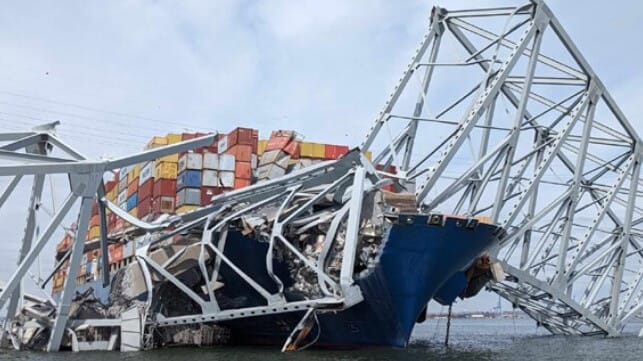
Dali containership and remains of bridge
Among the surviving civil claims are for damages to cargo in the impacted containers and the city's water main that ran below the bridge (USACE)

Published Aug 26, 2026 12:58 PM by The Maritime Executive


The district court in Maryland, hearing the civil portion of the claims related to the containership Dali destroying Baltimore’s Francis Scott Key Bridge, ruled on August 25, dismissing many of the economic loss claims while also letting several claims proceed. The court up until this point had declined to decide on issues related to a 1927 U.S. Supreme Court ruling that had limited economic losses only to claimants that had a direct property interest in the damaged property, in this case the Key Bridge.

Among the claims being issued was one from Star Bulk that argued the carrier’s ships were unable to reach the loading berth in Baltimore harbor because of the bridge collapse and, as such, it lost profits or earnings potential. Also dismissed was a class consisting of longshoremen who lost work, an insurance syndicate and Ports America Chesapeake, American Sugar Refining, and a large group of businesses and individuals, including a yacht sales company and American Publishing, that said the blocked harbor and loss of the bridge interfered with their business.

The owner of the Dali, Grace Ocean, and the manager, Synergy Marine, had filed at least since October 2024 to block the economic claims that were seeking recovery damages, citing the 1927 case, Robins Dry Dock & Repair Company. Additionally, in April 2024, they filed a motion that sought to invoke the Shipowners’ Limitation of Liability Act of 1851 as it related to the economic claims.

Judge James K. Bredar writes in his opinion that the Robins Dry Dock decision had “loomed large over these proceedings.” He also notes that there is nearly a century of case law that has interpreted and applied Robins and developed clear exceptions. 

The court moved to decide the application of Robins after it was agreed in June to delay the remaining claims. The companies and their insurers settled key elements of the civil claims, including all the wrongful death and personal injury claims, and the claims from the state of Maryland. All but 10 of the 54 initial claims filed in the civil case have been settled or voluntarily dismissed.

At issue is the 1927 U.S. Supreme Court decision that bars economic loss recoveries caused by negligence unless there were also physical damages to properties. Most of the remaining claims cite economic losses due to the closure of the port and the loss of the bridge. In Robins Dry Dock, the propeller of a vessel was negligently damaged while undergoing scheduled maintenance and delayed the vessel’s return to operation for two weeks.  A suit was brought to recover for the lost profits while the vessel was out of operation, and was rejected when it reached the Supreme Court. 

In the 75-page opinion, the judge considers each of the claims against the Robins decision and subsequent exceptions that have been established in case law.

The decision lets several claims survive and proceed. Included in this is one from the City of Baltimore for damages to a water main that was in the harbor below the bridge, while the court dismisses other claims from the city related to the loss of the bridge and damage to other streets and bridges. The court says the City of Baltimore failed to establish a proprietary interest in the Key Bridge sufficient to license recovery of the economic damages beyond the physical damage to the water main.

A claim for Baltimore County was also permitted to survive specifically for damages to the county’s waterways. The county claims debris from the bridge reached its shoreline, and the court is letting those claims stand, but dismissed claims similar to the city regarding roadways.

The final claim that survived is a class action filed by the trucking company R.E. West, which alleges physical damage to cargo from various companies aboard the Dali. A portion of the claim from West was dismissed, but the elements specific to damage of cargo resulting from the allision and the collapse of the bridge onto containers survive.

The judge notes in his conclusion that the plaintiffs had asserted that Robins would be transformative to the civil claims against the Dali, and the court agrees. It notes that the scope of the civil case has been significantly narrowed. It is likely the decision in this case will also further add to the case law in the century since the Supreme Court’s Robins Dry Dock & Repair decision.


Peking University team releases homogenized gridded climate dataset for China


Science China Press
Annual climate series from reanalysis, raw observations and HCD01 over China 

image: 

Annual mean time series and trends of surface solar radiation, temperature, relative humidity, wind speed and precipitation over China from reanalysis, raw observations and the homogenized gridded climate dataset HCD01.

view more 

Credit: ©Science China Press


How can we accurately trace China’s climate change over the past more than 60 years? Instrument upgrades, station changes, and gradual urbanization may leave “non-climatic” signals in conventional meteorological observations, seriously hindering our understanding of climate change in China.

Recently, a research team led by Professor Kaicun Wang from the College of Urban and Environmental Sciences at Peking University published a paper titled “A Homogenized Gridded Climate Dataset for China” in Science China Earth Sciences. At the same time, the team publicly released a daily homogenized gridded climate dataset for China (HCD01) covering 1961-2022 through the National Tibetan Plateau Data Center (https://doi.org/10.11888/Atmos.tpdc.302712). The paper systematically summarizes the evolution of China’s national surface meteorological station network and observing instruments. Building on homogenized raw observations from about 2,400 national meteorological stations and reanalysis data, the team developed a gridded climate dataset at 0.1° spatial resolution, providing high-quality data for studies of regional climate change and its impacts in China.

In-situ observations from surface meteorological stations are widely used for climate-change detection, attribution, and impact studies, as well as for evaluating satellite remote-sensing retrievals and model simulations. However, as observing instruments are continuously upgraded and replaced, different instruments may introduce different biases, causing artificial changes in observations, namely inhomogeneity in climate data.

In general, observational data are expected to represent large-scale climate-change signals of 100 km or more. Yet changes in the local environment around stations, such as urbanization, may be superimposed on large-scale climate signals. Therefore, to accurately detect and attribute climate change, it is necessary to remove, as much as possible, the effects of non-climatic factors and local environmental changes.

Among these effects, abrupt changes caused by station relocations and instrument replacements are usually large and relatively easy to detect and correct through homogenization. By contrast, changes in the observing environment around stations are often gradual, and each individual change has only a small effect on observations, making them difficult to identify and correct. Over time, however, such effects can accumulate and produce systematic biases, significantly affecting estimates of climate-change trends and even the reliability of climate-change detection and attribution.

Traditional homogenization methods generally rely on comparisons with neighboring stations. Specifically, reference stations with similar elevation and reliable data quality are selected around a target station, and possible inhomogeneities are identified by comparing their time series. However, when many stations in a region are simultaneously affected by instrument sensitivity drift, instrument replacement, urbanization, and other factors, the reference stations themselves may also contain inhomogeneities. As a result, traditional methods can miss such signals and have limited ability to detect both gradual and abrupt inhomogeneities under these conditions.

To address this problem, after more than a decade of research, Wang’s team proposed a homogenization method based on same-station comparison. This method overcomes key difficulties in detecting and correcting gradual inhomogeneities and enables the detection and correction of both gradual and abrupt inhomogeneities in China’s land-surface climate observations, including surface solar radiation, wind speed, relative humidity, air temperature, ground temperature, and precipitation. It therefore provides important technical support for building high-quality climate datasets for China.

The results show that, because strict calibration instruments and procedures were lacking before 1990, gradual inhomogeneity caused by instrument sensitivity drift affected China’s surface solar radiation observations. As a result, the decreasing trend in surface solar radiation during 1960-1990 was seriously overestimated, while instrument updates during 1990-1993 caused a sudden increase in the observations.

In the 21st century, China’s meteorological observations began shifting from manual to automatic observation, with the greatest impact on relative humidity. Under low near-surface wind-speed conditions, the dry- and wet-bulb thermometers used in manual observations tended to overestimate relative humidity, whereas the capacitive sensors used in automatic observations did not have this problem. This difference produced a false decreasing trend in relative humidity observations in the 21st century.

In addition, urbanization around meteorological stations amplified the warming trend of daily minimum temperature, while increased surface roughness caused by urbanization reduced near-surface wind speed. At the same time, relocations of meteorological stations from urban to rural areas caused abrupt increases in wind speed. Although the decline in station-observed near-surface wind speed does not represent large-scale change, it reflects real changes in near-surface wind speed at observing sites and affects station precipitation observations.

However, homogenized station observations alone are still insufficient for climate-change research. Because observing stations are sparse and unevenly distributed, and because observation periods differ among stations, it is difficult to conduct direct spatiotemporal analysis at the national scale. Therefore, based on homogenized station observations and ERA5-Land reanalysis, the team constructed the Homogenized Gridded Climate Dataset for China (HCD01), providing a high-quality data foundation with complete spatial coverage for regional climate-change research. The results show that HCD01 clearly improves the representation of long-term trends compared with reanalysis data and raw observations.

The study was led by Professor Kaicun Wang from the College of Urban and Environmental Sciences at Peking University, who served as the first author and corresponding author. The research team included current graduate students Hongze Cai, Yun Li, Hanmeng Xia, and Changjian Yin from Wang’s group, as well as former graduate students including Professor Chunlue Zhou from Sun Yat-sen University, Associate Professor Yanyi He from Sun Yat-sen University, Young Researcher Zhengtai Zhang from Lanzhou University, and Dr. Runze Zhao from the National Satellite Meteorological Center of the China Meteorological Administration. The study was supported by the National Key Research and Development Program of China (2022YFF0801302) and the Science and Technology Program of Guizhou Province (Qian Ke He Ren Cai XKBF[2025]012).

See the article

Wang K, Cai H, He Y, Li Y, Xia H, Yin C, Yu H, Zhao R, Zhang Z, Zhou C. (2026). A homogenized gridded climate dataset for China. Science China Earth Sciences, 69(8), 2856-2878. https://doi.org/10.1007/s11430-025-1889-0


Graded membranes point to a sustainable route for refining complex petroleum


Science China Press
Graded membranes point to a sustainable route for refining complex petroleum 

image: 

Conceptual illustration of the graded membrane strategy for molecular-level separation of light naphtha.

view more 

Credit: ©Science China Press


Petroleum refining depends heavily on the separation of complex hydrocarbons mixtures into a variety of valuable products. This process is particular challenging when the constituent molecules exhibit nearly identical physical properties. Researchers from the Dalian Institute of Chemical Physics, Chinese Academy of Sciences, and Sun Yat-sen University have developed a membrane-based strategy that offers a new approach to address this challenge. Rather than utilizing a single membrane, the researchers engineered membranes with distinct molecular sorting capabilities and integrated them into a sequential separation process. Their study, published in National Science Review, demonstrates molecular-level fractionation of light naphtha, an important petroleum fraction containing a complex mixture of hydrocarbons.

Light naphtha typically comprises hydrocarbons containing five to seven carbon atoms, including linear alkanes, branched alkanes, cyclic alkanes and aromatics. Although these molecules share chemically similarities, their industrial applications vary significantly. Linear and mono-branched alkanes commonly serve as feedstocks for ethylene production. Aromatics are utilized as essential chemical intermediates, whereas highly branched and cyclic alkanes are valuable constitutes of high-octane gasoline. However, the separation of these molecules presents considerable challenges. Conventional refining processes predominantly rely on distillation, which separates molecules through repeated vaporization and condensation, requiring substantial energy consumption.

Membranes provide an alternative approach by allowing selective passage of specific molecules through nanoscale channels. However, a single membrane is seldom capable of efficiently fractionating complex petroleum mixtures at the molecular level. To overcome this limitation, the research team developed a graded sorting strategy. They employed a porous material known as a metal–organic framework (MOF) as the membrane platform. Specifically, the material CuBTC, which posseses ordered nanopores, was utilized to regulate molecular transport.

The CuBTC membranes were treated with tannic acid, a naturally derived polyphenolic compound. This mild treatment progressively altered both the effective pore size and the chemical functionality of membranes. By adjusting the treatment conditions, the researchers developed membranes exhibiting distinct separation capabilities. One membrane type primarily separated hydrocarbons based on their molecular dimensions, preferentially permitting the passage of linear and mono-branched molecules. Another membrane exhibited modified chemical functionality that enhanced interactions with aromatics, facilitating their separation from structurally similar aliphatic hydrocarbons.

The researchers subsequently integrated two membranes with distinct functions into a cascade separation process. In the first stage, linear and mono-branched hydrocarbons were selectively extracted from a complex mixture, producing a stream suitable as an ethylene feedstock. In the second stage, aromatic hydrocarbons were preferentially separated, resulting in a stream enriched with chemical intermediates. The residual components, predominantly multi-branched and cyclic hydrocarbons, constituted a third stream suitable for gasoline blending. Using this approach, the team successfully separated a simulated light naphtha mixture containing 15 different hydrocarbons into three value-specific product streams. The recovery rate for each stream was approximately 85–90%.

The researchers also evaluated the energy consumption of the membrane process through chemical process simulations. For a representative five-component mixture, the membrane cascade was estimated to reduce energy consumption by approximately 91% compared to conventional distillation, while achieving the same target recovery.

The graded membrane strategy assigns distinct molecular sorting tasks to membranes engineered with tailored pore structures and chemical functionalities. This concept provide a foundation for the development of more energy-efficient separation processes applicable to complex petroleum fractions and other multicomponent chemical mixtures.

The study, “Molecular-Level Petroleum Refining by Graded Membranes,” was published in National Science Review. The corresponding authors are Weishen Yang and Yujie Ban of the Dalian Institute of Chemical Physics, Chinese Academy of Sciences, and Dongdong Zhou of Sun Yat-sen University. The first authors are Yuecheng Wang of the Dalian Institute of Chemical Physics and Fangdi Dong of Sun Yat-sen University.

Membrane cascade separation of a 15-component light naphtha mixture and recovery of the three product streams.

Credit

©Science China Press


New insights into how neurosurgeon Paul Kalanithi conceptualized death while facing terminal cancer


By Leon Barkho, University of Sharjah

A new study examining death-related conceptual metaphors employed by neurosurgeon Paul Kalanithi in his acclaimed memoir, When Breath Becomes Air, sheds light on how he depicted death after being diagnosed with stage IV lung cancer at the age of 36.

The memoir, published posthumously following Kalanithi’s death in 2015, received notable coverage and significant literary recognition. It was selected as a finalist for the 2017 Pulitzer Prize in Biography.

Led by researchers from the University of Sharjah, the study investigates how Kalanithi constructs the meaning of death through the use of metaphors. Drawing directly on textual evidence from the memoir, the authors identify and examine death-related metaphors in Kalanithi’s primary narrative and classify them into broad discursive frameworks.

The paper, published in the journal Language and Health, further explores the distribution and contextual functions of these metaphors within the distinctive genre of a medical literary autobiography, highlighting the unique blending of Kalanithi’s dual identities as a neurosurgeon-turned-terminally ill patient.

Using the Metaphor Identification Procedure Vrije Universiteit (MIPVU), a widely recognized method employed to identify metaphorical expressions in texts, the researchers found 211 instances of death discourse metaphors in the memoir. These were classified into five major metaphor frames and ten subordinate metaphor types. 

The findings reveal that Kalanithi predominantly conceptualizes death in his memoir “as a transition or movement, followed by a negative presence, an overwhelming or obscuring force, a concluding performance, and a biomedical breakdown.”  

“Furthermore, the results demonstrate how illness discourse, by its nature, blends medical discourse with personal and existential discourse and modifies conventional death metaphors,” the authors write.

Death and metaphorical mappings

Metaphors are fundamental to human cognition and communication. In When Breath Becomes Air, Kalanithi employs them not merely as stylistic embellishments but as powerful conceptual tools through which he understands and articulates a personal experience of dying. His metaphors show that death can be shared, narrated, and contemplated despite its abstract and intangible reality.

The authors argue that Kalanithi’s memoir offers a particularly rich site for examining death metaphors within a work of nonfiction that seamlessly intertwines literary narrative with medical discourse. They demonstrate that metaphorical representations of death arise not only from his expertise as a neurosurgeon but also from his deeply personal understanding of bodily decline as he confronted his own mortality.

Among the most compelling findings of the research is Kalanithi’s recurrent use of departure metaphors. Through these figurative constructions, death is conceptualized as the author leaving the world, moving away, or passing from one state of existence to another. One evening, while they were in bed, his wife, Dr. Lucy Kalanithi, asked him, “What are you most afraid or sad about?” His answer was simple yet profound: “Leaving you.”

The authors observe, “In Kalanithi’s memoir, departure metaphors convert death into a relational event: the dying person is imagined as leaving, while loved ones remain behind.” They further note that “the cultural work of the metaphor lies in making biological death narratable as separation, memory, and continuing influence.”

For Kalanithi, death was a lived experience, far more than an abstract existential concern or biological process. The researchers’ analysis reveals that, in addition to departure metaphors, he understood and expressed his impending mortality through what they describe as “coenesthetic metaphorical mappings.” They demonstrate how these metaphors conceptually and figuratively shape people’s experience of mortality and “frame their responses to death, mortuary practices, and their understanding of death itself.”

Death, metaphor, and meaning

Diagnosed with terminal cancer, Kalanithi came to recognize that the endpoint of his life had become painfully foreseeable. The authors analyze a range of metaphors that map the end of a journey onto death, constituting the basis for an alternative metaphorical conceptualization of death. Reflecting on his diagnosis, Kalanithi observes that before cancer he knew that “someday I would die, but I didn’t know when. After the diagnosis, I knew exactly when: when I had run out of life to give.”

In another metaphorical construction, Kalanithi casts himself as a runner likening his demanding medical career and his struggle with illness to a race whose endpoint is death. Death is implicitly situated at the finish line toward which his deteriorating body is moving: “Yes, I thought, and therein was the paradox: like a runner crossing the finish line only to collapse.”

Kalanithi’s transformation from neurosurgeon to patient is also metaphorically conceptualized through a shift in agency, from actor to one acted upon. In the text, the authors highlight figurative contrasts in his transition from a physician directing events to a patient increasingly controlled by illness. This change is poignantly expressed when he writes that he had “traversed the line from doctor to patient, from actor to acted upon, from subject to direct object.”

And despite his deadly cancer, Kalanithi resists the idea that the terminal disease is going to end his life: “This is not the end… Or even the beginning of the end. This is just the end of the beginning.” The figurative representation culminates in the following evocative comparison: “Like a candle in the wind, my life wavered, uncertain of when the gust would come to extinguish it.”

Kalanithi’s imagery of death at times evokes the traditional figure of the Grim Reaper, the silent force that ultimately claims every life. In these metaphors, death is presented not merely as a biological endpoint but as an inevitable presence drawing nearer. Yet, despite its certainty, Kalanithi refuses to allow death to dominate the life that remains for him. He acknowledges that the “curse of cancer created a strange and strained existence,” but emphasizes that he is “neither blind to, nor bound by, death’s approach.”

As the authors argue, “The contribution of the study is not merely the listing of metaphor labels. Rather, its significance lies in “showing how widely documented death metaphors are reorganized within the specific discourse of a medical memoir,” in which Kalanithi’s narrative “alternates between clinical expertise, patient vulnerability, literary reflection, and existential meaning-making.”

The study offers what appears to be the first systematic discursive exploration of death metaphors in When Breath Becomes Air, a memoir that occupies a distinctive place not only in medical science but also in literary craftsmanship. Its findings contribute to the fields of medical humanities, narrative medicine, and existential inquiry.

Additionally, the study is likely to resonate with universities where Kalanithi’s memoir is assigned as a core or supplementary text in courses on medical ethics, narrative non-fiction, journalism, literature, communication, and the humanities.