“The glacial collapse and deluge,” one scientist said, “was the structural failure of a mountain itself, nature’s latest commentary on the deadly consequences of human-caused planetary warming.”
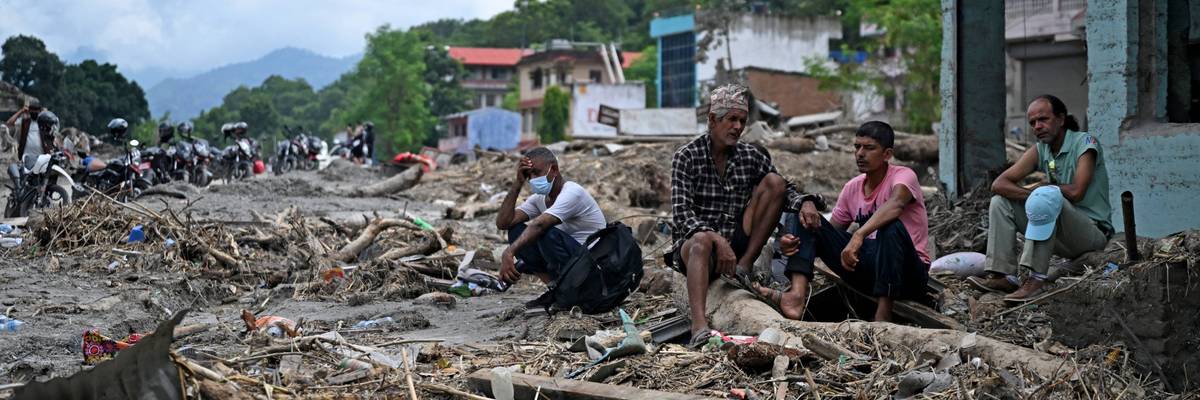
Residents sit beside debris following flash floods in Devighat, in Nepal’s Nuwakot district, on August 31, 2026.
(Photo by Arun Sankar/AFP via Getty Images)
Jessica Corbett
Sep 01, 2026
COMMON DREAMS
With more than 1,000 people dead as of Tuesday and rescue teams still searching for the thousands missing after a glacial collapse in the Himalayas that created a flooding crisis in Nepal and Tibet last week, campaigners, politicians, and scientists reiterated the need for global climate action.
China confirmed at least 16 people are dead and 546 are missing in Tibet, including 261 foreign nationals, while Nepal reported 1,003 deaths and 3,916 more unaccounted for, including 583 foreigners, according to The Associated Press. Among those missing in Nepal are about 900 workers from a dozen hydropower projects, 500 of whom are believed to be trapped in tunnels.

With 350+ Dead and 1,300 Missing, Nepal Carnage Seen as Climate Disaster
Thousands have been rescued since last Wednesday, and as the AP noted, “authorities in Nepal have been burying bodies in temporary graves until they can be identified. They are preserving DNA samples, photographing distinguishing facial features, and recording other identifying details. Each body is assigned a reference number to help families identify and claim the remains later.”
Nepali Prime Minister Balendra Shah has emphasized in recent days that “the flood in the Bhote Koshi River in Rasuwa was not an ordinary flood,” and “it is now time for us to strongly raise with the international community the issue of the disasters we are experiencing as a result of climate change.”
In a Monday interview with The New York Times, Maheshwar Dhakal from Nepal’s Ministry of Agriculture, Forest, and Environment also linked the disaster to human-caused climate change and said that “those who have contributed the least are suffering the most.”
Dhakal estimated the recovery cost at $5 billion, and shared his government’s letter to the United Nations’ fund for such disasters, which says in part that “early action in Nepal would send a signal that the fund is capable of responding with humanity, speed, flexibility, and solidarity when climate-vulnerable countries face losses and damages beyond their capacity to address alone.”
Stefan Rahmstorf, a scientist at the Potsdam Institute for Climate Impact Research in Germany, highlighted on social media Tuesday that experts have long warned about the kinds of disasters seen in the Himalayas over the past week.
“Why are climate scientists not surprised about mountains being destabilized by glacier melt and permafrost thaw?” he asked. “Because they have long predicted that as a result of global heating.”
Bill McGuire, professor emeritus of geophysical and climate hazards at University College London, wrote in a Tuesday column for The Guardian that “the increasingly temperamental behavior of the Earth beneath our feet teaches us that global heating is all-pervasive. It will intrude into every aspect of our lives and livelihoods, and leave no part of the planet untouched. As the world processes the horror of the events in Nepal and Tibet, it is a lesson that we ignore at our peril.”
Also writing for the British newspaper on Tuesday, Michael Mann, a renowned climate scientist at the University of Pennsylvania, similarly stressed that “the glacial collapse and deluge in Nepal and Tibet was not a freak weather event; it was the structural failure of a mountain itself, nature’s latest commentary on the deadly consequences of human-caused planetary warming. And it was the exclamation point on a summer of extremes, illustrating with a sole unnatural disaster the apocalyptic future that lies in store if we fail to take dramatic climate action.”
Mann pointed to the lack of such action in the United States—the world’s largest historical climate polluter—where President Donald Trump openly courted Big Oil on the campaign trail and has served the climate-wrecking fossil fuel industry’s interests since returning to the White House last year, from declaring a national energy emergency and ditching the Paris Agreement, again, to waging a war on renewable power projects.
“Trump and enabling congressional Republicans continue to double down on policies favoring fossil fuel extraction and dependence at the very time we need to be moving even more quickly away from fossil fuels toward clean energy,” Mann wrote. “These extreme events underscore the urgency of taking action now, and—while there are many things we can do—one of the greatest opportunities Americans will have to affect climate policy is the upcoming midterm election. You can make support for urgent and dramatic climate action a litmus test issue as you go to the voting booth.”
Highlighting that dozens of Americans are among those still missing in Asia, the US-based watchdog group Public Citizen argued on social media Tuesday that “this isn’t just a climate change catastrophe. It’s a crime. For decades, Big Oil knew fossil fuels would lead to disasters like this. Big Oil must be held accountable.”
In 2024, the group published a legal memo detailing how local or state prosecutors in the United States could bring criminal charges against Big Oil for deaths from extreme heat made more likely by the fossil fuel-driven climate emergency. With rapidly advancing attribution science, the approach could also be applied to other disasters linked to the human-caused crisis.
Greenpeace International also demanded accountability for the industry on Tuesday, saying that “it makes us SICK to think of people losing their homes, their livelihoods, and the people they love to fires, floods, and storms, while fossil fuel companies make billions. A FRACTION of those obscene profits could help communities rebuild. MAKE POLLUTERS PAY.”
“Make oil, coal, and gas corporations pay their fair share for the damage they cause,” the advocacy group added. “Introduce new taxes or fines on them to help communities at home and around the world rebuild from climate disasters and invest in climate solutions.”
Nepal warns of possible fresh flooding as communities grapple with devastation
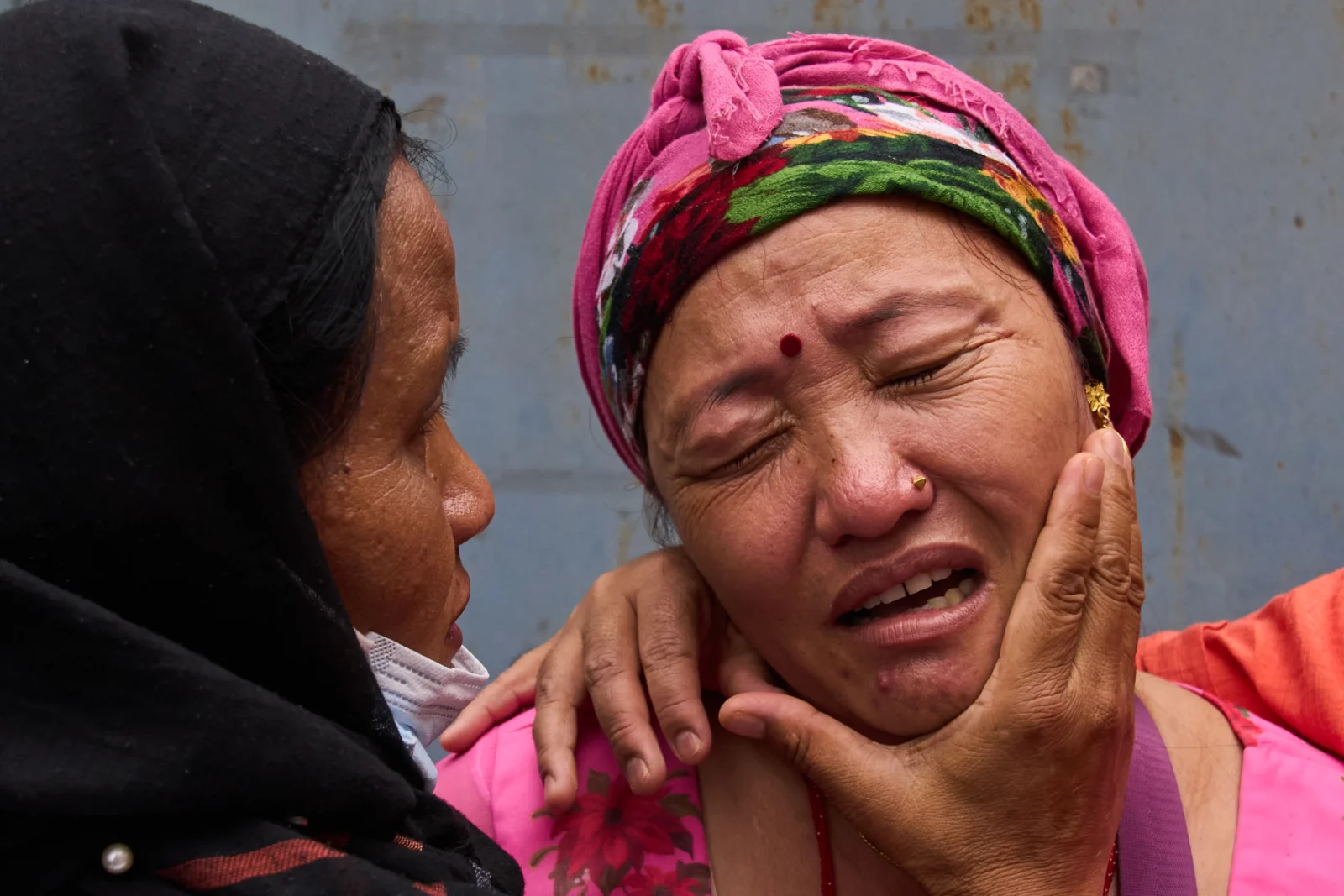
DHADING, Nepal (AP) — Authorities in Nepal warned of possible fresh flooding on Sunday and urged residents in flood-affected districts to remain on high alert after water levels rose in the Bhotekoshi River.
Flood warning notices were sent to people’s phones early Sunday as rescue crews worked to clear a major highway connecting Kathmandu to one of the areas worst hit by Wednesday’s catastrophic floods, which killed at least 800 people and left more than 3,000 missing in Nepal and Tibet.
The latest warnings came after Chinese authorities informed their Nepalese counterparts of increased water flow upstream, according to Dharam Raj Uprety, chief executive of Nepal’s National Disaster Risk Reduction and Management Authority.
The Chinese state news agency Xinhua, citing the country’s water resources ministry, said a new lake formed after Wednesday’s floods high in the mountains had largely drained.
But Xinhua said the ministry warned that a crater located 5.6 kilometers (3.5 miles) upstream, which held an estimated 1.4 million cubic meters (370 million gallons) of water, still posed some risk and required close monitoring.
Nepal’s disaster agency said Sunday the death toll had climbed to 788 with 2,502 missing, while Chinese authorities reported 16 deaths and 546 missing on the Chinese side of the border.
The missing include hundreds of people from over a dozen countries who were in the region to work, visit the mountains or make a pilgrimage to a sacred peak. On Sunday, Chinese state media said 261 foreigners were missing in Tibet, including over a hundred Nepalis and others from around the world.
Some are returning to what remained of their homes
In Dhading, one of the worst-hit regions in Nepal, some residents began returning to ruined homes to see what can be salvaged.
Residents sat in homes with walls washed away by the floods, shoveling sludge-like mud and rubble off balconies or window frames. Others scanned the ground for items they could pick out of the mud and rinse off. One man had returned for his chickens, which he found alive. He tied them up and put them in the cabin of his truck.
“Everything is finished. Nothing is left. Not even our home,” Sharmila Tamang, a Dhading resident who was trying to salvage items from her home, told The Associated Press.
At a key power plant that was severely damaged by the floods, workers started inspecting the facilities Sunday to survey the destruction. The plant serves over 20,000 people across four districts.
In the town of Galchhi, a group of residents sought higher ground on a nearby bridge and watched as the river roared by. Some pointed to enormous rocks washed downriver during the earlier floods, while others standing on a suspension bridge were warned off with whistles.
Along the river, homes, vehicles and farm tractors could be seen jutting from the thick gray-brown sediment that enveloped entire villages in some areas. Parts of rice terraces along the riverside had dropped into the river after landslides hit them.
Residents are receiving constant flood warnings
Homes and businesses left intact after the flooding were still without electricity on Sunday, as twisted power line poles and wires lay tangled in the mud.
Residents of flood-hit villages said they were struggling to make sense of near-constant alarms they’ve received since the initial floods.
“Sometimes they say a flood is coming, then we have to run again to higher ground, even at night. There is also rain,” said Govind Shreshta, a resident. “It’s really difficult for me. I have a 72-year-old father and 70-year-old mom. I must carry them and I am exhausted. It’s going on like this for those who are still alive.”
Large concrete and smaller suspension bridges were destroyed, leaving communities on the other side of the river with less easy access.
“Those who are there are now stuck there. Those who are here are stuck here. It’s going to be very difficult,” said Sattan Singh Tamang, 47, who was working near a bridge when Wednesday’s floods came.
Minister says Nepalis have become victims of climate change
Wednesday’s flash floods started after a glacial collapse high in the Himalayan region. Scientists who studied satellite images said bedrock underneath a glacier high in the Himalayan region had collapsed, taking part of the glacier with it. The rockfall was so extreme that it registered as a magnitude 5.2 earthquake.
The rocks and melted water then swelled the rivers in the valleys below, causing a torrent of water that swept buildings, bridges and earth downstream in Tibet and Nepal.
Nepal’s foreign minister called for a global response to climate change, saying Nepal was bearing a disproportionate share of its impact.
“Despite having only 0.1% contribution to the global emissions, people of Nepal have become major victims of climate change,” Shisir Khanal said Saturday.
Scientists have said it is too early to draw a direct connection between global warming and Wednesday’s catastrophe. However, they said that as Earth’s temperature rises because of human activities such as burning oil, gas and coal, the chances of such disasters increase, especially in the Himalayan mountains, which are warming considerably faster than many other parts of the world.
Meanwhile, Malaysia’s Prime Minister Anwar Ibrahim said Sunday his country will send a search-and-rescue team to Nepal to assist with relief efforts and help evacuate Malaysians affected by the disaster.
Malaysia has also pledged $1 million in financial aid to Nepal, he said in a statement.
___
Associated Press writers Aijaz Hussain in New Delhi and Shristi Kafle in Kathmandu, Nepal, and video journalist Shonal Ganguly in Dhading, Nepal, contributed to this report.
Floods in Nepal-Tibet disrupt pilgrimage to Mount Kailash, a sacred mountain with centuries of evolving tradition
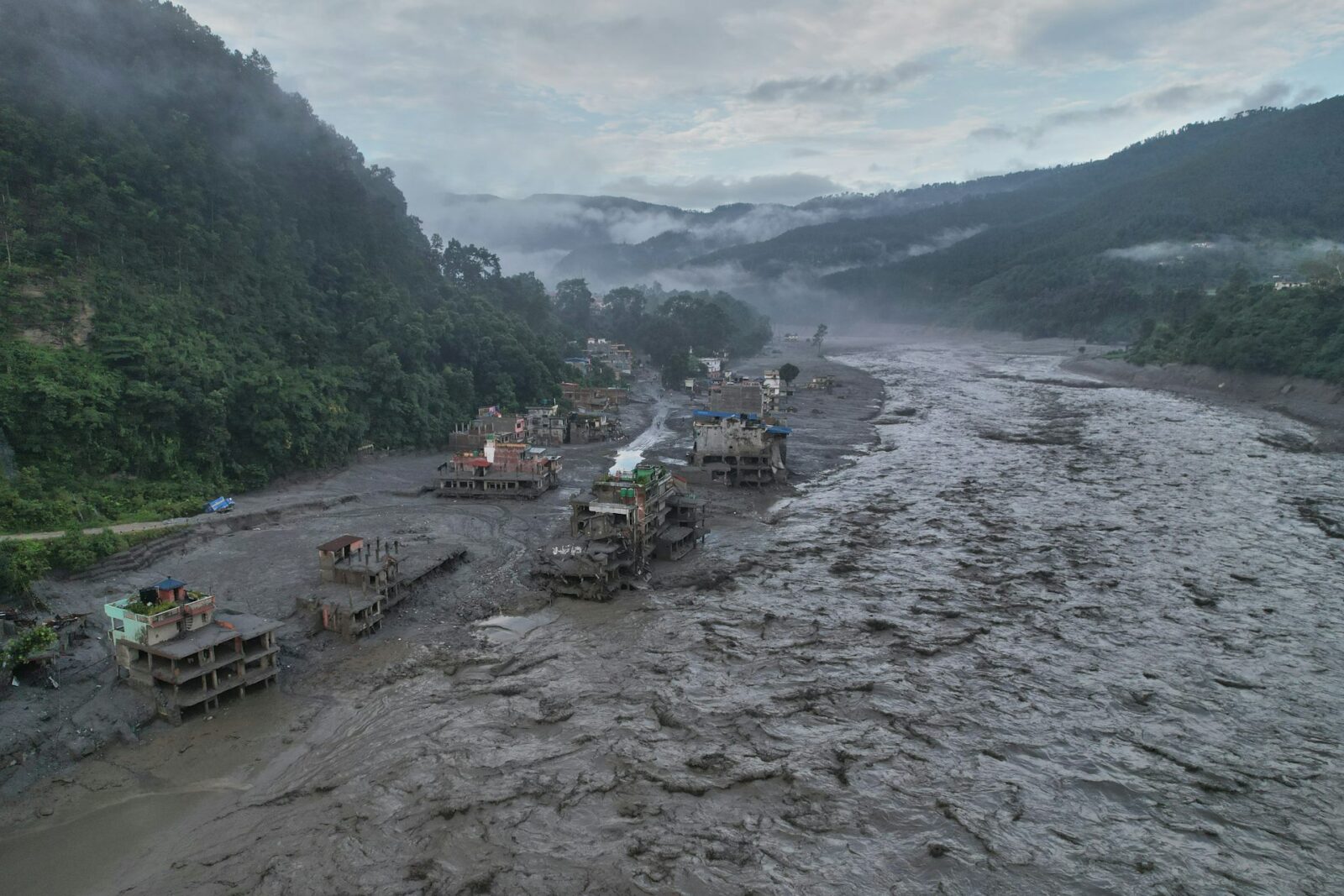
A drone view of the aftermath of flash flooding along the Trishuli River in Nuwakot district, Nepal, on Aug. 30, 2026. (AP Photo/Rajesh Kumar Singh)
(The Conversation) — Hundreds of pilgrims traveling to Mount Kailash were among those affected by devastating floods that struck the Nepal–Tibet border on Aug. 26, 2026. The floods destroyed the border crossing most commonly used to reach what is arguably the most revered holy mountain in the world, which sits in the Tibet autonomous region of China.
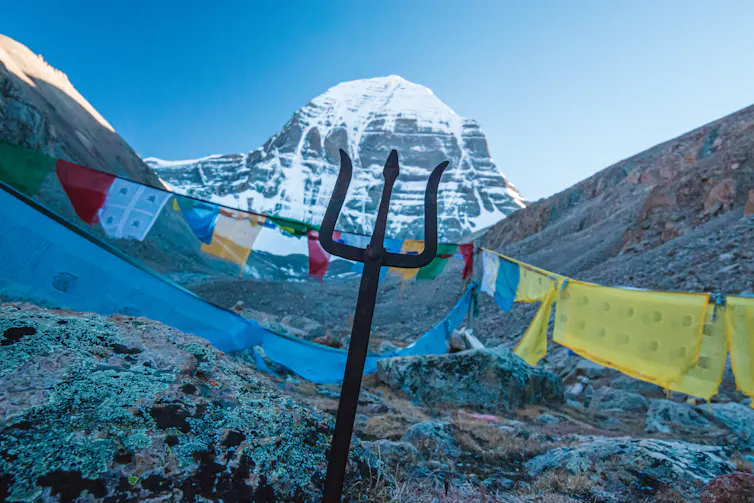
Hindus know the peak as the dwelling place of the god Shiva, Tibetan Buddhists as the abode of the deity Demchok, and Jains as the site where Rishabhanatha, their first spiritual teacher, achieved liberation. Today it also draws nonreligious travelers, who come for the harsh beauty of the landscape and the difficulty of the journey itself. Pilgrims and travelers do not climb Kailash. Instead, they walk a path roughly 33 miles around its base, which many believe to provide blessings and purification.
The legend of Kailash goes back thousands of years, to ancient Indian traditions describing a mountain at the center of the universe. But for most of that history, the Kailash of Indian literature was not associated with the peak that pilgrims travel to now.
In 2025, I published a book about Tibetan pilgrimage to Kailash. While researching it, I learned that it took centuries for a mythical mountain to become identified with this particular peak in western Tibet.
Kailash as legend
Indian religious texts describe a range of snowy mountains to the north called the Himalaya, or “abode of snows.” Beyond them, Indian cosmologies described a cosmic mountain called Meru, believed to stand at the center of the world.
The historian Alex McKay writes that the earliest mentions of a mountain named Kailash – Kailasa in Sanskrit – appear in the Hindu epics, composed roughly between the 4th century B.C.E. and the 4th century C.E.
In the “Ramayana,” an epic recounting of the god-king Rama’s search for his abducted wife, the monkey king Sugriva describes the far-off north, including Mount Kailash and Mount Meru. In the “Mahabharata,” an epic of dynastic war, the prince Arjuna visits a hermitage located on Mount Kailash.
However, these epics do not provide a specific location for Kailash. They portray it as a forbidding mountain realm of sages and gods, not as a pilgrimage destination for humans. The Mahabharata lists sacred places pilgrims should visit – sites across northern and western India – but Kailash is not among them. In fact, the epic states repeatedly that mere mortals cannot travel to the Himalayas.
It is in the “Puranas,” a body of Hindu religious texts composed between roughly the 3rd and 10th centuries, that Kailash is described as the abode of Shiva. The Puranas also begin to describe Kailash as the earthly form of the divine Meru. But it is still not a place of pilgrimage and still not fixed to a particular point on the map.
Kailash as physical place
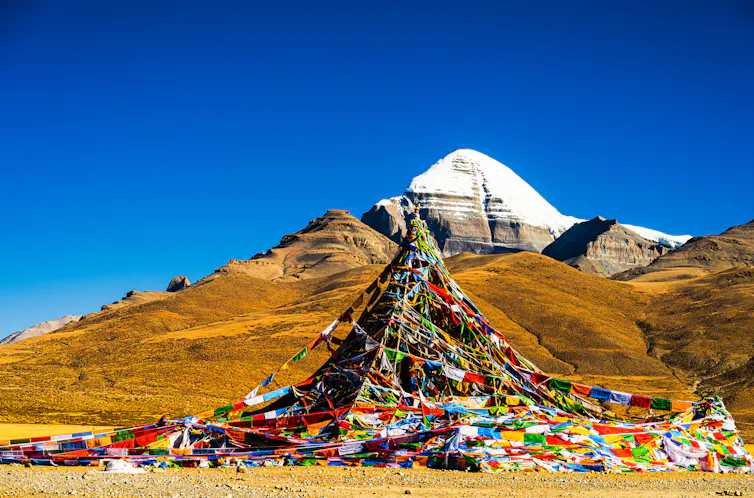
An image showing Mount Kailash in the Ngari Prefecture of Tibet.
Yongxin Wang/iStock / Getty Images Plus
Eventually, though scholars do not know exactly when, local traditions in North India began to identify particular peaks as Kailash. At least five different mountains, in the states of Jammu, Himachal Pradesh and Uttarakhand, have been claimed as the Kailash, and local pilgrimage to them continues today.
As Buddhism spread from India to Tibet beginning in the 7th century, Tibetans inherited Buddhist scriptures that spoke of Meru, Kailash and other sacred mountains. They also had their own long-standing practices of mountain veneration, making offerings to mountains that were believed to be the homes of local deities. Among them was the mountain now known as Kailash in western Tibet.
A mountain claimed
Tibetan traditions record that the geographical site of Kailash was claimed by practitioners of more than one religious tradition, and that the 11th-century saint Milarepa converted it to being a Buddhist site after defeating a non-Buddhist rival in a contest of magical power.
In the centuries that followed, Kailash became known as a particularly auspicious place to meditate and to visit on pilgrimage. Tibetans believed that while the mountain was the dwelling place of the deity Demchok, its true nature was only visible to the spiritually advanced. Any pilgrim who visited Kailash, known to Tibetans as Gang Rinpoche, would obtain blessings.
Even in Tibet, however, Kailash was only one pilgrimage site among many. Far more pilgrims visited the capital city of Lhasa.
The first clear reference to Indian Hindu pilgrims visiting the Tibetan Kailash comes in 1670, according to McKay, although earlier visits are possible. Its identity as the Kailash was not fully settled until the Indian subcontinent came under British colonial rule in the 19th century. Geographic surveyors mapping the border regions traced the sources of rivers such as the Indus to areas near Kailash. This matched ancient descriptions of Kailash as giving rise to rivers, and so the identification stuck.
By the 19th century, a small but steady flow of pilgrims traveled from India and Nepal, usually alongside the trade caravans crossing the Himalayan passes.
A pilgrimage closed and reopened
After China asserted control over Tibet in 1950, China and India negotiated official pilgrimage routes in a 1954 agreement. That arrangement did not last long. In 1959, a Tibetan uprising against Chinese rule was suppressed, and the Dalai Lama – the spiritual leader of Tibetan Buddhism – fled to India; religious life inside Tibet was severely restricted in the following years. In 1962, India and China fought a war over their disputed border, after which the border closed to Indian pilgrims for nearly two decades.
Routes reopened in 1981, and Tibetans were permitted to resume pilgrimage as well. But since then many Tibetans have found it difficult to obtain the necessary permits, and others have criticized excessive construction of hotels and roads at Kailash.
Most pilgrims today travel with private tour companies. Demand this year ran well above the Chinese government’s quota of 24,000 permits for Indian pilgrims. The Indian government also sponsors an official pilgrimage, with participants chosen by lottery, but places are limited to 1,000 people. Pilgrimage by Indian travelers had reopened only in 2025, after being suspended since 2020 because of COVID-19 and a deadly clash between Indian and Chinese troops in the Galwan Valley over the still-disputed India-China border.
Today, Kailash receives more pilgrims than at any point in its history. Most travelers from India now fly to Kathmandu and continue by bus through Gyirong, a road crossing between Nepal and Tibet that was expanded in 2014 and opened to international travelers in 2017. It became the most popular route after the 2015 earthquake damaged the main alternative. It was this crossing that the August 26 floods destroyed.
(Catherine Hartmann, Associate Professor of Religious Studies, University of Wyoming. The views expressed in this commentary do not necessarily reflect those of Religion News Service.)

No comments:
Post a Comment