It’s possible that I shall make an ass of myself. But in that case one can always get out of it with a little dialectic. I have, of course, so worded my proposition as to be right either way (K.Marx, Letter to F.Engels on the Indian Mutiny)
Saturday, August 29, 2026
Sweden Prosecutes Pilot and Cargo Ship Captain for Deadly Collision
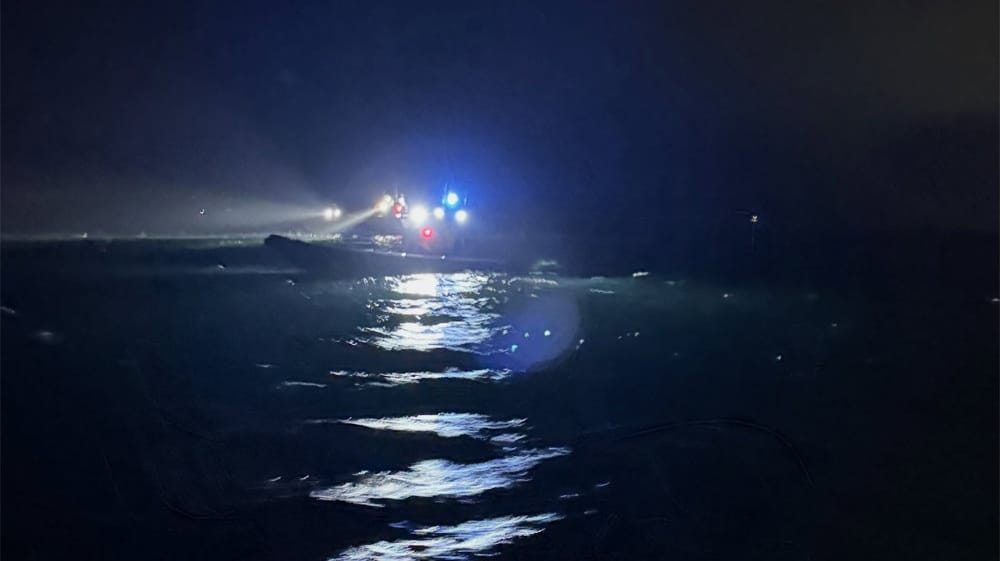
A search was launched for the missing woman and child while the man and his son were pulled from the water by another boat (Sjöräddningssällskapet)
Swedish prosecutors confirmed on August 28 that they are proceeding with the prosecution of the captain of the Norwegian cargo ship Misje Verde and the Swedish pilot who was aboard the vessel on July 28 when it ran down a small pleasure boat. Each is being charged with causing the death of the mother and her daughter aboard the pleasure boat, causing bodily injury to the father and son on the boat, and negligence in maritime traffic in connection with the ship accident near Tjörn on the west coast of Sweden.
“It is unusual for a pilot to be prosecuted for having been involved in a maritime accident involving the piloted vessel,” said Senior Prosecutor James von Reis, who is leading the preliminary investigation. “In this case, the police investigation revealed that the pilot took a very active role in the vessel's operation and accepted that the master was doing other things on the bridge than those related to operation.”
The 5,310 dwt cargo ship was navigating along the west coast of Sweden on the night of July 28. The ship, which was bound for Norway, was required to have a pilot aboard. While overtaking a small pleasure boat, it struck the vessel on the stern and kept going. The cargo ship did not stop until it was instructed to by the Coast Guard.
The father and son were ejected from the boat, which sank. They were rescued by another pleasure boat. After a search, the bodies of the mother and daughter were recovered along with the wrecked pleasure boat.
The captain, who is a Russian citizen, was quickly detained based on concerns that he could flee the country or interfere with the prosecution. Prosecutors later added charges of suspicion against the pilot, who was the only other person on the bridge with the captain.
“It is reasonable that the pilot's responsibility for the accident should also be examined by a court,” said von Reis.
According to the indictment, the defendants were negligent by failing to keep the required lookout so that the cargo ship did not give way to the overtaken pleasure boat. Under the Road Traffic Act, they had the obligation to give way to an overtaken vessel.
Prosecutors said they had reviewed factual information such as target tracks (of AIS and GPS positions) from the vessels involved. They also gained quick access to information from the cargo ship's VDR (Voyage Data Recorder).
Based on the review of the information, prosecutors said they now know for sure what could be seen in real time on radar screens on the bridge and what was said by the captain and the pilot on the bridge. Details about the division of roles between the master and the pilot emerged.
Prosecutors said they had determined the important fact that the recreational boat that was caught up and hit was clearly visible as a radar echo on displays on the bridge. They assert it was information that was missed by both defendants. The captain and the pilot deny any crimes.
The main hearing is scheduled to start on September 10.
Video: Two Crewmembers Killed in Fire Aboard South Korean Tanker
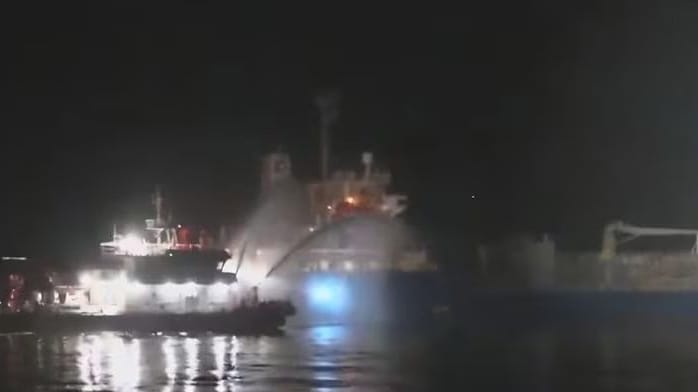
The fire took five hours to extinguish on the tanker and it killed two crewmembers (Incheon Coast Guard)
The South Korean Coast Guard is confirming that two crewmembers, one in his 20s and the other in his 60s, both were found dead after a fire on a tanker. The fire is assumed to have begun in the engine room of the unnamed South Korean-flagged vessel.
The report of the fire aboard the 7,300-ton oil product tanker was received by the Incheon branch of the Coast Guard around 10:30 pm local time on August 27. Multiple vessels, including fireboats, were dispatched. The tanker was about 4.6 miles north of Jawol Island near Incheon.
There were a total of 18 crewmembers, including 11 Koreans, aboard the vessel. The Coast Guard reported that 16 were rescued from the ship. The bodies of the two missing crewmembers were found in the engine room of the tanker.
The vessel was carrying 12.4 million liters of Bunker C fuel. The Coast Guard said the fire took over five hours to extinguish but that they were able to prevent it from spreading to the fuel tanks.
An investigation will be conducted into the cause of the fire. The vessel’s owner was arranging for a salvage tow.
MARAD Calls Up Training Ship Empire State for Federal Service
Training Ship Empire State is being activated for federal service (SUNY Maritime College)
In a surprise announcement released to the maritime and academic community, the State University of New York’s Maritime College (SUNY Maritime) reported on Friday afternoon that the training ship Empire State has been activated by the Maritime Administration for federal service. Neither the details nor the nature of the deployment for the vessel has been announced, but it is rumored it will be deployed to Diego Garcia, the U.S.-U.K. military base in the Indian Ocean.
Rear Admiral John A. Okon, President of the Maritime College, released a statement saying, “I received a decision memorandum from the Maritime Administrator, Stephen M. Carmel, outlining that MARAD will be activating Empire State for temporary federal service, commencing approximately September 1, 2026… There is still much that we do not know, but over the next week our obligation is to prepare the vessel for federal use.”
MARAD has told the college it anticipates a notional mission duration of approximately 170 days.
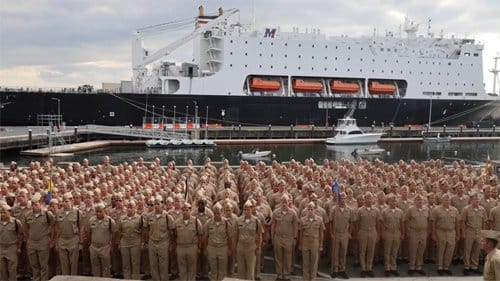
“What we do know is that we will face whatever comes next together,” said Okon. “I know this message is likely to cause anxiety and stress. Please know you are not alone, we are in this together.” He said attention is being paid to the stress placed on the study body, including the MUGs (Mariner Under Guidance) that had recently arrived to begin indoctrination for the new class of approximately 400.
At the beginning of the 2026-2027 academic year with the training ship in the background (SUNY Maritime College)
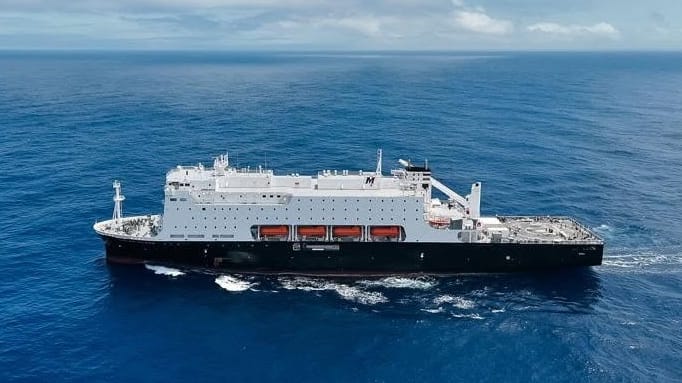
The vessel, which was delivered to SUNY in 2023 as the first of the new generation of training ships, was designed to support government missions. It was primarily anticipated that it would have a dual role for humanitarian support. The ship normally accommodates approximately 600 but can be equipped for up to approximately 1,000 and, as part of the humanitarian capabilities, has a full hospital aboard.
The training ship had returned to the campus in New York on July 16 after an approximately two-month training cruise with more than 600 students, faculty, and crew aboard. Empire State had departed the campus on May 12, first holding offshore for cadet training and then proceeding to Charleston, South Carolina, crossing the Atlantic to Malaga, Spain, and then to Southampton, England, before returning across the Atlantic to be in New York Harbor for the Sail 250 celebration. It had then made a rare trip up the Hudson River to Albany, New York, before the return to campus.
The Maritime College had highlighted just two weeks ago that the MUGs arrived on campus (August 12) and last week moved aboard the vessel for the next phase of their indoctrination and training. The academic year was getting underway this week.
This will be the first activation for any of the NSMVs (National Security Multi-Mission Vessel). Her sisterships have begun service in Massachusetts and Maine, and the fourth ship, Lone Star State, is scheduled to depart Monday, August 31, from Philadelphia, where she was built, on her delivery to Texas A&M Maritime in Galveston. The last vessel is still under construction for delivery to California in 2027.
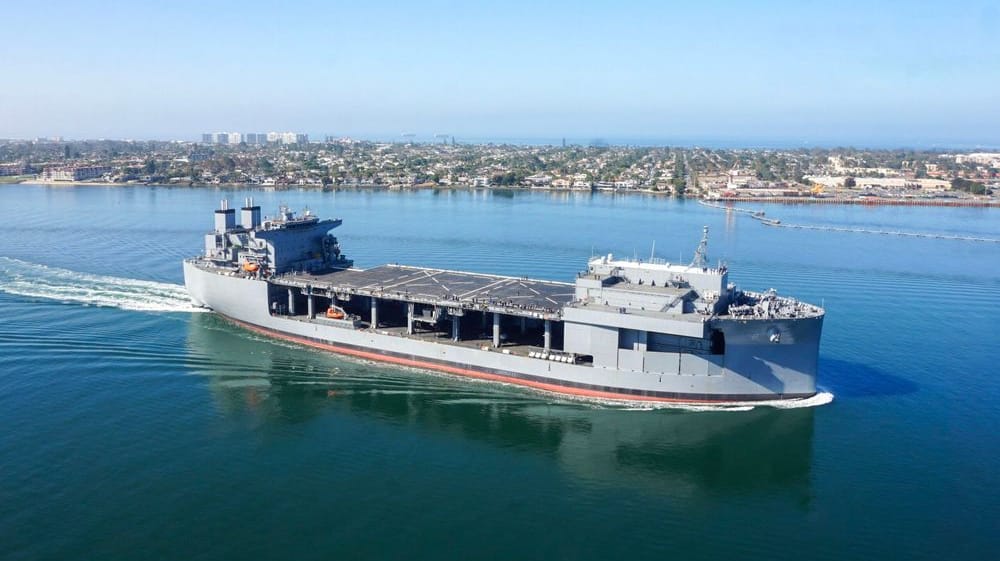
U.S. Navy Takes Delivery of Final Expeditionary Sea Base
The U.S. Navy has taken delivery of its final expeditionary sea base, USS Hector A. Cafferata Jr. (ESB-8). The vessel is named for Pfc Hector A. Cafferata Jr. (USMC), a Medal of Honor recipient who was severely injured while defending wounded squadmates during the Korean War.
The ESBs are a modified variant of the Alaska-class tanker, the VLCC design built by NASSCO in the mid-200s for BP's Valdez operations. From the outset, the Alaska-class was built with dual, fully redundant engine rooms with diesel-electric propulsion to minimize odds of a blackout; this high degree of survivability aligns well with military design requirements. With its freeboard cut down amidships and its cargo tanks replaced by a flat deck, the Alaska-class became the two-ship Expeditionary Transfer Dock (ESD) series.
Both ESDs have been put in reduced operating status, and the Marine Corps recommended their permanent retirement in 2022. They have been replaced in series production by the successful Expeditionary Mobile Base (ESB) - identical in hull form to the ESD, but with a raised helideck, a forward hangar bay over the main deck level, and other extra features to support special operations.
The ships were initially conceived of as civilian support vessels with civilian crews. In 2020, realizing the vessels' potential to support combat operations, the Navy commissioned them into military service. USS Hector A. Cafferata Jr. is the sixth vessel of the design to be commissioned.
"ESB 8 capabilities demonstrated during sea trials highlighted the power and flexibility of this ship and we are excited to have another ESB in the fleet. This delivery demonstrates the unwavering commitment to provide superior quality to the warfighter," said acting sealift program manager Jon Thomas in a statement. "Our ESBs are critical to maritime operations, providing logistics support from sea to shore for a broad range of military operations."
ESB 8 is named after Pfc Hector A. Cafferata Jr., who won a Medal of Honor for valor at the Battle of Chosin Reservoir in 1950. His unit was attacked by communist troops, and all but Cafferata and fellow Marine Kenneth Benson were injured or killed. Cafferata continued to defend the position and the rest of his unit; Benson had been blinded by a grenade, so he reloaded while Cafferata shot. The one-man battle continued for five hours, during which time Cafferata eliminated two enemy platoons and deflected multiple live grenades - one of which he grabbed and threw, suffering injuries in the process. He survived and was rescued by other Marines. President Harry Truman awarded him the Medal of Honor in 1952. After a long post-military career, Cafferata passed away in 2016.
Fincantieri Floats First Next-Generation Cruise Ship for NCLH's Oceania
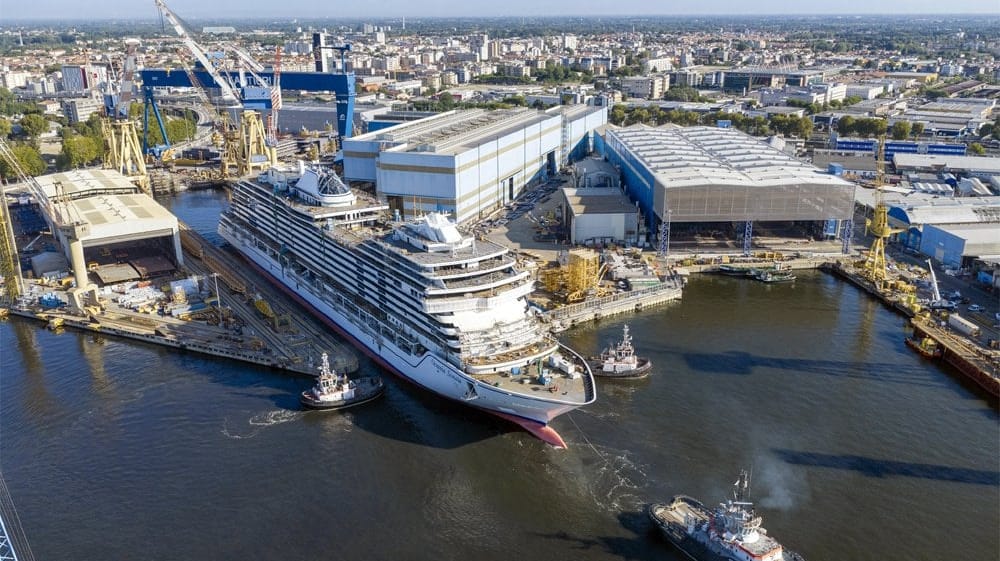
Oceania Sonata leaving the building dock as the first of a next-generation class of larger luxury cruise ships (Oceania Cruises)
Fincantieri and Oceania Cruises, a brand of Norwegian Cruise Line Holdings, marked the float-out of the first of a new generation of cruise ships as NCLH moves forward with a strategy to align the fleet with the enhanced luxury positioning of the brand. The launch came the same day as the first of the line’s oldest ships prepared to leave the fleet.
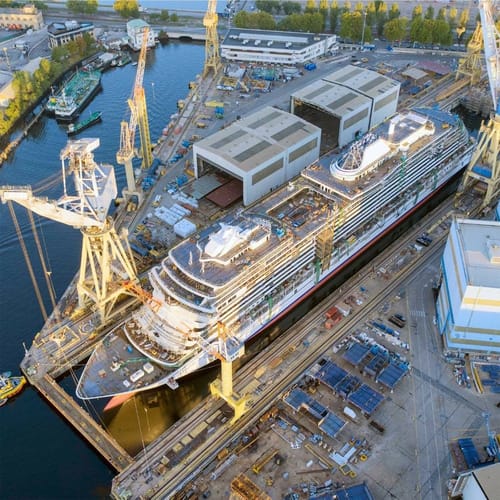
The new ship, named Oceania Sonata, was christened and floated out at the Fincantieri shipyard in Marghera, Italy. She was moved from the assembly dry dock to the fitting out berth for completion of her interior spaces. She is scheduled to enter service in 2027.
"The float out of Oceania Sonata is an incredibly exciting moment as we move one step closer to welcoming our first guests aboard next August," said Jason Montague, Chief Luxury Officer of Oceania Cruises. “As the first ship in our new Sonata Class, she represents the beginning of an exciting new chapter for the brand and a defining milestone in the continued evolution of Oceania Cruises."
The line highlights that the ship, at 86,000 gross tons, will be approximately 30 percent larger than the prior class, Allura and Vista (68,000 gross tons), and will increase passenger capacity by just 15 percent from 1,200 to 1,390 passengers with the addition of 90 staterooms. The line says the Sonata class is designed in keeping with the brand positioning to provide more space, elevate accommodations, and enhance the culinary experiences aboard. A third of the accommodations will be suites, including four Owner’s Suites and two new suite categories. Oceania Sonata will feature 13 dining venues.
Oceania Sonata is 30 percent larger than the lines' prior cruise ships (Oceania Cruises)
Construction began with the steel cutting in June 2025. NCLH has now expanded the order to a total of five ships, with a sistership, Oceania Arietta, starting construction for delivery in 2029. Three more sisters will deliver in 2032, 2035, and 2037.
The recently appointed CEO of NCLH, John Chidsey, says this is part of a “deliberate portfolio action … that better supports the brand’s positioning and long-term return profile.”
One of the line’s smallest and original ships, Oceania Regatta (30,000 gross tons), completed its final cruise for the line on August 27 in Istanbul. The line ultimately acquired four of the 684-passenger ships, but they have been outclassed by newer and larger ships designed to emphasize greater luxury. Oceania introduced the sisters Riviera and Marina (66,000 gross tons) in 2011 and 2012 and Vista and Allura (68,000 gross tons) in 2023 and 2024, all also built by Fincantieri.
The Oceania Regatta is starting a two-year charter to Australia-based My Cruises, which will operate the cruise ship on 365-day world cruises. The first begins on September 1 from Italy. Under the terms of the charter, it can be extended, or the ship can be sold to a third-party cruise operator.
Two of the other sisters are also slated for changes. Oceania Sirena was sold and will be delivered to its new owners in the spring of 2028. Oceania Nautica will be “reimagined” as Oceania Aurelia in 2027 for the luxury long cruise market. The ship’s accommodations will be reworked with 179 of the ship’s 238 cabins designed as suites. The total number of cabins is being reduced from 340 to 238 as they enlarge rooms to create more suites.
The changes are part of a broader strategy to improve the financial performance of Norwegian Cruise Line Holdings. The corporation is undertaking a fleet modernization across its three brands and reworking operations and costs after an activist shareholder demanded changes.
Bulker Demonstrates Wind Propulsion Integrated with Solar Power
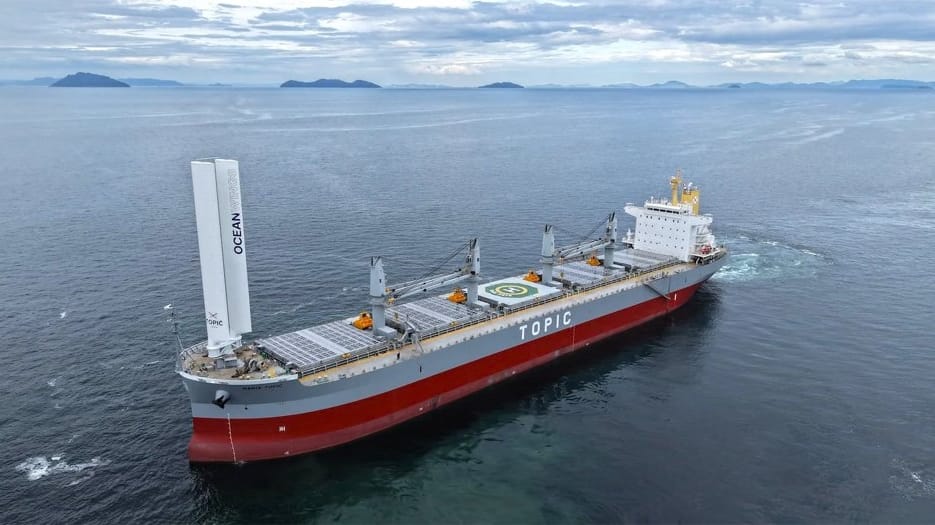
Ultramax bulker Maria Topic was the first bulker retrofit with OceanWing's rigid sail and solar panels (WHISPER)
Demonstrations are underway on an innovative power solution retrofitted to an ultramax bulker as part of a four-year research project to advance modular retrofit solutions to reduce GHG emissions from the long-distance maritime industry. The project, named WHISPER, recently completed the installation of a rigid wingsail and solar panels on the dry bulk carrier Maria Tipoc as the first of two demonstrations, which will also involve a containership.
The 60,155-dwt bulker was recently retrofitted by Tsuneiship Shipbuilding and is currently sailing trans-Pacific to Vancouver, testing the systems. It included the first installation of the French company OceanWings’ tiltable rigid wingsail on a bulker. It is also the final installation of Solibian’s solar panels, after a previous prototype test aboard the sistership Paolo Topic in March 2024. Building on that experience, it later installed additional panels as part of the WHISPER project in 2025.
The rigid, tiltable OceanWings system is intended to reduce the power required from the vessel's main engine and, consequently, fuel consumption and greenhouse-gas emissions. Solbian's solar panels supply renewable electricity for onboard use and contribute to WHISPER's wider objective of reducing demand on auxiliary generation.
With ongoing sea trials, the project now moves from installation to evidence gathering. The trials will examine system performance in real operating conditions, including energy production, fuel-saving potential, reliability, vessel integration, and the implications for routine ship and port operations. It is part of the work plan that called for generating operational evidence on how modular technologies can be retrofitted to existing vessels while preserving the safety, reliability, and operational flexibility required in commercial shipping.
The sea trials on board the Maria Topic, the project leaders report, will help the consortium confirm the expected performance of both technologies in day-to-day operations and validate the potential for wider replication across the existing merchant fleet. The resulting evidence will inform technical development, future vessel integration, lifecycle assessment, and the project's work on pathways to commercial uptake.
The WHISPER (Wind Energy Harvesting for Ship Propulsion Assistance and Power) project began in January 2023 and runs until December 31, 2026. It brings together 13 partners from six European countries, and it received funding from the European Union's Horizon Europe program. It focuses on the retrofitting of existing vessels and concept designs. WHISPER aims to demonstrate around 30 percent fuel savings on a retrofit bulk carrier and up to 15 percent on a retrofit containership.
The test on a containership will take place aboard a Samskip vessel. Preparations are reported to be underway, where SideWind’s horizontal wind turbines and Solbian’s solar panels will be installed on board a Samskip container ship. One innovation within WHISPER is the installation of Solbian’s solar panels directly onto SideWind’s horizontal wind turbines. As the wind turbines are located in repurposed containers with two sides removed, the container roof provides an ideal surface for installing solar panels.
California Sues DOI Calling Offshore Wind Cancellation “Blatantly Unlawful"
Among the areas California was developing was Humboldt Bay to support the offshore wind energy industry (USACE)
California Attorney General Rob Bonta and the California Energy Commission moved forward with their earlier challenges and filed a lawsuit on August 28 against the Trump administration and Golden State Wind over what it is calling “the unlawful buyout” of the offshore wind energy lease. The state is contending the deal to buy back the offshore wind lease is illegal and would jeopardize its investments to support the project, the state’s energy policy, and the commitments from the developer for workforce training, the supply chain, and investments in the local communities.
The California Energy Commission in May served an administrative investigative subpoena to Golden State Wind seeking documents and information related to the buyout. The California Department of Justice and CEC followed up in June by sending a Notice of Intent to Sue targeting what it terms an “unlawful agreement between the Department of the Interior and Golden State Wind.” It is asserting that the deal is “blatantly unlawful” and is asking the courts to strike it down.
“The Trump administration’s backroom buyout with Golden State Wind to stop offshore wind development in favor of gas and oil drilling is, unfortunately, a classic playbook for them to line the pockets of their Big Oil donors,” said Attorney General Bonta, announcing the filing of the lawsuit.
Golden State Wind, which is a joint venture of Ocean Winds (a 50/50 joint venture of EDP Renewables and ENGIE) and Reventus Power, paid $120 million in a 2022 lease auction for the Morro Bay Energy Area off the Central California coast. The plan called for a floating offshore wind project that, when fully developed, was expected to generate up to 2 gigawatts (GW). The company also provided commitments of more than $30 million for workforce training, supply chain development, and benefits to local communities like fishermen’s associations.
California contends that since the federal offshore wind planning began off California’s coast, the state has invested more than $100 million to ready California’s ports, transmission systems, and industries to support offshore wind generation. It points out that the state issued voter-approved climate bonds as part of its investment. Further, it says the project is part of the state’s offshore wind strategic plan that calls for the development of 25 GW of offshore power generation by 2045.
The Department of the Interior announced in April that it had struck a deal to terminate the lease as part of a move it said to settle litigation by Golden State Wind. It said that Golden State had agreed to voluntarily end its offshore wind lease located in the Morro Bay Wind Energy Area, and would be eligible to recover approximately $120 million in lease fees after an investment of an equal amount had been made in the development of U.S. oil and gas assets, energy infrastructure, and/or LNG projects along the Gulf Coast.
In the lawsuit, California argues that the Trump administration’s deal violated numerous federal laws, including the Outer Continental Shelf Lands Act, which limits DOI’s ability to cancel offshore wind leases. California also argues that the deal violates the Judgment Fund Act because the $120 million payment was not a settlement to resolve an existing lawsuit. Instead, it contends it was a fabricated arrangement designed to justify the unlawful cancellation of the Golden State Wind lease. It also points out that the investments are redirected away from California to other areas of the country.
California asserts that Golden State Wind never brought litigation against DOI challenging an action that it says DOI never took. Further, it highlights the Trump administration’s reference to unspecified national security concerns and responds by highlighting years of analysis and consultation that led to the approval of the lease area by the federal government and the Department of Defense.
The agreement with Golden State Wind was one of several the Department of the Interior has announced in the past few months. That same day, it also announced an agreement with a BlackRock-led project, Bluepoint Wind, for an offshore wind farm in the New York Bight. It also struck a deal with TotalEnergies and, more recently, a deal with Invenergy to terminate its four offshore wind leases located in the New York Bight, Central Coast of California, and the Gulf of Maine.
A coalition of states led by New York and Massachusetts filed suit challenging the deal with TotalEnergies, highlighting many of the same issues as California. In addition, the authorities in California are also investigating the agreement that canceled a second offshore wind lease in the state. The administration started the buyback strategy after it lost other challenges in the courts, including an attempt to stop work on five offshore wind projects that were under construction along the U.S. East Coast.
Australia’s First Offshore Wind Energy Auction is Now Live
The Bass Strait along the Victoria coast east of Melbourne is among the early targets for offshore wind farms (Star of the South file photo)
After delays and uncertainty among the developers, Australia has finally opened its first offshore wind energy auction. It has been a slow process for the country to move its offshore energy aspirations forward to catch up with its overall leadership in renewable energy.
The first auction is coming from Australia’s Victoria state in the southeast of the country and home to the city of Melbourne. Officials point out that renewables account for 45 percent of the state's total electricity generation currently.
Plans call for retiring Australia’s aging coal-fired generation capacity. However, demand is also growing, meaning the state must develop new sources.
In late 2021, Australia set forth the framework for its offshore wind energy industry, and a year later, the first wind zones were declared for the Gippsland area in Victoria. Reports said it could support as much as 10 GW of generation capacity, and Australia followed with the awarding of feasibility licenses. By 2024, it had awarded a dozen feasibility licenses, with several of the major developers actively exploring projects. Three companies, including RWE and Equinor, later relinquished their licenses. Plans for the Victoria auction were further delayed from last year as the industry continued to address the issues and sought more assurances from the Australian government.
“This auction is a giant leap towards getting Australia’s first offshore wind projects built,” said Minister for Energy and Resources Jaclyn Symes. “Victoria has some of the best offshore wind resources in the world. This auction is about harnessing that advantage and building the next generation of energy right here in Victoria.”
The auction officially opened on August 26, but the window runs for a year to August 2027. Victoria reports that the contracts will be awarded in 2028. It expects the projects to be integrated into the National Electricity Services Entry Mechanism.
According to the minister, bids will be assessed based on value for money, deliverability, and benefits for local workers, businesses, and communities.
The first tender calls for 2 GW of offshore wind capacity, which would power up to 1.5 million homes. They said the goal is to integrate offshore wind to complement Victoria’s growing solar, onshore wind, and storage capabilities.
Victoria was the first state in Australia to legislate targets for offshore wind energy capacity. Its goal is to have the first 2 GW by 2032, grow to 4 GW by 2035, and reach 9 GW by 2040.
Tasmanian Ferry Fiasco Nears End with New Vessel's Arrival in Devonport
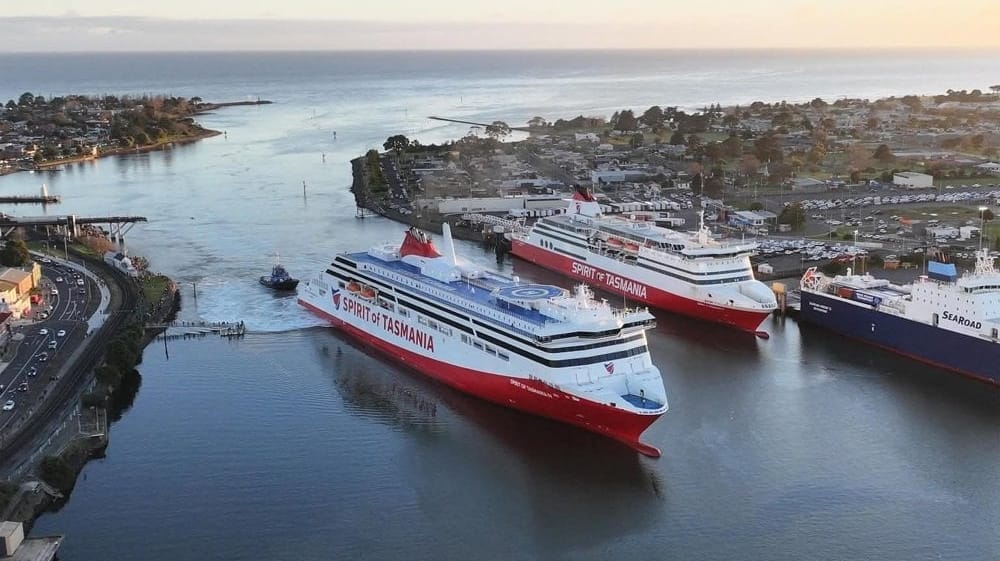
New Spirit of Tasmania IV finally arriving in Davenport for the first time passing the soon to be replaced 28-year old ferry (Premier of Tasmania Jeremy Rockliff)
The Tasmanian government is finally hoping to put the fiasco that has characterized its ferry replacement program behind it following the arrival of the Spirit of Tasmania IV ferry to its home port of Devonport, Tasmania, two years after the vessel was delivered.
After a debacle that has lasted for close to a decade in which plans to replace two aging ferries have been marred by issues cutting across contract termination, design changes, cost overruns, and finally a lack of a dedicated berth, Tasmania has reasons to celebrate after Spirit of Tasmania IV arrived in Devonport for the first time for operational commissioning works and training. The vessel is expected to enter service in October, providing a link between Australia and the Tasman city of Geelong.
Construction of the vessel began at the Rauma Marine yard in Finland in 2022, and it was delivered in September 2024. However, the vessel could not sail to Devonport due to delays in the construction of a dedicated berth. This meant the 212-meter (696-foot), 48,000 gross ton ship had to be mothballed in Leith, Scotland, for close to a year. Being docked in Leith was a costly affair for the ship’s operator, TT-Line, with berthing costs reported to be about A$47,000 (US$33,600) per week. At some point, TT-Line considered the idea of leasing the ship to a third party to save on costs and generate revenue.
Spirit of Tasmania IV departed Leith in June last year, making the 14,857 nautical mile voyage to Hobart, where she underwent final fitting-out and crew training. With the construction of the Spirit Quay, Terminal 3 Devonport, now nearing completion, the ship and the new terminal have finally been brought together for operational readiness.
Construction of Spirit Quay, which will offer nearly double the space of the current facility, has faced significant delays and cost overruns. Having originally been designed to cost A$90 million (US$64.3 million), the facility has ended up costing a reported A$495 million (US$354 million).
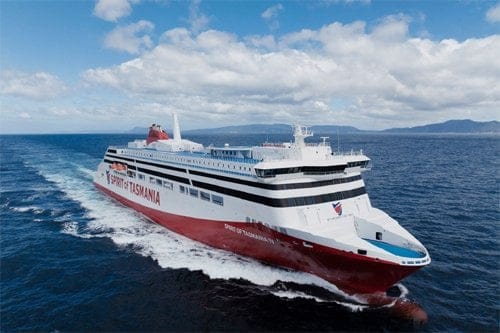
The Tasmanian government is terming the arrival of Spirit of Tasmania IV in Devonport as a game changer for Bass Strait travel and freight. The roll-on/roll-off ferry, which has a capacity of 1,800 passengers and a lifespan of 25 years, will increase the freight capacity on the route by 40 percent. The vessel operates at a speed of up to 26 knots.
The new ferries are fast at 26 knots and increase the capacity for the service (TT-Line)
While the arrival of Spirit of Tasmania IV is a major relief, its sister ship, Spirit of Tasmania V, which was delivered by Rauma Marine in June last year, is also in Australian waters, having arrived from Leith in April this year. TT-Line has highlighted that both vessels are scheduled to commence service in Bass Strait by the end of October.
“The vessels were designed and built with Bass Strait in mind – featuring an enhanced hull design and large stabilizer fins to ensure optimal passenger comfort during their 242-kilometer voyage between Devonport and Geelong,” said Ken Kanofski, TT-Line Chairman.
The ships are intended to replace two aging hulls, Spirit I and II, that were built in 1998 and which have reached their operational end of life. The road to replacing the two ships began in 2018 when TT-Line ordered two 212-meter ferries from the then Flensburger Schiffbau-Gesellschaft (FSG) yard in Germany. TT-Line later cancelled the order, made a number of modifications to the original design, and awarded the contract to Rauma Marine in 2021.
Hanwha Shipping Takes Delivery of Tanker as Fleet Construction Accelerates
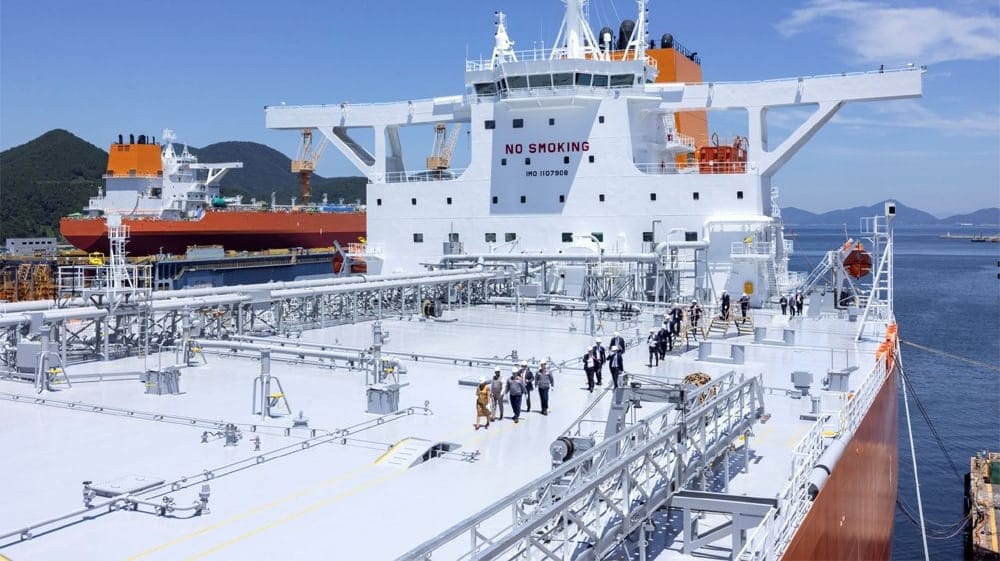
Hanwha Shipping named its VLCCs and took delivery on the first ship as it moves forward with construction on its LNG carriers (Hanwha Shipping)
The U.S.-based Hanwha Shipping, established in 2024, marked its next key milestone with the naming and delivery of its first VLCC tanker. It comes as the company’s fleet of three VLCCs and four LNG carriers are all moving into construction.
The company first announced its plans to work with the group’s South Korean shipyard to develop LNG carriers for the international market. At the time, it was pointed out that they would be the first modern LNG carriers in the U.S. registry. It also announced plans to build 10 MR tankers (49,500 dwt) in conjunction with the group’s USA Philly Shipyard for the Jones Act fleet due for delivery starting in 2029. Also on its website, it shows future consideration for ammonia & ethane carriers and LCO? carriers.
The first of Hanwha Shipping’s vessels are three large (320,000 dwt) VLCCs built in South Korea using the group’s advanced technologies. At the end of July, the company named the first vessel, Elandra K2, at Hanwha Ocean’s Okpo Shipyard in South Korea. Registered in the Marshall Islands, the company reported the first charter would be Vitol and its current AIS signal shows the tanker has arrived at the Khor Fakkan anchorage in the UAE.
“The delivery of the Elandra K2 is a major moment for Hanwha Shipping as we celebrate our first ship on the water,” said Charles Salmon, Chief Operating Officer, Hanwha Shipping, during the naming ceremony. The company reported that the second VLCC will be named Elandra Kunlun and is scheduled for delivery in December 2026. It will be followed by the Elandra Kilimanjaro, scheduled for delivery in February 2027.
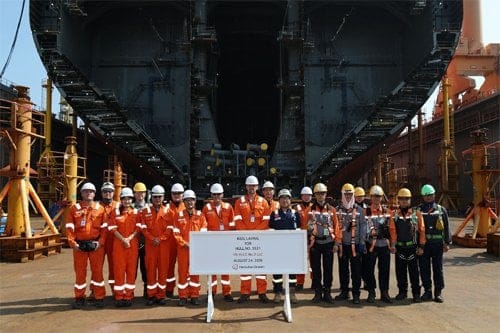
Two more VLCCs are being assembled, and work has begun on the LNG carriers (Hanwha Shipping)
The keel for the second VLCC was placed in the assembly dock in May. The third ship of the class is also under construction, with its keel block placed at the beginning of this week, August 24, into the assembly dock.
“Hanwha Shipping has taken a deliberate approach to how these vessels are designed and equipped, from multi-fuel readiness to integrated cyber resilience built in from the construction stage,” explained Matthew Mueller, ABS Vice President, North Pacific Business Development. ABS worked closely with the Hanwha team throughout the design and build, and the ships are built to ABS Class
The ELANDRA K2 holds a series of ABS Fuel Ready Level 1C notations, including ammonia, LNG, and methanol, providing a path to alternative fuel adoption as regulations evolve. The vessel’s cyber resilience framework builds on the first ABS approval in principle granted to an actual vessel under the IACS UR E26 framework, awarded to Hanwha Systems and Hanwha Ocean at Gastech 2025.
Following will be the company’s four LNG carriers, each with a capacity of 174,000 cbm. They are due to start delivery in 2027, and all the vessels will be compliant with all US LNG terminals. The keel block for the first of the vessels was placed into the assembly dock in June, while steel cutting is underway for the next two vessels.
Hanwha Shipping highlights that it will be working with strategic partners around the world. It looks to be an extension of Hanwha Ocean and to leverage the group’s global network.
Hanwha Group has strong ambitions for the U.S. market, announcing plans to invest in the expansion of the Philly Shipyard and recently indicating that it will bid to acquire the U.S. shipbuilding capabilities of Austal.