China’s Moonshot unveils world’s largest open AI model, closing in on U.S. rivals
Published:
Chinese AI startup Moonshot on Friday unveiled Kimi K3, a 2.8 trillion-parameter model that it said is the world’s largest open-weight AI system and delivers performance approaching U.S. giant Anthropic’s frontier Fable model.
The launch, which comes a month after Anthropic’s Fable and Mythos models were abruptly withdrawn by the U.S. government due to security concerns, underscores how quickly China’s open AI ecosystem is narrowing the gap with the most advanced U.S. systems.
Companies including Moonshot, Z.ai and MiniMax are releasing increasingly powerful models at sharply lower cost, challenging long-held assumptions in the West that Chinese developers trail their American peers by months.
Moonshot said Kimi K3 is the first open-weight model to approach the 3 trillion-parameter mark and is designed for advanced reasoning, long-horizon coding and knowledge work. The model features a 1 million-token context window, allowing it to process and retain substantially more information than earlier generations in a single prompt.
Open-weight models allow users to download, run and customize the underlying systems, unlike proprietary, closed-source models.
Kimi K3 “performed competitively with Fable 5 (with fallback) and substantially outperformed Anthropic’s Opus 4.8, GPT 5.6 Sol, and GPT 5.5” in terms of GPU kernel optimisation, the company said. The term refers to techniques that maximize AI hardware utilization and minimize latency.
The model has also posted strong results in third-party evaluations.
Arena.ai ranked Kimi K3 first in a benchmark assessing web interface-building capabilities, while Vals AI placed it second overall behind Fable 5 and ahead of GPT-5.6 Sol. Artificial Analysis said the model delivered performance comparable to OpenAI’s GPT-5.5 and Anthropic’s Claude Opus 4.8, particularly on tests measuring complex, multi-step tasks.
The Moonshot news drove shares of domestic AI competitors Zhipu and Minimax sharply in Hong Kong; just before market close, they were down 27.7 per cent and 16.5 per cent, respectively.
Faster release cycles
Chinese AI firms are accelerating their model release cycles as the global AI race intensifies. The shift follows the debut of Z.ai’s GLM-5.2, which stunned industry observers by scoring near top U.S. closed-source models on benchmark tests, undermining a consensus among Western analysts that Chinese AI models were at least six months behind.
Lian Jye Su, chief analyst at Omdia, said Chinese models were gaining traction because they could be deployed far more cheaply than leading U.S. systems.
“They can be run at a fraction of the cost that OpenAI charges its clients,” he said, but cautioned that Kimi K3’s scale didn’t “doesn’t necessarily mean you have the best performance by default.”
Kimi K3’s size also means few users are likely to host it themselves despite its open-weight release.
Ryan Fedasiuk, a fellow at the American Enterprise Institute, said in a LinkedIn post that running a 2.8 trillion-parameter model locally would require hundreds of thousands of dollars of computing equipment.
Trillion-parameter systems
Parameters are the internal variables a model learns during training and are often used as a rough measure of scale, though not necessarily capability.
Before Kimi K3’s release, Meituan’s LongCat-2.0 and DeepSeek’s V4-Pro led China’s AI industry with 1.6 trillion total parameters, while several other domestic rivals have passed the trillion-parameter threshold.
But a direct comparison with U.S. frontier models is difficult because companies such as Anthropic and OpenAI do not disclose the parameter counts of systems including Fable, Mythos or GPT-5.5.
Moonshot said Kimi K3 incorporates two significant architectural upgrades that improve computing efficiency and enable it to complete long-horizon coding tasks with minimal human supervision.
Backed by giants like Alibaba and Tencent, Moonshot has been heavily expanding its capabilities and capital to remain at the forefront of the AI sector.
Bloomberg reported last month that the startup was seeking US$2 billion in fresh funding at a valuation of about US$30 billion ahead of a potential Hong Kong listing.
---
Reporting by Laurie Chen; Editing by Eduardo Baptista and Shri Navaratnam
Xi positions China to challenge US grip on global AI rules
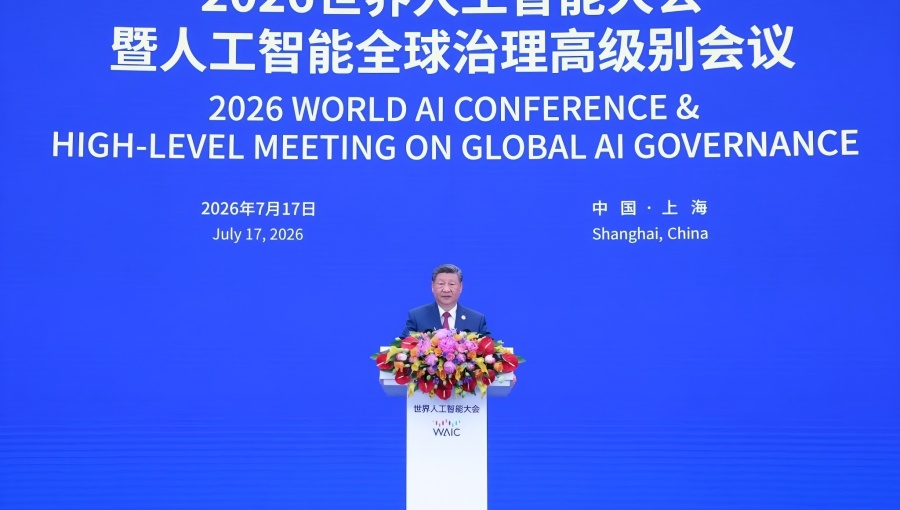
President Xi Jinping used the opening of China's flagship AI summit on July 17 to portray Beijing as an alternative rule-setter for artificial intelligence, unveiling a new intergovernmental body and a package of aid for developing nations and dealing yet another direct blow to Washington's long-standing leadership of the sector.
Speaking at the opening ceremony of the 2026 World AI Conference and High-Level Meeting on Global AI Governance in Shanghai, Xi called on countries to seize what he described as a "rare historic opportunity” presented by open-source AI, and cautioned that unequal access to the technology risked creating fresh injustices between rich and poor nations, according to an official readout of his remarks issued by the Chinese government.
The address followed the signing on July 16 of an agreement establishing the World Artificial Intelligence Cooperation Organisation (WAICO), a Shanghai-headquartered body that will count 29 founding members including Russia, Pakistan, Indonesia, Brazil, Cuba and Venezuela, according to state news agency Xinhua. Chinese Foreign Minister Wang Yi signed on Beijing's behalf, while UN Secretary-General António Guterres attended the ceremony.
Xi called WAICO an "important milestone in the history of AI development" that answered calls from Global South nations for a greater say in the governance of the technology, the government readout said. Over the next five years, Beijing pledged to give developing countries access to 5,000 places on AI-related courses and seminars, to establish AI application co-operation centres with the African Union, the Association of Southeast Asian Nations, the Arab League, the Latin American and Caribbean bloc CELAC, the Shanghai Cooperation Organisation and BRICS, and to extend its AI-powered weather-warning system, known as MAZU, to 30 countries.
Brazil's government said in a joint statement from its science, foreign affairs and innovation ministries that WAICO was intended to narrow gaps in access to AI technologies and to give member states a platform to coordinate strategy, share best practice and pursue joint scientific work, including on open-source systems.
The initiative sets up a direct rivalry with Washington's AI Opportunity Statement, which the US last month signed with 35 countries. A person familiar with the Trump administration’s position told Reuters that Kazakhstan is the sole country to have signed up to both schemes, an overlap so small that it points to broad reluctance among Washington's partners to also back the Chinese-led body.
The conference also highlighted China's advances in open-weight AI models. Beijing-based Moonshot AI used the event to unveil Kimi K3, which it billed as the world's largest open AI model by parameter count, weeks after the US government suspended access to Anthropic's most advanced models over security concerns, Reuters reported. Huawei separately showcased its Atlas 950 SuperPoD, a system for linking chips to boost computing power for large-scale data centres and model training, CNBC reported.
On safety, Xi urged countries to keep AI systems under human oversight at all times and to build early-warning and emergency-response mechanisms against the risk of autonomous systems evading human control, according to the government readout. He also called for countries to avoid stretching the concept of national security in the AI field or prioritising one country's security over another's, remarks widely interpreted as an implicit criticism of US export controls, though he stopped short of naming Washington.
China's industry ministry released an action plan on international AI ethics governance at the conference, framed within the United Nations' Global Digital Compact, calling for tiered risk controls, more agile governance mechanisms and greater support for developing countries' governance capacity, state broadcaster CGTN reported.
The conference, running from July 17 to 20, comes just ahead of the first formal AI discussions to be held between Beijing and Washington at government level since Donald Trump returned to the presidency. Kazakh President Kassym-Jomart Tokayev, Cambodian Prime Minister Hun Manet, Thai Prime Minister Anutin Charnvirakul and Guterres also addressed the opening ceremony, praising China's contribution to AI governance and calling for the technology's benefits to be shared equitably across the Global South.

No comments:
Post a Comment