IEA Warns Copper Supply Outlook Has “Worsened Considerably” Amid Sulphuric Acid Crisis
By Penny Langford
The International Energy Agency (IEA) has issued a stark revision to its near-term copper projections, warning in its Global Critical Minerals Outlook 2026 that the supply landscape for the "metal of electrification" has deteriorated significantly. While the long-term project pipeline has shown modest improvement, the immediate horizon is clouded by a burgeoning crisis in the sulphuric acid market: a critical, often overlooked reagent that accounts for a substantial portion of global refined copper production.
The agency highlights that while the 2035 structural deficit has narrowed slightly from previous estimates, the "worsened considerably" tag for the near-term reflects a convergence of geopolitical tensions, logistics chokepoints, and protectionist trade policies. With copper currently trading near $6.32/lb ($13,933/tonne), the industrial world is facing a reality where the transition to clean energy is increasingly tethered to the availability of a caustic chemical byproduct.
The Sulphuric Acid Chokepoint: An Invisible Catalyst
Sulphuric acid is the lifeblood of hydrometallurgical copper production, specifically the Solvent Extraction and Electrowinning (SxEW) process. Approximately 15% of the world’s copper is produced this way, particularly from oxide ores that cannot be easily processed through traditional smelting.
The current shortage is driven by two primary factors:
- Geopolitical Friction in the Middle East: Tensions surrounding the Strait of Hormuz have disrupted the global trade of elemental sulphur, the primary feedstock for acid production. The Middle East is a pivotal sulphur-exporting hub, and any perceived threat to shipping lanes immediately ripples through the chemical supply chains of major mining jurisdictions.
- China’s Export Ban: In a move that has sent shockwaves through the market, China recently implemented a ban on sulphuric acid exports, scheduled to remain in place through the end of 2026. Given that China typically supplies nearly 25% of the sulphuric acid required by the rest of the world, this policy shift has effectively orphaned SxEW operations that lack integrated acid plants.

Regional Vulnerabilities: DRC and Chile Under Pressure
The Democratic Republic of Congo (DRC) and Chile, the world's leading copper producers, find themselves most exposed to this chemical squeeze. In the DRC, where copper output has been a rare bright spot in global supply growth, roughly 45% of production: equivalent to 1.5 million tonnes: relies on sulphuric acid leaching. For many Congolese operators, acid now accounts for up to 20% of total cash costs.
Chile faces a similar "acid crunch." Approximately 1.2 million tonnes of Chilean leached output are currently at risk. While majors like Codelco and BHP have historically managed integrated supply chains, the tightening market is forcing smaller and mid-tier operators to compete for increasingly scarce and expensive acid shipments. This vulnerability echoes recent warnings in Pakistan’s copper crisis, where local disruptions are compounding a tight global market.
The crisis is not limited to leaching. On the smelting side, China’s top copper producers have already signaled a collective production cut of more than 10%. This decision stems from a dual pressure: a shortage of copper concentrates (raw ore) and the environmental and economic complexities of managing the sulphuric acid byproduct during a period of restricted exports.
When smelters cannot export or profitably store excess acid, they are often forced to throttle back their primary copper smelting operations to avoid environmental non-compliance. This creates a "double-bind" for the market: less refined copper from smelters and less reagent available for SxEW plants.
Market Snapshot: 2026 Copper Fundamentals
| Metric | Current Estimate (2026) | 2035 Outlook |
|---|---|---|
| Current Copper Price | ~$6.32/lb | N/A |
| Sulphuric Acid Dependency | 15% of Global Output | Increasing (Oxide depletion) |
| DRC Exposed Production | ~1.5 Million Tonnes | ~2.2 Million Tonnes (Est.) |
| China Smelter Production Cut | >10% | Variable |
| Global Supply Gap (IEA) | "Worsened Considerably" | 25% Structural Deficit |
Copper Deficit Impact 2026: Grids, EVs, and Data Centers
The copper deficit impact 2026 is expected to manifest most acutely in the rollout of energy infrastructure. The IEA notes that while global investment in critical minerals rose 10% in 2025, it remains insufficient to meet the stated goals of the Paris Agreement.
The primary drivers of this demand are relentless:
- Power Grids: Massive expansions of transmission and distribution networks to accommodate renewable energy.
- Electric Vehicles (EVs): Despite a plateauing growth rate in some regions, the copper intensity of EVs (up to 4x that of internal combustion engines) continues to drain available stocks.
- Data Centers: The rise of AI and high-performance computing has led to a surge in specialized copper-heavy cooling and power delivery systems.
As supply falters due to chemical shortages, these sectors face the prospect of project delays or significantly higher capital expenditures.

Copper Price Forecast 2026: Drivers and Cases
Analysts are recalibrating their copper price forecast 2026 to account for the acid-induced supply shock. The consensus suggests that the "floor" for copper has shifted higher.
- Base Case: Prices remain in the $5.80 – $6.50/lb range. This assumes a partial easing of China's export ban and no further escalation in the Middle East.
- Bull Case: Prices surge toward $7.20/lb ($15,800/tonne). This scenario is triggered if the Strait of Hormuz faces a sustained closure or if Chilean production downgrades exceed 500,000 tonnes due to acid shortages.
- Bear Case: Prices retreat to $4.80/lb. This would likely require a global recession significant enough to decouple copper demand from the energy transition, a scenario many analysts view as unlikely given the structural nature of current demand.
Similar to the silver price forecast 2026, the copper market is being driven by industrial necessity rather than purely speculative interest.
Analyst Perspectives: The "New Normal" for Copper
"We are moving from a world where copper was constrained by geology to a world where it is constrained by chemistry and logistics," says Marcus Thorne, a senior commodities analyst. "The IEA report confirms what many in the field have feared: the green transition is not just about having the metal in the ground; it's about having the entire chemical supply chain synchronized."
The IEA’s revised 2035 shortfall of 25% (an improvement from the 30% projected in 2025) offers little comfort for the current year. The improvement in the long-term outlook is largely credited to new projects in the DRC and Zambia, such as CMOC's Kisanfu expansion. However, if these projects cannot secure acid, their projected 650,000 tonnes of additional capacity by 2035 will remain theoretical.

Conclusion
The IEA’s 2026 Outlook serves as a reminder that the mining industry does not operate in a vacuum. The convergence of the sulphuric acid crisis and copper production highlights a critical vulnerability in the global supply chain. For investors and operators, the focus must shift beyond the mine gate to the broader logistics and chemical dependencies that underpin production.
As we noted in the Skillings Mining Intelligence July 15 update, the "investment edge" now lies in identifying companies with integrated chemical supplies or those operating in jurisdictions less reliant on external acid imports. While BHP iron ore production hits records, the copper sector remains the volatile heart of the energy transition, beating to the rhythm of a global chemical market in turmoil.
Copper price slides as monster storm bears down on Chile and Iran flare-up rattles metals
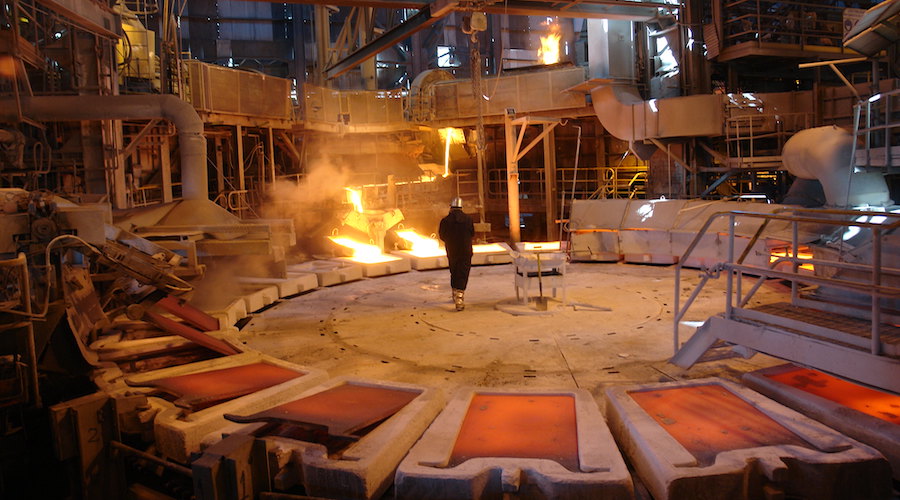
Copper retreated in after-hours trading on Thursday as an escalation in US-Iran hostilities sparked a broad selloff across metals. Damage to copper prices was more limited than gold and silver as a powerful storm sweeping across Chile kept supply risks squarely in view.

Copper for September delivery settled little changed at $6.342 per pound ($13,980 a tonne) on the Comex, holding near three-week highs, before sliding 1.1% to $6.27 a pound in evening trade as of 9 p.m. in New York.
The most-active contract is now trading about 6% below the all-time high above $6.60 a pound set in early June. In London, three-month copper ended the midweek session at $13,585 a tonne, with LME cash copper up nearly 8% so far this year.
The late-session pressure came after the US struck an oil tanker near Iran’s main export terminal for the first time since the restart of the blockade, driving the dollar and bond yields higher and rekindling expectations that the Federal Reserve may need to hike rates to contain oil-fuelled inflation. Gold fell 2.1% to below $4,000 an ounce and silver dropped almost 4%, while the S&P 500 lost 0.5%.
Category 5
Copper’s relative resilience owes much to Chile, where a major winter storm — classified as a potential Category 5 atmospheric river, the highest rating for such events — began sweeping across the country on Thursday, knocking out power and damaging homes in the south before an expected hit on the central copper heartland with as much as 150 millimetres of rain.
“We are going to have power outages,” Interior Undersecretary Máximo Pavez said Thursday. “We are doing everything possible so that authority coordination means a swift restoration of service, but with the wind we have, that service will be affected.”
The government convened emergency talks with mining industry representatives earlier this week and is coordinating with miners to make infrastructure, equipment and machinery available for the response, according to a Mining Ministry statement. The country’s largest copper export terminals remain largely operational.
The storm threat lands on an already stretched supply picture. Antofagasta reported this week that first-half copper output dropped 9.5% to 285,000 tonnes on lower production at two key mines, BHP has flagged declining Chilean output for next year, and the IEA warned just today that constraints on sulphuric acid supply have left the copper market facing a near-term outlook that has “worsened considerably”.
Chile’s own government underscored the tension on Wednesday: it cut its 2026 economic growth forecast to 1.8%, citing “elevated uncertainty associated with the conflict in the Middle East” — while raising its 2026 copper price assumption to $5.90 per pound from $5.46, joining a lengthening list of upgraded copper forecasts.
Miners caught in the selloff
Copper equities took the Iran news harder than the metal. Freeport-McMoRan (NYSE: FCX) fell 4% and Ivanhoe Mines (TSX: IVN) lost 4.9%, while Antofagasta (LSE: ANTO) gave up 4.1% after its production report and Southern Copper (NYSE: SCCO) shed 3.2%. BHP (ASX: BHP) slipped 2.3% on the day of its full-year results.

No comments:
Post a Comment