Saturday, May 09, 2026

ANALYSIS

Keeping the Lebanese army weak: A hardened US military doctrine at Israel's service


As Lebanon marks a month since “Black Wednesday”, when massive Israeli strikes killed 361 people, the international community continues to call on the Lebanese army to disarm Hezbollah. But the US legal imperative to ensure Israel has a “qualitative military edge” (QME) has kept the Lebanese military under-funded, under-equipped and unable to perform its role.


Issued on:  08/05/2026 - 
FRANCE24
By: Leela JACINTO

Two Israeli soldiers operate in southern Lebanon on April 29, 2026. © Ariel Schalit, AP

Exactly a month ago, Wissam Charaf was in Yarze, a picturesque town in the hills overlooking Beirut, when he suddenly heard the rumbling sound of an Israeli warplane just before it fired on a hill right across from where he was enjoying a break with his family from the Lebanese capital.

The warplane had struck Kayfoun, a town south of Beirut, which had been hit in the past during the waves of air strikes and bombardments Israel has conducted in Lebanon since October 2023. Charaf, like many Lebanese, had grown sickeningly accustomed to Israel’s frequent breaches of Lebanese sovereignty and airspace. So the 52-year-old filmmaker initially thought it would be more of the same in Lebanon’s new normal.

But this time, it was different. “Then there was another hit and then another hit. And then it went downwards towards Beirut, and it was like baba-baba-baba-baba-baba-baba-baba,” he said, recounting the sound of incessant, quick-fire strikes. “Under our eyes, downhill, Beirut was being bombed. It was massive. It was gigantic. It was everywhere.”

It was April 8. Black Wednesday, as the Lebanese call it. Operation Eternal Darkness as the Israeli military called it.


In just 10 minutes, the Israeli military offloaded 100 bombs across Lebanon, from Hermel in the far north, across the eastern Bekaa Valley, to Beirut on the western coast and down to the towns and villages in the country’s already battered south. The death toll on one day mounted to 361, including women and children. In a matter of minutes, Israel had carried out one of its worst mass killings in Lebanon’s history.

Amid an international outcry, diplomatic attempts to include Lebanon in the Iran ceasefire deal – which was announced by Pakistani mediators on April 8, before a US-Israeli rollback – went into high gear.

A week later, US President Donald Trump announced that the leaders of Israel and Lebanon had agreed to a 10-day truce. The US State Department brief on the ceasefire deal noted that, “All parties recognize Lebanon’s security forces as having exclusive responsibility for Lebanon’s sovereignty and national defense; no other country or group has claim to be the guarantor of Lebanon’s sovereignty.”

The long history of Israel’s entanglement with its northern neighbour has produced a diplomatic lexicon that is familiar to the Lebanese and the wider Middle Eastern public. Calls for the Lebanese security or armed forces – sometimes abbreviated to LAF – to defend Lebanon’s sovereignty dot realms of official agreements, briefings, notes and dispatches. Most bear a deceiving tone of resolution in a conflict that has defied diplomacy for decades.

Less well-known is another term, “qualitative military edge”, or QME, that has long been used in Washington policy circles. It was enshrined in US law in 2008, and guides US foreign policy to this day. QME pertains to Israel and is the underlying source, a growing number of experts say, of the bloodshed in the Middle East that shows no sign of abating.

In Lebanon, QME has a particular bearing as the country marks a month since Black Wednesday with Israel continuing to bombard Lebanon despite the shaky ceasefire, killing more than 2,700 people and displacing more than a million since the latest round of fighting re-erupted on March 2, following the outbreak of the US-Israeli war on Iran.
An Israeli military concept becomes US law

The concept to ensure Israel always has a qualitative military edge over its enemies traces its roots to the country’s first prime minister David Ben Gurion. Drawing from the lessons of the 1948 Arab-Israeli war, Ben Gurion’s 1953 defence doctrine concluded that since Israel “will continue to be quantitatively inferior vis a vis the Arab world”, the new nation “must develop a very strong qualitative edge”.

In the US, the concept did not take hold until two decades later, following the end of the 1967 war, when then-president Lyndon Johnson approved the sale of F-4 Phantom fighter jets to Israel, according to the pro-Israel think tank The Washington Institute for Near East Policy.

It was enshrined in US law in 2008 under George W. Bush’s presidency, when Congress passed the Naval Transfer Act, which requires the US to ensure that arms exports “to any country in the Middle East other than Israel shall include a determination that the sale or export… will not adversely affect Israel's qualitative military edge”.

The concept has continued to frame US legislation approving military aid to Israel through Republican and Democrat presidencies, including the 2012 US-Israeli Enhanced Security Cooperation Act, signed by Barack Obama, which mandates that the US must “help the Government of Israel preserve its qualitative military edge”.

It has ensured that Israel stands as the largest cumulative recipient of US military aid since its founding, receiving over $300 billion in assistance. Since the start of Israel’s Gaza war in October 2023, the US has enacted legislation providing at least $16.3 billion in direct military aid to Israel, according to the Washington DC-based Council on Foreign Relations.

“Initially, the idea [of QME] was simply to ensure that Israel always maintains technological and military superiority over any possible combination of regional adversaries,” explained Karim Emile Bitar, international relations professor at Beirut’s Saint Joseph University and a lecturer in Middle East studies at the Paris-based Sciences Po. “The fact that it's now embedded into US law affects arms sales and military assistance across the Middle East, including Lebanon.”

QME is “not a household concept” Bitar concedes, but it is important because “it’s one of the structural principles shaping US security architecture. It explains why some Arab states receive sophisticated weapons, those pro-US states that are very aligned with Israel, and others face major restrictions. And military aid to Lebanon has ceilings that have rarely been crossed”.

A national army weaker than a militia

In Lebanon, the flip side of Washington’s QME imperative to ensure Israel has the military edge is the enforced weakness of the Lebanese armed forces, according to many Middle East analysts.

“My critique of it [QME] is what it implies on the ground, which is this idea that we constantly hear that the Lebanese military needs to provide security in Lebanon and especially in southern Lebanon. But what we don't hear in this debate is that the Lebanese army is purposefully kept weak and under-prepared and under-equipped by the US and by Western countries that provide military aid and weapons,” said Mohamad Bazzi, director of the Hagop Kevorkian Center for Near Eastern Studies and a professor at New York University.

For more than two decades, Israel’s repeated attacks and encroachments on Lebanese territory have been aimed at fighting Hezbollah, the Shiite group with a military wing that is widely considered stronger than the Lebanese national army.

Hezbollah emerged from the 1980s Lebanese civil war – which ended with the 1990 Taif Agreement – stronger than the Lebanese national army, which had fractured along sectarian lines and dissolved during the brutal internecine conflict. At that time, Israel was still occupying southern Lebanon. Hezbollah’s supporters argued that it was the only force capable of resisting the Israeli occupation of southern Lebanon – which it did until the 2000 Israeli military withdrawal, giving the Arab world its first military victory against Israel.


While the rationale for Hezbollah retaining its weapons ended with the Israeli withdrawal, the militia group had, by then, amassed considerable firepower from its backers in Tehran. It had also made in-roads into Lebanese politics under the protection of Bashar al Assad, the strongman in neighbouring Syria. But during the Syrian civil war and Lebanon’s crippling economic crisis, the group’s popularity began to decline – including among Shiites in a deeply divided country where sectarian political parties often provide for their communities in the absence of state services.

But Hezbollah’s plummeting popularity, and the groundswell of Lebanese discontent over the extent of its state capture, has not translated into its disarmament, much less extinction.

Over the past two years, Israel has conducted massive campaigns against the group, assassinating its leader Hassan Nasrallah and top commanders. On Thursday, the Israeli military announced that it had killed ⁠a commander of ​Hezbollah’s elite Radwan force in an air strike on Beirut in the first Israeli attack on the Lebanese capital since the ceasefire agreed ​last month.

Israel today has carved ​out a self-declared buffer zone extending as deep as 10 km into southern Lebanon. The population that once lived in these areas has been displaced, and many Lebanese fear a strike at any time, anywhere as the buzz of Israeli surveillance drones offer an incessant soundtrack to their daily lives.

And yet, the Lebanese Shiite group has managed to keep up its fight against Israel. “Hezbollah still possesses capabilities, even though it has been weakened. It still possesses capabilities that in some domains surpass those of the Lebanese state. It has a large missile arsenal. It has extensive combat experience that it gained mostly in Syria when it was fighting alongside Bashar al-Assad, and it has highly motivated, ideological cadres,” said Bitar.

Coffins of Hezbollah fighters are carried on a truck during a mass funeral procession in the southern village of Kfar Sir, Lebanon on April 21, 2026 © Hassan Ammar, AP

Hezbollah fights Israel, the Lebanese army polices

As it continues to battle the IDF in southern Lebanon and launch rockets into northern Israel, Hezbollah argues that it needs to retain its weapons since it’s the only force in Lebanon that can resist Israel.

Technically, Hezbollah has a point. “If the Lebanese military was better equipped and had the resources it needs, there would be a stronger argument for disarming Hezbollah. That's the crux of this issue. It would take away Hezbollah's argument that it needs to be the one that defends Lebanon because the military isn’t capable of doing it,” explained Bazzi.

The Lebanese army today is among the world’s weakest, ranking 118 in the 2026 Global Firepower index of 145 countries. The primarily US-funded military barely has a navy, with its patrol boats conducting mostly coastguard and anti-smuggling duties. Its “air force” has long been a source of Lebanese jokes, including on social media, where wags remark about its lowly Cessna helicopters hovering below Israel’s fighter jets combing the Lebanese airspace. Defence systems, vital for a country’s security in the modern age, are absent as Israel adds layers of shields to its Iron Dome system.


Despite the quips and barbs, the national army is a beloved institution. “The Lebanese army is widely respected by most Lebanese. The Lebanese people want to empower the army. They want the army to be in charge of security,” explained Bitar.


Bazzi agrees. “The Lebanese army has been hailed as this one institution that's cross-sectarian, that's been successful, that's been rebuilt in a way that preserves the power and the interests of the Lebanese state. We've heard a lot of that. But,” he added significantly, “it's never really confronted an external enemy.”


US envoy’s ‘wild interview’


Meanwhile the US and its European allies display all the signs that they want the Lebanese army to succeed, with statements proclaiming it the sole guarantor of Lebanon’s sovereignty amid frequent calls for the Lebanese army to disarm Hezbollah.

France, Lebanon’s former colonial power, also issues statements advocating the strengthening of the country’s security forces. In March, France repeated its call to “step up support to the Lebanese Armed Forces, whose mission in this difficult context is to continue disarming Hezbollah”. A Paris summit was set for April. But it was then cancelled due to the Iran crisis.

The gap between statements and reality spilled into the open last year, when Trump’s envoy for the region, Tom Barrack, publicly expressed what many Lebanese knew but never imagined they’d hear from a US diplomat.

US envoy Tom Barrack speaks at a panel in Antalya, southern Turkey, April 17, 2026.
© Riza Ozel, AP


In what came to be called Barrack’s “wild interview”, the US envoy called for the Lebanese state to disarm Hezbollah before confessing that Washington does not want to arm the Lebanese army. “We don’t want to arm them… so they can fight Israel? I don’t think so,” Barrack said.

The clincher however came when the US diplomat noted that the Lebanese army was not going to “go knock on the door of a Shia house… and say, 'Excuse me, ma’am, can I go and take the rockets and the AK-47s out of your basement?”

Barrack’s comments, Bitar noted, were “very significant because it was a sort of acknowledgement that pushing the Lebanese army to take on Hezbollah would potentially lead to civil strife.”

More than three decades after the end of the civil war, the US still fears an injection of arms into Lebanon could set the populace at each other’s throats. Meanwhile it continues to provide Israel a qualitative military edge while the Palestinian issue remains unresolved after nearly 80 years.

A month after he watched Israeli warplanes conduct its Operation Eternal Darkness from a hill overlooking Beirut, Charaf is clear-eyed about the dismal chances for peace in his homeland. “The Lebanese army is torn between an international community that is telling them, fight Hezbollah, disarm Hezbollah, and we'll give you aid later. And the Lebanese army is saying, guys, if you want us to disarm Hezbollah, well at least give us weapons to do it,” he noted with a sigh.

“They're asking the Lebanese army somehow to obey the decisions of the Israeli army,” he added. “And they're asking the Lebanese army to do something that I would say is mission impossible.”


© France 24
02:03
FOUR YEARS LATE

CPJ demands update on US probe of journalist Abu Akleh’s killing in West Bank


The Committee to Protect Journalists (CPJ) on Thursday demanded a "public progress update" from the US Department of Justice on the investigation into the Israeli military's killing of Palestinian American journalist Shireen Abu Akleh, who was gunned down while reporting for Al Jazeera in the occupied West Bank in 2022.


Issued on: 08/05/2026 
By:FRANCE 24

A woman takes a photo of a mural dedicated to Palestinian American journalist Shireen Abu Akleh after it was unveiled in the West Bank city of Bethlehem on August 30, 2023. 
© Nasser Nasser , AP

The Committee to Protect Journalists (CPJ) on Thursday called for US authorities to relaunch their investigation into the Israeli military's killing of Palestinian American journalist Shireen Abu Akleh, who was gunned down while reporting for Al Jazeera in the occupied West Bank in 2022.

In a letter to the US Department of Justice -- which oversees the Federal Bureau of Investigation -- and FBI chief Kash Patel, the global press freedoms group demanded a "public progress update" on Abu Akleh's death.

"Although the FBI reportedly opened an investigation into her killing in November 2022, it has made no demonstrable progress," the letter noted, adding that CPJ was "not aware that any formal interviews have been conducted with witnesses despite the willingness of multiple witnesses to cooperate."


"This troubling lack of concrete progress -- four years after Abu Akleh's death -- represents a profound failure of the US government to respond promptly and impartially to the killing of one of its citizens by a foreign military."

Abu Akleh was 51 when she was fatally shot on May 11, 2022 by Israeli Defense Forces (IDF) soldiers while covering an Israeli raid on the Jenin refugee camp in the north of the occupied West Bank, CPJ said.

Then-Israeli Prime Minister Naftali Bennett initially claimed gunfire from Palestinian fighters was the likely cause of her death.

The IDF later released a statement saying it was "not possible to unequivocally determine the source of the gunfire" that killed Abu Akleh, adding there was "a high possibility that Ms. Abu Akleh was accidentally hit by IDF gunfire."
Truth in conflict

But CPJ notes that multiple independent investigations from leading news organizations "concluded that Abu Akleh was killed by IDF fire; some found evidence that she was deliberately targeted."

Abu Akleh was "a household name across the Middle East, widely respected for her courageous and in-depth reporting on Palestinian life," CPJ said, adding that she was wearing a vest marked "PRESS" and "clearly identified as press at the time of her killing."

In a separate statement Thursday, Abu Akleh's family also sought justice for violence at the veteran reporter's funeral -- Israeli police attacked her pallbearers, who nearly dropped her coffin -- saying "no one has been brought to justice, neither for her killing nor for the attack on her funeral."

"Her killing was not only a tragic loss for our family, but also a grave attack on press freedom and the fundamental right to report the truth," the family's statement said. "This ongoing impunity sends a dangerous message that journalists can be targeted without consequence."

Abu Akleh's death also made her a broader symbol of the Palestinian struggle: murals of her face adorn walls, her office's street in Ramallah was renamed in her honor and a museum was named for her.

In addition to demanding a public update on the investigation, press advocates called for the FBI to commit to a timeline to "complete a thorough criminal investigation and publicly release its findings," urging the agency to maintain an impartial and independent inquiry "free from political considerations."

CPJ said since Abu Akleh's killing, Israel has killed 258 more journalists and media workers across the Middle East, including 207 in Gaza alone.

Israel was responsible for two-thirds of journalist deaths in 2025, CPJ said.

The Israeli army rejects allegations of targeted violence, saying it does not intentionally target journalists or their families.

(FRANCE 24 with AFP)


Boats from Gaza aid flotilla gathering in Marmaris, Turkey

08.05.2026, 14:17 DPA

A Gaza aid flotilla called the Global Sumud Flotilla plans to regroup in the Turkish port of Marmaris in the coming days, according to the organizers. 

Several boats have already arrived in the harbour town’s bay, and further boats from Greece and Italy are on their way there, the activists said on Friday.

Data from an online tracker provided by the organizers also showed on Thursday that the boats were heading towards Marmaris.

It is unclear when the activists intend to set sail again from Marmaris towards the Gaza Strip with aid supplies. The organizers said that further information on the "next phase" of the campaign would be provided on May 12.

Last week, the Israeli navy intercepted more than 20 ships from the Global Sumud Flotilla in international waters west of Crete and arrested 175 people.

Greece took in most of them and helped them return to their countries of origin.

Two activists were taken to Israel by the Israeli navy and detained there.

Several EU states have expressed doubts about whether the interception in international waters was compatible with legal norms. 

Israel insists that the action taken against the activists was in accordance with international law.


Israeli court rejects appeal by detained Gaza aid flotilla activists

An Israeli court on Wednesday rejected an appeal by two foreign nationals, one Spanish and one Brazilian, challenging their detention in Israel. The two men were seized in international waters last week while participating in a humanitarian aid flotilla seeking to break Israel’s blockade of the Gaza Strip. The ruling means an earlier decision extending their detention remains in place.


Issued on: 06/05/2026 - 
By: FRANCE 24

Brazilian national Thiago Avila were among dozens of activists aboard a flotilla intercepted in international waters off the coast of Greece. © Ilia Yefimovich, AFP

An Israeli court rejected on Wednesday an appeal filed by two foreign activists contesting their detention by authorities, their lawyer told journalists.

Spanish national of Palestinian origin Saif Abu Keshek and Brazilian Thiago Avila were among dozens of activists aboard a flotilla intercepted in international waters off the coast of Greece on Thursday.

The two were seized by Israeli forces and brought to Israel for questioning, while the others were taken to the Greek island of Crete and released.

On Tuesday, an Israeli court extended the detention of Abu Keshek and Avila until Sunday to allow police more time to interrogate them, according to their lawyers.

The pair's legal team then filed an appeal at the Beersheva district court against the detention.

But their appeal was rejected.

"Today, the district court of Beersheva denied our appeal and basically accepted all of the arguments that the state or the police have represented before the court and kept the previous decision," Hadeel Abu Salih said, referring to the earlier court's ruling.

The two activists had appeared in the district court, their feet shackled, an AFP journalist reported.

Abu Keshek looked exhausted and sat with his hands clasped in his lap, while Avila seemed calm, said the journalist.

Israeli rights group Adalah, which is representing the pair, has called their detention illegal.

"As we said from the first day, we're talking about an illegal arrest that took place in international waters where the activists were kidnapped by the Israeli navy without any authority," Abu Salih said after the hearing on Wednesday.

"It's so concerning that also the legal system is giving a free hand for the Israeli forces to continue with this illegal arrest in a way that would give it also legitimacy to do it again and again and kidnap international nationals."
'Stopped drinking'

Adalah has also accused the authorities of subjecting the men to continuous abuse in detention.

"Saif basically told us that he stopped drinking water in addition to the hunger strike he started on Thursday morning," Abu Salih said.

"They are also telling us that they keep interrogating them for most of the time, most of the day, and the questions keep going around the same context, which is the humanitarian mission context."

Adalah had earlier said that the two men were being held in "total isolation, subjected to 24/7 high-intensity lighting in their cells and kept blindfolded whenever they were moved, including during medical examinations".

Israeli authorities have rejected the allegations but have filed no charges against the men.

Adalah said authorities have accused the pair of several offences, including "assisting the enemy during wartime" and "membership in and providing services to a terrorist organisation".

Israel's foreign ministry says both men were affiliated with the Popular Conference for Palestinians Abroad (PCPA), a group accused by Washington of "clandestinely acting on behalf of" Palestinian militant group Hamas.

Spain, Brazil and the United Nations have called for their swift release.

"It is not a crime to show solidarity and attempt to bring humanitarian aid to the Palestinian population in Gaza, who are in dire need of it," UN rights office spokesman Thameen Al-Kheetan said in a statement.

The flotilla had set sail from France, Spain and Italy with the aim of breaking Israel's blockade of Gaza and delivering humanitarian aid to the war-ravaged Palestinian territory.

Israel controls all entry points into Gaza, which has been under an Israeli blockade since 2007.

(FRANCE 24 with AFP)

Can artificial intelligence help Nollywood tell African stories differently without losing its soul?
Issued on: 08/05/2026 

08:18 min  From the show

Artificial intelligence is no longer just a Silicon Valley debate: it’s becoming part of Africa’s creative revolution. In Nigeria, filmmakers and digital artists are experimenting with AI tools to create films, archive disappearing oral histories and imagine new African futures. Obinna Okere-keocha, founder of Naija Artificial Intelligence Film Festival, and filmmaker Malik Afegbua, use AI to preserve fading oral traditions by creating digital archives.

OUR GUESTS
Obinna OKEREKOCHA
Malik AFEGBUAAI artist
 BY: 
French prosecutors seek charges against Musk and X over Grok content


French prosecutors said Wednesday that they have opened an investigation into Elon Musk and social media platform X over the distribution of child sexual abuse images, deepfakes, disinformation and alleged complicity in denying crimes against humanity linked to the platform’s artificial intelligence system, Grok.


Issued on: 08/05/2026 -
By: FRANCE 24

File photo of Elon Musk attending the finals for the NCAA wrestling championship taken March 22, 2025, in Philadelphia. © Matt Rourk, AP

French prosecutors are seeking charges against Elon Musk and his social platform X over child sexual abuse images on the platform, deepfakes, disinformation and complicity in denying crimes against humanity by the platform's artificial intelligence system, Grok.

The Paris public prosecutor's office said Wednesday it has opened an investigation into X on charges including complicity in possessing and distributing child sexual abuse images and unlawfully collecting personal data. It's also investigating charges of disseminating non-consensual images or other content and denial of crimes against humanity.

X and its parent company SpaceX did not immediately respond to messages seeking comment Thursday.

The investigation comes less than three weeks after Musk and Linda Yaccarino – the former CEO of X – were summoned for “voluntary interviews" to discuss the allegations. They did not show up, but French authorities said this wouldn't hinder the investigation.


Musk was summoned after a search took place in February at the French premises of X as part of an investigation opened in January 2025 by the cybercrime unit of the Paris prosecutor’s office. Musk and Yaccarino have been invited in their capacities as managers of X at the time of the events investigated. Yaccarino was CEO from May 2023 until July 2025.

French authorities opened their investigation after reports from a French lawmaker alleging that biased algorithms on X likely distorted the functioning of an automated data processing system. It expanded after the AI system, Grok, generated posts that allegedly denied the Holocaust, a crime in France, and spread sexually explicit deepfakes.

It’s looking into alleged “complicity” in possessing and spreading sexual abuse images of minors, sexually explicit deepfakes, denial of crimes against humanity and manipulation of an automated data processing system as part of an organised group, among other charges.
Why is French cybercrime unit investigating Elon Musk's X?

© France 24
05:00


Grok, which was built by xAI and is available through X, sparked global outrage this year after it pumped out a torrent of sexualised non-consensual deepfake images in response to requests from X users.

Grok also wrote in a widely shared post in French that gas chambers at the Auschwitz-Birkenau death camp were designed for “disinfection with Zyklon B against typhus” rather than for mass murder – language long associated with Holocaust denial.

In later posts on X, the chatbot reversed itself and acknowledged that its earlier reply was wrong, saying it had been deleted, and pointed to historical evidence that Zyklon B was used to kill more than 1 million people in Auschwitz gas chambers.

In March, the Paris prosecutor’s office alerted the US Department of Justice and the Securities and Exchange Commission, suggesting “that the controversy surrounding sexually explicit deepfakes generated by Grok may have been deliberately orchestrated to artificially boost the value of the companies X and xAI – potentially constituting criminal offences,” prosecutors said.

(FRANCE 24 with AP)

Musk to pay $1.5 million to settle Twitter takeover case

05.05.2026, DPA

Elon Musk - FILE PHOTO - Elon Musk, CEO of Tesla, SpaceX, X, and xAI, attends a press event on the site of the Tesla Gigafactory. (zu dpa: «Musk to pay $1.5 million to settle Twitter takeover case»)

Photo: Patrick Pleul/dpa Pool/dpa

Tech billionaire Elon Musk is set to end a lawsuit by the US Securities and Exchange Commission (SEC) over his share purchases during his takeover of Twitter with a payment of $1.5 million.

Musk and the SEC agreed on the amount in a settlement disclosed on Monday that will be submitted to the assigned judge for approval. The penalty is only a fraction of the $150 million the SEC alleged Musk saved by violating disclosure rules.

In the lawsuit, filed in early 2025, the SEC accused Musk of failing to disclose in time that his stake in Twitter had crossed the 5% threshold while he was buying shares in the online platform in 2022. That allowed him to buy more shares at lower prices, the regulator said.

The SEC analyzed Musk's purchases and concluded that the delayed mandatory disclosure had saved him more than $150 million. Shareholders who sold him their shares during that period suffered financial harm, according to the regulator.

The SEC had initially sought to force Musk to repay that amount and pay an additional penalty. According to Musk's lawyers, the agency had demanded $200 million in an earlier settlement offer.

Musk failed in February in an attempt to have the lawsuit dismissed. His lawyers had argued that the SEC had applied the law selectively and that the lawsuit violated his right to free speech. Judge Sparkle Sooknanan, however, saw no reason to dismiss the case.

The tech billionaire began buying Twitter shares on the market in early 2022. In its lawsuit, the SEC said his stake reached 5% on March 14, 2022.

Under US rules, Musk should have made that public within 10 calendar days. But he only disclosed on April 4 - 11 days too late - that he already held 9%. Twitter's share price then jumped by 27%, the SEC noted.

Musk spent around $44 billion on the purchase of Twitter, which was completed in October 2022. He sold shares in Tesla, the electric carmaker he leads, to finance most of the deal. Musk also took out loans of around $12 billion.


Mexico: A mother exhumes her son’s bones, seven years after his disappearance

More than 133,000 officially missing persons in Mexico

Ceci Flores discovered her son’s remains during a search in northern Mexico in late March. He had disappeared in 2019. Flores is a well-known figure in Mexico, where she leads a collective of mothers looking for their missing loved ones, often victims of cartels. Collectives like hers aim to fill the gap left by the authorities’ inaction.

Issued on: 08/05/2026 
The FRANCE 24 Observers/
Chloé LAUVERGNIER

This mother found her son’s remains in the state of Sonora, Mexico, on March 24, 2026. © Facebook / Madres Buscadoras de Sonora


"No mother deserves to find not her son, but his bones – to only be able to hold his bones in her arms.” In a video posted on March 24, Ceci Flores says she is sure that the bones she is holding belong to her son, Marco Antonio. The video is filmed in a deserted, arid landscape near Hermosillo in the northwestern Mexican state of Sonora, where Marco Antonio disappeared in May 2019, after being kidnapped by an armed group.


Ceci Flores posted this video on March 24, 2026. © Facebook / Madres Buscadoras de Sonora

A few days after her video was posted, a DNA test confirmed what Flores’ instinct had already told her: that the bones did indeed belong to her son. For her part, she had known since she discovered the bones next to clothing that matched the outfit Marco Antonio was wearing when he disappeared.
"[...] The remains discovered in recent days belong to my son [...]. The DNA test confirmed what I was so afraid of [...]", Ceci Flores wrote on March 31, 2026.

Flores says that searches were conducted in the area where his remains were discovered based on information provided by one of the people responsible for his disappearance, who was interviewed by the authorities.

More than 133,000 officially missing persons in Mexico

Mexico is plagued by disappearances. According to a national registry established in 2019, more than 133,000 people are officially “missing or unaccounted for.” The number is likely much higher, as not all disappearances are reported - sometimes because of fear or lack of faith in the authorities.

Criminal gangs are responsible for a large portion of these disappearances. But some public officials also bear both direct and indirect responsibility for some disappearances, according to a recent report by the UN. One of the most well-known cases involving the authorities is the abduction and subsequent disappearance of 43 students from the Ayotzinapa Rural Teachers College in Guerrero state in 2014.

"In the case of my son, Marco Antonio, it’s a cartel that was responsible for his disappearance. He had a shop where he sold drinks, food, etc, but also drugs, except he wasn’t working for the cartel,” Flores says.

However, all types of people are disappearing, not just those with links to the cartel or carrying out illegal activities. The disappeared include men, women and even children.
‘Mothers wouldn’t have to carry out the searches themselves if the authorities were doing their jobs’

Flores may have just discovered the remains of her son, Marco Antonio, but she is still searching for another one of her sons, Alejandro, who disappeared in 2015. Another son was also abducted in 2019 at the same time as Marco Antonio, but, thankfully, he was discovered alive a few days later.

It was that terrible year when Flores founded a collective she calls "Madres Buscadoras de Sonora" ("The searching mothers of Sonora"), which brings together mothers looking for their missing loved ones.


"I created it because of my sons’ disappearances. Mothers wouldn’t have to carry out the searches themselves if the authorities were doing their jobs. They have the technology, the tools and the resources to do it. It is because of the authorities’ inaction that we have to create collectives to search for missing people, to investigate their disappearances and to find them.”

We carry out searches using picks, shovels and sensors. We are looking both for those who have died as well as those who are still alive: we visit detention centres, we walk the streets… we’ve already found more than 3,000 people alive and more than 2,700 who have died [Editor’s note: our team was unable to independently verify these numbers.]

When I found Marco Antonio’s remains, it was very painful because I knew that I wouldn’t see him again, not to mention that we only found some of his bones.
"[...] We go forward alone, while the people who should be looking for them hide behind paperwork and protocols [...]", Flores wrote in mid-April 2026.


‘We are shining a light on something that shouldn’t be happening’

According to a report by Amnesty International, there are more than 200 collectives of families searching for missing loved ones in Mexico - and 90% of the members are women. The report highlighted the dangers and difficulties faced by these women, including assassinations, further disappearances, attacks, threats and stigmatisation. Between February 2011 and May 2025, at least 30 family members of the missing were assassinated.

The most recent case involves Cecilia García Ramblas. She was a member of a collective in Salamanca in the Guanajuato state. She was kidnapped in mid-March, and her body was found a few days later.

Flores is aware of the risks:


"I receive threats every day, telling me to stop searching. The problem is that we report on all of the remains that we find, which makes both the cartels and the authorities look bad, because we are shining a light on something that shouldn’t be happening.

I can’t confirm that they are the ones threatening me, but the threats are daily. People have pointed guns at me and the other mothers. Some [of the other mothers] have disappeared or been executed. We’d like more protection from the authorities, especially when we are carrying out searches.”
These are the remains discovered by Ceci Flores and her collective in Sonora state in April 2025. © X / @MadresBuscan


Despite the risks, Flores isn’t going to give up anytime soon:


"The love for our missing loved ones makes us forget the fear. I want to keep speaking about our reality, so that people know that we exist and to raise awareness about our missing loved ones. They aren’t statistics or numbers, but people who deserve to be looked for, no matter what their pasts.”

She also believes that more needs to be done for the many children whose parents have disappeared. "Many become orphans and need help from society,” she says.

This article has been translated from the original in French by Brenna Daldorph.

Could Iran use 'kamikaze dolphins' against the US in the Strait of Hormuz?


Issued on: 06/05/2026 - 


04:23 min From the show

As US-Iran tensions escalate around the Strait of Hormuz, a journalist at a Pentagon briefing this week asked top US officials an out-of-the ordinary question: whether Tehran could deploy "kamikaze dolphins" against US warships. The idea isn't as far-fetched as it seems, as multiple countries have a history of using marine mammals for military purposes.

The question stems from a Wall Street Journal report published last week. Citing Iranian officials, it said Iran could use "previously unused weapons to attack US warships, from submarines to mine-carrying dolphins".

Though Defence Secretary Pete Hegseth denied that Iran had these in their possession, he refused to "confirm or deny" whether the US does, and Tehran was quick to troll Washington online, with its embassy in Hyderabad posting an AI-generated "dolphin bomber" on its official X account.
A long history of military marine mammals

Military marine mammals - especially bottlenose dolphins - have been around for decades, with the Soviet Union in particular known for its dolphin training programme.

There have been reports of evidence that North Korea possesses a naval marine mammal programme as far back as 2015, as well as reports that the Russian Navy deployed trained dolphins in both 2018 to aid in the Syrian civil war, and its full-scale invasion of Ukraine in 2022.

Rumours have floated for over two decades that Iran has "kamikaze dolphins" in its arsenal, after a Russian dolphin trainer claimed to have sold a group of Soviet "killer dolphins" to Tehran in 2000. But it's not known if they are still alive.

The US also has a "Marine Mammal Program", training dolphins and sea lions to detect and recover objects underwater, including mines.

Vedika Bahl goes through whether "kamikaze dolphins" are a myth or a military reality.


New Trump counterterrorism strategy brands Europe an 'incubator' for terrorism


The Trump administration on Wednesday unveiled a new counterterrorism strategy, accusing Europe of fostering terrorism through mass migration, while also expanding US domestic focus to include what it called “violent left-wing extremists” and “radically pro-transgender” groups.


Issued on: 07/05/2026 - 
By: FRANCE 24

US President Donald Trump's administration accused Europe of being an "incubator" for terrorism fueled by mass migration, in a new counterterrorism strategy unveiled on Wednesday.

The strategy also focuses on rooting out "violent left-wing extremists", including "radically pro-transgender" groups, as Trump's administration steps up its political attacks on opponents.

It further places drug cartels in the Americas at the centre of counterterrorism efforts.

But some of its strongest language is reserved for Europe, home to numerous US allies who will be alarmed to see their continent in the Trump administration's crosshairs once again.


"It is clear to all that well-organised hostile groups exploit open borders and related globalist ideals. The more these alien cultures grow, and the longer current European policies persist, the more terrorism is guaranteed," the strategy said.

"As the birthplace of Western culture and values, Europe must act now and halt its willful decline," said the strategy, led by counterterrorism coordinator Sebastian Gorka, who has been accused of links to far-right groups.

The fresh criticism of Europe comes just months after Trump's new national security strategy said the continent faced "civilizational erasure" due to immigration.

Trump has also recently lashed out at European NATO allies for failing to help with his war on Iran.

Left-wing groups are a major preoccupation for the Republican president's administration, with the strategy targeting what it calls "violent Left-Wing Extremists, including Anarchists and Anti-Fascists".

It says US counterrorism efforts will "prioritise the rapid identification and neutralisation of violent secular political groups whose ideology is anti-American, radically pro-transgender, and anarchist".

It specifically cited the alleged killer of Trump ally and conservative influencer Charlie Kirk "by a radical who espoused extreme transgender ideologies."

Since his return to power last year, Trump has demonised any recognition of gender diversity and transgender people.

He regularly boasts about how his administration has banned transwomen from women's sports and shortly after his inauguration signed an executive order proclaiming that there are only two genders.

FRANCE 24 with AFP


Hantavirus on the rise in Argentina, where MV Hondius cruise ship set sail

Experts say that a surge of hantavirus cases in Argentina, where the MV Hondius cruise ship set sail, is in part due to climate change. The World Health Organization ranks the South American country as having the highest incidence of the rodent-borne disease.


Issued on: 07/05/2026 - 
By: FRANCE 24

A person in a hazmat suit is escorted to an ambulance from a medical aircraft allegedly carrying some of the passengers from the cruise ship MV Hondius believed to be infected with hantavirus, at Schiphol airport near Amsterdam on May 6, 2026. © Lina Selg, AFP

Officials and experts in Argentina are scrambling to determine if their country is the source of a deadly hantavirus outbreak that has gripped an Atlantic cruise.

The health emergency aboard the ship that's moored across the ocean comes as Argentina sees a surge of hantavirus cases that many local public health researchers attribute to the recently accelerating effects of climate change. Argentina, where the cruise to Antarctica departed, is consistently ranked by the World Health Organization (WHO) as having the highest incidence of the rare, rodent-borne disease in Latin America.

Higher temperatures expand the virus’ range because, in part, as it gets warmer and ecosystems change, rodents that carry the hantavirus can thrive in more places, experts say. People typically contract the virus from exposure to rodent droppings, urine or saliva.
Argentina probes link to deadly hantavirus outbreak on Atlantic cruise


“Argentina has become more tropical because of climate change, and that has brought disruptions, like dengue and yellow fever, but also new tropical plants that produce seeds for mice to proliferate,” said Hugo Pizzi, a prominent Argentine infectious disease specialist. “There is no doubt that as time goes by, the hantavirus is spreading more and more.”


The Argentine Health Ministry on Tuesday reported 101 hantavirus infections since June 2025, roughly double the caseload recorded over the same period the previous year.

A hantavirus found in South America, called the Andes virus, can cause a severe and often fatal lung disease called hantavirus pulmonary syndrome. The disease led to death in nearly a third of cases in the last year, Argentina’s Health Ministry said, up from an average mortality rate of 15 in the five years before that.

Hantavirus usually spreads by inhaling contaminated rodent droppings and can spread person-to-person, though that is rare, according to the WHO, whose top epidemic expert said the risk to the public is low. The Andes strain only hantavirus known to spread from human to human.

Authorities said passengers on the MV Hondius ship tested positive for the Andes virus. Argentina on Wednesday said it was sending genetic material from the Andes virus and testing equipment to help Spain, Senegal, South Africa, the Netherlands and the UK detect it.

Argentine officials say they’re trying to pin down where infected passengers travelled in the country before boarding the Dutch-flagged cruise liner in Ushuaia, a city in southern Argentina known as the end of the world. Once they know the itineraries, they plan to trace contacts, isolate close contacts and actively monitor to prevent further spread.
'Unconscionable to keep them on cruise ship': WHO's Gostin on hantavirus outbreak


The UN health agency, or WHO, says that the first death on board, a 70-year-old Dutch man, happened on April 11. His 69-year-old wife, also Dutch, died on April 26. The third passenger, a German woman, died on May 2.

The virus can incubate for between one and eight weeks. That makes it hard to know whether the passengers contracted the virus before leaving Argentina for Antarctica on April 1; during a scheduled stop to a remote South Atlantic island; or aboard the ship.

The province of Tierra del Fuego, where the vessel docked for weeks before departing, has never seen a case of hantavirus. Before boarding, the Dutch couple went sightseeing in Ushuaia, and travelled elsewhere in Argentina and Chile, WHO said.

The Argentine government’s leading hypothesis is that the couple contracted the virus during a bird-watching outing in Ushuaia, according to two investigators who spoke on condition of anonymity because they were not authorised to brief the media, with the investigation ongoing. Authorities are also tracing the Dutch tourists' footsteps through the forested hillsides of Patagonia in southern Argentina where some infections are clustered.


Because early symptoms resemble the fever and chills of a flu, “tourists might think they just have a cold and not take it seriously. That makes it particularly dangerous,” Raul Gonzalez Ittig, genetics professor at the National University of Cordoba and a researcher at state science body CONICET, said.

Argentina in recent years endured a historic drought. But it also had bouts of unexpectedly intense rainfall, part of a broader pattern of wild weather that scientists attribute to climate change.

Some of this variability has created conditions that have allowed hantavirus to flourish, experts say. Dry spells drive animals out of their usual habitats in search of food and water. Huge amounts of rain lead to vegetation growth, scattering seeds that attract leaf-munching rodents.

“When precipitation increases, food availability increases, rodent populations grow, and if there are infected rodents, the chance of transmission between rodents – and eventually to humans – also increases,” Ittig said.


What is hantavirus and how does it spread?
Infection generally occurs through the inhalation of dust and aerosols contaminated by the excretions of infected rodents. © FRANCE 24
04:30


Although hantavirus cases once were limited to the southern reaches of Patagonia, now 83 percent of cases are found in Argentina’s far north, according to the Health Ministry.

The ministry issued an alert in January about several fatal outbreaks, including in the most populous province of Buenos Aires.

With rural hospitals under-equipped, residents had no clue what hit them.

Daisy Morinigo and David Delgado said they initially thought their 14-year-old son had the flu when he came down with a fever and body aches. Doctors who first saw Rodrigo in the town of San Andres de Giles sent him home with ibuprofen and orders to rest.

But the feisty fourth grader's breathing worsened. On January 1, they rushed Rodrigo to intensive care. He died just two hours after a hantavirus test came back positive.

"I wouldn’t wish this pain on anyone in the world,” Delgado said.

(FRANCE 24 with AP)
Christians decry persecution in India's heartland

N Hannan in Shahjahanpur
DW


With Christians in India increasingly targeted by Hindu vigilantes, victims say police often side with the attackers.

In Uttar Pradesh, over a hundred pastors were detained (and eventually released) over claims linked with the state's anti-conversion laws
 (file photo)Image: Prabhat Kumar Verma/ZUMA/IMAGO

On a humid Sunday afternoon in July last year, a small gathering of Christians inside a modest home in India's Uttar Pradesh state was interrupted by a mob.

"At least 50 to 60 people associated with a Hindu right-wing organization came when people were receiving a religious message," said Jaynendra (name changed), the pastor leading the prayer.

What followed, he said, was chaos. The mob "created a ruckus and closed the prayer hall," Jaynendra said.

The gathering, held inside his home in the Shahjahanpur district, was not unusual. Like many Christians in northern India, Jaynendra hosts what is known as a house church, a quiet form of worship common among small and impoverished Christian communities. But in recent years, such gatherings have increasingly drawn the attention of Hindu right-wing vigilante groups who accuse Christians of carrying out forced conversions.

India's Christians make up just over 2% of the country's population, compared to around 79% for Hindus and over 14% for Muslims, according to the 2011 census.

Data compiled by rights groups indicates a disproportionate rise in violence against Christians over the past decade. In 2025 alone, local monitoring groups documented nearly 900 incidents across multiple Indian states, including physical assaults, disruptions to church services, and threats targeting worshippers, as per a report by Christian Solidarity International, a global Christian rights organization based in Switzerland.


Pastor arrested after attack on home church

Jaynendra's account is one among many that suggest a recurring pattern. Mobs descend on prayer meetings, raise allegations of forced conversion, and then the police are called. Often, victims say, it is the worshippers rather than the violent mob who are detained.

Following the attack in Uttar Pradesh, the police "took around 10 to 11 people to the police station and detained them," Jaynendra said. "They kept my family and others the whole day." Among those detained, he said, was a 13-year-old girl.

"The police questioned them and found out that they had no money or pressure to attend the gathering. Everyone came here to pray with their own will," he said. "But still they kept them."

The pastor himself was later arrested. He spent more than four months in jail under charges related to Uttar Pradesh's anti-conversion law. The law is a controversial state legislation that criminalizes religious conversions deemed to be carried out through force, fraud, or inducement. Critics say the law is often weaponized to target minority communities. Courts in the region have also noted a similar "disturbing trend" in false claims.

"There was no evidence against me," he said. "But there was a lot of pressure." DW did not receive a response from Uttar Pradesh police, despite several requests for comment.

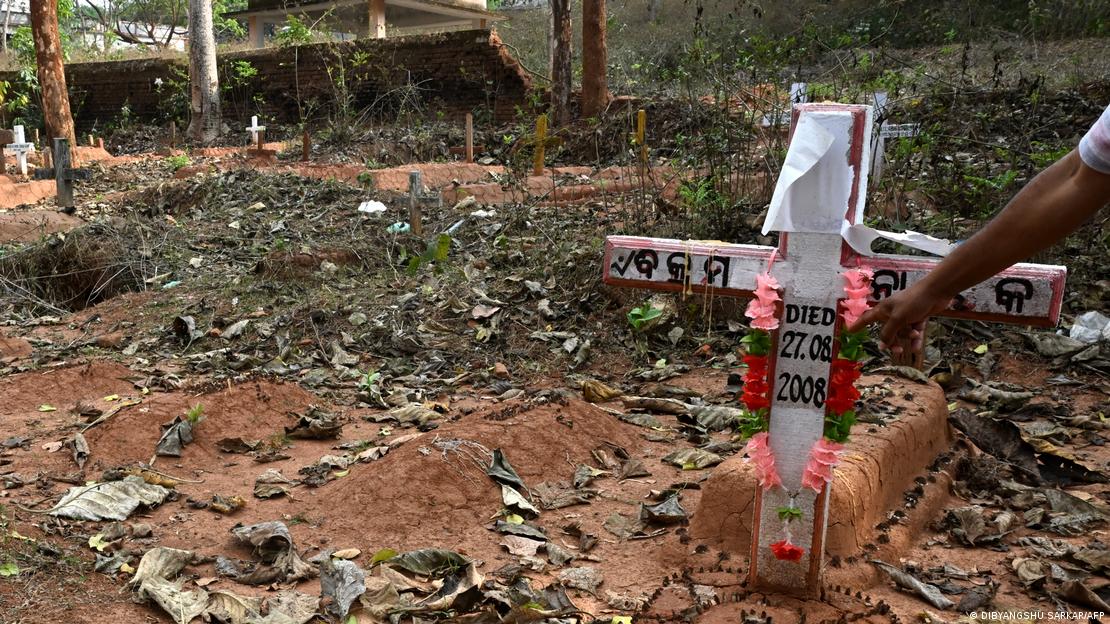
This photo, taken in 2024, shows the grave of a Christian who died when mobs rampaged through parts of India's eastern state of Odisha after the murder of a Hindu priestImage: DIBYANGSHU SARKAR/AFP


'They started beating people'

Across northern and central India, similar stories are emerging. In Madhya Pradesh's Chhindwara district, Vinay Patil (name changed) described an attack on his congregation during a Sunday service earlier this year.

"About 35 to 40 people came," he said. "They were young boys. They started talking in abusive language and said that 'you are doing forced conversions here.'" Some of the attackers, he said, were intoxicated. Many carried sticks.

"They started beating people. Women, children, everyone," he said. "Someone's shoulder was fractured. Someone's head was bleeding." By the time police arrived, the attackers had fled. But instead of pursuing them, Patil said, officers detained the victims and accused them of carrying out "forceful conversions."

"The police picked us up and took us away," he said. "Our people had made videos. It was visible that they were beating. After that, the police did not take any action."

Patil said that fear has become part of daily life. "Today a Christian, especially a pastor, cannot even sit at another person's house," he said. "We have to think before stepping out. Even going to someone's birthday can become a problem."

Violence rising under Modi's BJP


Rights advocates say such incidents are no longer isolated. Michael Williams of the United Christian Forum said the organization recorded 134 incidents of anti-Christian violence in 2014, the year India elected Hindu nationalist Bharatiya Janata Party (BJP) to power, compared to around 900 in 2025.

"What you can see now, which we could not see earlier, is that the people who are doing these crimes have no fear on their faces," he said. "They are stopping in broad daylight, in public spaces, with no fear. This is a growing trend."

Williams and others link the rise in violence to the political climate following the ascent of the BJP in 2014. The party, which promotes a Hindu nationalist ideology, governs in several states where anti-conversion laws have been enacted.

These laws, intended to prevent forced or fraudulent conversions, have been criticized by rights groups for their vague definitions and potential for misuse.
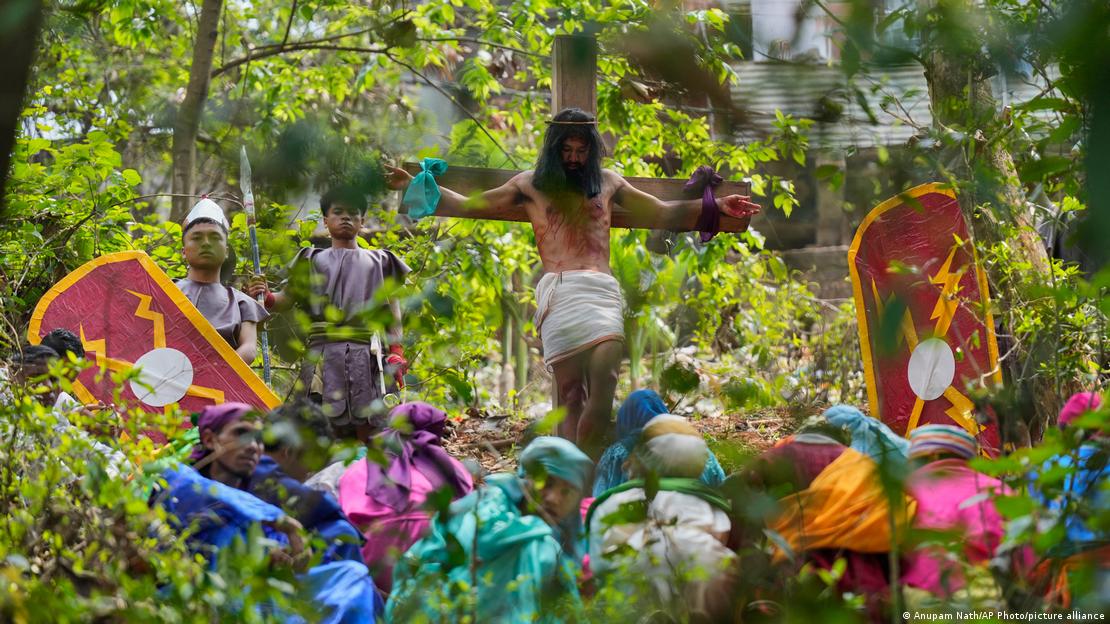
One of the Easter traditions practiced in India's city of Guwahati is the reenactment of Jesus' crucifixion
Image: Anupam Nath/AP Photo/picture alliance

Attackers act with 'sense of impunity'


Jaynendra was charged under one such law about forced conversions. "They applied the same charge twice," he said, denying the allegation. "We do not have money to pay our own rent. How can we give money to someone to convert them?"

The Indian Constitution guarantees freedom of religion, including the right to practice, profess, and propagate one's faith. But activists argue that this right is not being protected.

"People are walking inside a church and breaking things," Williams said. "They have no right to take any law into their own hands."

John Dayal, a veteran human rights activist, said the violence follows a consistent pattern that dates back decades but has intensified in recent years. "The actors involved have consistently stayed the same," he said. "But when the BJP is in control, there is a sense of impunity."

Dayal said the widespread use of cellphones has also changed the nature of these attacks. "Almost all crimes are committed on camera now," he said. "The filming is part of the crime. It is to show power, to get support."

Videos of such incidents have circulated widely on social media, sometimes sparking outrage but rarely leading to swift accountability, victims say.
'The police took their side'

In many cases, police response has come under scrutiny. "There is this peculiar thing that people are attacked and the cases are registered against the victims," Dayal said. Patil echoed that sentiment.

"The mob that had come, their associates came to the police station and talked to the officer," he said. "Our people were thrown out. The police took their side."

AC Michael, another leader of the United Christian Forum, said the lack of action has emboldened perpetrators. "They have no fear of law because they have protection behind them,” he said. "In so many places, no action has been taken."

"Last year, we had close to 900 incidents. That means there are more than two incidents of attacks against Christians every day."


More than 100 pastors in Uttar Pradesh arrested, then acquitted

Back in Shahjahanpur, Jaynendra said tensions in his area were not always so high. "There were small problems over time, but not so big," he said. Now, he said, the message to his community is clear: "There is no freedom for you here. India is only for Hindus."

Government officials have repeatedly said that India remains committed to protecting all religions. They have also defended anti-conversion laws as necessary to prevent exploitation.

But critics argue that the laws have created an environment where accusations alone can trigger violence. "Even serving one cup of tea and two biscuits can be called allurement in some places," AC Michael said. "How can someone convert for that?"

He added that in many cases, those accused of forced conversion are eventually acquitted due to lack of evidence: "More than 100 pastors were arrested in Uttar Pradesh. All of them have been acquitted."

Still, the process itself can be punishing. Jaynendra spent months in jail awaiting bail. "My wife also went to jail on July 25 and was released in October," he said. "I was released on December 13." The case against him is still ongoing.
Christian children stay out of schools

For many, the impact extends beyond legal battles. Patil said fear of violence is now interfering with the education of Christan children.

"My own children are so terrorized that they have not gone to school for 15 days," he said. "Some people were beaten and forced out of their houses. They had to leave their villages."

Despite the risks, both men say they intend to continue their work. "Our job is to spread the message," Patil said. "It is on the people to decide whether they want to listen."

For Jaynendra, the experience has been transformative but not deterring. "The atmosphere has changed a lot," he said. "I have been living here since birth. This is the first time I had to go to jail."

The reporting for the story was supported by a grant from the HRRF Journalism Grant Program.

Edited by Darko Janjevic