It’s possible that I shall make an ass of myself. But in that case one can always get out of it with a little dialectic. I have, of course, so worded my proposition as to be right either way (K.Marx, Letter to F.Engels on the Indian Mutiny)
Tuesday, June 02, 2026
On Day One of Posidonia, NZF and Strait of Hormuz Are at Center Stage
At the first day of the Posidonia conference in Athens, the contours of the Western shipping industry's biggest gathering became clear: This will be the biggest Posidonia ever, following on the heels of the biggest Marintec China conference ever - a sign of the industry's health and growth.
Against a backdrop of geopolitical uncertainty (and rising airfare prices), 2,200 exhibitors have descended upon the Athens Metropolitan Expo center in order to meet an estimated 40,000 attendees over the span of five days. Collectively, they are expected to spend more than $100 million on food, lodging and transport around the region - but the deals signed at the show should be worth far more.
On the first day, talk quickly turned - as might be expected - to the question of decarbonization and the future of the IMO Net Zero Framework (NZF). The regulatory scheme has critics in some quarters of Greek shipping, as it would have unpredictable effects on profitability and operations, and could create difficulty for planning fleet expansion.
In an opening keynote address at a Capital Link event on Monday, Greek maritime affairs minister Vasilis Kikilias called for IMO member states to go slowly, listen to shipowners and "be reasonable" on decarbonization policy. "This will allow us to gain time, to discuss, and gradually reach a real decision at the IMO on the important and serious issues. First and foremost, safety," Kiliakis told the audience. He was followed later in the day by three prominent tanker owners from Saudi Arabia and Greece, who voiced their opposition to the emissions plan, and by IMO Secretary General Arsenio Dominguez, who expressed confidence in its long-term success and pushed back on any "negativity" about the prospects for an emissions regulation system.
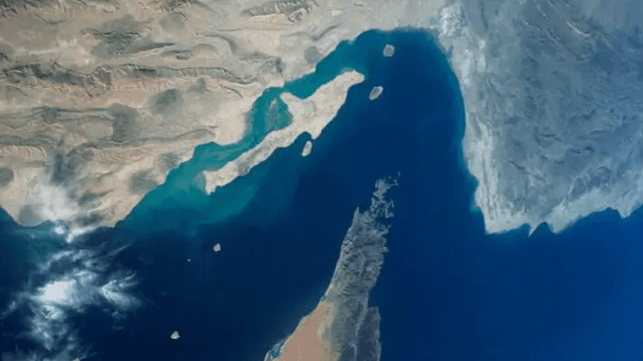
The situation in the Strait of Hormuz also figured prominently - especially the effects on seafarers trapped inside the Arabian Gulf. "The first objective is always to seafarers, to engage, so they can actually leave the conflict zone," said Dominguez.
Views on timing vary, but many owners appear confident that a ceasefire deal and a reopening of the waterway are within view. "I am quite optimistic that waiting for a couple of weeks or a month, a solution will be found," said leading Greek tanker owner Evangelos Marinakis hopefully.
Iran Demands an Israeli Ceasefire in Order to Continue Hormuz Peace Talks
The Strait of Hormuz remained largely closed on Monday, and the messaging from Iranian and American negotiators suggested a limited chance of an agreement in the immediate term. In the morning, Iran suggested it might stop reading messages from the Trump administration due to ongoing hostilities between Israel and Hezbollah in Lebanon, and President Donald Trump indicated that the U.S. might be just fine going "silent" for a while on talks. While the two sides contemplate a hiatus, the global oil supply remains curtailed by dueling blockades at Hormuz; the pace of global and U.S. petroleum reserve draws suggests that if the situation does not change, the physical oil market's ability to fend off price hikes may approach an end within months.
Early in the day, Iranian sources said that they had suspended peace talks with U.S. officials until such time as Israel agreed to limit its offensive against Iran-backed Hezbollah in southern Lebanon. Israel's military accelerated its campaign north of the Litani River over the weekend, angering Iran. "Given that Lebanon was part of the ceasefire preconditions, and now this ceasefire has been violated on all fronts, including Lebanon, the Iranian negotiating team is suspending 'discussions and exchanges of texts through intermediaries,'" reported semiofficial Iranian outlet Tasnim.
In addition, the official Islamic Republic of Iran Broadcasting network (IRIB) threatened that the ongoing Israeli offensive could jump-start Houthi anti-shipping operations in the Red Sea, long quiescent. "In the event of a ceasefire violation by Israel in Lebanon, the established order in the Strait of Hormuz will also prevail in the Bab al-Mandab," IRIB reported.
Following the Iranian warnings, Trump held a call with Israeli Prime Minister Benjamin Netanyahu and encouraged him to curtail operations in Lebanon, without apparent success. "There will be no troops going to Beirut, and any troops that are on their way, have already been turned back," Trump claimed in a post-meeting statement. However, Netanyahu signaled that Israeli operations would continue as circumstances required.
Sources familiar with the call told Axios - an outlet with close ties to the White House - that Trump reprimanded Netanyahu vigorously and profanely, reminding him of past personal favors and questioning his decision to advance so far into Lebanon.
Unusually, Trump also acknowledged a direct and "very good" call with Hezbollah, the designated terrorist organization that controls much of southern Lebanon and periodically harasses Israel with missile attacks. It is the first time in years that a U.S. president has openly communicated with the banned organization.
Despite his unprecedented efforts to obtain the preconditions demanded by Iran, Trump indicated that he was indifferent to the future of the conversation. "I don’t care if [the talks with Iran are] over, honestly. I really don’t care. I couldn’t care less. If they’re over, they’re over. If they’re not, you know, I think they took too much time. Frankly, I thought they started to get very boring," Trump told CNBC's Eamon Javers.
Notwithstanding the stalled state of talks, small amounts of traffic continue to trickle past the U.S. and Iranian blockades in the strait. The so-called Persian Gulf Strait Authority - a U.S.-sanctioned administrative body that handles transit payments and paperwork for the Islamic Revolutionary Guard Corps - said Monday that 300 vessels have submitted their applications to pass through the waterway to date. The Iranian agency claims that GCC states' shipping interests dominate the list of requests to enter the Gulf, led by the UAE, Iran's main local opponent (and target) in recent hostilities. The claims cannot be easily verified, and shipping interests have every reason to be circumspect about any interactions with the sanctioned agency.
On the southern side of the waterway, U.S. forces claim to have coordinated transits for about 70 vessels to date, and have directed Iran-linked tonnage to divert from course about 120 times. At present, U.S. forces are refraining from an on-the-water escort operation, but are providing remote assistance to neutral vessels that attempt to make the transit without Iranian permission.
U.S. Disables an Iran-Linked Tanker With a Hellfire Missile
Aftermath of a missile strike on Lexie's port quarter, in way of the engine room (Central Command)
U.S. forces have disabled another tanker near the Strait of Hormuz, according to U.S. Central Command, bringing the total tally to six vessels.
On June 2, Centcom forces observed the stateless tanker Lexie transiting towards Kharg Island, one of Iran's primary loading terminals for oil exports. Empty tankers provide the potential for Iran to extend its production capacity through floating storage, and Centcom has attempted to prevent this by blocking inbound traffic, with substantial success.
According to the command, U.S. forces repeatedly ordered Lexie's crew to halt their transit, but the tanker ignored the warnings for 24 hours. To bring the vessel to a stop, a U.S. aircraft launched a small Hellfire guided missile at the Lexie's engine room, disabling the vessel and preventing her from reaching Iran. As in several previous Centcom blockade-enforcement strikes, official video footage shows no sign that the tanker was making way towards a destination at the time of recorded impact.
It was the sixth Iran-linked ship that Centcom has disabled to date, and the strike adds to a series of exchanges of fire between U.S. and Iranian assets that have persisted over the past week. A ceasefire between the two sides remains in effect.
Lexie (also"Lexi," IMO 9203277) is a 300,000 dwt crude oil tanker built in 2001. She falsely claims to be registered with the flag state of Botswana, according to her Equasis record; the landlocked African nation does not have an international ship registry, but has been frequently used as a false flag by "shadow fleet" vessels like Lexie. The ship has a long history of false flagging, having previously claimed to be registered in the Comoros Islands and Samoa. She is sanctioned by the U.S. government for involvement with the Iranian oil trade and by Ukraine for involvement in the Russian oil trade.
AIS data provided by Pole Star Global shows that Lexie has spent much of the past three months operating in the dark, with her transponder likely turned off. When visible, she has been broadcasting a location at the northern end of the Gulf of Oman, near the Strait of Hormuz and Kharg Island. Her position was last received last week, on May 26.
Dali Civil Trial Delayed to Consider Legal Issue After Most Claims Settle
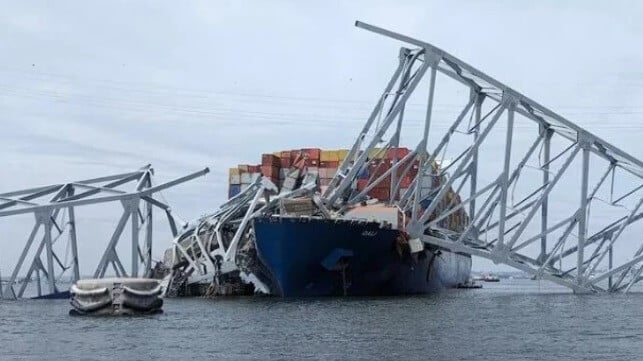
The civil trial related to the Dali was delayed indefinitely after most of the claims have been settled (Army Corps of Engineers photo)
The U.S. federal district court judge scheduled to hear opening arguments in the civil trial related to the containership Dali expressed frustration while agreeing to instead postpone the trial indefinitely. Most of the claims have now been settled, and all the remaining parties agreed to the delay, in part to consider a legal issue related to the remaining claims.
The owners of the Dali, Grace Ocean, and the manager of the vessel, Synergy Marine, made a last-minute motion on Saturday, May 30, to stay the civil proceedings, and Judge James Bredar ruled on Monday, June 1, to delay the trial instead of proceeding to opening arguments. He said that while it is typical to have last-minute settlements in civil trials, he still expressed general frustration for the court and the public after more than two years of legal process on the case that sought to test the ability of the companies to limit their civil liabilities.
The companies argued that all but 11 of the 54 initial claims filed in the civil case have been settled or voluntarily dismissed. They noted that all the wrongful death claims were settled, as well as the claims from the injured survivors. The court had denied a previous motion for a delay, saying it was time for the families to have their day in court. In addition, all but one cargo claim and one property damage claim (from the City of Baltimore) have been resolved.
Lawyers for the City and County of Baltimore agreed for different reasons that the trial should be delayed. They said a potential criminal conviction would change the remaining case as it would “conclusively demonstrate that petitioners (Grace Ocean and Synergy) cannot invoke the protection of the Limitation of Liability Act.”
Baltimore is claiming property damage for a water main that ran alongside the bridge and under the river that was damaged by the collapse. The remaining claims are economic loss claims.
At issue is a 1927 U.S. Supreme Court decision that bars economic loss recoveries caused by negligence unless there were also physical damages to properties. Most of the remaining claims cite economic losses due to the closure of the port and the loss of the bridge. The judge has given all the parties two weeks to file new motions on this issue. Judge Bredar expects the issue to be fully briefed by mid-July.
The largest of the settlements was a record $2.25 billion with the State of Maryland, as well as $100 million with the federal government. Terms of the settlements with the families have not been announced. Others, including the employer of the road crew working on the bridge, and cargo claims, such as one from Zim and MSC, have also been settled.
Synergy Marine and one of its port superintendents, however, were indicted by the federal government for issues related to the operation of the Dali. They are also facing charges of providing false information to the investigators, including the National Transportation Safety Board.
MSC Acquires Majority Stake in Ukrainian Terminal Operator
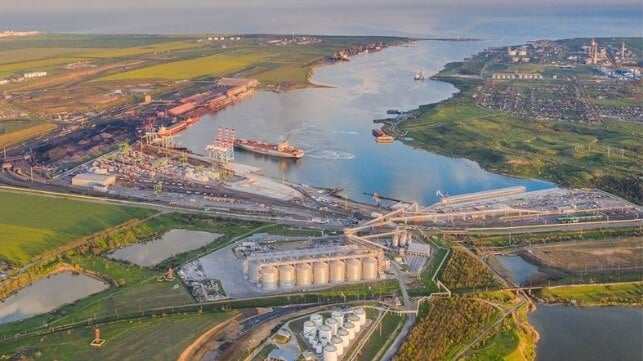
MSC is reported to have acquired a majority position in TIS, the operator Ukraine's Pivdennyi port near Odesa (TIS)
Media reports from Ukraine indicate that MSC Mediterranean Shipping Company has acquired a controlling stake (51 percent) in Ukrainian terminal operator TIS Group. Local industry executives are excited by the prospect of MSC’s investment, noting it would be the first time a major carrier has invested in Ukraine and that it will help to raise the operating standards in the country.
MSC Group is reported to have purchased the shares of TIS Group, replacing an earlier 51 percent investment by DP World. The Dubai-based company had, in March, sold its shares to the founders of TIS Group and exited Ukraine. The speculation was that the move was prompted by a deal between DP World and Russia’s Rosatom to develop shipping along Russia’s Northern Sea Route with FESCO. As part of the deal, TIS also regained control of the towing business, which had been operated as P&O Maritime Ukraine.
TIS (Transinvetservice) is reported to be the largest private terminal operator in Ukraine. It was founded in 1994, and before the war, the TIS terminal operation at Pivdennyi, the southern port in the Greater Odesa complex, handled over 30 million tons of cargo annually. It is reported to have accounted for 20 percent of the total cargo volume in Ukraine and to be the second-largest terminal in the Black Sea.
The port was purpose-built and is reported to have the deepest container terminal in Ukraine. It has specialized facilities for grain, bulk, and project cargo alongside containers and direct road and rail connections linking it to inland centers.
The acquisition of the shares by MSC would be subject to regulatory approval, as MSC also holds a large position in Germany’s HHLA, which owns a container terminal in Odesa. Experts note that, in addition to linking the two terminals, the deal also provides access to MSC’s network, including terminals in Treiste and Tallinn.
The move is the latest by MSC as it works to build out its terminal and logistics operations. Last year, it acquired a 50 percent interest in an intermodal logistics operator in Ukraine and a 25 percent interest in a cross-border terminal. Elsewhere in Europe, it has also been making terminal acquisitions, and it, of course, is the bidder behind the stalled deal to acquire CK Hutchison’s global network of terminals.
China’s COSCO JV with PTP Approved to Redevelop Spain’s Tarragona Port
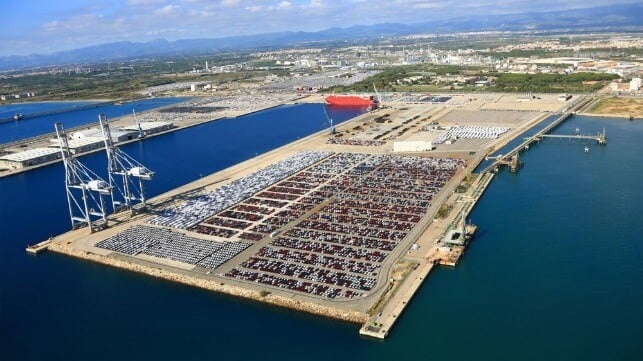
The approved plan calls for a 50-year concession for the development of a large new multipurpose terminal (Port Authority of Tarragona)
A newly formed joint venture between divisions of China COSCO and a Spanish company, PTP, was approved for a new concession and redevelopment of the Spanish Port of Tarragona. The deal, which includes a 50-year concession for port operations, comes as there is increasing scrutiny on Chinese efforts to expand global port operations.
Under the terms that were approved by the board of the Port Authority of Tarragona, the new JV will invest €116 million ($135 million) to redevelop the port, including a massive new terminal. The port authority justifies the 50-year concession, highlighting that the financial investment is far larger than envisioned in the plans for the port.
COSCO Shipping Ports and COSCO Bulk will form a company to hold 51 percent of the JV. The remaining 49 percent will be held by PTP Iberica, a Spanish subsidiary of the Argentine PTP Group. The awarding of the concession still requires the formation of the new operating company and the formalization of contracts following Spanish legislation.
The Port Authority says the plan will help the Port of Tarragona, which is located on the Mediterranean in northern Spain near Barcelona, to consolidate its strategic position. They predict that the port will develop as a regional logistics center in the Mediterranean, connected to both main international maritime routes, the Iberian Peninsula, and Europe’s inland centers.
“Not only are we recovering the container and expanding the general cargo and the movement of vehicles, but we will become one of the reference gateways in the Mediterranean for both traffic coming from China and the Far East and Latin America,” predicted the president of Port Tarragona, Santiago J. Castellà. He called the agreement “a historic moment for the Port.”
The concession includes over 510,000 square meters of area, which is the entire space available for the concession plus another 58,000 square meters belonging to the La Boella railway terminal. The plan calls for the development of a multipurpose terminal to handle containers, general merchandise, vehicles, and cold chain logistics, as well as auxiliary facilities and a maneuvering area.
The maximum capacity is estimated at 680,000 TEU equivalents, including both containers and general cargo. According to the business plan, they will grow traffic between 2027 and 2033 with a commitment to a minimum of 360,000 TEU equivalents starting in 2031. The majority must be containers with a minimum of 200,000 TEU annually, and the additional volume will come from general cargo.
Some political questions have been raised in Spain about awarding a long-term concession to a Chinese state company, but so far, it has not faced major opposition. This, however, comes as the sale of CK Hutchison’s global port terminal operations remains in question and political challenges continue in Panama. China’s development of the large Port of Chancay in Peru. COSCO is reported to have invested $1.3 billion in the port’s development, which was seen as a foothold in South America. It has created legal and political controversy in Peru, while the Trump administration continues to challenge China’s growing influence in global ports and port infrastructure, such as its dominance in large cargo cranes.
Diesel-Electric LNG Carriers Face Headwinds Under EU Emissions Rules
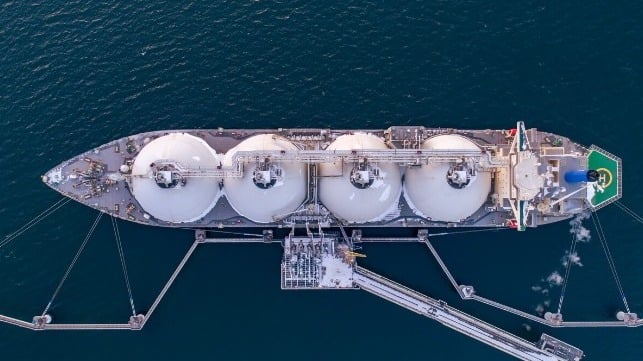
According to WoodMac, the fine details of climate policy are about to split the LNG carrier fleet into haves and have-nots. Aging steam turbine and diesel-electric vessels face increasing compliance costs because of their emissions, while modern ME-GI dual fuel ships (with low methane slip) are going to gain the upper hand as regulations get tighter.
Between the EU and the IMO, there are four different efficiency and emissions policy frameworks for shipping (plus one with an uncertain future): the EU ETS, FuelEU Maritime, and the IMO's CII and EEXI. The EU ETS is the most immediately impactful for LNG carrier operators because they emit methane, which was phased into ETS penalty coverage early this year. Methane slip is now billed at $75 per tonne of carbon equivalent for EU voyages (including EU components of international voyages, as defined in the rule).
Dual fuel diesel electric vessels will be significantly affected as the rules tighten further, Wood Mac reports. FuelEU Maritime is phasing in, bringing additional penalties and tightening fuel-reduction targets - at the far higher price of EUR645 per tonne.
"Owners who invested in DFDE vessels expecting them to be their compliance answer are facing a more uncomfortable reality," said Itzel Torruco, Research Analyst - LNG Freight, Wood Mackenzie. "Under EU rules from 2030, a DFDE ship on a European route faces penalties that make it commercially unattractive to charterers. The window to retrofit or exit is narrowing, and it has not yet been fully priced in."
DFDE technology entered service in the 2000s as a more efficient alternative to traditional steam plants, which were difficult to operate from a crewing perspective. Typical DFDE configurations use multiple medium-speed diesel engines that can run on boil-off gas or diesel, configured as generators to power electric final drives. Medium-speed four stroke diesels are generally less fuel-efficient than low-speed, two-stroke engines, and (historically) were prone to higher levels of methane slip than ME-GI designs; though modern medium-speeds have been much improved in this regard, DFDE propulsion is a legacy technology in the LNG carrier space, and the existing DFDE fleet runs on older engine designs.
This will be an increasing liability in Europe, a core market for the LNG carrier fleet. By 2030, the combined price of burning VLSFO in Europe will rise to more than $1250 per tonne, with equivalent pricing for equivalent emissions sources. This is high enough that DFDE vessels are likely to phase out of service by the mid-2030s, according to Wood Mac - but the trajectory could change if IMO adopts the NZF and the EU backs off of its regional regulations.
"If the IMO framework is adopted and the EU recognizes it as Paris-aligned, the compliance architecture operators have spent two years building could be simplified considerably," Torruco said. "If it fails, the overlap between EU ETS, FuelEU Maritime and the IMO framework becomes the permanent operating environment."
Trump Administration Invests in Removing Ocean Research Instruments
American mariners perform annual maintenance at the Station Papa array in the North Pacific, one of seven cabled sites that will be removed 15 years early (WHOI / Dee Emrich file image)
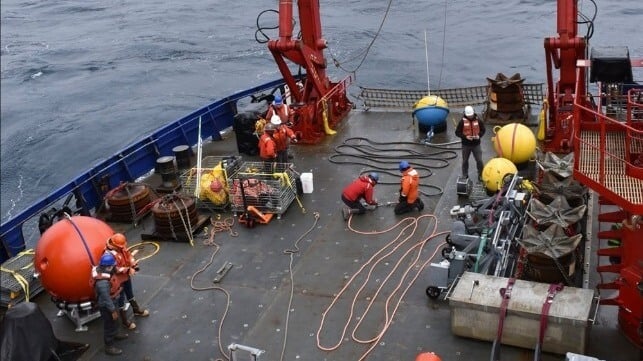
Moving the objectives of Project 2025 one step closer to completion, the National Science Foundation is removing 900 ocean data collecting buoys that cost more than $370 million to install. If left in place, the buoys would have continued to provide climate-related data to scientific researchers for another 15 years - an outcome that NSF's plan will prevent, saving taxpayers nearly $50 million per year. It will also unwind the decades of effort by American oceanographers, technicians and professional mariners who have installed and maintained the network. The Coastal Endurance Array off the Pacific Northwest is the first to go, and removal operations at that site are already in process, according to the Ocean Observatories Initiative (OOI).
Instead of abandoning the buoys and subsea landers in place, NSF will allocate ship-days to physically remove OOI equipment from far-flung locations around the globe, from the North Pacific to Greenland to the Southern Ocean, the New York Times reports.
"Over more than a decade, OOI has delivered the world’s most advanced continuously operating ocean observing systems, supporting science, engineering, education, and workforce development across the ocean sciences community. We are profoundly grateful for the extraordinary efforts of the scientists, engineers, operators, educators, students, and partners who made this facility possible and who continue to advance its legacy through the use of its data," said Jim Edson, the head scientist for the NSF Ocean Observatories Initiative in a statement.
The initiative to cease collection of climate-related ocean data aligns with the priorities of Project 2025's "Mandate for Leadership," a transition guide for the current administration. In 2024, the project's authors advised that the NOAA Office of Oceanic and Atmospheric Research (OAR) - a key customer of OOI ocean data, an adjacent enterprise through NOAA's U.S. Integrated Ocean Observing System (IOOS), and a funder of OOI host institution Woods Hole (WHOI) - was in the authors' view "the source of much of NOAA’s climate alarmism," and "the preponderance of its climate-change research should be disbanded."
This vision was partially realized over the course of the administration's first year. NOAA shed about 20 percent of its workforce through layoffs in the first 12 months, with cuts concentrated at OAR. The administration's first budget, written by Project 2025 co-author and current White House Office of Management and Budget director Russell Vought, would have seen OAR "eliminated as a line office," ended OAR's 16 scientific cooperation agreements with 80 different research universities, and folded the rest of its work into other departments. Congress declined to enact this proposal and funded OAR at $630 million for FY2026.
Seven-State Coalition Sues to Block Trump’s Buyout of Offshore Wind Leases
Six states are challenging the agreement to buyout TotalEnergies' US offshore wind leases (file photo)
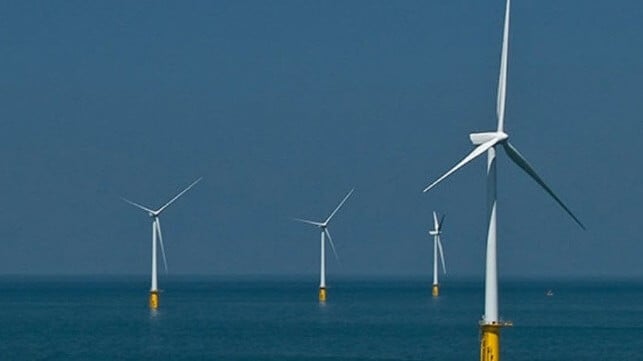
A coalition of seven northeastern states is suing the Trump administration, seeking to block a deal struck by the Department of the Interior to buy back offshore wind leases from TotalEnergies in exchange for investments in oil and gas projects in the United States. Led by New York Attorney General Letitia James, a vocal critic of Donald Trump and the administration, they are asserting that the deal with TotalEnergies is “blatantly unlawful,” jeopardizing the state’s ability to meet growing energy demands and renewable energy goals, as well as the economies of the states.
The coalition consists of New York, New Jersey, Connecticut, Massachusetts, Rhode Island, Vermont, and Maine. Asserting the deal with TotalEnergies is an “unlawful agreement,” the states are asking the courts to strike down the agreement, vacate the lease cancellation, and stop further actions by the administration to implement the deal. It comes after a group of 18 states and the District of Columbia won a previous suit, with the courts blocking actions by the Trump administration to indefinitely stop the review of project proposals for wind farms.
“This pay-not-to-play scheme pressuring a foreign company to forego planned offshore wind projects in America in favor of gas and oil drilling is an outrageous abuse of taxpayer dollars that hurts our ability to meet our energy needs, create good jobs, and help secure American energy independence while reducing emissions,” said New York Governor Kathy Hochul.
The Department of the Interior announced in March that it had entered into an agreement with Attentive Energy, a subsidiary of TotalEnergies, to repay the company the monies it had spent to buy leases off New York, New Jersey, and North Carolina. It had paid nearly $1 billion in winning bids in the New York Bight auction and a smaller auction for a property off North Carolina. The administration agreed to repay the lease values in exchange for the company investing similar amounts in the oil and gas projects on the Gulf Coast, canceling the offshore wind leases, and agreeing not to develop future U.S. wind energy projects.
James, who has already been the target of Trump’s retribution for her prosecution of the Trump Organization, said today, “After repeatedly losing in court, this administration cooked up a sham deal to pay a foreign energy company hundreds of millions of taxpayer dollars to abandon offshore wind and invest in oil and gas instead. We are fighting back to stop this illegal agreement.”
The coalition asserts that the cancellation of the Attentive Energy projects will harm their states’ economies, energy grids, and climate goals. The attorneys general argue that the Trump administration’s deal violated the Outer Continental Shelf Lands Act, which limits DOI’s ability to cancel offshore wind leases. The DOI must hold a hearing, they assert, specifically find that continuing the lease would likely cause serious harm to life, property, national security, or the environment, and determine that the benefits of cancellation outweigh the benefits of allowing the lease to continue. The DOI did none of that before canceling the Attentive Energy lease. The coalition also argues that the deal violates the Judgment Fund Act because the $795 million payment was not a legitimate compromise settlement in an imminent lawsuit, but rather an arrangement to satisfy the administration’s goals.
Others have also questioned how the administration would pay for this agreement and a second one reached with Ocean Winds, a global developer of offshore wind projects, which is a 50-50 joint venture between Engie and Portugal’s EDP Renewables.
The CEO of TotalEnergies has defended the deal, highlighting the change in policies in the United States and the at-risk investments of the company. He said forfeiting nearly $1 billion was unacceptable to the company and that the monies being returned to the company are “our money.”
Attentive Energy had proposed offshore energy projects to New York and New Jersey and submitted plans to the Department of the Interior and Bureau of Ocean Energy Management for review and approval. The first project would supply power to New York and the second to New Jersey, while plans for the North Carolina project were still in the development stage.
The other attorneys general highlight the regional impact of the cancellation of the projects. Massachusetts, for example, notes it routinely imports energy from New York to serve its growing energy demand. From January to April 2026, New England imported about seven percent of its energy load from New York.
Mapping carbon from ABoVE
Rapid warming in Arctic and boreal regions may transform forests and tundra from carbon sinks into carbon sources. Two University of Utah-led studies improve biomass mapping to assess whether northern ecosystems will mitigate or accelerate climate change
In the far north regions of Earth, where forests stretch across Alaska and Canada, climate change is unfolding at an accelerated pace. Arctic and boreal regions are warming up to four times faster than the global average, putting immense pressure on ecosystems that absorb enormous amounts of CO2 and help slow climate change. Through photosynthesis, vast expanses of vegetation naturally pull carbon from the atmosphere and sequester it in their biomass.
As climate-related disturbances like wildfires and drought intensify, parts of the region may shift from carbon sinks to carbon sources, disrupting the delicate global carbon balance. Understanding exactly how much carbon these ecosystems store or release through their biomass is important for climate mitigation efforts but getting accurate measurements is a challenge.
Two new papers aim to improve how scientists measure biomass across Arctic and boreal zones. Led by University of Utah biologists Wanwan Liang and Jon Wang, one reveals inconsistencies among widely used satellite-based datasets, and the other introduces a new biomass map that captures 40 years of ecological change in unprecedented detail.
The research emerged from the Arctic-Boreal Vulnerability Experiment (ABoVE), a NASA-funded, 15-year field research campaign to understand ecosystem change in northern high latitudes.
Making sense of remote sensing
The first study, published in Environmental Research Letters in March 2026, examines the growing number of satellite-based datasets used to map landscapes across Arctic and boreal North America.
“There are so many datasets out there now, but there’s very little guidance for users on how to choose among them,” explained Liang, U postdoctoral researcher and the study’s lead author.
One major contributor to dataset abundance is the rapid advances in remote sensing technology. Satellites continuously capture images of Earth’s surface, and scientists use those data, combined with field measurements, to estimate forest structure, growth and carbon storage.
As the number of datasets has grown, so has confusion about their accuracy and intended use. Different maps often produce different answers, depending on their design, data sources and landscape coverage.
“Two maps can give completely different estimates for the same region and if you’re not an expert, it’s really hard to know which one to trust,” said Wang, assistant professor in the U’s School of Biological Sciences and the study’s principal investigator.
To address that problem, Liang and her collaborators conducted a large-scale meta-analysis, comparing nine biomass datasets across North America’s Arctic and boreal regions. Rather than declaring a single “best” map, the study identifies which datasets are most reliable for specific uses, from tracking wildfire impacts to estimating national carbon budgets.
“It’s more like a guide,” Wang said. “Different maps are better for different purposes.”
Size of a baseball diamond
Liang also led the development of a new biomass dataset, one of the most detailed of its kind. Built using satellite imagery from the NASA/USGS Landsat Program, airborne LiDAR measurements and extensive forest inventory data from the U.S. and Canadian Forest Services, the dataset tracks aboveground biomass annually across nearly four decades. The dataset is described in a paper published in the journal Remote Sensing of Environment on April 30, 2026.
Spanning from 1984 to the present, the map captures changes at a resolution of 30 meters, roughly the size of a baseball diamond. That level of detail allows researchers to detect not only large disturbances like wildfires, but also smaller-scale changes such as logging or land conversion.
“Anything happening at 30 meters or larger, we can detect,” Liang said.
The dataset provides a powerful new lens for understanding how northern ecosystems are responding to climate change. By tracking where biomass is increasing or decreasing, scientists can identify the forces driving those changes, be it drought, fire, human activity, warming temperatures or rising atmospheric CO2 concentrations.
This matters because Arctic and boreal forests are potential buffers against climate change. As temperatures rise, scientists have hypothesized that these ecosystems could absorb more carbon, helping offset emissions from fossil fuels. But the reality is far more complex.
“There’s been this idea that northern forests will just keep taking up more carbon as it gets warmer,” Wang said. “But we don’t actually know if that’s true.”
The same warming that can stimulate plant growth can also increase wildfire frequency and intensity, insect outbreaks and drought stress—factors that boost forest mortality and release carbon back into the atmosphere.
“If plants start to die, they stop absorbing carbon,” Liang explained. “And as they decompose, they release CO₂. That would accelerate climate change.”
The uncertainty has real-world implications. Governments rely on carbon estimates to inform climate policy and report greenhouse gas inventories. In Canada, for example, national carbon accounting influences how emissions targets are set and evaluated.
“When different datasets give different answers, it creates a lot of uncertainty,” Wang said. “And that makes decision-making harder.”
Beyond policy, high-resolution biomass maps can help estimate how much carbon might be lost in a fire, identify high-risk areas and guide land-use decisions.
In contrast to some private-sector efforts that restrict access to carbon data, Liang and Wang’s project aims to make information transparent and usable for scientists, policymakers and the public.
“This is taxpayer-funded science,” Wang said. “We want people to be able to use it.”