Wednesday, June 03, 2026

Why Trump Blinked on Iran

Source: Originally published by Z. Feel free to share widely.

Donald Trump did not suddenly become a dove. He did not wake up one morning converted to the wisdom of Quincy Adams, George Kennan, or the old conservative suspicion of crusading wars. When he paused another planned attack on Iran, the public explanation was diplomatic: Qatar, Saudi Arabia, and the United Arab Emirates had urged restraint; Pakistan had carried a proposal; talks had become serious enough to justify delay. That explanation is true as far as it goes. It is not enough.

The deeper story is that Washington’s military calculus has changed. The old assumption—that Iran could be bombed, contained, humiliated, and then brought quietly to the table—has met the hard surface of reality. American power remains immense. But immensity is not the same as usability. A superpower can destroy a great deal and still fail to produce a political result worth the price.

That is what the Iran crisis has exposed. Trump’s hesitation was not merely a bow to Arab pressure. It was an admission, however reluctant, that another round of strikes might not restore deterrence at all. It might accelerate the very erosion of deterrence that the war was supposed to prevent.

The Pentagon’s problem is no longer simply target selection. It is predictability, exhaustion, and escalation. Open-source military tracking has shown how much of America’s naval, bomber, tanker, and missile-defense capacity has been drawn into Operation Epic Fury. Defense assessments have also raised questions about depleted U.S. interceptor stocks and the burden Washington has carried in defending Israel from Iranian missile fire. These are not the markers of a cheap war. They are the markers of a war consuming the machinery needed for other theaters for those who subscribe to “peace through strength,” even though nonviolent civil society can also carry deterrent power–or the Finnish deterrence of a combination of some military and a committed citizenry to noncoöperation with any invaders, an approach they term the “indigestible hedgehog.”

Iran, meanwhile, has not responded like the brittle adversary imagined in Washington seminar rooms. Its commanders have warned against renewed aggression, its forces remain on alert, and its defensive posture appears more adapted than at the beginning of the conflict. The relevant point is not that Iran can defeat the United States in a conventional contest. It cannot. The point is that Iran does not need to defeat America outright to make the next strike politically and strategically self-defeating.

That distinction is often lost in Washington. A bombing campaign can destroy facilities. It can kill commanders. It can announce resolve on television. But it cannot, by itself, compel surrender from a nation that believes survival is at stake. Even analysts skeptical of Tehran have noted that suppressing air defenses and striking leaders does not answer the central political question: how does military punishment become a durable settlement?

The answer, so far, is that it does not. Instead, the war has widened the bill. It has shaken energy markets and trade through the Strait of Hormuz. It has forced NATO discussions about what happens if the waterway remains unstable. It has driven gasoline anxieties into American households. It has placed U.S. troops, ships, and bases under constant threat. This is not strategic dominance. It is strategic entanglement.

For conservatives, the lesson should be obvious. A foreign policy worthy of the name must begin with American interests, not with the emotional needs of allies, donors, think-tank panels, or television generals. The American Conservative has long argued that America First must mean judging policy by America’s concrete national interest, not by abstractions or inherited commitments. By that standard, the Iran war is failing.

It is failing because the president has not explained the end state. It is failing because most Americans have disapproved of the military action. It is failing because two-thirds have favored ending U.S. involvement quickly, even without achieving every stated goal. And it is failing because Congress is now struggling to reassert its constitutional role after another president treated war powers as a personal instrument.

Trump’s defenders will say he paused because he is a dealmaker. Perhaps. But a deal reached after escalation is not proof that escalation was wise. It may be proof that escalation created dangers too large to ignore. If the administration now accepts diplomacy, sanctions relief, maritime de-escalation, and nuclear monitoring as the real path forward, then the obvious question is why American forces had to bleed readiness, spend scarce munitions, and risk a regional firestorm to arrive there.

The hawks will call restraint weakness. They always do. They called Iraq winnable, Afghanistan sustainable, Libya humanitarian, Vietnam an easy victory, and Syria manageable. Their record should disqualify them from lecturing anyone about strength. Real strength is not the refusal to reconsider a bad course. Real strength is the ability to stop before pride turns a mistake into a catastrophe.

Iran has not been made more submissive by pressure. It has been made harder, more prepared, and more determined. That may offend Washington’s sense of hierarchy, but it is the strategic reality. Another attack would not simply test Iran. It would test America’s ability to absorb a longer war, higher energy prices, weaker readiness in Asia, greater danger to U.S. forces, and deeper public distrust at home.

Trump stepped back because the next step looked less like victory than attrition. He should keep stepping back. The United States does not need another demonstration of airpower. It needs an exit from the logic that made airpower seem like a substitute for policy. Diplomacy is not a gift to Tehran. It is a rescue operation for Washington’s own overstretched strategy.

A conservative president should not ask how to bomb Iran again. He should ask why America is still paying for the fantasy that bombing can make the Middle East obey.

Sophia Gonzalez, syndicated by PeaceVoice, is an American political analyst focusing on U.S. strategy, Middle East affairs, and global security. She writes to challenge interventionism and promote diplomacy.


Source: Africa is a Country

The East German secret police kept a file on Michael Jackson. He performed near the Berlin Wall in June 1988, and the preparations for his arrival were elaborate. A memo dated May 4, 1988, recorded negotiations between East German officials and the West German concert promoter—names redacted—regarding stage height and speaker placement, specifically to minimize what could be heard or seen from Unter den Linden on the eastern side of the Gate. There was also a contingency plan: The concert would be broadcast from an East Berlin stadium with a two-minute delay, giving authorities a window to swap in archival footage if Jackson said anything political that might incite fans to riot. One report warned that young people were “prepared to go to any lengths” to hear the concert from near the Brandenburg Gate (near the Wall) and that the confrontations were meant to probe how far the security apparatus could be pushed. Coca-Cola sponsored the concert and was more than willing to meet the East German government’s demands.

It is unclear whether Jackson knew about these negotiations, but approximately 5,000 people gathered on the eastern side of the wall, hoping to hear the concert. Historian and Berlin-based translator Dr. Alan Nothnagle describes the confrontation:

We noticed “inconspicuous” men in civilian clothes, slouching on street corners in groups of three, eyeing the passers-by. The reason was no secret: somehow, everyone knew that Michael Jackson was giving a concert in front of the Reichstag that evening, just a few hundred meters from where we were standing. Hundreds, soon thousands of young people congregated to hear the music. The Stasi agents also multiplied . . . We never heard a note of music that night, but soon voices arose in the crowd calling “The Wall must go!” and “Gorbachev! Gorbachev!” Now the plainclothes Stasi men came alive. They hurled the young people to the ground, shouting, “What did you say? What did you say?” and hauled them off by the collar into side streets where police vans were waiting to bundle them off to Stasi headquarters.

The Guardian stated the violent crackdown was prompted because “the Stasi considered Jackson, like most western pop stars, to be a subversive influence on its youth.” They weren’t the only ones paying attention. And that’s the point of departure for this essay: the gap between who Michael Jackson was and who the various institutional actors in his life—the estate, the press, the critical establishment—have required him to be.

Antoine Fuqua’s estate-approved biopic Michael opened to $217 million globally, setting records in 82 territories, and has continued to dominate globally, reaching $710 million and still climbing. It broke opening records in Brazil for a major studio biopic, earned a 9.6 rating on China’s Maoyan, and drew audiences in Peru, the Netherlands, and Italy in numbers that surpassed every musical biopic before it. Critics gave it 39 percent. Audiences gave it 97 percent. The Guardian dismissed fans as people who want to live in a fantasy. The critical consensus settled around familiar complaints: cowardly, cursed, a plastic jukebox picture.

The question isn’t whether the film is honest, because it isn’t. The more interesting question is what the estate, the critics, and the broader cultural apparatus are so consistently invested in not showing us?

The film opens with real force. “Wanna Be Startin’ Somethin’” builds under the Lionsgate logo, loud and insistent. The camera starts at the feet: silver belt loops, the “Bad”-era silhouette. Then it cuts to Gary, Indiana, and a small boy who cannot meet his father’s eyes. At its core, Michael tells a familiar Hollywood story: poor Black kids from Indiana, raised by a brutal father and possessed of a musical gift so singular it seems almost unreal, who build something the industry machine cannot contain.

There is nothing wrong with that story. It is true and moving, and Fuqua directs it with skill. Jaafar Jackson’s physical performance is extraordinary—the precision of the moonwalk, the forward lean, the way he holds a note as if testing how much tension it can carry before it breaks. The music lands every time.

For fans and non-fans alike, for anyone who wants spectacle, nostalgia, and the collective pleasure of hearing these songs in a theater full of people who know every word, the film works. But it is also the only story the estate is willing to authorize, and that is not a neutral decision.

It is the same logic Berry Gordy used to build Motown: Leave your politics at the door, and make Black music legible and palatable to white America. When Marvin Gaye recorded “What’s Going On” in 1970–71—an album about Vietnam, police violence, and the conditions of Black life—Gordy initially refused to release it. He called it the worst thing he’d ever heard. He was wrong, of course, but the instinct is worth sitting with: The first response to a Black artist making explicitly political work was suppression. The estate that produced this film is making the same choice, at a greater remove and with better production values. 

The result is a biopic that tells you everything about Michael Jackson’s ascent and almost nothing about the man who made it. The film returns to his illustrated copy of Peter Pan so often that it becomes a thesis. After his death, a 1911 first edition was supposed to be auctioned from his estate—a real artifact of his reading life. What the film never shows are the books Jackson himself referenced throughout his life: works on civil rights, on Martin Luther King Jr., on Malcolm X. He described studying them seriously, as someone who understood exactly what it meant to be a Black man with his kind of reach. A Michael Jackson who reads Malcolm X is a Michael Jackson with politics, and a Michael Jackson with politics requires his audience to confront histories that remain unresolved. The estate knows this, and this film is the solution.

After a pyrotechnics malfunction during the filming of a 1984 Pepsi commercial, which set Jackson’s hair alight and put him in the hospital, the film gives him a spiritual epiphany: His purpose is to heal the world. It’s a moving scene. It’s also the estate’s thesis statement—not a Black man navigating a racist industry, but a universal figure, raceless, politics-free, and globally marketable.

That choice has consequences. The film covers 1966 to 1988, the estate’s chosen time frame, and within those 22 years, there is a documented political record it had full access to and chose to exclude.

The Jacksons were not entirely manageable, even within the Motown machine. Jackson wrote about it himself in Moonwalk. When a reporter asked the brothers about the Black Power Movement, a Motown representative answered for them: They did not think about that, he said, because they were a commercial product. Jackson recalled: “It sounded weird, but we winked and gave the power salute when we left.” A small act of refusal. The machine said these young men had no politics, but they tried to signal otherwise.

In 1969, the Jackson 5 returned to Gary for a concert and were photographed with Mayor Richard Hatcher, giving the Black Power salute. Michael was eleven years old, his fist raised. That photograph exists. It is not in the film.

In 1974, at 16, he stood at Gorée Island in Senegal—the departure point for enslaved Africans taken to the Americas—and wept. He received an award from the Organization for African Unity and said, standing on African soil for the first time, “This is where I come from.” That moment is documented, and once again, it is not in the film. Instead, the film shows Michael speaking to his pet rat about animals on the Serengeti. This is the film’s Africa: a nature documentary filtered through the imagination of a lonely child. Not the Africa he stood on, which was the Africa that moved him to tears.

The MTV confrontation is the film’s most revealing sequence. In the early 1980s, MTV largely excluded Black artists and focused on white rock acts, which meant it initially refused to air Michael Jackson’s “Billie Jean” video despite his commercial success. When CBS—Jackson’s label—threatened to pull its roster unless the network played Black artists, Jackson said: “I won’t be shoved to the back of the bus by anyone,” invoking Rosa Parks. At that moment, he explicitly named the structure: MTV had built its brand on the exclusion of Black music, a resegregation of popular culture at the very moment “Thriller” was reshaping the industry.

The film gives you the statement. Then, CBS president Walter Yetnikoff picks up the phone, and it becomes a contract negotiation. This is the epitome of the film’s method: Take the political and make it personal, take the systemic and make it individual, take a civil rights confrontation and repackage it as a business deal.

In 1984, during the Victory Tour, the Jacksons co-chaired the NAACP’s national voter registration drive, with booths outside stadiums. In 1985, he purchased the ATV music catalog for $47.5 million, including the Lennon-McCartney catalog, and became an economic force the industry had not anticipated. That same year, he recorded “We Are the World,” raising $63 million for famine relief in Africa. The film omits all of it. What it shows instead is a boy watching other children play through a window. A boy reading Peter Pan. A boy who becomes a man whose purpose is to spread love and joy.

That image requires a specific erasure, and it is not the one the critics are focused on. The film was supposed to begin in 1993, with the arrival of police at Neverland Ranch. But something else happened in 1993. In September, on a return flight from Tel Aviv—where he had performed two concerts days after the signing of the ill-fated Oslo Accords—Jackson took a sheet of British Airways Concorde stationery and wrote a song titled “Palestine, Don’t Cry.” The lyrics, “Bomb shells are flying. . . .  see the children crying,” were later offered at auction. During that visit, he had spent time with both Jewish and Arab children in hospitals, and a United Press International report from the time describes Palestinian children in keffiyehs at his concert.

His only concert in an Arabic-speaking country, Tunis in October 1996, sits largely outside his official legacy. After his acquittal in 2005, he did not go to London or Los Angeles, but to Bahrain, then Dubai. A man who had just survived the most public trial of his life chose the Middle East as a place of recovery. On MBC, the pan‑Arab satellite network, responding to a child’s question about Arabs, he answered with warmth and clarity. Western media paid little attention.

When people respond to this record with “Let him rest in peace” or “He wasn’t political,” they are demonstrating exactly what the film accomplishes. They watch two hours of his life and come away believing he had no politics, which is the intended outcome. The same depoliticizing editorial logic that turns Gary, Indiana, into a backdrop and the NAACP voter drive into an omission also obscures his Middle Eastern solidarities.

The estate is not alone in this. The critics angry at this film want the allegations on screen—the original third act that dramatized the 1993 abuse case and was then scrapped when producers discovered that a settlement barred any depiction of the accuser. The studio spent $10 to $15 million and 22 days on reshoots to build a new ending around that legal constraint. What many now describe as cowardice is, in part, prosaic litigation. Nonetheless, in their focus on what the film omits about the allegations, they have little to say about what it omits about Jackson’s politics, his civil rights engagements, or his international solidarities—they identify one erasure and miss the other, because they are not looking for it.

The comparison with Elvis makes the asymmetry clear. A white artist with a documented relationship with a 14-year-old is rewarded with eight Academy Award nominations. A Black artist whose alleged crimes remain legally contested and who was acquitted at trial is met with moral condemnation. That disparity is not explained by artistic merit. It has a racial dimension that the critical establishment has never been asked to explain.

To understand why, you need a history that the critics are equally reluctant to name. In 1967, the FBI issued an explicit directive under COINTELPRO to prevent “the rise of a messiah who could unify and electrify” and to discredit leaders before their politics could take hold. Malcolm X was surveilled and assassinated—Jackson was six. Martin Luther King Jr. was declared “the most dangerous Negro in the future of this nation,” subjected to wiretapping and sexual smears, sent anonymous letters urging suicide, then killed—Jackson was nine. Fred Hampton was shot in his bed, 35 miles from Gary—Jackson was 11. The mechanism was consistent: Destroy the person before the politics can spread.

The FBI did not need to open a political file on Michael Jackson. By the time it reached him, the mechanism COINTELPRO perfected had been absorbed into the infrastructure of American media. You no longer needed a government program. You needed a tabloid, a prosecutor with a vendetta, and a critical establishment willing to reduce a man’s entire legacy to the most sensational question about his life.

The American critical establishment cannot explain the global box office numbers for Michael without acknowledging something it has long resisted—that his music carried political meaning, that his reach unsettled established hierarchies, and that the version of him the film refuses to show was real.

In Brazil, where Jackson filmed “They Don’t Care About Us” in a Rio favela, the film broke box office records. The Hindustan Times gave it four stars. These audiences did not need a critic to interpret what they were seeing. They recognized something the official narrative works hard to obscure, and the music had already done the interpretive work.

“They Don’t Care About Us” was sung at an ICE detention protest in Broadview, Illinois, in 2025. “Earth Song” continues to circulate at climate demonstrations across Europe. His music moves through public space with political weight that neither the estate nor the critics can fully contain, which is not how fairy tales function. It is how political work persists.

Members of Jackson’s own family have distanced themselves from the film. His daughter has called it dishonest. His sister declined to participate. Even within the production, tensions surfaced—Jermaine Jackson, an executive producer whose son stars in the film, reportedly framed its reception in terms of momentum rather than accuracy. A wave, he called it, not a verdict.

The film ends with his face, finally visible. The screen cuts to black: His story continues.

It does. In 1988, they wanted to delay the broadcast in case he said something they could not control. The same instinct runs through this film, through its critics, and through the estate that produced it—the persistent fear that the full version of Michael Jackson might say something that cannot be taken back.

The estate buries him under Peter Pan. The critics bury him under the allegations. The film does both simultaneously, wrapping the erasure in music so extraordinary you barely notice what isn’t there. 


This article was originally published by Africa is a Country; please consider supporting the original publication, and read the original version at the link above.Email
Sherry Zane is a historian, cultural critic, and public scholar.

Book Q&A “No Bosses: A New Economy for a Better World”

Source: Originally published by Z. Feel free to share widely.

Not long ago, I received a request for short answers to some questions meant to prod discussion in a reading group about the book No Bosses. I sent back answers and don’t know what became of them. Perhaps they will be more generally useful. The “back story” is that  for some weeks I had been getting roughly an invitation every other day to some kind of promotion deal/arrangement for the book. This was part of a new cottage industry. Survey Amazon and find titles, new or old, to make such offers about. The first one I got was ostensibly from Oprah Winfrey. Obviously a scam. From there on the efforts got smarter.

Before long, they were writing as participants in, and then founders of book clubs, or then as presidents of promotion agencies, and in one case as the head of the promotion division of Scribners I think it was, a big publishing house. The people existed. Had the roles attributed. But the sender wasn’t them. There were a few versions of this scam but as best I could tell, all used AI to get a grip on the material in the subject book and even on elements of the life of the author. This enabled the invitations to be informed and sound plausible. The communications were very similar. In each case, the idea was to hook in the author, hoping for wider distribution, all without mentioning fees, until the target was sufficiently invested, when the scammer would mention the greater gains to be had if one would just send a fee to cover the costs.

At any rate, in one case, the approach was to get me to do an email interview preparatory to doing a live presentation and q/a for a book club, the latter after the fee of course. So I said, in this one case, sure send the questions. I am always game for an interview. I did it, returned it, suggested some ways the scam was transparent, and noted I wouldn’t be sending any money any time, and then then unsurprisingly nothing further happened. Be aware. I hate to say suspect everything, but it scam-itis does seem to have grown so ubiquitous that it may be good advice. The questions were good, however, I thought, so here is what emerged as an interview.


Why did you feel it was necessary to write No Bosses when you did? What gap or problem did you see in existing conversations about economics, work, and power that this book was meant to address?

People who seek a better society need economic vision to overcome cynicism and to orient activism. So when I write about vision, the gaps or problems that I hope to address are that when asked “what do you want that is better than capitalism,” activists rarely have much to say. And when they do answer that question, their vision violates worthy values people aspire to or it so vague that it is summarily ignored or even ridiculed. We need more and better vision.

No Bosses presents a vision that goes beyond critique and toward an alternative. For readers encountering these ideas for the first time, what makes this vision worthy of serious consideration?

First, I would say that No Bosses presents and explores key core values that a good economy should foster and fulfill, in this case empathetic solidarity, broad diversity, real equity, collective self management, and life enhancing ecological stewardship, or, in sum, if you like, classlessness. 

Second, because they each unrelentingly violate those values, No Bosses rejects private ownership of productive assets; rejects owners or bosses monopolizing decision making; rejects earning income for profits or for what you have the power to take or even for the value of your personal output; rejects a division of labor that elevates a few but subordinates most; and rejects both markets and central planning for allocation. In other words it rejects the defining features of capitalism by demonstrating how they all run roughshod over desired values.

And third, mostly, No Bosses proposes new institutions to replace those it rejects. They are a productive commons; collective self management by nested workers and consumers councils; income exclusively for how long and how hard and the onerousness of our socially valued work; a division of labor that balances jobs for their empowerment effects; and participatory planning for allocation. In other words it proposes a post capitalist economy with defining features that accomplish necessary functions even as they fulfill our sought values.

All that is a mouthful, but the point is, No Bosses presents and explains how new institutions would accomplish production, consumption, and allocation in accord with our highest aspirations.

Many people are skeptical of large-scale alternatives to existing economic systems. What assumptions or habits of thinking do you believe most often prevent people from imagining or attempting something different?

Popular skepticism of alternatives is historically undeniably warranted. After all, past efforts to transcend capitalism have most often either failed to be viable, or have brought on new conditions that were as bad or worse than what was left behind. 

But the problem of imagining desirable vision is overwhelmingly not a matter of technical difficulty. To comprehend the economic thinking in No Bosses is well within range for everyone who works and consumes in existing economies. What makes imagining a better world difficult is not intrinsic complexity but the manner in which prior learning and experience imprint on us a persistent belief that humans can’t do better which is summarized by Margaret Thatcher’s claim that “There is no alternative.” 

Constrained by that imposed belief, we tend to think about economics, if at all, only presupposing economies as we know them. We imagine only policy tweaks to reduce faults here or there. We hesitate to propose desirable values. We don’t even try to conceive new institutions able to fulfill desirable values.

Accompanying that baseline obstacle, there is also understandable fear that to question what is considered unavoidable will brand one as crazy, naive, deluded, or dangerous. To do so may not only clash with one’s prior views but even with one’s identity or the identities of one’s family or friends. To avoid friction, we turn off our imaginations and curb our desires. 

In place of that acquiescence, No Bosses tries to facilitate imagining alternatives—but not only in the hypothetical sense. It hopes to incite and empower that we imagine and elucidate not just to tell a rousing story, but for realistic implementation.

For someone who has not yet read the book, what are the most important questions you hope No Bosses prompts them to ask, even before they agree or disagree with its conclusions?

Why when we are told there is no alternative, do we accept it as gospel? 

Am I as greedy, pushy, and callous as I am constantly told everyone is, and are these traits our true selves or due to external pressures? 

What institutions around us subvert our best potentials to instead impose the twin ills of domination and submission? 

And then, finally, mainly, what new institutions could do better and what can I do to help make them real?

[You can buy No Bosses from here.]Email

avatar

Michael Albert`s radicalization occurred during the 1960s. His political involvements, starting then and continuing to the present, have ranged from local, regional, and national organizing projects and campaigns to co-founding South End Press, Z Magazine, the Z Media Institute, and ZNet, and to working on all these projects, writing for various publications and publishers, giving public talks, etc. His personal interests, outside the political realm, focus on general science reading (with an emphasis on physics, math, and matters of evolution and cognitive science), computers, mystery and thriller/adventure novels, sea kayaking, and the more sedentary but no less challenging game of GO. Albert is the author of 21 books which include: No Bosses: A New Economy for a Better World; Fanfare for the Future; Remembering Tomorrow; Realizing Hope; and Parecon: Life After Capitalism. Michael is currently host of the podcast Revolution Z and is a Friend of ZNetwork.

The Ebola Crisis: The Inconvenient Truths

Source: Originally published by Z. Feel free to share widely.

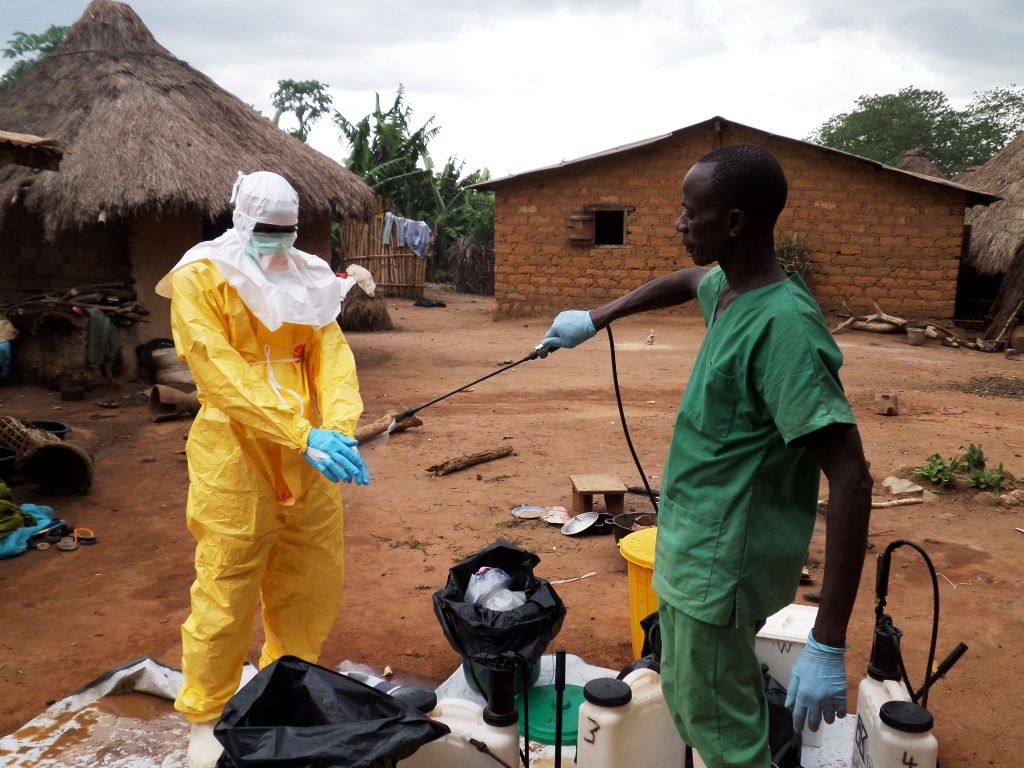
On Saturday, WHO Director-General Tedros Adhanom Ghebreyesus visited eastern Congo’s Bunia, a city at the heart of the Ebola outbreak, where the virus is spreading faster than the response.

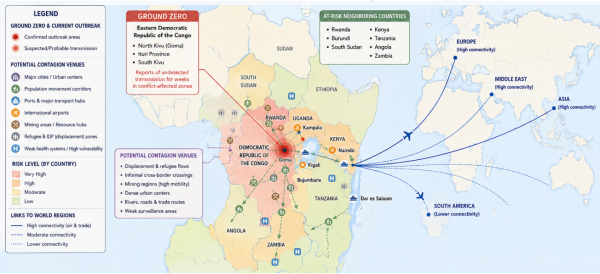
The crisis is centered in eastern Democratic Republic of the Congo (DRC), with spillovers into Uganda and rising concern across neighboring states. Official numbers remain uncertain because surveillance systems in conflict zones are incomplete. 

The outbreak circulated undetected for weeks, perhaps longer, before full recognition. By the time authorities moved aggressively, transmission chains may have spread across borders, refugee corridors and informal trade networks.

Why this Ebola crisis is different

The danger does not lie primarily in the current number of cases, which remain far below the scale of COVID-19 or even the West African Ebola outbreak of 2014-16. 

Historically, Ebola outbreaks have remained geographically concentrated. Although the virus is highly lethal, it is relatively difficult to transmit compared with airborne respiratory diseases. 

But the present crisis is unfolding under unusually adverse conditions: war, displacement, urbanization, weak public-health systems, declining international aid capacity and growing mistrust of authorities. “Never before has an Ebola outbreak recorded so many cases so soon after its declaration,” the medical charity Médecins Sans Frontières has warned.

Eastern Congo is one of the most difficult environments in the world for epidemic control. Armed militias, population displacement and attacks on medical facilities undermine contact tracing and isolation efforts. Informal border crossings are extensive. Urban growth has accelerated faster than health infrastructure. In some affected regions, public trust in government and foreign health interventions is extremely weak.

Moreover, the current outbreak involves the Bundibugyo strain of Ebola, for which no fully established licensed vaccine exists comparable to those deployed against the Zaire strain during previous outbreaks. That sharply complicates containment.

Potential contagion links

One of the least understood aspects of the present outbreak concerns contagion linkages beyond immediate epidemiology. Let’s start with physical contagion networks: Eastern Africa’s transport corridors increasingly connect local outbreaks to regional and global mobility systems. 

Cities like Kampala, Kigali and Nairobi are no longer isolated peripheral centers. They are integrated into international aviation and trade flows linking Africa to the Gulf, Europe and Asia.

Second, institutional contagion effects: Fragile health systems already weakened by debt burdens, inflation and post-pandemic exhaustion are struggling to absorb another major shock, particularly in sub-Saharan Africa.

Third, psychological and economic contagion: Financial markets, tourism flows, commodity exports and investment patterns can react violently even to limited outbreaks if fears of wider transmission intensify. The 2014-16 Ebola crisis demonstrated how panic itself can generate severe economic damage independent of the actual epidemiological scale.

Finally, geopolitical contagion: In a fragmented multipolar world, global health crises increasingly intersect with strategic competition, sanctions, debt restructuring and security concerns. Epidemics no longer operate outside geopolitics; they amplify it.

Sources: WHO, Africa CDC, Reuters, UNICEF, OCHA, IOM (May 29, 2026)


The impact of US aid withdrawal

One of the most consequential dimensions of the current Ebola crisis concerns the partial retreat of US and Western international health support over recent years.

American funding cuts and shifting priorities have weakened several pillars of global epidemic preparedness, including surveillance systems, laboratory support, emergency logistics and NGO operations across vulnerable regions. The abrupt manner these cuts have been executed has compounded the negative effects.

The broad erosion of development assistance after COVID-era fiscal strains aggravates the problem. In practice, this means slower outbreak detection, weaker field operations and reduced healthcare resilience precisely where early intervention matters most.

The retreat of preventative international health capacity is likely to ultimately increase the probability of far costlier future global emergencies.

In the case of Ebola, the Trump administration is contributing to amplified risks. Though most countries are following the WHO’s advice on travel bans, the U.S. is ignoring it

Contagion scenarios

The first and most likely plausible scenario is a severe but regionally contained epidemic. The outbreak could produce thousands or even tens of thousands of cases regionally, while devastating local economies and healthcare systems.

In this case, intensified international response efforts eventually stabilize transmission through traditional Ebola control measures: isolation, tracing, border monitoring and behavioral adaptation. For now, this is regarded as the likeliest scenario.

The second scenario involves a wider multinational African epidemic. This becomes plausible if transmission becomes embedded along mobility corridors linking Congo, Uganda, Rwanda, Kenya, Tanzania and beyond. Refugee flows, mining routes and informal commerce networks could facilitate wider regional spread. 

In this case, Ebola would remain primarily an African crisis, but one with major global economic, humanitarian and geopolitical repercussions.

The third scenario — a true global pandemic transition — remains relatively unlikely but can no longer be dismissed entirely. Sustained international spread would likely require repeated exportation into major cities combined with failures in hospital containment and perhaps viral adaptation toward easier transmission.

There is currently no evidence of such adaptation. Nevertheless, prolonged uncontrolled transmission increases evolutionary opportunities and magnifies systemic risk.

From regional emergency to global test

The present Ebola crisis has not become a global pandemic threat comparable to COVID-19. Public health officials hope it will remain regionally concentrated despite severe humanitarian consequences. 

The failure to contain the Ebola crisis in its early local stage suggests that the lessons of Covid-19 pandemic have not been learned. It heralds still another tragedy of missed opportunities

However, the world today is less institutionally cohesive, less politically cooperative and less strategically prepared for transnational crises than it was just a decade ago. Pandemic fatigue, geopolitical rivalry and fiscal retrenchment have weakened precisely the mechanisms needed for early containment.

Infectious disease containment operates according to a simple principle: outbreaks are cheapest to stop at the periphery. Once they reach major urban systems and international mobility corridors, costs rise exponentially. 

It is a principle that the international community can ignore only at its own peril.


Dr. Dan Steinbock is an internationally recognized strategist of the multipolar world and the founder of Difference Group. He has served at the India, China and America Institute (USA), Shanghai Institutes for International Studies (China) and the EU Center (Singapore). For more, see https://www.differencegroup.netEmail