Wednesday, August 19, 2026


Horsing around: How Trump's AI George Washington image has symbolically backfired
Horsing around: How Donald Trump's AI image of horse riding with George Washington has symbolically backfired
Copyright Screenshot Truth Social

By David Mouriquand
Published on

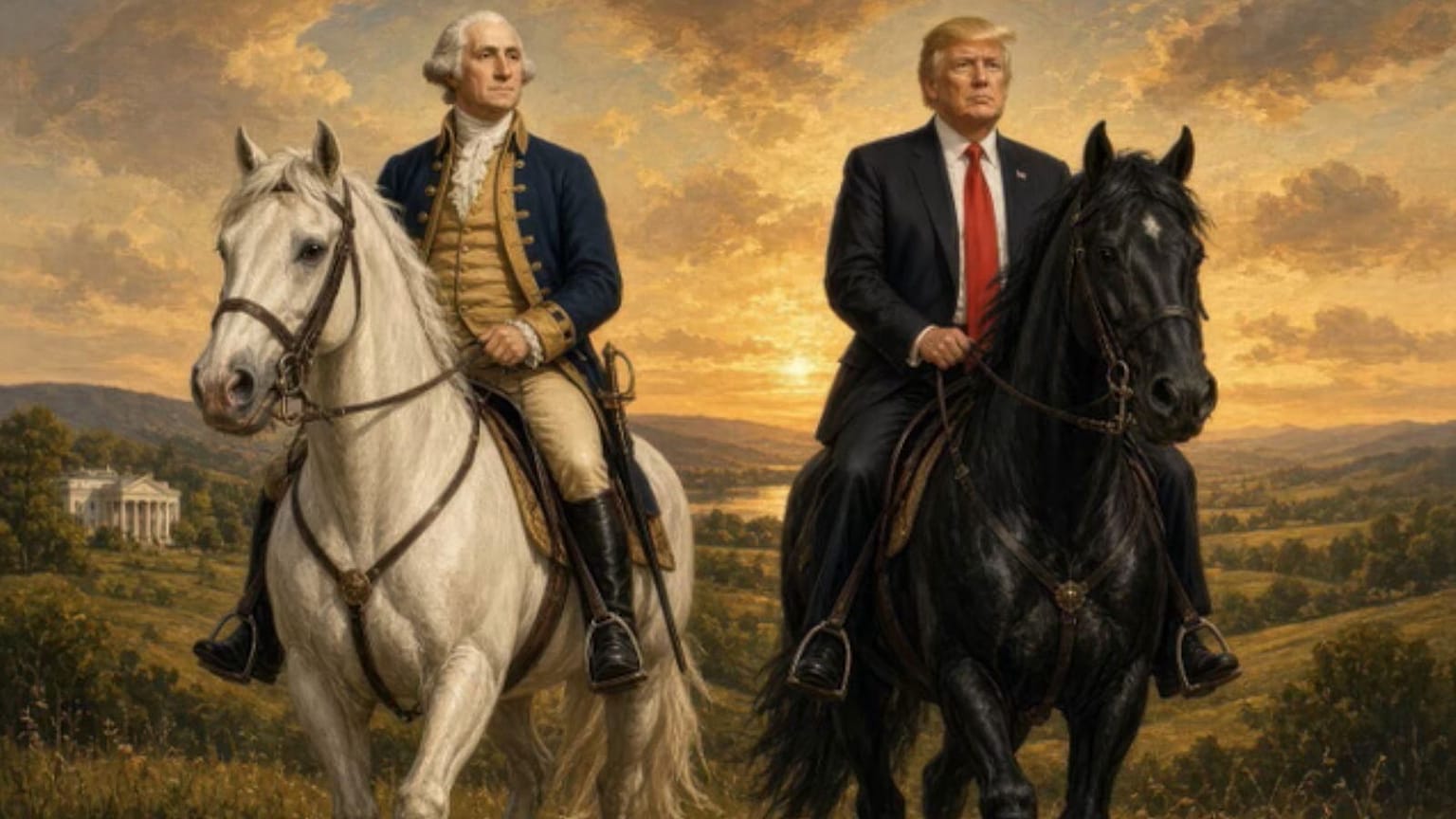
Donald Trump's latest AI-generated image, depicting him horse riding alongside George Washington, has backfired as many have pointed out the symbolic blunder of him riding a black horse in the current climate...

Donald Trump is no stranger to bulk posting AI-generated imagery as part of what has been referred to as “memetic warfare” - a tactic which sees him and his administration flood the zone when it comes to AI slop in order to appeal to his base and beyond.

While this social media strategy isn't new, one recently shared image has once again shown that the use of AI can be detrimental when it comes to conveying the proper message. Specifically, how the AI images he posts frequently backfire due to a lack of understanding when it comes to cultural references.

His recent cultural blunder is a symbolic one, which comes with an image he posted yesterday. It sees Trump horse riding with Founding Father and first president of the United States, George Washington.

The self-aggrandising image sees Washington riding a white horse, while Trump is on a black stallion.
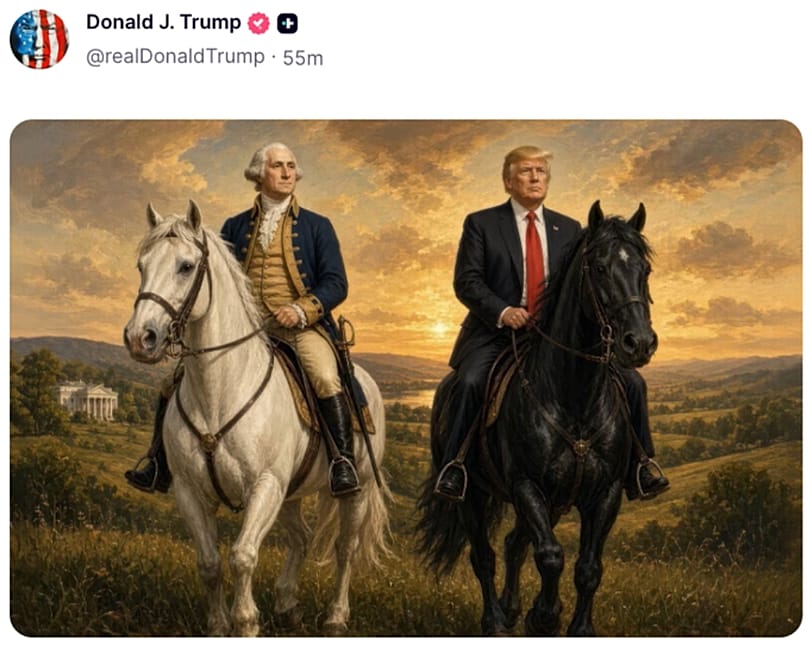
Washington and Trump
Washington and Trump Truth Social screenshot

While it's not the first time that Trump has hijacked the figure of George Washington, having posted a series of AI images of himself showing Washington around the new White House ballroom, it didn't take long for many to point out the symbolically charged equine error on show.

The cultural connotations of the black horse are numerous, and usually negative. In Henry Fuseli's 1781 masterpiece 'The Nightmare', the ghostly dark horse is a sleep paralysis demon and the embodiment of repressed dread.

In modern symbolism, the black horse can reflect hidden desires and dark secrets, but generally belongs to a series of images mirroring what psychologist Carl Jung called "the shadow self", which includes repressed anger and shame.

Then comes the Biblical reading, as the black horse is a known reference within apocalyptic contexts. The Four Horsemen of the Apocalypse in the Book of Revelation all ride different coloured horses. The white horse is pestilence; the red horse represents war; the pale horse is death; and the black horse is famine, representing food scarcity and economic hardship.

Considering Trump's image comes at a time when the price of gas, food and other essentials have soared due to the Iran war, which has now entered its sixth month, the image of him riding a black horse feels accidentally apt - what some have referred to as a "catastrophic self-own".

Social media users pointed out that Trump's handling of the ongoing US affordability crisis is unfortunately reflected in this symbolically loaded image, while others have made references to pop culture and films, with one X user noting: “Does Trump know that bad guys ride the black horse?”

Much like the red lightsaber SNAFU or the irony of portraying himself as Superman or using Spider-Man references, the misused cultural connotations have once again revealed a certain level of cultural illiteracy...

It's not the only black and white slip-up that has sparked alarm this weekend...

Trump posted a black and white 2028 image on Truth Social, which has been perceived as yet another inidication that he will be persuing a third term and is considering being president in 2028 - despite this being unconstitutional due to a two-term limit.

The image, posted with the caption “We are going to win” has reminded people of how Trump began selling red 2028 caps last year.

“I don’t think he’s planning on leaving,” said one X user, while another commented: “America needs to brace for chaos in 2028’s elections. NOT GOOD”.

 

Lorca's latest works found: a love letter cut short by the Spanish Civil War and an unpublished poem

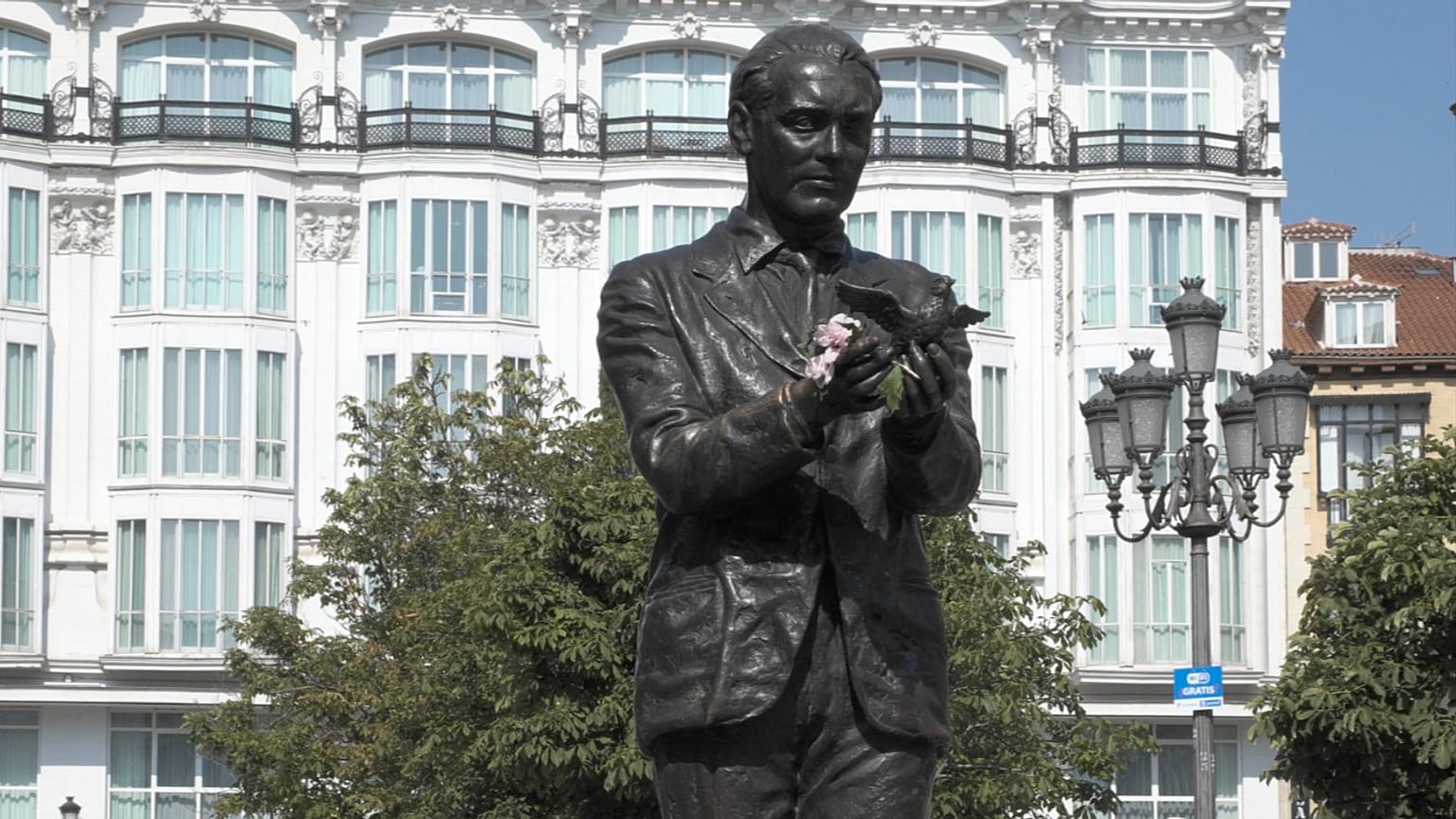
Statue dedicated to Federico García Lorca in Madrid.
Copyright Wikimedia Commons

By Javier Iniguez De Onzono
Published on


Scholars are still uncovering works by the Granada poet and playwright, shot 90 years ago for his politics and sexuality. Two biopics about him are due between 2026 and 2027.

Federico García Lorca chose to devote a few minutes to love from his Huerta de San Vicente during the uprising of 18 July 1936, once the news that would change Spain's recent history had already spread across the peninsula and sealed the fate, a month later, of the most universal of Andalusian poets.

I think about you a great deal, and you know this without my needing to tell you, but in the silence and between the lines you must read all the affection I feel for you and all the tenderness stored in my heart.

The recipient of these lines is believed to have been Juan Ramírez de Lucas, a journalist and art critic from Albacete. De Lucas, who died in 2010 and was at the time still a student, may have been the lover who inspired Lorca's 'Sonnets of Dark Love', although for obvious reasons he remained discreet about this, even after the end of the Franco dictatorship.

The letter between the 38-year-old artist and the student, barely 16, was kept by Ramírez de Lucas for 70 years. Shortly before he died, he handed his siblings a collection of drawings, letters and a diary about his relationship with the artist, among which the letter came to light. The experts who examined the material after it was made public in 2012 consider this to be the last letter written by Lorca before his arrest and execution at an as yet unidentified spot between the municipalities of Víznar and Alfacar.

Ninety years have passed since these events, yet manuscripts and works by the Andalusian are still being recovered, even though his body, like that of so many other Spaniards, has yet to be found. The Ministry of Territorial Policy and Democratic Memory has registered more than 3,000 mass graves in which victims' associations estimate that between 114,000 and 130,000 people still lie unexhumed.

Another example of this cultural recovery is a poem about time, one of the themes that have survived to this day as a Lorca cliché thanks to the version Camarón made of an extract from the play "Así que pasen cinco años" and which Los Javis have now reworked for the trailer of a new feature film inspired by Lorca's story, his lovers and his universe, "La Bola Negra", recently awarded the Best Director Prize at the Cannes Film Festival.

As well as overseeing the restoration of the house in the Nasrid jewel of Granada where the poet lived as a child between 1900 and 1916, a ground-floor flat at 50 Acera del Darro, the flamenco singer Miguel Poveda managed to acquire a manuscript on the back of which appears an unpublished poem by Lorca, whose handwriting has been authenticated by Lorca scholar Pepa Merlo.

I sing / The clock mechanically counts the hours / Seven or twelve, it makes no difference / I am not here / It is the token of flesh I left when I went away / So I can find my place when I return
 Canta el reloj 
Federico García Lorca

Both Merlo and Poveda have written "Las cosas del otro lado. Lo inédito en Federico García Lorca", published in April this year, to examine the latest discoveries concerning the artist's literary universe, which will become part of the catalogue of the newly reopened cultural centre housed in what was his childhood home.

A second feature film about Lorca, by director Fernando Franco, is due for release in 2027. It will reconstruct precisely the final weeks of Federico's life, from his escape from Madrid after the uprising to his execution in Granada. It will be several months before we know whether the film will devote a few minutes to paying tribute to the letter addressed to Ramírez De Lucas, which never received a reply.

Shakira and Warren Buffett's son announce rebuilding of schools in Chocó

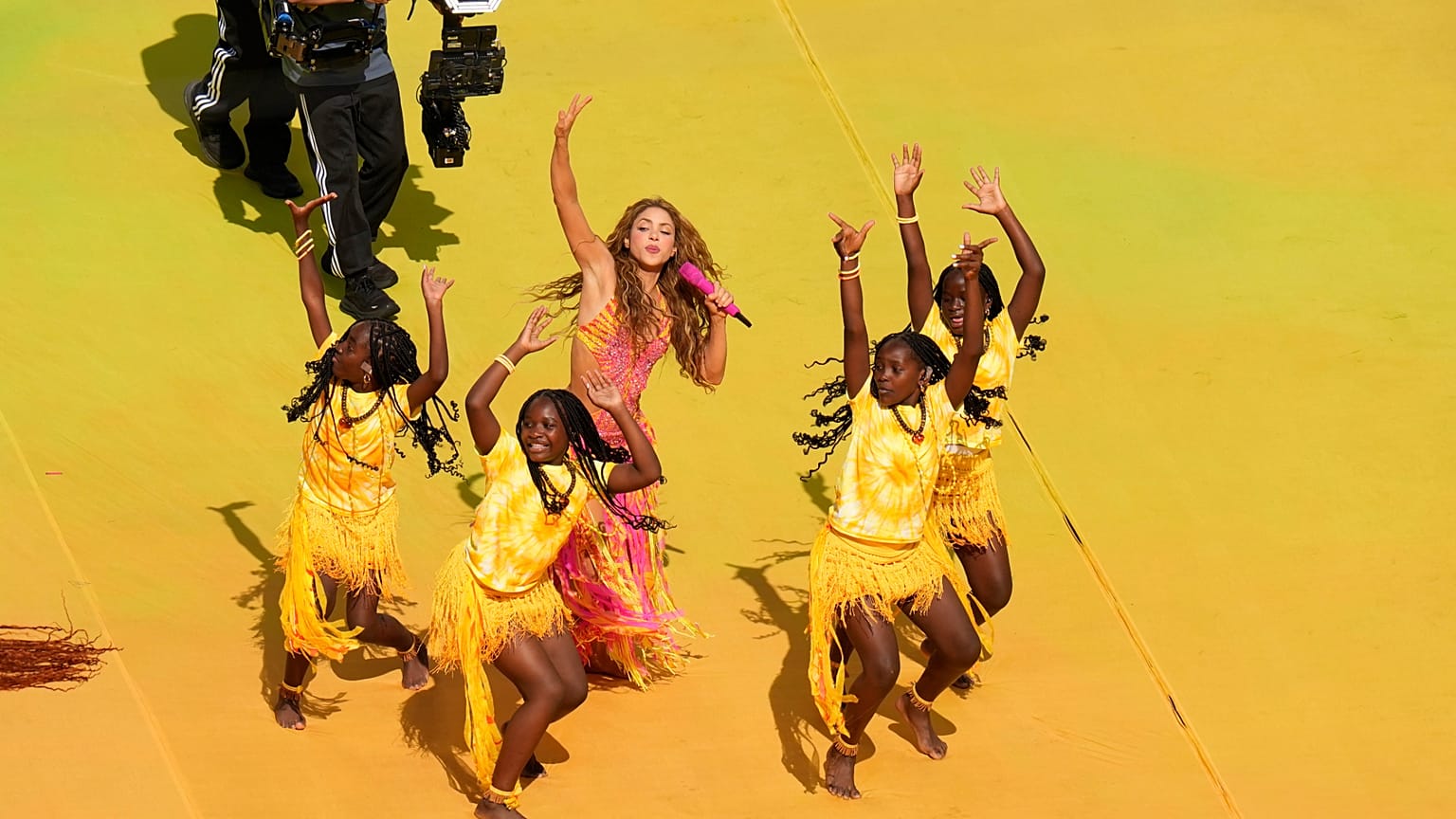
Shakira performs at half-time in the World Cup final between Spain and Argentina in East Rutherford, New Jersey, near New York, on Sunday 19 July 2026
Copyright Seth Wenig / AP

By Javier Iniguez De Onzono
Published on

The Colombian singer will not donate the announced one million dollars directly; it will be channelled via Global Citizen and promoter Live Nation, in which she is involved.

Shakira announced on Monday that she will mobilise funding to rebuild the Technological University of Chocó, damaged by the earthquake that struck Colombia on 10 August, as well as around ten non-university educational centres in one of the five departments worst affected by the quake.

The Barranquilla-born artist's donation will not be made directly. The philanthropic organisation Global Citizen will contribute 500,000 dollars (€432,250) and the concert promoter Live Nation, which organised her latest tour, 'Las Mujeres Ya No Lloran', and is also her commercial partner, will provide a further 500,000 at her instigation.

In October 2025 Shakira joined the advisory board of the education fund that FIFA runs with Global Citizen, alongside Serena Williams, The Weeknd and FIFA's own president, the embattled Gianni Infantino. This came several months before her participation as a performer at the recent 2026 World Cup was announced. The Barranquilla-born singer says she has allocated 100% of the royalties generated by the tournament's official song, 'Dai Dai', to that fund.

Shakira will work with Colombian-American philanthropist Howard Graham Buffett, son of tycoon Warren Buffett, one of the world's richest men thanks to multi-billion-dollar stakes in companies such as Apple, Coca-Cola and American Express.

The middle son of the billionaire obtained Colombian citizenship in 2021, under the government of Iván Duque, after investing more than 160 million dollars in projects in the Catatumbo region, including the rebuilding of roads, the replacement of illicit crops and demining work.

"Howard is going to help us, through [the Pies Descalzos Foundation], to build ten new schools in Chocó; that's why it was so important to bring him, that's why it was so important to come today," Shakira told reporters during a visit with Buffett to Quibdó, the capital of Chocó. Buffett's son has overseen Pies Descalzos for two decades; a foundation that has already taken part in the construction of several educational institutions in Colombia.

The visit comes a week after the earthquake, whose epicentre was in San José del Palmar but which affected departments such as Valle del Cauca and Risaralda. The quake has so far left 287 dead, 4,147 injured and 194 missing, according to the latest figures from the National Unit for Disaster Risk Management (UNGRD).


'Niu Lai': How is a 'disaster-level' Chinese animated film rivalling 'The Odyssey' at the box-office?

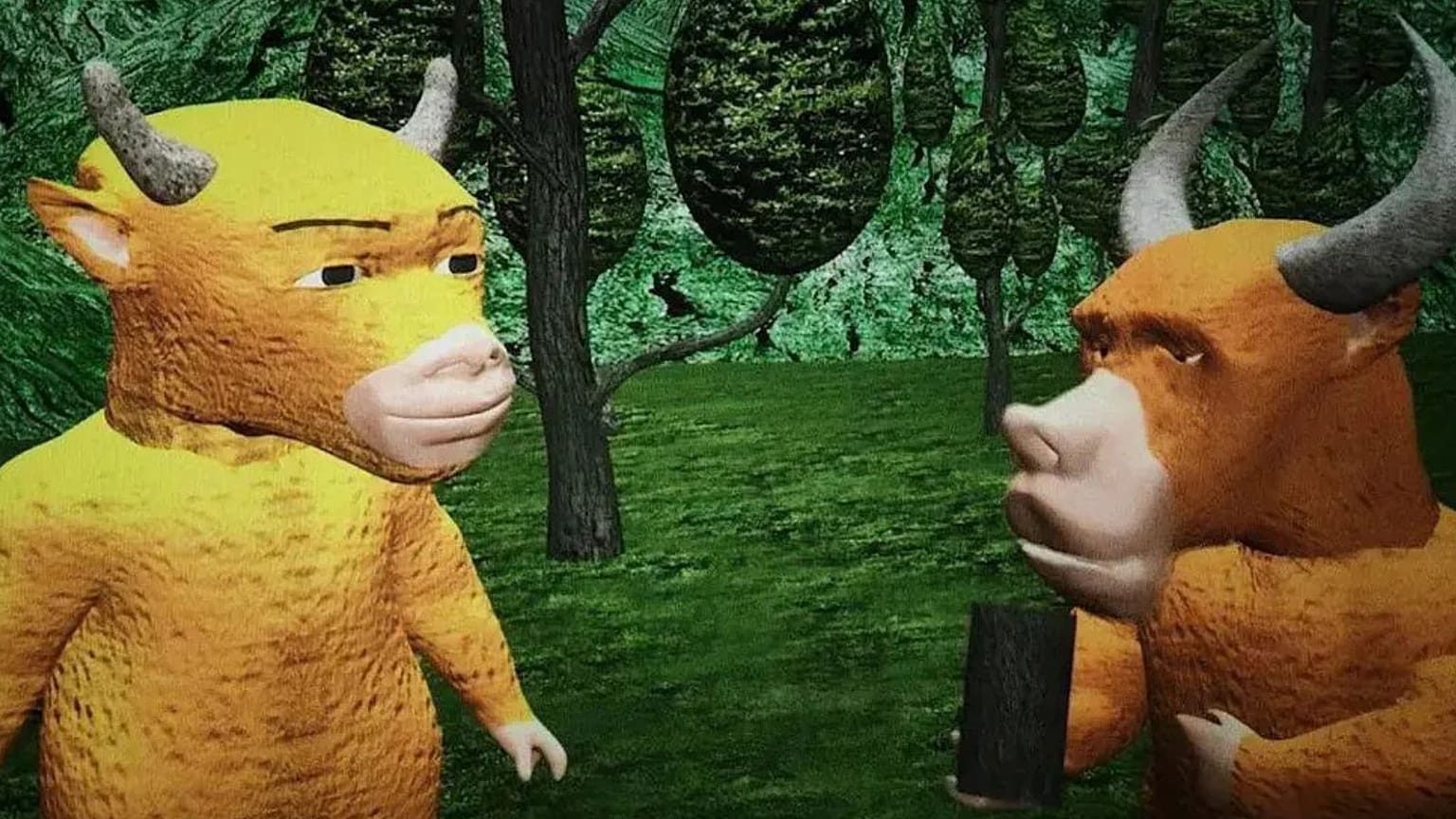
Niu Lai: The Chinese animated 'disaster' that became a viral phenomenon
Copyright Dalian Jingyuan Culture Film and Television Media - screenshot


By David Mouriquand
Published on


A low-budget and shoddy-looking animated film has emerged as this summer’s most unexpected box-office hit in China. Here’s how ‘Niu Lai’ has transformed online mockery into big bucks and a viral phenomenon.

There are films that fall under the "so bad, it's good" category... And then there's "ugly", "eerie", "godawful" and "disaster-level".

Those are some of the terms used to describe Niu Lai ('Here Comes The Cow'), a new Chinese animated film directed by Xin Yumeng and produced by Dalian Jingyuan Culture Film and Television Media, formerly an interior design and decoration company.

The film has been ridiculed for its shoddy animation and low-quality effects, and has even faced calls for theatres to stop screening it.

However, in a surprising turn of events, the film has gained sudden notoriety.

Niu Lai started its theatrical rollout with poor box office numbers and scathing reviews, with the stiff animation, poor voice acting and an abstract plot about a newborn calf growing up and coming to terms with love and sacrifice being the main points of criticism. But word of mouth and mockery soon transformed it into a viral sensation on Chinese social media.

From earning only about 10,000 yuan (approx. €1,281) at the box office in the first 10 days after its 5 August release – with some days tallying as little as 200 yuan (€25) at the box office, according to movie-tracking platform Maoyan – Niu Lai ’s box office surged to 8.2 million yuan (more than €1 million) as of Monday. Its total box office has reached 17.1 million yuan (€2.1 million).

As a result, the film is even rivalling Christopher Nolan's The Odyssey and is now among the top ten highest-grossing animated films in China in 2026.

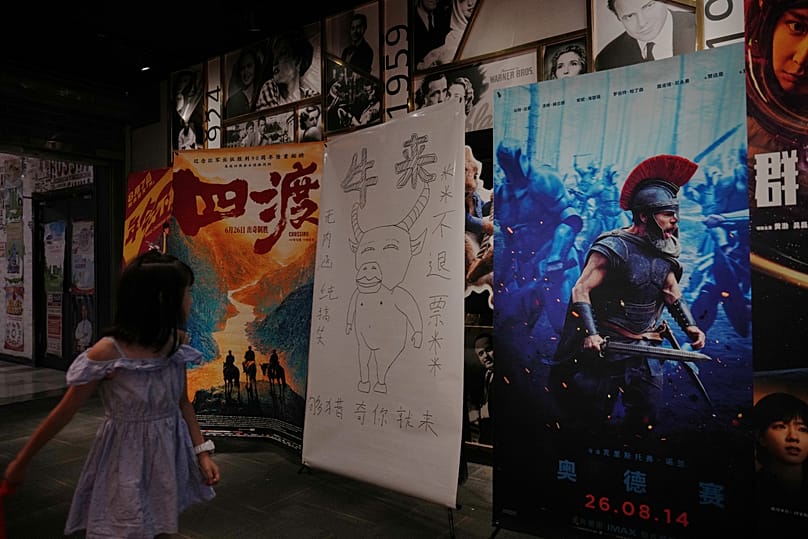
A drawing poster promoting Niu Lai on display with other movie posters at a cinema in Beijing - Tuesday 18 August 2026
A drawing poster promoting Niu Lai on display with other movie posters at a cinema in Beijing - Tuesday 18 August 2026 AP Photo

So, what gives?

Despite the flood of criticism and memes, some viewers have embraced the rudimentary animation and have started recommending the film as either a prank or a genuine antidote to AI slop taking over social media algorithms. Indeed, the handmade easthetic has apparently resonated with audiences, who champion Niu Lai as a welcome remedy for overly polished studio animation.

Quite where the irony stops and starts is still up for debate...

Regardless, countless fans have begun sharing clips of Niu Lai, praising its low-budget verve and complimenting Xin Yumeng and Sun Lifang, reportedly a mother-and-son team who made Niu Lai over the course of five years and served as the film’s writers, voice actors, and principal crew.

Others simply said they wanted to see it to find out "just how bad it could be" and joked that Nolan must be flabbergasted to witness that Niu Lai is becoming the unlikely rival to The Odyssey – which opened in China on 14 August.

It has proved so popular that cinemas have added screenings of the film in response to soaring demand, proving that all it takes is some social media buzz to elevate your film to certified hit status.

Predictably, some aren't so thrilled at the film's unexpected box office achievement, arguing that Niu Lai 's popularity comes at the expense of more accomplished productions.

For instance, state-owned Beijing News warned that cinemas risk "losing the trust" of viewers if they "continue to lower their standard" with additional screenings of Niu Lai.

The outlet urged cinemas to "act as gatekeepers for the audience, and clearly reject films that are obviously not up to standard instead of letting films like Niu Lai run rampant".

Spoilsports. Whether audiences are laughing at or with the film, Niu Lai has managed to turn mockery into a theatrical success story - as well as one of the highest returns on investment for a Chinese film. Your move, Odysseus.

TAYLOR SWIFT KILLS

Major album releases linked to 15% rise in traffic deaths, study finds

Canva
Copyright Research found a link between album release dates of major artists on streaming platforms and a surge in traffic deaths in the US.


By Alexandra Leistner
Published on

A new US study found that traffic deaths rose 15% on days when major albums by artists including Taylor Swift and Bad Bunny were released and music streaming surged.

A new US study suggests traffic fatalities increase when music streaming surges. Researchers found that the number of traffic deaths was 15.1% higher on days when major music albums were released than on surrounding days.

The researchers say using smartphones to stream music could be an overlooked source of driver distraction. They stress, however, that the study does not show that streaming music caused the additional deaths.

The study, published in JAMA Network Open, examined 233,809 traffic fatalities in the US between 2017 and 2022, using data from the Fatality Analysis Reporting System.

Swift, Drake, Bad Bunny released news albums

Researchers focused on the release dates of the 10 major albums that generated the highest number of first-day streams during the study period.

The albums included some of the biggest releases of recent years, including Taylor Swift's Midnights and Red (Taylor's Version), Drake's Certified Lover Boy, Bad Bunny's Un Verano Sin Ti, Kendrick Lamar's Mr. Morale & the Big Steppers and Harry Styles' Harry's House.

They then compared the number of traffic deaths on the days those albums were made available on streaming platforms with deaths during the 10 days before and after each release.

The approach provided what researchers described as a kind of natural experiment:

Album release dates are determined by the music industry rather than by road conditions or traffic risks. So when a highly anticipated album comes out, it can create a sudden increase in music streaming without being directly related to factors such as weather or driving conditions.

That makes it possible to ask whether anything else changes at the same time.

Traffic deaths rose alongside streaming

On the 10 album-release days, people streamed music an average of 123.3 million times, compared with 86.1 million streams on the surrounding days. That's an increase of about 43%.

Traffic deaths also increased. Researchers recorded an average of 139.1 deaths on album-release days, compared with 120.9 on the surrounding days. That's about 18 more deaths per day, or 15.1% more.

Overall, the researchers estimate that about 182 more people died in traffic crashes on the 10 release days than would have been expected based on the surrounding days.

It's not simply about listening to music

The findings do not suggest that having music playing in the car is inherently dangerous. Instead, the researchers were interested in the possibility that smartphones create a different kind of distraction.

Listening to a familiar playlist requires little interaction but finding a newly released album can be different. A driver may unlock a phone, open a streaming app, search for an artist, browse an album and select a track.

Each of those actions can take attention away from the road.

The increase in traffic deaths was strongest among younger and male drivers. It was also higher in crashes involving only one person and in cars with infotainment systems.

These patterns may offer clues about the role of distraction, suggesting that interacting with technology while driving, rather than simply listening to music, may be part of the problem.

Testing the “Friday effect”

Most major album releases take place on Fridays, which creates an obvious complication.

Fridays can have different traffic patterns from other days of the week, and they could potentially be associated with different numbers of crashes regardless of what music is being released.

The researchers therefore carried out additional analyses focusing specifically on Fridays. The increase in fatalities remained.

They also conducted placebo tests using randomly selected dates and Fridays. In most of those simulations, the increase in traffic deaths was smaller than the effect observed around the actual album-release dates.

These tests strengthen the case that the association was not simply the result of random fluctuations or the fact that many releases happened on Fridays.

Limitations of the study

The researchers did not know whether the people who died in the crashes were actually streaming music, using their smartphones or interacting with an infotainment system at the time.

The study only shows that three things occurred together: major album releases, a sharp increase in music streaming and a rise in traffic fatalities. That does not mean one caused the other.

Other factors could potentially have contributed to the increase. And because the study was observational, it cannot establish a direct causal link between streaming music and fatal crashes.

The researchers therefore describe online music streaming through smartphones as a potential contributor to distracted driving, rather than proving that it was responsible for the deaths.

Distraction while driving is a growing problem

The findings nevertheless highlight how distracted driving may be changing as smartphones become increasingly integrated into everyday activities.

Drivers have long faced distractions such as adjusting a radio or changing a CD. Smartphones have added a much wider range of potential distractions.

With smartphones competing constantly for people's attention, distracted driving may no longer be limited to texting or making calls. Sometimes, it may start with something as ordinary as wanting to hear the new Taylor Swift album.

Russians pull billions from banks fearing Kremlin will seize savings for war

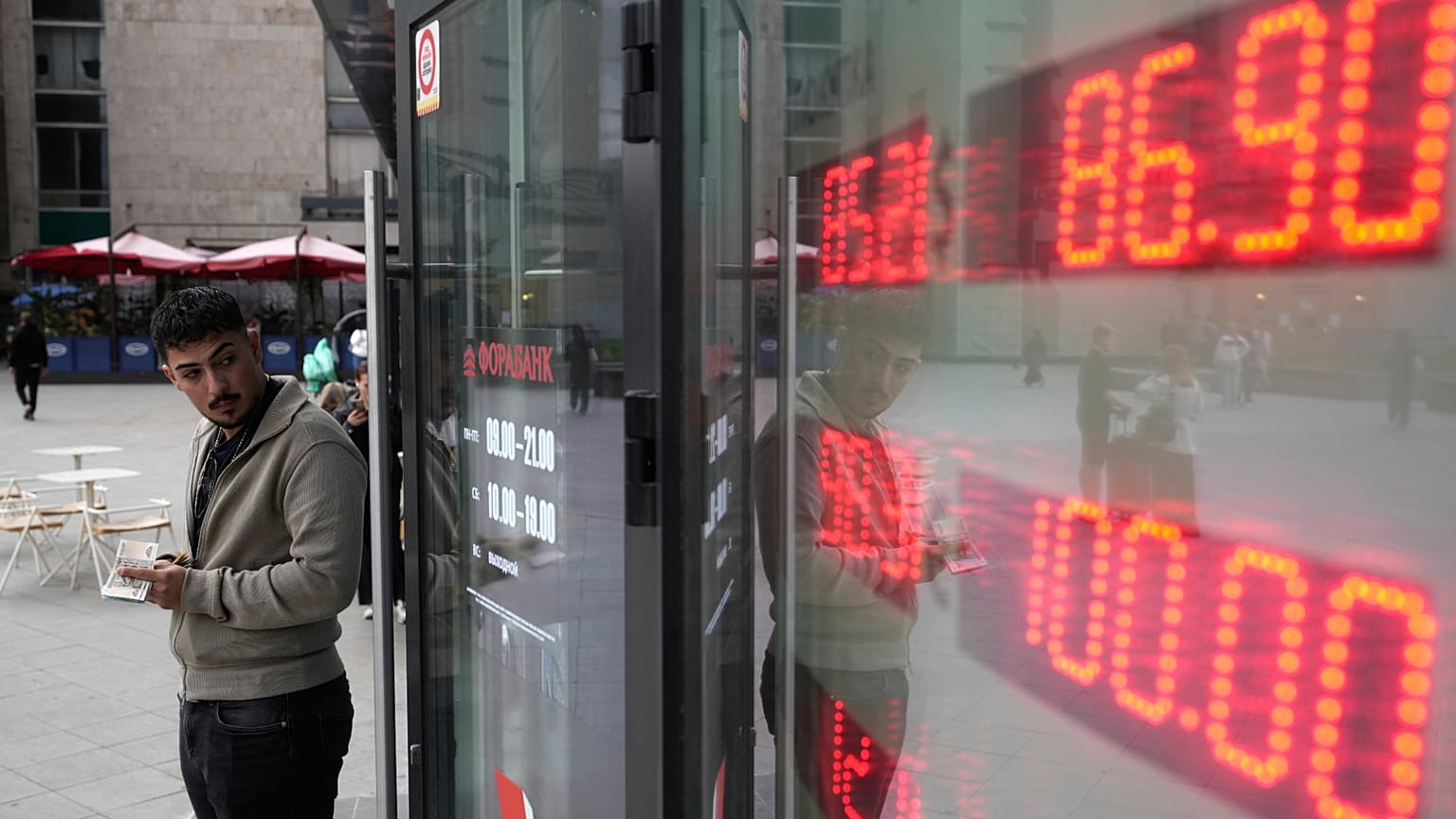
Currency exchange in Moscow, 14 August 2026.
Copyright AP Photo

By Yulia Gritsay & Euronews
Published on

Russia's central bank reported that billions of roubles have been withdrawn from banks each month, as Russians pull out cash amid fears of the Kremlin seizing their savings to fund the war in Ukraine amid a deteriorating economy.

Russians withdrew around €24.4 billion from the country's banking system in the first seven months of this year, as Ukrainian drone strikes on oil refineries and logistics infrastructure deepened the economic crisis, and fear spread that the Kremlin could move to freeze or nationalise private deposits to fund its war in Ukraine.

Data from the Banks.ru financial marketplace show that demand for cash began rising in early March and has continued growing, with around 300 billion roubles (€3.05 billion) leaving accounts every month.

Five of Russia's seven largest banks have recorded net outflows of individuals' deposits.

Gazprombank has been the most affected, losing 299.5 billion roubles (€3.04bn) — 10.8% of its total deposits — over four months. Rosselkhozbank shed 270.5 billion roubles (€2.75bn), a fall of more than 15%.

Alfa-Bank, Russia's largest private lender, lost 179.4 billion roubles (€1.82bn) or 5.6% of deposits. Sovcombank and VTB recorded further outflows of 81.7 billion roubles (€830m) and 20.4 billion roubles (€207m) respectively.

Sberbank initially held steady, but its depositors have also turned to cash: 211.6 billion roubles (€2.15bn) left in June, followed by a further 31.8 billion roubles (€323m) in July. T-Bank was the exception, recording an increase of 193 billion roubles (€1.96bn) in deposit volume.

The total amount of cash in circulation rose by 643.4 billion roubles (€6.53bn) in July alone, the largest monthly increase since the start of the year, according to the Bank of Russia. In the first half of August, a further 300 billion roubles were withdrawn.

Why Russians are pulling their money

The withdrawal is being driven by two overlapping fears: that Ukrainian drone strikes could destabilise the financial system, and that the Russian government might move to seize or freeze deposits to cover mounting war costs.

The second scare is grounded in recent events. Russian prosecutors transferred approximately $51.5 billion (€44.3bn) in private assets to state control last year, according to the Washington Post.

In June, authorities seized around $7.6 billion (€6.5bn) in assets linked to billionaire Vadim Moshkovich, founder of the agricultural holding company Rusagro.

Putin has simultaneously been extracting what officials describe as voluntary "donations" from oligarchs, with hundreds of billions of roubles flowing into the federal budget by mid-August, the Russian business daily Vedomosti reported.

Russian banks have spent years extending government-directed loans to defence industries at the Kremlin's instruction.

Large companies are also moving money beyond the reach of domestic regulators, with more than $9.4 billion flowing out of Russia's banking system in the second quarter of 2026 alone, according to central bank data.

In 2022, Russians also pulled money from banks in significant quantities following the invasion and the initial wave of Western sanctions.

The central bank temporarily raised interest rates to 20% and imposed capital controls to stabilise the system. Those controls were later lifted and the rush subsided, but the current trend is larger and longer in scale.

Russia's broader economic position is deteriorating. GDP expanded just 0.3% in the first half of 2026, compared with 1.2% in the same period last year, according to the Kremlin's own data, which cannot be independently verified.

Andrei Klepach, chief economist at the state development corporation VEB, was dismissed over the weekend after publicly questioning whether Russia could win a prolonged war.

"We will not win the competition in this war of attrition. We're under the illusion that everything will collapse. It hasn't, and it won't. Our costs are mounting," he said at a Moscow Exchange economic forum in May.


Seven in 10 Russians now call the situation at home tense or critical

Seven in 10 Russians now call the situation at home tense or critical
Levada's July reading puts public anxiety back where it was when Putin ordered mobilisation. War and the dead top the list of worries; drones over Russia come second. / bne IntelliNewsFacebook
By Ben Aris in Berlin August 17, 2026

Anxiety in Russia has climbed back to the level it reached when Vladimir Putin ordered mobilisation four years ago.

Some 57% of Russians describe the situation in their country as tense and a further 13% call it critical or explosive - 70% between them, the highest since September 2022. Only 19% say things are calm and 7% call them prosperous, according to the July survey published by the Levada Centre, Russia's last major independent pollster, on August 14. It questioned 1,612 people across 137 towns and villages in 50 regions between July 21 and 28.

Asked what worries them, respondents who gave a negative answer named the war, mobilisation and the deaths of people first, at 45%. Drone attacks, shelling and explosions inside Russia came second at 21% - a category that did not meaningfully exist in the 2022 readings this figure is being compared with, and the clearest measure yet of how far Ukraine's deep-strike campaign has travelled into Russian domestic sentiment.

Fear for themselves, their children and the future followed at 18%, instability at 10%, and the economic crisis and rising prices at 9%. Petrol shortages and queues at filling stations - a summer-long irritation that has been biting into the real economy since the agricultural peak season - were named by 7%, as were power, internet and mobile outages by 6%, alongside distrust of the authorities, also on 6%.

Those numbers describe the war arriving at home rather than a country turning against it. Levada's own breakdown of the minority who call the situation good is telling in the same way: 11% of them give as their reason that there are no protests, strikes or disturbances, and 9% that there is no fighting on Russian soil.

The reading lands with Russia's war economy grinding towards a halt despite an oil windfall, and a month before regional elections in September that the Kremlin is managing carefully.

Nothing in the survey suggests that 70% is about to do anything. It does suggest that the number of Russians who still describe the war as something happening somewhere else is shrinking.