It’s possible that I shall make an ass of myself. But in that case one can always get out of it with a little dialectic. I have, of course, so worded my proposition as to be right either way (K.Marx, Letter to F.Engels on the Indian Mutiny)
Friday, June 26, 2026
New EU Migration Policies and Their Impact on Refugees: A Call for a Universal Front to Protect Refugee Rights
By theInternational Federation of Iraqi Refugees
In June 2026, the European Union moved forward with the implementation of the “New Pact on Migration and Asylum.” This pact, presented under the guise of reforming the asylum system, aims to accelerate the processing of asylum applications, strengthen external border controls, prevent ‘illegal’ migration, and combat human trafficking networks.
The International Federation of Iraqi Refugees views these developments with deep concern. We believe these policies are not merely administrative or legal adjustments; they represent a fundamental and devastating shift that strikes at the very heart of the lives, rights, freedoms, and futures of thousands of refugees fleeing war, instability, and political, economic, and social injustice.
We believe these new policies harbour several critical risks:
First: Accelerated Decision-Making on Asylum Cases
Under this system, asylum applications are processed and decided upon with extreme haste. This occurs while many refugees lack adequate access to legal counsel, qualified translators, or the time needed to gather necessary evidence and documentation. In such a climate, a minor error or a lack of documentation can lead to the immediate rejection of a claim, deciding a human being’s fate without the benefit of full justice.
Second: Indirect Detention and Imprisonment of Refugees
According to the new measures, refugees can be detained at border zones or in specialized centres, forced to remain in closed facilities for extended periods. In terms of living conditions and the restriction of movement, these centres often function as prisons. This treatment inflicts severe psychological and social trauma on refugees, fostering fear, distress, and despair—all of which directly contradict the protections intended by international laws and conventions.
Third: The Risk of Forced Returns (Refoulement)
These policies pave the way for the rapid deportation of refugees whose claims have been rejected. In many instances, the countries to which refugees are being returned are still plagued by war, instability, violence, political threats, or systematic human rights violations. Consequently, this policy places the lives of many at grave risk.
Fourth: Restriction of Legal Rights
Under the new system, access to judicial review and the right to appeal decisions are further restricted. In many cases, refugees are granted only a single opportunity to appeal, while access to legal aid is significantly reduced. This undermines the principle of justice and strips refugees of their right to a fair defence.
Fifth: Specific Impacts on Women, Children, and Families
Women, children, and families are among the primary victims of these policies. Confinement in closed centres, the disruption of education, and the constant state of anxiety and instability have a devastating impact on the mental health and developmental growth of children.
Sixth: Deportation to Third Countries
Based on certain proposals, refugees can be sent to ‘safe’ third countries, even if they have no direct connection to them. This poses a massive threat, as legal and social protections in such countries are often weak, leaving the future of refugees in total uncertainty.
Demands of the Federation and the Front for the Protection of Refugee Rights
The International Federation of Iraqi Refugees stands firmly against any policy or law that restricts the rights and human dignity of refugees. We demand:
· Full protection of the right to asylum in accordance with international laws and treaties.
· An immediate end to arbitrary detention and the unnecessary holding of refugees.
· The establishment of a fair, transparent, and humane asylum processing system.
· The provision of specialized protection for women, children, and families.
· The creation of safe and legal routes for seeking asylum and humanitarian relocation.
The Call
The International Federation of Iraqi Refugees calls upon all human rights organizations, refugee advocacy groups, labour unions, activists, civil society organizations and all progressive forces to form a united front across Europe. We must stand together to defend refugee rights and confront these unjust anti-refugee policies. We believe that protecting human dignity and the rights of refugees is not solely the responsibility of the refugees themselves, but the shared duty of the entire civilized and humanitarian front.
Under these policies, a refugee does not only risk losing their rights; they risk losing their freedom, their security, and their entire future.
In July, events in the Middle East will push the typical family’s energy bill to £1,862, a 13% rise. Despite important steps the government has taken to target help to those who need it most, the experience for many around the country is that bills remain higher than before the energy crisis began and, for all the welcome recent talk in Westminster about wholesale prices and price caps, too many families around the country are losing faith in any politicians ability to fix it.
I spent my years before Parliament at the Bank of England working on climate risk. So I have little patience for the argument, now fashionable on the right, that the way to cut bills is to walk away from the transition – it isn’t. We heat our homes and set our electricity price with imported gas, and every household pays for that exposure. The route out of volatility runs through clean, home-grown power, not around it.
But I want to be honest with my own side too, and new polling, released today shows that we need to double down on making the energy transition pay.
Polling from Startup Coalition and Public First found there is no anti-net-zero public in Britain. Instead, there is a public that has lost patience with a transition that asks them to pay without paying them back. Support for the 2050 target swings by up to 66 points depending on how you frame it: it collapses by 39 points when it’s pitched as an unspecified cost to taxpayers, and surges by more than 20 when it’s about lower bills, British jobs and energy independence. The biggest movement comes from exactly the voters we’re told are lost to us, older voters, Reform-leaning voters, when the offer is about them.
56% of Brits feel the whole energy debate is about things outside their control and not about anything they can actually do. Trust in the Government to make bills affordable is split right down the middle. People feel locked out.
This Government’s instincts on energy are correct. I was proud to vote for Great British Energy and for getting Britain building again. The clean-power mission is the right one. But it has so far been a story about the system; about the grid, renewable auctions, and planning reform. It is largely invisible from the kitchen table. And the part people can see and feel is the part that’s lagging.
This gap, and the pace of change in an often overlooked technology crucial to the clean transition, gives us a huge opportunity to go further.
We must give power to the people, and help them kit up to make their homes part of the energy transition. The appetite here is enormous and almost entirely unmet: 82% say they’d take up new energy technology if they could sell surplus power back to the grid. A third would install plug-in solar (the panel-on-a-balcony kit that made over a million German homes their own little power stations). Two-thirds would buy the tech if it were sold in the middle aisle of Lidl.
What’s standing in the way isn’t engineering or appetite, but unfinished policy. We’ve opened a consultation to legalise plug-in solar, which is genuinely welcome, but currently it explicitly leaves out the battery, which otherwise would help deliver a step change in savings. That’s why we need to finish the job by speeding up the finishing touches on plug-in solar and then cracking on with batteries as soon as possible.
Just this week Octopus Energy announced they’re planning to get batteries to households across the country. Fuse Energy is also planning to double down on this tech. ESME energy have been helping households in my own constituency save through battery installation. These are British scale-ups delivering the transition to the masses – we should be helping them to reach as many as possible, as fast as we can.
I came into politics because I believe the climate transition can be the great fairness project of our time, but only if working people are its beneficiaries, not its bill-payers. The public are ahead of Westminster on this. They’re not asking us to abandon net zero. They’re asking to feel it in their pockets, soon. Reform offers them nothing but nostalgia and higher bills. We can offer them power – over their own energy and their own money.
Alistair Strathern MP
Alistair Strathern is the Labour MP for Hitchin.@alistrathern
The implementation of the Renters’ Rights Act on 1st May was a moment of real significance to 9 million households who currently pay their rent to private landlords in England. Yet, as welcome as these reforms are, I believe the time is right to go further and to begin a discussion on rent controls.
The headline change to the law recently brought about by the Government was the ending of invidious no-fault evictions, but the other measures are equally life changing for renters. From now, rents can only be increased on one occasion each year, subject to the landlord serving notice on the tenant which can then be challenged at a tribunal to determine a reasonable rent increase.
The disgraceful practice of rental bidding has been banned and discrimination against renters who have children or receive benefits is now illegal. These are all positive steps from the Government that will give greater security and peace of mind for so many people, but we need to do more.
The cost of living is the overwhelming concern of hard-pressed families in Dagenham and Rainham. I see it every week through my casework. A significant element of those cost-of-living pressures for private renters has been the scale of rent increases since 2010. In this period average rent costs have risen by 45% so that in England the average monthly private rent is £1,340, greatly outstripping increases in income for most people.
Lowest income renters face particularly acute pressures – paying about half of their income on rents – with 40% reporting difficulties in meeting their housing costs. Looking at recent studies, particularly a report by the Joseph Rowntree Foundation on tax reform and rent controls, it is clear to see that people living in cities like London are more likely to be paying a larger proportion of their income on private rent.
Whilst I understand the arguments against rent controls – one being the theory that it would result in the mass sale of property, flooding the market and leading to a crash in house prices – I think this is short-termism.
Many of our European neighbours have rent control systems. It isn’t a radical idea. France, Germany and Ireland have limitations on rent increases in areas experiencing a tight housing market. Ireland refers to these as ‘rent pressure zones’. I believe a similar model could be trialled in the UK at a local authority level in areas with significant social and economic pressures.
Before discarding this idea it is worth noting that, for more than 70 years from the First World War, the UK had rent controls of some form in place. The system was only brought to an end with the Housing Act 1988 as part of the Thatcher blitz on deregulating the economy and wider society.
As well as the financial impact high rent is having on families who are struggling, high private sector rents are also having a massive impact on the nation’s welfare budget and driving so many councils to the brink of collapse. The Housing Benefit bill has ballooned to well over £30 billion a year, with the majority of this going to private landlords. In addition to this sum, a further £3 billion is paid by local authorities on top of the HB payments.
Given the focus that exists on curbing welfare spending as well as seeking ways to ease the cost of living, now is the time to look again at rent controls.
However, as important as I think rent controls would be, to really get to grips with the chronic dysfunctional nature of housing demand and supply, a major increase in the stock of social rented homes must form the foundation of any strategy to tackle the housing and cost of living crises.
If this government can deliver a seismic shift in the supply of truly affordable rented homes coupled with rent controls, I believe we can finally begin to address the levels of desperate housing need in areas like my constituency of Dagenham and Rainham.
Margaret Mullane MP
Margaret Mullane is the Labour MP for Dagenham and Rainham.
“Let’s respond to the grim figures and assessments of the Milburn report by intensifying our resolve, campaigning on the structural and political issues that have driven this crisis.”
In our Red Weekly Column, Fraser McGuire looksat the Milburn Report’s troubling findings on youth unemployment — and what the trade union movement must do to fight back. The Government’s new report into youth unemployment and economic inactivity, headed by Alan Milburn, was released earlier this week. It makes for pretty grim reading. The headline statistic is that the number of young people neither working nor learning (NEET) has passed one million, for the first time in 13 years.
The review makes clear that a decline in entry-level jobs has been a major factor in youth unemployment, with 1.6 million fewer “low and medium-skilled” jobs in the economy than in previous decades.
On the numbers – Milburn said that young people are now in “a hopeless catch-22 where employers ask for work experience but the opportunities for young people to gain it have narrowed or gone”, and that these numbers could rise further to 1.25 million within 5 years, leading to a “lost generation”.
The number of young people out of employment, training, and education must be treated as a national crisis, and trade unions must go beyond Milburn’s identified drivers of the issues, recognising the deeper structural issues and ensuring that discussion recognises that young people are not responsible for this crisis. The reality is that 84 percent of young people who are ‘NEET’ want a job or training.
Milburn points to mental and physical health challenges, declining numbers of entry level jobs, and a lack of support and investment for skills and education, but the wider context of deindustrialisation, privatisation and marketisation, and the impacts of austerity, must be recognised.
There are immediate demands that trade unions can and must make, but our responses to the current situation have to be underpinned by explicit understanding that these numbers are the predictable result of decades of job losses in manufacturing and production, asset-stripping of public services, deregulation of the job market, and the treatment of young people as a problem to be managed rather than a future generation of workers needing investment.
Diagnosing unemployment as a skills problem or a welfare trap avoids addressing structural issues, fundamentally the spending problem of a government that doesn’t spend enough into the economy to meet the non-government sector’s desire to accumulate financial assets whilst also compensating for the money flowing out of our economy through imports, there simply isn’t enough in the system to employ everyone looking for employment or paid training.
Aggregate demand is too low, as a result of constraining ‘fiscal rules’ and the Bank of England raising interest rates to cool the economy. Workers, especially those in workplaces without collective bargaining and strong trade unions, have the least power in the economy, disproportionately so for the younger, the precarious, and the newly employed.
One of the key demands of unions should relate to mental health. The challenges that Milburn links to youth unemployment and inactivity have without a doubt been exacerbated by austerity and cuts over the past fifteen years, which have seen many youth spaces and community centres disappear, waiting lists at CAMHS skyrocket, and the number of mental health professionals in schools decline significantly.
Trade unions should strengthen campaigns for mental health support for young people, specifically focusing on restoring CAMHS funding, ensuring school counselling in every school, and making community youth workers a statutory provision. This must go alongside resistance to framing that links NEET numbers to the benefits system, puts the responsibility on the individual due to a putative lack of motivation, or fails to address mental health issues as structural and linked to funding cuts.
Furthermore, trade union response to the figures in the Milburn Report must recognise that the collapse of secure and well-paid entry-level employment is inseparable from the collapse of trade union density in the sectors that used to provide it.
Unions must campaign for legislation mandating full union access to workplaces (regardless of number and percentage of employees who are trade union members) with high concentrations of young workers, for the removal of the minimum threshold of 20 employees for statutory trade union recognition processes, and for sectoral bargaining that sets minimum standards across hospitality, retail, logistics, and care, as these are the industries where young workers are most concentrated and most exploited.
Campaigns that recognise and fight decimation of further education funding also link directly into resisting the youth NEET crisis. Colleges cannot provide the quality of provision young people need on the budgets they currently receive. All trade unions, particularly those in education, must build (and in some cases continue) campaigns for a substantial, ring-fenced increase in FE and skills funding, free at the point of use, with trade union representation on governing bodies.
The trade union movement has a responsibility to fight for a better future for the young people who should be in work, training, and education, not just those currently in full employment. More secure industrial jobs will also mean more future trade union members, provided we organise across greenfield and low density sites.
Currently, the number of young people who are NEETs undoubtedly contributes to the lower rates of trade union participation among under 30s, as workers with higher rates of transience or shorter periods of employment will be less likely to join and engage with trade unions.
The need to build renewable and green industries in the face of the climate emergency must be linked with tackling youth unemployment, and should be accompanied by additional funding to expand apprenticeship numbers and training, such as through widening the number of employers that pay into the Growth and Skills Levy, which currently applies to just 2% of employers.
Priority should be given to industries in areas where carbon intensive jobs are being lost, to ensure a real Just Transition, and to prevent further decline in communities who have already experienced the catastrophe of deindustrialisation.
High unemployment isn’t an aberration of our economic system, indeed a large pool of surplus labour means wages are suppressed and inflation kept in check. The ‘free market’ will not solve this crisis, and neither will simply subsidising or incentivising the private sector to provide more employment.
Where the private sector is failing to provide the number of jobs we need, and failing to maintain genuine employment security and good wages, the Government must be able to step in as the employer of last resort, and ensure direct investment, rather than private subsidies, into public services, infrastructure, and green industries.
Let’s respond to the grim figures and assessments of the Milburn report by intensifying our resolve, campaigning on the structural and political issues that have driven this crisis, and doubling down on our organising efforts with young people.
“This achievement demonstrates what can be won through collective action. The government should now apply the same approach to other outsourced services, including pension administration.”
Fran Heathcote, PCS General Secretary
The Public and Commercial Services Union (PCS) has welcomed the decision to insource facilities management contracts managed by the Government Property Agency, bringing around 2,000 workers back into the civil service.
The workers, employed in a wide range of essential roles including catering, security officers, cleaners and porters, deliver vital support to a number of government departments.
Despite carrying out essential work alongside directly employed civil servants, most of these workers were employed by private companies on significantly less favourable pay, terms and conditions. This insourcing decision will improve the working lives of hundreds of members and help address the inequalities that have developed through outsourcing.
As well as improving conditions for workers, insourcing will deliver better value for money. PCS has long campaigned for services to be delivered directly for the public good, generating savings for the taxpayer and improving accountability, rather than allowing private companies to extract profits from publicly funded contracts.
The move will also tackle the multi-tier workforce that currently exists across government workplaces. Bringing these workers in-house will create greater parity, coherence and fairness in pay, terms and conditions, ensuring staff are treated with the dignity and respect they deserve.
The announcement proves that insourcing can be done and PCS hopes it will act as a catalyst for further action across government, particularly relating to Capita and the current civil service pension crisis.
PCS general secretary, Fran Heathcote said: “This is a huge victory for members and a clear vindication of our campaign for insourcing.
“For too long, outsourced workers have faced lower pay, poorer conditions and been treated as second-class citizens. Bringing around 2,000 workers back into the Civil Service will help end that unfairness, deliver better value for taxpayers and show that public services work best when they are delivered in the public interest, not for private profit.
“This achievement demonstrates what can be won through collective action. The government should now apply the same approach to other outsourced services, including pension administration.”
‘The government is at risk of killing off British car manufacturing’
Anna Krajinska23rd June, 2026
Nearly two years into government, Labour still lacks a credible automotive strategy. Worse, it risks undermining the one policy currently giving manufacturers and investors a clear sense of direction.
Reports that Business and Trade Secretary, Peter Kyle, is allegedly pushing for the dilution of the UK’s zero emission vehicle (ZEV) mandate amount to a striking admission of failure.
The UK’s flagship Zero Emission Vehicle mandate was never intended to carry the full weight of industrial policy. It is a foundation upon which a strong industrial strategy, designed to drive investment, build domestic supply chains and develop the necessary skills for the sector, is built. Weakening or removing the ZEV mandate now would destroy that foundation. Creating uncertainty and destroying the investment case for EV and battery manufacturing in the UK.
Crucially, it would expose the central failure of the Department for Business and Trade: not that the mandate went too far, but that ministers never produced a credible plan to keep British automotive manufacturing competitive in an electric future.
And Britain’s competitors are not hesitating. China is successfully executing its New Energy Vehicle Industrial Development Plan cementing its place as a leading global EV exporter. The EU, meanwhile, is pairing regulation with its Automotive Action Plan and Industrial Accelerator Act in order to ensure that the EU automotive industry remains competitive through the transition. Key policies included in EU requirements require on-shoring of manufacturing in the EU and tariffs to prevent over subsidised Chinese EVs undercutting EU manufacturing. In both cases, governments are matching ambition with strong policy to support their domestic auto manufacturing.
By contrast, the UK is not committed to either. Faced with mounting pressure from carmakers, the Secretary of State for Business and Trade would rather loosen the rules than confront the sector’s deeper structural challenges: high energy costs, global overproduction capacity among some manufacturers like Stellantis and fast moving competition from China. China is now not only highly competitive on EVs but is also increasingly gaining market share on internal combustion engine models. Jaecoo, a Chinese carmaker, now sells more plug in hybrids in the UK than any other brand after only entering the market in 2024.
This means that slowing down the transition and sticking with petrol and diesel is not going to help the UK’s auto industry either. The consequences of weakening the ZEV mandate are not abstract. Investment decisions are being made now about where the next generation of electric vehicles, batteries and supply chains will be built. If the UK cannot offer policy certainty alongside competitive conditions, that investment, and the jobs and growth that come with it, will go elsewhere.
This is the real test of Labour’s economic credibility. Managing the transition to electric vehicles is not optional, it is already underway globally. The question is whether the UK shapes that transition or loses its automotive sector all together.
If the Government proceeds with changes, it will send a damaging signal across the economy: when the pressure rises, Britain steps back while its competitors press ahead. The question is whether Labour wants to be known as the government who led the UK auto industry to global EV leadership, or that set it on the path to destruction.
Anna Krajinska
Anna Krajinska is Director of Transport and Environment UK, The UK national office of Europe’s leading advocates for clean transport and energy.
Opinion
Keir Starmer failed the NHS. The next Labour leader must do better.
'We need commitment to a publicly funded, provided and accountable NHS, not an ever-closer relationship with the parasitic private sector'
As Keir Starmer ended his resignation speech with tears in his eyes, we remember the rivers of tears flowing from the people of Gaza and the occupied territories. Closer to home is the lasting sadness among the families of 305 people dying avoidably every week from delays in emergency care, and those impacted by the deep social inequalities and poverty that have not been seriously addressed.
Starmer, Chancellor Rachel Reeves and former Health Secretary Wes Streeting have conspired to deliver a prescription without hope for the NHS and for patients. In place of compassion and positivity, they have built their ambitions on fear of the bond markets, the worthless opinions of the right wing press and partnership with private corporations.
Reeves stubbornly wears her self-imposed fiscal rules straitjacket. This prevents serious investment in public services despite being essential infrastructure for a healthy population and successful economy. Starmer has lacked any vision or urgency in addressing manifest social inequalities that contribute to poverty, homelessness, rising racism, sickness and almost 3 million people out of the workforce for health reasons. Instead, his political compass led him to keep the two-child benefit cap for too long, impose a winter fuel payment cut and attack disabled people’s benefits – all of which contributed to his downfall.
Starmer’s unforgivable ‘island of strangers’ speech asserting that immigration had caused ‘incalculable damage’ – regardless of his subsequent apology – poured petrol on the flames of racism targeting black and brown NHS staff and patients. Far from rowing back on the racism of Theresa May’s hostile environment, with its harsh and bankrupting charges to undocumented migrants and health surcharges for migrant workers, he has overseen Shabana Mahmoud’s new onslaught of punitive immigration law.
In Streeting, Starmer appointed a powerful neoliberal voice, heavily funded by donors linked to the private health industry. He repeatedly asserted that the NHS needed ‘reform’ and partnership with the private sector, rather than funding and that AI, data and technology would replace the need for a health and care workforce delivering personal care. The prime minister lapped all this up and regurgitated it.
Starmer’s legacy is a series of policy failures and acts of omission. He ignored Labour’s manifesto commitments to roll back outsourcing of public services to the private sector, to scrutinise existing contracts and to return them to the public sector. He and Streeting were silent when the East Suffolk and North Essex Foundation Trust (ESNEFT) outsourced 1000 NHS staff to Sodexo in April 2025. He allowed Streeting to announce arrogantly the abolition of NHS England, the 50% funding cut and merging of Integrated Care Boards, and the enforced financial cuts to trusts which, when totalled up, may lose the NHS between 50-100,000 clinical, technical, support services, admin and management staff – collective experience discarded without even a workforce or redundancy plan, and guaranteeing damage to clinical services. The 7.2 million waiting list simply cannot be addressed in this way.
The crisis in the NHS spans the whole service: inadequate numbers of GPs facing intense pressures and thousands of unemployed colleagues; insufficient community nurses making a mockery of Streeting’s ‘hospital to community’ shift; social care in crisis, with over a million people denied the support they need. Lack of community and social care support means around 13,000 hospital beds are occupied by patients unable to be discharged; A&E’s consequently overwhelmed, with patients experiencing delayed transfer from ambulances, many hours waiting for assessment, and in May, 3,000 patients a day needing admission but kept waiting in corridors, storage spaces and other unsafe areas for a hospital bed and definitive treatment.
If one thing is unforgivable – and there are many, from maternity and infant deaths, to dental deserts and mental health failures – it is the silence from Starmer and Streeting on this crisis at the frontline in A&E: in 2025 there were 554,000 patients who waited on trolleys for over 12 hours for a hospital bed leading to 15,860 preventable deaths.
The 10 Year Health Plan for England, crafted by Alan Milburn – endorsed by Streeting and embraced by Starmer – is an open-door invitation to the private sector to continue its parasitisation of the NHS, with private health care funded by the NHS, the return of private finance for estate building, and involvement in commissioning and workforce planning.
The starkest example of why this is so dangerous and wrong is the privatised cataract surgery industry. In 2023-24 the five main companies received £536 million in NHS cataract contracts, extracting 32% (£169 million) in profits while, at the same time, NHS Eye departments lost funding for healthcare for patients with serious eye conditions where delay in treatment can lead to blindness.
We need commitment to a publicly funded, provided and accountable NHS, not an ever-closer relationship with the parasitic private sector. Politicians must recognise that underfunding brings inefficiency and costs and that investment is essential to restore the NHS to its number one world-wide status up until 2014. While urgent action is needed to save thousands of lives, Starmer and his team have looked the other way, falsely claiming victory on waiting list reductions. We need an end to cronyism, yet we have Streeting’s mentor and Epstein associate Mandelson, Global Counsel, Palantir, Samantha Jones and Matthew Swindells mired in revolving door unethical influence and conflicts of interest. Instead of hope for millions of people that the social care system would be addressed, the Government kicked that can to beyond the next election.
For too long, our national health service has been treated as an aberration to be corrected by neoliberals in both the private sector and in government. We need the stable to be cleansed and a new approach that sees the needs of the population and public services as a top priority. Tony O’Sullivan and John Puntis are co-chairs of Keep Our NHS Public
Labour and Brexit: the arguments that still divide the party a decade on
Daniel Green23rd June, 2026
Ten years on, the Brexit referendum remains one of the most consequential events in post-war British political history. It toppled prime ministers, redrew Britain’s electoral map and transformed the UK’s relationship with the EU. For Labour, Brexit was never simply a contest between opposing parties, but a battle that was also fought within its own ranks.
While much of the discourse about 2016 is framed as a clash between the pro-European and eurosceptic factions of the Conservative Party, Labour also entered the referendum with divisions of its own. Not only were its voters, and to a much lesser extent its MPs, split over competing visions of sovereignty and internationalism, but questions were raised about Jeremy Corbyn’s support for Remain during the campaign, which many saw as lacklustre.
A decade later, LabourList spoke to five prominent Labour voices who found themselves on opposite sides of the argument. Their reflections reveal not only how Labour experienced the referendum campaign, but how its divisions over Europe continue to shape Labour’s and British politics today.
‘I tried hard to persuade Miliband that we should say we’d have a referendum’
Questions over Brexit began when David Cameron promised an in-out referendum on EU membership in the run-up to the 2015 election.
Graham Stringer, a long-standing eurosceptic in the PLP, said he was among a group of Labour MPs calling on Ed Miliband to make a similar pledge in the run-up to the general election.
He said: “I tried very hard to persuade Miliband that we should say we’d have a referendum. His words to me were ‘I don’t want to spend my first five years in Downing Street campaigning about the European Union’.
As part of the Labour for a Referendum campaign, the late Labour donor John Mills commissioned polling that suggested such a commitment would shift the dial in dozens of constituencies and prevent Labour seats from going to the Tories.
Brendan Chilton, the campaign’s director, said: “We presented this information to the party and said this is significant – and it wasn’t a one-off poll; it was a series of polls with field research as well. The party said no, and funnily enough one of the seats that was going to be affected was Morley and Outwood, which was Ed Balls’ seat.”
Labour’s Eurosceptic past
Once the stage was set for an in-out referendum on membership after the Tories’ victory in 2015, Labour dropped its opposition for such a poll, with the party supporting the campaign to remain within the EU.
Labour had not always been so supportive of the European project, having called for Britain’s withdrawal from the EEC in 1975, although Harold Wilson and his Cabinet backed continued membership.
Stringer said: “Most of the Labour Party and trade union movement were in favour of coming out – you’d find it difficult to get selected as a parliamentary candidate if you were in favour of staying in.”
He said that he still holds the same principles that led to him voting out in 1975.
“I believe in national democracy and the fundamental right of being able to throw out the people who make our laws in elections, which you can’t do with the European Union.”
Former MP Alan Johnson, who worked as a postmaster at the time of the 1975 referendum, said Wilson’s approach was critical in helping secure a victory for the ‘yes’ side in that vote.
“He [Wilson] played that brilliantly, because he got the Cabinet to vote in favour of ‘yes’. He knew the party was against it, he knew the PLP was against it ten to one, but thanks to Tony Benn’s brilliant idea of a plebiscite, he managed to sail his way through it and in the campaign, he stayed out of it… but he made sure the Cabinet were behind yes, which allowed him to then say the government is in favour of staying.”
Two tribes
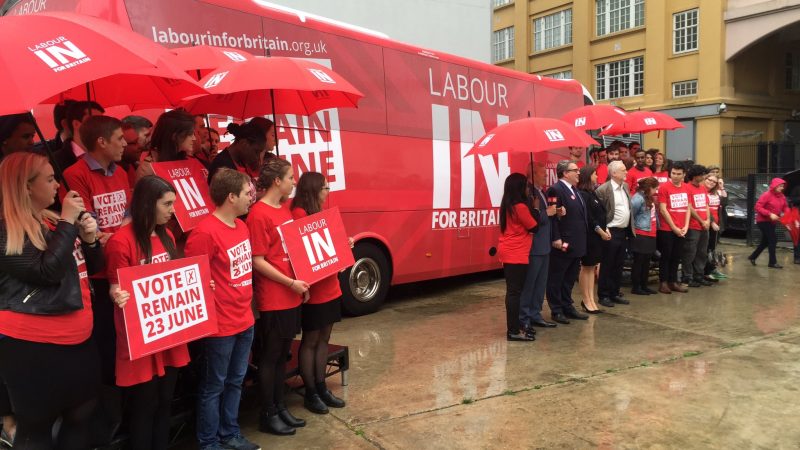
As the 2016 referendum got underway, two Labour campaigns emerged – Labour IN for Britain, founded by Alan Johnson, and Labour Leave, chaired by Brendan Chilton.
Johnson said: “Our job was to get a Labour vote out, pure and simple – to get Labour people voting Remain.”
He said the strongest argument for Remain through a Labour lens could be summarised in a single word: “solidarity”.
“When countries that had been dictatorships were suddenly democracies all without a bullet being fired, all because there was a thing called the European Union – that reflected our values and principles and toleration and respect of the law.”
Meanwhile, the smaller band of 20 or so Labour MPs in the Labour Leave camp, including Graham Stringer, focused their case for Leave around Bennite-style arguments of accountability, democracy and national sovereignty.
Chilton said: “Our job, first of all, was to represent that cohort of voters that were Labour but also wanted to Leave.”
However, he also said another job in the campaign was to “disrupt” Labour’s Remain campaign.
“We would attend debates; if there was a Labour Remain stall in some village, ours would pop up next to it; if we got wind that a load of Labour Remain leaflets were being delivered in East London, ours would go out the next week, that sort of thing.
“I remember one night, I don’t know why, but there were like 20 debates in London – and we had to organise Ubers to pick up MPs as soon as the debate was finished and ferry them immediately over to another [debate].
“I remember we had this little map with little dots of where our people were speaking that night. I felt like the air command in the war, with nothing in reserve.”
‘Corbyn was the biggest asset the Leave campaign had’
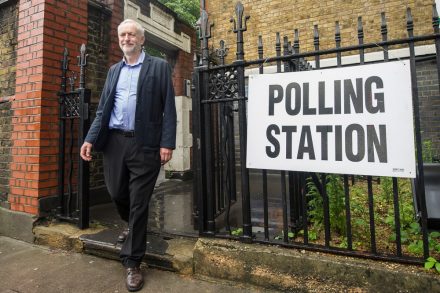
Jeremy Corbyn at a polling station on June 23, 2016 – photo: Euan Cherry/Shutterstock
Then-Labour leader Jeremy Corbyn, who had long been a eurosceptic, came under fire for his lacklustre enthusiasm in campaigning for Remain.
Chilton said: “Jeremy Corbyn was the biggest asset the Leave campaign had, because essentially he was a Brexiteer – he was an old Bennite Brexiteer – and everyone knew it.
“When he appeared on television, no one believed it. What the party should have done, but it would never have done, would be to say the leader has got a different view to the members.”
Johnson told LabourList that Corbyn was often obstinate when working with Labour’s Remain campaign.
“We didn’t have much to do with Stronger In (the official Remain campaign), but they would help us by having days clear for us to do stuff that would not be diluted by them doing something as well. Jeremy had all these opportunities, but never took them.
“We were going to do something with the surviving Labour leaders, except Jeremy wouldn’t share a platform with Tony [Blair]. There were all these plans and he would not do it.
“He had no problem standing with existing Labour people, but it would have been more powerful if we could have done it with Gordon [Brown] and Tony.”
Despite this, Johnson was clear where the blame for the referendum result lies.
“I don’t blame Corbyn, I blame Cameron. It was absolute folly to have a referendum on Europe out of nowhere.”
‘We surrendered immigration to Leave’
For Johnson, the Remain campaign’s biggest mistake was to surrender the debate around immigration to Leave activists. In particular, he highlights the publication by the ONS of net migration figures around a month before the referendum, with net migration hitting 330,000 in 2015.
He said Labour’s Remain campaign had sought to sell the positive case for immigration and freedom of movement, but “Stronger In wouldn’t talk about it”.
“They said when the argument’s on the economy, we win. When the argument’s on immigration, Leave wins – so let’s keep the argument on the economy.
“Too late – the 330,000 wiped that away. We surrendered it [immigration] to them. We did our bit, David [Blunkett], in particular, was brilliant – but it never got the cut-through.”
When asked what he would have done differently during the campaign, Johnson said: “I would get the immigration stuff in early. We were on the back foot because the ONS published that figure. When they published it, we were kind of reacting to it, so I’d have got in a bit earlier.”
‘Leave should never have put that figure on the side of a bus’
Among Chilton’s memories of the referendum campaign, one rally in Essex stood out.
“I was sitting next to Sir David Amess and we were going onto the stage one by one to speak. The audience had had quite a lot of beer, they were well oiled.
“In terms of the speaking order, it always went everyone, me and then Farage. I’d finished my speech, I sat down and Farage came onto the stage. All I can remember is his silhouette moving up onto the stage and speaking – this was really the moment when I thought this man one day could be a severe and terrifying threat to the Labour movement.
“The audience was what I would call a white working class, but also mixed race working class people from that part of the world. He held that audience in his hand, he was like a conductor.
“I can remember David leaning over to me and he said ‘Thank God there’s not an election tomorrow’.”
For all his criticism of “fanciful claims” made by the Remain campaign, there was one element of the Leave campaign which Chilton singled out for disapproval.
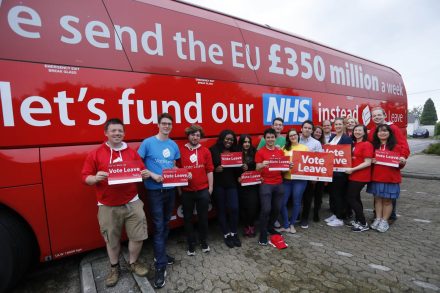
“The official Leave campaign should never have put that figure on the side of a bus. From a PR and marketing campaign, it was very clever – but actually it wasn’t about the referendum.
“It was a silly thing to do, because the way they presented it people were going to expect that we’d leave on the Thursday and on the Friday £350 million was going to land in the NHS’ lap. That was never going to happen.”
‘I anticipated we would lose the referendum’
MP for Oxford East Anneliese Dodds, who served as an MEP for the South East at the time of the Brexit referendum, said there was no point in the entire process that she believed Remain would win the referendum.
“I anticipated we would lose the referendum for two reasons. The first was I was very used to knocking on people’s doors across the South East of England and having the response from people that they didn’t like Europe. They had nothing against me personally but they didn’t like Europe, so that was the first reason why I knew from the beginning that this would be a really difficult referendum.
“Secondly, I felt those who traditionally represented the EU in debates about it within the UK tended to be presenting themselves as supporting the institutions – and for me, as a Labour Party member and activist, I never supported a set of rules and procedures. I supported the fact they had delivered more jobs, that they had brought families’ costs down.
“That was why I supported us remaining, but that argument had just not been made in Britain and, if I’m being completely honest, it wasn’t really made during the referendum either. The debate was focused again on institutions that felt as far away, if not further, than Westminster.”
Stringer, on the other hand, was confident throughout almost all the campaign that Leave would win.
“Our private polling always indicated Leave would win. It turned out to be on a false basis; it was based on relatively low turnout and the extra commitment of Leave voters to vote. It turned out both sides were committed; we just had a majority.
“I always thought we were going to win, until I was sat watching a football match and the news came through that Jo Cox had been shot. I thought that, in the way politics is sometimes completely irrational, I felt at that moment we were ruined.”
The beginnings of the ‘red wall’ schism
In the end, Britain voted by a narrow margin to Leave the European Union, with more than three million Labour voters – particularly in the North of England – splitting with the party’s official stance to vote Leave.
Johnson told LabourList that he was surprised by the result – having expected the Leave margin to be wider than it ended up being on referendum night.
Chilton sees the referendum as the origin of the schism between Labour’s traditional voters in the ‘red wall’ and the party.
“For the first time, Labour voters said to the party ‘we do not agree with your policy’ in their millions and they were able to vote Leave. They were then able to vote Tory, because once they had voted Leave they dabbled a bit, and now they’ve gone Reform.”
Stella Creasy, MP for Walthamstow and chair of the Labour Movement for Europe, said that the relatively close margin of the Scottish independence referendum should have been a “wake-up call” that traditionally progressive voters were losing connection with the principle of collaboration – and that the party was not connecting with them during the campaign.
“The whole Remain campaign was infused with the sense of the sheer arrogance of people for even questioning our membership, that nobody would be that stupid to give it up, so we made a case for the status quo – and as progressives, we should never be satisfied with the status quo until the status quo is without inequality, injustice or inequity.”
Dodds recalled returning to the European Parliament in the wake of the referendum, with many of her colleagues in the Socialists and Democrats grouping being surprised by Britain’s decision to leave – apart from one notable figure.
“Interestingly, the one person who wasn’t was Martin Schulz. He articulated one of my concerns, saying the UK had just gone through a financial crisis, people were rejecting the status quo – and therefore the referendum provided a way for people to register their discontent.”
‘Backing second referendum was the biggest mistake’
In the aftermath of the referendum result, Labour underwent a shift in policy on Brexit from an initial soft Brexit approach toward backing a second referendum by the time of the 2019 election.
All the people we interviewed for this piece, from both sides of the Brexit divide, were unanimous in their view that Labour’s support for a second referendum was a huge mistake.
Johnson said: “It was the biggest mistake. They called it a ‘people’s vote’ – who do you think voted the first time? It fed into this argument that the ruling classes are very keen to get our views, except when they get them, they just ignore them and want to do something else.”
He argued that Labour should have instead supported Theresa May’s Brexit deal, describing it as being “as close as you’re going to get to a soft Brexit reflecting a 52-48 decision”.
“It would have been tough to support Theresa May’s deal, but in a sense we would have been supporting Brussels’ deal.”
Britain’s future with the EU
What should Britain’s relationship with Europe look like in the decade to come? Rather than calling for Britain to rejoin, a position Mayor of London Sadiq Khan has recently urged Labour to adopt, Creasy has advocated for the UK to look into adopting a Swiss-style deal to rebuild our damaged relationship with the EU.
She argued that, while jumping to rejoin is unrealistic in the short term, Switzerland’s sector-by-sector agreements with the EU have helped unlock access to parts of the single market vital to manufacturing and industry.
“I call it a salvage operation. None of that rules out any future relationship or rejoining, but it does recognise the catastrophic damage done by the way in which we left, the urgency of giving people some sense that you could actually fix some of these challenges and showing our European counterparts that we understand and appreciate we have to win back their trust.”
Chilton, on the other hand, sees Brexit as “largely settled”, comparing those wanting to rejoin to the “Japanese soldiers on the islands after World War Two, still fighting after the emperor’s declared peace”.
Instead, he argues the government ought to be doing more to take advantage of being outside of the EU and embrace Mark Carney’s idea of an “alliance of middle powers”.
“I’d like to see a Britain that is looking out to the world… looking to other countries like a resource-rich Canada, Australia, the Pacific countries and India.
“In a world where we’ve got Donald Trump, and even when he goes it’s likely that this American isolationism will continue, we need a Britain armed to the teeth and that is going to mean some very difficult choices in terms of spending.
“We have a real competitiveness problem and a real productivity problem. We should be massively trying to incentivise industry in this country. Why can’t we have a lower corporation tax for manufacturers? Why can’t we have employment incentives for manufacturers? What on earth has happened to planning reform?
“We’ve got a finite time left in government, and if people don’t feel at the end of this that they are wealthier and the country is on a path to prosperity, we’re going to be in real difficulty.”
A decade on, it is clear that scars remain within the Labour family over the divisive referendum and the legacy of the deal struck by Boris Johnson. With growing calls for Labour to pursue a closer relationship with Europe, and with new leadership heading for Number 10, the European question that the referendum sought to answer looks set to continue rumbling through Labour politics for another decade to come.
At the end of May, Greg Bovino, the former chief of the US Border Patrol, was the keynote speaker at a “Remigration Summit” in Portugal. There, he won applause from neo-Nazis for a program that ends in the forced removal of immigrants, legal residents, even citizens. A week later, US Vice-President JD Vance used a British teenager’s murder to attack the country’s immigration policy.
Neither man is British, yet both are helping to engineer Britain’s next Brexit.
The comfortable story is that this is a domestic argument: a homegrown mood and a country internally debating immigration. But Brits told themselves something similar in 2016, when American money, Cambridge Analytica data, and foreign social media operations turbocharged a fringe idea into a referendum result before anyone grasped what had happened.
Remigration is the same playbook. Except now, it runs out in the open.
Look at who is doing the talking. In May, the White House posted an image of Donald Trump crossing out “replacement migration” and writing “remigration”, a word with white-nationalist roots in Europe. Only last week Vance pinned 18-year-old Henry Nowak’s murder on a “mass invasion of migrants”, though the perpetrator was a British citizen. Downing Street has itself warned of outside attempts to interfere in British democracy and stir up division. Vance and Elon Musk are not amplifying a British movement so much as manufacturing one, with Muslim communities as the target and Reform as the vehicle.
The communities on the receiving end feel it deeply. A survey by Opinium for transatlantic thinktank The Concordia Forum found that more than half of British Muslims are more frightened of anti-Muslim violence than a year ago, and roughly a third have changed their routines to avoid certain places. Nearly half fear that they or someone close to them will be harmed.
What makes this so dangerous is that Britain is now less equipped to resist. In March, the government stripped the term “Islamophobia” and the framing of anti-Muslim hatred as racism from its official definition. The same day, it launched a social cohesion plan, with an incoming anti-Muslim hostility “tsar” expected to make that narrower definition permanent. That is a government chasing Reform’s voters, as Labour chased UKIP’s in 2015, and they should realize how that strategy ends: not with the threat contained, but with the mainstream redrawn around it.
The ground has already shifted under our feet. A Hope Not Hate survey this year found that 54% of Reform members want non-white citizens born abroad removed or encouraged to leave – not a fringe grumble about migration, but a majority position, inside a party leading the polls, that some British citizens do not truly belong.
I have seen how this works in my own country. For years, Sweden treated the Quran burnings on its streets mainly as a matter of public order and free speech, arguing over permits and police powers rather than naming the anti-Muslim hatred behind them. One of the men who staged them, Salwan Momika, was eventually shot dead. A government that will not name this hatred as racism loses the power to fight it, and the hostility keeps spreading without ever having to admit what it is.
Yet even Sweden is walking into the same trap again on remigration. Aggressive deportations of teenagers and proposals to pay refugees to leave have focused public debate on how many non-white or Muslim Swedes should be in Sweden, and invited the most hateful to participate. Our once proudly open society risks closing, and threatens the core values that make Swedish and European democracy work.
Some will say this is overblown, that worrying about immigration is legitimate and “social cohesion” is a worthy goal. It is. But a cohesion strategy that deletes the very word for the racism it claims to confront is not building cohesion; it is managing the people it has already decided are a problem. The danger is not only what anti-Muslim racism does to Muslims; it is also about what it does to democratic societies. When a society begins to treat the belonging of one group as conditional, it weakens the principle of equal citizenship for everyone. Historically, exclusion rarely stops with a single group.
And the premise underneath all of it, that Muslims are unassimilated and a threat to Western values, falls apart on contact with the evidence. In that same Concordia poll, British Muslims backed democracy more strongly than the general public – 85% to 71% – and 94% said everyone should be treated equally under the law, against 80% of the wider population.
Naming anti-Muslim racism as racism does not shut down debate; it is a precondition for an honest one, and for protecting every citizen equally. I wrote the Council of Europe’s 2022 report defining Islamophobia as anti-Muslim racism. In doing so, I hoped to give governments across Europe the tools to identify and confront discrimination before it shakes the foundations of European democracy. Britain risks throwing those tools away.
If nothing changes, the cost will not be only trade deals and wasted years, as it was with Brexit. It will be millions of British citizens being told that their place here is conditional, and a party system reorganized around the question of who counts as truly British.
The way to resist is simple. Keep the language. Keep Muslim organizations in the room. Hold the line institutionally and refuse to let the meaning of racism be quietly rewritten under pressure from the same forces that brought us Brexit. In 2016, Britain did not see the interference coming. This time, nobody can say they were not warned.
Momodou Malcolm Jallow is a Member of the Swedish Parliament since 2017 and Chair of the Civil Committee since 2022. His tenure includes roles on the Swedish Delegation to the Council of Europe and contributing to various Riksdag committees. An advocate for racial justice, Jallow previously served as General Rapporteur on Combating Racism and Intolerance for the Parliamentary Assembly of the Council of Europe, and leads the Afro-Swedish Forum for Justice, promoting anti-racism and the welfare of Afro-Swedes.