Offshore Wind Installation Vessels
Cadeler Orders Two More WTIV Vessels Citing Continued Strong Sector Demand
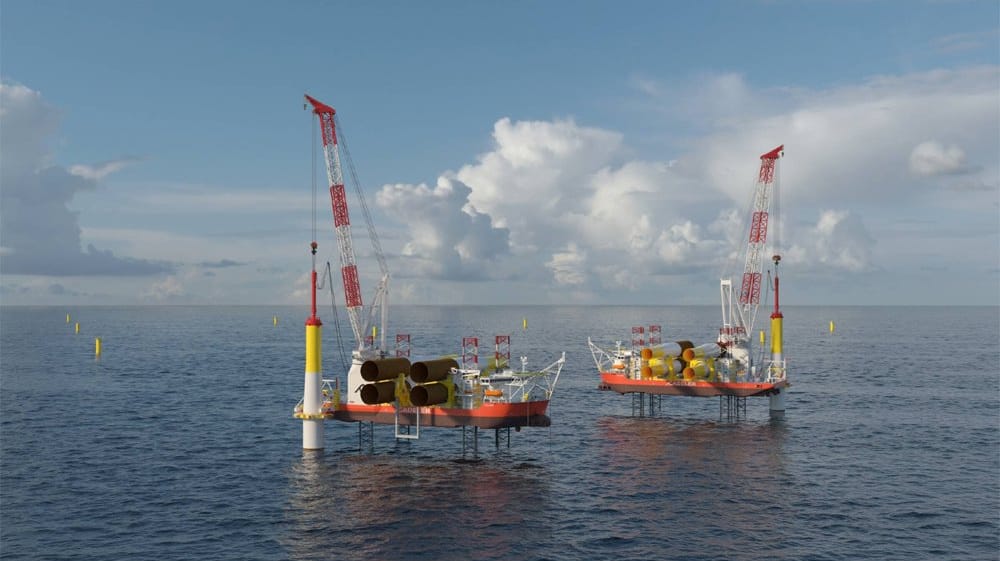
Cadeler, which already says it has the industry’s largest fleet of jack-up offshore wind installation vessels, reported that it has placed a new construction order for two more vessels. The company is continuing its relationship with COSCO Shipping Offshore shipyard in Qidong, China, reporting the value of the new contract at approximately €805 million (US$930 million).
The company recently took delivery of its eleventh vessel, also from the shipyard in China, and still has one more vessel under construction due for delivery in the first half of 2027. It says its strategy is to become the preferred offshore wind installation partner of the industry. It already reports a strong list of projects for the fleet.
The two new ships will be part of what it is calling T-class offshore wind installation vessels, scheduled for delivery in 2030 and 2031. The new T-class series vessels, it says, have been engineered to be the largest and most capable vessels ever introduced to this market, incorporating breakthrough technologies and operational capabilities that extend well beyond current industry standards. The recently introduced A-Class has a deck space of 5,600 square meters, a payload exceeding 18,000 tonnes, and a main crane capable of lifting above 3,300 tonnes at 39 meters. It says the current class can transport and install up to six sets of XXL monopile foundations per load. The A-Class was also designed to be capable of conversion from the installation of XXL foundations to the installation of wind turbine generators.
It did not provide details on the capabilities of the T-Class. However, it said, “Designed to tackle increasingly complex projects with greater efficiency, versatility, and performance, they are expected to open access to new opportunities while reinforcing Cadeler's long-term competitive advantage and commitment to innovation.”
The new Wind Ace is currently undergoing commissioning, and then it will be deployed on ScottishPower Renewables’ East Anglia Two offshore wind farm in the UK. Cadeler will provide the transportation and installation of both foundations and wind turbines for the project. Wind Ace will be joined by one of Cadeler’s O-Class vessels at the site when offshore work commences in 2027.
As of the end of March, Cadeler reported an order backlog at EUR 2,705 million (more than $3.2 billion). The company reports that 82 percent of its backlog relates to projects where clients have already taken final investment decisions.
Vestas Shares Surge as Wind Turbine Orders Rebound
Shares in Danish wind turbine maker Vestas Wind Systems surged more than 20% after the company raised its full-year profit guidance and announced a €400 million share buyback, signaling a sharp recovery for the wind industry.
Vestas said turbine orders jumped to 3.35 gigawatts (GW) worth €3.4 billion in the second quarter, up from 2 GW worth €2.2 billion a year earlier. Its total turbine backlog has now reached 32.5 GW, valued at €36 billion.
The company reported adjusted operating profit of €446 million for the quarter, compared with just €57 million a year earlier. Its operating margin reached 9.4%, putting Vestas close to its long-term target of a 10% margin.
All of the orders booked during the quarter were for onshore turbines, while offshore orders remain more volatile because projects are larger and take longer to develop.
Vestas said the improvement reflects stronger demand for wind projects as governments and developers become more willing to pay higher prices for new capacity. The industry has also benefited from easing supply-chain pressures and a recovery in turbine manufacturers' profitability following a difficult period in 2022 and 2023.
The €400 million buyback is the latest in a series of shareholder returns announced as Vestas recovers from years of rising costs and supply-chain disruptions.
Vestas remains the world's largest wind turbine manufacturer by installed capacity, although Chinese competitors have overtaken it in annual turbine deliveries.


No comments:
Post a Comment