MSC and Chief Engineer Guilty and Fined for 2024 Runaway Boxship Incident
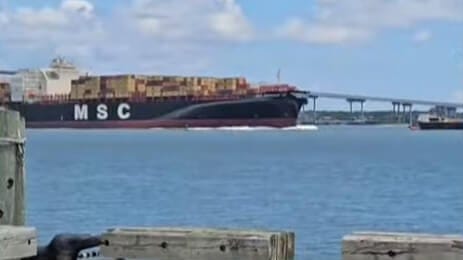
MSC Shipmanagement, as the operating company for the containership that took a full-speed runaway trip through Charleston harbor in 2024, and the chief engineer of the MSC Michigan VII appeared in court on Monday, August 10, admitting their guilt and being ordered to pay fines. The National Transportation Safety Board and the U.S. Coast Guard detailed a series of mechanical failures aboard the vessel, citing maintenance issues and charging a failure to report a hazardous condition.
The company pleaded guilty in court and was sentenced to a criminal fine of $6 million. The company was also ordered to conduct a root-cause analysis of the circumstances relating to the hazardous conditions on the MSC Michigan VII. It will also serve a four-year probation for failing to report the hazardous conditions and obstructing an NTSB and USCG investigation.
The chief engineer of the MSC Michigan VII, Fernando San Diego San Juan, had previously pleaded guilty to failing to report the hazardous conditions and also for obstructing the investigation. He was sentenced to pay a $2,000 fine and will be returned to his home in the Philippines.
“The hazardous condition onboard this vessel, and MSC’s failure to report it, could have ended in a fatal bridge strike,” said Principal Deputy Assistant Attorney General Adam Gustafson of the Justice Department’s Energy and Natural Resources Division (ENRD). “Had the MSC Michigan VII been heading into port instead of out to sea, the result would likely have been catastrophic.”
MSC Michigan VII was built in 2000 and was registered in Liberia. Databases show it started operating for MSC in 2022. The vessel is 998 feet (304 meters) in length with a capacity of 6,648 TEU.
The chief engineer admitted in his pleas that he found the vessel to be in poor condition when he boarded at the start of his contract months earlier. He had discussed the issue with the technical supervisor before the ship reached Charleston in June 2024. On the day of the incident, it was departing the terminal and completed the turn in the basin to begin the transit out of the port on the Cooper River.
The pilot reported to the USCG that they had lost control of the ship, and it was runaway making between 16 and 17 knots during its wild ride through the harbor. The two-and-a-half-mile, eight-lane Arthur Ravenel Jr. Bridge spanning the harbor was ordered closed and evacuated. Two people were injured on the shore by the wash from the vessel, which was going approximately four times the speed limit in the harbor. Ships and boats tied up along the river were damaged, as well as piers. The Coast Guard ordered local beaches cleared. Somehow, the crew was able to steer the vessel, avoiding the bridge and finally regaining control outside the harbor.
During the investigation, it was determined that the linkage rod running to the vessel’s governor had disconnected. The main engine was running at full speed, and the crew was unable to control the speed of the containership.
It came out that the ship was having a problem achieving the ordered speeds from the bridge, and the solution was to manually adjust the linkage rod between the governor and the fuel rack to achieve the ordered RPMs. It was discovered that the nuts on both ends of the linkage rod were loosened by the MSC Michigan VII’s engine department crew so that the rod could be more easily turned to adjust its length and, therefore, the main engine RPMs. The upper and lower locking washers, designed to prevent the rod from being backed out, had been removed. USCG found one of the locking washers on the deck beneath the governor.
In the court filing, it was asserted that only trained technicians should manually adjust a vessel’s governor and linkage rod. It states that none of the engineering crew onboard the MSC Michigan VII were qualified to make the adjustments. San Diego San Juan admitted that he knew that this practice was hazardous because manually adjusting the length of the linkage rod could cause it to fail. Nevertheless, he allowed the practice to continue.
During their investigation, the USCG and the NTSB interviewed San Diego San Juan, and asked him if the linkage rod was ever adjusted. He said that the crew never adjusted the linkage rod, and only a qualified technician would adjust the linkage rod.
The NTSB and USCG later interviewed San Diego San Juan again and asked him whether there had been a delay between the bridge telegraph and the main engine response in the past. He said there had not been. San Diego San Juan was asked again if anyone had ever adjusted the linkage rod, and he falsely answered “no.” However, he later admitted he knew that the governor linkage rod had at previous times been manually adjusted to reach the desired RPM.
In pleading guilty, MSC and San Diego San Juan admitted that, on occasion, the exact revolutions per minute (rpm) ordered by the MSC Michigan VII’s bridge telegraph could only be achieved if the length of the linkage rod between the governor and fuel rack was manually adjusted.
Further, during the USCG inspection of the MSC Michigan VII after the incident, it is alleged that San Diego San Juan told another crew member that he had said to the USCG that he did not see anyone adjust the linkage rod. He told that crewmember and two others to say what he had said to the USCG so they would be on “the same page.”
The court papers detailed other issues that San Diego San Juan discovered after joining the ship in April 2024. One of the main air compressors leaked and was malfunctioning. As a result, there was a risk that the main engine would not receive sufficient air during maneuvering. The ship’s generators could also not sustain enough power at times to run the bow thruster. The ship was also said to be at risk of a blackout.
The ship was detained for weeks in Charleston, but made repairs and returned to service. The chief engineer had been facing a maximum sentence of six years imprisonment and/or a fine of $250,000, as well as a term of up to three years supervised release for failing to report the hazardous condition. The charge of obstructing the proceeding also had a maximum sentence of five years imprisonment and/or a fine of $250,000, as well as up to three years supervised release.
MSC’s Terminal Company Withdraws Antitrust Review for Barcelona Acquisition
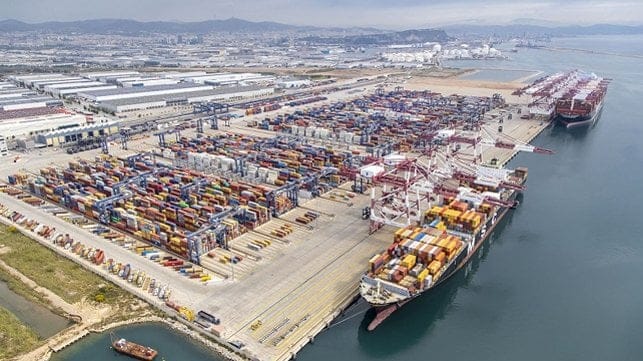
MSCs’ terminal operating company, TiL (Terminal Investment Limited), withdrew its application last week for an EU antitrust review for its proposed acquisition in Barcelona. Last year, the company agreed to the acquisition of the Barcelona Europe South Terminal (BEST) operated Terminal Catalunya in Barcelona, which is a division of CK Hutchison.
There was no explanation why the application was withdrawn, just a brief status note as of August 3 on the case, which was under review by the European Commission. The competition authority had been notified of the proposed acquisition at the beginning of November 2025 and reported that it found in a preliminary examination that it could fall within the scope of the European Commission’s Merger Regulation.
It was highlighted that the terminal is one of the main deep-sea gateways for cargo to Barcelona and Spain. Opened in 2012, the terminal is part of the port’s larger operations, which also include bulk cargo and vehicles. Hutchison BEST recently highlighted that the terminal has tripled its volume since 2013, reaching close to 2.8 million TEUs in 2025 and consolidating its position as a key Mediterranean gateway for international trade. This growth translates into high operational activity, with more than 1,200 vessels handled in a single year and a strong commitment to rail transport, reinforcing its role as a benchmark logistics node. It further reported that the terminal had exceeded its initial forecasts, reaching €876 million in investment — 32 percent above the expected figure — driving automation, digitalization, and sustainability projects that strengthen its long-term competitiveness.
The European Commission in December 2025 reported that it was proceeding with an in-depth investigation into the proposed acquisition of TERCAT, noting that MSC already had significant operations in the port of Barcelona.
The Commission said it had preliminary concerns that the transaction could lead to higher prices or reduced quality of container terminal services at the port of Barcelona. It said the investigation would consider the potential for significantly reduced competition for container services in Barcelona and the potential impact on shipping companies competing with MSC.
The Commission speculated that the merged entity could provide preferential treatment to MSC for the use of BEST’s container terminal services. They said this could take the form of higher prices, late access to the berth, or the limited availability of cranes and storage space for MSC’s competitors. They said competitors would also have a limited possibility to switch to the other deep-sea container terminal in the port of Barcelona, Terminal de Contenedores de Barcelona.
Under the European regulations, the Commission had until the end of April to reach a decision. However, that could be postponed as it sought information or other input.
The acquisition was separate from the larger deal that TiL and BlackRock were negotiating with CK Hutchison for the acquisition of its international terminal portfolio. The larger deal ran into roadblocks due to Chinese opposition, and while there is still interest, so far, a revised deal that might carve up the Hutchison portfolio, with a portion going to COSCO, has reportedly been discussed, but no agreement was announced. It was also further complicated by Panama’s moves in February that voided Hutchison’s concession for the two ports in Panama, which were a separate element of the larger transaction.

No comments:
Post a Comment