Ukraine Confirms Hits on Four Russian Warships at Novorossiysk
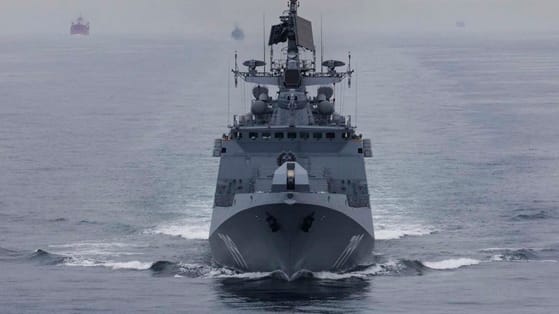
Ukraine's military has confirmed that its latest attack on Novorossiysk damaged four Russian warships, demonstrating again that the entire Black Sea is a high-risk region for the Black Sea Fleet.
Overnight August 12, Ukrainian forces used jet-powered strike drones, locally-built Neptune anti-ship missiles, and its well-known naval drones to attack the Russian Navy fleet at Novorossiysk. Bystander footage showed an intense barrage of air defense activity. Despite the attempt to fend off the strike, Ukraine's attack hit two frigates - Admiral Essen and Admiral Makarov - one Buyan-M missile ship and one Vasil Bykov-class patrol vessel. The General Staff said that it is still assessing the full extent of the damage, but independently-obtained satellite imaging suggests that it was not catastrophic: none of the targets were visibly on fire or sinking as of Wednesday.
Admiral Essen and Admiral Makarov are both Grigorovich-class missile frigates, with eight VLS cells for Kaliber, Oniks or Zircon cruise missiles - all routinely used to strike targets in Ukraine. These warships' launch capabilities make them high priority targets, and Ukraine has claimed to have hit both vessels before - Essen on March 2 and Makarov on March 6.
The strike August 12 also hit a grain terminal and a pier at the Sheskharis oil terminal. The region's governor claims that drone debris also damaged a residential area, killing one eight-year-old child and injuring other civilians.
Novorossiysk is a key export hub for Russia's Black Sea oil trade, including both all-Russian volumes at the Sheskharis terminal in the inner harbor and the primarily-Kazakh volumes at the CPC single-point mooring facility just off the coast. Under pressure from U.S. oil interests - heavily invested in the CPC's abundant production - Ukraine has agreed to stop attacking the SPM and its marine traffic, though Sheskharis remains on the list.
Inside the harbor, the Russian Navy has accumulated a large concentration of warships, many of which were previously stationed at Sevastopol. The threat of Ukrainian seaborne drones has forced the Black Sea Fleet to retreat to the relative safety of the Novorossiysk - but the range and persistence of Ukraine's drone forces has made even this option less attractive.
Ukrainian Strikes Hit Novorossiysk Naval Harbor

On Wednesday morning, the waterfront at the Russian Black Sea port of Novorossiysk was once again blanketed in smoke, the result of yet another Ukrainian drone strike on the strategic port facility.
Novorossiysk is a key export hub for Russia's Black Sea oil trade, including both all-Russian volumes at the Sheskharis terminal in the inner harbor and the primarily-Kazakh volumes at the CPC single-point mooring facility just off the coast. Inside the harbor, the Russian Navy has accumulated a large concentration of warships, many of which were previously stationed at Sevastopol. The threat of Ukrainian seaborne drones has forced the Black Sea Fleet to retreat to the relative safety of the northeastern Black Sea - but that safety is increasingly at risk.
Hundreds of Ukrainian drones descended upon the port overnight Tuesday, according to Krasnodar's regional government. Despite intense air defense activity, some number of drones appear to have reached their targets in the harbor. NASA FIRMS infrared remote sensing shows bright fires burning inside the naval yard at Novorossiysk, including some areas that are directly on the waterfront. Defense analyst MT Anderson assesses that in this area, current Russian assets include nearly two dozen warships and auxiliaries, ranging from rescue tugs up to an improved Kilo-class sub. Notable elements of the list include Russian tank landing ships (both Ropucha-class and older Tapir-class) and two Admiral Grigorovich-class frigates.
Novorossiysk is far from the only target. Throughout the Black Sea and the Sea of Azov, the Ukrainian threat to Russian shipping is forcing "shadow fleet" operators to make adaptations, including physical modifications to the vessels. Newly-spotted examples include cables strung from the bridge forward; netting and IBC totes arrayed around a pilothouse; and dazzle paint, an innovation of World War I designed to confuse enemy forces about the vessel's true heading.
Ukrainian Attack Halts Operations at Key Russian Black Sea Grain Terminals
Did President Zelensky and the Ukrainian armed forces not listen to US Vice President JD Vance's warnings and request after all?
On Wednesday a "massive" Ukrainian drone and missile strike was unleashed on Russia's port city of Novorossiysk, which badly damaged grain export terminals at what also constitutes the last major Russian naval base on the Black Sea.
Three were killed, including an eight-year-old child, and also 24 people were injured in the Wednesday nighttime attack.
Zelensky acknowledged the rocket and underwater drone attack in what he hailed as a "unique operation" to strike the Russian naval base at Novorossiysk.
It seems Zelensky is distinguishing this instance as a hit on a purely 'military target' given he did not mention the grain export terminal aspect of the destruction.
"The occupying fleet and all the infrastructure that supports it will not be safe as long as Russian aggression continues," Zelensky said.
Many Russian assets previously docked at the longtime Russian fleet's home base of Sevastopol were forced to vacate during earlier phases of the war, given the frequent prior targeting of the historic Crimean naval hub. Some ships have even been relocated as far away as the Caspian Sea in order to protect them.
The attack could seriously impact global food supplies, particularly in the African continent.
Reuters has said shutdowns resulted: "Two of Russia's biggest grain terminals at the southern port of Novorossiysk have suspended operations as a result of overnight Ukrainian drone strikes, four industry sources told Reuters on Wednesday."
"Russia is the world's largest wheat exporter and most of those exports are shipped via its Black Sea ports like Novorossiysk. Russia's main grain lobby group warned last month that Ukrainian drone attacks could shut down grain exports via the Black Sea in the near future, pushing up prices and causing hunger in Africa and the Middle East," the report added.
Novorossiysk is also home to vital oil export infrastructure. Kiev has essentially declared open season on Russian oil exports, arguing that proceeds fuel Russia's military machine.
A state of emergency has been declared in Novorossiysk after a Ukrainian drone attack
Due to the rupture of two water mains, the city’s water supply system has been damaged, and water delivery to residents has been restricted.
We reported earlier that at the urging of Vice President Vance, Ukraine indicated that it has suspended attacks on oil tankers using Novorossiysk. The request was made in late July, but first reported today by the Financial Times, citing Ukrainian officials.
Vance's plea sprang from the Trump administration's worries that Ukraine's attacks were creating dangerous instability in global fuel markets. There were also concerns that strikes on vessels transporting Kazakhstan crude oil to the Caspian Pipeline Consortium (CPC) terminal at Novorossiysk were detrimental to American companies.
So it will be interesting to see if in the wake of this latest Wednesday attack, Washington ramps up the pressure on its Ukrainian ally - or whether such attacks will continue and be met with US silence.
By Zerohedge.com
Refinery Attacks Deepen Global Diesel Supply Crunch
- Diesel prices are surging as Ukrainian attacks on Russian refineries and Houthi attacks on Saudi energy infrastructure are deepening an already severe global fuel shortage.
- U.S. diesel futures jumped 7.4% this week, while retail prices reached $5.32 per gallon.
- Refining capacity is stretched to the limit, with margins soaring and major U.S. refiners running above 95% utilization
Diesel prices surged earlier this week on news about yet another Ukrainian attack on a Russian refinery and a Houthi attack on a Saudi refining facility. Global fuel supply is already out of balance, and the continued refinery disruption will only aggravate the situation, right before peak demand season.
Reuters reported Monday that refining margins in Europe had surged by 10%, and that surge was from an already elevated starting point as refiners around the world see their margins rise to all-time highs on the supply tightening caused by the war in the Middle East and the Ukrainian drone attacks on Russia’s refinery network.
In the United States, the report said, diesel futures booked their sharpest rise since July on Monday, adding 7.4% to $4.19 per gallon. The average retail price for a gallon of diesel was $5.32 on Tuesday, according to AAA data. That was up from $4.88 per gallon a month ago and $3.71 per gallon a year ago. To put it mildly, this is problematic.
Diesel is often referred to as the workhorse of any economy. Indeed, economies run on diesel, which is used for everything from freight transportation to farming, to heating during the winter. If diesel prices are consistently higher for an extended period of time, they will inevitably be passed on to consumers, fueling a more generalized inflation trend.
“Refining margins remain elevated because every additional barrel of product has become significantly more valuable than every additional barrel of crude,” Kpler lead analyst for refining supply and modeling, Sumit Ritolia, told the Wall Street Journal this week.
Indeed, refining margins are breaking records this year, with the WSJ noting that the 3-2-1 crack spread used as a sort of refining margin benchmark had gone up to over $70 per barrel—from a usual level of less than $20 per barrel.
What’s more, refineries are operating at higher than usual utilization rates to make up for lost supply from the Middle East and Russia, but there are limits to how much they can ramp up production. “Refinery utilization above 90-95% simply means there is very little operational flexibility left,” Kpler’s Ritolia told the Wall Street Journal.
Exxon and Chevron recently reported utilization rates of 95% to 97%, while Shell reported utilization rates of over 100%. Now, refineries are beginning to enter maintenance season, which has become even more essential than it already is to ensure fuel supply security. However, refinery season does mean that some output will be temporarily lost, likely pushing fuel prices even higher.
In some parts of the world, there is a refinery shortage, as well. One such part is Europe, where refineries have been closing for years, as national governments and the central EU government pushed ahead with their decarbonization agenda that envisaged mass electrification of transport. This has not happened yet, keeping demand for hydrocarbon fuels substantial, but domestic supply has dwindled. That has exposed the EU even more to global energy markets and caused its import bill to swell.
Analysts now expect refining margins to remain significantly higher than usual until the end of the year because even if the war in the Middle East ends tomorrow—highly unlikely as this is—it will take a while for supply to get rebalanced and Russia’s ban on diesel fuel exports is not getting lifted until 2027.
China, which prevented a surge in global crude oil futures prices by slashing imports, is not about to do the same for fuel prices. The country has kept its export curbs in place, although it has relaxed them, allowing refiners to export more fuels in August. The temporary easing of export caps will be in effect this month, but refiners would also be allowed to roll some of the volumes over to September if they fail to secure purchase deals for the whole allotment.
That will not help with the global fuel crunch, like record U.S. exports have not helped, although they have filled some of the gap left by Russia and the Middle East. Meanwhile, in the U.S. itself, diesel inventories have slumped to the lowest for this time of the year in 30 years, Reuters noted in its report on record diesel prices. In other words, the U.S., the world’s biggest oil and fuel exporter, has limited space for boosting exports to fuel-hungry parts of the world further.
To make the picture even gloomier, the U.S. Energy Information Administration said earlier this week it expected some oil production in the Middle East to remain shut in well into 2027, maybe even until the end of the year. This suggests a prolonged supply squeeze both in crude oil and, as a consequence, in fuels. Such a trend might accelerate transport electrification, but then again, it might sap demand for EVs as well as higher fuel costs spread to every industry, including EVs.
By Irina Slav for Oilprice.com

No comments:
Post a Comment