Vietnam Starts Construction of its Largest Domestically Built Frigate

Vietnamese officials turned out on Monday, August 10, to celebrate the start of construction of what is being billed as the country’s largest and most modern warship. The frigate is being built domestically, with the state emphasizing it is part of its strategy to develop internal capabilities and demonstrate its expanding skills.
The reports highlighted that the frigate is being designed entirely by Vietnamese engineers. In addition, most of its weapons and military equipment will be developed or assembled in Vietnam. In the past, Vietnam has largely depended on its allies for military equipment.
For example, it introduced approximately 15 years ago a class of multi-role missile frigates designed and built in Russia by the Zelenodolsk Design Bureau and the A.M. Gorky shipyard. Known as the Gepard 3.9 missile frigates, the vessels displace around 2,000 tons with a length of 102 meters (335 feet). These warships are deployed by the Vietnam People's Navy for surface strikes, air defense, and anti-submarine warfare.
In the past, Vietnam’s military shipbuilding has mostly focused on building missile boats and patrol vessels. In addition to Gepard-class frigates, Vietnam also acquired Russian-built Kilo-class submarines.
Few details were provided about the size or capabilities of the new class, but analysts are saying they will be in the 2,000 to 3,000-ton displacement range. Reports said Vietnam projects the first ship will be completed in 36 months. The reports indicate that the vessel will likely incorporate an active electronically scanned array (AESA) radar, air-defense missiles, and anti-ship missiles.
The new frigate is being described alternately as a multipurpose vessel and an anti-submarine warship. The project was assigned to the Song Thu Corporation, which is reported to be one of the country’s leading military shipbuilders.
Party officials said during the steel cutting ceremony that the goal is developing a defense industry that is self-reliant, self-sufficient, capable of dual-use and fully modern. Vietnam has already developed a successful commercial shipbuilding capability, which it looks to further co-op into naval projects.
Vietnam has been actively pursuing efforts to expand and modernize its navy and military. It, along with several other neighboring countries, has found itself in an increasing number of disputes as China seeks to expand its influence and range in the region.
Video: Poland Rolls Out First of Three Next-Generation Frigates
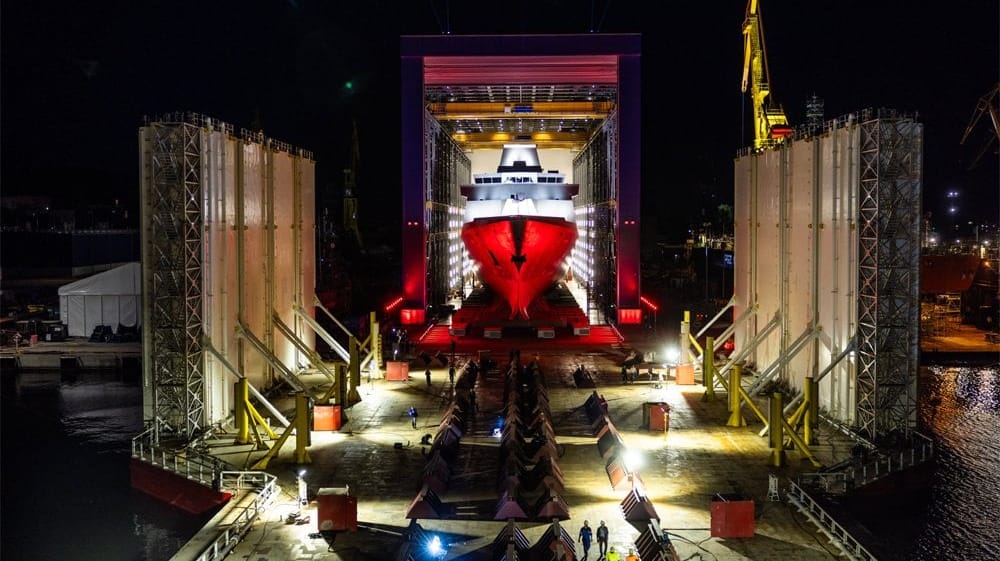
In a dramatic nighttime event in Gdynia, Poland, the first of the country’s three new frigates was rolled out of the building hall on August 9. The program, which is reported to be costing more than $4 billion, started more than a decade ago and will be the largest in Polish naval history.
Poland originally envisioned building smaller vessels, but as world events evolved, the country ordered three 7,000-ton displacement frigates in 2021. The vessels are designed to replace two aging vessels, Gen. Kazimierz Pulaski and Gen. Tadeusz Kosciuszko, Oliver Hazard Perry-class guided-missile frigates commissioned by the United States in 1980 and transferred to Poland in 2000. The aging vessels are smaller at 4,100 tons displacement.
The new ships are designed as multi-role frigates to support Poland’s activities in the Baltic and coastal monitoring as well as NATO. The new ships measure approximately 140 meters (459 feet) with a crew of 120 and a speed of 28 knots. The design of the vessels is adapted from the Babcock International Arrowhead-140 vessels.
The ships will be equipped with anti-aircraft and anti-missile systems, surface-to-surface and surface-to-surface fire systems, and anti-submarine torpedoes. Ultimately, the ships will be outfitted with VLS Mk-41 vertical launchers and CAMM missiles for anti-aircraft systems. RBS-15 missile launchers will be used to engage surface and land targets. Artillery armament will include a 76 mm OTO Melara Super Rapid Strales medium-caliber gun, two 35 mm OSU-35K guns, and remotely controlled weapon modules equipped with large-caliber machine guns.
Work on the project known as Miecznik is underway at the PGZ Stocznia Wojenna shipyard. Assembly of the first of the vessels, named Wicher (Polish for Gale), began in February 2024 with the keel laying in December. The second vessel, Burza (Storm), began construction in May 2025, and the keel for the third vessel, Huragan (Hurricane), will be laid in November.
The hull of the new vessel was placed on a barge cradle and pulled from the building hall. Wicher is scheduled to be christened on Wednesday, August 12, and then the barge will be towed into the Gulf of Gdansk and lowered. After the vessel is afloat, tugs will tow it to the berth for outfitting.
Wicher is scheduled to be delivered to the Polish Navy in 2029. Her sisters will follow in 2030 and 2031. Part of a program to rebuild the Polish Navy, the frigates will be among the most capable in NATO when they are commissioned.

No comments:
Post a Comment