Showing posts sorted by relevance for query Frida Kahlo. Sort by date Show all posts

Tuesday, July 16, 2024

On anniversary of Frida Kahlo’s death, her art’s spirituality keeps fans engaged around the globe


 An art handler adjusts Frida Kahlo’s “Diego and I” on display at Sotheby’s auction house during a press preview for the Modern Evening auction,in New York. 
The 70th anniversary of Kahlo’s death is on July 13, 2024. 
(AP Photo/Mary Altaffer, File)


BY MARÍA TERESA HERNÁNDEZ
 July 13, 2024

MEXICO CITY (AP) — Frida Kahlo had no religious affiliation. Why, then, did the Mexican artist depict several religious symbols in the paintings she produced until her death on July 13, 1954?

“Frida conveyed the power of each individual,” said art researcher and curator Ximena Jordán. “Her self-portraits are a reminder of the ways in which we can exercise the power that life — or God, so to speak — has given us.”

Born in 1907 in Mexico City — where her “Blue House” remains open for visitors — Kahlo used her own personal experiences as a source of inspiration for her art.

The bus accident that she survived in 1925, the physical pain that she endured as a consequence and the tormented relationship with her husband — Mexican muralist Diego Rivera — all nurtured her creativity.

Her take on life and spirituality sparked a connection between her paintings and her viewers, many of whom remain passionate admirers of her work on the 70th anniversary of her death.

One of the keys to understand how she achieved this, Jordán said, lies in her self-portraits.

Kahlo appears in many of her paintings, but she did not portray herself in a naturalistic way. Instead, Jordán said, she “re-created” herself through symbols that convey the profoundness of interior human life.

RELATED STORIES
Peace must be a priority, say Catholic leaders on anniversary of priests' violent deaths in Mexico
In secular France, chaplains prepare to provide Olympians with spiritual support during the Games
The Camino, a Catholic pilgrimage, increasingly draws the spiritual but not religious

“Diego and I” is the perfect example. Painted by Kahlo in 1949, it sold for $34.9 million at Sotheby’s in New York in 2021, an auction record for a work by a Latin American artist.

In the painting, Kahlo’s expression is serene despite the tears falling from her eyes. Rivera’s face is on her forehead. And, in the center of his head, a third eye, which signifies the unconscious mind in Hinduism and enlightenment in Buddhism.

According to some interpretations, the painting represents the pain that Rivera inflicted on her. Jordán, though, offers another reading.

“The religiosity of the painting is not in the fact that Frida carries Diego in her thoughts,” Jordán said. “The fact that she bears him as a third eye, and Diego has a third eye of his own, reflects that his affection for her made her transcend to another dimension of existence.”

In other words, Kahlo portrayed how individuals connect to their spirituality through love.

“I connected with her heart and writings,” said Cris Melo, a 58-year-old American artist whose favorite Kahlo work is the aforementioned painting. “We had the same love language, and similar history of heartache.”

Melo, unlike Kahlo, did not go through a bus accident that punctured her pelvis and led to a life of surgeries, abortions and a leg amputation.

Still, Melo said, she experienced years of physical pain. And in the midst of that suffering, while fearing that resilience might slip away, she said to herself: “If Frida could handle this, so can I.”

Even if most of her artwork depicts her emotional and physical suffering, Kahlo’s paintings do not provoke sadness or helplessness. On the contrary, she is seen as a woman — not only an artist — strong enough to deal with a broken body that never weakened her spirit.

“Frida inspires many people to be consistent,” said Amni, a London-based Spanish artist who asked to be identified only by his artistic name and reinterprets Kahlo’s works with artificial intelligence.

“Other artists have inspired me, but Frida has been the most special because of everything she endured,” Amni said. “Despite her suffering, the heartbreak, the accident, she was always firm.”

For him, as for Melo, Kahlo’s most memorable works are those in which Rivera appears on her forehead, like a third eye.

According to Jordán, Kahlo touched a chord that most artists of her time did not. Influenced by revolutionary nationalism, muralists like Rivera or David Alfaro Siqueiros kept a distance from their viewers though intellectual works that mainly focused on their social, historic and political views.

Kahlo, on the other hand, was not shy in portraying her physical disabilities, her bisexuality and the diversity of beliefs that weigh on the human spirit.

In “The Wounded Deer,” for example, she is transformed into an animal whose body bleeds after being shot by arrows. And just like a martyr in Catholic imagery, Kahlo’s expression remains composed.

Aligned with a Marxist ideology, Kahlo thought that the Catholic Church was emasculating, meddlesome and racist. But in spite of her disdain toward the institution, she understood that devotion leads to a beneficial spiritual path.

A decade after her accident, probably overwhelmed by the fact that she survived, Kahlo started collecting votive offerings — tiny paintings that Catholics offer as gratitude for miracles. In her Blue House, the 473 votive offerings are still preserved.

Kahlo might have regarded her survival as a miracle, Jordán said. “The only difference is that she, due to her context, did not attribute that miracle to a deity of Catholic origin, but to the generosity of life.”

Perhaps that’s why, in her final days, she decided to paint a series of vibrant, colorful watermelons that would be her last work.

In that canvas, over a split watermelon lying underneath a clouded sky, she wrote: “Vida la vida,” or “Long live life.”


 The house where Frida Kahlo once lived, called the Diego Rivera and Frida Kahlo House and Studio Museum, is linked with a walkway bridge to a white and pink house-studio once occupied by her husband Diego Rivera, in Mexico City, Oct. 31, 2017. The 70th anniversary of Kahlo’s death is on July 13, 2024. (AP Photo/Anita Snow, File)

 Frida Kahlo, Mexican painter and surrealist, poses at her home in Mexico City, April 14, 1939. The 70th anniversary of Kahlo’s death is on July 13, 2024. (AP Photo, File)

 A visitor stylized as Frida Kahlo takes a selfie with Frida’s Kahlo self-portrait at the Frida Kahlo retrospective exhibition at the Faberge Museum in St. Petersburg, the first Frida Kahlo exposition of such scale in Russia, Feb. 2, 2016. The 70th anniversary of Kahlo’s death is on July 13, 2024. (AP Photo/Dmitry Lovetsky, File)

Autumn Williams and Mateo Londono view a 1938 photo by Nickolas Muray titled “Frida and Diego with Gas Mask” at the Frida Kahlo and Diego Rivera art show hosted by the NSU Art Museum in Fort Lauderdale, Florida, March 10, 2015. The 70th anniversary of Kahlo’s death is on July 13, 2024. (AP Photo/J Pat Carter, File)

 Dione Lugones shows off her tattoo in the likeness of Mexican artist Frida Kahlo, at La Marca, or The Brand tattoo parlor in Havana, Cuba, Feb. 3, 2016. The 70th anniversary of Kahlo’s death is on July 13, 2024. (AP Photo/Desmond Boylan, File)

- Children color in a giant poster of Mexican artist Frida Kahlo, during a ceremony marking the 5th anniversary of the Tate Modern gallery in Southwark, London, May 12, 2005. The 70th anniversary of Kahlo’s death is on July 13, 2024. (AP Photo/Lefteris Pitarakis, File)

Play director and actress Carla Liguori performs the role of the Mexican painter Frida Kahlo in the musical “Frida, entre lo absurdo y lo fugaz” or “Frida, between the Absurd and Fleeting” in Buenos Aires, Argentina, July 15, 2013. The 70th anniversary of Kahlo’s death is on July 13, 2024. (AP Photo/Natacha Pisarenko, File)

 A mural of Mexican painter Frida Kahlo, painted by Los Angeles muralist Levi Ponce, decorates the Pacoima section of Los Angeles, known as Mural Mile, June 6, 2015. The 70th anniversary of Kahlo’s death is on July 13, 2024. (AP Photo/Richard Vogel, File)

 An artist makes screen prints in the background of Frida Kahlo’s face printed on the art installation from artists, Rirkrit Tiravanija and Tomas Vu, at the Untitled Art gallery during Art Basel, Dec. 6, 2018, in Miami Beach, Florida. The 70th anniversary of Kahlo’s death is on July 13, 2024. (AP Photo/Brynn Anderson, File)


____

Associated Press religion coverage receives support through the AP’s collaboration with The Conversation US, with funding from Lilly Endowment Inc. The AP is solely responsible for this content.


MARÍA TERESA HERNÁNDEZ
Hernández is a reporter on the AP’s Global Religion team. She is based in Mexico City and covers Latin America.

Thursday, December 10, 2020

Feminist Art
Frida Kahlo and Georgia O’Keeffe’s Formative Friendship
Karen Chernick
Mar 20, 2020 


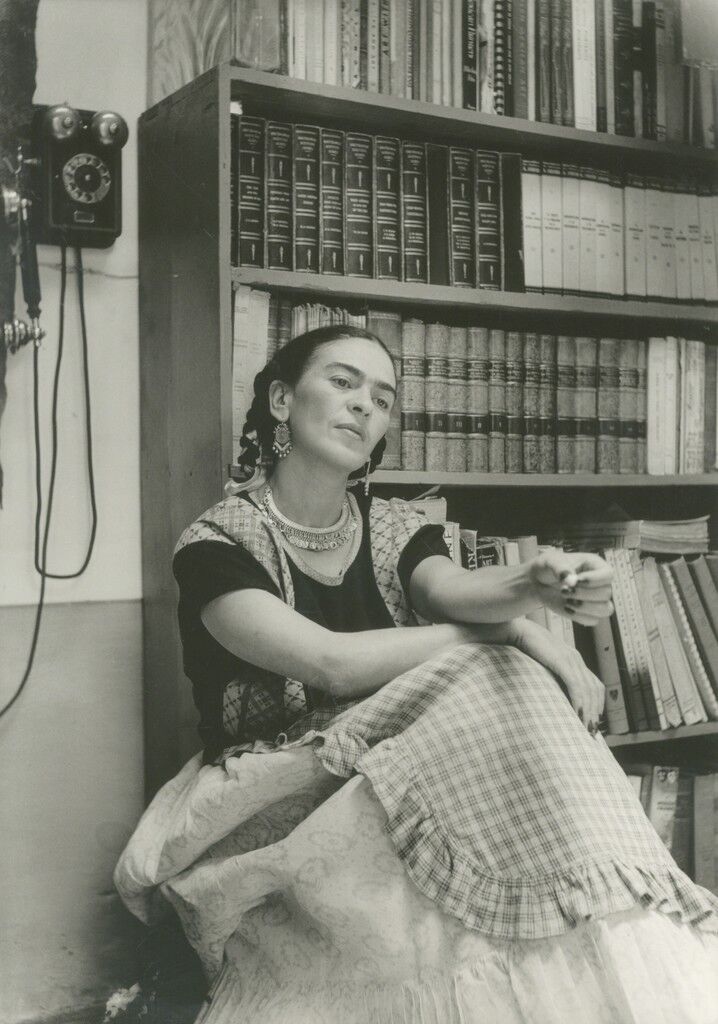
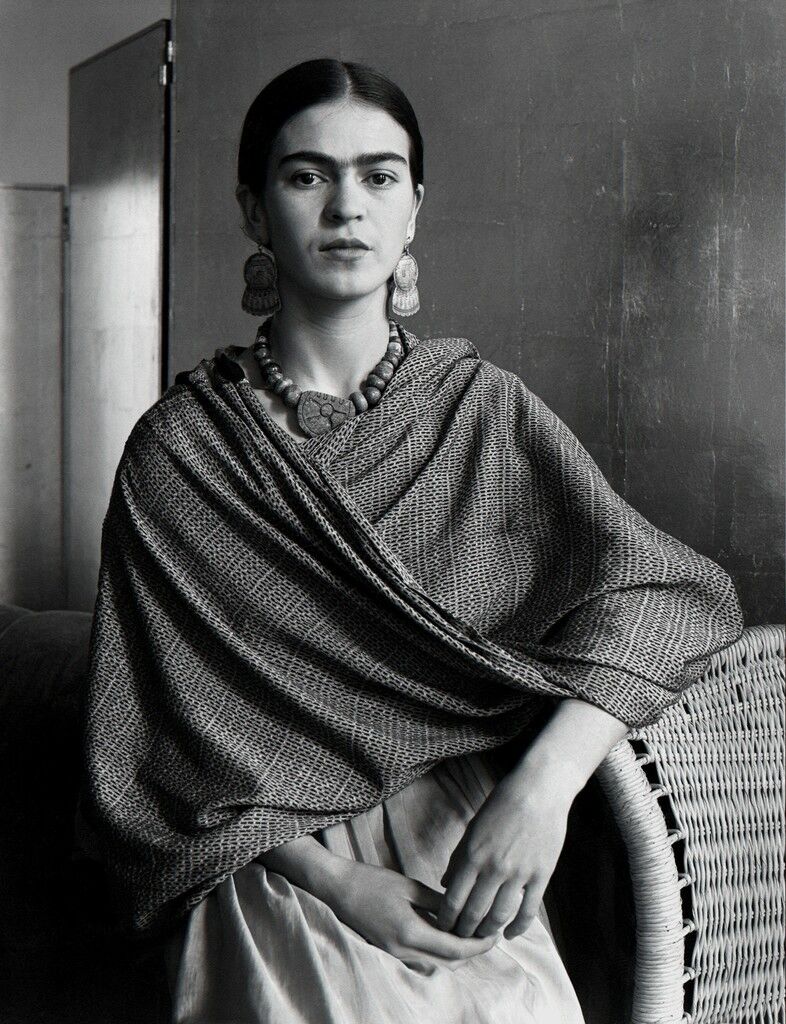
Imogen Cunningham
Frida Kahlo Rivera, 1931
Atlas Gallery£2,500 - 5,000


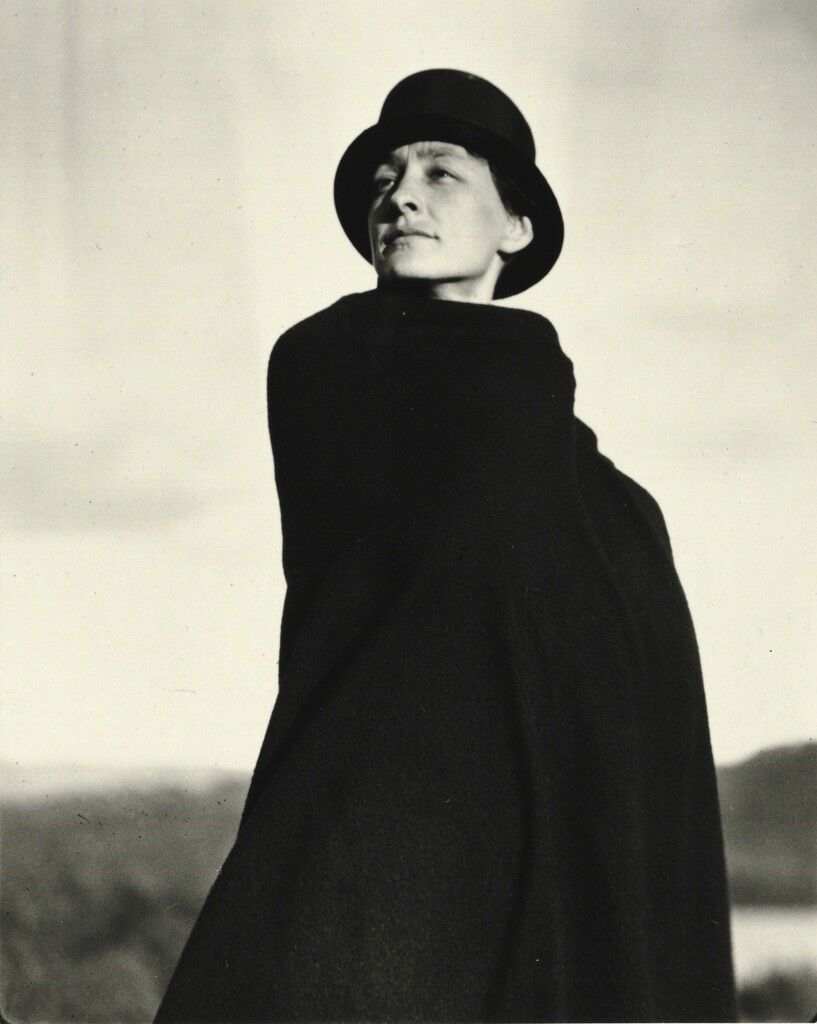
Alfred Stieglitz
Georgia O'Keeffe: A Portrait, 1920–1922
Christie's


Frustrated, Frida Kahlo was finding that none of the letters she was writing felt quite right, and she tore them up, one by one. The young Mexican artist was penning a note to Georgia O’Keeffe—an artistic rock star nearly twice her age, whom she’d befriended while living briefly in New York about a year before. “I can’t write in English all I would like to tell, especially to you,” reads the two-page letter Kahlo ultimately deemed worthy of sending. “I thought of you a lot and never forget your wonderful hands and the color of your eyes. I will see you soon.”

That letter, sent on March 1, 1933, is currently housed at the Beinecke Rare Book & Manuscript Library at Yale University and is the sole document filed in the Alfred Stieglitz/Georgia O’Keeffe archive’s Kahlo folder. 

But Frida in America(2020), a new book about the Mexican painter’s first trip to the United States—from 1930 to 1933, accompanying her husband Diego Rivera on multiple mural commissions—reveals more details about the friendship between a 24-year-old Kahlo, then barely known as a painter, and a venerated and successful 44-year-old O’Keeffe.


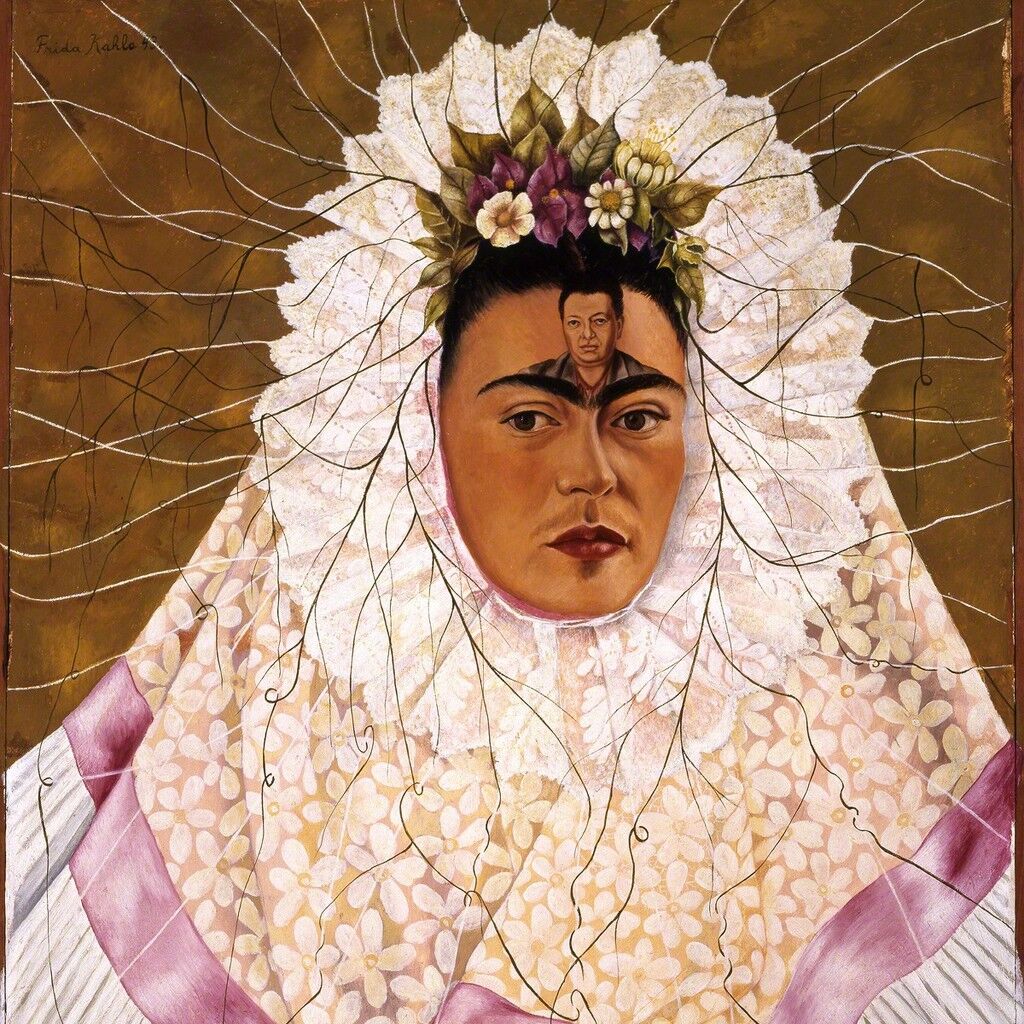
Frida Kahlo
Diego on my mind (Self-portrait as Tehuana), 1943
Art Gallery of New South Wales


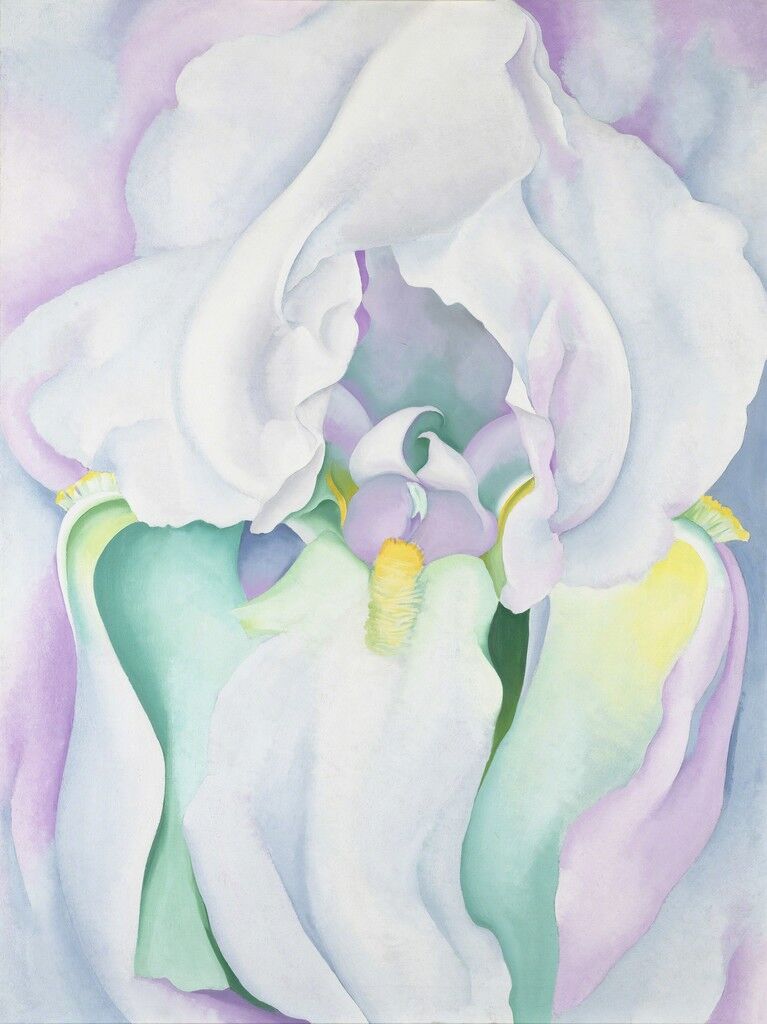
Georgia O’Keeffe
White Iris , 1930
"Georgia O'Keeffe" at Tate Modern, London


Imagining the unibrowed self-portraitist hobnobbing with the eccentric painter of abstracted flora is a fantastic and downright fun image. Understanding Kahlo’s friendship with O’Keeffe also helps flesh out the impact these formative American years had on the budding artist, as she bounced between San Francisco, New York, and Detroit. “It’s important to understand more about this relationship between Frida and Georgia because it provides a fuller context, at least for Frida’s creative development,” says Celia Stahr, author of Frida in America. “What did Frida see while she was in the United States, what did she experience?”


Lucienne Bloch
1909–1999


The two painters met in December 1931, at the opening of Rivera’s big solo exhibition at New York’s Museum of Modern Art. According to Lucienne Bloch, one of Rivera’s assistants, the famed muralist later bragged that his wife had been flirting with O’Keeffe (O’Keeffe already owned a Rivera painting, Seated Woman, making it likely that she and Stieglitz were on the list of people Kahlo felt she should chat up).


Frida Kahlo
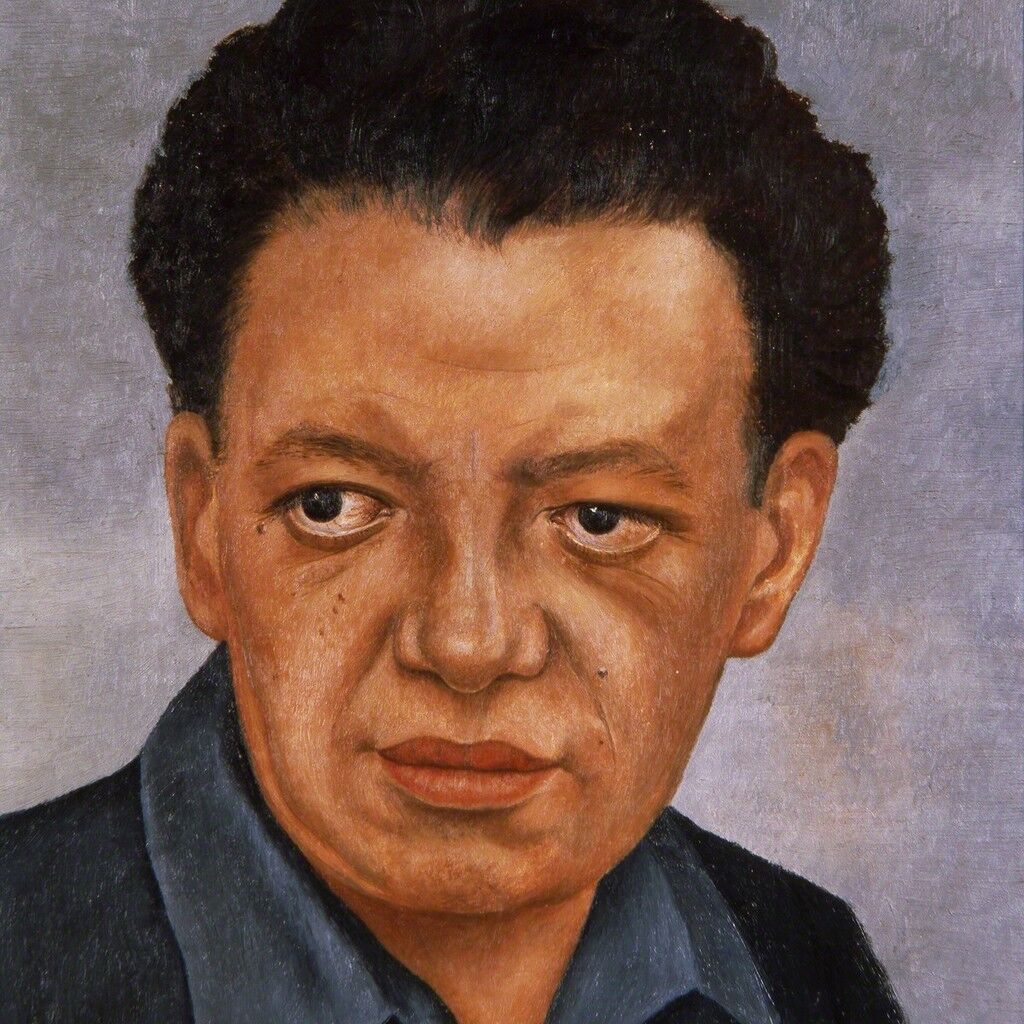
Portrait of Diego Rivera, 1937
Art Gallery of New South Wales

Diego Rivera
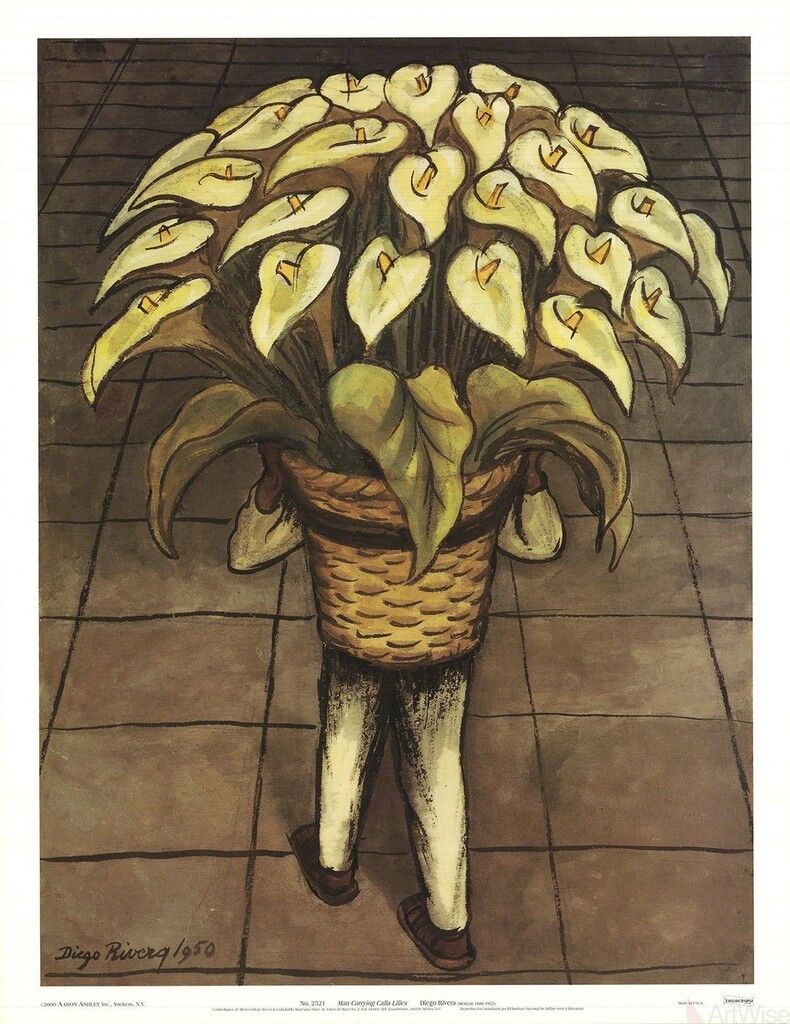
Man Carrying Calla Lilies, 2000
ArtWiseSold

Bloch’s mostly unpublished journal, which Stahr accessed while researching her book, was a window into how Kahlo filled her days in the early 1930s. “I was able to get a much clearer sense of Frida’s social world,” notes Stahr. “Little by little, I was able to piece out that yes, Frida’s hanging out with Georgia.”

Sometimes they went on double dates with their husbands, and sometimes the two of them, plus Bloch, ventured out. “I love this one scene [from the journal] where Frida, Georgia, and Lucienne go to a Mexican restaurant together. They drink tequila, and then they end up getting tipsy and singing in the toilet,” recalls Stahr. “I just think that’s an amazing image.”


Frida Kahlo
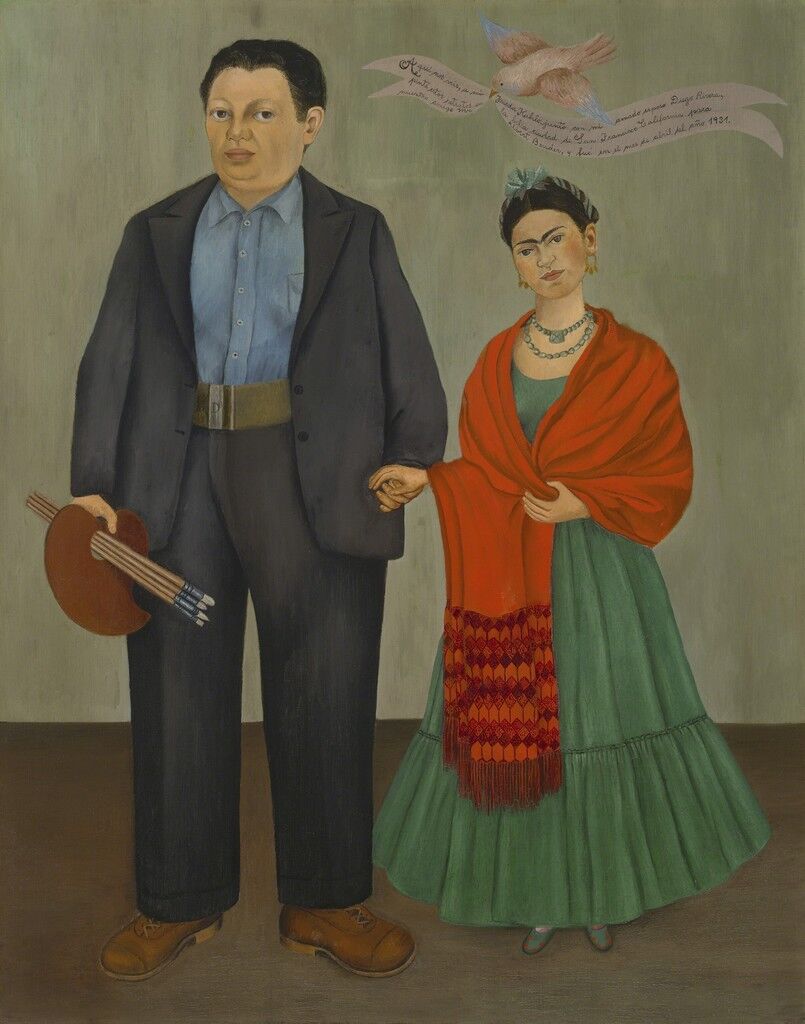
Frida and Diego Rivera, 1931
San Francisco Museum of Modern Art (SFMOMA)Permanent collection


Georgia O’Keeffe
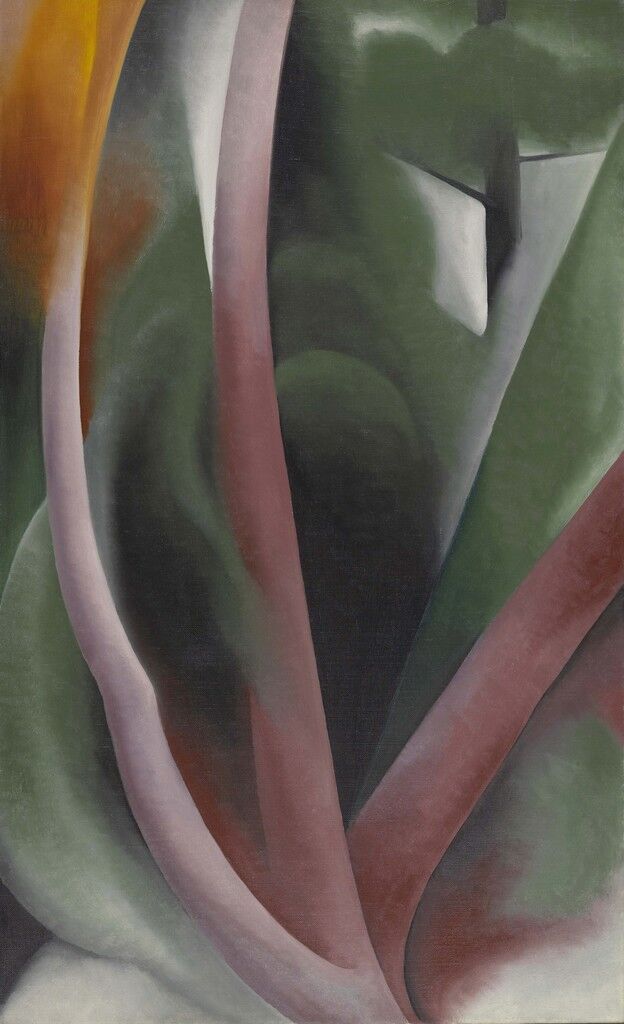
Birch and Pine Trees - Pink, 1925
Colby College Museum of Art

But their friendship wasn’t all flirtations and tequila. The two women were quite similar in many ways—both played with fashion, dressing themselves in striking ways outside the mainstream feminine vogue; both pursued careers of their own while married to older, unfaithful, and powerful male artists. “Both were fearless, flamboyant, and very powerful personalities,” explains Linda Grasso, author of Equal under the Sky: Georgia O’Keeffe and Twentieth-Century Feminism (2017). “They automatically would have been attracted to each other.”

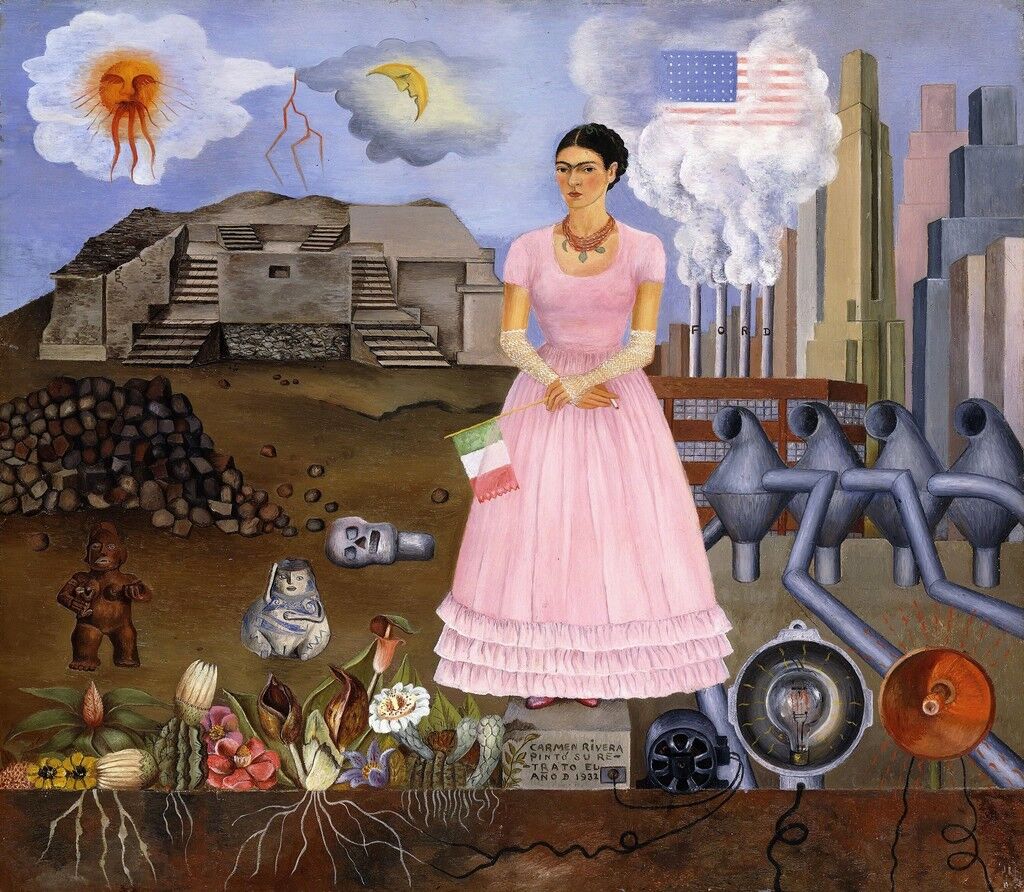
In addition, Kahlo was looking closely at O’Keeffe’s paintings. In the spring of 1932, Kahlo and Rivera left New York for Detroit, where Kahlo painted Self-Portrait on the Border Line Between Mexico and the United States (1932)—a canvas depicting the artist in a pink gown, dividing a bleak landscape of American industry on the right and ancient Mexican ruins on the left.
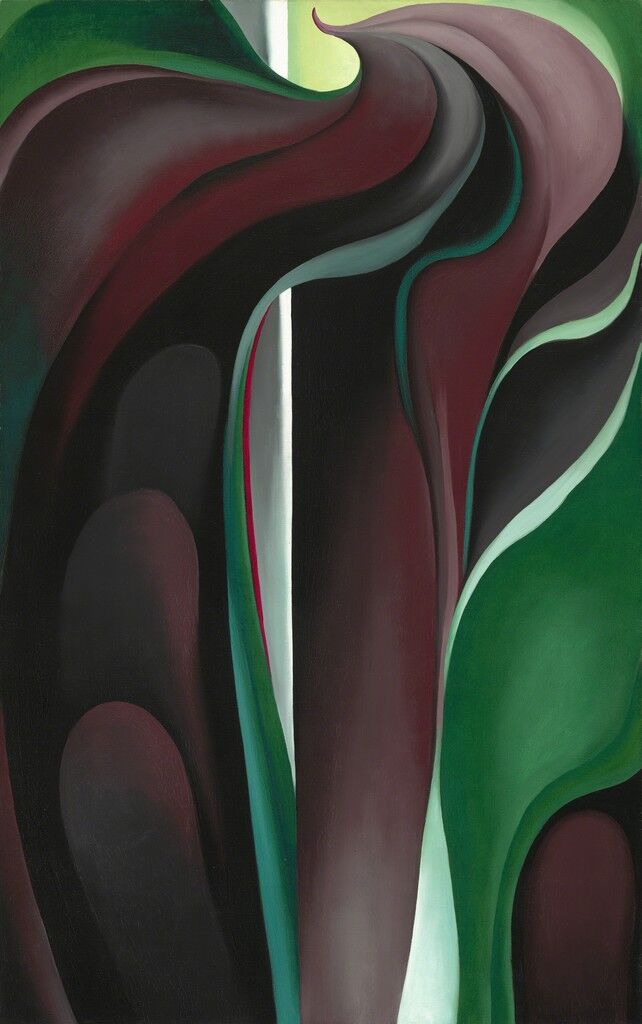
On the Mexican side, a few jack-in-the-pulpit flowers sprout between other plants—a flower that O’Keeffe devoted an entire series to just two years earlier and which isn’t indigenous to Mexico. “You see not just one but three. You see the growth of it, the process—one’s fully closed, one’s open,” Stahr observes. “That’s what Georgia showed in her series, this whole process of growth, and from different perspectives.”


Georgia O’Keeffe
Jack-in-the-Pulpit No. IV, 1930
"O'Keeffe, Stettheimer, Torr, Zorach: Women Modernists in New York" at

Frida Kahlo
Self-Portrait on the Border Line Between Mexico and the United States, 1932
"Paint the Revolution: Mexican Modernism, 1910–1950" at Philadelphia Museum of Art

And so even in Detroit, when it was unclear whether she’d ever see O’Keeffe again, the older artist’s influence lingered. Their next known contact was when Kahlo phoned O’Keeffe sometime in late 1932, after learning that she’d suffered a nervous breakdown. When Kahlo mailed her letter to O’Keeffe in 1933, she was hospitalized.

“If you [sic] still in the Hospital when I come back I will bring you flowers, but it is so difficult to find the ones I would like for you,” Kahlo wrote at the end of her note. “I like you very much Georgia.” Kahlo returned to New York two weeks later, and visited her friend right before O’Keeffe left for Bermuda to continue her recovery.


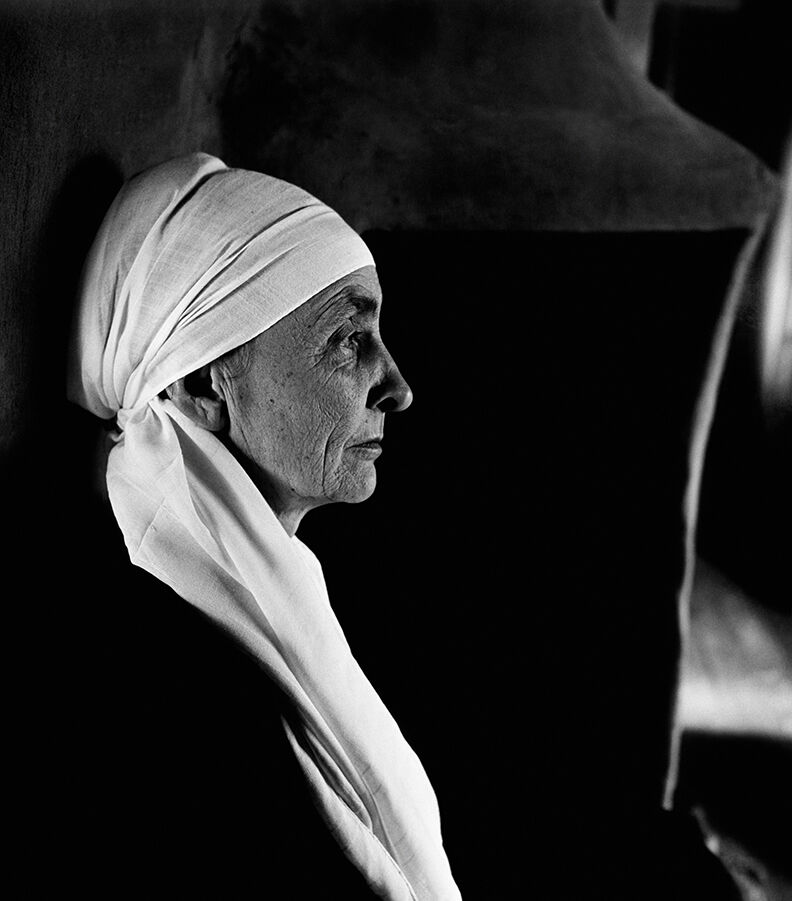
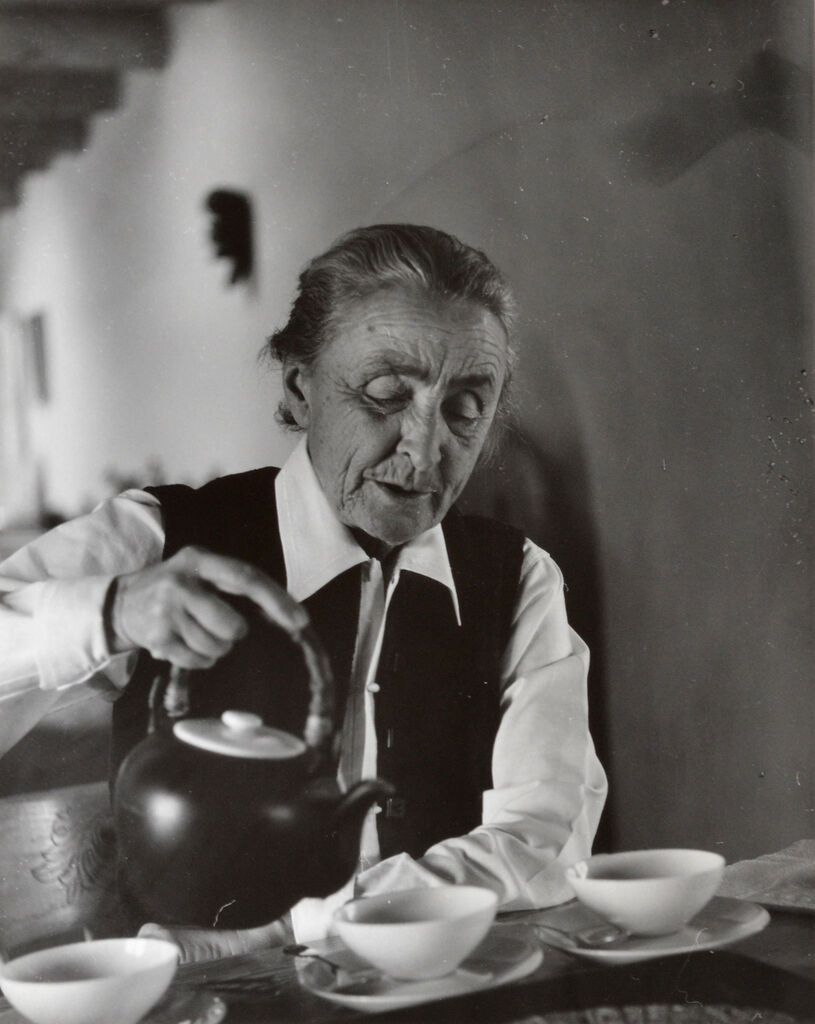
Philippe Halsman
Georgia O'Keeffe, in Abiquiu, New Mexico, unique vintage print, 1948
°CLAIRbyKahn GalerieContact for price


Frida Kahlo
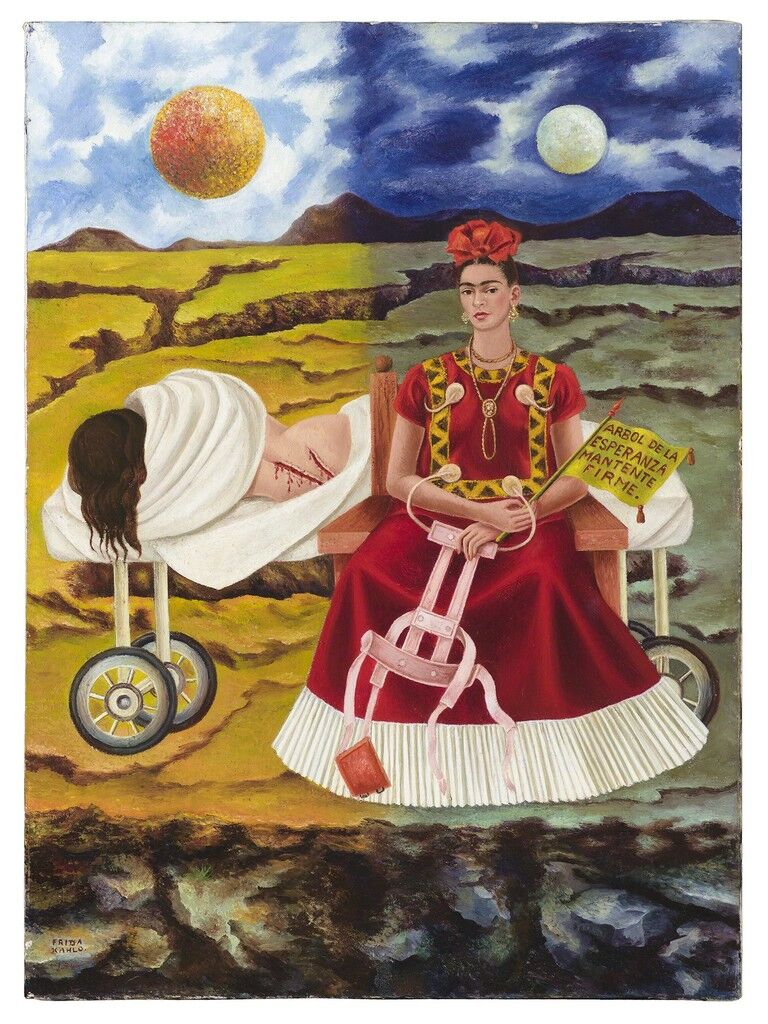
Arbol de la Esperanza (Tree of Hope), 1946
MCA Chicago

Kahlo rehashed the reunion in a letter to Clifford Wight, one of Rivera’s assistants. “She didn’t make love to me that time,” she lamented. “I think on account of her weakness. Too bad.” Kahlo’s wording implies that O’Keeffe had made love to her before, but it’s unclear what she meant exactly. While some scholars argue that O’Keeffe had romantic relationships with women, the official line from the Georgia O’Keeffe Museum and major O’Keeffe scholars is that there’s no evidence. “The term ‘make love’ had a variety of meanings,” offers Grasso. “It might have just meant flirting.”

The story of Kahlo and O’Keeffe’s friendship is fairly one-sided, with most of the records coming from Kahlo (to whom the relationship likely meant more). No letters have been identified, to date, from O’Keeffe, and it doesn’t look like she kept any mementos.


Antonio Kahlo
Frida Kahlo, 1949
Matthew Liu Fine ArtsContact for price

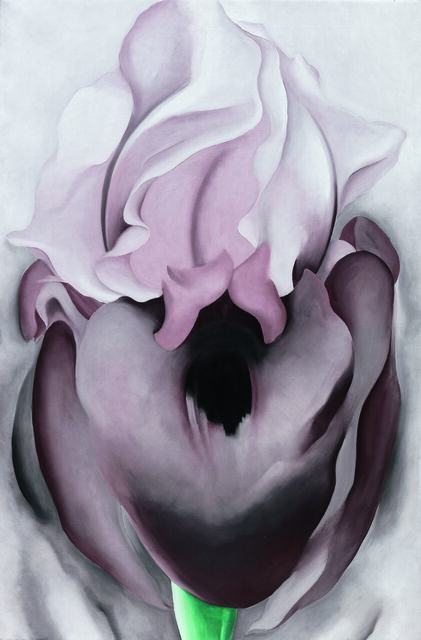
Georgia O’Keeffe
Black Iris VI, 1936
Seattle Art Museum

One small trace, which Grasso identified recently in an O’Keeffe address book from the early 1930s, is a Chicago address for Frida Rivera (the artist’s married name). When Kahlo was in New York in 1933, her next scheduled destination was Chicago (where Rivera was commissioned to paint a mural for the World’s Fair, which fell through after the controversy surrounding his Rockefeller Center mural).

O’Keeffe probably never used that Chicago address, but when the Mexican painter came to New York in November 1938 for her first solo exhibition, at the Julien Levy Gallery, O’Keeffe was there on opening night. Stahr thinks this was deliberate, since by this point she was spending July through December in New Mexico, and could have easily missed Kahlo.
“It’s possible they saw each other other times,” Stahr adds. “Frida did visit New York on different occasions.” And when O’Keeffe traveled to Mexico in 1951, she visited Kahlo twice at her home, the Casa Azul.


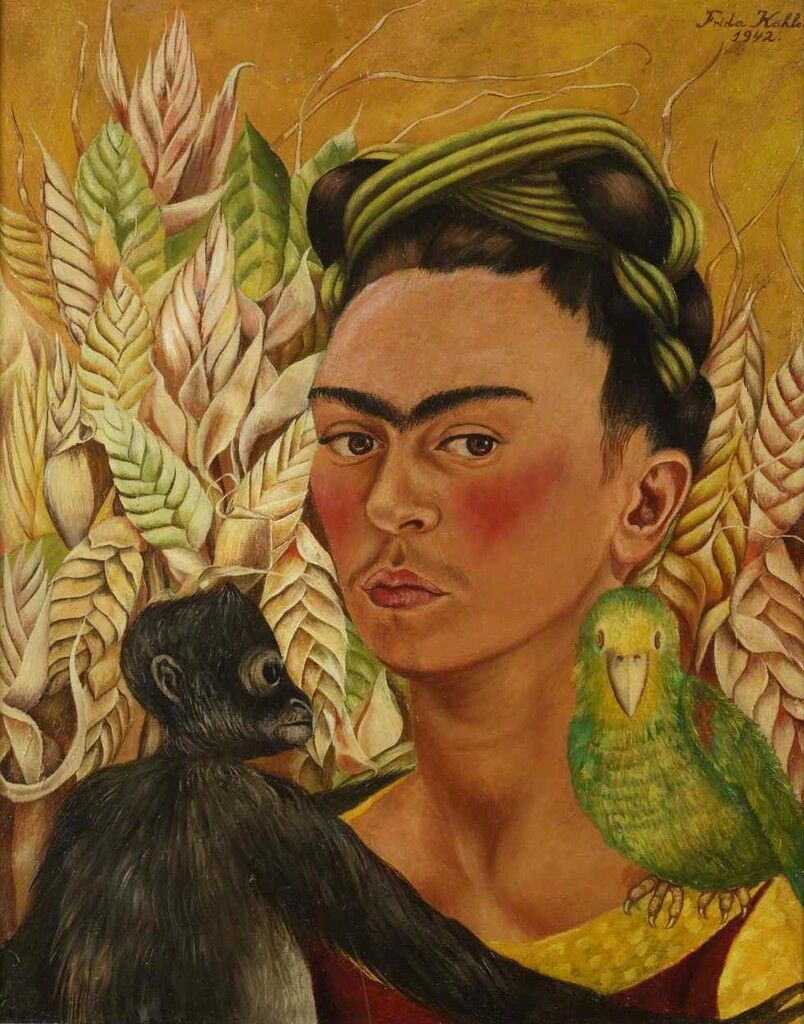
Frida Kahlo
Autorretrato con chango y loro, 1942
MALBA Permanent collection


That last time, it was Kahlo who was confined to bed, recovering from recent operations. She must have been thrilled to see her old pal, who showed her what being a successful woman artist could look like. “O’Keeffe was the woman artist…the representative, the token, the exemplar,” Grasso says. “You can think about how much O’Keeffe—as a person, as a friend, as a woman, and as an artist—might be absolutely fascinating and important to her.”

Maybe O’Keeffe brought Kahlo flowers, and maybe Kahlo offered her friend some local tequila. The two were different people than when they first met, two decades earlier, and they hadn’t been permanent fixtures in each other’s lives. Their bond, however loose, was still there.

Karen Chernick

Monday, July 19, 2021

Enough with the Ableist Worship of Frida Kahlo

Emily Rapp Black’s new book cuts though self-serving interpretations of disabled bodies like Kahlo’s, which have long emphasized the comfort or pleasure of others

by Sophia StewartJuly 15, 2021
A display of Frida Kahlo's shoes at La Casa Azul, Mexico City (photo by learnatw)


The question that propels Emily Rapp Black’s Frida Kahlo and My Left Leg is simple and self-implicating: “Why do we (I) love Frida?” Throughout the book’s fourteen loosely-linked essays, Black lays claim to Kahlo for unique reason: like the painter became later in life, Black is an amputee, and both women’s lives were shaped by physical disability. In her youth, the author formed what she calls “the perfect imaginary friendship” with Kahlo. “I chose to try and understand the story of her body as a way of knowing or accessing mine,” Black writes, “as if the story of her life set out a path or trail that, no matter how difficult, I might follow.” Latching onto public figures like this is common among young disabled people, who are desperate to find other people in the world like us, to trace a possible road map for our own lives. Still Black admits the limits of an attachment to a woman who “lives only in the terrain of my imagination where I set all the terms of the story.”

But what about the rest of Kahlo’s legion of fans? Few, if any, other artists have become objects of such intense parasocial affection. Kahlo’s disembodied likeness adorns lipsticks, coasters, aprons, magnets, leggings, notebooks, keychains, backpacks, even Christmas ornaments. (Full disclosure: I have previously owned a Kahlo-emblazoned pencil case, t-shirt, pair of socks, and sticky-note pad; I still display her “Self-Portrait with Cropped Hair” in my bedroom.) Surely the outspoken communist would have abhorred the commercialization of her image and art. But what would she make of how her life has been interpreted, packaged, and flattened by her own admirers?
 
The cover of Frida Kahlo and My Left Leg (Notting Hill Editions, 2021) by Emily Rapp Black

Black observes these admirers during visits to La Casa Azul in Mexico City and the Victoria and Albert Museum in London, both of which contain many of the artist’s personal artefacts. In the essay “The Viewing, London,” she eavesdrops on her fellow exhibit-goers: “Isn’t it just terrible, the pain she was in?” one remarks to a friend as she inspects some of Kahlo’s prosthetics and orthopedic devices. “But it inspired her to paint,” the friend replies. “Yes,” the other says, “it made her an artist. All that pain.” Rapp, who walks through the exhibition on the prosthetic leg she’d worn since early childhood, who like Kahlo has navigated surgeries and doctors and medical apparati all her life, seethes at the insinuation that pain is a noble muse. Pain did not make Frida Kahlo an artist; Frida Kahlo made Frida Kahlo an artist. What she went through, the author reminds us, had no bearing on the vision and talent she already possessed. Black’s most harrowing experiences inform her own work — including this very book — but they do not produce it. “Suffering does not create art,” she thinks, observing Kahlo’s hand-painted plaster corset, “people do.”

But Kahlo has been canonized to the extent that she is no longer understood as just a person. London exhibit-goers ogle her braces and casts “as if passing by a saint’s shrine”; at La Casa Azul, visitors “treat the bed where the artist died as Christian supplicants treat the slab in Jerusalem.” Black worries over how Kahlo’s suffering has been romanticized, her body fetishized: fans obsess over the details of her accident (how “lovely” her mangled body must have looked coated in gold dust) and resultant injuries (how “intimately” the handrail exited her torso). Her life was so dense with senseless tragedies that we have to make it all mean something. As a result, Kahlo has been poured into familiar, palatable molds, with the aim of turning her into the sort of disabled person we can admire, not just tolerate; the sort of disabled person who doesn’t remind us of “the chaos of the world.” Black herself has been constricted by these sorts of molds. Time and time again, as she recounts, her body has been interpreted to ensure other people’s comfort or pleasure. Passengers willfully mistake her for a military veteran during a flight and applaud her accordingly; acrotomophiles lurk outside amputee conventions and swear their devotion to her. Through a self-serving able-bodied gaze, disability — Black’s, Kahlo’s — is made estimable or fuckable or brave.
Frida Kahlo’s medications and crutches on display at La Casa Azul, Mexico City (photo by learnatw)

Candid and eloquent, Frida Kahlo and My Left Leg is an invaluable addition to the canon of disability literature and the field of disability studies. Black eloquently articulates the longing and frustrations that are central to experiences of living with a disability. She isn’t interested in uncritically celebrating or passively meditating on Kahlo’s story; she wants to know exactly what she can glean from a woman who was all the things disabled folks are told we can’t be: sexy and productive and complicated, roiling with ego and desire. “What can all of us learn from Frida, no matter our embodiment?” she writes. The answers she lands on are, like the rest of the book, lucid and profound. I won’t spoil them, as they’re most resonant when earned. But Black makes clear that to honor Kahlo properly means embracing both her art and her disability, and more important, that we can learn the most from the artist when we peel away the fanfare and iconography, and see her for the person she was.

Frida Kahlo and My Left Leg (Notting Hill Editions, 2021), by Emily Rapp Black, is now available on Bookshop.

Tuesday, August 10, 2021

Frida Kahlo: new book highlights lesser-known works

A new, curated compilation of the Mexican artist's 152 paintings — including lost and lesser-known pieces — focuses on Kahlo and the stories behind her works.


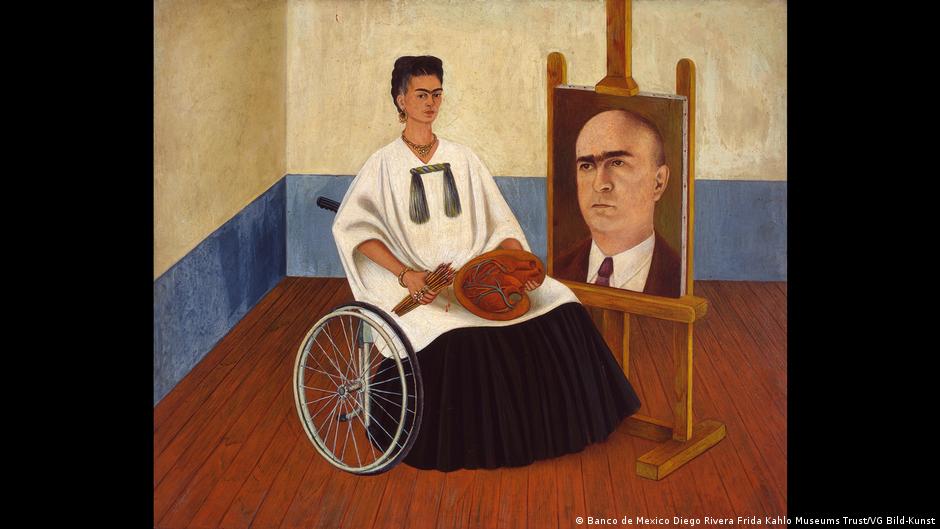
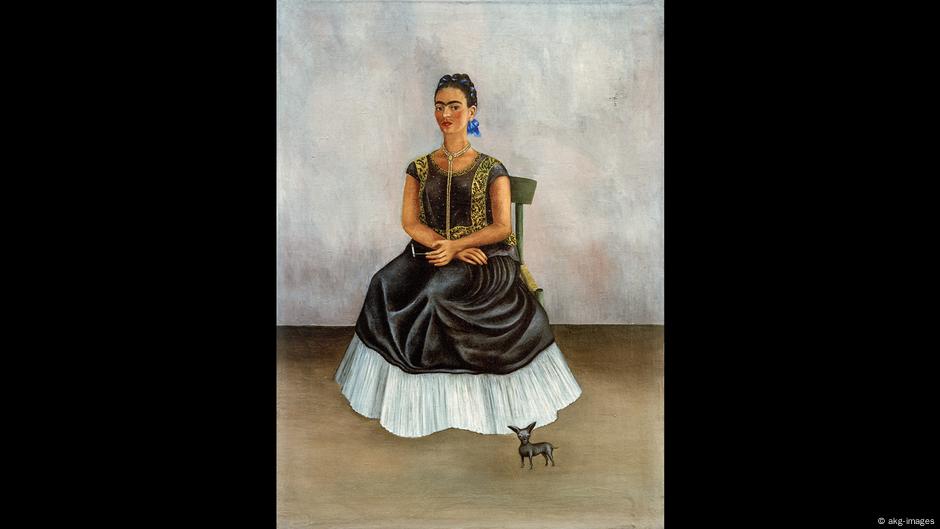
'Self-portrait with Dr Farill' is the last self-portrait to which Kahlo added her signature


In 1951, Mexican artist, Frida Kahlo wrote in her diary: "I've been unwell for a year. Seven operations on my spine. Dr. Farill saved me. He gave me back my joy in life. I'm still in a wheelchair and I don't know how soon I'll be able to walk again… But I do want to live. I've already started the little painting I'm going to give Dr. Farill and am doing it for him with the utmost affection."

That "little painting" is the picture you see above. It would also prove to be the last self-portrait Kahlo painted to which she added her signature.

But who was this Dr Farill? Why is Kahlo dressed the way she is? What has Catholicism got to do with that palette on her lap? Wait, is that a palette or a heart?

Have these questions prompted you to look closer?


A pencil sketch by Kahlo that is a departure from the lush colors typically attributed to her

Shedding light on Frida's lesser-known works

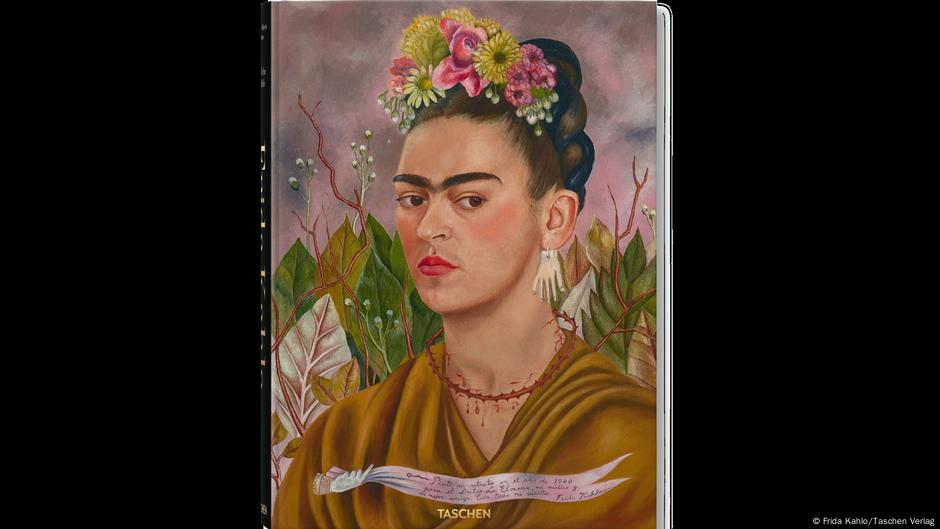
The answers lie in an expansive book on her works titled, Frida Kahlo: The Complete Paintings, published by Taschen.

Triggered by the lack of comprehensive art history on Kahlo's work, Mexican art historian Luis-Martin Lozano and his co-authors Andrea Kettenmann and Marina Vazquez Ramos embarked on this ambitious project to give people a deeper understanding of Kahlo, the artist.

"First of all, who was she as an artist? What did she think of her own work? What did she want to achieve as an artist? And what do these paintings mean by themselves?" Lozano said about the focus of his book in an interview with the BBC.

He added that some of her works have "amazingly" never been written about. "Never, not a single sentence!" Others were either wrongly titled or dated. "It's a mess as far as art history is concerned," Lozano said.

His book is a study of each of Kahlo's 152 paintings done between 1924 and 1954, identified by their origins and exhibition history. Paintings that were destroyed or whose present whereabouts are unknown are identified only by photographs.


Frida Kahlo: The Complete Paintings includes previously unseen or overlooked works by the artist (Credit: Taschen)

Beyond her renowned portraits


Mention Frida Kahlo, and chances are her arresting self-portraits come to mind first: the one in which she stares unflinchingly at the viewer, clad in traditional Mexican garb and eye-catching accessories, braided hair worn up and adorned with flowers, her trademark unibrow and hint of mustache bucking conventional beauty ideals.

Forming a third of her entire works, these self-portraits — sometimes her unibrow alone suffices — have long been money-spinners, adorning assorted paraphernalia from flowerpots to yoga cushions to yes, even face masks, as collectibles for Frida fans.

Much has also been documented about Kahlo's life-altering accident at age 18, which saw her bed-ridden, bored and turning to art for emotional release; her rocky relationship with fellow Mexican artist Diego Rivera, which involved infidelities on both sides and, in her case, with both sexes; her heartbreak at motherhood eluding her; her passion for flora and fauna; and her inimitable style influenced by her Mexican heritage and her fierce individuality.

Labeled and embraced by turns as a style/feminist/LGBTQ/cult icon, Kahlo's storied life ironically tended to divert attention from her journey as an artist and the history behind her art, Lozano feels. People either viewed her paintings through the lens of her publicized private life or are overwhelmingly drawn to her better-known pieces.


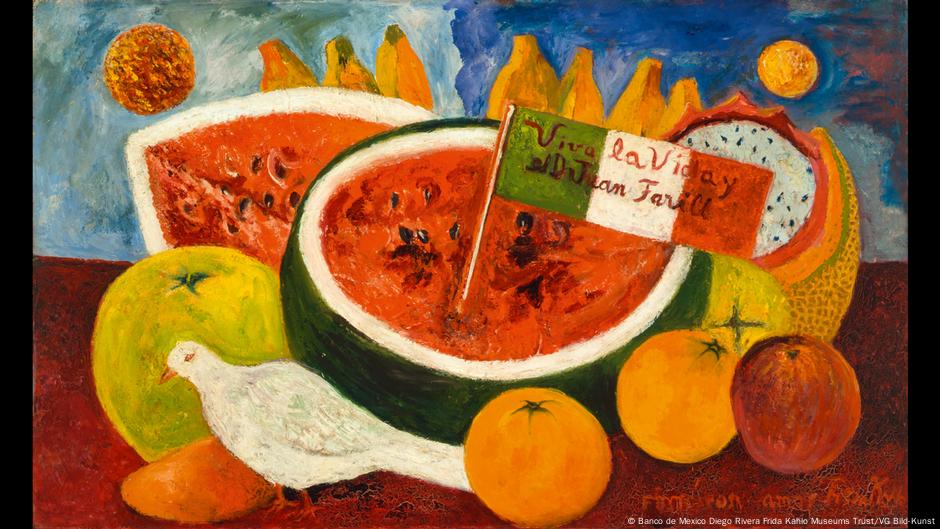
Kahlo dedicated and gave this still life to her surgeon, Dr. Juan Farill whom she highly respected

More than meets the eye


Totaling 624 pages, this tome is an eye-opener not just for fans but also for the uninitiated.


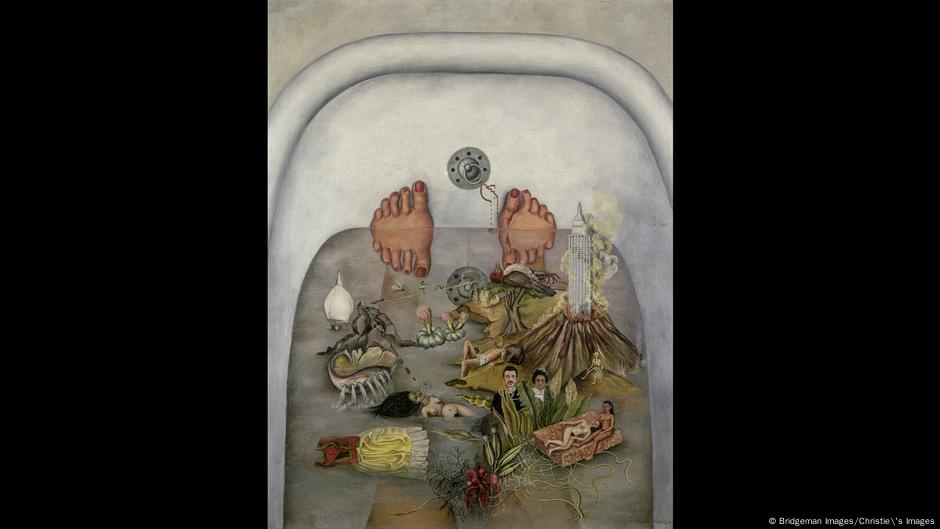
Readers may be surprised by many of her lesser-known or overlooked works "that may not be associated with Kahlo," in Lozano's words. These include pencil sketches such as Showing the Scar (1938), still-life paintings including Long Live Life (1953), surrealist pieces like What the Water Gave Me (1938-39), and early portraits that differ in style and rendition from her renowned later, lusher works.


"What Water Gave Me" suggests self-analysis begins in the womb and is fed by life's memories

However, the heart of this book is the catalog that runs over 100 pages, where Lozano and his colleagues have painstakingly researched the history and context, and sometimes even the timelines of ownership of Kahlo's works.

Accompanying interviews, newspaper articles, photographs, notes, diary pages and personal letters in Kahlo's own handwriting flesh out the stories surrounding her pieces.
Unvarnished stories

What emerges are stories that sometimes reveal the mundane in an artist's life. For instance, that the painting Ixcuhintli Dog with Me (Self-portrait with Xoloitzcuintli Dog) that she painted around 1938, had been painted over a previous picture.

Piecing together other circumstances in her life then, historians speculate that she reused the canvas as money may have been tight and she may have been pressed for time to deliver pieces for an exhibition.

X-ray photograpy of "Ixcuhintli Dog With Me (Self-portrait With Xoloitzcuintli Dog)" reveals an earlier painted-over piece underneath

Consider the other piece that she bequeathed to her beloved orthopedic surgeon, Dr. Juan Farill, titled Still Life (Still Life Dedicated to Dr. Juan Farill). On the little Mexican flag pierced into the watermelon she had written, "Long live life and D Juan Farill."

Older photos of the piece reveal that she had originally written "Juanito" — a more informal way of addressing people in Spanish. However, she might have had second thoughts about being over-familiar with a man she highly respected, and thus painted over it resulting in a slightly smudged dedication.

Furthermore, the wealth of information on religious and cultural symbolism in her choice of colors, clothing, subject positions, fruits, animals, draw attention to the tiniest details, adding further layers to appreciating her art.

In all, the book underscores the journey of an art icon, who at the core was human and who sublimely captured her humanity on canvas.

Tuesday, July 07, 2020

These Pictures Capture What Frida Kahlo Was Really Like


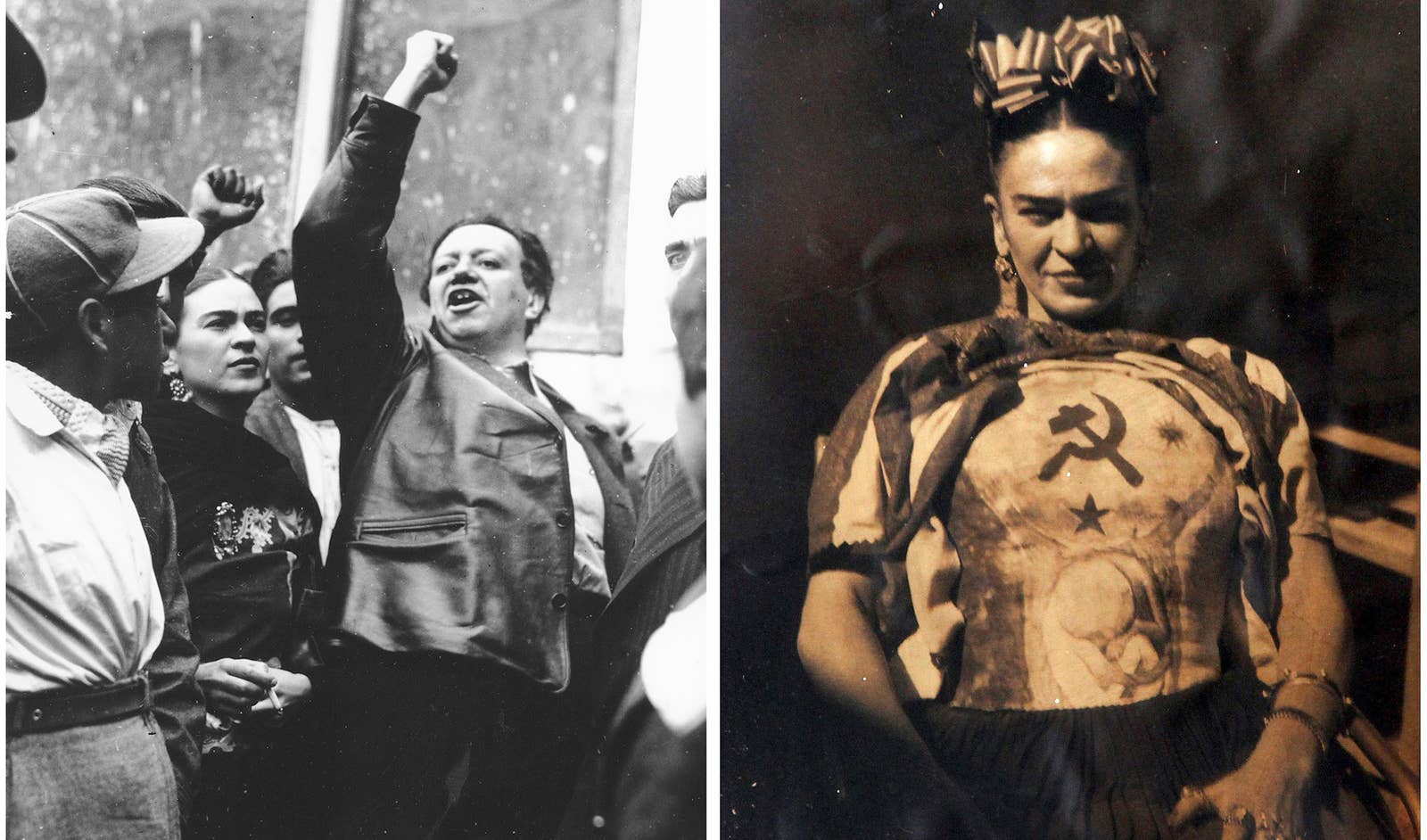
Left: Rivera and Kahlo raise their fists in a communist salute during an anti-fascist demonstration in Mexico City, Nov. 23 1936.
 Right: This undated picture depicts Frida Kahlo wearing a body cast with a communist hammer-and-sickle symbol painted on the front
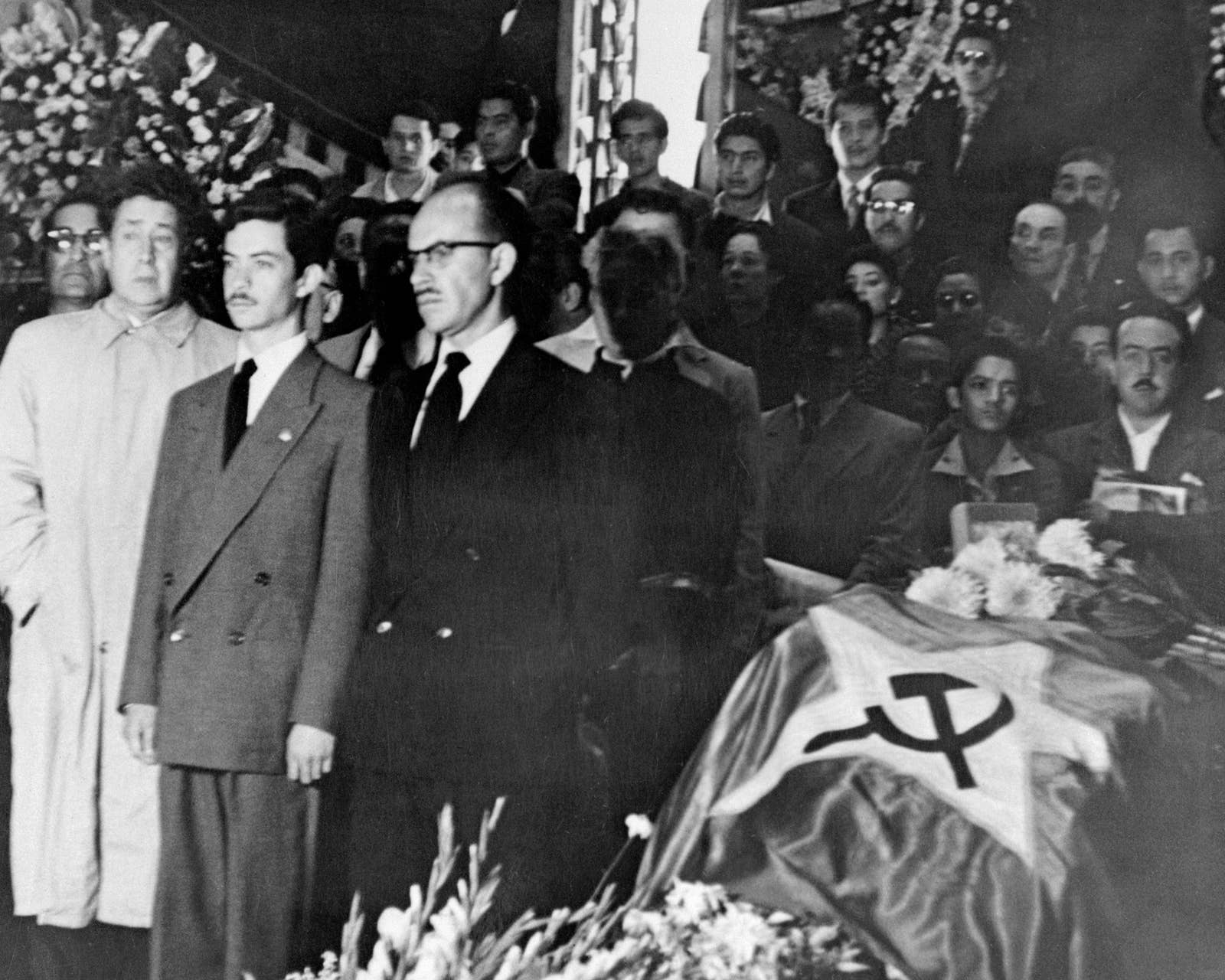
The communist hammer-and-sickle emblem is draped over Kahlo's casket at the Palace of Fine Arts in Mexico City where mourners viewed the remains prior to the funeral, July 19, 1954.
  
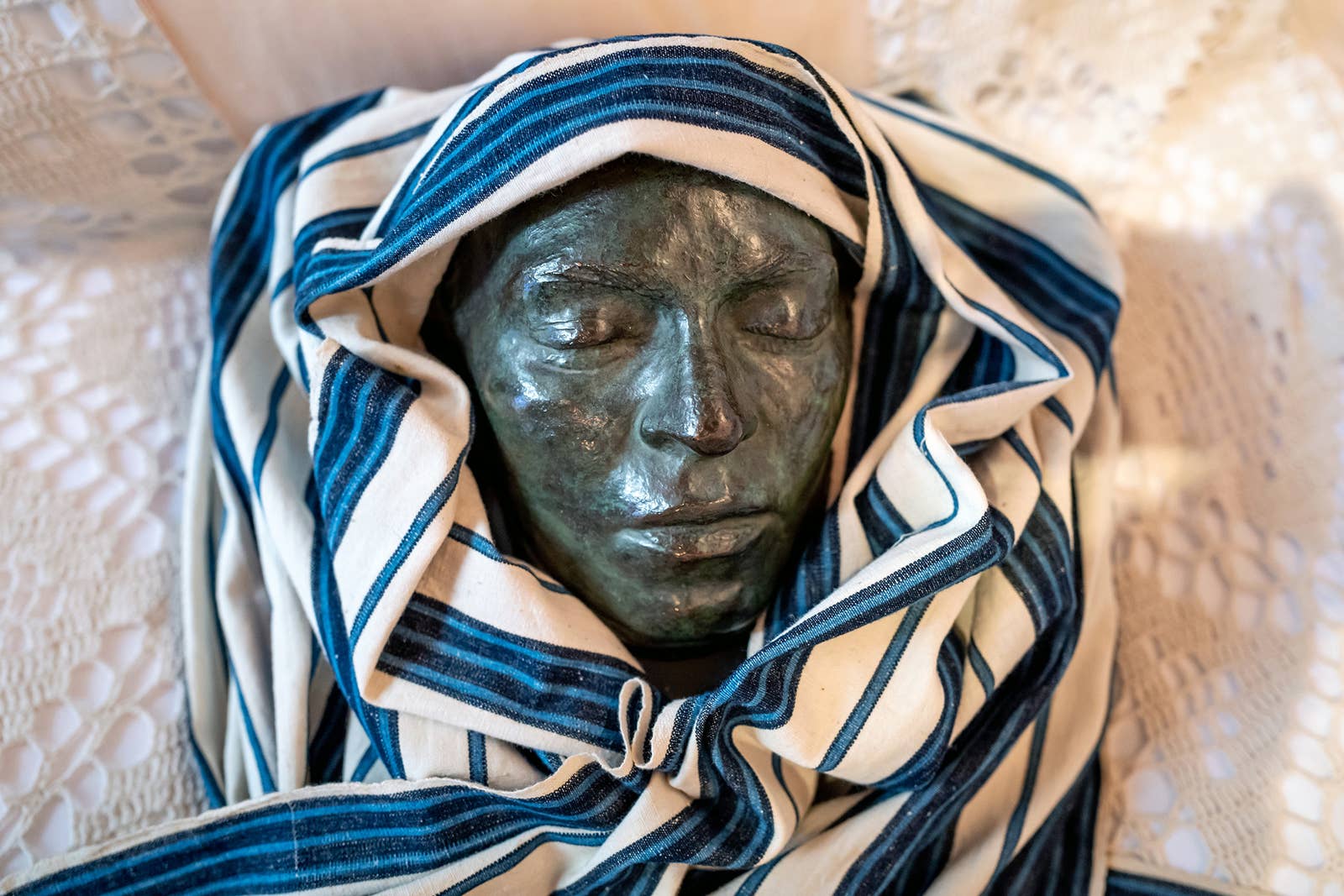
Kahlo's death mask inside her studio museum in Mexico City, Jan. 17, 2019.
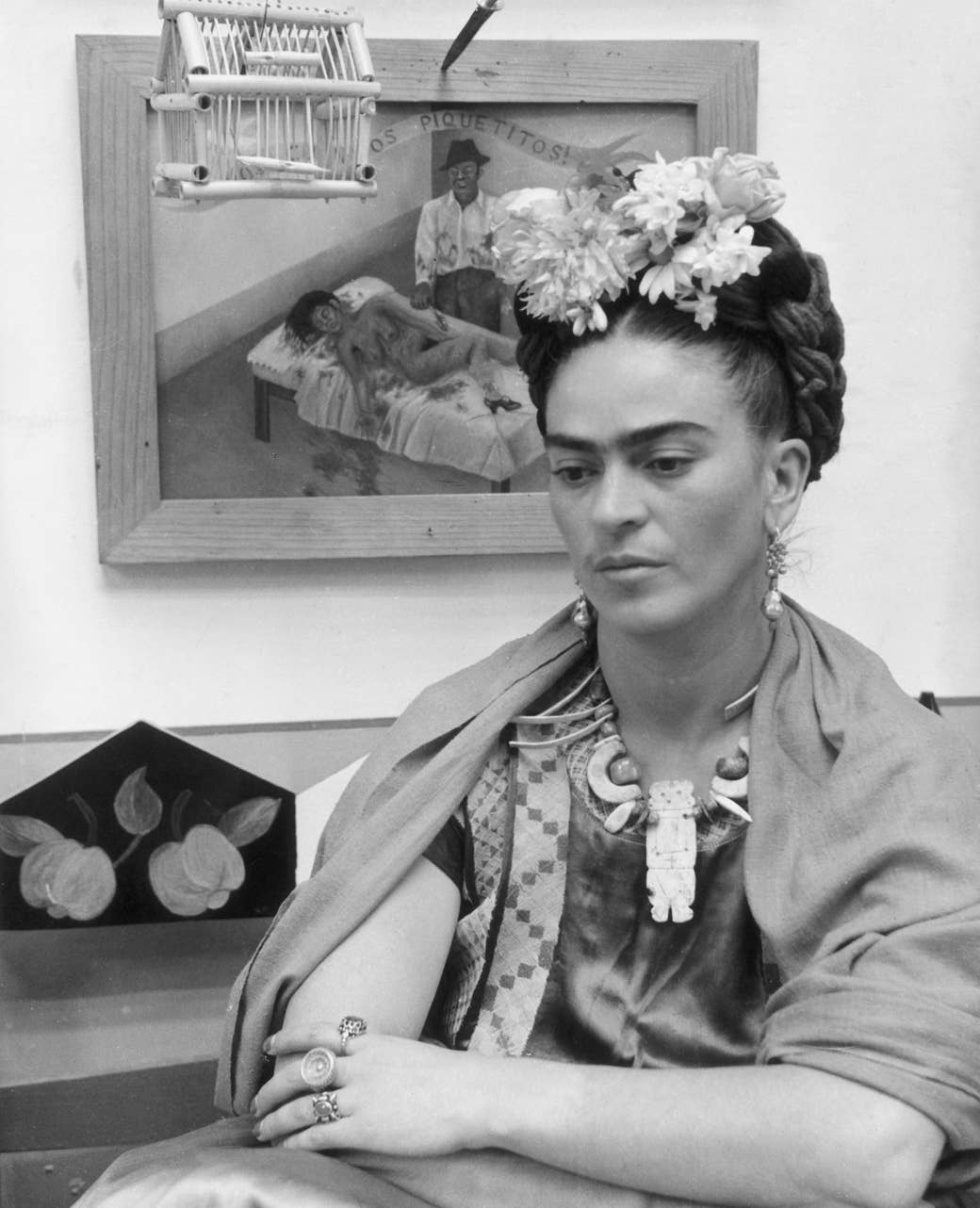
Frida Kahlo sits in front of one of her paintings, circa 1945.
NOT JUST ANY ONE OF HER PAINTINGS
BUT A DENUNCIATION OF FEMICIDE


These Pictures Capture What Frida Kahlo Was Really Like

A look back at the incredible life of one of art history's most recognized 
and celebrated icons. 


Toni Frissell / Library of Congress
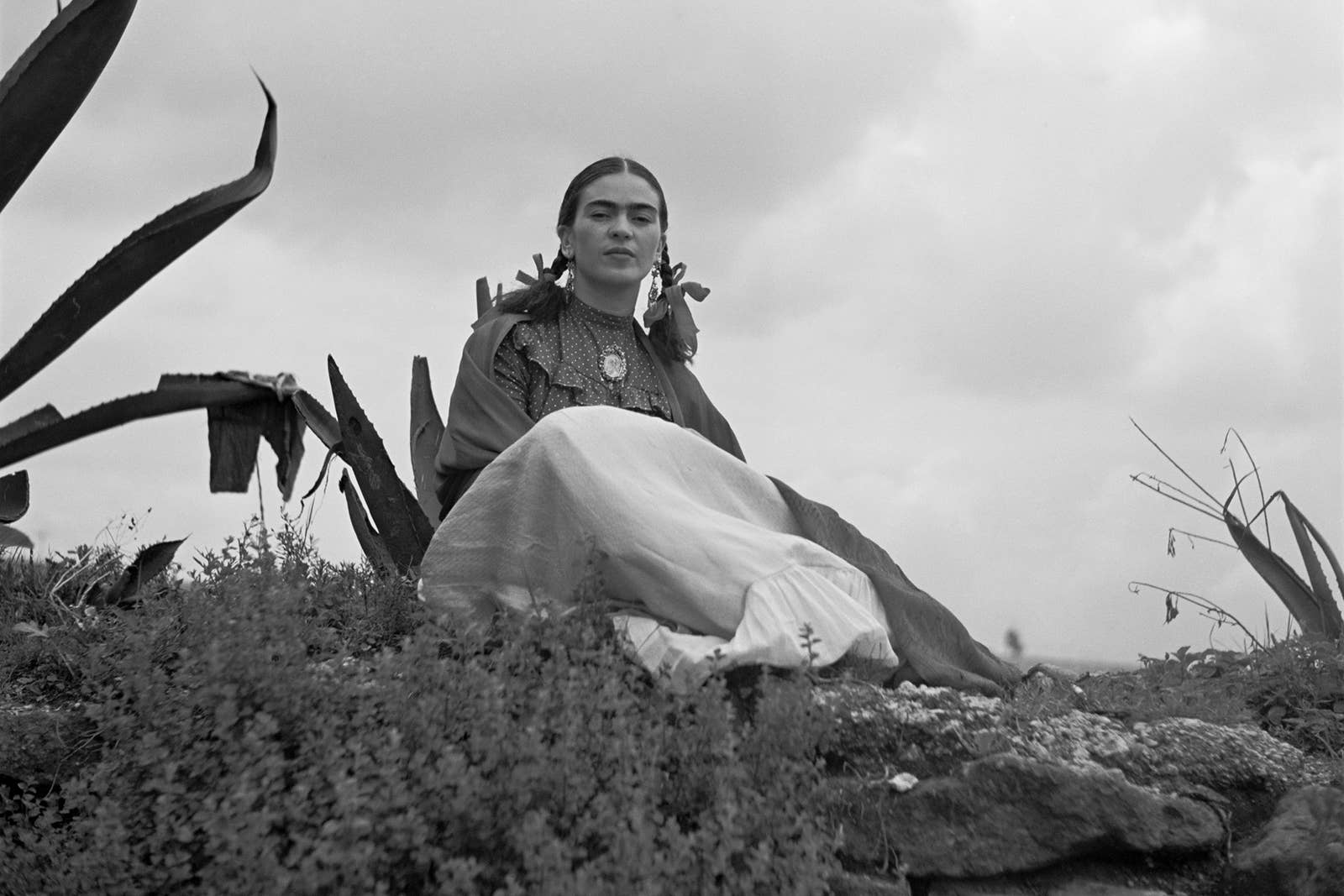
Frida Kahlo sitting next to an agave plant, 1937.

This week marks the 113th birthday of one of art history's most celebrated artists — Frida Kahlo. The Mexican painter rose to prominence in the mid–20th century with her unique approach to self-portraiture that blended elements of surrealism and naive folk art to create vibrant expressions of love, pain, tragedy, and passion.

As the daughter of a well-known photographer who immigrated to Mexico from Germany, Kahlo's upbringing in the visual arts had a lifelong impact on how she perceived and portrayed the world. Her childhood was also marked by tragedy when at age 6 she contracted polio, a disease that left her permanently scarred and in pain for the remainder of her life. At 18, Kahlo was impaled by a handrail in a bus crash that killed many passengers. She was bedridden for weeks in a Mexico City hospital; during this time, she began experimenting in expressing her agony through painting. Without nature or subjects to paint, she searched for inspiration internally and created some of her first self-portraits during the time.

In the years that followed, Kahlo became a vocal proponent of the Mexican Communist Party and through her activism entered a long and at times turbulent relationship with Mexican muralist Diego Rivera. The pair maintained a studio in Mexico City, where Kahlo would continue to develop her distinct visual language by drawing from her life's struggles to create deeply psychological paintings. In 1953, she had her first solo exhibition in Mexico, one year before her death at the age of 47.

Today, her former studio has been transformed into a museum that celebrates the artist and her life's work. These pictures offer a glimpse into this museum and the colorful life of Frida Kahlo


THE REST OF THE PICTURES ARE HERE 

https://www.buzzfeednews.com/article/gabrielsanchez/pictures-from-frida-kahlo-life

Friday, November 21, 2025

Frida Kahlo self-portrait sells for $54.7 million, sets new record for women artists


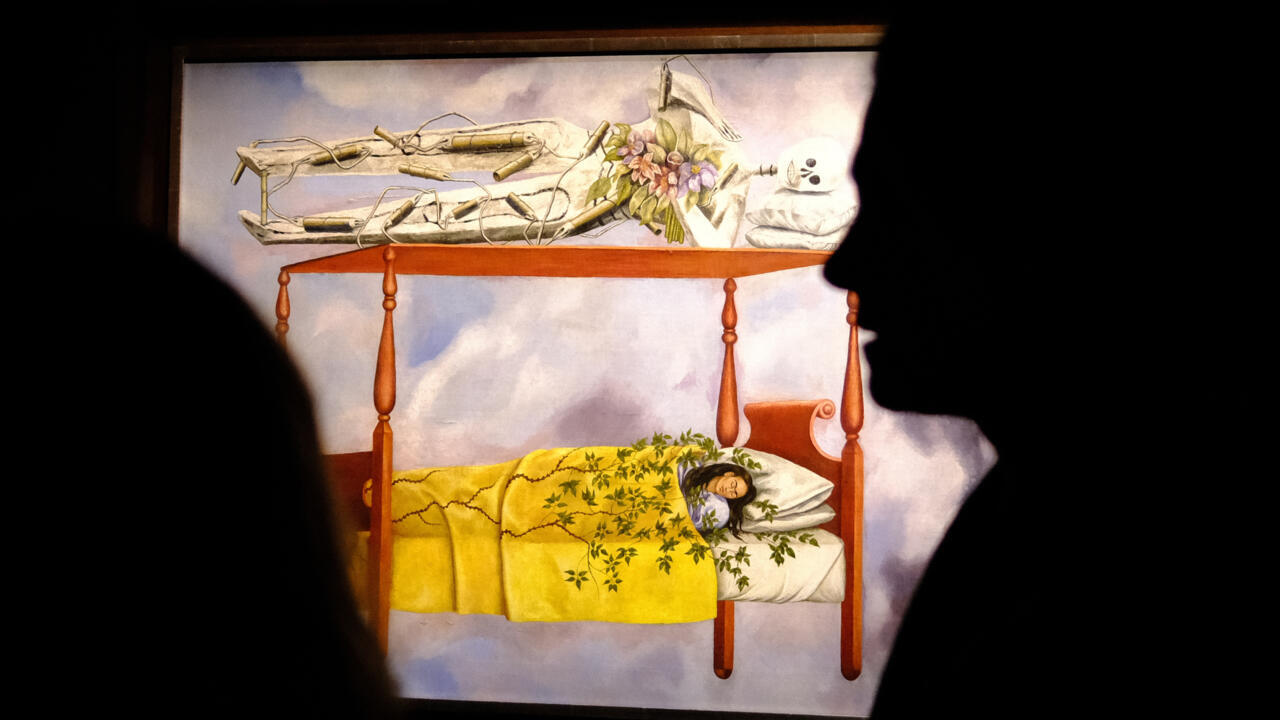
Frida Kahlo’s 1940 self-portrait “El sueno (La cama)” sold for $54.66 million in New York on Thursday, Sotheby’s said, setting a record for the most expensive painting by a woman.


Issued on: 21/11/2025
By: FRANCE 24

Auction house Sotheby's says Mexican artist Frida Kahlo's "El Sueno (La cama)" has sold for $54.6 million, a new record for a woman's painting. © Charly Triballeau, AFP

A self-portrait by legendary Mexican artist Frida Kahlo sold for $54.66 million in New York on Thursday, setting a new record for the price of a painting by a woman, the auction house Sotheby's said.

The sale of Kahlo's 1940 artwork, titled "El sueno (la cama)" – which translates to "The dream (The bed)" – breaks the previous record in this category, set by American artist Georgia O'Keeffe, whose 1932 painting "Jimson Weed/White Flower No. 1," sold for $44.4 million in 2014.

Kahlo's painting is "the most valuable work by a woman artist ever sold at auction," Sotheby's said in a post on X.

The auction house said Kahlo's work was "painted in 1940 during a pivotal decade in her career, marked by her turbulent relationship with Diego Rivera".


Kahlo's self-portrait went on the auction block at Sotheby's with an estimated price ranging from $40 million to $60 million.

The buyer's name was not disclosed.

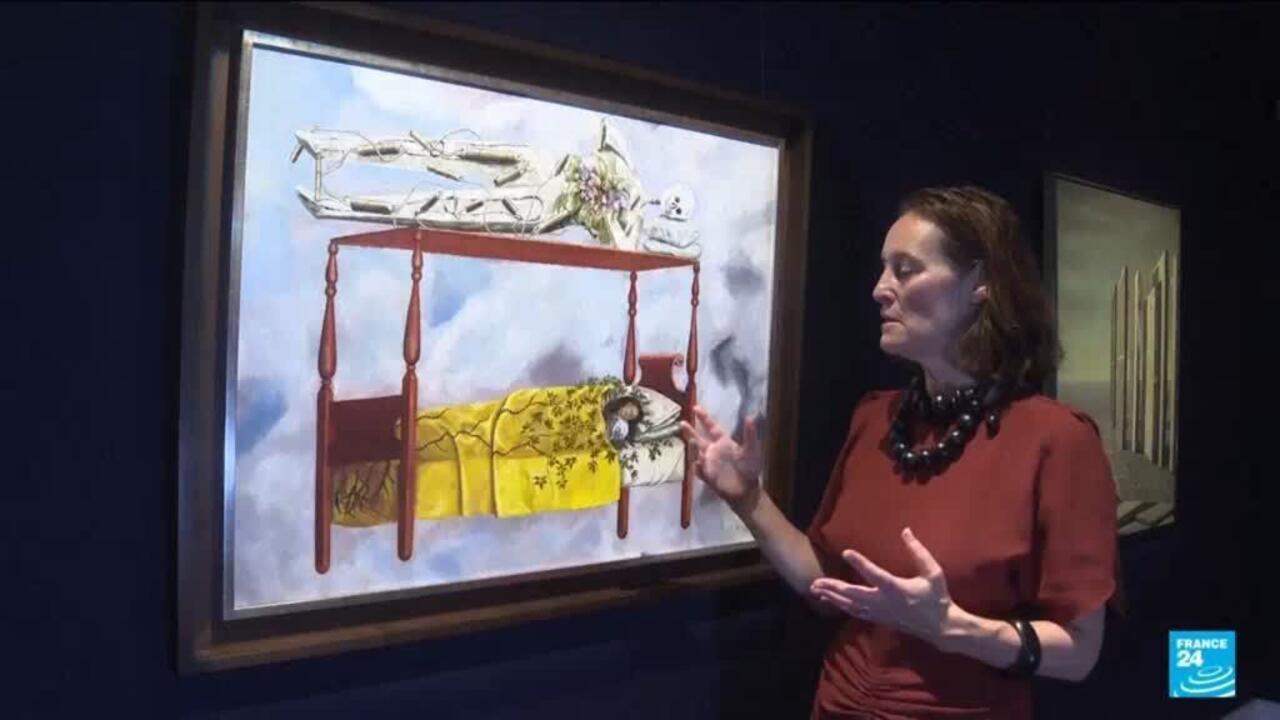
The artwork depicts the artist sleeping in a bed that appears to float among clouds in the sky, laying beneath a skeleton with legs that are wrapped with sticks of dynamite.

This painting is a "very personal" image, in which Kahlo "merges folkloric motifs from Mexican culture with European surrealism", Anna Di Stasi, head of Latin American art at Sotheby's, told AFP.

The Mexican artist, who passed away in 1954 at age of 47, "did not completely agree" with her work being associated with the surrealist movement, Di Stasi said.

However, "given this magnificent iconography, it seems entirely appropriate to include it" in this movement.

The record-setting sale came two nights the New York auction house reeled in another record sale, with a painting by Austrian artist Gustav Klimt fetching $236.4 million on the block – the second most expensive artwork ever sold at auction.

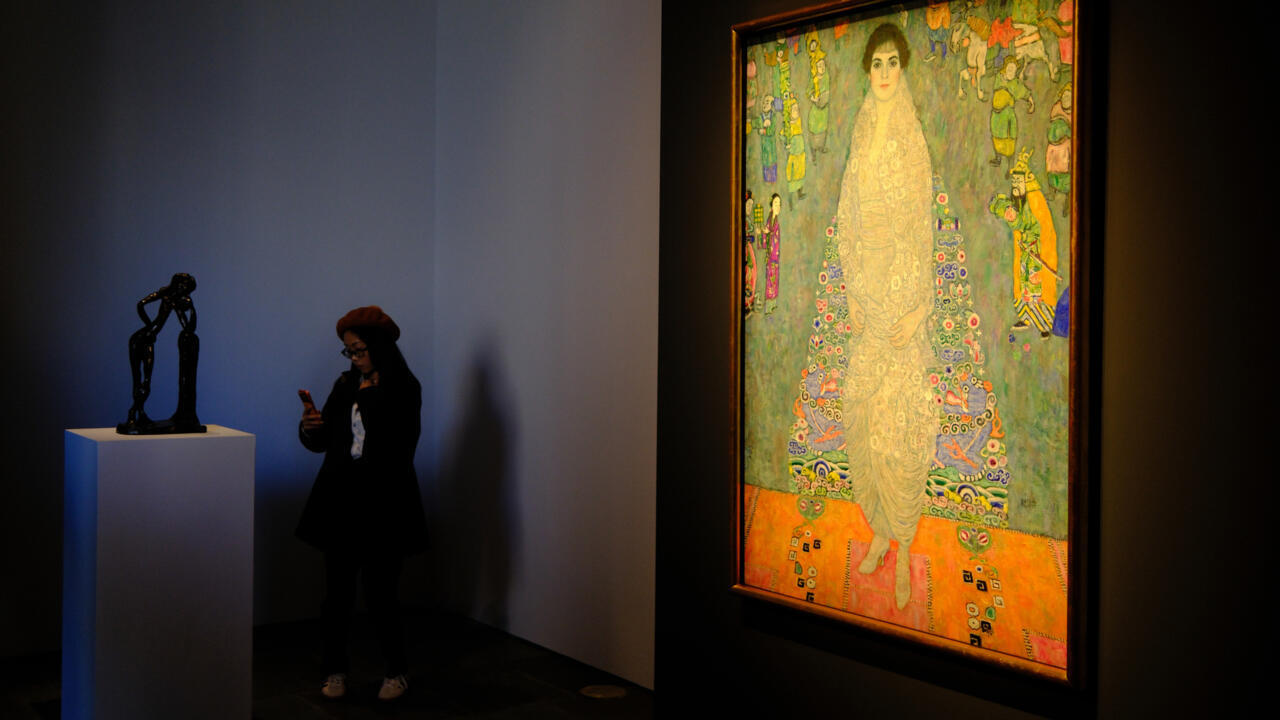
Klimt's "Portrait of Elisabeth Lederer," which he painted between 1914 and 1916, depicts the daughter of his main patron dressed in a white imperial Chinese dress, standing before a blue tapestry with Asian-inspired motifs.

The most expensive painting ever sold at auction remains the "Salvator Mundi," attributed to Leonardo da Vinci, which was bought for $450 million in 2017.

(FRANCE 24 with AFP)

A Klimt portrait is now the second most expensive artwork ever auctioned

A rare full-length portrait by Austrian painter Gustav Klimt sold for $236.4 million in New York on Tuesday, becoming the second most expensive artwork ever auctioned. The fiercely contested sale underscores surging demand for museum-calibre pieces as Sotheby’s prepares to offer a major Frida Kahlo work later this week.


Issued on: 19/11/2025 - By: FRANCE 24

Gustav Klimt's “Portrait of Elisabeth Lederer” exhibited by Sotheby's in New York on November 8, 2025. © Charly Triballeau, AFP

A portrait by Austrian artist Gustav Klimt fetched $236.4 million in New York on Tuesday, becoming the second most expensive artwork ever sold at auction.

Six bidders battled for 20 minutes over the “Portrait of Elisabeth Lederer,” which Klimt painted between 1914 and 1916.

The piece depicts the daughter of Klimt's main patron dressed in a white imperial Chinese dress, standing before a blue tapestry with Asian-inspired motifs.

Sotheby's, which managed the sale, did not disclose the identity of the buyer.

The most expensive painting ever sold at auction remains the “Salvator Mundi,” attributed to Leonardo da Vinci, which was bought for $450 million in 2017.

“Full-length society portraits of this impressive scale and from Klimt's pinnacle period (1912–17) are exceptionally rare; the majority in major museum collections,” Sotheby's said of Tuesday's sale.

READ MORELost Claudel sculpture found in Paris flat fetches $3 million at auction

“The painting offered this evening was one of only two such commissioned portraits remaining in private hands,” it added.

For Klimt, the past auction record for his work was held by "Lady with a Fan", which sold for 85.3 million pounds ($108.8 million) in London in 2023.

On Thursday, a self-portrait by Frida Kahlo has a strong chance of setting a record for a female artist when it goes on sale, also at Sotheby's in New York.

Kahlo painting likely to break record for most expensive work by any female

© France 24
01:22


Estimated at $40 to $60 million, the 1940 piece called "The Dream (The Bed)" shows the Mexican painter sleeping in a bed overshadowed by a large skeleton.

The most expensive painting by a female artist sold to date is a 1932 work by American Georgia O’Keeffe, which fetched $44.4 million in 2014.

The record for Frida Kahlo is another 1949 self-portrait, "Diego and I", which sold for $34.4 million in New York.

(FRANCE 24 with AFP)