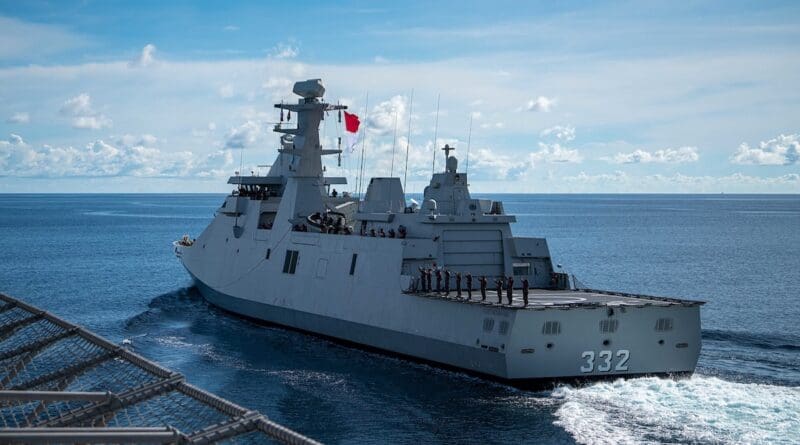
File photo of Indonesian Navy's KRI I Gusti Ngurah Rai (332) frigate. Photo Credit: U.S. Navy photo by Petty Officer 3rd Class Andrew Langholf, Wikipedia Commons
August 12, 2026
By Simon Hutagalung
Key Takeaways
A joint China–Indonesia naval exercise conducted in waters east of Taiwan has intensified regional tensions, with Beijing using it to normalise PLA Navy presence beyond the first island chain while Taiwan views it as part of a broader encirclement strategy.
Indonesia faces a foreign-policy dilemma: participation risks being interpreted as tacit support for China’s maritime claims, potentially complicating its defence ties with the United States and undermining its long-standing non-aligned stance and strategic autonomy.
The exercise contributes to a shifting Indo-Pacific balance that is prompting other regional actors to strengthen their own security cooperation, highlighting the need for clearer Indonesian and ASEAN strategic communication, maritime confidence-building measures, and careful management of great-power rivalry to preserve an open, rules-based maritime order.
A recent naval exercise conducted by China and Indonesia in the waters east of Taiwan, in a region of increasing strategic importance to China, exposed the rising tensions between China and Taiwan, as well as the deepening divide in the Indo-Pacific region. Indonesia has portrayed the exercise as routine, while Beijing has a different agenda for its military.
The engagement of a foreign navy in the region, as China is increasing its military presence in the East China Sea, which Beijing claims as its own, marks a significant turning point in the power shift in the region. The exercises, which were conducted in the East China Sea, an area that China is increasingly trying to claim as its own, are part of Beijing’s attempts to normalise the presence of the People’s Liberation Army Navy (PLAN) beyond the first island chain. Taiwan, increasingly isolated in the region, is extremely concerned about the development, as it sees it as part of a broader strategy by Beijing to encircle the island.
The naval exercise also poses several challenges for Indonesia’s foreign policy. Firstly, by participating in the exercise with China in a politically sensitive area, Indonesia risks being perceived as having given its support to China’s increasing claims to the maritime territories. Indonesia is currently trying to deepen its defence cooperation with the US. If Indonesia were to participate in a military exercise with China in a politically sensitive area, this could be perceived by China and other countries as an indicator that Indonesia is becoming more inclined to side with China. This in turn could trigger a response from the US, such as increased surveillance and naval presence in the Philippine Sea. This would place Indonesia under pressure to avoid further military cooperation with China, in order to preserve its non-aligned foreign policy and strategic autonomy.
However, the exercise has negatively affected the politics of the Indo-Pacific region. The recent naval exercise conducted by the navies of China and Indonesia in the waters to the east of Taiwan exposed the deepening geopolitical tensions in the region. Although Jakarta described the recent naval exercise as routine, Beijing very strategically and publicly announced that the recent naval exercise conducted by the navies of China and Indonesia in the waters to the east of Taiwan was a joint military drill. The announcement by Beijing marked a significant turning point in the current balance of power in the region. The exercise of military might by China in the waters to the east of Taiwan, which are close to Taiwan, exposed the current level of deepening geopolitical tensions in the region.
By conducting the recent exercise of military might in these particular waters to the east of Taiwan, China very actively attempted to normalise the presence of the naval might of the PLA-N in the first island chain of Indo-Pacific Asia, in particular in the waters close to Taiwan. In doing so, Beijing very clearly attempted to convey a very clear and powerful message to the governments of the nations of the region that it is China that is in control of the region and that it is China that will be leading the naval forces of the region. Therefore, the recent exercise of military might by China in these particular waters to the east of Taiwan created a very significant problem for Taiwan. The exercise of military might by China in these particular waters to the east of Taiwan exposed China’s very well-known strategy of encirclement of Taiwan by China.
In military terms, China has increased its presence in the Philippine Sea. It can now, on a regular basis, invite other navies to conduct joint exercises with the PLA Navy in the area. Russia, Pakistan and even Cambodia could be invited to join China in such exercises in the near future. The increased Chinese military presence in the area will further erode regional stability and put additional pressure on Taiwan to enhance its military presence in the eastern part of the island in order to counter potential attacks from China.
In such a scenario, Taiwan would need to increase its military presence in the region, in particular air and sea defence systems. Relations with Jakarta and the rest of the ASEAN region should also be reconsidered in order to increase presence in the region. The rest of the Indo-Pacific region is reviewing its relations with each other in order to better counter China’s expansion. Japan and the US are conducting more joint patrols to better protect sea lines of communication; the Philippines is increasing its defence cooperation with the US under the Enhanced Defence Cooperation Agreement, while Australia is increasing its defence diplomacy with countries in the region to better ensure that China does not undermine existing maritime norms.
By taking part in this naval exercise, Indonesia needs to boost its strategic communication to stress that the routine naval exercises held by Indonesia and China do not signify that Indonesia is taking part in the political efforts of China. As for ASEAN, it needs to outline its military operations, particularly those that are held in sensitive zones of the sea, to prevent its members from escalating the existing great power rivalry. Taiwan and her allies need to strengthen their maritime confidence-building measures to forestall conflicts. At the same time, China and the US must enhance their communication and maintain close monitoring in the Philippine Sea in order to avoid any miscalculation. Maintaining an open, stable and maritime-related order in the Indo-Pacific region would depend on how non-aligned nations would safeguard their foreign policy independence in the midst of a Sino-US great power rivalry.
The recent joint naval exercise between China and Indonesia, which took place east of Taiwan, has changed the strategic landscape of the Indo-Pacific region. The event has, in essence, transcended the scope of normal military cooperation between the two countries and has assumed a geopolitical dimension. It will impact the open, stable, and rules-based maritime order in the region and how non-aligned countries can protect their foreign policy independence in the face of Sino-American competition for influence.
The opinions expressed in this article are the author’s own.
ReferencesLin, B., Hart, B., Li, L., & Tinsley, T. (2026, February 5). Tracking China’s increased military activities in the Indo-Pacific in 2025. Centre for Strategic and International Studies (CSIS).
Laksmana, E. A., & Michaels, M. (2026, March). Building blocks: Enhancing Southeast Asia’s crisis-response architecture. International Institute for Strategic Studies (IISS).

About Simon Hutagalung
Simon Hutagalung is a retired diplomat from the Indonesian Foreign Ministry and received his master's degree in political science and comparative politics from the City University of New York. The opinions expressed in his articles are his own.
View all posts by Simon Hutagalung →

No comments:
Post a Comment