CPEC And Balochistan: A Corridor Of Opportunity Or Missed Promises? – OpEd
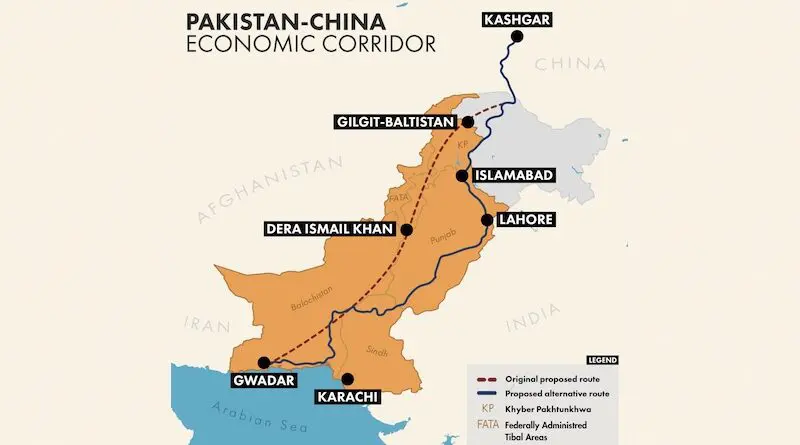
Approximate routes for the China Pakistan Economic Corridor (CPEC). This map is for illustrative purposes only. Credit: RFE/RL
August 12, 2026
By Patial RC
Key Takeaways
Balochistan is Pakistan’s largest and most resource-rich province, with critical strategic value as the centrepiece of the China-Pakistan Economic Corridor (CPEC) via Gwadar, yet it remains one of the country’s least developed regions with deep local grievances over representation, resource benefits, employment and infrastructure.
Nearly a decade after CPEC’s launch, the corridor has largely failed to deliver the promised transformation: industrialisation and job creation lag far behind projections, infrastructure often bypasses local communities, and security threats—including attacks on Chinese personnel—continue to undermine progress.
Long-term success requires shifting from an infrastructure- and security-first model to people-centred development that generates tangible local benefits, addresses legitimate political grievances through constitutional channels while confronting militancy, and ensures Balochistan becomes a principal beneficiary rather than merely a transit corridor.
Balochistan occupies a paradoxical position in Pakistan. It is the country’s largest province by area, possesses enormous reserves of natural gas, copper, gold, coal and other minerals, and commands a coastline of extraordinary strategic importance. Yet it remains one of Pakistan’s least developed regions, with persistent grievances over political representation, resource distribution, employment, infrastructure and the benefits accruing to local communities.
The province also lies at the heart of the China-Pakistan Economic Corridor (CPEC), the flagship component of China’s Belt and Road Initiative (BRI) in Pakistan. The $62bn CPEC, formally launched in 2015 was to be a “Game Changer” for Pakistan’s economy. Conceived as a transformational economic corridor, CPEC was expected to connect China’s Xinjiang region with Gwadar on the Arabian Sea through roads, railways, energy infrastructure and industrial development. For Pakistan, it was projected as an opportunity to transform connectivity, energy supply, employment and industrial growth. For China, it offered a shorter overland connection to the Arabian Sea and an important strategic and commercial link with South Asia, the Middle East and Central Asia.
Almost a decade after its formal launch, however, the central question remains: Has CPEC delivered the transformation promised to Balochistan and Pakistan?
Balochistan: A Province at the Centre of a Grand Strategy
Gwadar is the geographical and strategic centrepiece of CPEC. Its location gives Pakistan an important Arabian Sea port and gives China the possibility of developing an alternative route for trade and energy supplies. The overland connection between western China and Gwadar was envisaged as a means of reducing the distance involved in transporting energy supplies from the Gulf and, strategically, of mitigating China’s long-standing concerns over its dependence on vulnerable maritime routes such as the Malacca Strait.
But the strategic importance of Gwadar has not automatically translated into prosperity for the people living around it.For many residents, the most striking feature of CPEC has been the gap between the scale of the promises and the realities of everyday life. Roads, ports, power projects and security installations may demonstrate state activity, but development is ultimately measured by whether ordinary citizens have better schools, functioning hospitals, reliable water and electricity, employment, business opportunities and meaningful participation in the economic activity taking place around them.
CPEC Complicated
The original vision included Special Economic Zones intended to attract investment, establish industries and generate employment. Yet the industrialisation promised under the first phase has progressed far more slowly than initially anticipated. Employment creation has also fallen substantially short of the extraordinarily high projections made at the beginning of the programme. For Balochistan, this matters enormously.
A province sitting on mineral wealth and strategic infrastructure can reasonably ask why large-scale investment in its territory does not produce proportionate opportunities for its population.
Gwadar: A Symbol of Disappointment?
Gwadar was supposed to become a major commercial centre. Instead, the city continues to face fundamental developmental challenges. The criticism frequently heard from local residents and observers is not necessarily that infrastructure should not be built, but that development should not occur around the population while bypassing it.
A port cannot become an economic engine simply because ships can dock there. It requires an ecosystem of businesses, logistics, manufacturing, services, skilled workers, entrepreneurs and local supply chains. If local traders, fishermen, small businesses and young people do not see tangible opportunities, the perception that development is being imposed rather than shared inevitably grows.
This is particularly important in Balochistan, where historical mistrust of Islamabad is already deep. CPEC therefore faces a problem that cannot be solved merely by building more roads or deploying more security personnel.The economic corridor must also become a corridor of opportunity for the people whose province hosts it.
Security and Economics
The security environment has further complicated the CPEC equation. Chinese citizens and companies working on infrastructure projects have repeatedly been targeted by militant organisations in Pakistan. Baloch separatist groups have specifically attacked Chinese personnel and projects, arguing that Chinese investment represents exploitation of Balochistan’s resources and insufficient benefit to its inhabitants.
The large-scale attacks in Balochistan in August 2024 demonstrated the continuing capacity of militant groups to strike security installations, transport infrastructure and civilian targets. Such violence inevitably reinforces Beijing’s concerns about the security of its citizens and investments.
Balochistan’s legitimate Political Grievances
At the same time, Balochistan’s legitimate political grievances should be distinguished from militant violence.Democratic political actors must have space to articulate concerns over land, employment, resource distribution, missing persons, provincial autonomy and development. At the same time, armed attacks on civilians, security personnel, infrastructure or foreign workers cannot be legitimised as political expression.
A mature policy must be capable of doing both things simultaneously: confronting terrorism while addressing legitimate grievances through political and constitutional means.
Rich in Resources, Poor in Returns
Perhaps the central contradiction of Balochistan is that its natural wealth has not translated into comparable human development. The province possesses major mineral and energy resources, yet many communities continue to struggle with basic services.This creates an uncomfortable question for Pakistan:
If Balochistan is so strategically and economically valuable, why has its population not experienced a corresponding transformation in living standards?
The answer cannot simply be that the province is remote or insecure. Those difficulties are real, but they also underline the need for a development model specifically designed around local participation.
Resource extraction without local value addition can deepen resentment. Large projects that employ outside labour while leaving local workers on the margins can create perceptions of exclusion. Infrastructure that connects mines and ports but does not adequately connect communities to markets, schools and hospitals can appear to serve the project rather than the people.CPEC therefore has to move beyond the concept of infrastructure first towards people-centred development.
China’s Patience and Pakistan’s Responsibility
Beijing also has legitimate concerns. China has invested heavily in Pakistan, but Chinese companies require security, predictable regulations, commercially viable projects and continuity of policy. Repeated attacks on Chinese personnel naturally increase the cost and risk of investment.
China’s reassessment of overseas infrastructure investment should therefore not automatically be interpreted as China abandoning Pakistan. Rather, it reflects a broader reality: major investments must eventually produce economic returns. Pakistan cannot expect China to finance projects indefinitely simply because the two countries describe themselves as “All-weather Friends,higher than mountains, deeper than oceans, sweeter than honey, and stronger than steel.”
The responsibility ultimately lies with Pakistan to create conditions in which Chinese investment—and investment from any other country—can succeed.That means improving governance, reducing bureaucratic bottlenecks, ensuring policy continuity, strengthening provincial participation, protecting investors and workers, and creating transparent mechanisms through which local communities can see how they benefit from projects undertaken in their region.
CPEC as a Corridor of Success
The original promise of CPEC was much larger than a collection of roads, power plants and a port. It was supposed to become an economic ecosystem linking Pakistan with China and, eventually, Afghanistan and Central Asia. Its second phase envisages industrial cooperation, agriculture, technology, connectivity and other forms of economic integration.
But for this vision to succeed, Balochistan cannot remain merely the geographical location of the corridor. It must become one of its principal beneficiaries.
The success of CPEC should therefore not be measured merely by kilometres of highways constructed, megawatts of electricity generated or billions of dollars committed but should generate local recruitment, vocational education, scholarships, healthcare, water supply, fisheries development, support for local traders, opportunities for small and medium-sized enterprises, and greater participation of provincial institutions in planning and implementing projects.
Mining and mineral development should similarly create local processing, skilled employment and downstream industries rather than simply extracting resources and transporting them elsewhere.
If CPEC generates economic activity but Balochistan remains poor, the project will struggle to convince its most important local audience of its value.
Pakistan’s Prism of Terrorism
Balochistan should not be viewed solely through the prism of terrorism. Nor should its legitimate developmental and political grievances be dismissed because militant groups exploit them. Both realities can exist simultaneously.
There is a security problem in Balochistan. There is also a governance and development problem. There are militant organisations seeking to exploit instability, but there are also ordinary citizens seeking education, employment, dignity and a greater stake in their province’s future.
Pakistan must therefore pursue both security and development. It must confront violent networks while strengthening democratic institutions, improving governance and ensuring that the province’s natural wealth generates visible benefits for its people.
China, too, has an interest in this outcome. A secure Gwadar cannot be created by security checkpoints alone. A successful CPEC cannot be sustained by infrastructure alone. And long-term Chinese investment cannot flourish without the confidence of the communities in which those investments operate.
Balochistan is too important to Pakistan as a transit route, its resources, coastline and strategic location give it enormous potential.
Potential but No Development
Balochistan’s story is therefore not simply one of terrorism. It is also a story of communities seeking peace, political actors working through constitutional institutions, security agencies confronting violent networks, and development initiatives attempting to create greater opportunity.
The recent appeal by Mir Yar Baloch to the international community for recognition of Balochistan as an independent country, accompanied by his assertion that the movement had entered a new phase focused on diplomatic and political recognition, illustrates that the political dimension of the Balochistan question remains very much alive. Supporters marked August 11, as “Balochistan Independence Day”.
CPEC visioned to reshape Pakistan’s economy with its extensive network of roadways linking rural and urban areas. Appears that CPEC after a decade of promised opportunities has “Not taken off to fulfill the role of a “Game-Changer” in the regional development as dreamt for the local Balochipopulace.

About Patial RC
Patial RC is a retired Infantry officer of the Indian Army and possesses unique experience of serving in active CI Ops across the country and in Sri Lanka. Patial RC is a regular writer on military and travel matters in military professional journals. The veteran is a keen mountaineer and a trekker.
View all posts by Patial RC →

No comments:
Post a Comment