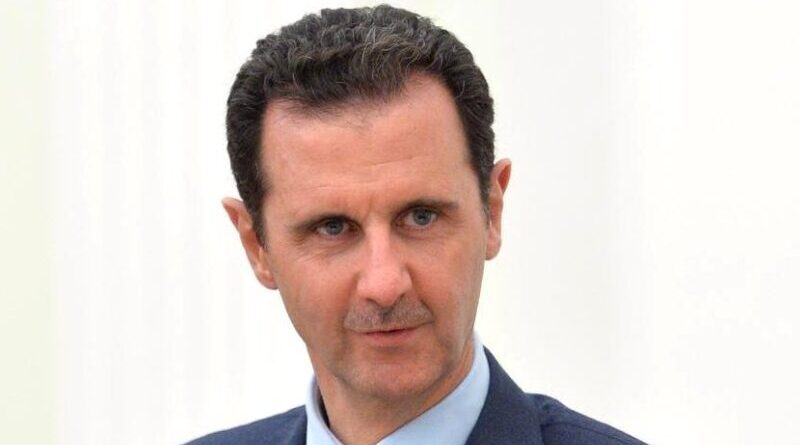
File photo of Syria's Bashar Assad. Source: Kremlin.ru
August 12, 2026
Arab News
By Tarek Ali Ahmad and Gabriele Malvisi
Key Takeaways
Syria’s Fourth Criminal Court in Damascus sentenced former President Bashar Assad to death in absentia for premeditated murder (including of children), torture, arbitrary arrest and crimes against humanity—the first such conviction by a Syrian court since his regime collapsed in December 2024.
The ruling carries major symbolic weight by formally ending the culture of impunity that long protected the top of the Assad system, yet it remains largely unenforceable while Assad stays in Russia and does not by itself amount to comprehensive transitional justice.
Experts note that Syria’s legal framework is still ill-equipped for mass atrocity cases, the death sentence may hinder future extradition efforts, and the true test of the transition will be whether this landmark judgment opens the door to broader, impartial accountability rather than remaining an isolated symbolic act.
For almost a quarter of a century, Bashar Assad stood at the apex of a Syrian state in which the president appeared beyond the reach of its courts.
On Tuesday, that relationship was dramatically reversed.
Syria’s Fourth Criminal Court in Damascus sentenced the ousted president to death in absentia after convicting him of offenses including “premeditated and intentional murder of more than one person and of children” as well as “torture, arbitrary arrest and crimes against humanity” committed during the country’s long conflict.
It is the first conviction handed down against Assad by a Syrian court since his government collapsed in December 2024 and he fled to Russia.
His brother Maher, the former commander of the feared Fourth Armored Division, and Atef Najib, the former security chief in Daraa whose treatment of teenage protesters helped ignite the 2011 uprising, were among those also sentenced to death.
Najib, detained in Syria last year, was the only senior defendant present in court.
For many Syrians, the symbolism was unmistakable.
Crowds gathered outside the courthouse in Damascus and celebrated in Daraa, where the uprising against Assad began after security forces arrested and tortured teenagers accused of writing anti-government graffiti.
For Rahaf Aldoughli, lecturer in Middle East and North African studies at Lancaster University, the ruling carries “enormous symbolic significance.”
“For decades, one of the defining features of the Assad system was impunity: the assumption that those at the very top of the state could never be held legally accountable,” she told Arab News.
“A Syrian court formally identifying Bashar Assad as criminally responsible therefore breaks, at least symbolically, with that legacy.”
But she cautioned against overreading the moment.
“We should be careful not to equate sentencing Assad with transitional justice. Transitional justice cannot be reduced to the punishment of one individual, however central he was to the system.”
The verdict also confronts Syria’s new authorities with a harder question: does sentencing Assad to death bring him closer to justice, or does it make the prospect of ever physically trying him — and those who enabled his apparatus — even more remote?
“All in all, this is a significant move, but we should not overstate it,” Robert Pinfold, lecturer in international security at King’s College London, told Arab News. “It’s still largely symbolic — one simply because Assad is in Russia.”
While Damascus and Moscow’s continued warm ties could theoretically be a “curveball,” he said, it is reasonable to assume Assad and his family’s assets will remain out of reach in the short term.
“On the death sentence itself, most Syrians will broadly agree with it,” Pinfold said. “Very few people today — including some of his former supporters and Alawites who feel he betrayed them by fleeing — still back Bashar Assad. So this isn’t a controversial decision.
“But the government’s ability to actually enforce it is limited, since Assad is out of the country.”
He argued that as Damascus faces growing demands for truth, reconciliation and accountability, it must pursue them carefully to avoid the perception that minority communities are being collectively blamed for the former regime’s abuses, even as Syrians continue to call for justice.
Assad became the unlikely ruler of Syria from 2000 until December 2024, succeeding his father Hafez Assad and presiding over a system dominated by the presidency, security agencies and military establishment.
When peaceful protests erupted in 2011, government forces responded with deadly force. The uprising quickly developed into a war that killed over 580,000 people, displaced over 13 millions and produced allegations of systematic torture, enforced disappearance, indiscriminate attacks and other grave violations.
For years, attempts to establish accountability largely took place outside Syria. European courts used universal jurisdiction and other legal mechanisms to prosecute former Syrian intelligence officers and other suspects who had reached their territory.
French courts have also pursued Assad himself. In 2025, French investigating judges issued a warrant for his arrest in connection with the 2012 shelling of a media center in Homs that killed journalists Marie Colvin and Remi Ochlik.
Tuesday’s ruling is significant because it was issued inside Syria, formally placing Assad in the country’s criminal record as a convicted defendant rather than merely the subject of foreign investigations, allegations or sanctions.
But the death sentence does not necessarily represent a final legal outcome. Assad was tried in absentia, and under Syrian procedural law the verdict could be overturned and proceedings reopened if he surrenders or is arrested and brought before the court, according to analysis by the Syrian Network for Human Rights.
“The fact that it also involves a death sentence also complicates other extradition treaties with other countries that may or may not have provided asylum for Syrian regime officials,” Samy Akil, senior adviser at The Syria Report, told Arab News.
“I think the EU and the ICC are against extraditing anyone to a death sentence who have been tried in absentia. I think this is something also that the Syrian officials have not really taken into account.”
Farhan Haq, Deputy Spokesman for the Secretary-General, said at a press briefing on Tuesday that the UN had “taken note of the decision” and remained committed to supporting transitional justice efforts.
“What I can tell you is that addressing longstanding demands for justice, accountability, and truth can contribute to restoring confidence in institutions and laying the foundations for healing, national reconciliation, and sustainable peace. We recall the General Assembly’s call to establish a moratorium on executions with a view to abolishing the death penalty, and we encourage the Syrian authorities to pursue accountability through a victim-centred transitional justice process that upholds human rights and the rule of law.”
There is also a wider legal question. Syrian law does not define “war crimes” or “crimes against humanity” as distinct offences. Such cases are therefore generally pursued under ordinary criminal provisions, including those covering murder, torture and unlawful detention.
Prosecutors have sought to address this gap by invoking international legal principles, although Syria is not party to the 1968 UN Convention on the Non-Applicability of Statutory Limitations to War Crimes and Crimes against Humanity.
The proceedings will therefore help establish the legal framework for future accountability cases.
“Syria’s legal framework and legal system is not well equipped to deal with the scale and scope and type of the massacres that have been conducted in Syria — be it war crimes, be it torture, be it all the relevant topics that need to be discussed,” said Akil.
“So the fact that they relied heavily on the penal code that existed — despite over a year and a half of work on a transitional justice law and draft and advocacy from a lot of civil society groups — undermines the transitional process (today) and for the future.
“At the end of the day you need a functioning independent judiciary to deal with other (similar) cases that are maybe less high-profile like people who were commanders of divisions who committed massacres under orders from the upper echelons of the chain of command.
“The lack of a clear transitional justice law is, I think, the main concern, but at the end of the day obviously the decision is a symbolic victory.”
For now, Assad is unlikely to face the sentence imposed on him. He remains in Russia, which is unlikely to extradite him, while the death penalty could complicate any attempt to secure his extradition from another country.
Yet dismissing the ruling as purely symbolic would also overlook its significance.
For the first time, a Syrian court has formally established the criminal responsibility of the former regime’s most powerful figure — a man who once embodied the authority of the Syrian state, but is now recorded as a fugitive convicted of serious crimes.
“In the immediate term, the sentence is unlikely to result in Assad’s imprisonment or execution as long as he remains protected in Russia and Moscow refuses to extradite him,” Aldoughli said.
“Its immediate power is therefore primarily legal and symbolic rather than coercive. But that does not make it meaningless.”
Assad’s conviction closes one chapter in Syria’s relationship with its former ruler. The more consequential question is whether it will mark the beginning of a comprehensive and impartial transitional-justice process, or remain a landmark judgment that can never be enforced.
“Perhaps the larger significance is that Assad, who governed Syria for more than two decades with virtually unlimited power, is now a fugitive from a Syrian judicial process,” Aldoughli said.
“For many Syrians, that reversal itself will carry considerable symbolic weight. But the real test of Syria’s transition will be whether this moment becomes the beginning of a comprehensive and impartial justice process, rather than its culmination.”

No comments:
Post a Comment