NAKBA2.0
At UN Security Council, Officials Say Israeli Settler Violence Has Brought West Bank to ‘Breaking Point’
“Settler violence has reached unprecedented levels,” said a coordinator for the Middle East peace process. “Many incidents occurred in the presence of Israeli forces.”
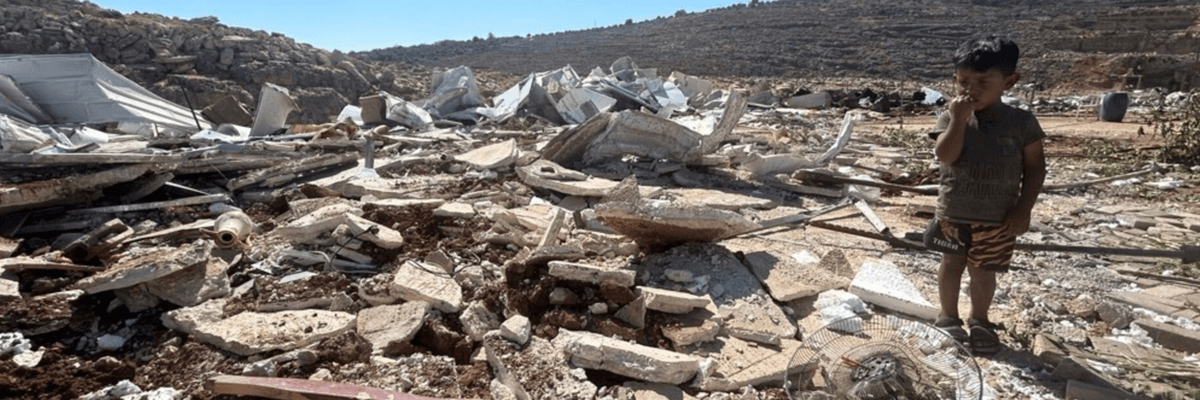
A child stands among the rubble after Israeli authorities demolished his family’s home and other residential and donor-funded structures in a Bedouin community in Qalqiliya governorate, the West Bank, on July 14, 2026.
(Photo by United Nations Office the Coordinator for Humanitarian Affairs)\
Julia Conley
Aug 12, 2026
COMMON DREAMS
Home demolitions by Israeli forces; attacks on healthcare infrastructure, homes, and schools; mass displacement of Palestinians; and the expansion of illegal settlements across the West Bank have brought the occupied Palestinian territory to “the breaking point,” said a top humanitarian official at the United Nations Security Council Tuesday, calling for a “coordinated international effort” to end the violent Israeli occupation.
At a meeting on the situation in the territory, Ramiz Alakbarov, the UN special coordinator for the Middle East peace process, addressed the council as families in the town of Qusra, northern Nablus, were facing days of attacks by Israeli settlers.
That violence exemplified what the Israeli human rights group B’Tselem called an escalating “ethnic cleansing” operation that Israel’s military allows.
As B’Tselem said Wednesday, settlers had established an illegal outpost in the yards of two Palestinian families’ homes, “forcing the families out and taking over their homes,” and the US-backed Israel Defense Forces (IDF) had done nothing to protect the Palestinian residents.
“Israeli ethnic cleansing in the West Bank is accelerating and expanding in full view of everyone,” Yuli Novak, president of B’Tselem, told Anadolu Agency, adding that the settlers’ seizure of the Palestinian homes was “not an isolated incident.”
Breaking the Silence, an organization run by former IDF members who oppose the occupation, explained how settlers, with the backing of the military, essentially blockade individual homes as a method of driving Palestinians out.
“Violent settlers may do the ‘dirty work’ of daily terror against Palestinian men, women, and children, but neither this terror nor ethnic cleansing would be possible without the army’s support,” said the group. “Village after village, house after house. It keeps happening because it is policy.”
At the Security Council meeting, Alakbarov said Israeli forces have killed 76 Palestinians, including 18 children, in the West Bank in 2026 so far, while children make up nearly half of the 3,800 Palestinians who have been displaced by settler attacks, demolitions, and evictions.
“One hundred and twenty-seven Palestinian communities have experienced full or partial displacement since January 2023, including 47 that have been entirely displaced, affecting more than 6,390 Palestinians,” said Alakbarov. “Settler violence has reached unprecedented levels. So far this year the UN has documented more than 1,430 incidents involving Israeli settlers that resulted in casualties, property damage, or both, affecting approximately 260 Palestinian communities. Many incidents occurred in the presence of Israeli forces.”
As Alakbarov spoke Tuesday, the World Health Organization warned that the West Bank has also seen an uptick in violence against healthcare infrastructure, with Israeli carrying out 83 attacks on healthcare transport such as ambulances and 11 attacks on medical centers and facilities, injuring at least 33 people and killing four. July saw a surge in healthcare attacks—a hallmark of Israel’s assault on Gaza that began in 2023—with 37 strikes on infrastructure.
Settler attacks were once mainly concentrated in Area C, which comprises about 60% of the West Bank and is under Israeli control.
But Alakbarov said settlers are increasingly waging violence against Palestinians in Areas A and B, which are under the administration of the Palestinian Authority.
“The future of the region is at stake,” the UN permanent observer for the state of Palestine, Riyad Mansour, told the Security Council. “International will cannot bow before the colonial whims of the Israeli government.”
Israeli officials in recent months have advanced and approved about 12,360 housing units in settlements across the West Bank this year, with the Security Cabinet signing off on 13 new settlements in the central part of the territory last month. The move further isolates East Jerusalem, which Palestinians consider the capital of a future Palestinian state, from the rest of the West Bank.
Last year Prime Minister Benjamin Netanyahu also signed an agreement to develop 3,400 new units in the E1 settlement, which would also cut off access to East Jerusalem. The prime minister said as he approved the deal, “There will be no Palestinian state.”
The approvals of more settlement housing this year and the escalation in IDF-sanctioned violence against Palestinian communities across the West Bank “are interconnected steps, not isolated developments,” Alakbarov said Tuesday.
“The situation in the West Bank must be treated as an emergency requiring urgent action,” he said. “The concern is not only the continued expansion of settlements, but the speed and systematic manner in which new facts are being created on the ground. New outposts are established, often with state support, and can be retroactively authorized or incorporated into the wider settlement system. From these outposts, settler violence and intimidation have driven the displacement of Palestinian communities.”
He added that the spread of settler outposts in agricultural and grazing areas is “deeply troubling.”
“Requiring only a small number of settlers, they enable control over vast areas of land,” said Alakbarov. “Israeli monitoring organizations report that agricultural and pastoral outposts now exercise effective control over close to 20% of the West Bank.”
Israeli forces also arrested 23 Palestinians on Tuesday, including two children, days after a large-scale operation at Qalandia refugee camp resulted in the detentions of more than 60 people.
Hannah Sulieman, deputy executive director of the UN Children’s Fund (UNICEF), emphasized that 355 Palestinian children are currently being detained in Israeli military prisons—“the highest number in eight years.”
The arrests and the violence mean that for children and their families in the West Bank, “the fundamental spaces of childhood—the home, the classroom, the street, the community—are becoming increasingly unsafe,” said Sulieman.
“Children in the West Bank have the same rights as children everywhere,” she said. “To live, to learn, to be protected, and to imagine a future beyond violence and fear.”

No comments:
Post a Comment