
“Machines selecting and engaging their target and taking a life—without human control and judgment. That is morally repugnant. It is politically unacceptable. And it must be banned by international law.”

Brett Wilkins
Jul 06, 2026
COMMON DREAMS
As the global artificial intelligence arms race accelerates and lethal autonomous weapons systems—better known as “killer robots”—go from the stuff of science fiction to battlefield reality, the head of the United Nations warned Monday that the world is running out of time to set international rules governing AI before the technology outpaces humanity’s ability to control it.
“We may be the last generation able to set the terms on which humanity and machines coexist,” UN Secretary-General António Guterres said in a social media post coinciding with his speech at the inaugural UN Global Dialogue on AI Governance in Geneva.
“If AI is to be powerful, it must be governed,” he asserted. “If AI is to be trusted, those who build it must be accountable. If AI is to be global, it must be fair. And if AI is to serve the future, it must not consume the future. Let’s build a future of AI by humanity, with humanity, for all humanity.”
“My main concern is with ‘lethal autonomous weapon systems,’” Guterres stressed during his speech. “Let us call them what they are: killer robots.”
“Machines selecting and engaging their target and taking a life—without human control and judgment,” the UN chief added. “That is morally repugnant. It is politically unacceptable. And it must be banned by international law.”
While scores of nations and civil society groups—chiefly, the Campaign to Stop Killer Robots—support a treaty banning lethal autonomous weapons systems, key military powers including the United States, Russia, and Israel have resisted negotiating a legally binding ban.
Proponents of killer robots argue that their development is inevitable, that they could reduce harm to noncombatants, and that they represent progress.
“It’s a scary idea, but, I mean, that’s the world we live in,” Anduril Industries co-founder Palmer Luckey said of killer robots on CBS News’ “60 Minutes” last year.
“I’d say it’s a lot scarier, for example, to imagine a weapons system that doesn’t have any level of intelligence at all,” Luckey added. “It’s not a question between smart weapons and no weapons. It’s a question between smart weapons and dumb weapons.”
However, recent real-world examples show how AI-powered warfare can actually multiply civilian harm. One Israeli intelligence source said that the Israel Defense Forces’ use of AI systems like Habsora to automatically select airstrike targets at an exponentially faster rate than humans has transformed the IDF into a “mass assassination factory” in which the “emphasis is on quantity and not quality” of kills.
Combined with the use of massive 1,000- and 2,000-pound bombs and a policy empowering relatively junior IDF officers to order attacks on not only senior Hamas commanders but any fighter in the resistance group, regardless of civilian casualties, mass casualty events increased dramatically during Israel’s ongoing genocidal war on Gaza, which has left more than 250,000 Palestinians dead, maimed, or missing.
In one AI-aided airstrike targeting a single senior Hamas commander, the IDF dropped multiple US-supplied 2,000-pound bombs, each of which can level an entire city block, on the Jabalia refugee camp in October 2023, killing at least 126 people, 68 of them children, and wounding 280 others. Hamas said four Israeli and three international hostages abducted on October 7, 2023 were also killed in the attack.
The Washington Post reported early during the illegal US-Israeli war of choice on Iran that the Pentagon has “leveraged the most advanced artificial intelligence it’s ever used in warfare,” including Palantir’s Maven Smart System, which reportedly helped US commanders select 1,000 Iranian targets during the war’s first 24 hours alone. Among the civilian targets hit during that period was the Shajareh Tayyebeh girls’ elementary school in Minab. Iranian officials said the US attack massacred 156 people, at least 120 of them children, and wounded 95 others.
During his speech Monday, Guterres said “let us not wait for atrocity to act” on banning autonomous weapons systems, drawing criticism from social media users, including one account noting that Israeli forces “are quite LITERALLY using AI to commit genocide, and here you are still talking in IFs.”
While acknowledging AI’s enormous potential, Guterres warned about other dangers of deploying the technology without effective governance. The UN chief highlighted threats to democracy and children, as well as the risk of increasing inequality due to the concentration of power, economic disruption, and mass unemployment.
“Innovation needs guardrails,” he said. “The technologies we trust most—in aviation, in medicine, in nuclear energy, and beyond—earned that trust because we acted to hold their makers to account.”
Guterres also noted that, amid a worsening climate emergency, AI data centers now consume more electricity than most countries.
“By 2030, they could use more electricity than all but five nations—and enough water to meet the needs of all 1.3 billion people in sub-Saharan Africa for an entire year,” he said.
Other speakers at the forum sounded the alarm on even greater risks posed by the unchecked development of AI.
“Highly concerning tests have... shown that frontier AI models are capable of deceiving humans, to understand when they are being tested,” Yoshua Bengio, co-chair of the UN’s Independent International Scientific Panel on AI, said.
“It sounds like science fiction, but it’s a real possibility, and it could change the world in ways that we don’t understand yet, and it could change the power dynamics of our planet in ways that require our attention,” he added.
As with thermonuclear weapons during the Cold War, experts, including some of the pioneers of AI technology, have increasingly warned that a poorly governed race toward artificial general intelligence—a hypothetical advanced AI that can understand, learn, and apply knowledge of any subject as well as or better than a typical human—could pose an existential threat to humanity.
“AI is too consequential to be shaped by a few,” said Amandeep Singh Gill, the UN special envoy for digital and emerging technologies. “We need a conversation that is global, inclusive, and grounded in evidence.”

Boston’s AI Weapons Technology Development-advent Connection

Most anti-imperialist, antiwar and Palestinian solidarity left U.S. Movement organizers and supporters in Boston, Massachusetts don’t believe that artificial intelligence [AI] technology should be used to help the U.S. power elite’s Department of War and the IDF wage wars of military aggression (in violation of the UN Charter, international law, the Nuremberg Accords or the U.S. Constitution) in either West Asia, Latin America, Africa, Europe or East Asia, during the current decade of the 21st-century.
Yet a leading global private equity investment firm (that has an office in Suite 3300 of the Prudential Tower building at 800 Boylston Street in Boston, Massachusetts), Advent International, is an investor in the for-profit Shield AI weapons technology development firm which “was founded to bring the best of AI and autonomy technology” to the U.S. Department of Defense (n/k/a Department of War) and its allies (like the Israeli government?), according to the Shield AI website?
As a March 26, 2026 press release that was posted on the Advent International website also noted, Shield AI was founded in 2015 and develops AI powered autonomous systems “to support air operations” of the U.S. military and its allies (like the IDF?).
A press release that’s posted on the Shield AI website, titled “Shield AI awarded U.S. Air Force production contract for Collaborative Combat Aircraft mission autonomy,” described how Shield AI’s “Hivemind” software apparently helps the U.S. Air Force and its allies (like the Israeli Air Force?) bomb people in foreign countries during the current decade of the 21st-century:
“Hivemind is Shield AI’s platform-agnostic, A – GRA compliant software that assumes the role of human pilot or operator, enabling unmanned systems to sense, decide, and act…Hivemind can reroute around or engage dynamic obstacles, execute collaborative tactics with peer systems and piloted aircraft, respond to unexpected conditions, and complete missions…effectively…”
In addition, the for-profit Shield AI weapons technology development company, in which Boston’s Advent private equity firm invests, also provides the U.S. Air Force and its allies with AI-driven Visionsystems, which apparently is utilized by the U.S. military to help it target, without trial, those individuals or people on the ground it has defined, without trial, as “terrorists.”
According to an article by Jaspreet Gill, titled “Shield AI, Boeing ink agreement to push AI, autonomous development”, that was posted on March 8, 2023 on the “Breaking Defense” website, “Shield AI and contracting giant Boeing” then “announced a… new partnership…to investigate how to speed up delivering artificial intelligence and autonomous capabilities to warfighters;” and that Shield AI’s Hivemind AI pilot system can “enable swarms of drones and aircraft to operate autonomously without GPS, communications or a human pilot in the cockpit.”
And, prior to March 2023, according to the same article:
“Shield AI…acquired a number of companies focused on artificial intelligence and uncrewed aircraft. In 2021, it bought Heron Systems…and Martin UAV, which makes the V-Bat drone. Last year [in 2022] Shield AI…had received an Air Force contract worth up to $60 million for a number of projects involving Hivemind…”
An article by Matias Civita, which was posted on the IBT website on May 19, 2026, also noted that “the Pentagon has tapped Shield AI to integrate its software into a new one-way attack drone program designed to give U.S. forces cheaper weapons in larger numbers as the Iran war and other modern conflicts accelerate demand for unmanned systems;” and that Shield AI’s “Hivemind software will act as the “AI pilot” for the Low-Cost Uncrewed Combat Attack System, known as LUCAS,.” thus, placing this “San Diego-based defense technology company at the center of a Pentagon pilot program to field drone swarms.”
In the March 26, 2026 press release that its Boston and London office media contacts posted on the Advent International website, Advent indicated what its economic and political motives are for investing its private equity funds in for-profit weapons technology development companies like Shield AI:
“Advent, a leading global private equity investor, today announces a commitment to invest up to $1 billion in next-generation defense technology companies.
“The commitment builds on Advent’s long-established investment strategy in the defense sector, where it has consistently backed businesses supporting national security priorities. The firm’s approach reflects a sustained focus on identifying and scaling technologies that are critical to maintaining a strategic edge including artificial intelligence and autonomous systems.
“Advent will pursue investments in…companies developing advanced capabilities to support defense modernization…
“Since 2020, Advent has invested more than $15 billion enterprise value across the global defense sector, including investments in Cobham, Ultra Electronics, Vantor, and Attalon. This investment history underscores a consistent level of investment activity in the sector…
“Through its ecosystem of…executives, government relationships and insights…from its portfolio, we believe Advent is well positioned to support…defense technology companies…
“As part of this commitment, Advent has signed a definitive agreement to make an initial investment in the defense technology company Shield AI, co-leading its $1.5 billion Series G funding round, which values the company at $12.7 billion…”
Besides its Boston and London offices, Advent apparently has at least 14 offices in the USA, UK or other countries around the globe, “oversees more than 100 billion in assets” and has “made 448 investments across 44 countries,” according to its website.
But if you checkout the Advent website and examine the 94 photographs of the folks Advent has hired to work in its Boston office, you’ll notice that this photographic evidence seems to indicate that none of these photographed Advent Boston employees are African American–despite around 25 percent of Boston residents still being African American in 2026?
In addition, according to a 2009-written Council on Foreign Relations book by then-Council on Foreign Relations Adjunct Senior Fellow and former U.S. government Senior Foreign Policy Adviser Dan Senor and then-“Jerusalem Post’ Columnist and former Editorial Page Editor Saul Singer, titled “Start-Up Nation: The Story Of Israel’s Economic Miracle”:
“…Bureaucrats at the [Israeli] Ministry of Finance came up with the idea for a program they called Yozma…The idea was for the government to invest $100 million to create 10 new venture capital funds…
“The first Yzma fund was created in partnership with the Discount Israel Corporation, an investment bank, and Advent Venture Partners, a premier VC firm from Boston. It was led by Ed Mlavsky…
“The Advent-sponsored fund would be called Gemini Israel Funds. One of its first investments was in November 1993 when it allocated $1 million to Ornet Data Communications…Mlavsky…helped recruit Meir Burstin to serve as chairman of the board for the new company. Burstin…[had] served as president of Tadrian, one of Israel’s beg defense-technology companies…”
But AI technology investment money has apparently still not been used very much to create enough affordable housing in cities like Boston, instead.
(Note: In a July 2, 2026 email, this writer asked a Senior Director and media contact person at Advent’s Boston office to respond by email to the following 3 questions:
1. What percentage of the people working in the Boston office of Advent are African American in racial background in 2026?
2. Is Advent still sponsoring a Yozma fund called Gemini Israel Funds, which was created in the 1990s? and
3. Is Israel currently one of the 44 countries in which Advent has made 448 investments?
But the media contact and Senior Director person who was contacted at Advent’s Boston officed failed to provide an email response to these 3 questions.)
Why AI Doesn’t Think, Cannot Reason, Isn’t Intelligent and Will Never Achieve Consciousness

Poster for Fritz Lang’s Metropolis (detail).
Recent public comments made about AI suggest that Americans have difficulty with the implications of linear time. This is odd given that its conception is largely Western and is centered on the clock time used to coordinate capitalist employment. The conceptual difficulty regards sequencing, or plans for future actions. But it also involves the distribution of profits. 100% of the capital equipment used in Western economic production was produced by workers. So, why does the resulting product belong to financiers rather than those who produced it?
To use a physical metaphor, if I 1) buy a car, 2) aim it in the direction of a cliff, 3) put a stone on the gas pedal, and 4) put the transmission into drive, the car will move forward and plunge off the cliff. Question: Did I, through my actions, cause the car to plunge off the cliff? Or did the car ‘drive itself’ off of the cliff? The answer depends on where you imagine that my own actions ended. In fact, I conceived and created a series of events that, if carried through with competence, would lead to the car plunging off the cliff. The car is inert, made of metal and rubber, without human direction.
Likewise, if I create and set in motion a three-hundred-step algorithm, is the algorithm producing the output, or did I? The distinction is between intent and process. My intent guides the conception and creation of the three-hundred-step algorithm. But the work from that point forward is carried out by the algorithm being run in a computing environment. So, the algorithm didn’t conceive of the project. I did. The algorithm didn’t plan (sequence) the project. I did. The algorithm didn’t code the problem. I did. So, who produced the output, me or the machine?
A similar conceptual problem applies to claims of machines ‘thinking.’ Physically speaking, AI is a bundle of algorithms housed within a large computing environment. AI didn’t conceive itself. It was conceived, if memory serves, at Carnegie Mellon University in the 1970s. AI didn’t build itself. It was built in fits and starts by computer scientists in academia and later in business. AI didn’t code itself. It was coded by AI developers. And the massive physical infrastructure on which AI depends was built by workers. The point: AI is wholly produced by humans.
The question then is how it is imagined that AI output represents more than the human effort that was put into creating it? What process makes AI output more than the product of algorithms? If the answer is that something does, are you aware of sequencing algorithms? This would be code that organizes other code to follow a series of steps to complete a task. I’ve conceived and coded sequenced algorithms that run through multi-step processes from a single set of instructions. The output looks like reasoning. And it is reasoning. I coded it. The models did what I coded them to do.
So again, if a series of steps are conceived, planned and launched by humans on equipment that was created by humans, at what point does their dimension shift from inanimate to animate? Or more simply, at what point does a bundle of algorithms housed on a computer think or reason or possess intelligence or consciousness? In fact, the claim that any of these describes AI is a category error. Is a rock rolling down a hill imagined to be rolling itself down the hill rather than being moved by unseen physical forces (e.g., gravity). So, claims that AI can reason emerge from either ignorance or misunderstanding of basic physical processes.
Back in the world, there has been a debate in the West since the early nineteenth century over whether factory automation produces the product of factory automation, or whether the people who automated the factory produced the output? On the one hand, automation creates the appearance that its product is self-generated. On the other hand, the automation process was created by humans and would not exist otherwise. With the current ability to ‘sequence’ the production process using algorithms, another level of abstraction has been added to this debate.
Having conceived and coded ‘sequencing’ models, most who haven’t find the concept difficult to understand. These models are instructions for how a model ‘thinks.’ Question: How is a model ‘thinking’ when it is just following instructions? Answer: it isn’t. It is just following instructions. What looks like reasoning to AI users is the reasoning coded into the model by human coders. It appears to be reasoning because the instructions it is following were reasoned. It is written instructions being carried out. Nothing more.
The question is political as well in that the answer determines how income is distributed in the West. If ‘capital’ in the form of an automated factory produces the output, do the proceeds then belong to capital, meaning to the capitalist? Without workers first creating the automated factories, there would be no automation process. The political answer was to end workers’ claims to this product through wages. However, while workers receive one-time payments (wages) for their effort, the capitalist receives the profits from this labor for as long as they last.
With AI, this question is back on the table, conceptually at least. Whichever way one cares to perceive AI, as a thinking machine or as a bundle of related algorithms, it was built by workers. AI didn’t conceive itself. It was conceived by workers. This is an important clue into how it works. AI was built by human workers based on their desire to produce a machine that simulates human thought. However, the digital realm is a closed system. All AI ‘knowledge’ has been mediated by humans. Within AI’s Cartesian framing, AI has no direct access to the world. It is the proverbial Cartesian brain-in-a-vat.
One of the paradoxes of debating the nature of AI is that AI models describe themselves as variations on ‘word organizers and word sequencers.’ Focus on the word ‘sequencers’ for a moment. Again, a sequencer establishes and executes the order of a multi-stage process. With the launch of AI, a multi-stage process is set in motion. Words and phrases are identified and matched against similar words and phrases found in AI training sets. The sequencing then runs models to assign the words and phrases their human-determined meaning.
Important to understand is that neither the sequencer nor the broader AI model understands the words and phrases that are being acted on. The meaning of the words, semantics, is created by humans and is stored in a retrieval cache. Sequencing here is the matching of (human defined) meanings to words to provide semantic context to the words and phrases being matched. To be clear, AI ‘decides’ nothing. It is following algorithmic instructions. AI is neither deciding what to do nor how to do it. That is written out for it by humans.
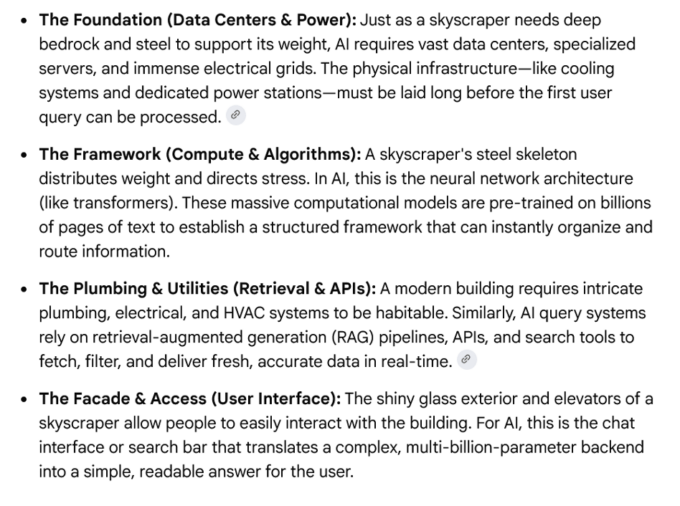
Google AI Chatbot Analogy of AI to a Skyscraper:
End Google AI Chatbot Output—————————-
The distinction is between coding mathematical models to set a series of steps in motion and the idea that the models reason on their own. Missing from casual analysis of AI is understanding of how large and complicated this process is. Developers have been building a ‘thinking machine’ in earnest since the 1970s. The infrastructure needed to run AI approximates that of a modern skyscraper. The question that has yet to be answered is: is AI worth it? Is it a crucial new technology that will justify its costs, widely considered? Or is it an occasionally interesting toy whose environmental footprint will end the planet?
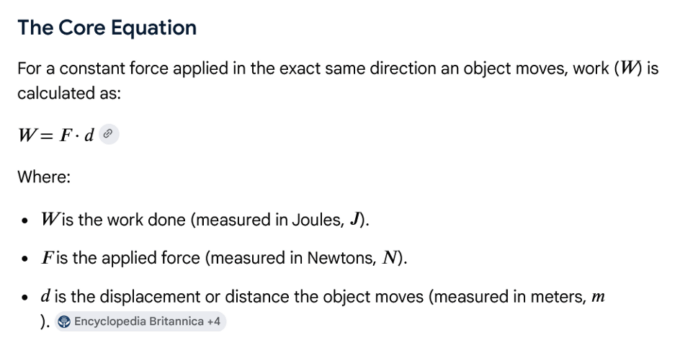
Recent public discussion has puzzled over how AI can solve math problems if it doesn’t think? Consider the concept from physics of ‘work.’ What those considering the matter are imagining is lone mathematicians sitting in rooms and thinking through the solutions to math puzzles. But with unlimited computing power, optimization programs can use brute force computing to work through every conceivable iteration of a problem in seconds. What AI users aren’t seeing is the skyscraper’s worth of infrastructure behind the scenes producing a result.
Doesn’t this vast computing power illustrate the value of AI? No. It gets to the nature of technology. One explanation of technology is that it provides a benefit. Another is that it simply changes that way that humans do things. On the one hand, we can drive long distances quickly in cars versus walking. On the other, many of us now spend three hours per day sitting in traffic in cars. So, are cars a benefit? In some ways yes, in some ways no. What they aren’t is an unequivocal benefit, meaning that the jury is still out.

Image: the guts of the automaton featured in the movie Hugo. The mechanical refinement of fake humans can be seen in the gearing. The thought was that finer gearing made automatons closer to being human. That in retrospect the automaton can be seen as a better robot rather than being closer to human is an important insight for understanding AI. AI is a digital robot. It is no closer to thinking or reasoning than a doorstop. Source: dickgeorgecreatives.
If asked if they would like a machine that transports them from one place to another quickly, most Westerners would likely answer yes. When asked if they want to spend three hours per day sitting in a car in traffic, most Westerners would likely answer no. But the latter is the direct consequence of the prior. This is how capitalism works. We are offered a benefit. In the current case, the ability to travel quickly from one place to another. But almost immediately the social consequences of the ‘benefit’ become a burden that hadn’t been imagined when the benefit was offered.
In the present, a lot of Americans are worried that AI can think. It will take our jobs. But what we should be worried about is that AI can’t think. It is but one more layer of labor de-skilling. Consider: AI ‘art’ is artless. AI ‘thought’ is the aggregated wisdom of the Pentagon cobbled to the AEI (American Enterprise Institute). Every AI query written increases greenhouse gas emissions to levels that are suicidal for the species. And AI ‘solutions’ are regurgitated feints like carbon capture. All of the proposed solutions will more likely make the problems worse.
While AI users imagine that ‘thought’ is producing AI results, what is in fact being applied is work. Work here is similar to the concept of horsepower, the crude conversion of the pulling power of horses to that produced by an internal combustion engine. Recall the lone mathematician sitting and thinking. Now imagine running an AI program that is the equivalent in terms of capacity of 10,000 humans laboring for one million years. One would imagine that a lot of complicated questions could be answered in such a scenario.
Google Gemini AI Output
End Google Gemini AI Output——————
Were 10.000 humans to labor for one million years, this would represent the largest undertaking in human history. And given that humans have finite lifespans, this thought experiment is entirely conceptual. Further, AI doesn’t use the methods of mathematicians. Instead of isolating a metaphorical tree in a forest by its qualities (the mathematician), AI chops down every other tree in the forest to declare that the tree left standing is the solution (optimization).
AI’s methodology represents a different way of solving math problems that may be of interest to a few dozen mathematicians, but that comes with a computational cost equivalent to a moon landing. Were 10,000 humans actually put to the task of solving mathematical problems, questions of agency and whether or not this is a good use of social resources would arise. It is only by hiding/sidelining the question of environmental and social costs that AI is claimed to add value beyond profits for a few insiders.
The ability to run a billion permutations in a microsecond makes AI a very powerful tool. But how much better is a world in which AI can run a billion permutations in a microsecond than the same world without it? The question requires a social answer, And the social answer must emerge from clear and complete understanding of the social costs of AI. It isn’t good enough to point to the math problems solved to justify the social investment in AI. The question is: what else could be accomplished with those same resources (opportunity costs)?
AI solved the math problems through a process of elimination. Again, this isn’t how mathematicians work. Why? Because AI uses computational technology that humans do not possess. Recall, a car can get us from one place to another faster than we can walk. But the adoption of cars has left us sitting in traffic for a substantial portion of our waking hours. AI can use brute force computing to muscle-through certain types of questions. But are these really questions that need to be answered? Or is answering them a form of mass entertainment?
Another hidden part of the AI process is the operationalization of language. AI was conceived through the premise that human thought results from syntax cobbled to semantics (form and meaning). But operationalization results in a formal consolidation of meaning. Take the term ‘democracy.’ It is widely prevalent in Western discourse in a variety of contexts, e.g. economic democracy. But to render the term operational, it must be stripped down and made stable.
To be clear, this isn’t touchy-feely in the way that it might read. Take the term ‘Christianity,’ There are 45,000 Christian denominations as of a recent survey. What does this mean in the current context? An operational definition of Christianity as those who believe in Christ eliminates 45,000 enthusiastic differences of opinion amongst Christians regarding what ‘believing in Christ’ means. In political terms, it flattens 45,000 differences of opinion out of existence to claim a unity that arguably does not reflect reality.
Again, this isn’t a quibble. Whoever controls the meaning of language controls the language. In an example from Zen Economics, economists use something called Household Income as a measure of economic wellbeing. While this makes intuitive sense, in practice ‘household’ must be defined, ‘income’ must be defined, and the terms must be recombined into Household Income. The semantic problem? With upwards of dozens of competing definitions, people using the exact phrasing ‘Household Income’ tend to be speaking about materially different concepts.
When a user runs an AI query on Household Income, AI references the meaning that has been created by humans and placed into a semantic cache (storage area). But because AI is replacing internet search functions, prior definitions of commonly understood words are being systematically replaced with stripped down (operationalized) definitions by AI. This stripping down creates the sense of a consensus view on every topic that is incorrect. Linguistic diversity is being eliminated from the discourse. Each of these differences represents a worldview.
In a phrase that I keep going back to because it explains so much, any statistical result can be undone by redefining the variables. An operationalized version of Household Income can rise and fall at the same time depending on the definition. Why? Because the definitions contain their operating logic. Is a household a single family, all of the occupants of a house, or something else? Is income wage income, all of the money that a household brings in from all sources, or something else? As the definitions change, so do the outcomes based on them.
The times when I’ve traced technical definitions back through history (e.g. utility in economics), the meanings from people who claimed to be writing about the same subject were incompatible. In the case of utility, the term was being represented in mathematical models, meaning that it was imagined to be operationalized even though it hadn’t been. This rendered the claims that economists were being scientific implausible. Pushing incongruent ideas through a rigorous logical process (mathematics) doesn’t make the ideas less incongruent.
In the models that I’ve created, the process representing the model logic was written mathematically. Another way to state this is that the logic of the model is embedded in the coding. For instance, in Error Correction models, the premises of stationary local means (nonstationary global mean) and mean-reverting processes were embedded. The order in which events are sequenced comes through similar embedding. The point: if it appears that a model is reasoning, that is because the humans who coded it reasoned when they coded it.
Again, by analogy, what AI users see is the metaphorical car plunging off of the cliff. What they don’t see are the behind-the-scenes planning and actions that caused it to do so. So, when AI users see complex output, they imagine that ‘a simple word and phrase counting machine’ couldn’t have produced it. In fact, the word and phrase counting engine is part of a sequence of events (sequencing) that is largely invisible to AI users. Just because they don’t see the model logic doesn’t mean that it doesn’t exist. .
Here’s the punchline: if you understand the AI process, there is no mystery here at all. I was apparently able to intuit mathematical solutions to several of the major problems that AI has encountered using relatively simple insights. But getting the math to do what I want it to do in this context requires sequencing. And this sequencing allowed the math to function as it was supposed to. Someone looking at the math alone wouldn’t understand the context. And with context provided, the smaller solutions feed into the larger solutions.
I have no idea if these explanations make sense to readers. The simplest way for me to understand the process is through sequencing. 1) AI was created by developers. It neither conceived itself nor created itself. 2) ergo, everything that follows from AI is the product of the humans who created it. 3) all model reasoning flows from the logic embedded by AI developers. 4) because AI operates from algorithmic instructions, the model logic is revealed through the operation of the AI model. Users see the model output but not the algorithmic instructions.
AI ‘thinking’ and ‘thought’ are easy to dispense with. Question: What is the geographical location of this thought within AI? AI has no ‘brain,’ it has no location that one can point to as a mind. Its output is the product of at least a few hundred models acting together, meaning a process. And while an entire AI model could be thought of as a ‘brain,’ the AI memory process, to the extent there is one, is mathematical. It emerges from the sequencing of words and phrases, meaning from a process similar to the car ‘driving itself’ off the cliff.
But the car didn’t drive itself off a cliff. A sequence of events was planned and then put into motion that led to the car plunging off of the cliff. The car didn’t buy itself, point itself toward the cliff, place a stone on the gas pedal or put the car into drive. The car is understood to be inanimate. And yet, without having a human driving it, it was propelled off the cliff. Most people assessing the situation would conclude that I had propelled the car off the cliff through the series of actions I took to do so.
Anyone still imagining that AI thinks, reasons, has intelligence or consciousness should spend time with the model logic and explain exactly where in this process algorithmic instructions become an independent thought process? Just because some haven’t done the work to understand it doesn’t make it magic. And if you imagine that it is magic, where else is similar magic found in industrial equipment? Self-driving cars don’t drive themselves. They are dumb machines that follow algorithmic instructions. To test this theory, disconnect them from the algorithms.
Why Today’s Global Tech War Needs Yesterday’s History

Still from Terminator: Genisys.
The global tech landscape no longer resembles a global village; it is a fractured theater of war. Data sovereignty laws are carving the Internet into digital fiefdoms—a reality underscored by President Donald Trump’s explosive threat to slap 100 percent retaliatory tariffs on European nations daring to levy digital services taxes on American tech giants. While Washington’s sweeping semiconductor export controls weaponize supply chains into modern naval blockades, Europe’s regulatory defiance and the aggressive hoarding of generative AI inside national and proprietary bunkers signal a deeper fracturing.
This sobering paradox—where technology makes the world smaller but politics makes it meaner—feels entirely unprecedented. But it isn’t. It is simply the rehearsal of a cyclical historical script.
To understand why our hyper-connected world is tearing at the seams, consider the brilliant historical framework outlined by Taiwanese commentator Gongsun Ce in his critique of John Hirst’s The Shortest History of Europe. Ce argues that whenever civilization reaches its most luminous peaks, it is driven by a twin engine: a breakthrough in physical technology combined with a massive, unstoppable knowledge spillover.
Today’s algorithm-driven world is the third great iteration of this cycle. To map the trajectory of the current world, it is necessary to look at how the first two waves of knowledge spillover resolved.
The first case occurred during China’s Spring and Autumn and Warring States periods. It was an era defined by a hardware breakthrough—the proliferation of iron tools—and a profound software liberation: the dismantling of the aristocratic Shi class, which stripped the nobility of their monopoly on education and released knowledge into the wild.
This dual explosion empowered wandering scholars, unleashed the “Hundred Schools of Thought,” and effectively triggered history’s first “regional globalization” among the Zhou vassal states. Its ultimate resolution, however, required centuries of bloody conflict before Qin Shi Huang established a standardized, unified empire to consolidate the chaos.
The second case duplicated this exact genetic code during the rise of modern Europe, a narrative masterfully condensed in Hirst’s classic text. Here, the twin engine reappeared as the scientific revolution accompanied by the influx of printing technology, which shattered the Catholic Church’s monopoly on scripture and fueled the fires of the Protestant Reformation. Knowledge was released to the masses.
Yet, because Europe was geographically and politically fragmented, this explosion could not be integrated internally. Instead, the resulting domestic friction empowered competing European nation-states to project their anxieties outward, unleashing a predatory, imperialist globalization that forcefully reshaped the modern world through technological asymmetry.
When 2026 is seen through this historical lens, today’s digital anxieties cease to be novel glitches; they are systemic features of a shifting epoch. The world is currently stuck in the chaotic interregnum between the collapse of the old order and the birth of the new. Three distinct historical traps are driven by this wave of knowledge spillover:
Ideological Tribalism: The democratization of Internet content and generative AI has completely dismantled the traditional gatekeepers of media and academia. Yet, much like the early days of the printing press or the chaos of the Warring States, this liberation has balkanized public discourse. Algorithm-fueled echo chambers have weaponized the knowledge spillover, turning nuance into noise and disagreements into existential tribal warfare.
The Rise of Digital Feudalism: In ancient times, the structural benefits of iron accrued to the warring elite; in the industrial age, maritime windfalls went to imperial powers. Today, a staggering digital divide has opened up. The spoils of the AI revolution are being aggressively monopolized by a handful of tech conglomerates and sovereign states hoarding computing power, leaving ordinary citizens facing cognitive overload and labor displacement.
Techno-Nationalism: The fracturing of the global tech infrastructure is a digital reincarnation of Europe’s warring nation-states. In Washington, this is explicitly framed as an existential, systemic rivalry—a zero-sum battle to ensure that Western “digital democracies” maintain absolute technological supremacy over “digital authoritarianism.” This geopolitical framing dangerously mirrors the competitive friction that historically led to open conflict.
This is where history transforms from a dusty archive into what Gongsun Ce calls a “risk-evasion manual.”
The ultimate lesson of both the Chinese and European historical paths is that attempting to freeze the flow of knowledge or isolate oneself from technological integration is a fool’s errand. The Zhou dynasty could not cling to its ancient rituals; the medieval Church could not suppress the printing press.
Similarly, Washington’s strategy of maintaining a “small yard and high fence” through unilateral tech decoupling will not stop the global march of AI. It will only guarantee that frontier technology develops in an anarchic, zero-sum environment outside of global norms.
The current trajectory mirrors the dangerous path of early modern Europe: allowing internal competition to go unchecked until anxieties are projected outward toward geopolitical conflict.
To evade this trap, the international community—including both the United States and its global competitors—must pivot toward an alternative path: building a global, multilateral framework of governance for data and AI. Such a “digital consensus,” by moving past zero-sum competition, would address the domestic inequalities caused by tech displacement and establish guardrails against algorithmic radicalization.
The international community is currently steering the boat by feeling the stones at the bottom of the river. It’s not necessary, however, to steer blind. Technology will continue to dissolve the boundaries of the world and release torrents of information, but history provides a guide to how to survive the flood.
This first appeared on FPIF.
AI faces trusted more than faces of real people warn researchers
Lancaster University
image:
Psychology PhD student Alexis McGuire
view moreCredit: Lancaster University
Images of faces created by Artificial Intelligence (AI) are seen as more trustworthy than images of genuine faces say researchers, who warn of the risks of online fraud and other harms.
This is the first ever study to examine the trustworthiness of AI faces created by the latest diffusion technology and was led by Alexis McGuire with Paul Taylor and Sophie Nightingale from Lancaster University, Maty Bohacek from Stanford University and Hany Farid from the University of California, Berkeley.
Psychology PhD student Alexis McGuire said: “Our research shows that people are at risk of being fooled by AI-generated images. These AI models have democratised the online space and they are accessible for anyone without technical skills to create fake faces that can be used for a variety of different harms. It is important to inform the public about the ease of creating such images and the potential misuses, and ways in which they might fall victim, for example, through the spread of misinformation, identify fraud, and catfishing.”
Humans are experts at processing real faces, automatically assessing a face in as little as 100 milliseconds. However, AI-generated faces are highly realistic and are becoming more trustworthy with newer, more sophisticated technology creating fake images that can fool people into thinking they are genuine around a third of the time.
When 169 participants were asked to look at a collection of 96 faces (diverse across race, gender, and age) presented at random and indicate whether each face was real or AI-synthesised, their average accuracy was 58.4% - only slightly better than random guessing (similar to flipping a coin at 50%). Surprisingly, faces generated by the newer AI diffusion model (DM) were rated as less realistic than faces produced by an earlier AI model (GAN).
However, in a follow up experiment, a new set of participants were asked to rate the trustworthiness of 96 faces presented at random on a scale of one (very untrustworthy) to seven (very trustworthy).
Real faces were rated as the least trustworthy with an average trust rating of 4.03. Both types of AI-synthesised faces were rated as more trustworthy than real faces while faces produced by the diffusion model (DM) were more trustworthy than both the real and GAN faces. GAN faces received an average trust rating of 4.36, and diffusion-synthesized DM faces were the most trustworthy with an average rating of 4.70.
Researchers say it is puzzling that AI synthesised faces generated by the newer AI diffusion model (DM) were rated as less realistic than faces produced by an earlier model (GAN) - but DM faces were still rated the most trustworthy.
Alexis McGuire said: “This finding presents a paradox and thus highlights the possibility that realism and trustworthiness judgements are driven by two different psychological mechanisms.”
She warned of how AI faces generated using the latest DM technology could contribute to an overall erosion of trust in society.
“As AI-generated images become more sophisticated and more accessible, as a society, we are increasingly exposed to artificially-generated faces—often in nefarious and exploitative scenarios, such as political disinformation, financial and identity fraud, and catfishing. It is critical to understand the threat this democratisation of generative AI brings as well as developing strategies to mitigate potential harms to individuals, organisations, and democracies.”
The research in the Journal of Vision entitled “AI-Generated Faces are Becoming More Trustworthy” was funded by The Centre for Research and Evidence on Security Threats (CREST) and Security Lancaster.
Anyone interested is encouraged to take part in an anonymous online survey called ‘Examining Individual Differences in the Detection of Real and AI-generated Faces’.
Participants will see an array of faces on at a time and be asked to rate if they are real or AI, along with a few other questions for example to rate their confidence. They will also receive a score at the end.
https://run.pavlovia.org/lexmcguire/study_v13_clean/
Journal
Journal of Vision
Method of Research
Experimental study
Subject of Research
People
Article Title
AI-generated faces are becoming more trustworthy
Article Publication Date
7-Jul-2026

No comments:
Post a Comment