Matthew Chapman
July 6, 2026
RAW STORY
(Screengrab via CNN)
President Donald Trump is headed to meet with NATO allies in Turkey this week to try to strategize an end to the Russian invasion of Ukraine — but CNN data guru Harry Enten has some sobering numbers that should make Trump think twice about whether his presence will do much at all.
"How much sway does he have with the Ukrainian public?" anchor Sara Sidner asked him.
"What Trump is hoping is that he can, you know, put his finger on Volodymyr Zelenskyy and pressure him," said Enten. However, "look at this number. Net approval of U.S. leadership among Ukrainians."
When former President Joe Biden was at the helm, said Enten, "U.S. leadership was on the positive side of the ledger at +3 points," said Enten. "Look at how this number has absolutely fallen through the floor to now -72 points. That is a 75-point switcheroo in the wrong direction" — and, he said, it means Zelenskyy is unlikely to fear that rejecting Trump's potential demands to make concessions to Russia will damage his own standing with voters.
That's no surprise, Sidner argued. "Some of the comments that Trump has made, some of the niceties with Russia, and yelling at the president while they are in war has been a real problem for the Ukrainian people."
But that's not the only bad news for Trump in the data, said Enten — it turns out that voters in America don't have a lot of confidence in him to end Russia's war in Ukraine, either.
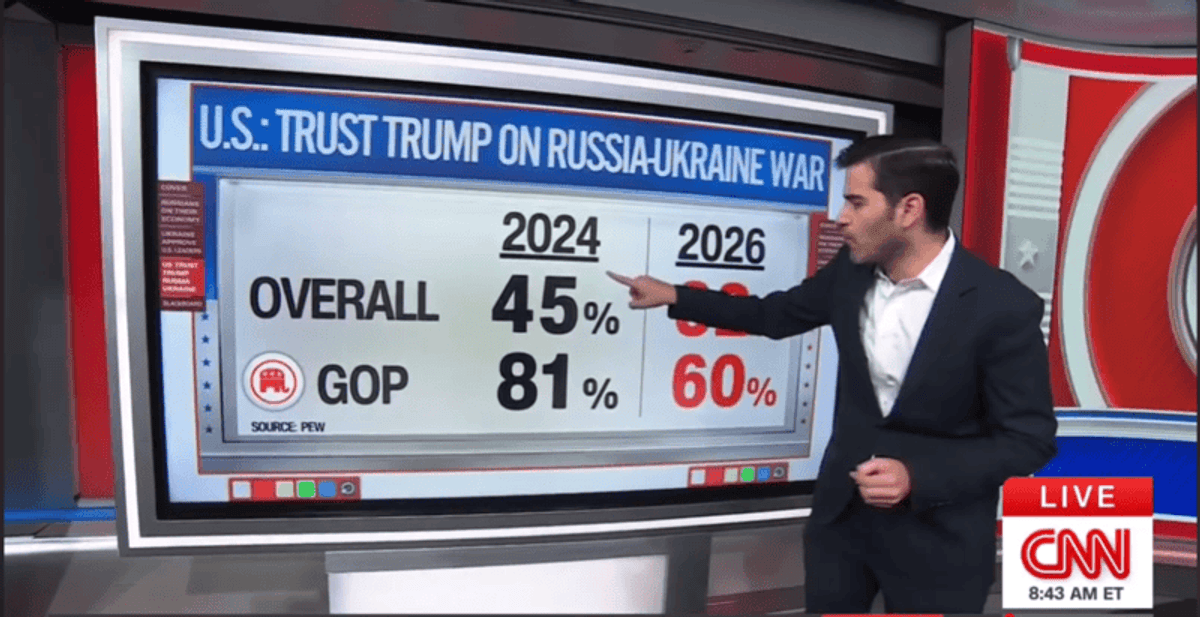
"Take a look here," said Enten. "U.S. trust in Trump, on the Russia-Ukraine war. Look at this number. Overall, it's fallen from 45 percent back when Trump was on the campaign trail to just 32 percent now." Worse, it's even fallen among Republicans, as "it was 81 percent two years ago. It is now just 60 percent."
The bottom line, said Enten, is that "Trump comes into any negotiations in a weakened state, given the domestic feelings in Russia and Ukraine and the domestic feelings here in the United States as well."
(Screengrab via CNN)
President Donald Trump is headed to meet with NATO allies in Turkey this week to try to strategize an end to the Russian invasion of Ukraine — but CNN data guru Harry Enten has some sobering numbers that should make Trump think twice about whether his presence will do much at all.
"How much sway does he have with the Ukrainian public?" anchor Sara Sidner asked him.
"What Trump is hoping is that he can, you know, put his finger on Volodymyr Zelenskyy and pressure him," said Enten. However, "look at this number. Net approval of U.S. leadership among Ukrainians."
When former President Joe Biden was at the helm, said Enten, "U.S. leadership was on the positive side of the ledger at +3 points," said Enten. "Look at how this number has absolutely fallen through the floor to now -72 points. That is a 75-point switcheroo in the wrong direction" — and, he said, it means Zelenskyy is unlikely to fear that rejecting Trump's potential demands to make concessions to Russia will damage his own standing with voters.
That's no surprise, Sidner argued. "Some of the comments that Trump has made, some of the niceties with Russia, and yelling at the president while they are in war has been a real problem for the Ukrainian people."
But that's not the only bad news for Trump in the data, said Enten — it turns out that voters in America don't have a lot of confidence in him to end Russia's war in Ukraine, either.
"Take a look here," said Enten. "U.S. trust in Trump, on the Russia-Ukraine war. Look at this number. Overall, it's fallen from 45 percent back when Trump was on the campaign trail to just 32 percent now." Worse, it's even fallen among Republicans, as "it was 81 percent two years ago. It is now just 60 percent."
The bottom line, said Enten, is that "Trump comes into any negotiations in a weakened state, given the domestic feelings in Russia and Ukraine and the domestic feelings here in the United States as well."
Trump was betrayed by world leaders he never should have trusted: analysis
(REUTERS)

(REUTERS)
July 06, 2026
ALTERNET
Italian Prime Minister Giorgia Meloni has had a gradual falling out with President Donald Trump, motivated by everything from his belligerent rhetoric toward Europe to him falsely claiming that she had begged him for a photograph together. Now, according to an opinion piece by the editors at Newsweek, Trump is being widely betrayed by the international coalition of nationalists he has supported — and the break up was entirely predictable.
“Trump has sought to cohere a loose orbit of leaders, parties, conferences and media figures into a larger patriotic, sovereignist movement—one hostile to liberal internationalism and multilateral institutions, and one that is capable of winning seats in power,” Newsweek’s Editors wrote on Monday. “His own National Security Strategy encouraged America's European political allies to promote ‘unapologetic celebrations’ of national character, welcomed the growing influence of ‘patriotic European parties,’ and called for Europe to operate as a group of ‘aligned sovereign nations.’”
Listing various world leaders including “Poland's Karol Nawrocki. Hungary's Viktor Orbán. Argentina's Javier Milei. Spain's Santiago Abascal. Germany's Alice Weidel. France's Marine Le Pen. Colombia's Abelardo de la Espriella. The Netherlands' Geert Wilders,” Newsweek said the so-called Trump International has a fatal structural flaw — namely, that “it is fragile as politics because each member owes the home audience the same promise: Nobody abroad gets to tell us what to do. The peace shatters when two nationalists collide.”
The article then delved into detail about how Meloni has distanced herself from Trump because he has become increasingly unpopular among Italian nationalists.
“Meloni can cooperate with Trump on migration, defense spending and the EU,” Newsweek explained. “What she cannot do is accept the appearance of a patron-client relationship with Washington, or swallow personal insults that transmute into national ones. YouGov found in April that only 7 percent of Italians had a favorable view of Trump, while 86 percent had an unfavorable one.”
Newsweek anticipated that Trump’s upcoming meeting with Turkey’s dictator Recep Tayyip Erdoğan would be consequential.
“The Ankara family photo will still be taken, smiles all around,” Newsweek wrote. “NATO's communiqués will still be signed, as they always are, even in turbulent times. Trump and Meloni may yet find more common ground on migration, defense and the EU that moves them past the current falling-out.”
They added, “If the summit delivers a genuine reset—and Rome quietly restores the kind of cooperation it withheld over Iran—the brotherhood's contradiction will look more manageable than it does today. But the feud has exposed the weakness inside Trump's preferred international coalition. He wants allies who speak the language of sovereignty, then bristles when they speak it back to him—even when he insulted them first.”
The editorial concluded that “Trump's brotherhood was always going to betray him because every member joined it for the same reason. Each came to defend a nation, and every nation eventually asks to be defended from its friends.”
Italian Prime Minister Giorgia Meloni has had a gradual falling out with President Donald Trump, motivated by everything from his belligerent rhetoric toward Europe to him falsely claiming that she had begged him for a photograph together. Now, according to an opinion piece by the editors at Newsweek, Trump is being widely betrayed by the international coalition of nationalists he has supported — and the break up was entirely predictable.
“Trump has sought to cohere a loose orbit of leaders, parties, conferences and media figures into a larger patriotic, sovereignist movement—one hostile to liberal internationalism and multilateral institutions, and one that is capable of winning seats in power,” Newsweek’s Editors wrote on Monday. “His own National Security Strategy encouraged America's European political allies to promote ‘unapologetic celebrations’ of national character, welcomed the growing influence of ‘patriotic European parties,’ and called for Europe to operate as a group of ‘aligned sovereign nations.’”
Listing various world leaders including “Poland's Karol Nawrocki. Hungary's Viktor Orbán. Argentina's Javier Milei. Spain's Santiago Abascal. Germany's Alice Weidel. France's Marine Le Pen. Colombia's Abelardo de la Espriella. The Netherlands' Geert Wilders,” Newsweek said the so-called Trump International has a fatal structural flaw — namely, that “it is fragile as politics because each member owes the home audience the same promise: Nobody abroad gets to tell us what to do. The peace shatters when two nationalists collide.”
The article then delved into detail about how Meloni has distanced herself from Trump because he has become increasingly unpopular among Italian nationalists.
“Meloni can cooperate with Trump on migration, defense spending and the EU,” Newsweek explained. “What she cannot do is accept the appearance of a patron-client relationship with Washington, or swallow personal insults that transmute into national ones. YouGov found in April that only 7 percent of Italians had a favorable view of Trump, while 86 percent had an unfavorable one.”
Newsweek anticipated that Trump’s upcoming meeting with Turkey’s dictator Recep Tayyip Erdoğan would be consequential.
“The Ankara family photo will still be taken, smiles all around,” Newsweek wrote. “NATO's communiqués will still be signed, as they always are, even in turbulent times. Trump and Meloni may yet find more common ground on migration, defense and the EU that moves them past the current falling-out.”
They added, “If the summit delivers a genuine reset—and Rome quietly restores the kind of cooperation it withheld over Iran—the brotherhood's contradiction will look more manageable than it does today. But the feud has exposed the weakness inside Trump's preferred international coalition. He wants allies who speak the language of sovereignty, then bristles when they speak it back to him—even when he insulted them first.”
The editorial concluded that “Trump's brotherhood was always going to betray him because every member joined it for the same reason. Each came to defend a nation, and every nation eventually asks to be defended from its friends.”


No comments:
Post a Comment