HII Adds Another Workboat Shipyard to its Unmanned-Vessel Program
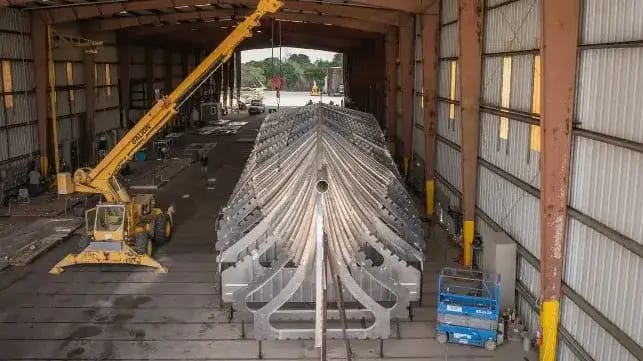
In the latest sign of the growing opportunities for smaller shipyards in the unmanned-systems sector, Huntington Ingalls Industries has contracted with a second Louisiana-based workboat yard to build its Romulus USV platform.
Romulus is a fast, midsize USV designed to meet the Navy's MUSV program requirements: a containerized-payload carrier with a capacity of two FEU and a range of 2,500 nautical miles. It was one of seven competing designs approved to enter the "prototype evaluation phase" of the MUSV competition in May. Other competitors include Leidos, Sea Machines/St. Johns Shipbuildng, Saronic, Galliano Marine Services (Chouest), PacMar Technologies and Birdon. Those who past the Navy's underway test will receive $15 million and will be approved for follow-on production.
To build Romulus at scale, HII set up a construction partnership with Breaux Brothers Enterprises, an aluminum-construction crewboat yard outside of New Iberia. Breaux Brothers is known for high-speed fast supply vessels, crewboats, passenger vessels, pilot boats and other working vessels; HII designed Romulus in partnership with the small yard in order to take advantage of commercial-standard hull construction methods, making the USV easily reproducible in existing small shipyard settings. HII announced in March that it would support construction of a dedicated Romulus "assembly line" facility at Breaux Brothers, centered on automated processes for high efficiency.
"Romulus is engineered from the outset for scale," HII executive vice president Andy Green said earlier this year. "By aligning design, autonomy, and manufacturing, we are creating a production model that delivers predictable outcomes and positions us to meet growing demand for autonomous maritime capability."
In addition to Breaux Brothers, HII has now agreed to work with Halimar Shipyard to expand production of the Romulus 151. Halimar is emblematic of the promise of the Navy's new interest in USVs: it is a commercially-focused small yard in Morgan City, the historical center of the offshore oil and gas industry. Typically engaged in construction and repair for the marine towing, dredging and offshore-vessel industries, it does not have a high profile in the defense world but is known for delivering quality workboats. This puts it in good company with other new USV competitors, like Breaux Brothers, Chouest, St. Johns Shipbuilding (with Leidos) and Conrad Shipyard (with Blue Water Autonomy).
“We are proud to partner with HII on the Romulus program and contribute to the future of autonomous maritime operations,” said William Hidalgo Jr, executive vice president and chief operating officer, Halimar Shipyard. “Our team has decades of experience building high-quality vessels, and we look forward to applying that expertise to help deliver reliable, scalable production capacity that supports evolving mission needs.”
Lockheed Buys Sub-Hunting Sonar Firm
Ultra Maritime
Published Jul 6, 2026
American private equity firm Advent has exited its investment in British subsea acoustic sensing company Ultra Maritime, selling the sonobuoy and sonar maker to Lockheed for $3.45 billion - within the approximate range of the price paid for its purchase and improvement, after accounting for inflation.
In 2022, Advent secured UK government permission to buy Ultra Electronics, acting through Advent's UK-based subsidiary Cobham. The $3.1 million deal gave Advent access to sophisticated sonar technology and a team of experienced anti-submarine warfare engineers. The UK green-lit the proposal, with the understanding that the facilities that supply cutting-edge subsea technology to the Royal Navy would remain in place and under separate governance.
"When we invested in Ultra Maritime in 2022, we saw a business with mission-critical technology . . . but one that had been underinvested and was not yet fully delivering for its customers," said Shonnel Malani, Managing Partner at Advent. "Ultra Maritime is now a stronger, more innovative partner to allied navies."
The sale is meaningful for the U.S. Navy, the Royal Navy and their allied partners, as it puts Lockheed in control of some of the most innovative submarine- and UUV-hunting equipment on the market. Ultra has a portfolio of hull-mounted sonars, towed sonar arrays and advanced sonobuoys, all required equipment for ASW. It is the only maker of G-size sonobuoys, built extra-small for deployment from unmanned aircraft - an affordable way to deliver acoustic sensing capabilities to track opponents' subs. General Atomics is integrating these sonobuoys into the MQ-9B SeaGuardian platform; the combined capability is designed to meet the Royal Navy's requirements for detecting Russian subs in the North Sea.
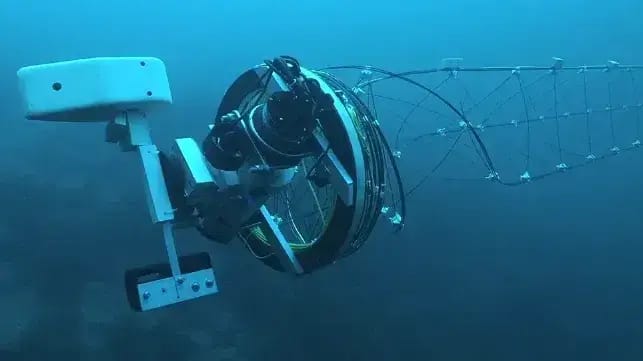
It also makes more exotic products, like the Sea Spear UUV-deployable subsea sonar array, which can be installed covertly and can persist on the seabed until recovered. The device is intended for insertion in difficult, demanding environments where traditional means of deployment are impractical. Ultra plans to work with autonomous-tech defense startup Anduril on the concept of operations.
The sale of Ultra Maritime is Advent's latest divestment from its Cobham division, which it bought in 2020 for $4 billion and has been streamlining through spin-offs of individual business units. Previous Cobham divisions sold include Aviation Services, Aerospace Connectivity and Missions Systems, among others, collectively resulting in revenue of more than $7 billion.

No comments:
Post a Comment