Calls for Sudan ‘Ceasefire Now’ Grow as 300+ Children Killed, Wounded in 2026 Alone
“Children are not incidental victims; they are directly affected, facing forced recruitment, sexual violence, unlawful detention, torture, and a lack of medical care,” Amnesty International USA stressed.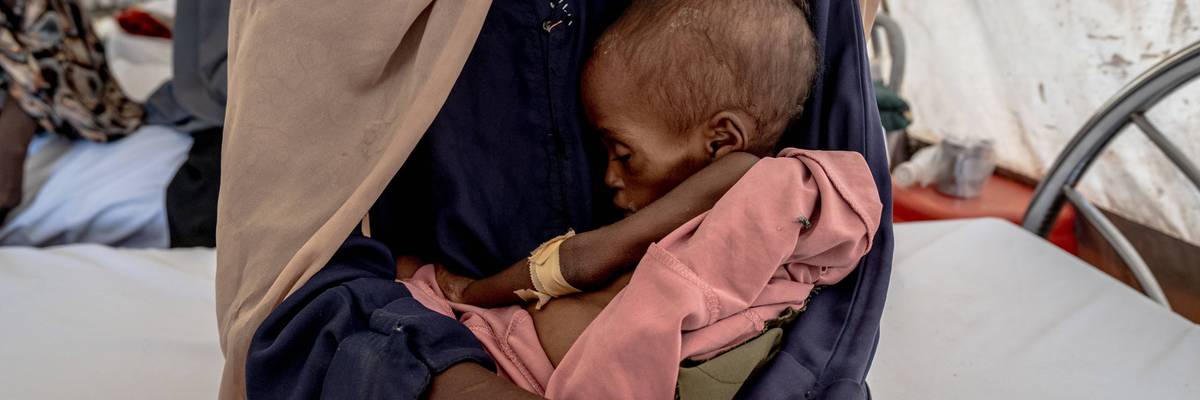
A starving Sudanese 3-year-old weighing less than 12 pounds lies inside the severe acute malnutrition ward at the Médecins Sans Frontières (MSF) Paris Hospital in Tawila, Sudan in this photo published on May 27, 2026.
(Photo by Giles Clarke/Avaaz via Getty Images)
Brett Wilkins
Jul 06, 2026
COMMON DREAMS
Demands for a ceasefire in Sudan’s three-year civil war mounted this week amid reports that more than 300 children have been killed or injured in the northeastern African nation this year alone, mostly by drone strikes.
The United Nations Children’s Fund (UNICEF) said Modaysu that “children across Sudan continue to bear the brunt of a war that is becoming increasingly deadly, with at least 330 children reported killed or injured during the first six months of 2026. Darfur and Kordofan states continued to record the highest levels of child casualties.”
“The situation in and around al-Obeid, and more broadly across North Kordofan, is particularly alarming,” UNICEF continued. “Since May 2026, drone strikes and other attacks have reportedly resulted in more than 35 child casualties in the state, including at least 18 children killed and more than 17 injured. The affected children ranged in age from just 2 months to 17 years. According to reports, drone attacks accounted for 60% of these casualties, highlighting the growing impact of this method of warfare on children and families.”
“Repeated drone strikes and shelling have also damaged civilian infrastructure, including homes, schools, health facilities, water systems, and markets; disrupted supply routes; and placed essential services under increasing strain,” the agency added. “With an estimated 500,000 civilians at risk in and around al-Obeid and across North Kordofan, any further deterioration could expose even more children to death, injury, displacement, and other grave protection risks.”
Amnesty International USA said Monday that both the Sudanese Armed Forces (SAF) and Rapid Support Forces (RSF) rebels “have committed numerous human rights violations, including deliberate attacks on civilians.”
“Ethnic targeting has resulted in assaults on non-Arab communities, with women and girls subjected to sexual violence and exploitation,” Amnesty added. “Children are not incidental victims; they are directly affected, facing forced recruitment, sexual violence, unlawful detention, torture, and a lack of medical care.”
On Monday, the United Nations Human Rights Council approved a measure proposed by five European countries—Germany, Ireland, the Netherlands, Norway, and the United Kingdom—condemning escalating RSF-led violence in and around al-Obeid.
While both the SAF adnd RSF have committed documented human rights crimes, an independent United Nations panel released a report earlier this year detailing allegedly genocidal crimes committed by RSF rebels during last October’s offensive in Darfur, where thousands of people were killed and others tortured, raped, and starved during the capture of el-Fasher.
The UN experts found that “genocidal intent is the only reasonable inference that can be drawn” from RSF’s actions.
The ceasefire demands from UNICEF and Amnesty follow similar calls from governments, including France and the United Arab Emirates, as well as other UN agencies.
On Friday, UN High Commissioner for Human Rights Volker Türk warned that “another human rights catastrophe is unfolding” in al-Obeid.
“Civilians have been subjected to siege-like conditions for 18 months, battered by relentless drone attacks as the Sudanese Armed Forces and the Rapid Support Forces battle for control over areas surrounding the city,” Türk noted.
“Some people are selling their belongings to finance their escape from the city,” he continued. “For many, the exorbitant cost of transport and constant attacks on vehicles along exit routes, make leaving impossible.”
“We have documented patterns of summary executions, abductions, torture and ill-treatment, sexual violence, and looting along the routes taken by displaced people across the Kordofan region,” Türk added. “This is not a drill. It is a red alert that needs to land on the desks of heads of state and government around the world.”
Since April 2023, Sudan’s conflict has killed at least 59,000 people, displaced around 13 million others, and fueled famine in different parts of the country of approximately 52 million inhabitants. More than 30 million Sudanese are also in need of humanitarian assistance.
Sudan’s Proxy War: Gulf Rivalries, Resource Extraction, and the Fragmentation of a State
Introduction: From Civil War to Regional Systemic Conflict
Sudan’s ongoing war is often described as an internal power struggle between rival military factions. While domestic rivalries are central to the conflict, this framing risks obscuring the broader regional and global dynamics that increasingly shape and sustain it.
What is unfolding in Sudan can also be understood as a case study in how regional competition, resource extraction, and global geopolitical interests intersect in fragile postcolonial states. The conflict is not only internal; it is embedded in wider networks of political economy and external engagement that have developed over decades.
Rather than a conventional civil war, Sudan represents a fragmented conflict environment in which domestic power struggles and external influence are deeply intertwined.
Regional Rivalries and the Externalization of the Conflict
A key dimension of the war is the involvement of regional actors, particularly Gulf states, whose competing interests have contributed to the internationalization of the conflict.
The United Arab Emirates and Saudi Arabia have both developed strategic relationships with different elements of Sudan’s military and economic structures. These relationships are often interpreted as part of broader regional competition over influence, security priorities, and access to strategic corridors along the Red Sea.
The Rapid Support Forces (RSF), which have become a central actor in the conflict, are widely reported to be embedded in Sudan’s gold economy and informal cross-border trade networks. Various investigations and reports have suggested that these networks intersect with external financial and logistical channels connected to regional actors, including Gulf-based intermediaries.
At the same time, the Sudanese Armed Forces (SAF) maintain closer institutional ties with Saudi-aligned regional security frameworks. These overlapping relationships have not created direct control over the conflict, but they have contributed to its persistence by embedding local actors within wider regional systems of support.
Sudan’s Strategic Position and the Political Economy of Gold
Sudan’s geopolitical importance is shaped not only by internal fragility but also by its location along the Red Sea corridor and its resource base, particularly gold.
Over decades of military rule and economic restructuring, state capacity has been weakened and formal economic institutions have partially fragmented. In this context, survival increasingly depends on informal extraction networks, especially in peripheral regions.
Gold extraction has become a key pillar of these networks. These flows are not purely domestic: they are integrated into transnational trade circuits, where regional financial hubs—particularly in the Gulf—play an intermediary role in processing, trading, and circulating value.
This does not imply a single centralized command structure. Rather, it reflects a fragmented political economy in which armed groups, intermediaries, and financial centers each occupy different positions within a broader system of extraction and circulation.
External Powers and the Internationalization of the War Economy
Western governments have consistently called for ceasefires and humanitarian access in Sudan. At the same time, they remain structurally connected to regional security arrangements and arms transfers that shape the broader environment in which the conflict unfolds.
This tension between humanitarian diplomacy and strategic partnership reflects a broader pattern seen in other regional conflicts, including Libya and Yemen, where external involvement has contributed to both containment efforts and the reproduction of instability.
In parallel, emerging global actors such as China and Russia have expanded their engagement in Sudan, primarily through infrastructure projects, resource agreements, and arms-related cooperation. Rather than resolving instability, these engagements have added additional layers to an already fragmented conflict economy.
From Political Transition to Military Fragmentation
The 2019 uprising against Omar al-Bashir briefly opened a period of political transition and raised expectations of civilian governance. However, the absence of durable institutional restructuring, combined with the entrenched power of military and economic networks, left the transition highly vulnerable.
The 2021 coup and the outbreak of full-scale war between the SAF and RSF in 2023 marked the collapse of this transitional process. Since then, Sudan has experienced a deepening fragmentation of authority and increasing competition over territorial, economic, and logistical control.
War as an Economic System
One of the defining features of the current conflict is the extent to which it has become economically self-reproducing.
Gold extraction, smuggling routes, taxation systems imposed by armed actors, and external financial flows have together created a war economy that operates with a degree of autonomy from any unified political project.
In this context, violence is not only a means of accessing political power. It also functions as a mechanism of economic accumulation. This dynamic makes the conflict particularly difficult to resolve, as multiple actors derive material benefit from its continuation.
Conclusion: Fragmented Sovereignty and Prolonged Instability
Sudan illustrates a broader transformation in contemporary conflict dynamics, where internal wars are increasingly shaped by external networks of influence, extraction, and finance.
Sovereignty in this context remains formally intact but is practically fragmented. The distinction between internal and external conflict has become increasingly blurred, as domestic actors are embedded in transnational systems of support and accumulation.
The future of Sudan will depend not only on military developments on the ground, but also on whether these intersecting networks of extraction and external involvement can be meaningfully restructured.
Without such a transformation, any political settlement is likely to remain fragile, and the cycle of fragmentation may persist in new forms.


No comments:
Post a Comment