America Praised The ICC Until It Came For An Ally – OpEd
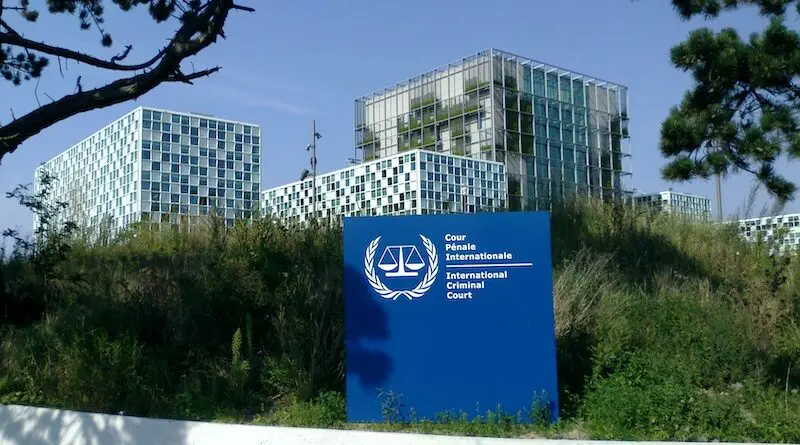
The International Criminal Court (ICC) in The Hague. Photo Credit: OSeveno, Wikipedia Commo
Key Takeaways:
- Amman commentator Osama Al-Sharif argues that after years of Global South complaints about a hollow UNSC, Washington has since the Gaza war turned on the ICC—sanctions on judges and the court’s president—after 2024 warrants for Netanyahu and Gallant, having praised the 2023 Putin warrant.
- He quotes the late Sen. Lindsey Graham’s reported line that the court is for “Africa and thugs like Putin,” not “democracies like Israel and the United States,” and lines up Ukraine territorial acquisition, 2025 Iran strikes, and a January seizure of Venezuela’s president as the same exceptionalism.
- His warning: if the Rome Statute court (120+ parties; the U.S. signed but voted against the final statute) is dismantled, illegal wars become the rule; protecting a flawed ICC is treated as a test of whether law still binds the strong.
For years, countries in the Global South have accused the West of hypocritical behavior: applying international law selectively and openly breaking it to serve their narrow interests. In their view, the UN Security Council lost its credibility long ago, with the Palestinian issue being a case in point — decades of Israeli occupation, dozens of unenforced resolutions and a council dominated by greater powers.
The track record of the UNSC speaks volumes about blatant double standards, while the term “rule of law” has become hollow boilerplate.
But something has changed in the last three years. It is no longer just the UNSC that is being hollowed out. Since Israel launched its war on Gaza — now approaching its third anniversary with no end in sight — the US has turned its attention to undermining another pillar of international justice: the International Criminal Court in The Hague.
That institution is now in the White House’s crosshairs and, ironically, the assault on it exposes the antithetical rhetoric of key US officials and lawmakers when it comes to observing international law and respecting its sanctity.
The Nuremberg trials, held in the wake of the Second World War, established a radical idea: that even the most powerful leaders could be held personally responsible for atrocities, not just the states they represented. That idea sat mostly dormant for decades. Genocides in Rwanda and the former Yugoslavia in the 1990s revived the idea and launched a rare drive to make war criminals accountable under international laws and conventions.
In 1998, more than 120 countries signed the Rome Statute, creating a permanent court to fulfill that goal. The ICC’s mission was simple and, at the time, widely supported by Western democracies, but not by the US, which, interestingly, signed the founding treaty but voted against the final Rome Statute over concerns about American military protection. The ICC’s message was clear: No one should be able to commit genocide, war crimes or crimes against humanity and walk away untouched simply because they hold power.
For years, the ICC mostly prosecuted African warlords and rebel commanders, which drew fair criticism about geographic imbalance. But it was always designed to apply to everyone, anywhere.
Since the ICC issued arrest warrants against Benjamin Netanyahu and then-Israeli Defense Minister Yoav Gallant in 2024 for potential war crimes and crimes against humanity in Gaza, the reaction from Washington has not been to challenge or question the evidence, as it has done with South Africa’s genocide file against Israel at the International Court of Justice. Instead, it has chosen to attack the court and its prosecutor. It has declared that it is seeking to dismantle the court, calling it an illegitimate organization that threatens American sovereignty.
The Trump administration and members of Congress have sanctioned ICC judges and prosecutors, frozen their assets and threatened them with travel bans and legal action. The most recent target was the president of the court herself, sanctioned directly by the State Department.
One of the US objections to the ICC is the assertion that the court acts illegitimately by claiming jurisdiction over nonmember states that have not signed the Rome Statute.
Compare that to how Washington reacted when the same court, applying the same law, issued an arrest warrant against Russian President Vladimir Putin in 2023 for the allegation that Russia had unlawfully deported Ukrainian children. Back then, American officials praised the warrant as a legitimate act of accountability. Nothing about the court’s mandate has changed between 2023 and today. What has changed is that the court has targeted Israel’s conduct in Gaza.
Late Sen. Lindsey Graham put the double standard into words more bluntly than most officials dared. He reportedly told the ICC’s prosecutor that the court was, in his words, for “Africa and thugs like Putin” — not for “democracies like Israel and the United States.” Graham, who did not mince his words, captured the underlying logic driving the US campaign against the ICC: international law is treated as a tool to use against rivals, not a universal standard to be held to. American exceptionalism also meant that the application of international law was selective.
The US and Israel are, in effect, waging a campaign to destroy an institution that was built specifically so that absolute power alone could never be a shield against justice. But this is not happening in isolation. The sense of exceptionalism fits a pattern stretching across nearly every major conflict of the last four years.
Russia’s full-scale invasion of Ukraine in 2022 broke one of the most basic rules of the international order: that no country should acquire the territory of another by force. The world rightly condemned it. But that condemnation, especially by Western powers, now looks less like adherence to a universal principle and the preservation of the law and more like the fulfillment of a political objective. In 2025, Israel and the US struck Iranian nuclear facilities without any authorization from the UNSC, relying on the same argument as Moscow: preemptive self-defense — an argument that Western governments ironically refused to accept in the Russian case.
The International Court of Justice in 2024 found it plausible that Palestinians in Gaza had a right to be protected from genocide as it heard South Africa’s case against Israel. Then, in January, American forces crossed another line, breaching another international law: they seized Venezuela’s sitting president from his own capital and flew him to New York to face charges many legal experts consider weak — with no UNSC resolution and no self-defense justification to back it up.
It would be easy to look at all of this and conclude that international law is abstract at best — that in a world that has seen illegal wars and invasions waged under false pretexts by superpowers, courts and treaties are decorative at best and that only the weak are bound by them. That conclusion is dangerous and describes a bleak, fraught future.
The entire point of the ICC was to bypass the political will of any government, including the most powerful ones. A court that holds accountable only weak states, rebellious leaders and countries unfriendly to the big powers is not really a court of international law.
The world order is shifting quickly and some would say it is teetering, as once-strong democracies shift toward authoritarianism. A multipolar world is emerging, alliances are being tested and states are watching closely to see whether the rules of the postwar era will hold. If the ICC survives the US-Israeli assault, it will send a message that accountability is still possible, however imperfect and slow.
In reality, the onslaught is not only against the ICC but against the 120 countries that signed its statute. If the court collapses, the message is far more dangerous: that the invasion of Ukraine, the war in Gaza, the annexation of Palestinian and Arab lands, and the kidnapping of a foreign head of state are no longer aberrations.
Protecting the ICC, flaws and all, is no longer a matter of legal technicality. It is one of the last real tests of whether the rule of law survives this decade.
- Osama Al-Sharif is a journalist and a political commentator based in Amman. X: @plato010

No comments:
Post a Comment