Showing posts sorted by relevance for query BATTLE FATIGUE. Sort by date Show all posts

Monday, July 27, 2026


Towards a Fatigue Management System for the U.S. Navy
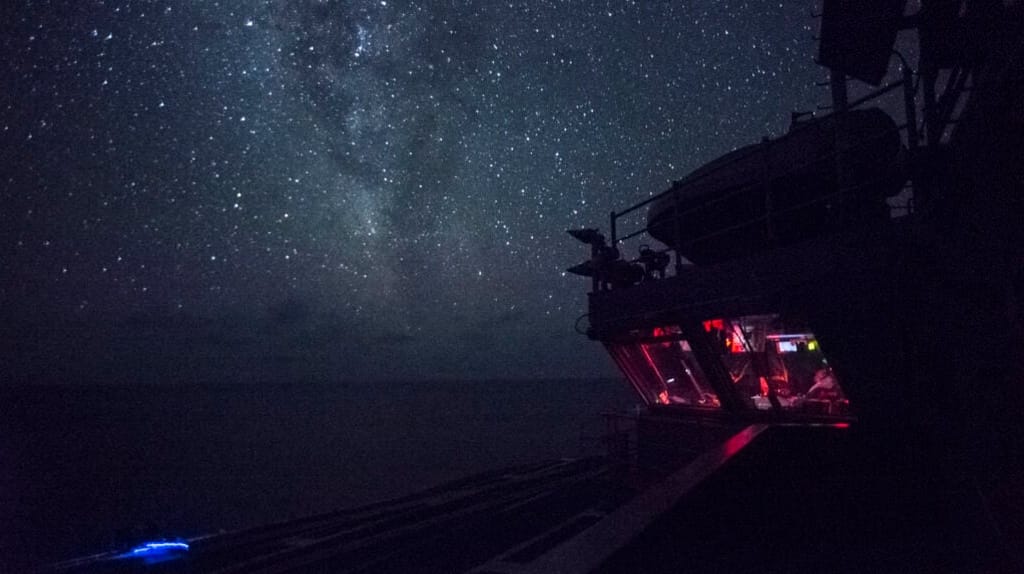
bridge
USN file image

Published Jul 26, 2026 2:27 PM by CIMSEC

By Dr. John P. Cordle, Captain, USN (Ret).


The first week of June 2026 marked a seminal event in the history of sleep and fatigue in the military. The Department of War (DOW) Fatigue Related Management Working Group hosted the first ever Sleep and Fatigue Summit with over 130 experts in the field from all military services, providing a huge burst of momentum in the area of fatigue management as an operational imperative for our warfighters. For the first time in years, there is hope that the military, and especially the Navy, is finally turning a corner in this critical arena. But there remains much work to be done.

My relationship with fatigue is a long and storied one. I joined the Navy in 1984 and grew up as a Surface Warfare Officer at a time when fatigue was seen as a badge of honor. Later serving as a Human Factors Engineer, I studied its impact on individual readiness as well as mental health and advocated for changes to Navy policy. As a veteran, I live with the effects of a lifetime of sleep deprivation and non-circadian watch rotations, hooking up to my Continuous Positive Airway Pressure (CPAP) machine every evening and dealing with obstructive sleep apnea and the onset of heart disease caused by atrial fibrillation (AFib). This is all tied to a Navy lifestyle and culture that ignored the known effects of fatigue, to the detriment of its sailors.

I am gratified that there has been solid progress in the understanding and application of fatigue mitigation policies in various parts of the Navy. However, despite both DOD direction and concrete recommendations from many authoritative bodies, including the Government Accountability Office (GAO), National Transportation Safety Board (NTSB), and Department of War (DoW), the Navy has still failed to implement an overarching fatigue management program to include education, research, and policy.

One of the last projects that I worked on as a Government Service (GS) Human Factors Engineer prior to retirement last year was trying to define the Navy’s Fatigue Management program in a single document. As with any large organization, a change like this is likely to meet bureaucratic obstacles, obfuscation, and outright obstruction… and it did. The main challenge to this effort was that no one in the Navy felt compelled to step up and say “I own this problem,” an obstacle that has now been overcome with the designation of the Office of Warfighting Advantage (OWA) as the process owner. It would be a shame to unlearn the lessons of the ship collisions of the USS McCain and USS Fitzgerald, both of which occurred in 2017. The investigations for these separate incidents identified fatigue as a significant factor in the death of 17 Sailors.

Unfortunately, this was not the last collision for which sleep was a contributing factor. In 2025 the USS Harry S. Truman suffered a collision during her deployment to the Middle East. The investigation results cited fatigue as a major factor in the collision. While no one was killed, several sailors came within inches and seconds of losing their lives. The below figures from the Navy investigation tell the story:
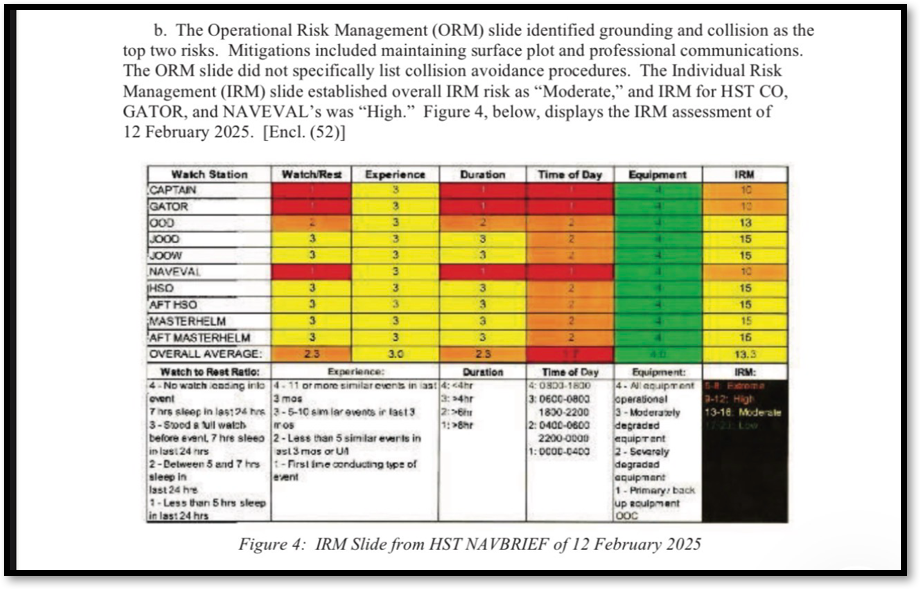
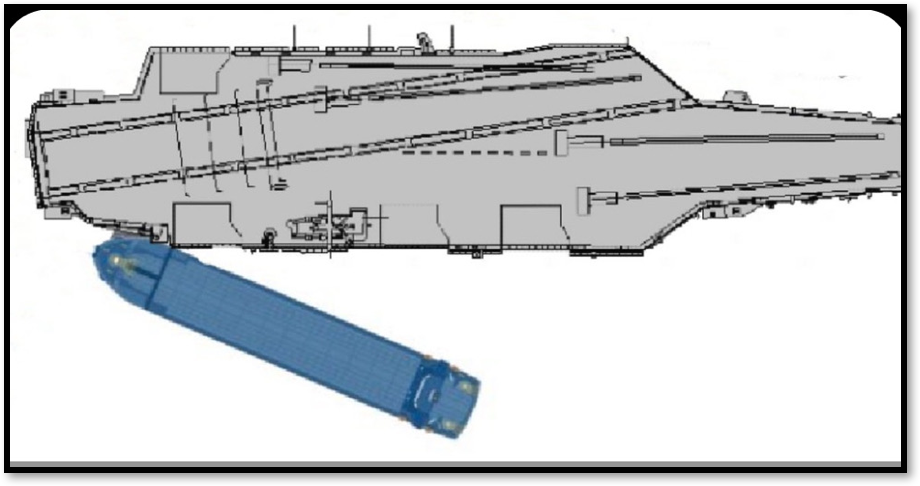
Figure 1. The Risk Management Brief specifically identified fatigue as a risk factor for senior leadership. They would not have been allowed to fly a plane in this condition but can drive a ship. The second figure shows the result. Source: Navy Investigation of USS Harry S. Truman Collision.

Eerily, (Admiral) Whalen’s investigation stated that, “… fatigue as a human factor in the collision and cited department heads who described a ‘just get it done’ atmosphere aboard the carrier. Both sailors’ lack of sleep and pressure to perform tasks regardless of risk were crucial themes in the 2017 collisions.” The similarities with the 2017 collisions are impossible to miss. And yet, eight years later, little has changed within the U.S. Navy.

To be fair, there are policies in place in most of the major warfare areas, and the last two Carrier Strike Groups deployed with sleep monitoring devices on most sailors and a program to provide sleep data to inform individual Sailors, shipboard leaders, and Navy research efforts. Specifically, the Command Readiness, Endurance and Watchstanding (CREW) program shows huge promise in collecting sleep and other biometric data and providing feedback to individuals and leadership to inform operational decision making. There is ongoing research to design more comfortable mattresses that meet material condition and fire safety requirements on board ships. My former colleagues continue to push hard for improvement in this area, but it is still largely a “bottom up” effort – they deserve full policy and financial support.

To that end, I offer here the below document as a proposed road map, including the key references and directives that should drive two significant outcomes:

First, the designation of a single entity, responsible for fatigue management in the Navy, to include resource sponsorship (funding) for research and technology. Of note, since the drafting of this article, this recommendation has occurred. The Office of Warfighting Advantage (OWA) has been designated to do just this.

Second, a formal policy for fatigue management, which includes research, education, and operational guidance for commanders.

I present the below draft document for consideration by the U.S. Navy to address this critical problem. It was the result of over one year’s collaborative effort between the Navy Sleep expert team, many of whom have moved on or retired without replacement, leaving many key billets that support sleep research and policy unfilled.

The below document represents an 80 percent solution and would provide a starting point. It is ready to download, print, and sign. But who will take that important step? I hope it does not take another deadly collision, with fatigue as a major factor, for someone in Navy leadership to stand up and say, “I will!”


OPNAVINST XXXX

Subj: United States Navy Crew Endurance and Fatigue Management Program

Ref: (a) Department of Defense Instruction 1010.10, Health Promotion and Disease Prevention (Apr. 28, 2014) (incorporating change 3, effective May 16, 2022).

(b) Department of Defense, Report to Congressional Armed Services Committees, Study on Effects of Sleep Deprivation on Readiness of Members of the Armed Forces, March 2021

(c) Secretary of Defense Memorandum, Next Steps on Suicide Prevention in the Military, March 2023

(d) GAO 24-105917 Military Readiness: Comprehensive Measures needed to Address Service Member Fatigue and Related Efforts.

(e) USFF Comprehensive Review of Surface Incidents, October 2019.

Encl. (1) Tables of Requirements and Recommendations

1. This instruction establishes overarching guidance IAW references (a) through (e) for the implementation of Crew Endurance and Fatigue Management practices to improve warfighting effectiveness across the Navy operational domain. It is intended as a framework based on scientific and operational principles to be tailored by instruction for individual communities based on specific needs of their operators.

2. Background. As described in reference (a) and (b), sleep is considered a protective factor against combat operational stress, and sleep restriction is considered a risk factor for symptoms of combat operational stress. The DOD requires that all commanders consider circadian rhythm—the body’s internal resting or wakefulness schedule over the course of a day—when creating policy related to sleep. For example, watchbills are schedules for when Sailors stand watch for fixed periods of time. Circadian rhythm watchbills are designed so that Sailors stand watch and sleep at the same time each day, allowing the body to follow its natural biological processes on a 24-hour cycle. The Suicide Prevention and Response Independent Review Committee (ref c) also made recommendations related to sleep. For example, it recommended that duty schedules allow for eight hours of sleep and minimize the frequency of shift changes, and that the department provide education in healthy sleep habits during training and unit formations. The report clearly shows the connection between sleep deprivation and fatigue as contributing factors to stress, anxiety, and even suicidal thoughts and actions.

3. Extensive research over the past decade has shown the importance of crew endurance and fatigue management to individual readiness and war fighting capability. Research has shown that cognitive ability degrades at a consistent rate as sleep deprivation progresses, with a major impact on decision making, which can prove fatal in battle. Performance starts to degrade after as little as 18 hours of wakefulness, and 24 hours without sleep can have similar impacts on performance to a blood alcohol level of 0.08 percent. While operational commitments and manning shortages may challenge leaders to provide their crew with sufficient sleep, every effort must be made through planning, education, and risk management to plan for, account for, and mitigate excessive fatigue in the fleet. This policy supports Operation Total Force and is foundational to Warrior Toughness, Operational Stress Control, and other Culture of Excellence initiatives.

4. Enclosure (1) Tables 1-3 provide a summary of DOD requirements and recommendations. They were used to produce the required actions in this instruction and are provided here for easy reference.

5. Action. This instruction does not dictate a particular watchbill or schedule but is designed to provide a set of guiding principles upon which to build a policy and tailored instruction at the Echelon III level. Collaboration is encouraged. While primarily applicable to ships, aircraft carriers, and submarines, the basic tenets apply to other teams such as staffs, guard forces and watch floors. The following precepts will be incorporation into each Type Commander’s instructions:

a. Focus on alert watch standers.

b. Implement a circadian watchbill based on a 24-hour schedule (i.e., watch, work and sleep periods occur at the same time each day).

c. Promote a sleep environment that considers complete darkness, good ventilation, ambient temperature control, and low noise levels.

d. Adjust working hours, meal hours, and daily routines to support watch standers and maintenance personnel at sea and ashore.

e. Establish periods of protected sleep to equal at least eight hours in every 24.

f. Consider individual fatigue as a risk factor for all evolutions, including go/no-go criteria for both operations and maintenance.

g. Allow additional sleep during ramp up to mission and recovery times following periods of extreme sleep deprivation or during period of high operational tempo.

h. Establish metrics and measures to track implementation of this policy at the unit level. Wearable technology is encouraged to support this effort.

i. Establish go/no-go criteria to stop or delay evolutions when fatigue poses an unacceptable risk.

j. Implement sleep and crew endurance education and training in all levels of officer and enlisted pipeline training for each community.

k. Assign one individual per unit as a sleep expert for training and support of sleep-related policies.

l. Promote good nutrition and moderation in caffeine and energy drinks into programs like Warrior Toughness, Basic Training, and command training programs.

m. Establish policies and procedures to incorporate wearable sleep monitoring technology, data collection, analysis and display commensurate with security requirements.

n. Develop guidelines for training programs which may include periods of intentional sleep deprivation to prevent inflicting harm on personnel in a training environment.

o. Develop and maintain an online repository of sleep related research and best practices.

p. One size does not fit all – Commanders should obtain analysis of watch rotations and schedules from experts such as the Naval Postgraduate School and Naval Health Research Laboratory.

6. Nothing in this instruction precludes a Commander from executing the mission assigned. Conflict with a peer competitor may be characterized by a long duration of high stress operations; the ability of Sailors and Marines to continue to operate at peak performance over long periods is critical. It is imperative that everyone from the Commanding Officer to the most junior watch stander be capable of sustaining peak performance, and sleep is a necessary prerequisite for that requirement.

Enclosure (1) Tables of DOD Requirements and Recommendations
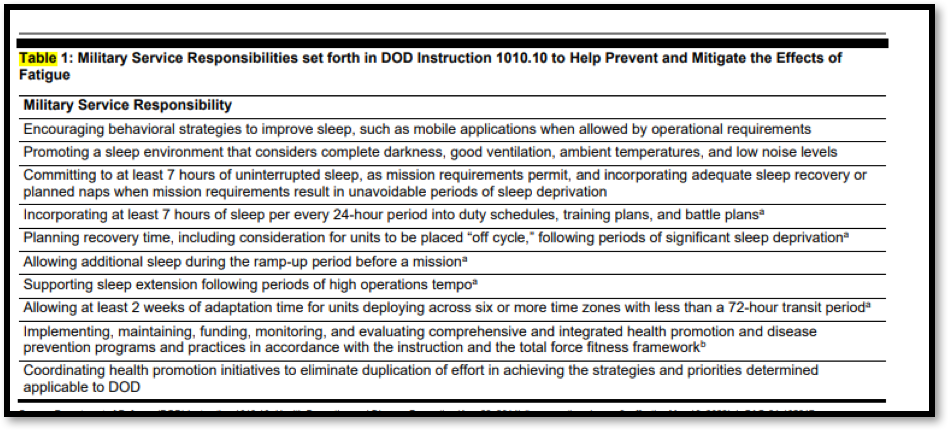
Table 1. Military Service Responsibilities set forth in ref (a), DOD Instruction 1010.10
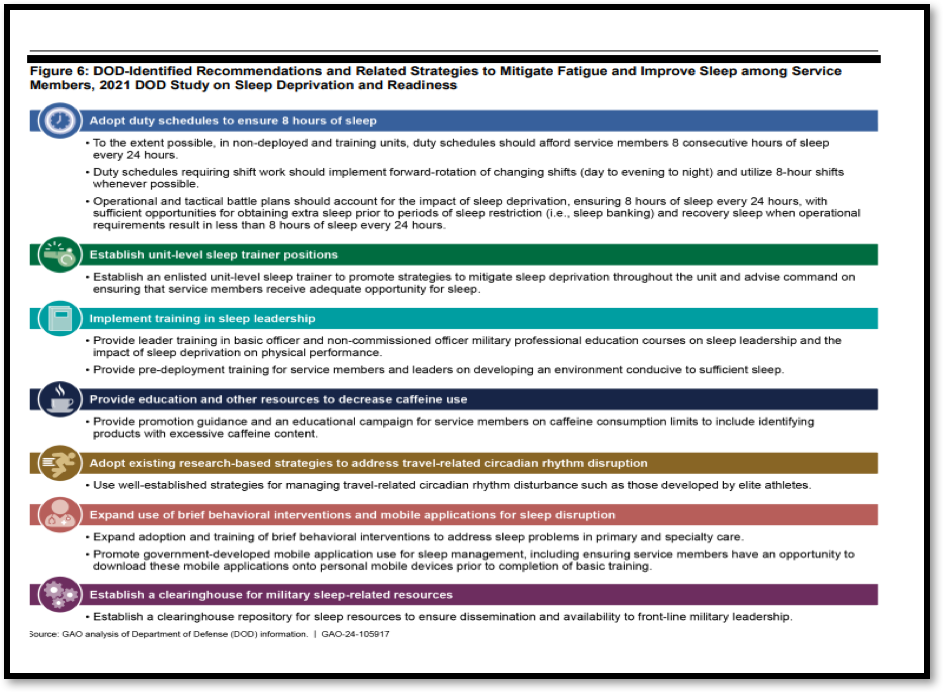
Table 2. Recommendations from Reference (b), DOD Study of Fatigue in the Military.

Table 3. Sleep Policy Recommendations from the DOD Suicide Prevention and Response Review Committee Report (2022).


The recommendations in the above instruction are grounded in existing documents; they are clear, actionable, and they will save lives. Most can be implemented with minimal cost. All it needs is a signature. But whose?

We now have an answer. The Office of Warfighting Advantage has been designated as the process owner for Fatigue Management in the Navy. They can now take ownership of the process from policy, instructions (like the above) to research and (importantly) as a budget priority. The current CNO and VCNO have well-established records of advocacy for Sailor Wellness and of recognizing the importance of sleep to mental health, physical fitness, and warfighter readiness. CNO Caudle even added Dr. Matthew Walker’s excellent book Why We Sleep to his 2026 Reading List! This is a perfect opportunity for the CNO to put his “stamp” on this service-wide safety and performance issue by demanding action – and accountability – across the force with a formal policy; maybe even a “CNOte” titled “Sleep as a Weapon!”

Certainly there are obstacles to implementing such an instruction, such as manning shortages and excessive OPTEMPO. But like rust, fatigue doesn’t care how important or busy you are; it eats away at the foundation of readiness and, if unchecked, will eventually lead to failure. The instruction above must be accompanied by strong institutional resolve; it must come with education, funding, and a culture of learning to address the “get ‘er done” and excessive “can do” attitude that contributed to both the 2017 and 2024 collisions. This instruction must be more than “checking a block”; it needs to come with a strong commitment to drive real change.

Dr. John Cordle is a retired Navy surface warfare officer (nuclear). He commanded the destroyer USS Oscar Austin and the cruiser USS San Jacinto during his 30-year military career and was recognized with the U.S. Navy League John Paul Jones Award for Inspirational Leadership.

This article appears courtesy of CIMSEC and may be found in its original form here.

References

1. Captain John Cordle, U.S. Navy and Dr. Nita Shattuck, “A Sea Change in Standing Watch,” USNI Proceedings, January 2013, https://www.usni.org/magazines/proceedings/2013/january/sea-change-standing-watch

2. Captain John P. Cordle, U.S. Navy (ret.), “Fatigue is the Navy’s Black Lung Disease,” USNI Proceedings, January 2020, https://www.usni.org/magazines/proceedings/2020/january/fatigue-navys-black-lung-disease

3. Captain John P. Cordle, U.S. Navy (ret.), “Go Circadian Now!”, USNI Blog, September 2017, https://blog.usni.org/posts/2017/09/22/go-circadian-now

4. Captain John P. Cordle, U.S. Navy (ret.), “Improve Sleep-Disorder Treatment for Service Members and Veterans,” USNI Proceedings, September 2022, https://www.usni.org/magazines/proceedings/2022/september/improve-sleep-disorder-treatment-service-members-and-veterans

5. Captain John P. Cordle, U.S. Navy (ret.), “Make Crew Endurance an Operational Warfighting Imperative,” CIMSEC, 23 September 2019, https://cimsec.org/make-crew-endurance-an-operational-warfighting-imperative/

Featured image: Red lights glow from the primary flight control room aboard the USS Ronald Reagan during a darken ship period. (U.S. Navy photo by Mass Communication Specialist 3rd Class Ryan McFarlane)

The opinions expressed herein are the author's and not necessarily those of The Maritime Executive.

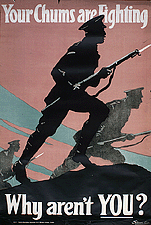
Monday, November 28, 2005

WWI Xmas Mutiny


It was Christmas Eve 1914 and the soldiers in the trenches, Brits, Canadians, Germans and French, muddy, covered in blood and guts, coughing up bloodied mucus of poison gas, called a truce in the War. A truce that remains a mutiny on the books of the ruling clases and their military to this day.

A new film has been made of this famous mutiny for and it will be shown to British Troops in Iraq.

Now if they sneak in the Americans to watch this that just might be the inspiration for the American all volunteer working class army to down arms and end this war.

So subersive is the legend of the Christmas Truce of 1914 that the French still refuse to allow their soldiers to see this film and refused to be part of the production effort.

Brit troops to see 1914 Xmas 'anti-war' film

During the ceasefire, German, British and French troops stopped shooting, got out of their trenches and shared cocoa and cigarettes. They sang hymns together and returned to fighting a few days later.The French army refused to participate in the making of the film, saying soldiers who participated in the Christmas truce were disobeying orders. German troops have already taken in the movie, but it will not be presented to French soldiers. The ceasefire was seen as treason by superiors on both sides.

It was of course this famous truce that gave rise to the 1960's comic Christmas song Snoopy's Christmas by the Royal Guardsmen Listen to it here.

And it was the inspiration for Dalton Trumbos classic Anti-War novel, Johnny Got His Gun.

During the summer of 1914 in a crucial battle in Mons Belgium British troops claimed to have seen St. George and a group of Longbowmen in the skies, which they claimed to have turned the battle in their favour.

This is known as the Legend of Mons, and occult horror author Arthur Machen claimed at the time that it was based on his short story called the Bowman which had been published in the popular press of the day. However historian A.J.P Taylor believed the story and recorded it in his history of WWI.

The fact that the tale and trench rumours of Angels of Mons appeared the summer before may have had a subconcious effect on the soldiers in the trenches facing the first industrialized war of mass murder.

Such was the horror of WWI and the introduction of mechanized death, mass slaughter by machine gun, huge mortars and giant Big Bertha guns that deafened you, poison gas, tanks, trench warfare, etc. the veritable impass of the No Mans Land lead to the need for a moment of humanity, human contact that became the Christmas Truce.

Shell shocked, cold, wet, facing certain death, suffering what was called Battle Fatigue, the first time it was ever recorded in war and we know now as Post Traumatic Syndrome, soldiers fled the field not in cowardice but in terror. And the officers on both sides of the trenches shot them mercilessly.

The Officer Corps of all the Armies of WWI were the last vestiges of the Aristocracy while the soldiers in the trenches were the original grunts, and like modern industrial capitalism which the war so effectively modeled itself after, they were expendable cogs in the machine.

Canadians know this well for even our officers like their men were expendable, as colonial troops, in both WWI and WWII. In the case of the later the battle of Dieppe saw the ruthless sacrifice of Canadians on the whim of Lord Mountbatten for his personal ego trip in securing a position of command.

23 Canadians were executed for desertion or cowardice in WWI. 2 were executed for murder (murder in war you ask well...) one after he suffered a head injury went nuts, the other was a case of shooting a superior officer, a Sgt. Major, the guys who were particularly brutal to their men. We would call it fragging today.Thousands more died in the trenches, including almost all the 1st Royal Newfoundland Regiment.

All those boys from the prairies, the cities, from the farms and the factories, from Saskatchewan, Iowa, Sheffield, Paris and Berlin died for the glory of Imperialism and Capitalism. When they came home there were no jobs, a depression, and no Veterans benefits. It was not such a Great War.

Happy Christmas (The War is Over)

There's nothing noble about dying. Not even if you die for honor. Not even if you die the greatest hero the world ever saw. Not even if you're so great your name will never be forgotten and who's that great? The most important thing is your life little guys. You're worth nothing dead except for speeches. Don't let them kid you any more. Pay no attention when they tap you on the shoulder and say come along we've got to fight for liberty or whatever their word is there's always a word.

Just say mister I'm sorry I got no time to die I'm too busy and then turn and run like hell. If they say coward why don't pay any attention because it's your job to live not to die. If they talk about dying for principles that are bigger than life you say mister you're a liar Nothing is bigger than life There's nothing noble in death. What s noble about lying in the ground and rotting. What's noble about never seeing the sunshine again? What's noble about having your legs and arms blown off? What's noble about being an idiot? What's noble about being blind and deaf and dumb? What's noble about being dead. Because when you're dead mister it's all over. It's the end. You're less than a dog less than a rat less than a bee or an ant less than a white maggot crawling around on a dungheap. You're dead mister and you died for nothing.


Imagine


Sunday, February 16, 2020


Why aren’t brain injuries taken seriously?


Mike Bebernes Editor, Yahoo News 360•February 11, 2020
“The 360” shows you diverse perspectives on the day’s top stories and debates

What’s happening

More than 100 members of the U.S. military suffered traumatic brain injuries as a result of an Iranian missile attack on a base in Iraq that housed American troops, according to the U.S. Department of Defense.

Iran bombarded the base in early January in retaliation for an American airstrike that killed Qassem Soleimani, one of the country’s top generals. Though there were no U.S. fatalities, the number of military members who have been treated for brain injuries has gradually increased in the weeks since the attack. Last month, President Trump downplayed the injuries, saying the soldiers were experiencing “headaches,” which he didn’t consider “very serious injuries relative to other injuries.”

To the general public, traumatic brain injury (TBI) is most commonly understood to be caused by a direct blow to the head like the ones football players endure. The impact from an explosion — even if it doesn’t cause bodily injury — could cause TBI. Brain injuries have been called the “signature wound” of the wars in Afghanistan and Iraq, where improvised explosive devices have been a persistent threat. More than 413,000 American soldiers have suffered TBI since 2000, according to the Department of Defense.

Most of those cases involved mild TBI, which can lead to headaches, cognitive impairment, mood changes and fatigue in the short term. Research has shown that even mild brain injuries can be linked to a increased long-term risk of depression, post-traumatic stress disorder and suicide.

Why there’s debate

The president’s comments echo a view, prevalent in the military and in sports, that brain injuries aren’t considered as serious as physical injuries. Part of the disconnect may stem from the nature of the injuries. A bullet wound, for example, is immediately noticeable and easily understood as life-threatening. The symptoms of head injuries, however, can take days to show up and are often difficult to define. Severe outcomes, like depression, may not manifest for months or even years and can be difficult to attribute directly to head trauma.

Some military veterans say the culture of the armed forces puts pressure on soldiers to return to action unless physically unable, which can lead to TBI symptoms going unreported. Others argue that military leadership has been too slow to respond to the issue and that the government doesn’t do enough to provide mental health services to veterans after their service is complete.

What’s next


The modern understanding of the impact of traumatic brain injuries is still relatively new. Scientists and doctors are working to develop better methods to diagnose, monitor and treat TBI. The military has instituted new procedures for managing brain injuries within its ranks in recent years. President Trump, however, appears committed to his view that TBI isn’t as serious as other injuries. “I viewed it a little bit differently than most, and I won't be changing my mind on that," he said Monday.
Perspectives

Symptoms can take time to surface

“The long-lasting effects of TBI can be delayed, and its victims can appear unchanged to the eye. Because of this, it is easy to dismiss mild TBI or concussion as a bump to the head, and the victims of TBI are often returned back to the field, the court, work or the battlefield all too soon without the necessary neuropsychological testing and subsequent treatment.”
— Neurologist Starane Shepherd, Newsweek

Veterans often see their symptoms as personality problems

“Victims of traumatic brain injury often blame themselves for their changed behavior, not realizing that blows or force to the head have caused lasting harm. … Step one is helping them understand they have injuries, not character flaws.” — Dr. Chrisanne Gordon, Columbus Dispatch

Fear of judgment prevents soldiers from seeking treatment

“A major hurdle has been to destigmatize brain injury and make people realize that injuries to the brain that can’t be seen are just as serious — and sometimes more difficult to treat — than bloody wounds to other parts of the body.” — Editorial, Washington Post

Mental health is consistently treated as less seriously than physical health

“Historically, mental health services get shortchanged in funding and support across the country, but the failure to care for the war fighters has been notably shameful. Looking back 18 years, we find that the medical campaign to treat psychological problems and brain injury has largely failed.” — Stephen N. Xenakis, USA Today

Medical science is only starting to understand brain injuries

“It's the brain — and medicine is only on the forefront of understanding what, exactly, goes on in there.” — Leah Asmelash, CNN

Many doctors still rely on ineffective treatments

"A lot of physicians will say, 'Well, you shouldn't do anything. Go into a dark room, don't strain the brain and wait until you recover.’ … And we have a national epidemic of people that are sitting in a room waiting for their headache to go away.” — Dr. Jamshid Ghajar to Military.com

TBI symptoms are often discounted

“What I know is that if you show most people an invisible wound, you’ll get invisible compassion. Wear earplugs all the time, and even your close friends will just blow it off. … Empathy requires stimulus, and in the average person’s perspective, anybody can just ‘fake’ post-traumatic stress or a TBI.” — Military veteran Bryan Box, New Republic


Brain Injuries Are Common in Battle. The Military Has No Reliable Test for Them.
WHAT THEY CALL CONCUSSION OR SERIOUS BRAIN TRAUMA WAS ONCE KNOWN AS SHELL SHOCK AND LAST CENTURY DURING THE BIG ONE WWI IT WAS AN EXECUTABLE OFFENSE ON THE BATTLEFRONT FOR COWARDICE
SEE  https://plawiuk.blogspot.com/search?q=WWI
SEE  https://plawiuk.blogspot.com/search?q=SHELL+SHOCK
SEE  https://plawiuk.blogspot.com/search?q=BATTLE+FATIGUE

Thursday, December 22, 2022

Chronic dysentery unlikely killer of Edward the Black Prince as is commonly believed

Malaria and inflammatory bowel disease among possible causes that changed course of English history, suggests military expert


Peer-Reviewed Publication

BMJ

Whatever disease killed Edward the Black Prince—heir apparent to the English throne in the mid 1300s, and heralded as the greatest English soldier ever to have lived—is unlikely to have been chronic dysentery, as is commonly believed, writes a military expert in the journal BMJ Military Health.

But whether it was malaria; brucellosis, caused by eating unpasteurised dairy products and raw meat; inflammatory bowel disease; or complications arising from a single bout of dysentery—all possible causes—the disease changed the course of English history, says Dr James Robert Anderson of 21 Engineer Regiment.

And what happened to the Black Prince, who pretty much continuously fought wars and was exposed to violence from the age of 16, has been endlessly repeated throughout millennia, with disease, rather than battle injury, taking the heaviest toll on life during warfare, he says.

Edward of Woodstock, the Black Prince, was never seriously injured despite the number of military campaigns he led. But he had a chronic illness that waxed and waned for almost 9 years, to which he finally succumbed in 1376 at the age of 45. 

His early death changed the course of English history, because the crown passed directly to his 10 year-old son after the death of King Edward III. Young King Richard II was later deposed and murdered, sparking over a century of instability, including the Wars of the Roses and the rise of the Tudors, notes the author.

The Black Prince’s illness is thought to have started after his victory at the Battle of Nájera in Spain in 1367, writes the author. A chronicle suggested that up to 80% of his army may have died from “dysentery and other diseases.” 

And most later accounts of the Black Prince’s death suggest that he died from chronic dysentery, possibly the amoebic form, which was common in medieval Europe. 

Amoebic dysentery can cause long term complications, including internal scarring (amoeboma), intestinal inflammation and ulceration (colitis), and extreme inflammation and distension of the bowel (life threatening toxic megacolon), points out the author. 

But if he really did have amoebic dysentery, with its symptoms of chronic diarrhoea, would he really have been well enough, or even welcomed aboard, a ship with a cargo of soldiers heading for battle in France in 1372, asks the author? 

Complications from surviving a single bout of dysentery are a possibility, particularly as historical records indicate that paratyphoid—similar to typhoid, but caused by a different bug—and a recently discovered cause of dysentery, was in circulation in 1367.

Complications from this could have included long term health issues, such as anaemia, kidney damage, liver abscess and/or reactive arthritis, suggests the author.

Dehydration due to lack of water during the hot Spanish campaign is another possibility. This could have caused kidney stones which would fit with a fluctuating illness lasting several years, he says. 

Another candidate is inflammatory bowel disease, which might have accounted for relapsing-remitting symptoms and gradual deterioration, suggests the author.

Brucellosis was also common in medieval Europe, and its sources (dairy products and raw meat) were often kept aside for the nobility on military campaigns, says the author. It can produce chronic symptoms of fatigue, recurrent fever, and joint and heart inflammation.

Another common disease in medieval Europe was malaria, the symptoms of which include fever, headache, myalgia (muscle aches and pains), gut problems, fatigue, chronic anaemia and susceptibility to acute infections, such as pneumonia or gastroenteritis, leading to multiorgan failure and death, he adds.

“This would fit the fluctuating nature of his illness and the decline towards the end of his life. Any anaemia would not have been helped by the purging and venesection [blood letting] treatments of the time,” he suggests.

“There are several diverse infections or inflammatory conditions that may have led to [the Black Prince’s] demise…However, chronic dysentery is probably unlikely,” he writes. 

And he concludes :“Even in modern conflicts and war zones, disease has caused enormous morbidity and loss of life, something that has remained consistent for centuries. Efforts to protect and treat deployed forces are as important now as in the 1370s.”


Thursday, October 17, 2024

AMERIKAN RIGHT WING VIEW

Zelenskyy’s long-promised blueprint to end Russia war draws mixed reviews

'Victory plan' vows to reclaim land, join NATO, but some decry unrealistic 'wish list'


In this photo provided by the Press Service Of The President Of Ukraine on Oct. 16, 2024, Ukraine’s President Volodymyr Zelenskyy speaks to parliamentarians at Verkhovna Rada in Kyiv, Ukraine. (Press Service Of The President Of Ukraine via AP) 

By Ben Wolfgang - The Washington Times - Wednesday, October 16, 2024

The Russia-Ukraine war could end next year on terms favorable to Kyiv if the U.S. and NATO back an ambitious — and, by most accounts, unrealistic — five-point victory plan, Ukrainian President Volodymyr Zelenskyy said Wednesday as he outlined a proposal that seemed to fall flat across much of the West.

Mr. Zelenskyy told the Ukrainian parliament that his plan would end the war and guarantee his country’s security for decades.

It was the long-awaited public announcement of a plan the Ukrainian president has been discussing privately on trips to Washington, the United Nations and a string of European capitals in recent weeks. The plan aims to stem mounting public war fatigue in Ukraine and among its leading Western supporters.

Much of the plan reads like a Kyiv wish list while its troops battle to hold back advancing Russian forces that occupy nearly one-fifth of Ukraine in the south and east.

The plan calls for NATO to immediately extend a formal “unconditional invitation” to Kyiv, provide additional arms and satellite data, and help Ukraine “deploy a comprehensive non-nuclear strategic deterrence package” that would force Russia into “an honest diplomatic process” to end the fighting or face the destruction of its army.


Most of the key points mirror wish list items that Mr. Zelenskyy has publicly outlined several other times. Washington and other major alliance powers have long resisted some headline-worthy points, such as the call for Ukraine to immediately be invited into NATO. Part of Russian President Vladimir Putin’s justification for invading in February 2022 was to keep Ukraine out of NATO.

A NATO invitation seems wildly optimistic and centers on theoretical U.S. policy moves to allow Ukraine to strike deep inside Russia with American weapons.

Still, it is noteworthy that Mr. Zelenskyy attached such a clear, definitive time frame to the proposal. He insisted the war could end next year if his plan is adopted.

The Ukrainian leader said a clear signal of NATO membership would show Moscow that its war plans are “headed for defeat.”

Fatigue

Mr. Zelenskyy’s relatively specific end date seems to be a subtle acknowledgment of the fatigue setting in across the West, especially in the U.S., and that a victory by Republican Donald Trump in next month’s presidential election could put significantly more pressure on Kyiv to begin cease-fire talks with Moscow.


Amid the strong support for Ukraine in the U.S. and across Europe is a growing sense that the focus must turn to some kind of peace settlement short of total victory for either side. Mr. Zelenskyy’s comments appear designed, at least in part, to motivate war-weary allies to redouble their support for Ukraine with the understanding that peace is on the horizon.

“The urgency of the victory plan is now. These are points, most of which are thoroughly time-based,” Mr. Zelenskyy told Ukrainian lawmakers. “If we begin following this idea, this concrete victory plan right now, it may be possible to end the war no later than next year.”

The Ukrainian president also framed the conflict in global terms. “The fate of the coming decades is being decided by the actions of our global coalition in defense of Ukraine and international law,” he said.

“For us, it is entirely legitimate to turn to our partners for support in this battle. For our partners, it is completely practical to help us not only endure but also prevail in war for our lives. In doing so, they will help themselves just as much,” he said.

He suggested commercial profit for those who stood by his government. Ukraine has significant deposits of critical minerals such as uranium, titanium and lithium, and its farmlands are among the most extensive grain-producing fields in the world. A Putin victory, he said, would put those resources in the wrong hands.


Ukraine’s raw materials and physical assets are “strategically valuable resources, and they will strengthen either Russia and its allies or Ukraine and the democratic world.”

Mr. Zelenskyy’s victory plan will likely disappoint observers expecting a clear push toward ending the war that perhaps lays out broad terms for peace talks with the Kremlin.

President Biden spoke with the Ukrainian leader on Wednesday, but a White House readout of the call said little about the administration’s position on the proposal.

“President Zelenskyy updated President Biden on his plan to achieve victory over Russia, and the two leaders tasked their teams to engage in further consultations on next steps,” the White House statement said.

At the State Department, spokesperson Matthew Miller also said little.


“We continue to engage with the government of Ukraine about that plan,” he said.

Some key political figures inside Ukraine said the proposal failed to offer anything that would dramatically change dynamics.

“First of all, it’s not a plan. Plan means something with concrete steps,” said opposition lawmaker Oleksii Honcharenko. “It’s kind of a wish list from Ukraine for our partners, how they can and should support us. And it doesn’t look realistic. We were waiting for some real serious conversation about the situation and the strategy, and this is not that.”

Even NATO Secretary-General Mark Rutte sounded skeptical.

“We are working with the Ukrainians to understand better … how this would help in ending the war,” he said.

NATO has given vague promises of a road map to eventual Ukraine membership, but the alliance has been reluctant to take concrete steps to bring Kyiv into the fold while it remains at war with Russia. Such a move could draw the entire bloc into the conflict. At the very least, the Kremlin would see it as a highly provocative act that may necessitate further Russian military aggression in Europe.

America’s role


It’s almost surely no coincidence that the Biden administration announced another $425 million in U.S. military aid to Ukraine just hours after Mr. Zelenskyy’s speech. The assets include surface-to-air missiles, anti-tank weapons and anti-aircraft missiles.

Since the February 2022 invasion, the U.S. has given Ukraine more than $61 billion in direct military aid and other financial and economic assistance. The administration pledged more aid in the next several months.

Western weapons have helped Ukraine capture and hold a significant swath of Russian territory in the Kursk region. The Kursk operation has given Ukraine new momentum in the war, though analysts warn that Russian forces are making gains in other areas and that Ukraine’s long-term trajectory in the conflict is still an uphill battle at best.

Indeed, Mr. Zelenskyy’s victory plan hinges on major influxes of additional military aid from the U.S. and other NATO nations. The proposal even calls for “assistance from our partners in manning our reserve brigades for the armed forces of Ukraine,” a step that seemingly would deepen the direct involvement of other Western powers in Ukraine’s future security.

The plan also calls for Western financial investment in Ukraine in the immediate postwar period that Mr. Zelenskyy said would pay off.


“This is an opportunity for the United States and our partners in the [Group of Seven] to work with Ukraine — the ally that can provide a return on investment,” he said.

Kremlin spokesman Dmitry Peskov mocked the plan as “ephemeral,” and Russian Foreign Ministry spokeswoman Maria Zakharova called it “a set of incoherent slogans.”

Elsewhere in Europe, key leaders reiterated that they are prepared to directly engage with the Kremlin and with Mr. Putin personally to help end the war.

German Chancellor Olaf Scholz told his country’s parliament that a peace conference must include Mr. Putin.

“If we are asked, we will also speak with the Russian president,” he said, though he insisted no decisions would be made with the full participation of Ukraine in any peace talks.

• This article is based in part on wire service reports.


• Ben Wolfgang can be reached at bwolfgang@washingtontimes.com.

Thursday, April 09, 2020

War metaphors used for COVID-19 are compelling but also dangerous
A surgical mask adorns a war memorial statue in Toronto on March 19, 2020. 
THE CANADIAN PRESS/Frank Gunn

Author
Costanza Musu
April 8, 2020 

As COVID-19 sweeps across the globe, many politicians and news media have adopted war metaphors to describe the challenges we are facing.

In Britain, Queen Elizabeth II delivering a rare speech on Apr. 5 said “we will meet again” evoking a Second World War song. On March 9, Italian Prime Minister Giuseppe Conte also invoked the Second World War when he used Winston Churchill’s words to talk about Italy’s “darkest hour.” President Donald Trump has described himself as a “war-time president,” fighting against an invisible enemy.

In New York, as residents face the explosion of new cases and casualties, Governor Andrew Cuomo used the war metaphor extensively during a press conference:

“The soldiers in this fight are our health care professionals. It’s the doctors, it’s the nurses, it’s the people who are working in the hospitals, it’s the aids. They are the soldiers who are fighting this battle for us.”

The United Nations Secretary-General Antonio Gutiérrez embraced the comparison during his remarks at a G20 virtual summit on the COVID-19 pandemic:

“We are at war with a virus – and not winning it. …This war needs a war-time plan to fight it.”

Journalists have also been using the metaphor. A recent headline in the Globe and Mail read: “We are at war with COVID-19. We need to fight it like a war.”The ‘We Can Do It!’ poster was made to boost worker morale during the Second World War.
 (J. Howard Miller/Office for Emergency Management. War Production Board, circa 1942.)

The war-time imagery is compelling. It identifies an enemy (the virus), a strategy (“flatten the curve,” but also “save the economy”), the front-line warriors (health-care personnel), the home-front (people isolating at home), the traitors and deserters (people breaking the social-distancing rules).

Furthermore, it highlights the urgency that underpins drastic policy decisions like the closing of schools, the imposition of travels bans, the grinding to a halt of economies around the world. It appeals to citizens’ sense of duty and obligation to serve in their country’s hour of need.

This is certainly not the first time leaders and policy-makers have used the war metaphor to describe a threat that does not qualify as military. Think the war on poverty, on cancer, on illegal immigration, not to mention the war on drugs or on crime.

While highly appealing as a tool of political rhetoric, the war metaphor hides several pitfalls that, in the case of the COVID-19 pandemic, are particularly dangerous.
Are we all soldiers now?

Using the war metaphor shuffles categorizations in insidious ways. For example, we are no longer citizens; we are now “soldiers” in a conflict. As such, politicians call for obedience rather than awareness and appeal to our patriotism, not to our solidarity.

It is under the guise of these categorizations that we have already seen, across the world, shifts towards dangerous authoritarian power-grabs, as in Hungary, where Prime Minister Viktor Orbán seized wide-ranging emergency powers and the ability to rule by decree.

Similarly, in the Philippines President Rodrigo Duterte, in the context of a national emergency bill, gained the right to punish people spreading “false information” about the outbreak, a right that could easily be used to silence political dissent.

In the United Kingdom, a country with robust democratic institutions, the Coronavirus Bill gave government ministries the power to detain and isolate people, ban public gatherings including protests and shut down ports and airports. Health Secretary Matt Hancock put it this way:


“The measures that I have outlined are unprecedented in peacetime. We will fight this virus with everything we have. We are in a war against an invisible killer and we have to do everything we can to stop it.”

In Alberta, the passing of Bill 10 gives the premier and his cabinet broad and extraordinary powers.

Moreover, defining the pandemic as war leads inevitably to the need to identify an enemy. The enemy here is the the coronavirus, but many politicians have also added qualifiers to the enemy virus.

The expression, “the China Virus,” by President Trump and other American policy-makers, has been linked to a rise of racist anti-Asian attacks in the North America.

As the virus has spread like wildfire in large cities like New York, Toronto and Montréal, another dichotomy is between big urban centres and smaller rural areas whose residents may feel at risk of exposure from city-dwellers escaping the metropolis.
A new nationalism

As we find ourselves at war we may be irresistibly drawn to an inward-looking, my-country-first attitude. Arguments over essential supplies have erupted, with countries blocking shipments of items like masks and other protective equipment or life-saving ventilators.
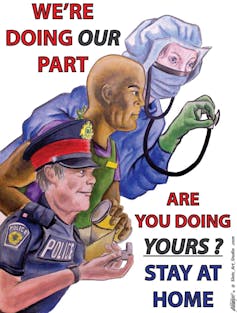
Inspired by Second World War efforts, a Canadian artist created posters to help prevent the spread of COVID-19. (Michael Slotwinski), CC BY-SA

Within the European Union an initial failure of solidarity has made many suggest that the pandemic might eventually claim another victim: the EU itself.

The Trump administration has attempted to prevent 3M, the world’s largest manufacturers of protective medical gear, from sending masks to Canada. The attempt was promptly followed by a not-too-subtle reference by Prime Minister Justin Trudeau to the large number of Canadian doctors and nurses crossing the border to work in American hospitals.
The long run

Experts have been increasingly talking about a large time window before we can expect this crisis to be over. Laboratories around the world are racing to find a vaccine or, at least, an effective treatment to reduce casualties.

In other words, we are in this for the long run: democracies and authoritarian states, rich and poor states, Chinese, Americans, Russians and the rest of the world.

If we are “at war” for an undetermined amount of time, battle fatigue may derail all efforts. Leaders would do better to promote civil responsibility and global solidarity instead of the idea of warfare. Finding a solution to the pandemic is a shared responsibility, and the solution must be global.

It is not by cultivating the image of warriors that governments will convince people to continue to comply with health authorities: it is by appealing to civic duty, solidarity and respect for fellow human beings.

This shift in perspective is necessary, if we want to resolve not only this crisis, but other global emergencies, including climate change and the depletion of the planet which are, as the World Health Organization has indicated, inextricably linked with the spread of infectious diseases.


Costanza Musu
Associate Professor, Graduate Scool of Public and International Affairs, University of Ottawa, L’Université d’Ottawa/University of Ottawa
Disclosure statement
Costanza Musu receives funding from the Social Sciences and Humanities Research Council (SSHRC)
Partners
University of Ottawa provides funding as a member of 
The Conversation CA.