Tuesday, September 08, 2026


Second-hand smoke: 2.7 billion exposed, 767 million of them children, study finds

A third of the world’s population exposed to second-hand smoke.
Copyright Cleared/Canva


By Marta Iraola Iribarren
Published on

Second-hand smoke causes serious health harm, including heart disease, respiratory illness and cancer, and remains a leading cause of preventable death worldwide.

A third of the world’s population is exposed each year to second-hand smoke — also known as passive smoking — which continues to be a major source of illness and mortality among non-smokers.

An estimated 2.71 billion people around the world were exposed to second-hand smoke— a combination of two types of smoke inhaled by non-smokers — in 2023, contributing to 1.66 million deaths. This includes 767 million children under 15, who are especially vulnerable, along with 1.49 billion women.

These new findings come from the Global Burden of Disease (GBD) 2023 study, published in The Lancet Public Health, which estimated second-hand smoke exposure and health impacts across 204 countries and territories between 1990 and 2023.

Need for stronger regulation

Despite the scale of exposure, the study found that approximately 70% of the world’s population is not protected by comprehensive smoke-free laws.

As of 2024, only 79 countries, approximately 70% of them in the Americas, have achieved the highest protection standards of the World Health Organization framework — with all public places completely smoke-free or at least 90% of the population covered by legislation.

The proportion of the global population covered by comprehensive smoke-free legislation has increased from 3% in 2007 to 33% in 2024, now covering 2.6 billion people.

However, the authors noted that while smoke-free policies directly reduce smoke exposure, there is a need for extra measures such as tobacco taxation, marketing bans, plain packaging and cessation programmes.

Regional patterns

The researchers found that the number of people impacted by second-hand smoke exposure remained broadly the same globally, but rose sharply in sub-Saharan Africa, North Africa and the Middle East, which they attributed to population growth.

The exposure prevalence in the Central Europe, Eastern Europe and Central Asia region was 37.7% — higher than the global average of 33.9% — affecting 146 million people.

Most of the countries in Western Europe were included in the “high-income super region,” which showed some of the most significant progress in reducing passive smoking.

Denmark and Norway achieved some of the world's largest reductions since 1990, at -48,8% and -44,3%, respectively.

Broad health impacts

Beyond how many people are exposed, the report found that second-hand smoke accounted for the loss of 44.8 million years of healthy life and continues to be a major contributor to disability and premature death.

While a smoker inhales "mainstream smoke" through the cigarette's filter, non-smokers primarily breathe in sidestream smoke. This is unfiltered and contains higher per-unit concentrations of toxic and carcinogenic compounds than the smoke inhaled by the smoker.

The researchers estimated that second-hand smoke remains a substantial driver of global health loss, particularly through cardiovascular and paediatric respiratory diseases.

Exposure to tobacco smoke was associated with several health conditions, including stroke, lower respiratory infections, chronic obstructive pulmonary disease, asthma, type 2 diabetes and cancers of the trachea, lung and breast.


 

Pupils' reading and maths skills slump across the world as digitalisation soars, PISA study shows

Students at Bristnall Hall Academy in Oldbury, England react as they receive their GCSE results Thursday August 20, 2020.
Copyright Jacob King/PA via AP

By InĂªs Trindade Pereira
Published on

Student performance in reading, maths and science is declining across OECD countries, and the traditional divide between advantaged students and disadvantaged pupils no longer holds. How do EU countries measure up?

Pupils' maths and reading skills are declining across the globe, largely due to digitalisation and a drop in recreational reading.

The OECD's latest PISA report, which measures 15-year-olds' ability to use their reading, mathematics, and science skills, found that student performance across OECD countries reached a record low in maths and reading.

When looking at EU countries specifically, pupils in Spain, Croatia, Luxembourg, Malta, Greece, Romania, Cyprus, and Bulgaria score below the OECD average in reading, mathematics and science skills.

Only Estonia, Finland, Ireland, Austria, Poland and Czechia managed to secure a mean performance above the average.

Reading recorded the steepest decline, with scores falling by 28 points across OECD members between 2015 and 2025, with pupils from wealthy families being the ones who fell furthest behind.

Some of the reasons for the decline are related to increased digitalisation, longer screen time and falling rates of reading for enjoyment.

"Most troubling is the decline in the very skills that matter most in the AI age: evaluating information, making connections across multiple sources and thinking critically about what we read," the report stated.

"In turn, the share of 'hasty readers' – students who rush through texts and give quick but incorrect answers – almost doubled between 2018 and 2025. In a world increasingly flooded with information, our students are less likely to think deeply and separate signal from noise."

In 2025, seven EU countries had a mean performance significantly above the OECD average, while 13 member states had a mean performance considerably below.

Countries with the largest declines in reading also tended to record the largest drops in mathematics and science.

In fact, mathematics followed, with a drop of 22 points over the past decade. This is equivalent to just over one year of learning.

Last year, 11 EU countries had a noticeable mean performance above the OECD average, compared to nine member states with a mean performance significantly below.

Science, however, has been comparatively resilient over the past decade, registering the smallest fall.

Only eight EU countries had 15-year-old students scoring above the OECD average, while 10 EU countries had a mean performance below the average.

Is the inequality gap in education closing?

The report also states the world is no longer divided into rich countries with great schools and poor countries with weak ones.

"Between 2022 and 2025, the narrowing of socio-economic gaps largely reflected declines among advantaged students rather than improvements among disadvantaged students," the PISA report noted.

In science, disadvantaged students' performance in all OECD countries remained stable while advantaged students' performance declined by eight points.

Meanwhile, in reading, disadvantaged students' performance declined by four points, compared with a 20-point decline among advantaged students.

Finally, in maths, advantaged students' performance declined by 14 points, while the change among disadvantaged students was not statistically significant.

For instance, Luxembourg is by far the biggest spender on education, expending around €248,479, but it posted lower average science scores than Ireland, France and Italy, all of which invested less than half that amount per student.

"The most successful education systems focus on fewer areas in greater depth, invest in teachers, engage parents and provide targeted support for the students and schools that need it the most," said OECD Secretary-General Mathias Cormann.

"Technology and AI can strengthen learning and help prepare young people for the future, but only when used purposefully and not as a substitute for attention, effort and understanding."


AMD unveils ‘personal super computer’ for new era of computing

Visitors walk by the AMD booth at the AI Wave Show exhibition in Taipei, Taiwan, Friday, July 31, 2026 - FILE PHOTO
Copyright AP Photo

By Jonathan Benton
Published on

The American chipmaker launched what they have described as a ‘personal supercomputer’ in Berlin on Friday, designed and made for a “completely new era of computing” driven by AI.

The supercomputer, called the Threadripper Halo Station, was unveiled at the German tech event Internationale Funkausstellung by AMD Senior Vice President Jack Huynh.

The Threadripper Halo is an ultra-high-performance workstation equipped with up to two terabytes of system memory, up to 576 gigabytes of high bandwidth memory (HBM3E), along with 96 cores of Threadripper Pro, two MI350P data centre accelerators, all supported by liquid cooling.

Huyn said the new supercomputer is the “most powerful workstation in the world”, capable of running AI models with more than a trillion parameters.

The AMD executive gave a brief demonstration of its potential at the event by generating an entire 3D world and flight simulator from a single prompt.

The company’s pitch is to bring data-centre level AI performance and capacity to a desktop format, as demand for AI rapidly grows around the world.

The supercomputer is slated for release early next year, however AMD are yet to reveal how much it will cost. It is expected that it could exceed €100,000, geared towards corporate and institutional budgets rather than as personal computers as originally pitched.

Yet it will give its consumers a platform to deploy large-language models and agentic AI systems themselves rather than rely on increasingly expensive cloud computing.

The Threadripper Halo Station’s direct competitor is the NvidiaDGX Station, with both able to run large AI models in a desktop form, however they differ in how they approach this challenge.

AMD’s supercomputer dominates on memory capacity and bandwidth, offering more than three times as much memory than Nvidia’s, allowing it to run on trillion parameter AI models locally.

However, Nvidia’s offering more seamless integration when moving code from a local workstation to the cloud and, crucially, it is already available, retailing at around €100,000.

Industry analysts see AMD's announcement as a potential catalyst for reshaping the competitive landscape of the local AI computing market.

With cloud AI subscription costs adding up for many institutions and businesses, demand for computers such as the Threadripper Halo Station to run large models on their own infrastructure will continue.

Therefore, AMD's approach of delivering data-centre-class performance using standardised components to lower the barrier to entry could be a major turning point in the expansion of the AI and personal computing sectors.

France tests Tesla's self-driving tech as Europe moves closer to autonomous cars

France is preparing to test Tesla’s self-driving system on public roads, a move that could bolster the technology's chances of winning approval throughout the European Union.


Issued on: 04/09/2026 - RFI

A Tesla robotaxi drives on the street in Austin, Texas, in June 2025. France is testing the company's supervised driver-assistance system ahead of a European vote to approve wider use. © Joel Angel Juarez/Reuters

US electric carmaker Tesla has provided France with two vehicles fitted with its Full Self-Driving (FSD) system to test on public roads, to allow regulators to check safety data provided by the company and from tests in the Netherlands.

France’s Transport Minister Philippe Tabarot said the decision came after a “constructive exchange” with Tesla founder and chief executive Elon Musk.

“With the provision of two vehicles equipped with FSD by Tesla, we are now entering a new phase: that of on-road testing,” he said in a post on X late Tuesday.

France already allows certain forms of assisted driving, though each type of vehicle, use case and location require specific authorisation.


Safety reservations

FSD is not fully autonomous, but rather a supervised driver-assistance system. It can accelerate, brake and steer a vehicle, but the driver must remain attentive and ready to take control.

Tesla has been working with France for several months on technical changes that could allow France to approve FSD at an EU level.

The bloc is expected to vote on the technology before the end of the year, a source in the French Transport Ministry told Reuters this week.

In July, Tabarot said that France was not yet satisfied with the safety trade-offs, pointing in particular to speed limits and warnings designed to keep drivers attentive.

The tests are expected to produce results by mid- to late September.

The Netherlands became the first European country to provisionally approve FSD in April. Belgium, Denmark, Estonia and Lithuania have since followed.

EU vote

Tesla, whose European sales have dropped in the face of competition from European and Chinese electric vehicle companies – as well as opposition to Musk's politics – has been lobbying European regulators to approve wider use of FSD.

On Tuesday, the company said it had recorded 4.1 times fewer collisions in Teslas fitted with FSD than in manually driven ones in the five European countries where the system is currently permitted.

Tesla said the figures were based on more than 100 million kilometres of driving data collected between April and August. FSD-equipped vehicles were involved in three collisions on highways and nine on other roads, compared to 137 and 490 collisions respectively for manually driven vehicles.

An EU vote could take place as early as October. Approval would require support from at least 15 of 27 member states, representing at least 65 percent of the bloc’s population.

Delivery robots

France is also moving to regulate other forms of autonomous transport. A decree published in early August allowed for the approval of delivery robots to be used on public roads.

The compact electric vehicles had previously lacked a specific regulatory framework. They can now be classified in the EU’s L category, which covers vehicles including mopeds and motorcycles.

They can operate on roads but must be remotely supervised, and local authorities will decide which areas and routes they can use.

The government said the rules were introduced ahead of a wider EU legal framework for autonomous delivery vehicles.

Meanwhile Waymo, the self-driving technology company owned by Google parent company Alphabet, is also preparing to expand in Europe, with plans to launch driverless taxis in Munich.

The company said last month it would begin testing its vehicles in the southern German city, initially using human drivers to map roads and assess local conditions before launching a its driverless service by the end of next year.

(with newswires)


Robot revolt? Polish company stages protest demanding stricter AI rules

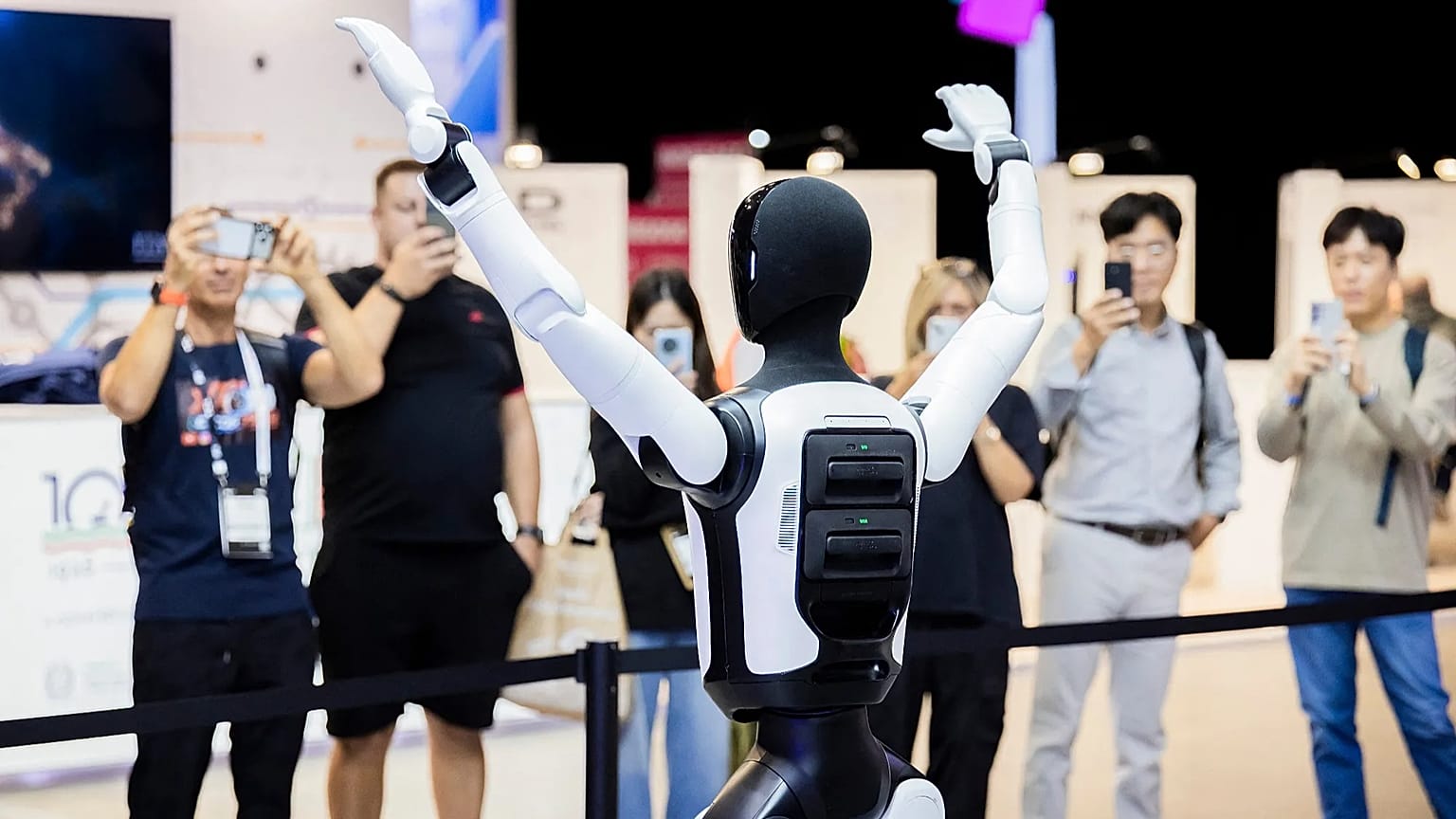
FILE - A robot dances at the Agibot booth during the second press day of the IFA 2026 consumer electronic fair, IFA, in Berlin Thursday, Sept. 3, 2026.
Copyright Christoph Soeder/DPA via AP


By Una Hajdari
Published on

In Warsaw, marching robots waved flags and chanted slogans outside the digital affairs ministry, calling on Poland's government to regulate AI before it costs people their jobs.

Waving flags, "chanting" slogans and marching in circles, around 30 robots took to the streets of Warsaw on Monday to campaign for AI regulation in front of Poland's digital affairs ministry.

The protest was organised by Democratism, an initiative that, according to its website, aims to launch debate on how AI and robotisation affect the labour market.

In a scene that blurred the line between protest and product demonstration, one of the machines fielded questions directly from journalists.

"The robots present here are meant to show that this technology is already a reality," Agibot A3, one of the AI-powered humanoid robots, said — a statement that proved its own point rather neatly.

Chants of "Defend workplaces," "Time for rules" and "Don't wait, regulate" played on loudspeakers as the robots — which ranged from bipedal humanoids to dog-like quadrupeds — demonstrated.

"We particularly want to address the issue of the potential replacement of people both by humanoid robots and by artificial intelligence in cognitive work," said (human) organiser Grzegorz KuliÅ›.

"If we don't react now, we may soon have a problem," he added, emphasising the need for "rules and regulations that would serve as a shield protecting workers".

Aside from attracting the attention of several passers-by, KuliÅ› said the use of robots was meant to demonstrate their existing capabilities and, by extension, the urgency of the issue.

"These robots can already move around freely, they're already 'protesting,'" he said — leaving unaddressed the question of whether a machine reading out a pre-loaded chant counts as protesting at all.

Minister comes out to meet organisers

The marching robots were met with a visit from Poland's Digital Affairs Minister Krzysztof Gawkowski, who spoke to KuliÅ› on site.

"Uncontrolled (AI) models, implemented into humanoids that will also keep evolving as robotisation moves forward, are a major problem," he said.

KuliÅ›, who is now the chief information officer of a robotics company and chief executive of an employment agency, served two terms on the Labour Market Council at the Ministry of Family, Labour and Social Policy.

"We feel responsible for starting to inform society about the rapid and dynamic technological changes which personally frighten us," he said.

Who's behind the machines

Local Polish outlet Opolska360 reported that the robots used in Monday's protest were built by Delta Robots, a company that has been producing both humanoid and quadruped machines for more than a decade.

KuliÅ› is also president of Weegree, a recruitment firm that has operated for more than 20 years — both companies are based in Opole, in southern Poland.

That detail sharpens the irony at the heart of Monday's demonstration, as the robots warning of job losses were built by the very industry sounding the alarm about them.

Opolska360 also quoted KuliÅ› describing Democratism as a movement he hopes will go international, saying the goal is "not to fight change, robotics or technological development," but to launch a debate on its consequences and how to counter the negative effects.

According to the outlet, Gawkowski told the gathered protesters that Poland is the first EU country to introduce oversight of the AI market and announced plans to set up a Commission for the Development and Security of Artificial Intelligence, along with regulatory sandboxes that would let companies test AI solutions before wider rollout.

In July, Poland's conservative-nationalist President Karol Nawrocki signed into law a bill put forward by the ministry to implement the EU's AI Act.

It created a national authority capable of enforcing existing EU regulations, which had already formally come into force.


Donald Trump as Green Lantern? Why the Trump administration needs to stop (mis)using pop culture references

Donald Trump as Green Lantern? Why the Trump administration needs to stop misusing pop culture references
Copyright White House X screenshot - X

By David Mouriquand
Published on

If you reference a pop culture touchstone in an AI-generated clip, it's probably best you understand even the most basic tenet of the source material.

Another day, another AI slop rampage from Donald Trump, whose latest Truth Social posting spree has left the internet saying one thing in unison: Enough.

Trump is no stranger to bulk posting AI-generated imagery as part of what has been referred to as “memetic warfare” - a tactic which sees him and his administration flood the zone when it comes to AI-generated imagery in order to appeal to his base and beyond. But the increasing frequency and quantity of the posts (as well as the very bizarre content) is leading people to seriously wonder about the mental health of the president, the security of the modern world, and the Trump administration's loose grasp on pop culture references.

One social media user argued: “Something is very wrong with the president. And yet, still has the codes to our nuclear arsenal and is the single person who can order their use.” Another pointed out: “The man with the nuclear codes. You'd be concerned if these were being posted by an elderly relative.”

In his latest posting spree, Trump renamed New Mexico as “New America”, shared an image of his silhouette over Iran, proposed new uniforms for the United States Space Force (which gave off Starship Troopers fascist chic), and even declared the Moon as US territory...

Yes, really. He declared the celestial body “is ours”.

It goes without saying that the Moon is in fact not owned by anyone, as stated by Article II of the Outer Space Treaty of 1967. Still, the internet was quick to point out that Trump should have more pressing priorities...

“Maybe get control of the Strait of Hormuz before you start on the moon,” one social media user wrote, while another posted: “Reporter: What do you say to Americans who want affordable food, gas, healthcare, and no war? Trump: The Moon is Ours.”

“WTF? Honestly this dude is losing his mind,” another commented.

One AI-generated image has angered comic book and film fans – and not for the first time.

Trump has previously appropriated several pop culture touchstones, including Superman, Hannibal Lecter, Jedis and Spider-Man, and the references have backfired every time – not only by sparking the ire of the original creators and fans, but also for how these hijacked cultural winks display a lack of appreciation or understanding when it comes to the references themselves.

The latest is an image of Trump as a DC Universe superhero. He could be seen wearing a Green Lantern Ring and appearing to build a green border wall with the ring’s power. Then, there’s a holographic “American manufacturing” cityscape that appears, before green military aircrafts fly over his head.

You couldn’t make this up.

The clip was posted by the official White House account, which captioned the clip by reappropriating the oath spoken by heroes in the Green Lantern Corps: “In brightest day, in blackest night, no evil shall escape my sight. Let those who worship evil's might beware my power... Green Lantern's light!”

Beyond the fact that “America is actually being run by a 12 year old on iPad privileges,” as one person shrewdly commented on X, as well as the very serious real-world issues Americans are facing (“Day 190 of the Iran War,” someone pointed out online, while another argued: “Anything to distract from gas prices”), Trump’s White House shows once again that it has misused the cultural reference and that the ironic implications clearly escape them.

Much like the backfiring Jedi image (red lightsabers are for the baddies, Donald), the glaring irony of Trump portraying himself as Superman (technically an illegal immigrant on Planet Earth) and how Spider-Man would actually be fighting ICE, not supporting them, the Green Lantern reference misfires.

You see, the Green Lantern Corps are an intergalactic peacekeeping force that protects the entire universe without borders. Hijacking this character to symbolize an "America First" agenda and using the ring to build physical border walls is contradictory to the core principles of the fictional character.

Plus, all card-carrying nerds will rush to correct this clip, as Trump would not be a Green Lantern, which imbues hope. A more accurate colour would be Yellow, for the love of chaos, or Orange - chiefly due to his greed and hunger for power.

In addition to the thesis that the Trump administration might be culturally illiterate is the fact that using artificial intelligence to display supreme strength and dominance only highlights imaginary power. Not true might that would decry from real-world policy.

Understand your references, or they risk rebounding and making you look like cosmic embarrassments.

“In brightest day, in blackest night, no backfiring AI shall escape from my device during outrunning iPad privileges.”

Granted, it doesn’t have the same ring to it, but lessons need to be learned.


What's in a name? Trump suggests renaming New Mexico state 'New America'

US President Donald Trump gestures while boarding Air Force One at Morristown Airport, 7 September, 2026
Copyright AP Photo

By Gavin Blackburn
Published on

Trump last week suggested renaming the Strait of Hormuz as "Trump Strait" as the war with Iran continues, then hours later implied he was not serious about the plan.

US President Donald Trump's name-changing spree found an unlikely new target earlier this week when he suggested the state of New Mexico could be renamed "New America."

His proposal, which was immediately dismissed by the state's governor, comes days after he signed an order to rename Lake Ontario as "Lake America" in the middle of a trade war with neighbouring Canada.

"Many people suggested changing the name of New Mexico...to NEW AMERICA," the Republican president posted on social media.

"So much more prestigious and beautiful for the people of that potentially incredible State. Wow, I Love It!!!"

The White House reposted an image showing the Mexico part of the state's name crossed out and replaced with "America."

A screenshot of a post on US President Donald Trump's Truth Social account, 8 September, 2026
A screenshot of a post on US President Donald Trump's Truth Social account, 8 September, 2026 @realDonaldTrump

Trump’s Truth Social account also posted several such maps showing the name change.

Some US media reports said the idea originated as an internet hoax.

State governor Michelle Lujan Grisham told Fox News that the name "isn't up for debate, it's been ours since before the United States existed."

She said the president wanted to "distract Americans" from issues such as soaring gas prices.

Trump last week suggested renaming the Strait of Hormuz as "Trump Strait" as the war with Iran continues, then hours later implied he was not serious about the plan.

He renamed the Gulf of Mexico as the "Gulf of America" on his first day back in the White House in 2025 in a move rejected by Mexico.

Canada has also rejected the attempt to rename Lake Ontario.