Showing posts sorted by date for query APEC. Sort by relevance Show all posts

Friday, June 05, 2026

South China Sea tensions drive a quiet realignment against Beijing

South China Sea tensions drive a quiet realignment against Beijing
/ IntelliNewsFacebook
By Mark Buckton in Taipei June 4, 2026

The geopolitical map of maritime Asia is gradually changing. Not dramatically so and not by way of formal alliances, but through a steady coming together of interests among states increasingly concerned by China's growing power in the South China Sea region.

Nowhere else is that clearer than in the Philippines.

For years, Manila has maintained unofficial and close ties with Taiwan just to the north, while carefully observing Beijing’s preferred ‘One China’ policy. That position has not formally changed as was seen in late March when both countries came together in Quanzhou, Fujian Province for the 24th China–Philippines Foreign Ministry Consultations then last month when the Philippines participated in the APEC Ministers Responsible for Trade meeting in Suzhou, China.

The practical relationship though is becoming steadily deeper, particularly in the fields of security and maritime affairs. To this end, recent comments from Philippine Defence Secretary Gilberto Teodoro mark perhaps the strongest public signal yet.

Speaking in the past week at the Shangri-La Dialogue in Singapore, Teodoro said the Philippines was seeking closer ties with Taiwan as part of a broader effort to deter China's "nefarious plans". In doing so, he described Taiwan, Japan and Vietnam as part of a growing network of countries pursuing what he called a "convergence endeavour" aimed at strengthening regional security, according to Taiwan’s Taipei Times.

Speaking so openly against China is rarely done at this level.

For decades, many Southeast Asian governments have actively sought to avoid being drawn into any tensions related to the Taiwan Strait and Chinese claims on democratic Taiwan. However, today that is changing. Philippine officials increasingly view Taiwan's security as directly linked to their own. At their closest point the shortest distance between Taiwan and the Philippines is just 88 miles across the Bashi Channel between southern Taiwan and the Batanes Islands of the northern Philippines.

Geography thus explains much of this shift. Taiwan sits just north of the Philippines across the Luzon Strait – of which the Bashi Channel makes up the southern part – a waterway through which global military forces and commercial shipping move between the Pacific and the South China Sea. Because of this proximity to internationally used waterways, any conflict involving Taiwan would almost inevitably affect the Philippines, most noticeably in the form of blocking trade routes and national security.

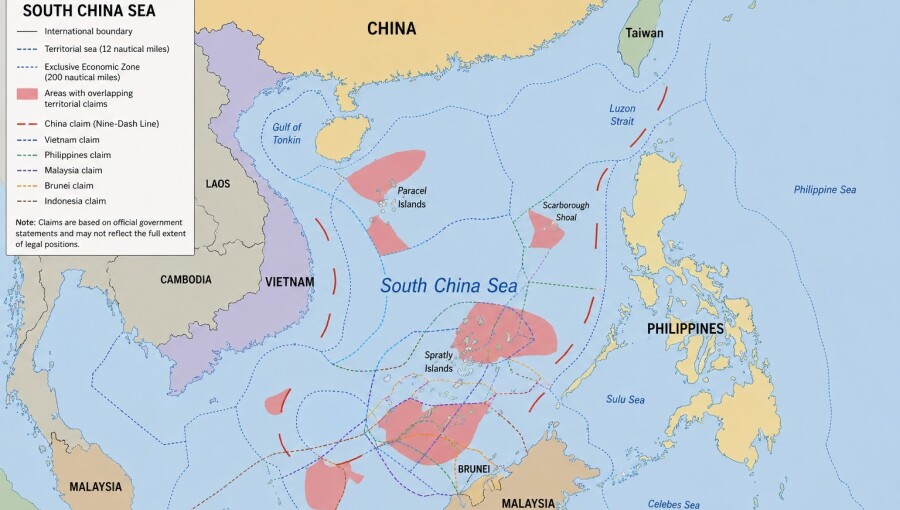
In recent years, Manila's concerns have intensified as confrontations with Chinese vessels have become more and more frequent around disputed features in the South China Sea (see map above).

Philippine officials on an almost weekly basis warn that Chinese activities pose a significant security threat regardless of the on-again, off-again bromance between US President Donald Trump and Chinese President-for-life, Xi Jinping.

At the same time, unofficial links between Taiwan and the Philippines have broadened with trade figures pointing to Philippine imports from Taiwan rising 18.6% year-on-year to over $4.7bn in 2025 and Manila’s exports to Taiwan up 22.1% year-on-year at $3.3bn. Because of this, Taiwan is now among the Philippines’ top 10 trading partners, local Taiwanese media reports.

Bloomberg also recently reported growing exchanges involving business leaders and security officials holding discussions on coastguard cooperation and maritime security. While still falling short of formal defence cooperation in any official manner, the direction the relationship is taking is increasingly clear.

Add to this Taiwan's role in advanced semiconductor production on the global stage and the nation’s role as a tech supplier is evident for both the Philippine government in Manila and others across Asia.

In turn, Taiwanese President (William) Lai Ching-te, like his predecessor, has repeatedly argued that stability in the Taiwan Strait is critical not only for regional security but also for global supply chains.

As such, for the Philippines, attracting Taiwanese investment and in particular technology offers economic benefits alongside potentially military aid in the event of conflict with the result being a relationship that is increasingly ‘official’ in all but name.

The Philippines is not alone – other countries bordering the South China Sea are also starting to push back against China.

Surprisingly given shared Communist ideals is Vietnam, which has become one of the region's most active challengers of Chinese maritime claims. In doing so, Hanoi continues to expand facilities and reclaimed land on islands and reefs it occupies in the heavily contested Spratly chain, while at the same time it maintains extensive political and economic ties with Beijing, according to The Star.

That China and Taiwan as well as Malaysia, the Philippines, and Brunei also claim parts of the Spratlys only complicates the issue.

Vietnam's approach though is often described as "bamboo diplomacy" in that it is highly flexible and designed to avoid choosing sides – shared border with China notwithstanding – with President To Lam of Vietnam recently indicating the importance of strong relations with China while simultaneously reaffirming Vietnam's commitment to protecting its sovereignty and maritime interests, according to Reuters.

Yet beneath the diplomatic language, Hanoi continues building on the islands it currently occupies, strengthening its position in contested waters.

This, coupled to Vietnam's decision earlier in the week to elevate relations with the Philippines to an an enhanced partnership of sorts only reflects the shared concern felt in both Manila and Hanoi as both governments declared that peace and a rules-based order in the South China Sea were "non-negotiable", according to Reuters. In the days since, China has offered little in the way of response.

Malaysia presents a different case altogether, however, as Kuala Lumpur remains much more cautious than either Manila or Hanoi. Prime Minister Anwar Ibrahim has consistently pushed for dialogue and regional solutions rather than any form of confrontation and Malaysia continues to pursue extensive economic engagement with China while at the same time avoiding inflammatory rhetoric – in part perhaps as a result of its long-standing cultural and historical links to China with over 20% of Malaysians being ethnic Chinese.

Even so, Kuala Lumpur has quietly strengthened cooperation with Vietnam and continues to defend its own maritime claims. Bloomberg reported in late 2024 efforts by Vietnam and Malaysia to boost trade and to coordinate more closely on maintaining stability and freedom of navigation in the South China Sea.

Elsewhere around the South China Sea, a similar pattern is emerging.

Japan and the Philippines have deepened defence ties. Australia has increased security cooperation across Southeast Asia and Canada and New Zealand are also becoming more active participants in regional maritime initiatives. None are actively looking for confrontation with Beijing and all are seeking greater resilience against potential coercion, according to Bloomberg.

China, meanwhile, is getting increasingly aggressive and continues to assert its myriad claims across the South China Sea. Part of this has seen Chinese forces increase coastguard and maritime patrol activity around disputed areas thousands of kilometres from Chinese shores. Daily air and naval intrusions into Taiwanese economic zones and airspace are the norm for the nation of 24mn.

As such, the significance of Manila's growing engagement with Taiwan extends beyond bilateral ties or agreements to work together and reflects a broader regional trend in that Asian governments are not forming an explicit anti-China bloc. Instead, most remain deeply dependent on trade with Beijing and continue to seek stable relations, but they are slowly coming together to stand up to the neighbourhood bully.

Governments around the South China Sea are increasingly coordinating with one another, in terms of trade and militarily to prepare for a future in which China's maritime ambitions may spill over into open hostilities.

For now, the Philippines has simply moved further and faster than most.

Sunday, May 31, 2026

Trump suffers two huge court losses in one day as his legal nemesis hails 'landmark day'


David McAfee
May 31, 2026 
RAW STORY


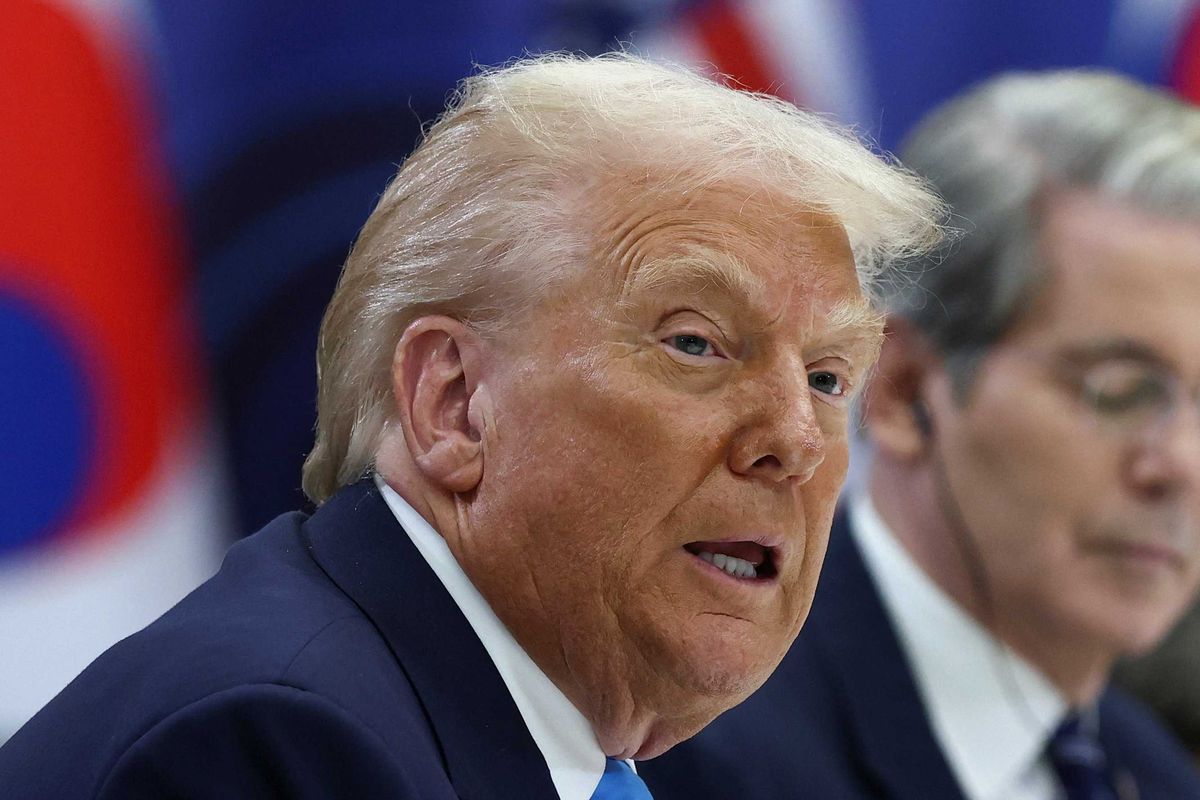
U.S. President Donald Trump speaks during a meeting with South Korean President Lee Jae Myung (not pictured) on the sidelines of the Asia-Pacific Economic Cooperation (APEC) leaders' summit in Gyeongju, South Korea, October 29, 2025. REUTERS/Evelyn Hockstein

Norman Eisen, the former White House ethics czar who has been coordinating legal challenges against the Trump administration, declared Friday a landmark day for democracy after courts handed him back-to-back wins on two of the most high-profile cases in his portfolio.

In a Substack post titled "Contrarians Strike Two Mighty Blows Against Trump," Eisen described the victories as among the biggest in his organization's more than 300 active legal cases and matters.

The first came in the Kennedy Center case, where a federal judge blocked the administration's attempt to close the venue for renovations and ordered Donald Trump's name stripped from the building and its official title within two weeks. The court ruled that only Congress has the power to change the name of the national cultural landmark. Eisen helped argue the case alongside Democracy Defenders Action, the Washington Litigation Group, and Rep. Joyce Beatty of Ohio, the lead plaintiff.

The second win came in Florida, where Judge Kathleen Williams reopened Trump's IRS lawsuit after Eisen and his partners filed a motion on behalf of 35 bipartisan former federal judges. The judges argued that Trump's $1.8 billion anti-weaponization settlement was a fraud on the court, used to funnel taxpayer money to political allies while shielding Trump, his sons, and his businesses from future prosecution. Williams launched a formal investigation into whether the court had been deceived.

Eisen noted that additional courts were also moving against the fund. A judge in the Eastern District of Virginia entered a temporary restraining order blocking the $1.8 billion fund from operating while the case is argued, and Citizens for Responsibility and Ethics in Washington filed for similar emergency relief in D.C. federal court.

"I don't think I have ever had two of my cases as the top two stories on both The New York Times and The Washington Post websites," Eisen wrote in the Substack piece, "but that happened Friday because these two wins were good news for democracy."


‘A 1-2 Punch Against Trump’s Corruption’: Judge Blocks Renaming, Closure of Kennedy Center

“Congress gave the Kennedy Center its name, and only Congress can change it.”


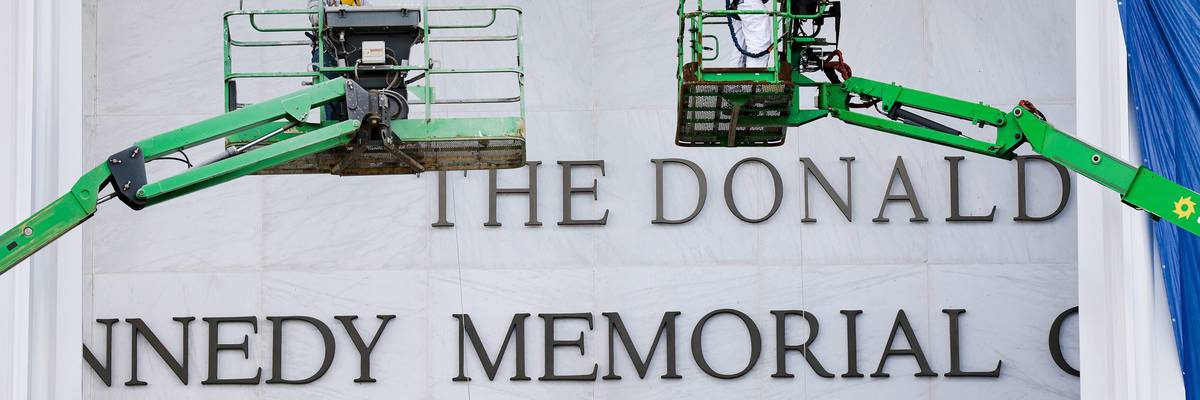
Workers add President Donald Trump’s name to the John F. Kennedy Memorial Center for the Performing Arts in Washington, DC on December 19, 2025.
(Photo by Heather Diehl/Getty Images)


Brett Wilkins
May 30, 2026
COMMON DREAMS


A federal judge ruled Friday that President Donald Trump’s renaming of the John F. Kennedy Memorial Center for the Performing Arts after himself is illegal and temporarily barred the president from shuttering the Washington, DC cultural institution for renovations.

Trump’s effort to rename the iconic Kennedy Center the Trump-Kennedy Center came after the president used his authority to purge the institution’s board and appoint new trustees. In an unprecedented move, the trustees then voted to make Trump the center’s board chair. Last December, the board voted unanimously to rename the institution—a move that violated federal law.

Congresswoman Joyce Beatty (D-Ohio), an ex officio member of the Kennedy Center board, sued over the name change, which outraged many Americans and, along with Trump’s addition of his name to the US Institute of Peace, sparked legislation aimed at banning the naming or renaming of federal assets after sitting presidents.

“May the John F. Kennedy Center for the Performing Arts be renamed absent Congressional authorization? The answer, plain from the face of the statute, is no,” US District Judge Christopher Cooper wrote in his ruling on Beatty’s suit. “Nor can any other individual be memorialized on the front portico of the building.”


Originally called the National Cultural Center, the Kennedy Center was renamed via an act of Congress following former President John F. Kennedy’s 1963 assassination.

“It is hard to imagine a more intentional legislative effort to call the Center by its chosen name,” Cooper—an appointee of former President Barack Obama—wrote. “The organic statute also takes pains to ensure that the Kennedy Center’s public spaces honor President Kennedy and President Kennedy alone... The prohibition is unambiguous.”

“Congress gave the Kennedy Center its name, and only Congress can change it,” the judge added.

Cooper also temporarily blocked Trump’s planned two-year closure of the Kennedy Center for renovations.

“In ratifying President Trump’s closure announcement, the Board was derelict in discharging the full range of its responsibilities to the Center,” he wrote. “More specifically, the Board based its decision on an insufficient, one-sided presentation of information and
neglected to consider the full range of its statutory obligations and potential adverse consequences of closure on programming and memorial functions.”

While Trump claimed the decision to shutter the Kennedy Center was based on input from a group of “many Highly Respected experts,” who said the center was “tired, broken, and dilapidated,” critics including John F. Kennedy’s descendants pointed to artists not wanting to perform there after the president’s takeover and purge, which resulted in programming including the world premier of a documentary film about his wife panned by one critic as “a scowling void of pure nothingness.”

Cooper said that the Kennedy Center could be allowed to close “after independently balancing its multiple obligations to the Center in a prudent fashion.”

Beatty welcomed Cooper’s ruling, which she said “rightly affirms that this administration’s efforts to rename and close the Center have no basis in law.”

“The Kennedy Center is an institution that belongs to the American people, not to Donald Trump,” she added. “He has desecrated this sacred memorial for his own vanity. I am proud to have fought for the rule of law and to protect this sacred institution.”

Trump, meanwhile, took to his Truth Social network to rail against Cooper, “a Judge appointed by Barack Hussein Obama.”

“Cooper ruled that The Kennedy Center, which was going to close in early July for largescale renovations and construction due to years of neglect, decay, and poor maintenance, and which was to be transformed by the Trump Administration into the Finest Facility of its kind, anywhere in the World, is not allowed to close for these renovations, which would not be possible to properly do without such a closure,” the president wrote.

“Additionally, Judge Cooper ruled that the 36 Member Board of Trustees, which unanimously voted to add the name ‘TRUMP’ onto the former Kennedy Center, making it The Trump Kennedy Center, did not have the right to do such an addition, and the name, ‘TRUMP,’ must be removed,” Trump’s screed continued.

“I took great pride in taking over a losing Institution, and looked forward to making it into a Great and Prestigious WINNER for Washington, D.C., and indeed, the United States of America,” he continued. “Unfortunately, Judge Cooper and the Radical Left would rather see it DIE than have President Trump transform it into something that everyone could be proud of, much as I have done, in many cases, throughout my life.”

“Therefore, based on the fact that the Radical Left Democrats care more about opposing your favorite President, ME, than saving a dying Performing Arts Center, almost all of which lose large amounts of money throughout the Country, we are going to be working with Congress to transfer this failing Institution back to them so they can make a determination as to what to do with it,” Trump said.

“Judge Cooper should be ashamed of himself! I cannot be involved with a situation where danger to the Public is allowed to flourish in plain and open sight,” the president wrote. “Unless I am free to do what I do better than anyone else, bring this Institution back, physically, financially, and artistically, I have no interest in continuing what could only be a hopeless journey into ‘NEVER NEVER LAND.’”

“There has never been a President of the United States who has been treated so unfairly by the Courts as I,” he added, “but, that’s OK, I will continue to do, what is considered to be, a great job for the wonderful people of our Country.”

Friday, May 29, 2026

War With Iran, Phase Two: All Three Plausible Explanations Call for One Corrective Action


 May 29, 2026

Photograph by Nathaniel St. Clair

On May 25, US president Donald Trump went back to war with Iran, launching strikes in the southern part of that country on a laughable claim of “self-defense.”

The previous phase of the war was stupid, evil, and illegal, as is this phase.

It was and is stupid because even given Trump’s constantly shifting (and mostly themselves stupid) objectives, there was no way to “win” it other than nuking all of Iran’s major cities and sending in a massive occupation force for the foreseeable future.

It was and is evil because war is always evil. Noncombatants are killed, injured, and impoverished, purposely or accidentally. There are seldom any “good guys” on the “leadership” level of any side — it’s merely a street gang turf rumble writ large, with regular people caught in the violent middle.

It was and is illegal because here was no declaration of war, and the attack didn’t even meet the minimal  requirements of the War Powers Resolution. Additionally, even if that resolution was constitutional (it wasn’t), Trump had 60 days to get congressional approval for continuing the operations (he didn’t — and no, the clock did not magically “reset” just because he took a brief break).

Wars usually aren’t really “won” in any meaningful sense of the word, but in this war the US regime — and the American people — have clearly lost, no matter the military outcome. It’s already impoverishing us considerably, and we’re only seeing the early impact of a situation which will drag on for a long time regardless of what happens next.

The most obvious indicator, of course, is the price of gasoline at the pump, but the shortages of petroleum products and fertilizer components that usually pass through the Strait of Hormuz will soon become very real in the prices we pay for consumer goods and groceries.

So, here we are: Instead of taking his lumps, letting the war end, and hoping for an economic upturn before the midterm elections mangle his party’s present projects and future prospects, Trump is doubling down.

There are three, and only three, plausible explanations:

Explanation One is that he’s evil, hates America, and is doing his damnedest to destroy the US economy. If that’s the  case the US House of Representatives should impeach him and the US Senate should convict and remove him. His illegal war clearly meets the standard of “high crimes and misdemeanors.”

Explanation Two is that he’s stupid — whether by nature or due to his obvious cognitive decline — and just doesn’t know what he’s doing or understand its moral, political, or economic implications. If that’s the case, the vice-president and a majority of the cabinet should, per the 25th Amendment, “transmit to the President pro tempore of the Senate and the Speaker of the House of Representatives their written declaration that the President is unable to discharge the powers and duties of his office,” after which the vice-president can become “acting president” and put a stop to this nonsense.

Explanation Three is that Trump — again, possibly due to the obvious cognitive decline he’s publicly and frequently displayed since before his second inauguration — isn’t in charge; the presidency is effectively controlled by other people who happen to be evildoers. If that’s the case, and if the 25th Amendment isn’t invoked because those evildoers also control — or consist of — the vice-president and cabinet, then it’s the public’s job to shut the war machine, and the regime controlling it, down.

That might look like a general strike, or even a revolution. It wouldn’t be pretty. But Trump clearly must be removed from power, and a popular uprising would likely be less ugly than the alternative, which is that US military commanders cease obeying Trump’s unlawful orders and depose him themselves. A junta is a lateral move on the evil and stupidity metrics, not an improvement on either.

There’s no question of “winning” the war. The war is lost, and lost it shall remain. The questions are about how much longer it lasts, how many more people are killed, maimed, displaced, and impoverished, what the terms of the US surrender look like, and what comes after. The sooner Trump loses the power to babble non-answers and act on them, the better.

Thomas L. Knapp is director and senior news analyst at the William Lloyd Garrison Center for Libertarian Advocacy Journalism (thegarrisoncenter.org). He lives and works in north central Florida.


Geopolitics


Iran’s shockwave in Asia

Wednesday 27 May 2026, by Pierre Rousset


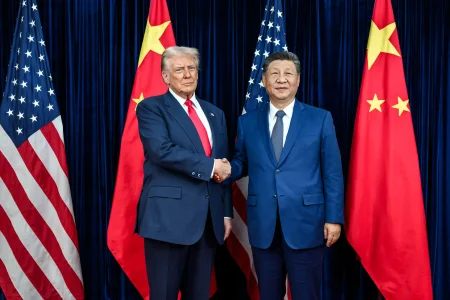
By dint of dragging on, the United States’ war against Iran seems to be becoming a real international tipping point whose scope varies according to the region. Its consequences are expected to be major in Asia. On the geopolitical terrain, of course, as illustrated by the Xi-Trump summit in Beijing on 14-15 May. But it will also aggravate the social crisis in many countries as well as boosting the global climate and ecological crisis. It is the beginning of multiple upheavals that will only be fully measured with hindsight.

Donald Trump had postponed his visit to Beijing (to the great displeasure of Xi Jinping) to give him time, he hoped, to finish with Iran and arrive in a position of strength. The opposite happened. He has come to beg the Chinese, allies of the Iranians, to help him get out of a mess for which he alone is responsible.

In the current situation, Beijing and Washington share common goals, starting with the reopening of the Strait of Hormuz, through which a fifth of the world’s oil and gas transits. China currently imports about 40 percent of its oil from the Middle East, and many of its refineries are designed to process oil from Iran. Moreover, even if it supports Iran, the Chinese regime does not want to see a new country enter the very exclusive club of nuclear powers. This is a fact that Tehran does not seem to have understood. Possessing (or threatening to possess) the weapon certainly appears to be a guarantee of security and influence, but the great powers have tolerated the appearance of new applicants only if their own interests are at stake (for example, North Korea from Beijing’s point of view, a buffer state between South Korea and US bases and its border).

Xi Jinping knows, however, that Trump is under pressure for domestic political reasons (the midterm elections are taking place in November), and he has put the deal in his hands: he must make big concessions on support for Taiwan. For the time being, he does not seem to have made any commitment to intervene vis-à-vis Iran (assuming that he can indeed change Tehran’s policy).

Dangerous uncertainty for Taiwan

Xi elaborated on his warning on 14 May, the day after Trump’s arrival, saying at a press conference that the Taiwan issue was “the most important in Sino-American relations.” Well treated, “relations between the two countries can remain stable overall.” Otherwise, they will “clash, or even come into conflict.” Trump seems to have been taken aback, as this subject is not usually dealt with in the public sphere, and he dodged journalists’ questions.

Very concretely, Xi demands that the United States replace its official position, “the United States does not support Taiwan’s independence” with “opposes Taiwan’s independence” and that it stop supplying arms to the island state.

After announcing an agreement to deliver $11 billion worth of U.S. weapons by the end of 2025, the U.S. administration is considering a new program of some $14 billion, a record amount since the United States committed in 1979 in the Taiwan Relations Act to deliver sufficient military equipment to Taiwan to defend itself. This law was passed by the U.S. Congress in the wake of the establishment of diplomatic relations between Washington and Beijing the same year and the concomitant severing of U.S. diplomatic ties with Taipei. Since then, America has remained almost the only country to provide military aid to Taiwan. To meet Chinese demands, the US Congress would therefore have to abrogate this treaty.

The CCP would now prefer to impose a severe economic blockade of the island, rather than attempt a rather random military invasion. The invasion of Taiwan would not be an easy task. Xi Jinping promises great things to businessmen, mafiosi and politicians who would serve as his fifth column, to ensure Beijing’s stranglehold, but given the way he has been blithely purging his allies for a while, they should be wary. It also plays on soft power, with many fun shows being watched on both sides of the Strait.

Taiwan (the Republic of China) has a very special history. Beijing is playing on its internal contradictions. The Kuomintang, a counter-revolutionary party, invaded the island after its defeat on the mainland in 1949, imposing a dictatorial regime until the Sunflower Movement in 2014, which gradually led to the establishment of a democracy. The KMT nevertheless retains a social base and political weight, with the help of clientelism and corruption. Its leaders are now divided over relations with China.

However, it is difficult to see why the Taiwanese population, which enjoys a (bourgeois and imperfect) democracy, would freely opt to abandon it in favour of an opaque and super-authoritarian regime. It has the right to a self-determination exercised without external threats.

Taiwan is de facto independent, but does not officially proclaim it. The entire regional balance is due to this strategic ambiguity. Xi Jinping is once again questioning it, and Donald Trump seems to be taking his pressure into account. Just before leaving Beijing, he sent a form of warning through the Fox News channel to Taiwan against declaring independence at the cost of a distant war. “I want [Taiwan] to lower the temperature. I want China to lower the temperature.” If the statement is worrying, it is because the proclamation of independence was not on the agenda at all.

In doing this, Trump forced the Taiwanese authorities to react. The foreign minister said he took note of the remarks, noting that the arms sales were a U.S. commitment to the island’s security that was guaranteed by the Taiwan Relation Act and was a common form of deterrence in the region. The Taiwanese government, led by the Democratic Progressive Party (DPP), and President Lai Ching-te, declared on May 16 that “Taiwan is a democratic, sovereign and independent nation, which is not subordinate to the People’s Republic of China,” reaffirming the traditional position: de facto independence, although not proclaimed.

Strategic Balances in East Asia

Donald Trump is therefore now helping to reopen the Taiwan issue, a veritable Pandora’s box: geostrategic balances and control of the seas in East Asia are at stake. This state is located in the middle of the first chain of islands in the Pacific Ocean. Taking possession of it would give Beijing a key point of support for controlling this international seaway of primary importance from a commercial point of view (it is one of the busiest routes), very rich in resources (including in its seabed), whose sovereignty China claims, against international law, (at least in its southern part, which it has militarized to excess, without recognising the maritime borders of the other riparian countries).

The entire region is therefore concerned, from Japan and South Korea to Vietnam, including Singapore, Malaysia, Brunei, Indonesia and the Philippines. The conquest of Taiwan would be a real earthquake whose “aftershocks”, given the geopolitical centrality of Eurasia, could affect Central Asia, the Arctic, Russia and Europe.

Donald Trump’s erraticism and his lack of regard for the interests of his allies are already having consequences. Thus, Japanese Prime Minister Sanae Takaichi has initiated a real strategic turning point for Japan to assert itself as a great military power. The United States had imposed a pacifist constitution on the country in 1947 (with article 9), which the population had largely accepted. The counterpart to this renunciation of war was obviously the assurance of American protection in the event of a threat. This quid pro quo no longer seems obvious and allows Tokyo to justify the acceleration of its militarist program, while the so-called Japanese Self-Defense Forces are already at the top of the basket of conventional armies (without nuclear weapons), effectively emptying the constitution of its substance.

In 1976, under prime minister Takeo Miki, the sale of arms was banned. In 2014, prime minister Shinzo Abe opened a first breach in this embargo policy. On 21 April, all the previously stated principles of the country’s foreign policy were annulled. Japan can now export weapons, including “lethal” weapons, to the 17 countries with which it has a defence agreement. One of the largest military export contracts since 1945 was signed with Australia, for Mogami-class frigates produced by Mitsubishi Heavy Industries (these frigates have multiple functions and can operate with a short-crewed, high-quality frigate). Similarly, 1,400 soldiers are taking full part in the Balikatan (“shoulder to shoulder” in Tagalog) exercises in the Philippines, together with the United States and six other countries (China has invited itself into this area, also carrying out its own competing manoeuvres).

What does Donald Trump really want? If he allowed Beijing to conquer Taiwan in some form, the credibility of the United States in Asia would collapse, leaving the field open for China. He declared that he did not want to fight a war “9,500 miles away”. The problem is that the largest US military bases abroad are located precisely in this region: in South Korea and Japan (above all on the island of Okinawa). In the front row. Would he like to negotiate zones of influence: the south of the East Asian Seas to China, the north to the United States? It’s hard to believe. Perhaps he is simply trying to buy time given the mess he got himself into in Iran. He uses and abuses his military means and risks finding part of his armada out of service, while the refurbishment of an aircraft carrier, for example, requires a lot of time. Xi Jinping knows this perfectly well. However, the Chinese army is not operational today. Its staff has been the victim of successive purges, in all sectors. Xi’s paranoia is wreaking havoc. He also needs time. The icing on the cake is that we are dealing with two psychopaths, one cold and calculating, the other explosive, and this is not reassuring.

Speculation does not accomplish much, especially when one is not privy to the secrets of the Gods. However, we are living in a dangerous moment of uncertainty. In the face of militarism and great power rivalries, people-to-people solidarity remains our political compass, both in the region and internationally. For the right to self-determination (including for Taiwan), for demilitarization (especially of maritime spaces), for the seas and oceans to be freed from state borders in order to become once again common goods of humanity.

Towards a Sino-American duopoly?

What is confirmed, however, is that we are (temporarily?) moving towards a Sino-US global duopoly (necessarily very confrontational) and not towards a military confrontation between great powers in the short term. This was the hypothesis that seemed to me to have been favoured for a long time. Today, China is strengthening its hand in this duopoly in Asia, but we must not forget its impotence when Trump “co-opted” a wing of the Venezuelan regime and while he threatens Cuba, two countries that had or have Chinese support.

Beijing is certainly strengthening its global military presence thanks to its policy of purchasing ports with a dual function, economic and military. Considerable funds have been allocated for this purpose. Between 2000 and 2025, China acquired 168 ports in 90 countries, on all continents. Moreover, in Chinese companies established abroad, it is the army that ensures “security” (without displaying it). It is developing its naval base. The launch in November 2025 of its third aircraft carrier, the Fujian, represents a major step forward in modernization with its electromagnetic catapult system. However, its army has never been tested in a real contemporary military conflict (reliability of armaments, capacity of the chain of command, combined arms coordination and so on). Its deployment primarily concerns Asia-Pacific.

The Indo-Pacific has become a region of major strategic importance where global balances are (also) at stake. Joe Biden understood this and one of his main successes was to have prepared, at the time of the Afghan debacle that he had inherited from Donald Trump, a deployment of politico-military, economic and diplomatic means in this region. Back in power, Trump hastened to undo this Asian “pivot”. It was a bad thing for him. It has given China the opportunity to further weave its own cooperation in this part of the world (in rivalry with India). This strengthened its hand vis-à-vis Washington. From a geopolitical point of view, beyond the seas of East Asia, it is here that the Sino-American rivalry will be most alive.

More generally, the functionality of the Sino-US duopoly will be tested in the coming months, with Trump and Xi due to meet on multiple occasions, either face-to-face (Xi’s visit to Washington at the end of September, before the US mid-term elections), or during meetings: in November, the Asia-Pacific Economic Cooperation (APEC) summit in Shenzhen (China); in December, the G20 meeting in Miami (United States). If Beijing and Washington have common interests, they will rule the roost, as has been the case in the past. The areas of confrontation, on the other hand, should express themselves.

Despite Donald Trump’s cries of victory, no significant progress seems to have been made at the recent summit concerning the standards for the deployment of artificial intelligence and very high technology (superconductors), rare earths, trade deficits and so on. A truce in the tariff war had been decided until October (to the advantage of China). Its extension has not (yet) been announced. But the main if not the only tangible economic outcome of the summit may be the continuation of the fragile trade truce previously agreed in Busan, South Korea, when Trump suspended triple-digit tariffs on Chinese goods, while Xi Jinping gave up strangling U.S. supplies of critical rare earths.

Can a Sino-American duopoly last? Who lives will see. The United States is griped by a major regime crisis and this is probably also the case with China if we are to believe the extent of the purges, the disaffection of the population who no longer hope for an improvement in their standard of living, the ageing population, corruption, the environmental crisis, the growing dependence on exports and so on. In addition, the boomerang effects of the climate-ecological crisis are increasingly being felt. This increases the number of uncertainties.

An unimportant summit?

Many analysts seem to consider this summit to be of little importance. It is true that it will not have the same historical significance as the meeting in Beijing in 1972 between US President Richard Nixon and Mao Zedong, or that of Deng Xiaoping to the United States in 1979. However, this is the first visit to China by a US president since 2017, almost a decade ago – and that was during Trump’s previous term!

Xi Jinping probably aims to take advantage of the “Trump-Iran” moment to set a balance of power more to China’s advantage in view of the post-Trump era, as an established fact. This is a step in the rise of Chinese imperialism (except in the not insignificant field of finance, as Xi does not dare to make the Yuan a truly international currency) and in its desire to assert an alternative hegemony to that of the “West”.

The popular classes, inflation and ecological disaster

The inflation fuelled by the Iranian war is affecting the popular classes in Asia as elsewhere, with one particularity. In many Asian countries, the money sent by migrants allows families to survive. The Middle East is a major destination for this immigration, as far as Muslim countries are concerned. According to the International Labour Organization, the region is home to 24 million migrant workers. It is proving to be the world’s leading destination for foreign labour. Most of this comes from Asia: Bangladesh, India, Indonesia, Pakistan, Philippines (Mindanao), Sri Lanka. Many of these workers are in low-paying or precarious jobs and have little access to services such as health care.

The repatriation of emigrants is large scale. In the past two months, the Philippine government has secured the return of more than 9,500 of its nationals who were working in the Middle East. Many people remain blocked in unbearable conditions.

Finally, the wars in the Middle East are fuelling the climate and ecological crisis, the global crisis. A real disaster. This “polycrisis” is the greatest challenge we face. It is what makes the difference with all past periods. The number of “climate victims” is increasing exponentially in Asia, in particular.

In Asia, poverty and precariousness are spreading. However, once you have entered extreme poverty, you can no longer get out of it without long-term aid that states do not provide, but that movements try to ensure (with our help, sometimes).

The climate-ecological crisis

It’s the elephant in the china shop that no one (or almost) talks about. Debates follow one another on the economic consequences of the closure of the Strait of Hormuz, without saying a word about the climate crisis or the major attacks on biodiversity. Unfortunately, the international activist press does not always escape this syndrome. Articles appear that completely obscure the subject. Others mention it, but without concluding on the campaigns to be carried out in this area. A strange self-censorship.

While Europe is warming twice as fast as the global average, the health and social consequences are particularly severe in Asia, where societies are very vulnerable. Much of Bangladesh will disappear under water, but also densely populated areas in Indonesia. When the humidity level in the air becomes too high, even a “normal” temperature can become deadly, as the body can no longer cool itself by sweating. The violence of typhoons is increasing. Massive floods follow exceptional droughts...

19 May 2026

Translated by International Viewpoint from ESSF.