China Tests New 83-Mile Inland Canal to Expand Southeast Asian Trade
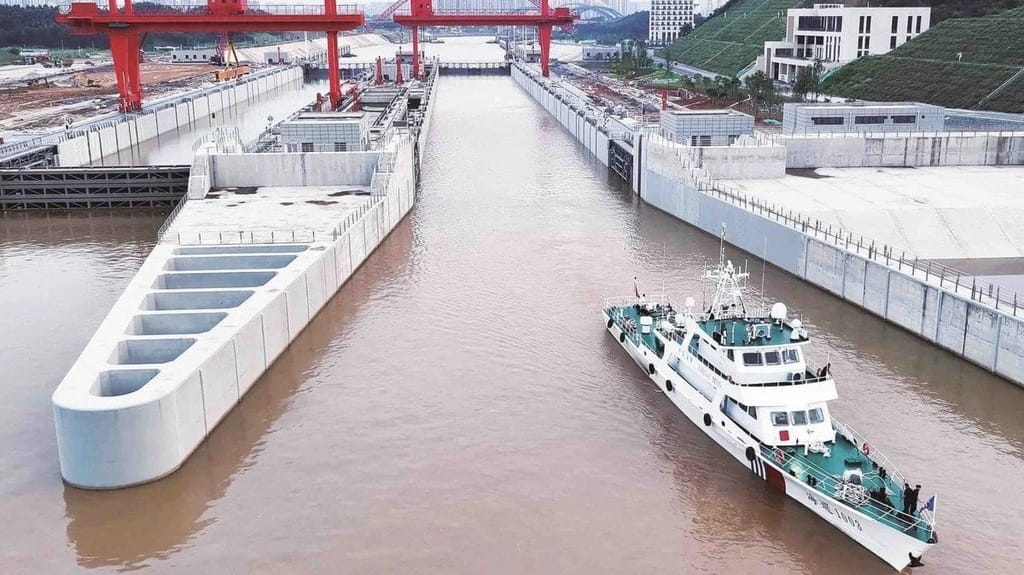
China is nearing the official opening of a new 83.4-mile inland canal designed to improve access to the trade markets of Southeast Asia. The first trial navigation of the full canal was completed by a Chinese patrol boat ahead of a planned September opening of the Pinglu Canal.
The state project, which is costing an estimated $10.3 billion, runs from the Ping River estuary in Hengzhou and follows the Qingjian River to the Beibu Gulf. Previously, goods manufactured in the region had to detour through the Pearl River Delta to reach the Guangzhou Port.
It is China’s first major river-to-sea canal project planned and executed at the national level since 1949 and the founding of the People’s Republic. It is seen as a major component of the Belt and Road Initiative.
Organizers highlight that the canal will shorten inland waterway transport by about 560 kilometers (nearly 350 miles). They promote that it will help relieve volume and congestion on the Yangtze River while also lowering transportation costs. They estimate the canal could reduce transport costs by about $735 million annually while also providing increased access to Southeast Asia. China is placing a high priority on trade with Southeast Asia as a new market to help offset anticipated declines in U.S. imports.
The Chinese patrol boat Haixun 1003 (approximately 10,000 tons displacement) sailed through the Qingnian lock on August 7. The vessel, which is 46 meters (151 feet) long, completed the first full transit of the canal both as a test and for inspections.
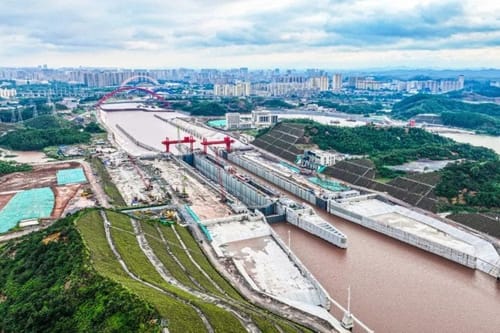
Construction of the canal took four years, becoming the first of its kind built by the Communist government
Construction of the canal began in 2022 and required moving 315 million cubic meters of material. The design had to overcome a 65-meter (213-foot) elevation difference between the river estuary and sea level. Chinese engineers built three key hubs along the route with locking stations. Reports are calling the middle hub at Madao the “world’s largest inland water-saving ship lock.” The chambers measure about 984 feet with a width of 112 feet and a depth of 26 feet. They are saying the locks can handle up to a dozen 5,000-tonne ships at one time.
The locks are also reported to have several key firsts. They report that the 70-tonne operating values at the Madao and Qishi hubs set a world record for operating speed. The massive values require just one minute to open and can be closed in 30 seconds. They report this is two to four times faster than conventional ship locks and will reduce waiting times for ships on the Pinglu Canal.
Chinese officials are also emphasizing the environmental considerations of the project. A 240-meter long wildlife overpass with soil was created so that native animals can continue to move around freely in their habitats. They also relocated over 9,500 mature mangrove trees in the creation of the canal’s estuary and replanted saplings elsewhere. They also created a 480-meter-long dual-channel fishway for migrating fish.
The plan calls for the canal to start commercial operations in September as China pushes to expand trade with Southeast Asia. However, it will require further port development at the terminus of the canal for cargo handling and transshipment to Asia.

No comments:
Post a Comment