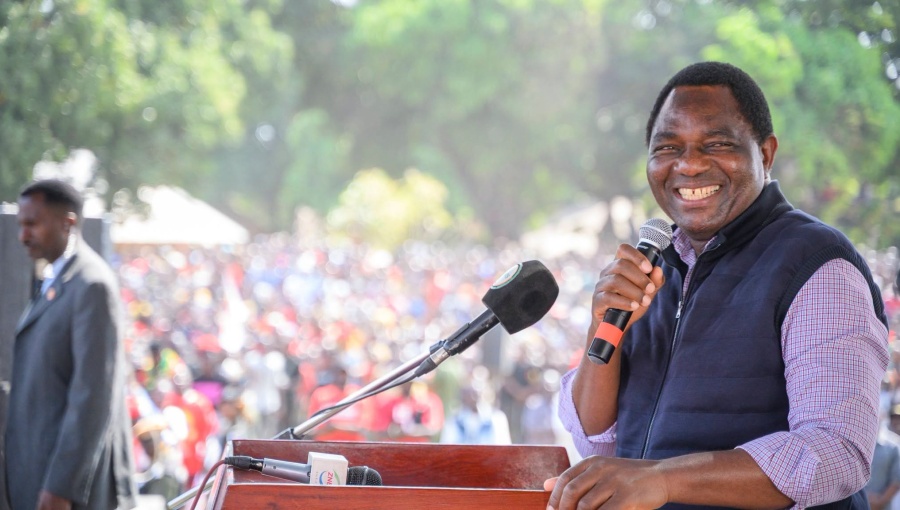
Zambian President Hakainde Hichilema has won a second five-year term with 61.4% of the vote, giving him a renewed mandate to pursue an investment-led economic programme centred on sharply expanding copper production after restructuring the country's debt.
The Electoral Commission of Zambia declared the 64-year-old incumbent the winner early on August 18 after he secured 2.97mn votes. His main opposition challenger, Brian Mundubile, received about 38%, or 1.86mn votes.
Hichilema campaigned on the economic stabilisation achieved since he took office in 2021, when Zambia was struggling with the aftermath of its 2020 sovereign default. His government restored relations with international lenders, completed a $1.7bn IMF programme and largely restructured about $13bn of external debt.
The president's second term is expected to place particular emphasis on mining. Zambia, Africa's second-largest copper producer after the Democratic Republic of Congo, produced 890,346 tonnes of copper in 2025 and is seeking to more than triple annual output to 3mn tonnes by 2031.
“Hichilema can point to a strong economic record. GDP has expanded by a solid ~5% p.a. during his term, while inflation has fallen from a peak of 24.6% y/y in 2021 to 6.5% y/y in July. This was helped by the surge in copper prices during his time in office. But the president can take some credit for the recovery in copper production, which rose to 0.89mn tonnes in 2025, the highest since Zambia’s independence in 1964,” wrote David Omojomolo, Africa Economist at Capital Economics, ahead of the vote.
“The improvement in macro stability creates good foundations for sustained growth, but what remains to be seen is whether Hichilema can move from crisis management to structural reforms. Ambitious plans to increase copper production to 3mn tonnes a year by 2031 are welcome, but we think as much emphasis needs to be placed on processing and adding value along Zambia’s mining supply chain […]. And while Zambia’s investment attractiveness is amongst the highest in the region, there is still much scope to improve the operating environment, from addressing electricity constraints to improving logistics.”
The copper mining expansion drive under Hichilema has drawn investment from companies including First Quantum Minerals (TSX: FM), Barrick Mining (NYSE: B; TSX: ABX), China's JCHX Mining Management (SSE: 603979), privately held International Resources Holding and US-backed KoBold Metals.
Achieving the 3mn-tonne target will require substantial investment beyond the mines themselves. Industry executives estimate Zambia needs at least 2,000 MW of additional power capacity to support the planned expansion, while miners have also called for improvements in exploration incentives, processing capacity and transport infrastructure. Mining accounts for around 70% of Zambia’s export earnings and more than 10% of GDP, making the sector’s expansion central to Hichilema’s broader growth strategy.
Hichilema's government has sought to revive projects, provide greater regulatory certainty and attract billions of dollars of mining investment as global demand for copper and other critical minerals rises. The sector is central to efforts to create jobs, increase export revenues and broaden an economic recovery that has yet to translate into improved living standards for many Zambians.
“By our estimates, copper export revenues are likely to be about 8% of GDP higher this year than last, more than offsetting the weaker terms of trade pressures from the energy shock. This should also keep the external position on better footing, with the current account deficit moving into surplus by 2028, meaning the kwacha does not lose too much of its 18% year-to-date gains against the dollar,” Omojomolo wrote.
“The public finances have also been repaired under Hichilema’s watch. While a long and tortuous process, Zambia has now made substantial progress restructuring external debt, including agreements with China and official creditors, alongside navigating tricky commercial creditor talks in parallel.”
The country's mineral wealth has also placed Lusaka at the centre of growing competition between the United States and China. Chinese companies have established a major position in Zambia's mining industry, while Washington has sought greater US participation in African critical-minerals supply chains.
Relations with the United States became strained earlier this year after Zambia said Washington was attempting to link a proposed health assistance agreement worth up to $2bn over five years with a separate critical-minerals agreement. Foreign Minister Mulambo Haimbe said Zambia objected to preferential treatment for US companies and insisted the health and minerals negotiations should be considered separately.
The vote nevertheless exposed political tensions that will follow Hichilema into his second term. Opposition parties and civil society organisations accused his government of restricting political activity and using state institutions to its advantage, allegations the administration has rejected.
The European Union's election observation mission said voting on August 13 was generally calm and offered voters a competitive choice but concluded that restrictions on fundamental freedoms and unequal campaign conditions had produced an uneven playing field.
“Key incumbency advantages blurred the line between state and political campaigning, creating an uneven playing field,” the mission said.
Vote counting was temporarily suspended after attacks on election workers and the theft of ballot papers. Authorities also arrested several prominent opposition figures following a nighttime raid in which gunfire was exchanged, accusing them of involvement in a planned insurrection. Opposition leaders rejected the allegations and accused the government of intimidation.
Mundubile questioned the credibility of the results and had claimed victory before the final count without providing evidence. Hichilema and his supporters rejected allegations that the election had been manipulated.
Greg Musiker, Zambia analyst at advisory firm Signal Risk, said a legal challenge by the opposition was possible but widespread instability was unlikely, Reuters reported. “While localised political violence is possible in the coming days, widespread unrest is not expected,” he said.
Hichilema now faces the challenge of converting stronger macroeconomic conditions and renewed investor confidence into broader gains for households. Despite falling inflation and progress on debt restructuring, poverty and living costs remain major concerns.
His government is also seeking to agree a new IMF programme before the end of 2026 as it tries to channel further investment into mining, energy and agriculture. The success of that strategy — and of the plan to lift copper output to 3mn tonnes — is likely to define the economic record of Hichilema's second term.
Copper squeeze builds with spreads surging and price near record
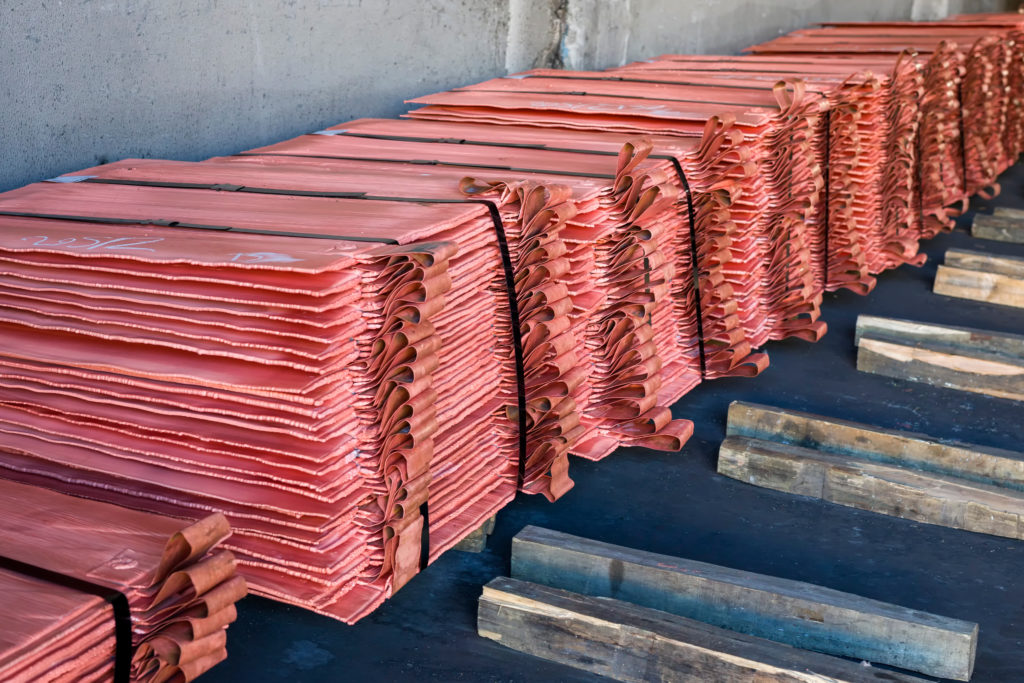
Copper rose toward a record on the London Metal Exchange, with soaring price spreads highlighting an increasingly acute squeeze in near-term supply.

The metal’s spot price traded as much as $545 a metric ton above the three-month futures contract, the widest backwardation since a historic squeeze in 2021 prompted the adoption of emergency measures to contain a runaway rally. Other spreads have also surged, and futures are closing in on a $14,500-plus peak reached during a spike in January.
The current supply crunch is being fueled by a surge in shipments to the US in anticipation of a potential decision on import tariffs, while recent tightness in China has also drawn cargoes there. That has led stockpiles across the LME’s global warehousing network to shrink by almost half since mid-May.
Investors were already warming to the metal, whose biggest application is in electrical wiring. They cite longer-term themes of robust demand powered by the energy transition toward electrification, the need to build data centers and infrastructure for artificial intelligence, as well as the mounting industry challenge of finding and funding new mining pits.
The elevated premium for the near-term delivery of copper “points to continued scarcity of available metal,” said Ewa Manthey, a commodities strategist at ING Groep NV. “We expect these supply constraints to keep the market well supported in the near term, particularly if demand remains resilient.”

The fireworks on Monday came at a key moment in the LME’s calendar, just ahead of the third Wednesday of the month, which is the main focus of liquidity in the exchange’s contracts.
Traders and brokers with short positions on that date were trying to cover their positions by buying cash contracts and selling later-dated ones, driving spreads higher, according to market participants. On the other side, owners of metal have been reluctant to relinquish it given the lucrative arbitrage opportunities presented by a surge in US prices on speculation of tariffs.
LME warehouses are a crucial last-resort source of supply to the physical copper industry, and metal in its depots can also be used to close out expiring futures contracts.
Global benchmark three-month futures advanced as much as 1.7% to $14,396 a ton on the LME before paring gains to trade at $14,179 as of 4:09 p.m. in London. The gains build on a seven-week winning streak.
Stockpiles tracked by the LME are currently just above 200,000 tons, the lowest volume since February. On Monday, they rose slightly after a 42-day run of declines, the longest since 2014.
Unbalanced inventories
A quirk of the current situation is that total global inventories are not particularly low, but are concentrated in the US as traders bet on President Donald Trump slapping tariffs on the refined metal. In addition, demand in China is not seen as particularly strong, but smelters there have struggled with feedstock supplies, increasing the need for imports.
The White House has kept the market guessing on plans for levies on refined copper, with no announcement emerging about seven weeks after a deadline for the Commerce Department to make a recommendation. Meanwhile, flows to the US have continued as markets price in a potential tariff.
With the cash-to-three month spread spiking, attention is turning to whether more copper might emerge from China, which often happens during periods of short-term supply pinches.
Among other LME metals, aluminum rose 0.6%, while zinc was up 0.3%, with advances also driven by a weaker US dollar, which aids commodities priced in the currency.
Codelco nears Pucobre deal as new leadership pushes partnerships, asset review
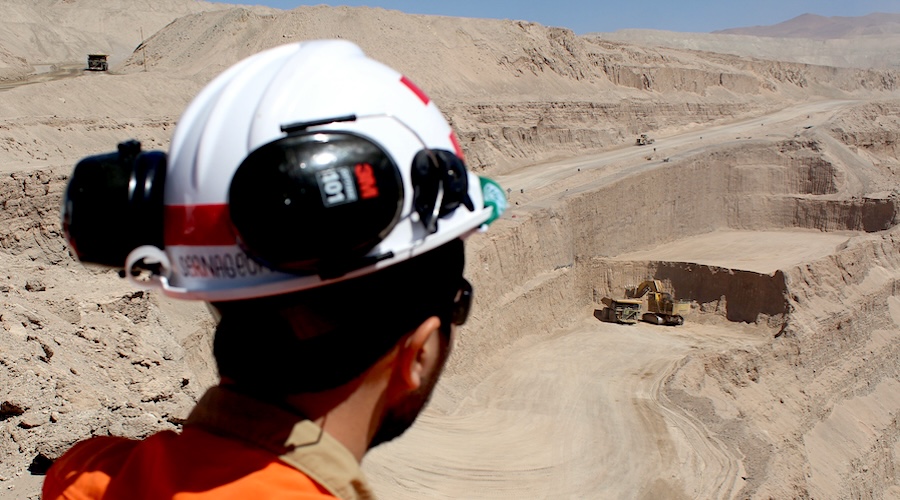
Chilean state miner Codelco is close to signing an agreement with local miner Pucobre on the Tovaku copper project in northern Chile, Chairman Bernardo Fontaine said in a television interview on Sunday, as the company’s new leadership plans to rely more heavily on private-sector partnerships to drive growth.
Fontaine said alliances with private companies were essential for Codelco’s expansion because they bring capital, technology and shared risk, as one of the world’s largest copper producers tries to improve performance while limiting additional borrowing.
“We are close to signing another agreement with local miner Pucobre on a project called Tovaku,” Fontaine said in an interview with Canal 13’s Mesa Central.
The Pucobre deal would pave the way for a joint venture for Tovaku, an oxide copper project in Chile’s Antofagasta region that is under environmental review. Codelco and Pucobre first signed an exploration agreement for the property in 2009.
Pucobre holds an option to acquire 60% of the mining rights that make up Tovaku, with Codelco retaining 40% if the project advances and required investment, technical and environmental conditions are met.
Tovaku carries an estimated investment of $870 million and is expected to produce about 46,000 metric tons of copper cathodes a year. Industry estimates point to startup in 2035.
Fontaine said Codelco’s investment pipeline totals about $34 billion and cannot be financed with the company’s own resources, while additional debt is not the preferred solution. He said the company was also reviewing whether to sell some stakes it holds in private companies and reinvest the proceeds directly into Codelco, with that analysis expected by November.
He added that Codelco’s current production trend makes it difficult to achieve its 2026 target of 1.34 million metric tons, though he said the target had not been abandoned.
(Reporting by Kylie Madry, Editing by Iñigo Alexander)

No comments:
Post a Comment