Showing posts sorted by date for query GMO. Sort by relevance Show all posts

Wednesday, June 03, 2026

It’s Time for a Progressive Policy to Protect Agricultural Supply Chains

Price floors and supply management programs seem common sense to policymakers when it comes to oil and minerals, but what about US farmers and our overall food system?


Glenn Morris, 83, harvests corn on October 11, 2021 in Princeton, Indiana.
(Photo by Scott Olson/Getty Images)
Laurel Levin
Jun 03, 2026
Common Dreams

The race to obtain critical minerals and the war in Iran have not only exposed a dangerous dependence on fossil fuels and mining, but they have also uncovered something more surprising—Republicans in Congress actually understand progressive agriculture policy. They just don’t want to admit it.

In February, Vice President JD Vance announced at the State Department that the administration must institute a price floor to protect the US critical mineral market. “This morning, the Trump administration is proposing a concrete mechanism to return the global critical minerals market to a healthier, more competitive state: a preferential trade zone for critical minerals protected from external disruptions through enforceable price floors,” Vance explained. Meanwhile, the US—and other countries around the world—are deploying oil reserves to buffer price shocks caused by the Israel-US attacks on Iran. Price floors and supply management programs seem common sense to these policymakers when it comes to oil and minerals, but what about US farmers and our overall food system?

Like oil and critical minerals, food and agriculture supply chains, such as corn, soy, and dairy, are vulnerable to global shocks, including extreme weather events, wars, and other supply disruptions. The public also needs to understand that without inflation-adjusted price floors, agricultural commodity prices may sink to disastrously low levels, leaving farmers no choice but to increase production with more chemicals and GMO seeds at the expense of our land and water. Congress and the US Department of Agriculture can avoid low prices by creating reserves accumulated during large harvests and, just like the federal petroleum reserve, bringing them back on the market to stabilize prices in times of shortage. We can all agree that food shortages would be disastrous, so guaranteeing its citizens food security should be imperative for any democratic government.

So while Republicans can recognize the importance of price floors and supply management during this administration, Democrats should look at history to understand how the same instruments were developed for agriculture during the Great Depression under the Democratic Party’s New Deal. The twin crises of farm bankruptcies and the Dust Bowl spurred militant farm organizations to demand a response from the federal government. The response was parity farm bills that stopped farm bankruptcies and stabilized the farm economy so that conservation measures and preservation of diversified farming could lead to food security and a balanced economy. Federal leadership in the White House and Congress recognized that price and supply management benefited both farmers and society as a whole. The policy was simple and transparent: The farm bill would ensure that during years of good harvests, public grain reserves would purchase the surplus at the parity rate (price floor adjusted for inflation) and store it to protect consumers in future times of shortage.

A productive agricultural economy that conserves our resources, challenges agricultural consolidation, and offers economic opportunity in rural communities should be a top priority for all our citizens.

However, both parties abandoned this common-sense approach to farm policy in the early 1950s, so that costs of farming have totally outpaced commodity prices. Subsequently, headlines warning of a farm crisis in 2026, like during the Great Depression and the 1980s, are not uncommon. The prices paid to farmers for commodities such as corn, soybeans, wheat, and dairy have dropped to record lows in real dollars. Over the years, this imbalance has led to the loss of family farms, the consolidation of agribusiness and food processing monopolies, along with their profits benefiting handsomely. Stabilizing the ratio of farm prices to farm costs (the correct goal of any Farm Bill) is the key to a sustainable agriculture that avoids soil loss, water pollution, and the decline of rural communities.

A supply management program would not only help revive family operations and rural economies but would also be essential to combat the expansion of confined animal feeding operations (CAFOs) and lower costs for taxpayers. As reported by Food & Water Watch, CAFOs are a disaster for our climate, air, and water, especially for nearby communities. CAFOs are among the most egregious features of today’s low-price, commodity-based industrial agriculture. Thousands of livestock (owned or vertically integrated with large food processors) are confined in small facilities without fresh air or sunlight and fed cheap corn and soy.

CAFOs have been replacing conscientious family farmers who are stewards of the soil and their animals. When family farmers are forced out of livestock production, they face the dilemma of “get big or get out” and often have no farming alternatives other than to tear up their pastures to grow corn and soybeans that will end up feeding animals in CAFOs.

The Trump administration is applying often-forgotten policy instruments to sustain our fossil fuel dependence and our high-tech future, rather than prioritizing a resilient, sustainable economy. Managing a price floor and creating federal food reserves in the agriculture sector are necessary to combat the adverse effects of food processor monopolization, farm consolidation, soil and water degradation, and external shocks, such as wars.

A productive agricultural economy that conserves our resources, challenges agricultural consolidation, and offers economic opportunity in rural communities should be a top priority for all our citizens. “We love farmers” and “We put America’s farmers first” are just political slogans to get votes with no substance behind them. These slogans lead to the usual sleight of hand to send taxpayer dollars to get some farmers through the next planting season. This policy leaves the disastrous cheap commodity regime in place—encouraging CAFO production and exporting commodities at a loss.

The administration’s discovery of the logical policy of price floors and reserves for oil and minerals must open new doors to applying these logical and transparent mechanisms to agriculture to restore the security of family farmers and conservation of our precious resources—after all, we can’t eat petroleum or precious minerals.

Our work is licensed under Creative Commons (CC BY-NC-ND 3.0). Feel free to republish and share widely.


George Naylor
George Naylor has been farming his family farm in west central Iowa for 50 years, the last 14 years as organic. He is a board member of Family Farm Defenders and Center for Food Safety, and past president of National Family Farm Coalition.
Full Bio >

Patti Naylor
Patti Naylor is an organic farmer in Iowa and president of Family Farm Defenders. She also participates as civil society in processes of the United Nations Committee on World Food Security.
Full Bio >

Laurel Levin
Laurel Levin is a research assistant with the Race, Climate, & Agrarian Justice Lab at American University and a junior fellow at Climate & Community Institute. In her work, she bridges her decade-long experience in the climate justice movement with her current work to help advance just food and farm policy.
Full Bio >

Billionaires Have Two Parties. Why Do the People of America’s Great Plains Have Only One?


Abandoned by the party they once considered their own, many Democrats across vast areas of the nation’s heartland turned to the Republicans to vent their anger at a system that was screwing them.


“Working-class voters and family farmers sensed that the party’s priorities were changing long before Chuck Schumer said the quiet part out loud,” writes Leopold.
(Photo by Shelley Pauls on Unsplash)

Les Leopold
Jun 03, 2026
Common Dreams

Not so long ago the Democrats wielded significant power in the Great Plains states. In 1990, 10 of the 18 Senators from Oklahoma, Kansas, Nebraska, Missouri, Iowa, South Dakota, North Dakota, Montana, and Idaho were Democrats. Today, none are.

In much of this area, the Democrats are no longer functioning as a competitive second party. They lose by 25 percent or more in 21 of the 30 congressional districts in these states. By my rough count, the Democrats did not even run candidates in about 40 percent of the region’s 1,400 state legislative races. Clearly, something has gone profoundly wrong.

What happened?

During the Reagan era (from his election in 1980 and up through the early 1990s) Great Plains Democrats resurrected the populist traditions of the late 19th-century People’s Party, the progressives of the early 20th century, and the Nonpartisan league a few years later. The core ideology of this tradition focused on protecting family farmers and workers from the rapaciousness of big corporations and banks. The political opponents of the Reagan Revolution followed in their path and enough of them were in Congress in 1983 to form the Congressional Populist Caucus.

“It is political malpractice to abdicate so much of America’s heartland.”

These 14 congresspersons adopted the populist moniker and fought against corporatized free trade deals, the high Federal Reserve interest rates, plant closings, anti-union legislation, and farm foreclosures. And they did so in alliance with, and in support of, dozens of community groups including abortion and gay rights organizations.

But in 1990, a powerful segment of the Democratic establishment created the centrist Democratic Leadership Council and made a firm decision to embrace corporations, agribusiness, free trade, and Wall Street deregulation, while moving away from labor unions and family farmers. In the 1992 presidential primaries, Bill Clinton was the Democratic Leadership Council’s representative, while Senator Tom Harkin of Iowa represented the progressive populists. As we know, Clinton won.

In When the Democrats Lost the Heartland Corey Haala shows that this turn to neoliberalism was not the inevitable result of technological advances, nor was it predetermined by the iron laws of capitalism. Rather, it was a victory by one interest group within the Democratic Party over another, and the consequences were felt immediately.

After the centrists won, they starved the Great Plains Democrats of funds and legislative victories, leaving them with little to offer their constituents—the populist-oriented farmers and workers struggling to survive against corporate power.

Working-class voters and family farmers sensed that the party’s priorities were changing long before Chuck Schumer said the quiet part out loud:

“For every blue-collar Democrat we lose in western Pennsylvania, we will pick up two moderate Republicans in the suburbs of Philadelphia, and you can repeat that in Ohio and Illinois and Wisconsin.”

The same logic could easily have been applied to the Great Plains.

Abandoned by the party they once considered their own, many Democrats turned to the Republicans to vent their anger at a system that was screwing them.

Rebuild the old or build something new?

Despite this fundamental ideological shift, it’s hard for progressives to move away from the Democratic Party, especially given the rise of MAGA. Don’t we have to do everything we can to support Democratic candidates in order to win back Congress and stop the fascist takeover of America?

Of course, defeating the MAGA Republicans is crucial. And the fortunes of the Democrats are a real concern in blue and marginal districts where new seats can be won and old seats can be held. Third-party candidates in those competitive districts would only serve as spoilers likely to help elect MAGA Republicans.

But that’s not the case in the ruby red states in which the Democrats have given up on 40 percent of the local races, and where they lose congressional seats by 25 percent or more.

In these areas there is nothing to spoil.

It is political malpractice to abdicate so much of America’s heartland. One strategy is for progressives to recapture the Democratic Party in the Great Plains and elsewhere, infuse it with new energy, change its neoliberal brand, and run new working-class candidates across the board.

But a new survey by the Center for Working Class Politics shows that many of those who have given up on Trump show little interest in voting for Democrats. And a recent New York Times/Siena survey reports 43 percent of registered voters nationally are dissatisfied with both parties. That’s a hell of a headwind to overcome, given how tarnished the Democratic Party brand has become.

Something new that isn’t blue?

Dan Osborn’s race for the US Senate in Nebraska points in another direction. This former local labor leader is running against both parties, what he calls “the two-party doom loop,” in an unabashed progressive populist campaign—the Nebraska Fairness Plan. As he says “It’s not a party’s platform or written by consultants. It’s written for the people who punch a clock and wonder why nobody in Washington is fighting for them.”

Osborn is appealing to independents, disaffected Democrats, and even disgruntled Republicans. So far, the race is a toss-up in a state where Republicans outnumber Democrats by nearly two to one. The Democratic nominee, Cindy Burbank, has said she will avoid playing the spoiler by dropping out before ballots are printed if she doesn’t see a path to victory.

Osborn’s effort (and the polling we report on in The Billionaires Have Two Parties, We Need a Party of Our Own) strongly suggests that the best path forward in the Great Plains districts largely abanoned by the Democrats is to create a new organization by and for working people to run independent candidates.

That requires a break from the Democrats. Osborn says he will not caucus with either major party, and attacks both billionaire parties that have left so many working people high and dry. Independent working-class candidates will need to take strong progressive populist positions that protect jobs, create new ones, and save what’s left of family farming—positions with strong support across the Great Plains.

Working people can build independent political power even in places where the Democratic Party has ceased to function as a competitive second party.

And progressive political activists will need to get comfortable with turning neoliberalism on its head—putting people instead of capital in the center of our economy. That means promoting real job creation, not public-private partnerships that enrich corporations and rarely produce new jobs.

We will need to promote strong policies like “the right to a job at a living wage, provided by the public sector if the private sector fails to do so.”

As radical as this policy seems, polling shows again and again that it is very popular. People want stable, secure jobs even if the government has to step in to provide them.

Rebuilding progressive populism in the Great Plains requires the kind of boldness that challenged corporate power from the 1880s onward. Those populists were able to grow their appeal nationally, and their efforts led to progressive reforms like the graduated income tax, anti-monopoly moves against the robber barons, the formation of public universities and colleges, and even a public bank in North Dakota, among other successes.

We must escape the corporatist framework that governs today’s Democratic Party, which appeals to wealthy donors, admires the billionaire class, and has given up on the working class it considers socially backward.

Can it be done? Not quickly. Not easily. But the Great Plains once produced some of the most powerful populist movements in American history that challenged concentrated wealth, built durable institutions, and won reforms that reshaped the country. We won’t know what is possible until we try again.

We need to leave our blue bubbles, talk face-to-face with alienated working people, and rebuild an independent politics rooted in work, community, and economic security.

And really, where better to spread populism than in America’s heartland, “where the wind comes sweeping down the plain.”

If we dare to act boldly, perhaps we can once again become the wind.

*****

The questions raised in this essay are explored in much greater depth in my new book, The Billionaires Have Two Parties, We Need One of Our Own: How Working People Can Build Independent Political Power.

The book examines why so many working people have abandoned the Democratic Party, why independents are now the largest political bloc in many states, what voters in the heartland actually want from politics, and whether a new working-class political organization can be built without acting as a spoiler.

Drawing on new polling and historical research, it argues that working people can build independent political power even in places where the Democratic Party has ceased to function as a competitive second party.

If these arguments resonate with you, I hope you’ll take a look at the book.

All book proceeds support our Reversing Runaway Inequality educational programs for working people.


Our work is licensed under Creative Commons (CC BY-NC-ND 3.0). Feel free to republish and share widely.


Les Leopold


Les Leopold is the executive director of the Labor Institute and author of the new book, “The Billionaires Have Two Parties, We Need a Party of Our Own” (2026). His previous books include: “Wall Street’s War on Workers: How Mass Layoffs and Greed Are Destroying the Working Class and What to Do About It" (2024); "Runaway Inequality: An Activist's Guide to Economic Justice" (2015); and “The Man Who Hated Work and Loved Labor: The Life and Times of Tony Mazzocchi” (2007). Read more of his work on his substack here.
Full Bio >

Friday, May 22, 2026

Greenpeace Raises Alarm After Microplastics Found in Top Companies’ Baby Food Pouches

“Plastic pollution is not just wrecking our environment, it’s entering our bodies, starting from infancy,” said one campaigner. “How our food is packaged is designed for profit, not for people’s health.”


Research commissioned by Greenpeace International has found microplastics in baby food sold in plastic pouches by two of the world’s largest food companies, Nestlé and Danone.
(Photo by Greenpeace)

Jessica Corbett
May 21, 2026
COMMON DREAMS

Parents often reach for squeeze pouches of baby food to feed little ones on the go or because they aren’t likely to break if dropped from a high chair, but research commissioned by Greenpeace International and released Thursday raises concerns about how the convenient packaging is exposing children to microplastics and plastic-associated chemicals, with potential health risks.

“In supermarkets worldwide, shelves are now lined with these soft plastic squeeze pouches of pureed baby food, promoted with safety and environmental claims such as ‘BPA-free,’ ‘non-GMO,’ ‘pesticide-free’ and ‘organic,’” notes the group’s new report, “Tiny Plastics, Big Problem: The Hidden Risks of Plastic Pouches for Baby Food.”

“In the US alone, it has been reported that sales of baby food pouches skyrocketed by approximately 900% between 2010 and 2023, becoming a dominant format for baby nutrition,” the report continues. Given the rising popularity of pouches, Greenpeace had SINTEF Ocean conduct laboratory testing of Danone’s Happy Baby Organics and Nestlé's Gerber pureed baby food.

The researchers found up to 54 microplastic particles in Gerber yogurt pouches and up to 99 particles in Happy Baby Organics fruit pouches, on average—or as many as 270 microplastics per teaspoon in the former and 495 in the latter. They estimated that a full pouch of Gerber contains more than 5,000 particles, while Happy Baby has over 11,000 particles.

“Spectral analysis identified polypropylene (PP) and polyamide (PA), as well as tentatively identifying polyethylene (PE),” the report explains. “Particles tentatively identified as PE microplastic were the most abundant, occurring at similar levels in both products. This suggests that abrasion or degradation of the inner PE lining in contact with the food may contribute to the microplastic content in the food.”

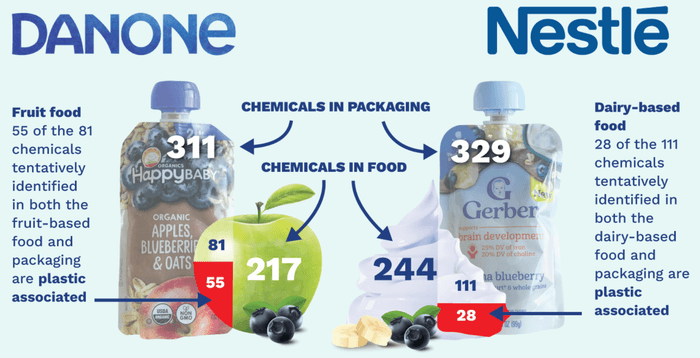
The experts also examined chemicals in the pouched food, and “tentatively identified 81 chemicals in the Danone fruit puree and 111 in the Nestlé dairy-based puree, which were also detected in the respective packaging materials,” according to the report.

“Cross-referencing with the PlastChem database, an inventory of chemicals known to be used in or found in plastics, revealed that 55 of the substances found in the fruit sample and 28 in the dairy sample were identified as plastic-associated chemicals,” the publication notes. “One chemical found in both the packaging and the yogurt was tentatively identified as 2,4-di-tert-butylphenol (2,4-DTBP), a chemical of concern. It is recognized as hazardous to human health and the environment, has been associated with endocrine-disrupting effects, and could also act as an obesogen.”


(Image by Greenpeace International/"Tiny Plastics, Big Problem: The Hidden Risks of Plastic Pouches for Baby Food")

“Our findings are not occurring in isolation,” the report emphasizes, citing other research on baby food pouches, infant bottles, and other plastic packaging, including breast milk storage bags. “Wherever we look with the right tools, we find the fingerprints of plastics permeating baby foods.”

The document also acknowledges that “besides the potential health risks of microplastics and plastic chemicals on babies, concerns have been raised by public health nutritionists about the growing market for spout pouches and their nutritional impact on babies and toddlers, specifically the high levels of sugars and low mineral and vitamin content in many products.”

“Overreliance on spout pouches is starting to be associated with growing levels of dental decay and obesity amongst young children,” the report adds, pointing to warnings from the World Health Organization and the United Kingdom’s National Health Service that “babies can eat too fast when they suck directly from the pouch.”

Considering the findings, “delaying action is not just ill-advised, it’s unethical,” Greenpeace argued. “Governments must work nationally and globally to secure a strong global plastics treaty that dramatically reduces global plastic production, eliminates hazardous plastics and associated chemicals, and drives a justice-centered, at-scale transition to reuse-based systems.”

Several rounds of negotiations on crafting a United Nations treaty to combat plastic pollution have been largely fruitless. In March, the chair of the talks, Chilean diplomat Julio Cordano, released a roadmap to renew the global push for a deal. Following that release, another round of talks is expected later this year or next year.


The Greenpeace report doesn’t just put pressure on governments. It also says that “all companies that rely on plastic packaging must reconsider their business model, prioritizing baby food, baby products, and food contact packaging. Nontoxic, plastic-free, zero-waste, reuse-centered product delivery systems and packaging alternatives already exist in communities around the world.”

“Nestlé and Danone, and other major consumer goods companies and supermarket chains must take responsibility by swapping flexible packaging for healthier alternatives and supporting policies that accelerate reuse system expansion,” it stresses.

Graham Forbes, Greenpeace USA’s global plastics campaign lead, declared that “this study is a wake-up call for parents everywhere, who trust these brands to put their kids first. Plastic-dependent companies like Nestlé and Danone owe families a clear answer: What are they doing to eliminate microplastics and chemicals from the products they sell to babies?”

“Plastic pollution is not just wrecking our environment, it’s entering our bodies, starting from infancy,” Forbes added. “How our food is packaged is designed for profit, not for people’s health. Cutting plastic production and eliminating harmful chemicals is essential to protect human health, especially the health of our children.”

Wednesday, April 08, 2026


GMO pictures may reinforce existing views, deepening the divide


A new paper in JCOM shows that images of GMOs tend to reinforce pre-existing attitudes, amplifying polarization rather than changing minds


Sissa Medialab

Coactive image 

image: 

An example of "coactive" image used in the experiements

view more 

Credit: Bailey et al, JCOM, 2026


Images have long played a powerful role in shaping public perceptions of genetically modified organisms (GMOs), often reinforcing emotional reactions more than scientific understanding. A new experimental study published in the Journal of Science Communication (JCOM) explores how different types of images can influence people’s attitudes toward GMOs — and suggests that pictures may reinforce existing views, further polarizing them.

Powerful tools

Images are powerful tools, especially when it comes to food: they can push consumers toward one choice and steer them away from another. 
Already at the beginning of this millennium, the “war” against GMOs relied heavily on images to convey negative messages — and scientifically misleading information, if not outright falsehoods — about foods produced using this technology. You may be familiar with the term “frankenfood”, popularised in a number of communication campaigns that paired images of food with those of the famous “creature” invented by Mary Shelley. Greenpeace’s campaigns are among the most famous examples, but they are far from unique: many other actors have used — and continue to use — this type of communication strategy.

Rachel Bailey is a researcher at the School of Communication at Florida State University who studies how images in the media can automatically influence people’s choices and opinions, drawing on approaches from evolutionary psychology. “I study how the media can naturally encourage people to do different sorts of things in automatic ways based on our own biological imperatives. And images tend to be quite helpful in that,” Bailey explains. 

Bailey and colleagues (Jay Hmielowski, Myiah Hutchens, Pooja Ichplani, Jessica Sparks and Sun Young Park) have just published an experimental study in JCOM investigating how images may influence public attitudes toward GMOs. 

Through the platform YouGov, the team recruited nearly a thousand participants, forming a sample representative of the U.S. population. Participants in the experiment read a short neutral description of GMOs accompanied by one of three possible conditions: no image, an image of an apple, or an image of an apple being injected with a substance using a syringe — intended to evoke the idea of “unnaturalness”.

Before the experiment, participants were classified according to their initial attitude toward GMOs (positive, negative, or uncertain). After viewing the text and images, they were asked to answer a series of questions measuring their attitudes toward GMOs, their willingness to try them, and the positive and negative components of their evaluation — from which the researchers calculated their level of “ambivalence” toward GMOs.

Deepening the divide
Contrary to what one might expect, in Bailey’s experiment the “positive” image — the apple alone — had a small effect on avoidance intentions among those who already supported GMOs.

The stimuli defined by the researchers as coactive (the apple with the hypodermic syringe, combining both a positive element — the apple — and a negative one — the syringe suggesting artificiality) produced an interesting result: “Compared to the no-image condition, the coactive image made people who were already supportive toward GMOs even less negative,” Bailey explains.

What emerges is a kind of opinion-extremizing effect: the images tended to reinforce attitudes that were already present. “The positive cue can make positive people more positive, but in exploratory analyses, the coactive cue did make the skeptics and the uncertain folks even less positive  towards GMOs,” Bailey comments.

Bailey’s study confirms that images can have important effects on people’s opinions — particularly when food is involved — but in ways that are not always easy to predict, highlighting the importance of careful research. “I think images are still one of the best ways that we can change people’s opinions or at least lead them to be more open to a change of opinion in a persuasive context,” she says. “In this case, people have very strong attitudes. Those who had really strong attitudes towards GMOs were pretty stuck in those ideas. And that makes sense. So just an image, one cue over a very short period of time, didn’t change much for them.”
 

Tuesday, March 24, 2026

The MAHA Deception: What RFK Jr., Trump, and Company Are Really Doing to Our Food

People’s understandable distrust and discontent are being manipulated in service of a villainous power grab by some of the very same players that MAHA performs opposition to.


Health and Human Services Secretary Robert F. Kennedy Jr. eats a mint chocolate chip ice cream cone during a press conference on the steps of the United States Department of Agriculture on July 14, 2025 in Washington, DC.
(Photo by Michael M. Santiago/Getty Images)


Andrea Brower
Mar 23, 2026
Common Dreams

Robert F. Kennedy Jr., Kid Rock, and Mike Tyson are on the stage of American slopaganda telling us that “for the first time in our nation’s history, the federal government put REAL FOOD at the center of the American diet.” “Something” is finally being done about ultra-processed foods, harmful additives, environmental toxins, and corporate capture of the regulatory system to “Make America Healthy Again.”

I’ve spent much of my life in food justice movements that are fighting to address these very same problems. I’ve taught and written about the toxicity and corporate control of the food system (and was actually featured in a documentary alongside RFK Jr., who strangely had no connection with the grassroots Hawai’i movement that the film was about). Of all the vile corporations and politicians I’ve studied and gone head-to-head with, the forces congealing at the top of MAHA are far and away the most spectacular threat I’ve ever seen to a healthier food system (and just about everything else).


‘One Year of Failure’: The Lancet Warns RFK Jr.’s Assault on Science May ‘Take Generations to Repair’


Alongside shirtless RFK workouts, the MAHA performance opened with purported “wins” around synthetic dyes and whole foods. In reality, RFK did not ban artificial food dyes, but asked large companies to “voluntarily phase them out” (food companies have a long history of doing absolutely nothing “voluntarily”). And in reality, though whole foods are emphasized in new dietary guidelines, federal programs like school meals are having their budgets for whole foods sliced out.

Far more significantly, these exaggerated, largely symbolic gestures are masking a whole slew of far-reaching poisonous actions that are of grave danger to our health, and radically bolster the power of Big Ag, Big Chem, and all Big Capitalists (yes, including Big Pharma). It’s not just that rhetoric and actions don’t match. It’s that people’s understandable distrust and discontent are being manipulated in service of a villainous power grab by some of the very same players that MAHA performs opposition to.

The evil genius of MAHA elites has been the appropriation of elements of progressive movements that have struggled for decades to illuminate corporate control of the food system and forge a healthier and fairer food system for all. We cannot give our wicked Doppelgänger this win.

Part of the MAHA song and dance is to hyper-emphasize individual choice and responsibility for health, often in intensely patronizing, shaming, and classist ways. Telling people they can avoid chemicals and disease all via individual choices has provided a profitable opportunity for MAHA influencers to peddle their products.

But it’s a cruel illusion that consumers can avoid toxins they don’t even know are in their food (much less invisible in the wider environment), eat food that isn’t available, spend dollars they don’t have, and avoid corporate monopolies that are entirely ubiquitous in the food system. Of course individuals have some amount of agency, but the rules of the system are stacked. And it’s the very people that the rules are stacked in favor of who are working hardest to distract us from seeing those rules.

Here are just some of the food system “rules” that the Trump-MAHA-RFK regime is solidifying as they smoke and mirror us with illusions of “choice”:

One of the primary, open goals of this regime is to destroy regulation

Extreme deregulation of the past decades is the reason we have massive corporate consolidation in the food system; the reason over half of American farmland is blanketed in ecologically destructive herbicide-GMO monocrops; the reason overproduction of these crops forms the basis of our highly-processed food system; the reason children are being manipulated via advertising to get hooked early on foods that sentence them to a life of chronic disease; the reason food is packed full of unpronounceable toxic additives; the reason a concentrated grocery sector has left sweeping food deserts across the country; the reason hunger rates are so high in spite of there being an abundance of food; and the reason workers all along the food chain are living on poverty wages while they labor in horrifically dangerous conditions. 

The MAHA-Trump-RFK regime is bringing us to a new apex in a deregulated food system. The regime has already reduced oversight of factory farms, increased factory farm slaughter speeds (175 chickens per minute), demolished food safety regulations, removed pesticide use reporting, gutted the agencies and workforce tasked with regulating Big Ag, and all while slanting an already monopolized market further toward Big Ag via subsidies (and forms of government intervention that big business does like).

Farm bill policy and subsidies largely dictate what gets grown in the United States and what ends up on our plates. MAHA rhetoric pushes individual responsibility for “healthy,” “wholesome,” and “fresh” eating, while the Trump-MAHA regime is making those very choices impossible for people by systematically deepening an ultra-processed food system. One of President Donald Trump’s first actions in 2025 was to terminate $1 billion in funding for programs that helped schools and food banks buy fresh, local food from farmers, while increasing subsidies by many billions to the largest 5% of mega corn and soy monocrops. It’s not about the farmers getting rich—these subsidies directly bolster the profits of corporate agribusiness, such as food manufacturers who buy commodity crops far below production cost to make the ultra-processed foods we are instructed not to eat in the new Dietary Guidelines.

These subsidies also go straight to the pockets of factory farms in the form of extraordinarily underpriced herbicide-resistant (GMO) corn and soy animal feed. MAHA influencers champion grass-fed, pasture-raised beef and dairy, but the Trump/MAHA regime has eliminated billions in funding for programs that supported regenerative grazing and fired more than a thousand Natural Resources Conservation Service staff that helped farmers transition to regenerative agriculture. An estimated 99% of animals used for food in the United States are raised on factory farms that are driving antibiotic-resistant infections, zoonotic diseases, foodborne illness, and massive water and air pollution (which together kill hundreds of thousands of people annually).

As the Trump-MAHA regime pours lavish sums of public money into the bloated coffers of private agribusiness, it has made the biggest cuts in history to food assistance for poor people. Already, 20% of children in the United States were experiencing food insecurity amid skyrocketing food prices. Over the next decade 22.3 million families will loose support they rely upon to eat, credit of the Make American Healthy Again regime.
MAHA’s rhetoric around dismantling the corporate stranglehold on government likely carries its greatest mass appeal; it is also the most significant inversion to reality. The regime has radically increased the power of big money over politics, and corporations are spending at historic, record-breaking levels to grab all that they can. Today’s most influential and highest-earning lobbying firm, Ballard Partners, transferred directly from the Trump campaign and is now representing the American Chemistry Council, Bayer-Monsanto, and multiple Big Ag (and Big Pharma) companies.

The policy-change prizes being handed out to the highest corporate bidders in the food system are even more extreme than classic deregulation and corporate welfare subsidies. The draft new Farm Bill would actually shield pesticide companies Monsanto-Bayer, DuPont-Dow, Syngenta, and BASF from liability for deadly health impacts of their products that they have knowingly covered up for decades.

Trump is also gifting special legal impunity to Bayer-Monsanto, makers of glyphosate (Roundup), as it faces over 177,000 lawsuits alleging that glyphosate causes cancer. Under the RFK-endorsed Trump+Monsanto executive order, domestic production of glyphosate will also ramp up, meaning more glyphosate in our food, water, soil, air, and bodies, especially those of farmworkers.

While glyphosate has received the most surprise from MAHA moms, it is far from the only dangerous pesticide being shoved down the public’s wary throats. The regime has green-lit new PFAS pesticides, “forever chemicals” that never break down in the environment and are linked to thyroid tumors, liver damage, and reproductive harm. They have also gone around the courts and reapproved the twice-banned pesticide dicamba, linked to pancreatic and colon cancers. Dicamba (also made primarily by Bayer-Monsanto) can vaporize and move through the air for several days after application and is causing unprecedented damage to small farms and communities surrounding genetically engineered dicamba-resistant soy and cotton monocultures.

Meanwhile, the new Farm Bill is attempting to eradicate state and local laws that currently protect people from pesticides, and preempt new ones from being passed. In sum, the Trump-MAHA regime is approving new forever pesticides, increasing pesticide production, wiping away laws that protect people from pesticides, and then blocking people’s ability to sue over the harms. It’s hard to see this as anything but rule by and for Monsanto-Bayer and friends.

Poisons will also increase at other levels of the food chain. The MAHA regime is rolling back the Toxic Substances Control Act, shifting toward “chemical industry science,” reduced transparency, and severely weakened risk evaluations. They are going to court to defend the continued use of phthalates, extremely toxic “everywhere chemicals” added to things like food packaging that have been found in nearly all tested food and are known to cause reproductive issues, genital abnormalities, neurodevelopmental disorders, respiratory issues, diabetes, and heart disease. Across the board, the regime is gutting the already insufficient laws we had for regulating poisons.

In order to push forward with this poisons-everywhere agenda, the Trump-MAHA regime is disassembling the science that has been revealing the links between chemicals and human health, slashing research funding, and sabotaging knowledge production (and thus the regulation that follows scientific discovery) on everything from microplastics to PFAS to the synergistic effects of pesticides. Federal workers who investigated toxic substances and pollutants have also been fired en masse. Toxic corporate totalitarianism relies on the destruction of truth (including the manipulation and weaponization of science, with haunting parallels to other authoritarian regimes).

One type of “regulation” that a fascist-aspiring oligarchical regime actually relies upon is the type that distracts from the criminals at the top by demonizing and policing the people at the bottom. The people growing our food, who already faced intense exploitation and marginalization, are being especially scapegoated—abducted, detained, deported, separated from their families, “hunted like animals.”

The list could go on. And the full picture on the MAHA regime and health is even more sickening—unprecedented cuts to healthcare; massive increases in air, water, mercury, and PFAS pollution; dismantled gun violence prevention laws (guns are the leading cause of death for children and teens in the US); billions in handouts to big pharma; destroyed public health institutions; hastened apocalyptic climate breakdown… The aims and repercussions of the MAHA deception extend far beyond any particular policy or issue—it is a project that ultimately serves authoritarian oligarchical rule.

There’s a tendency among some progressives and leftists to simply dismiss anything that touches the MAHA matrix as innately conspiratorial, unscientific, and reactionary—at times even inadvertently positioning themselves on the side of Big Ag so as to seem in opposition to MAHA and Trump (an all around win-win for Big Ag). While the power at the top of MAHA is deeply reactionary and using conspiracy to pull ordinary people further right, the evil genius of MAHA elites has been the appropriation of elements of progressive movements that have struggled for decades to illuminate corporate control of the food system and forge a healthier and fairer food system for all. We cannot give our wicked Doppelgänger this win. Instead of abandoning everything RFK Jr. touches, we need to spin it back at them with the missing elements of truth and justice.

Truth: We have a food system designed around maximization of profit at every level, intensified by decades of bipartisan policy that has unleashed corporate power to the severe detriment of health, safety, workers, local economies, the Earth, the 99.9%. The biggest conspiracy is plain before our eyes: a system doing exactly what it is supposed to do, capitalism (which yes, the overlords of do all sorts of perverse things to preserve and extend). Justice demands getting to the roots of that system and challenging the 0.1% who are benefiting from it—many of whom happen to be puppet-mastering MAHA.


Our work is licensed under Creative Commons (CC BY-NC-ND 3.0). Feel free to republish and share widely.


Andrea Brower
Andrea Brower is an activist and scholar from Kaua‘i. She is an assistant professor in the Solidarity & Social Justice Program with Gonzaga University's Department of Sociology. Her research, writing, and teaching on capitalism, colonialism, the environment, food, and agriculture is embedded in social movements for justice, equality, liberation, and ecological regeneration.
Full Bio >


Monday, March 16, 2026

A Poisoned Politics Poisons People: 

All Three Branches Move to Shield

Bayer/Monsanto from Liability Amid One of

the Largest Cancer Litigations in American

History


Executive Order Secures Glyphosate Supply, EPA Regulatory Decisions Shape the Legal Defense, DOJ Supports Bayer, the Supreme Court Takes the Case, & House Farm Bill Advances Chemical Liability Shield


Healthy soil, water, and ecosystems are the foundation of human life. The health of creation gives rise to the health of life.

Powerful outside interests are using America’s treasury and public policy to advance profit-driven agendas while the health, land, and future of the American people bear the cost.

The same public purse that finances war abroad is now underwriting policies that poison the land at home.

Political energy that should be confronting this system is instead being redirected into advertising, messaging, and branding, while the real decisions are made through law, regulation, and votes.

While the long planned objectives of a foreign country drew America’s Department of War, the Department of State and the U.S. taxpayer’s purse into an expanding conflict across the Middle East, a foreign corporation, Bayer/Monsanto suddenly blasted onto the policy scene.

In the span of three weeks, the Executive Branch, the Judicial Branch, and the Legislative Branch each took major actions to shield the German corporation, Bayer/Monsanto, from liability as it stands at the center of one of the largest mass injury litigations in American history.

First, President Donald Trump issued an executive order invoking the Defense Production Act to secure the domestic supply of glyphosate-based herbicides and elemental phosphorus, a key industrial input used in the manufacture of agrochemicals and certain weapons systems. Bayer is currently the only domestic producer of elemental phosphorus in the United States.

Second, the Department of Justice filed an amicus brief in the United States Supreme Court supporting Bayer in Monsanto Company v. Durnell, a case addressing whether federal pesticide law preempts state law, placing at risk claims brought by citizens harmed by glyphosate-based herbicides.

Bayer traces its corporate lineage to IG Farben, the German chemical conglomerate that built facilities at Auschwitz and conducted pharmaceutical experiments on concentration camp prisoners. After the Nuremberg trials, IG Farben was dismantled and Bayer emerged as one of the companies created from its breakup. In 2018 Bayer acquired Monsanto, producer of the glyphosate herbicide Roundup.

In June 2025, the U.S. Supreme Court asked the Solicitor General to provide the federal government’s view on whether it should hear Monsanto Company v. Durnell. The Justice Department responded by supporting Bayer’s argument that federal pesticide law should preempt state law claims that companies failed to warn citizens about the risks of their products.

In January 2026 the Supreme Court agreed to hear the case. The decision now before the Court could determine whether tens of thousands of cancer victims’ claims against Bayer/Monsanto survive or disappear.

The Supreme Court receives roughly 7,000 to 8,000 petitions each year and typically agrees to hear fewer than one percent of the cases. Four Supreme Court Justices must agree to grant review and place a case on the national docket.

The Roundup litigation had already moved through a lengthy legal process. Juries examined evidence. Appellate courts reviewed the verdicts. Injured citizens were exercising a long recognized right to seek redress through state tort law.

Yet, four Justices chose for the nation’s highest court to take up the question at the very moment when tens of thousands of claims against Bayer remain pending.

If the Court ultimately adopts Bayer’s argument, the ruling could eliminate thousands of existing Roundup cancer lawsuits and close the courthouse doors to hundreds of thousands of potential future claims. Glyphosate is the most widely used herbicide in the United States, meaning the legal precedent would extend far beyond the cases already filed and would shape the rights of Americans exposed to the chemical glyphosate, as well as other toxic chemicals, for decades to come.

Citizens possess the right to bring claims when they believe a company’s product caused them harm. That right is the foundation of American tort law. Juries examine evidence, determine liability, and hold companies accountable when their products cause injury.

Bayer’s legal strategy seeks to replace that system with federal preemption. If the Environmental Protection Agency approved the label, the company argues, injured citizens should lose the right to sue for failure to warn, even when juries find evidence of harm. If that theory prevails, the courthouse doors close not because a jury rejected the evidence, but because federal regulatory approval becomes a legal shield against accountability.

The Court’s decision to hear the case could set the stage for a significant narrowing of citizens’ ability to seek redress through state tort law, raising profound questions about due process under the Fourteenth Amendment. In this respect, the stakes echo the Court’s decision in Citizens United v. Federal Election Commission, which dramatically expanded the political spending rights of corporations under the First Amendment and reshaped the balance of power in American elections.

Third, House Farm Bill negotiations advanced language that would strengthen pesticide preemption and shield chemical manufacturers from certain state-based liability claims.

Executive action, judicial review, and legislative protection have now moved in the same direction, impairing the basic rights of people to recover damages for injuries caused by poisonous chemicals.

Glyphosate sits at the center of one of the largest mass injury litigations in American history. More than 165,000 Americans have filed lawsuits alleging that exposure to Roundup and other glyphosate based herbicides caused their Non-Hodgkin lymphoma.

Bayer agreed in 2020 to a settlement package worth up to $10.9 billion to resolve a large share of existing claims. Tens of thousands of cases remain pending as new litigation continues, leaving Bayer’s potential exposure in the hundreds of billions of dollars.

Previously, injured citizens brought claims. Evidence was examined. Juries reached conclusions. Now, instead of allowing Americans to continue seeking legal recourse for grave harms, the federal government is moving to shield Bayer from liability. The Department of Justice argues that if the Environmental Protection Agency approved the label, injured citizens should lose the right to sue for failure to warn.

The Farm Bill language now under consideration would harden that shield. Rep. Chellie Pingree described the provision plainly, warning that it would protect chemical manufacturers such as Bayer from lawsuits and preempt state and local warning label laws or usage regulations.

The provision would also undercut local authority to act when federal regulators delay or defer to industry pressure. Seven states currently do not preempt local governments from regulating pesticide use. Pingree’s office warned that in Maine alone more than thirty state and local pesticide protections could be undermined by the proposed language.

This matters because states carry constitutional responsibility for protecting the health and welfare of their citizens.

State tort law, consumer protection law, and public health authority form the backbone of that responsibility. When federal law blocks states and municipalities from regulating pesticide exposure or pursuing accountability for harm, local governments lose the tools they rely on to protect their communities.

The American farmer carries the risk while the chemical manufacturer receives the shield.

The consequences extend far beyond agriculture. Physicians, nurses, oncologists, hospitals, public health officials, and health insurers should be at the forefront of this fight. Glyphosate induced Non-Hodgkin lymphoma imposes enormous costs on patients, families, medical systems, and insurers.

When chemical companies are shielded from liability, those costs do not disappear. They shift to hospitals, insurance systems, families, and taxpayers. This is a public health crisis moving through the American food system and across the landscape of the American heartland.

The system that produced this crisis has deep historical roots.

Modern chemical agriculture arose in the context of warfare. The twentieth century chemical industry developed many of its core technologies during periods of global conflict, and after World War II chemical manufacturing capacity and scientific expertise were redirected toward agriculture. The language followed the chemistry.

We declared war on weeds, war on insects, and war on fungi. Fields became battlegrounds. Industrial agriculture relies on chemicals designed to kill. Herbicides kill plants. Insecticides kill insects. Fungicides kill fungi. This is Ecocide.

These compounds eliminate living organisms in the interests of industrial production. Some targets are labeled pests. Many others are casualties of unregulated industrial production. Pollinators, soil organisms, birds, aquatic life, and beneficial insects disappear from landscapes saturated with chemical inputs.

Human beings live inside those same landscapes. Farmworkers, rural communities, and consumers become collateral damage in a system built to deploy lethal chemistry across millions of acres.

Ecocide becomes a pathway to human suffering and disease.

The mentality that accepts ecological destruction in pursuit of control resembles the mentality that accepts civilian casualties as an unavoidable cost of war. Life treated as expendable in one arena rarely remains protected in another.

The American heartland must challenge a permanent war against the living systems that sustain it, and us!

At the same time, the Environmental Protection Agency (EPA) is reshaping pesticide regulation in ways that benefit the chemical industry. The agency has accelerated pesticide approvals, delayed safety reporting requirements for toxic chemicals, and allowed chemicals to remain on the market while safety reviews remain incomplete. Those regulatory decisions now form the scientific basis the Justice Department is asking the Supreme Court to treat as final authority on pesticide safety.

At the very moment those regulatory decisions are being used in court to protect chemical manufacturers, the scientific infrastructure inside the EPA is being weakened. Last year EPA officials began dismantling the agency’s research office that provided much of the scientific foundation for chemical risk assessments. Career scientists warned that removing this office will weaken independent analysis and increase the risk of political interference in decisions about chemical safety.

Congress is moving in the same direction. Separate legislation introduced by Republican lawmakers would weaken the nation’s toxic chemical laws by limiting the scientific evidence regulators can use to determine health risks and by giving industry a larger role in the chemical assessment process under the Toxic Substances Control Act, the federal law that governs chemical safety in the United States.

While these proposals are not part of the Farm Bill itself, they move the regulatory system in the same direction. The scientific guardrails that once helped protect public health are being weakened, and industry influence over chemical safety decisions is expanding.

In short, government policy and law are being rewritten to shield chemical companies while the public bears the risk.

The revolving door between the chemical industry and federal regulators is visible. Four chemical industry lobbyists now sit in the top four posts at the EPA office that regulates chemicals and pesticides. One example is Kyle Kunkler, now a Deputy Assistant Administrator in the EPA’s Office of Chemical Safety and Pollution Prevention, previously worked as a pesticide lobbyist for the American Soybean Association.

Inside the White House, Chief of Staff Susie Wiles previously worked at Mercury Public Affairs, a lobbying firm that later registered to represent Bayer, according to U.S. Right to Know’s reporting on Bayer’s influence network in Trump’s Washington.

Investigations by U.S. Right to Know document the scale of Bayer’s influence campaign in Washington. Their reporting, Tracing Bayer’s Ties to Power in Trump’s Washington, details the company’s network of lobbyists and political influence across Congress and federal agencies.

According to U.S. Right to Know, Bayer spent $9.19 million lobbying Washington in 2025, employing dozens of lobbyists across more than a dozen firms. The Justice Department brief supporting Bayer was signed by Deputy Solicitor General Sarah M. Harris and Assistant to the Solicitor General Aaron Z. Roper, both of whom previously worked at Williams & Connolly, the law firm that defended Monsanto in major pesticide litigation.

Corporate power now operates across the three arenas that shape American law. Legislatures write the law. Regulators determine the science that informs it. Courts decide how that law is interpreted. Bayer and its allies operate in all three arenas.

During the House Agriculture Committee markup of the Farm Bill, Rep. Chellie Pingree (D-ME) introduced an amendment to strip the pesticide liability shield from the bill. Every Republican on the committee voted to keep the liability shield. Every Democrat but one voted to remove it.

Chairman Glenn “GT” Thompson defended his bill as bipartisan and dismissed criticism that it served industry interests as a mischaracterization of the facts. The committee ultimately approved the bill 34 to 17, with seven Democrats joining Republicans.

Several members of Congress from both parties have attempted to push back against chemical industry influence.

Rep. Thomas Massie (R-KY) and Rep. Chellie Pingree (D-ME) introduced the bipartisan No Immunity for Glyphosate Act, which would prevent pesticide manufacturers from receiving federal liability protections tied to glyphosate.

Rep. Jim McGovern (D-MA) has warned that chemical agriculture policy now contradicts the public health goals many lawmakers claim to support, and Rep. Anna Paulina Luna (R-FL) has introduced legislation to ban the herbicide diquat.

Resistance exists inside Congress. The pressure of industry lobbying remains immense. This is all the more reason why a unified movement must galvanize around issues and not political parties. Food touches on all issues and all aspects of our lives.

Robert F. Kennedy Jr. helped to catalyze a movement demanding a transition away from chemical intensive agriculture and toward regenerative organic farming. I helped organize that effort and hosted the campaign’s national agriculture roundtable that brought together farmers, scientists, and food system leaders and drew more than 36,000 participants. That movement carried a clear mandate, to end chemical dependency in agriculture, restore soil health, and protect farmers and public health, and by doing that, create on farm and economic resilience.

Dr. Bob Quinn, PhD in Plant Biochemistry, regenerative organic pioneer and Montana farmer, is a longtime friend and mentor. He built the internationally recognized Kamut ancient grain brand and has spent decades demonstrating that regenerative organic agriculture can succeed at scale.

During Senator Roger Marshall’s MAHA soil health roundtable, and in policy recommendations delivered to Secretary of Agriculture Brooke Rollins and Secretary of Health and Human Services Robert F. Kennedy Jr., Quinn framed the issue with striking clarity.

Dr. Quinn has shown through both science and practice that regenerative organic transition can restore farm profitability while building viable market pipelines for farmers. His own family farm was once operating in the red, burdened by the rising costs of chemical inputs and seed. Out of economic necessity he transitioned to organic production. That decision not only saved the farm, it helped establish the pathway he now shares with farmers across the country who seek to restore both economic independence and soil health.

Dr. Quinn describes the shift away from toxic chemical agriculture toward regenerative organic systems as Pro Life agriculture. Life with a capital “L”, from the genome and the unborn child to the living soil, the farmer, and the entire ecosystem of creation.

This systems perspective recognizes a simple truth: Everything is connected. The health of one part of creation determines the health of the whole.

The phrase captures the moral clarity this moment demands. The foundations of life itself are being eroded at accelerating rates.

The chemicals at the center of this debate are designed to kill. A policy that shields companies producing lethal chemicals from accountability cannot honestly claim to defend life. The American heartland needs Pro Life agriculture.

Millions of Americans who supported this administration identify strongly as pro life. That conviction carries profound moral weight, and it demands consistency. Yet many of the same elected officials who campaign on protecting life are advancing chemical liability shields and deregulation that protect corporations while exposing farmers, families, and communities to harm.

Citizens must now ask their legislators and their government a simple question: Does this policy truly protect life? Does it protect the soil, the farmer, the farmworker, the child, the patient, and the community? Is this policy truly Pro Life, with a capital L?

American agriculture now operates inside a chemical dependency system engineered through decades of policy, subsidies, and corporate influence. The country should be helping agriculture enter a recovery program from chemical dependency.

Farmers did not create this system alone. Recovery requires new markets, new infrastructure, crop insurance reform, transition support, and policies that reward soil health rather than chemical throughput.

The power of this moment does not sit inside Washington alone. It sits with the farmers, families, physicians, and citizens who built this movement.

The coming midterm elections will determine whether chemical agriculture tightens its grip on American law or whether citizens reclaim the mandate they created. Policy does not move in a vacuum. It moves in response to political pressure, public scrutiny, and the willingness of citizens to hold their representatives accountable.

This moment should serve as a clear lesson in how power actually moves in Washington. Advertising may shape public narratives, but law shapes the systems that govern our food, our farms, and our health.

The alignment that occurred across the Executive Branch, the Judicial Branch, and the House of Representatives shows how quickly policy can move when powerful interests are focused on shaping legislation, regulation, and potential court outcomes. If Americans want to change the direction of the food and farming system, their attention must now turn to the place where the law is still being written.

That place is the United States Senate.

ElizabethKucinich is a Professor, Coventry University, UK and producer of documentaries, GMO OMGHot Water, and Ground OperationsRead other articles by Elizabeth, or visit Elizabeth's website.